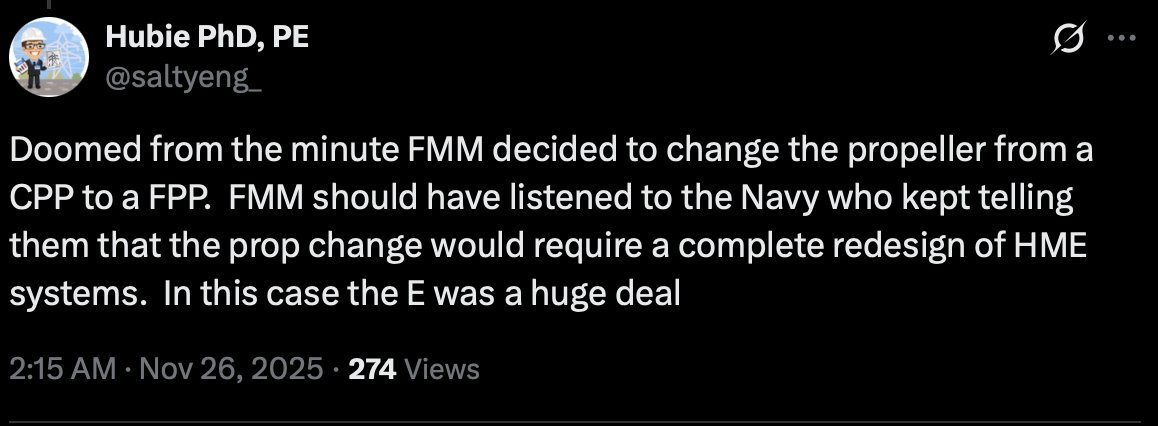
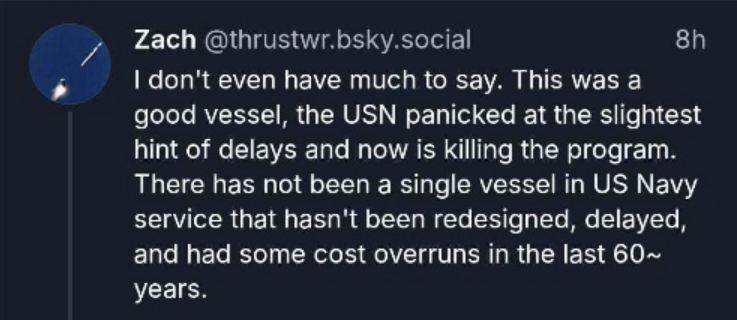
Yes, or else the NAVSEA Ship Design Manager and FMM will be held criminally responsible. They wouldn’t be continuing production of the two hulls if the design requirements are physically impossible.


Precisely why none of this makes sense and is very clearly politically motivated.
I think it could go either way here depending on the specific reasons they cite. I don't know if we'll ever know the real reasons behind it but

If the current design can be finalized and is a good enough design, then yes - cancelling it is stupid.

If the current design can do the job in the near term, but does so in ways that hampers maintenance, extensive upgrades and makes too much compromises vs a proprietary design, then maybe there's an argument for it.

I'd much rather them get it right now and lay the ground work for something akin to the extended utility of a Burke or a B-52 than to pump out another dozen or so ships like the LCS class and find out they are completely unfit for the fight. If your goal is to compete in the near term - sure rush all you want. If your goal is to compete in the long term, then it's a lot better to do things in a grounded and, albiet slower, way to ensure long term utility.
 
Last edited:
If the current design can do the job in the near term, but does so in ways that hampers maintenance, extensive upgrades and makes too much compromises vs a proprietary design, then maybe there's an argument for it.
That would mean FMM cannot deliver the contracted design, which evidentially isn’t the issue, as we’re still building two of them.

pump out another dozen or so ships like the LCS class and find out they are completely unfit for the fight
Both types have seen succesful combat deployments, so that point is moot. And even then, FFG(X) is a much safer program as there’s no associated technological development. So the notion they’re going to get built and had dozens of teething issues doesn’t hold water.
 
That would mean FMM cannot deliver the contracted design, which evidentially isn’t the issue, as we’re still building two of them.
It kinda sounds like they haven't been able to deliver what the navy wants... and the two being built is a consolation prize for time wasted...
Both types have seen successful combat deployments, so that point is moot.
No... no it isn't. Successful combat deployment hardly means there's enough room for growth, sustainment and utility into the future.
And even then, FFG(X) is a much safer program as there’s no associated technological development. So the notion they’re going to get built and had dozens of teething issues doesn’t hold water.
So much for a safe program that still doesn't have a finalized design yet...

The whole point here is to have a hull that's not only useful at the point of launch but has enough utility and room for expansion going forward. If your FFG already has to compromise to fit existing systems on there, how much do you think those future upgrades are going to cost?
 
Last edited:
they letting 2 be built 'cause the setting up shop already done. gutting it would mean quite a few congressmen would pick up the phones and cause problem for the cancellation. 2 ships is just to politically please certain part of congress.
 
Maybe the problem is with the NAVSEA standards?

I wasn't aware "more survivable" was ever an issue when facing anti-ship missiles, though. NAVSEA has stricter requirements on compartmentalization and damage control that no European design could hope to match. This has been demonstrated in two wars, now.

None of this adds up

The ships are too hard to make functional given the demands for American warship survivability standards. If they weren't frontline combatants, but were instead police cutters or perhaps a naval auxiliary like the T-AGOS, they would be perfectly acceptable as-is.

Marinette should probably have known this but Marinette doesn't know how to make a warship. If you want a Moskva, or a Sheffield, you ask Europeans but if you want Stark you ask NAVSEA.
 
Last edited:
The USN was looking for an off-the-shelf solution, but in hindsight there wasn't one. Because nothing anyone else builds is to NAVSEA standards.
And the USN should have known that. So now they're going to get next to nothing.

I guess the best NAVSEA standards save lives through not getting anything build. Can't lose men if you have no ships to lose...
 
Last edited:
The USN was looking for an off-the-shelf solution, but in hindsight there wasn't one.. Because nothing anyone else builds is to NAVSEA standards.
And the USN should have known that. So now they're going to get next to nothign.

I guess the best NAVSEA standards save lives through not getting anything build. Can't lose men if you have no ships to lose...

Well, there's Burke, but that's it. NAVSEA should just nationalize/corvee/press-gang the entire G&C corpus, minus management, and force them to learn NAVSEA standards. Then it will have internal R&D back and be able to send these things to shipbuilders instead of being held hostage by market forces.

Correcting course from the disastrous 1990's will be hard though.
 
Last edited:
I think it's better for the USN this way tbh. JSF should be the exception not the norm. We can't go the way of having only terrible stuff on hand and learn to live with them.

In any case, no war is breaking out that would ask for new frigates in the Connie's capability frame, and more Burkes could manage as they have done so. Merely recognizing geopolitics.

Though SECNAV better has a solid plan behind this cancellation. Regardless it's not like the Connies are any close to completion.

Having less ships may benefit the US as a whole because they will learn, earlier, that they are no longer the 1st superpower. Cut the addict off his stash early.
 
NAVSEA has stricter requirements on compartmentalization and damage control that no European design could hope to match. This has been demonstrated in two wars, now.
I'm not convinced the Stark did much better than the Sheffield. And NAVSEA was pretty quick to waive standards wrt the LCS programme (which may be why they've been so reluctant on Constellation).

There's obviously a role for survivability standards in building a ship to win the fight, but another part of that equation is having sufficient ships there to fight and win, not some exquisitely engineered dockyard queen that is years late to the fight and then overwhelmed by numbers (cf Yamato). Survivability is about more than just damage resistance, it's also seaworthiness (where the USN reportedly falls short compared to the RN) and having the force structure needed, when it's needed.

If you're worried about an imminent confrontation you don't build a Rolls Royce, you build lots of Toyotas.
 
It's beyond farce now.
I can't see how they are going to develop a new FFG(X) alongside the DDG(X).
Drone boat spam might be one way to get numbers but there just isn't enough practical experience to declare that option as feasible.
Given how many nations and shipbuilders have designed and built frigates it's not exactly rocket science.
 
I'm not convinced the Stark did much better than the Sheffield. And NAVSEA was pretty quick to waive standards wrt the LCS programme (which may be why they've been so reluctant on Constellation).

There's obviously a role for survivability standards in building a ship to win the fight, but another part of that equation is having sufficient ships there to fight and win, not some exquisitely engineered dockyard queen that is years late to the fight and then overwhelmed by numbers (cf Yamato). Survivability is about more than just damage resistance, it's also seaworthiness (where the USN reportedly falls short compared to the RN) and having the force structure needed, when it's needed.

If you're worried about an imminent confrontation you don't build a Rolls Royce, you build lots of Toyotas.

Well, ships are built in 20 year cycles outside the PRC, so any U.S. fleet built today is going to be the fleet of 2045 and not the fleet of 2027. Only DOD branch doing well for itself is the USAF and that's debatable given B-21 was slow.
 
I wonder what degree of completion has the first hull reached. In April TWZ reported a rather disappointing milestone of 10%.
 
I wonder what degree of completion has the first hull reached. In April TWZ reported a rather disappointing milestone of 10%.
I just saw 12% as the current figure in something I looked at this morning.
 
The USN was looking for an off-the-shelf solution, but in hindsight there wasn't one. Because nothing anyone else builds is to NAVSEA standards.
USN was looking for an off-the-shelf solution, and made people getting paid for designing (not delivering) ships responsible for it.
Add some representative valuable input (sm-6, tomahawk, armored belt like Iowa and special ops class hyperdrive) and you got Magic!

I thought and still think that constellation was a case of deliberate, bold sabotage by the NIH guys. And yet they're somehow the heroes.
I wasn't aware "more survivable" was ever an issue when facing anti-ship missiles, though. NAVSEA has stricter requirements on compartmentalization and damage control that no European design could hope to match. This has been demonstrated in two wars, now.
One, and to be fair there are EU ships with more reputation for survivability (from actual two). Just pick it if you want it.(though they struggle just as much from similar problems now)

USN problem, however, is if NAVSEA doesn't deliver - they're certainly legally clean, but someone else will be meeting torpedoes, usvs and missiles.
And that will be fleet auxiliaries and civilian tankers, whose crews are usually very excited about non-contractual opportunities for heroic ways to go.
 
Last edited:
If the USN wants to learn from this debacle, they absolutely need to do a detailed comparison of NAVSEA standards and foreign standards to see if the differences are actually an asset, or a liability. Remember all the issues the US had on entry into WWII when standards the Bureaus insisted were required turned out to be masking abject failure (torpedoes)
 
I think one of the reasons for some of these procurement failures is because the United States has spent the last few decades with an overwhelming advantage over an opponent and therefore has gotten used to having low casualties when going to war. The problem with this mindset, in the context of a peer/near peer war is that a peer/near peer adversary is going to be near you quantitatively and/or qualitatively. Maybe even exceed you. That means you're going to lose equipment and lives.

The USN (and perhaps the military as a whole) needs to accept this reality before trying to design and build anything else.
 
Well, there's Burke, but that's it. NAVSEA should just nationalize/corvee/press-gang the entire G&C corpus, minus management, and force them to learn NAVSEA standards. Then it will have internal R&D back and be able to send these things to shipbuilders instead of being held hostage by market forces.

Correcting course from the disastrous 1990's will be hard though.

Gibbs and Cox likely wrote a huge chunk of the NAVSEA survivability standards. They essentially designed the DDG-51 and are design agents for DDG(X). I don't think they need to be taught anything here.

The problem lies in the fact that the Navy lacks the preliminary design expertise to understand what the impact of their changes are. Having G&C working from the Navy again, instead of as a competitor, may help on DDG(X).
 
Last edited:
I wonder what this will do for US ship building... All those people the shipyard hired...

Thats why they are continuing with the two ships.

US shipbuilding is in bad enough shape.

They will build two and then by that time be ready to transition to something else.

That's the idea anyway.
 
they letting 2 be built 'cause the setting up shop already done. gutting it would mean quite a few congressmen would pick up the phones and cause problem for the cancellation. 2 ships is just to politically please certain part of congress.

It's important to support the industrial base. MM hired a bunch of people and made improvements to their yards. Let's not let that go to waste and have to start over again the next time we try to build something.
 
Last edited:
If the figures of 10% complete in April and 12% today are correct, then we're looking at around 3% progress per year, and a commissioning date of sometime in 2054....

In practice they'd have to speed up, but only 2% progress in 8 or 9 months suggests NAVSEA are still messing about with the design at a fairly fundamental level.
 
Thing is, we're still planning to spend all the money to design FFG-62 and then waste it by only building two, then restart the whole merry-go-round again while we keep building even more increasingly overstuffed and expensive Flight IIIs.
 
Last edited:
When was the last successful US clean sheet warship design? Ford is a modified Nimitz but had issues with lifts and catapults that caused long delays, both LCS class had issues one immediately the other a fundamental design flaw discovered later (and they have been unsuccessful at even gifting them away to allies, no one wants to touch them and the Saudi MMCS despite them being built in the US by Lockheed has switched to European rather than US weapon systems), Zumwalt was a failure.

Is NAVSEA just strangling innovation and perpetuating 50 year old legacy designs seeing less and less seakeeping performance in each iteration.
 
provides for the discontinuity of the contract for the four other Constellation-class frigates already under contract,

Thats some Orwellian wording there

On top of the aforementioned award of future orders, in order to cover the above, the agreement indemnifies Fincantieri Marine Group, on existing economic commitments and industrial impacts through measures provided by the U.S. Navy, as a result of the contractual decision made for its own convenience.
 
A statement from the Navy says:

"Now, in 2025, the ongoing redesign has driven weight growth at levels that exceed available tolerances. Already the Navy is considering a reduction in the frigate’s speed requirement as one potential way, among others, to resolve this weight growth"

Way late. Way over budget. Over weight and underperforming.

There are tough calls to be made with projects like this. Do you continue to pour money into it and reward poor program execution and underperforming kit or do you flush the turd.

NAVSEA knew the program was on the bubble and were given a chance to complete the design and right the ship.

That apparently didn't happen.
 
A statement from the Navy says:

"Now, in 2025, the ongoing redesign has driven weight growth at levels that exceed available tolerances. Already the Navy is considering a reduction in the frigate’s speed requirement as one potential way, among others, to resolve this weight growth"

Way late. Way over budget. Over weight and underperforming.

There are tough calls to be made with projects like this. Do you continue to pour money into it and reward poor program execution and underperforming kit or do you flush the turd.

NAVSEA knew the program was on the bubble and were given a chance to complete the design and right the ship.

That apparently didn't happen.
Amazing that the last successful Navy surface ship procurement dates back to the late 70s in what would become the DDG-51.
 
PLAN leadership must be laughing their asses off right now I imagine.

It's quite baffling how the US always pushes a haphazardly thrown together program for urgent needs, like more hulls preferably yesterday, just to axe this same program after several years, yielding no results and then having the awful habit of canceling it without a Plan B in sight. It's so terrible it ends up becoming hilarious again.
 
Maybe the problem is with the NAVSEA standards?
Among other things, like simple institutional incompetence on the side of the Navy.

On the NAVSEA and foreign vessels debate though, you can tell me many things I'll be willing to believe, but you can't tell me that US ships are inherently safer as comparable vessels from Japan, South Korea or the top European ship builders. Especially knowing the overall state of American heavy industry, safety standards and protocols compared to Europe and many parts of East Asia.
 
PLAN leadership must be laughing their asses off right now I imagine.

It's quite baffling how the US always pushes a haphazardly thrown together program for urgent needs, like more hulls preferably yesterday, just to axe this same program after several years, yielding no results and then having the awful habit of canceling it without a Plan B in sight. It's so terrible it ends up becoming hilarious again.
As “President” SuckAss would have said, “They’re laughing at us.”

I think part of the problem is acknowledgement of the vulnerability of surface ships in general and a mindset of “we can’t afford politically to lose even ONE!” in particular have made DoD/USN constantly doubt everything they’ve tried.

This “administration” in particular lives in absolute terror at having a military embarrassment.
“We’ll look WEAK!”

Yep, DDG-51 forever.
 
On the NAVSEA and foreign vessels debate though, you can tell me many things I'll be willing to believe, but you can't tell me that US ships are inherently safer as comparable vessels from Japan, South Korea or the top European ship builders. Especially knowing the overall state of American heavy industry, safety standards and protocols compared to Europe and many parts of East Asia.
This is thing that stands out in my mind. Maybe someone with understanding with shipbuilding can chime in, but what makes US buidling standards so much higher compared to those of Europe and Asia.

As EmoBirb points out, US shipbuilding is in a terrible state so how have they managed to have might higher standards then their foreign counterparts?
 
This is thing that stands out in my mind. Maybe someone with understanding with shipbuilding can chime in, but what makes US buidling standards so much higher compared to those of Europe and Asia.

As EmoBirb points out, US shipbuilding is in a terrible state so how have they managed to have might higher standards then their foreign counterparts?

The issue is requirements/specifications. The USN requires more stringent (and different) damage control standards than their counterparts elsewhere.
 

Similar threads

Back
Top Bottom