Attachments

  • 1715189789599.png
    1715189789599.png
    218.8 KB · Views: 963
Last edited by a moderator:

Attachments

  • 1715192151272.png
    1715192151272.png
    222.6 KB · Views: 944
  • 1715192122234.png
    1715192122234.png
    193.9 KB · Views: 928
  • 1715192092574.png
    1715192092574.png
    197.9 KB · Views: 939
Last edited by a moderator:
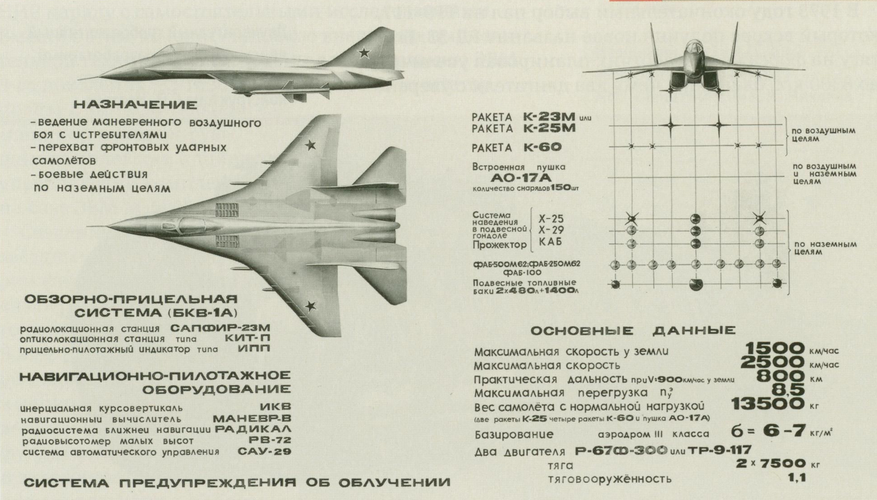
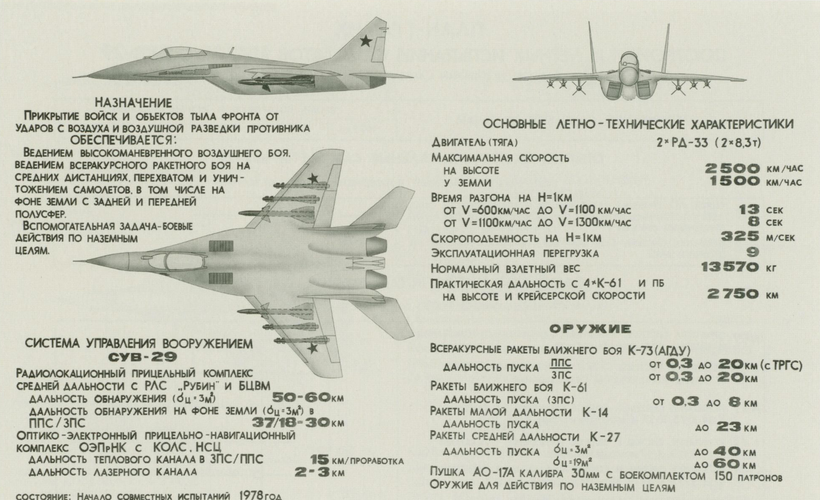
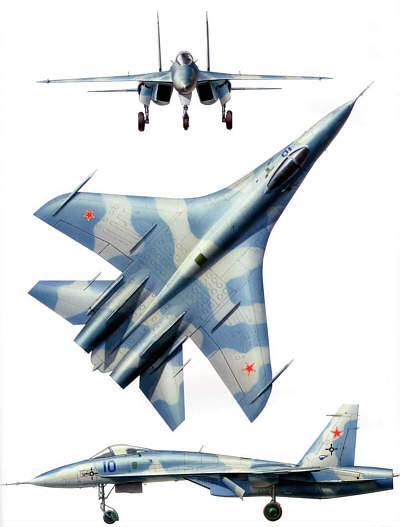
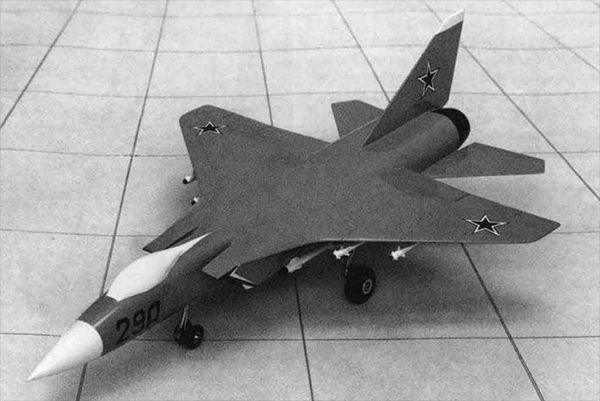
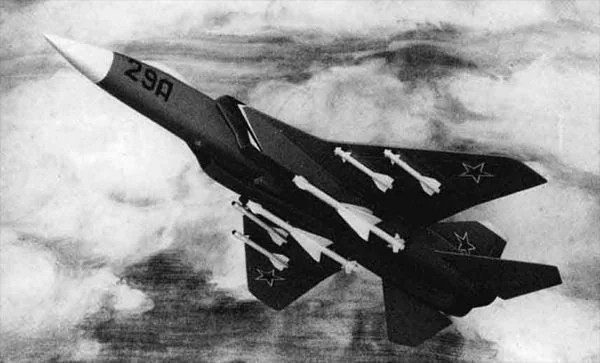
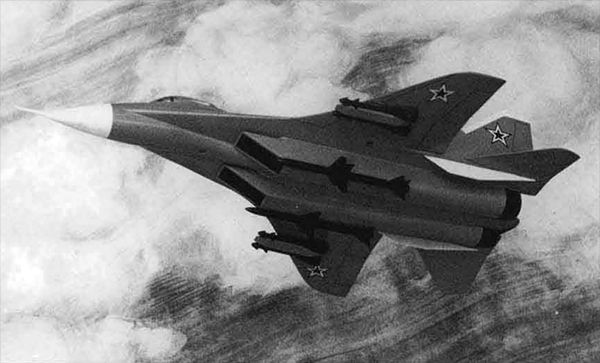
The first picture seems to be the variant shown by the models in this earlier post https://www.secretprojects.co.uk/threads/evolution-of-the-mikoyan-mig-29.1398/post-174935 and is similar in planform to the Sukhoi T-10.

Two TsAGI alternatives? MiG chose wisely?

View attachment 728262
According to Sukhoi, the layout for the "integral" design was entirely Sukhoi's with no "help" from TsAGI (who were more aligned to MiG). Sukhoi also tested a more conventional F-15ish design as a baseline. MiGs design at that time was a MiG-25/F-15 blend with awful rear view.

p1010739_mig-jpg.69500


Sukhoi's integral design easily beat Mikoyan's design in the first meeting in key parameters.

Mysteriously, by the second meeting, Mikoyan had an "integral" layout of their own and it was smaller, F-16 sized.
1715023092454-png.728125
They obviously refined it from the initial starting point, and the later MiG-29 layout is more "MiG-ified" in general.

1715023127872-png.728126
 
According to Sukhoi, the layout for the "integral" design was entirely Sukhoi's with no "help" from TsAGI (who were more aligned to MiG). Sukhoi also tested a more conventional F-15ish design as a baseline. MiGs design at that time was a MiG-25/F-15 blend with awful rear view.

Sukhoi's integral design easily beat Mikoyan's design in the first meeting in key parameters.

Mysteriously, by the second meeting, Mikoyan had an "integral" layout of their own and it was smaller, F-16 sized.
They obviously refined it from the initial starting point, and the later MiG-29 layout is more "MiG-ified" in general.
Just to clarify what do you mean when you say "integral"?
 
Blended wing/body with voluminous LERX and centroplane (engines and intakes spaced widely apart).
 
According to Sukhoi, the layout for the "integral" design was entirely Sukhoi's with no "help" from TsAGI (who were more aligned to MiG). Sukhoi also tested a more conventional F-15ish design as a baseline. MiGs design at that time was a MiG-25/F-15 blend with awful rear view.
And eventually Sukhoi had to 'MiG-ify' their T-10 when their integral design did not work out?
 
Last edited by a moderator:
There were less drastic aerodynamic fixes available for the original layout, but the (newly arrived from TsAGI) Mikhail Simonov wanted to make his mark by casting the T-10 as a failure and taking personal credit for the redesign. This is the story of the Su-27 origins we were originally sold while Simonov was still in charge, which has been nuanced a bit later.

Both designs went from continuous curved leading edges to separate conventional wing and LERX, which the F-16 also did, so it doesn't necessarily follow that Sukhoi cribbed that idea back from Mikoyan.
 
There were less drastic aerodynamic fixes available for the original layout, but the (newly arrived from TsAGI) Mikhail Simonov wanted to make his mark by casting the T-10 as a failure and taking personal credit for the redesign. This is the story of the Su-27 origins we were originally sold while Simonov was still in charge, which has been nuanced a bit later.

Both designs went from continuous curved leading edges to separate conventional wing and LERX, which the F-16 also did, so it doesn't necessarily follow that Sukhoi cribbed that idea back from Mikoyan.
I totally understand why they had to do that redesign, but aesthetically I wish they'd stuck with the original T-10 layout!
 
There were less drastic aerodynamic fixes available for the original layout, but the (newly arrived from TsAGI) Mikhail Simonov wanted to make his mark by casting the T-10 as a failure and taking personal credit for the redesign. This is the story of the Su-27 origins we were originally sold while Simonov was still in charge, which has been nuanced a bit later.

Both designs went from continuous curved leading edges to separate conventional wing and LERX, which the F-16 also did, so it doesn't necessarily follow that Sukhoi cribbed that idea back from Mikoyan.
I have Fomin's Su-27 book but that is a bit old. Is there one that looks at all of this for both MiG and Sukhoi?
 
There's no objective account about the entire PFI program, which I think is what you need. I'd like to read that. Might make a good article.

The best account of the PFI program I've seen is in Su-27: Beginning of Story by Ildar Bedretdinov et al. It's written by some of the original Sukhoi engineers and hence presents a Sukhoi insider view of things (and not necessarily Simonov's version).

A guy at SIBNIA has written an account of how important they were in the Su-27 development.

Everyone agrees that Yakovlev came a distant last.
 
TsAGI recommended three generic shapes for fighters in the MIG-31 to MiG-29 era: conventional MiG-25/F-15 with small LERX, VG, and tailless delta. You will note that Mikoyan made designs for all of them for the MiG-31 requirement. There was no requirement to follow TsAGI recommendations, but Mikoyan tended to follow them quite closely.

TsAGI were supposed to do generic research, and general layout recommendations, but Sukhoi (at least) preferred to rely on Western basic research papers more often than not, rather than waiting for TsAGI to replicate it eventually. However, neither Sukhoi nor Mikoyan had their own wind tunnels, so if you wanted to test out your chosen configuration in a wind tunnel, you had no choice but to get TsAGI to test it. Sukhoi had some internal model building capability, but needed to get the larger and more models fabricated, which took a lot of time. You then had to wait for TsAGI to test it - and Mikoyan's brother was a big shot in the Communist Party, so there's the suspicion at least that maybe they got priority.

The T-10 design was constantly being iterated even as the prototypes were under construction, and the wind tunnel and model test results were almost always too late to be useful. Sukhoi had achieved amazing lift/drag values with the T-10 shape,, and didn't want to ditch it or change it too much, though some engineers had preferred a less complex (LERX + slightly swept conventional wing) shape from the start.

TsAGI eventually tested Sukhoi's models, and made some reports which Mikoyan had access to. The first MiG-29 "integral" layout is near identical in wing shape to T-10.Yes, Mikoyan stole the generic configuration from Sukhoi, via TsAGI ("it was an official recommendation!"). TsAGI then recommended a separate LERX and conventional wing instead of the curved leading edge. Mikoyan adopted this, and the MiG-29 design emerged quite trouble free.

T-10 hit issues in test flights. Sukhoi had started working with the new SIBNIA institute, which had excellent modelmaking facilities and a lack of work compared to TsAGI, which allowed them to rapidly iterate through different LERX shapes, wing sweep angles, tail positions. The end result was a superb design.
 
You then had to wait for TsAGI to test it - and Mikoyan's brother was a big shot in the Communist Party, so there's the suspicion at least that maybe they got priority.
Anastase Mikoyan had been put into retirement by Brejnev Dec. 9,1965. Then wrote his memoirs (published 1970). Could not have been of any influence during the time-frame of T-10 / izdeliye 9 development.
 
Last edited by a moderator:
Anastase Mikoyan had been put into retirement by Brejnev Dec. 9,1965. Then wrote his memoirs (published 1970). Could not have been of any influence during the time-frame of T-10 / izdeliye 9 development.
Fair point, I hadn't realised that.. TsAGI and GosNIAAS both favoured Mikoyan still though.
 
Does SIBNIA have windtunnels in addition to their modelling? Or was/is TSAGI still the place where the main testing is carried out?
It's a fascinating post, which I learnt a lot from.
 
Does SIBNIA have windtunnels in addition to their modelling? Or was/is TSAGI still the place where the main testing is carried out?
It's a fascinating post, which I learnt a lot from.
Yes, they had their own windtunnels. They were at the ass end of nowhere, though. 3245 km by road from Moscow. Novosibirsk Aircraft Production Association built Sukhoi aircraft.
 
This caption
From the site,which my dear PaulMM discovered it today,

https://dzen.ru/a/Yf5nZoUxwCtuhBvw
This caption is complete fiction. This is not an alternative Draken style intake. Other photos of this model make that very clear.

The 'additions' on each LERX were devices to hide the MiG-29's LERX shape from satellites and make it look like it used MiG-25 style ramp intakes. This measure may have worked - the early MIG-29 artists impressions all have MiG-25 style intakes.
 
This caption

This caption is complete fiction. This is not an alternative Draken style intake. Other photos of this model make that very clear.

The 'additions' on each LERX were devices to hide the MiG-29's LERX shape from satellites and make it look like it used MiG-25 style ramp intakes. This measure may have worked - the early MIG-29 artists impressions all have MiG-25 style intakes.

OK my dear Paul,please delete it.
 
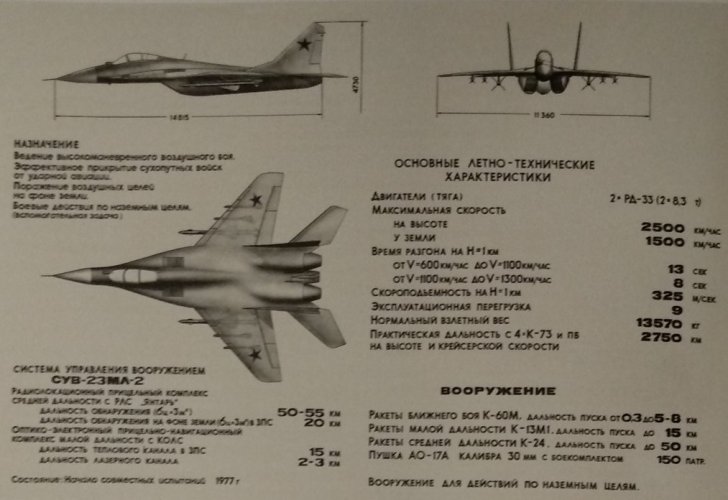
Hey folks, this picture appears to show the "MiG-23MA-2," a 1977 project featuring a MiG-29 fuselage paired with MiG-23 avionics, likely intended for export or as a backup in case the original MiG-29 avionics were delayed. In some ways, it reminds me of the F-16/79. :confused:
Maybe our Russian members can provide a better translation of this picture and share more details about this project.
Primary source (Russian): "Миг": Полет сквозь время Том 2
Secondary source (X fka twitter):
View: https://x.com/Combination_K/status/2043733119824507335?s=20
 

Attachments

  • 20260413_MiG-23MA-2_MiG-29_001.jpg
    20260413_MiG-23MA-2_MiG-29_001.jpg
    93 KB · Views: 181
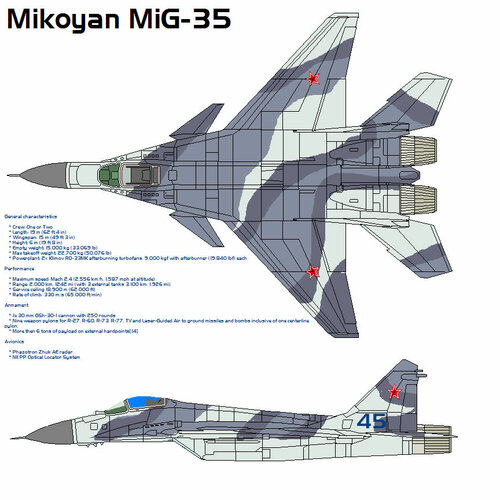
Does anyone know what this "Mikoyan-Gurevich MiG-35 Fulcrum F" plan corresponds to ? I found it on TheBlueprint.


​

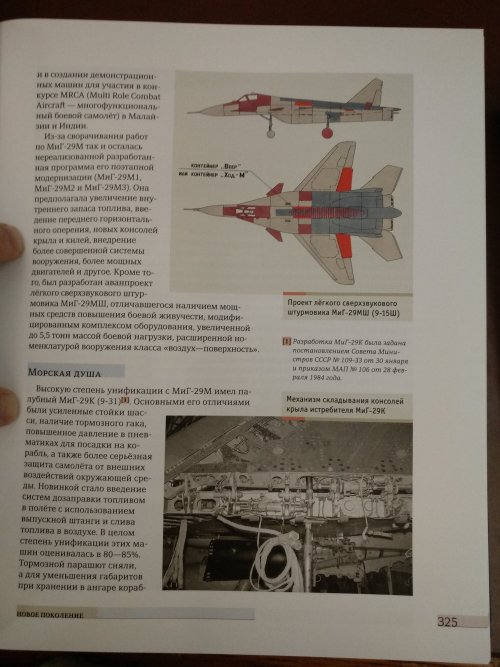
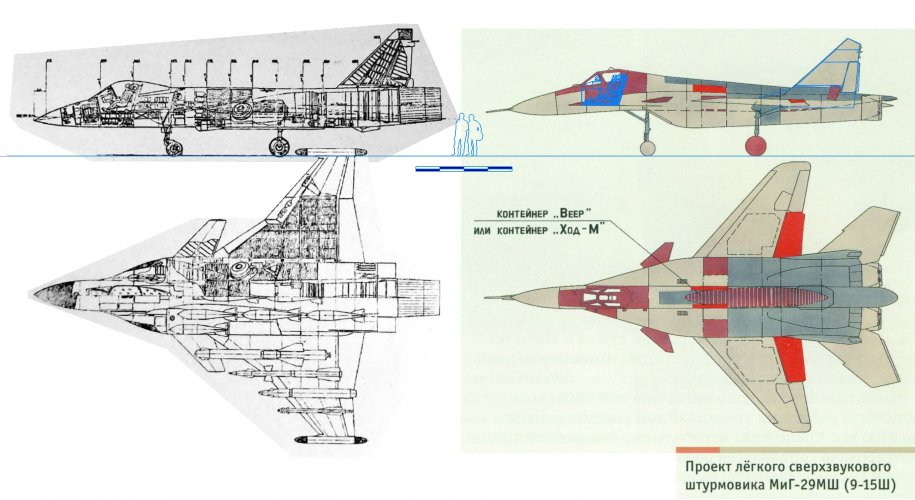
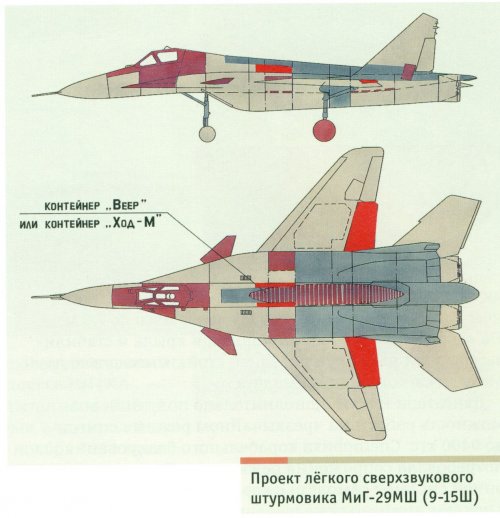
Allegedly according to ""Миг": Полет сквозь время Том 2" this seems to be a "light attack aircraft (or Sturmoviks as the Sh suggest) proposal, called “MiG-29MSh” (or 9-15Sh) from the chapter that discussed the 9-15 MiG-29
 

Attachments

  • 1783698070258.png
    1783698070258.png
    486.4 KB · Views: 159
  • 1783698085537.jpeg
    1783698085537.jpeg
    1.3 MB · Views: 192
Last edited:
Allegedly according to ""Миг": Полет сквозь время Том 2" this seems to be a "light attack aircraft (or Sturmoviks as the Sh suggest) proposal, called “MiG-29MSh” (or 9-15Sh) from the chapter that discussed the 9-15 MiG-29

I have this book, and in my files,the 9-15 was appeared in these versions;

MiG-29M,MiG-29ME,MiG-29UBM,MiG-29MSh,MiG-29M1,MiG-29M2 & MiG-29M3.
 
Allegedly according to ""Миг": Полет сквозь время Том 2" this seems to be a "light attack aircraft (or Sturmoviks as the Sh suggest) proposal, called “MiG-29MSh” (or 9-15Sh) from the chapter that discussed the 9-15 MiG-29
Not quite.

Due to the curtailment of work on the MiG-29M, the developed program for its phased modernization (MiG-29M1, MiG-29M2 and MiG-29M3) remained unrealized. It involved an increase in the internal fuel supply, the introduction of a front horizontal tail, new wing consoles and fins, the introduction of a more advanced weapons system, more powerful engines, and more.

In addition, a preliminary design of the light supersonic attack aircraft MiG-29MSh was developed, which was distinguished by the presence of powerful means of increasing combat survivability, a modified set of equipment, an increased combat load weight of up to 5.5 tons, and an expanded range of air-to-surface weapons.

The canard was a feature of the planned MiG-29M development in general, also featuring on the MiG-29MSh attack version. Butowski's drawing is of the MiG-29M development.
 
MiG-29MSh, Most likely, it will become a competitor to the Su-137 carrier-based attack aircraft for the Ulyanovsk aircraft carrier's air group.
 
MiG-29MSh, Most likely, it will become a competitor to the Su-137 carrier-based attack aircraft for the Ulyanovsk aircraft carrier's air group.

Wow,my dear Paralay,what was Su-137 ?.

Unfortunately,the company confused us by giving 12 concepts to
the designation MiG-29M ?.
 
Hey @paralay , could the "Su-137" actually be referring to the Sukhoi S-37 (Su-37) project?
:confused:
Edit:
According to pages 926 to 928 of the Russian publication "Sukhoi Design Bureau - 85th Anniversary," the designation "S-137" likely refers, in my opinion, to the integrated crew warning and monitoring system "Экран-137" intended for implementation in the Sukhoi S-37 (Su-37).
Russian: встроенного контроля и предупреждения экипажа "Экран-137"
English, translated with AI: integrated crew warning and monitoring system "Ekraan‑137"
 
Last edited:
Hey @paralay , could the "Su-137" actually be referring to the Sukhoi S-37 (Su-37) project? :confused:

The original S-37 is the exact aircraft being referred to. Both the Mig-29MSh and the S-37 were probably designed to the same late 1980s Soviet requirement for a low-altitude fighter-bomber, presumably to replace the Su-17, Mig-27 and Su-25 in Frontal Aviation units. Note that one of the labels for the under fuselage pod ('container') refers to 'Khod-M' which I guess was related to the Khod FLIR system for the Su-25TM (see here - link). The best translation I can find for 'BEEP' is 'fan' and I have no idea what its referring to, perhaps @overscan (PaulMM) knows?
 
Last edited:
I have a strong feeling that the fifth generation of Soviet fighters would have been the "hundredth series", the Yak-141 VTOL, the Su-137 attack aircraft, the Su-132 (Su-47) carrier-based interceptor, and the MiG-135 (MiG 1.42) land-based interceptor. Unfortunately, we are not able to verify the reality of this.
 
Wow @paralay, thanks a lot for explaining, even if it is only your own opinion, that if the USSR/СССР had persisted, the fifth generation of Soviet fighters might have had the "hundredth series" designation. :cool:
 
Last edited:
Soviet avionics names were pretty much arbitrary words, and its not possible to intimate anything about the pod from the name. ВЕЕР / Veer indeed means a hand-held fan - I've never seen anything about it. I would assume an alternative targeting pod to the Khod-M.
 

Similar threads

Back
Top Bottom