There's a video on YouTube from a deceased SR-71 pilot who described flying the Murmansk mission in the middle of winter at ISA -48 IIRC. Min burner, accelerating past M 3.4 towards 3.5. So, yes, the Raptors out of Elmendorf do some impressive climbs when it's cold.So, Elmendorf winter intercepts are going to be impressive to watch. Gotcha.
I just don't want to freeze my nuts off to witness it!

You are using an out of date browser. It may not display this or other websites correctly.
You should upgrade or use an alternative browser.
You should upgrade or use an alternative browser.
Does the Su-27S climb better than the F-15C?
- Thread starter wile coyote
- Start date
-
- Tags
- acceleration climb eagle flanker

- Joined
- 3 June 2011
- Messages
- 20,989
- Reaction score
- 19,254
The Streak Eagle flights were done in North Dakota specifically because of the cold.There's a video on YouTube from a deceased SR-71 pilot who described flying the Murmansk mission in the middle of winter at ISA -48 IIRC. Min burner, accelerating past M 3.4 towards 3.5. So, yes, the Raptors out of Elmendorf do some impressive climbs when it's cold.
Indeed, temperature does wonders for jet engines.The Streak Eagle flights were done in North Dakota specifically because of the cold.
- Joined
- 8 February 2018
- Messages
- 72
- Reaction score
- 152
Why would not do that....? F-16s and F-15s almost always carry drop tanks. Flying wit 50% fuel would be the same as an F-15 go mission with only internal. Can you imagine that stupidity?I don’t think flankers are flying 100% fuel for their missions; that’s too much.
There's a video on YouTube from a deceased SR-71 pilot who described flying the Murmansk mission in the middle of winter at ISA -48 IIRC. Min burner, accelerating past M 3.4 towards 3.5. So, yes, the Raptors out of Elmendorf do some impressive climbs when it's cold.
Same did Su-27P's from ex-941 fighter aviation regiment based at Kilp Yavr air base ,Murmansk region,Kola peninsula (69 05 37N, 32 24 06E).
Why would not do that....? F-16s and F-15s almost always carry drop tanks. Flying wit 50% fuel would be the same as an F-15 go mission with only internal. Can you imagine that stupidity?
There is two variants of refueling , full ( 9400kg/100%) and unfull (5240 kg/63%). In 1989 , Su-27S and Su-27UB flew from Kubinka to Le Bourget without refueling ,almost 2500km.
Because when you fly with 100% on a flanker you are g limited, you don’t need that much fuel for all the missions.Why would not do that....? F-16s and F-15s almost always carry drop tanks. Flying wit 50% fuel would be the same as an F-15 go mission with only internal. Can you imagine that stupidity?
- Joined
- 8 February 2018
- Messages
- 72
- Reaction score
- 152
?????Because when you fly with 100% on a flanker you are g limited, you don’t need that much fuel for all the missions.
F-15C with 2x drop tanks carry ~20 000lb fuel. The internal of Su-27 is ~20000 lb also.
- Joined
- 3 June 2011
- Messages
- 20,989
- Reaction score
- 19,254
Should have bought enough CFTs for all the F-15Cs.?????
F-15C with 2x drop tanks carry ~20 000lb fuel. The internal of Su-27 is ~20000 lb also.
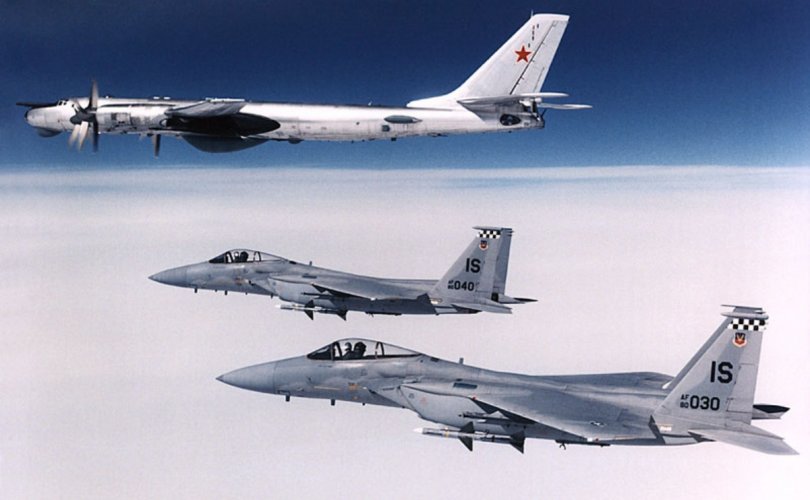
- Joined
- 8 February 2018
- Messages
- 72
- Reaction score
- 152
Only the F-15C is Keflavik used CFT-s. You post the image about them IS = Keflavik AB.
Operationally Su-27 flew with full fuel. Period.
- Joined
- 3 June 2011
- Messages
- 20,989
- Reaction score
- 19,254
Which part of my post did you not understand?Only the F-15C is Keflavik used CFT-s. You post the image about them IS = Keflavik AB.
Operationally Su-27 flew with full fuel. Period.
CLASH OF THE TITANS SU-27 vs F-15
Doc. on 36 pages. Author is Predrag Pavlovic
''The document compares the 4th generation fighters F-15 Eagle and Su-27 Flanker. It discusses their design improvements over previous generations including increased maneuverability through larger wings and more powerful engines. Both fighters have advanced avionics and materials like titanium alloys that improve strength and reduce weight compared to earlier aircraft. The Su-27 and F-15 match or exceed all other fighters of their time in capabilities until newer designs like the MiG-29, Eurofighter Typhoon, and Dassault Rafale entered service 10-27 years later.''
https://www.scribd.com/presentation/137334946/F-15-vs-Su-27
Su-27 Vs F-15: Predrag Pavlović, Dipl - Ing
Doc. on 36 pages. Author is Predrag Pavlovic
''The document compares the 4th generation fighters F-15 Eagle and Su-27 Flanker. It discusses their design improvements over previous generations including increased maneuverability through larger wings and more powerful engines. Both fighters have advanced avionics and materials like titanium alloys that improve strength and reduce weight compared to earlier aircraft. The Su-27 and F-15 match or exceed all other fighters of their time in capabilities until newer designs like the MiG-29, Eurofighter Typhoon, and Dassault Rafale entered service 10-27 years later.''
https://www.scribd.com/presentation/137334946/F-15-vs-Su-27
wile coyote
ACCESS: Restricted
- Joined
- 16 January 2025
- Messages
- 46
- Reaction score
- 17
Is Mach 0.99 the max straight line speed or Max vertical speed?In a long since deleted forum post, which resulted in a USAF wide OPSEC training, a now former Raptor pilot described a max performance vertical departure at ED. Full burner take off, gear up, hug the runway, acel to 500, pull vertical, bust altitude badly above assigned 30kft, max Mach # 0.99. Possible if the air is cold enough, I've seen that profile (from a Raptor) in cold air and it was impressive.
Is Mach 0.99 the max straight line speed or Max vertical speed?
If we talk about vertical speed ( in this case' initial rate of climb') ,prototype of the Su-57, T-50-4 with AL-41F-1 hold the record with 382m/s .That speed was above 1 Mach.With gaining height, speed drops of course. E.g. MiG-29 can climb to 11000m within about 55sec ,vert. speed is M 0.85 ,climb angle 80 degrees.
wile coyote
ACCESS: Restricted
- Joined
- 16 January 2025
- Messages
- 46
- Reaction score
- 17
Well, what I was asking was, is Mach 0.99 the vertical speed or was it the aircraft speed Also I am assuming the 382 m/s is vertical speed as well?If we talk about vertical speed ( in this case' initial rate of climb') ,prototype of the Su-57, T-50-4 with AL-41F-1 hold the record with 382m/s .That speed was above 1 Mach.With gaining height, speed drops of course. E.g. MiG-29 can climb to 11000m within about 55sec ,vert. speed is M 0.85 ,climb angle 80 degrees.
Well, what I was asking was, is Mach 0.99 the vertical speed or was it the aircraft speed Also I am assuming the 382 m/s is vertical speed as well?
382m/s is only the ''initial rate of climb'' (alt 1000 m). Mach 0.99 was vertical speed of course.
wile coyote
ACCESS: Restricted
- Joined
- 16 January 2025
- Messages
- 46
- Reaction score
- 17
382m/s is only the ''initial rate of climb'' (alt 1000 m). Mach 0.99 was vertical speed of course.
Thanks, 382 is impressive, one can only wonder what the Al51 will bring ... I hope to see those someday

RadicalDisconnect
Tony F.
- Joined
- 28 April 2014
- Messages
- 240
- Reaction score
- 202
Source?If we talk about vertical speed ( in this case' initial rate of climb') ,prototype of the Su-57, T-50-4 with AL-41F-1 hold the record with 382m/s .That speed was above 1 Mach.
Source?
Is somewhere in the new Su-57 thread. Result was achived during 2014 if I remember well.
Thanks, 382 is impressive, one can only wonder what the Al51 will bring ... I hope to see those someday
With AL-51F ,Su-57 has pretty chances to climb supersonically through troposphere.AL-51F should have max dynamic thrust about 20000 kgf ( cold weather conditions).
- Joined
- 3 June 2011
- Messages
- 20,989
- Reaction score
- 19,254
Both the F-104 and F-4 beat that. I wonder if the F-104 was lighter and the F-4 heavier. A production XF8U-3 would have been about the right size but they only flew a prototype to 23,170m.''On April 26, 1995, the MiG-29 set its first world aviation record. Test pilot R.P. Taskaev reached a flight altitude of 27,460 m, which was a record achievement in the class of jet aircraft with a takeoff weight of 12 to 16 tons. Later, pilot O.V. Antonovich set two more records: flight altitude with a load of 1 ton and time to climb to 15 km with a load of 1 ton.''
RadicalDisconnect
Tony F.
- Joined
- 28 April 2014
- Messages
- 240
- Reaction score
- 202
This sound lot like just making it up, “trust me bro”. I search for 382 m/s climb and found nothing.Is somewhere in the new Su-57 thread. Result was achived during 2014 if I remember well.
This sound lot like just making it up, “trust me bro”. I search for 382 m/s climb and found nothing.
In fact it was 384m/s. Find but better....
RadicalDisconnect
Tony F.
- Joined
- 28 April 2014
- Messages
- 240
- Reaction score
- 202
Cool, you’re talking about this claim because I was the one back in 2016 who brought this up.In fact it was 384m/s. Find but better....
https://www.secretprojects.co.uk/th...ations-2012-current.15626/page-21#post-274073
but @flateric and @flanker, both sources I trust, said it was BS. Digging further, this source originated from an Indian Facebook post, which was picked up by a Russian language article and spread for a bit.
The Russian language article in question: https://rg.ru/2016/02/19/pak-fa-rekord.html#/2704_0defc7dc/1/
Last edited:
Cool, you’re talking about this claim because I was the one back in 2016 who brought this up.
https://www.secretprojects.co.uk/th...ations-2012-current.15626/page-21#post-274073
but @flateric and @flanker, both sources I trust, said it was BS. Digging further, this source originated from an Indian Facebook post, which was picked up by a Russian language article and spread for a bit.
The Russian language article in question: https://rg.ru/2016/02/19/pak-fa-rekord.html#/2704_0defc7dc/1/
OK then, what 's wrong with this ?
'' official UAC twitter ''
And it was not during 2014 but 2013....
''During the tests in 2013 the prototype 054 took off in just 310 m. It achieved a climb rate of 384 m/sec. The aircraft climbed 24,300 meters and was not allowed to climb further for safety reasons. It achieved a maximum speed of 2610 km/hr. ''
Source: http://fullafterburner.weebly.com/aerospace/sukhoi-pak-fa-the-anti-stealth-gamechanger
Why is that 384m/s so impossible ?
PS
If one RD-33 can have max dynamic thrust on Full AB mode during take off /initial climbing of 11000kgf what can be value for AL-41F-1 ...
Last edited:
RadicalDisconnect
Tony F.
- Joined
- 28 April 2014
- Messages
- 240
- Reaction score
- 202
OK then, what 's wrong with this ?
'' official UAC twitter ''
And it was not during 2014 but 2013....
''During the tests in 2013 the prototype 054 took off in just 310 m. It achieved a climb rate of 384 m/sec. The aircraft climbed 24,300 meters and was not allowed to climb further for safety reasons. It achieved a maximum speed of 2610 km/hr. ''
Why is that 384m/s so impossible ?
PS
If one RD-33 can have max dynamic thrust on Full AB mode during take off /initial climbing of 11000kgf what can be value for AL-41F-1 ...
Such BS. So, you’re then telling us Sukhoi must have lied about their PAK-FA T-50 envelope expansion in 2014 then. By the time PI-1 (Предварительные испытания 1) concluded in 2014, the envelope expansion is as follows:
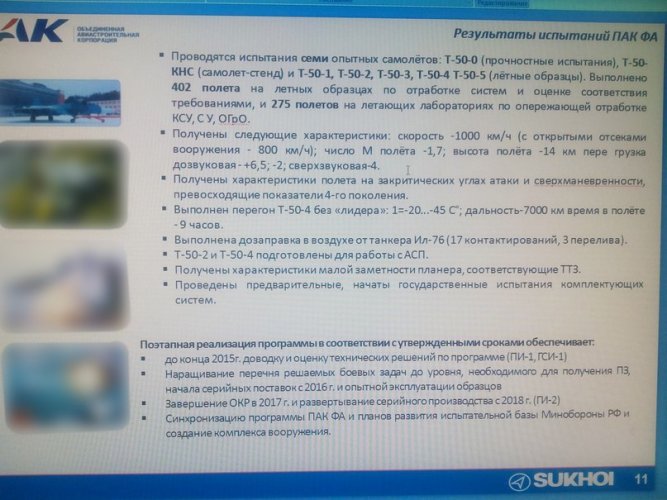
Altitude: 14,000 meters
Mach number: 1.7
Indicated airspeed: 1,000 km/h
Max g: +6.5
So somehow the fanboy beliefs can go back in time to create performance numbers contradicting Sukhoi’s own Su-57 envelope expansion reports.
Edit: LOL this isn’t even the first time you dig up this claim, and then when contradicted by Sukhoi’s own envelope expansion data, you just ignored that. Happened less than a year ago here.
https://www.secretprojects.co.uk/th...ations-2012-current.15626/page-81#post-732784
Last edited:

- Joined
- 1 April 2006
- Messages
- 12,285
- Reaction score
- 15,110
with this WHAT?OK then, what 's wrong with this ?
'' official UAC twitter ''
And it was not during 2014 but 2013....
- Joined
- 1 April 2006
- Messages
- 12,285
- Reaction score
- 15,110
Did even try to check FAI climbing speed records?Why is that 384m/s so impossible ?
If I knew, I couldn't say. I quoted something public source. A whole lot of that is dependent on atmospheric conditions. Finally, there's a ton of stuff floating around out there about EM profiles and optimum climb profiles. Read up.Is Mach 0.99 the max straight line speed or Max vertical speed?
Could a stock Raptor demolish time to climb records, almost certainly. USAF however has elected not to do so. Any information I have on this topic other than the times I saw Raptors do unrestricted climbs was mind blowing is not public domain. Sorry.
Scott Kenny
ACCESS: USAP
- Joined
- 15 May 2023
- Messages
- 19,669
- Reaction score
- 28,152
Yeah, a Raptor at mission weight (full internal fuel and full weapons) is only about 65klbs, and has ~70klbs of thrust to play with.Could a stock Raptor demolish time to climb records, almost certainly. USAF however has elected not to do so. Any information I have on this topic other than the times I saw Raptors do unrestricted climbs was mind blowing is not public domain. Sorry.
Get one at an airshow on minimal fuel and no weapons loaded for about 50klbs takeoff weight, you're in for some "WTF did I just see?!?" craziness.
Okay, @Scott Kenny twist my arm, and I'll tell you a Raptor story. So, I forget which Space Shuttle it was, but they landed at Edwards. The SCA was scheduled to depart at sunrise. Flight line photography was rescinded, so we all went to the roof of our building before dawn to watch the SCA depart with the shuttle on top of it. Just prior to the NASA chase Bug taking off, a Raptor took the active, got airborne in about a thousand feet, tucked the gear in, accelerated to 500 kts and went vertical at mid field. It was a below ISA day, very impressive. Did I mention before dawn, the afterburner plume lit up the sky.Yeah, a Raptor at mission weight (full internal fuel and full weapons) is only about 65klbs, and has ~70klbs of thrust to play with.
Get one at an airshow on minimal fuel and no weapons loaded for about 50klbs takeoff weight, you're in for some "WTF did I just see?!?" craziness.
The NASA chase doing an airborne pickup was a very close second for a demonstration of aviation skills that morning.
RadicalDisconnect
Tony F.
- Joined
- 28 April 2014
- Messages
- 240
- Reaction score
- 202
IMO people are getting too carried away. A completely clean F-16C Block 50 at 50% fuel, can manage just over 72,000 ft/min initial climb rate at sea level (1,200 ft/s, 366 m/s). Based on HAF F-16C doghouse plot.

I highly doubt an F-22 can do much better than that. For one max climb rate is achieved at subsonic/transonic region at low alatitude, and F-22 the aerodynamics optimized for supersonic, instead of that region. And the main benefit is with internal weapons, it can have maneuverability similar to clean 4th gen fighters even when armed. Same goes for Su-57 or J-20.
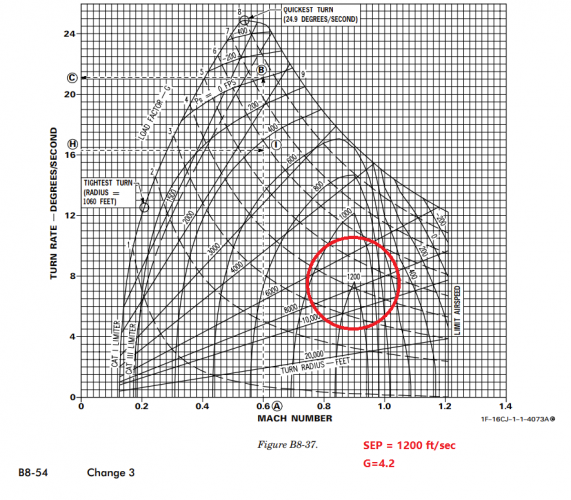
I highly doubt an F-22 can do much better than that. For one max climb rate is achieved at subsonic/transonic region at low alatitude, and F-22 the aerodynamics optimized for supersonic, instead of that region. And the main benefit is with internal weapons, it can have maneuverability similar to clean 4th gen fighters even when armed. Same goes for Su-57 or J-20.
View attachment 793692
Edit: LOL this isn’t even the first time you dig up this claim, and then when contradicted by Sukhoi’s own envelope expansion data, you just ignored that. Happened less than a year ago here.
https://www.secretprojects.co.uk/th...ations-2012-current.15626/page-81#post-732784
In fact, all of that has nothing to do with the '384m/s story'.
Yes of course I remember what we commented on the 81st page of the Su-57's thread. Btw, this was your comment :
Su-57 with about 18,500kg empty weight and 5,000kg of fuel would have T/W ratio of 1.23, since these are definitely only with izd.117 engines.
Empty weight isn't near close to that 18500kg.It is closer to reality that it is at least 2 tons lighter (no fuel,no weapons,no pilot and with the full ammo box for the single-barrel 30mm gun).
Now what about the AL-41F-1?
Some details are publicly known like it has 80% of new details and that it is 150kg lighter in comparison with the old AL-31F . Some sources mentioned that it has 20% greater max static thrust then old AL-31F ( 15000 kgf vs 12500kgf). Of course on the Full AB mode. But in which working mode? Combat/boyevoy or special / osobiy. Let us see how it looks something like that in the Su-35S cockpit.
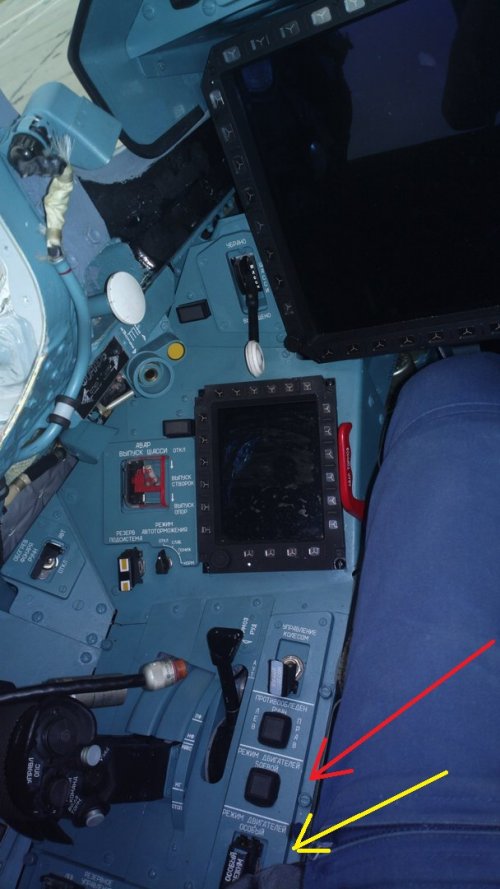
'режим двигателей боевой' - red arrow , 'режим двигателей особый' -yellow arow
E. Marchukov once said that t/w ratio of the AL-41F-1 is 11:1 ( 15000kgf vs 1380kg). Again ,it is only the max static thrust vs dry weight of the engine. In the real flight we must count max dynamic thrusts of course.
Btw ,RD-33 in MiG-29 has also some kind of the 'special working mode' . It is known as RPT (increased temp. mode) and can be used with MP ,Min AB and Full AB mode.
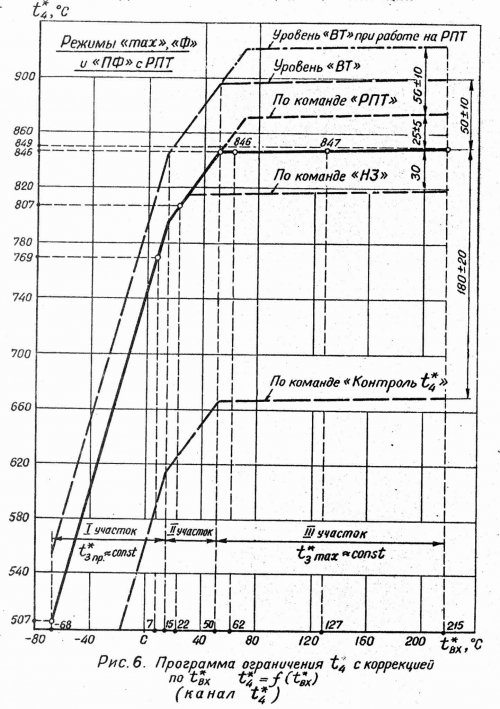
384m/sec ??? It can be only the initial rate of climb at 1000m .It is not some constant vertical speed. MiG-29's example: no weapons,50% fuel before pre-flight preparation ,330m/s rate of climb at 1000m.
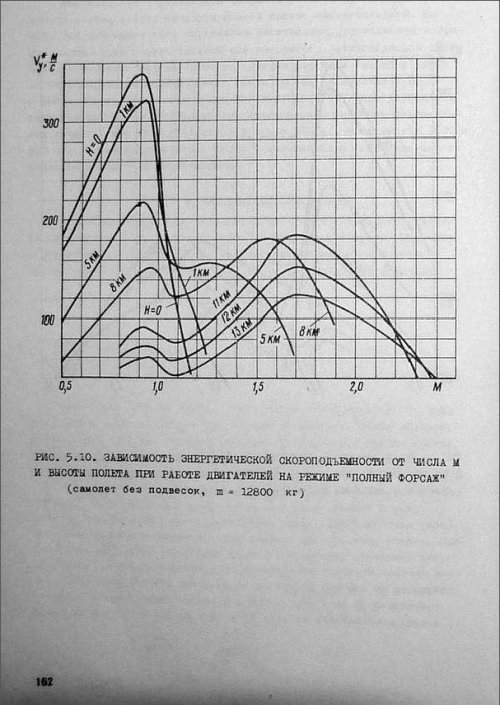
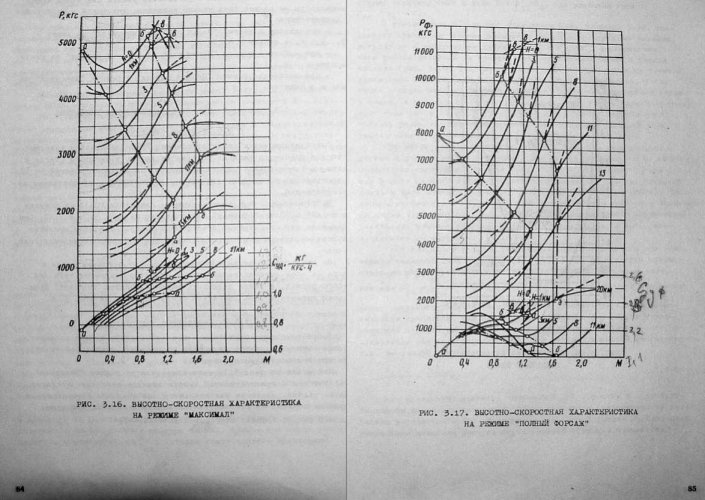
RD-33 has max dynamic thrust on the Full AB mode at 1000m of 11000kgf. T/w ratio during take-off and initial climb to 1000 m? More than 1.7 : 1. Take-off roll is 240m.
Citation of the colleague 'paralay' from the 81st page ( new Su-57's thread) :
"... So during tests this spring (2013), with a full load of fuel and mass-dimensional models of weapons, the 4th board (054) took off from 310 meters, reached a cruising speed of 2135 km / h and a maximum speed of 2610 km/ h (M = 2.46), at the same time, there was still a potential for acceleration, and I also climbed 24,300 meters - they didn't let me go any further"
Now as we can see this was achieved during one test flight from 2013.Also we can see that citation was written in the first person singular.So that was story from one of the OKB Sukhoi test pilots.
Paralay's comment was next : '' Not "fake", but not confirmed by anyone.''
On the other side, story about that '384m/s' is in fact from 2016 and not from 2013 ( so not from 2010-2015 period) and both sources for that you gave personally.
Cool, you’re talking about this claim because I was the one back in 2016 who brought this up.
https://www.secretprojects.co.uk/th...ations-2012-current.15626/page-21#post-274073
The Russian language article in question: https://rg.ru/2016/02/19/pak-fa-rekord.html#/2704_0defc7dc/1/
One of them was ''official UAC source''. Offical UAC/OAK source just like that 11th page which you showed so many times. Of course the source ( one article from 2017 ) which I mentioned earlier ,one citation exactly ( added link) was wrong about flight test from 2013 which was described by the test pilot.
So that ''record breaking'' initial rate of climb was achieved in completely different configuration than those mentioned by the pilot during his test flight in 2013 ( if that was true). I think/suppose that there was no ''full load of fuel and mass-dimensional models of weapons'',but something similar,very similar configuration as of MiG-29.
Calculation will be ... empty weight on the tarmac before pre-flight preparation about 16.5 t ? It was Feb 2016 ,so there was all of the first stage prototypes only. Normal fuel load ,about 60% ? Let us count on the max dynamic thrust of the AL-41F-1 on the Full AB mode/ combat or special ?/ , during take off and initial climb to 1000m .Maybe close to 20.000kgf in very cold weather cond's. T/w ratio during take off roll and initial climb???
P.S.
Maybe this is closer to Su-57's thread ,suppose.
Last edited:
- Joined
- 1 April 2006
- Messages
- 12,285
- Reaction score
- 15,110
STOP.SPREADING.THIS.BSSo that was story from one of the OKB Sukhoi test pilots.
Last edited:
PeregrineFalcon
ACCESS: Confidential
- Joined
- 31 January 2023
- Messages
- 67
- Reaction score
- 274
IMO people are getting too carried away. A completely clean F-16C Block 50 at 50% fuel, can manage just over 72,000 ft/min initial climb rate at sea level (1,200 ft/s, 366 m/s). Based on HAF F-16C doghouse plot.
View attachment 793720
I highly doubt an F-22 can do much better than that. For one max climb rate is achieved at subsonic/transonic region at low alatitude, and F-22 the aerodynamics optimized for supersonic, instead of that region. And the main benefit is with internal weapons, it can have maneuverability similar to clean 4th gen fighters even when armed. Same goes for Su-57 or J-20.
I also think that people are getting too carried away with the claims that the F-22 would break the climb records, especially since there are planes like the F-16 that have a similar level of acceleration and climb rate (according to U.S. pilots). There are also planes that are even superior in this regard, like the EF2000 and probably the Su-57.
Here is the interview of the U.S. F-22 pilot who has extensive experience flying the EF2000:
At 17:00, he is discussing the difference in acceleration and power between the two planes.
Here he is talking about the takeoff performance and climb rate:
Also, the F-16 Block 50 in the chart you have presented is not flying with 50% of fuel but with around 29-30% of fuel, so the performance numbers with 50% of fuel would be worse.
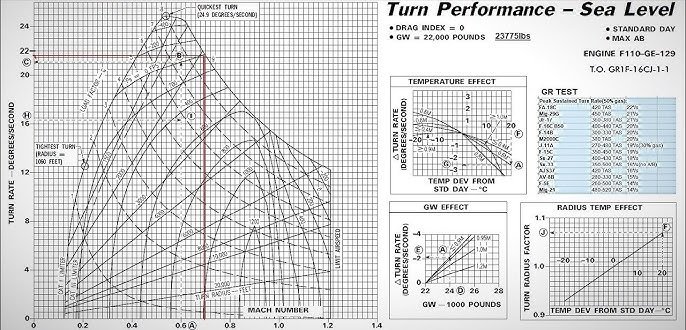
In that chart the F-16 Block 50 is flying clean and at 22000 lbs. With the 50% of fuel the plane would fly at around 23500 lbs. We can see that the 1500 lbs in the F-16 can have significant effect on the overall performance. For example, if we put that number into the GW EFFECT table we can see that the turn rate drops by the 1,5 deg/s at 23500 lbs.
And here is the chart where we can see the weight of the F-16 Block 30 and 50 with a full fuel tank, 2 AIM-120, 2 AIM-9M and ALQ131:
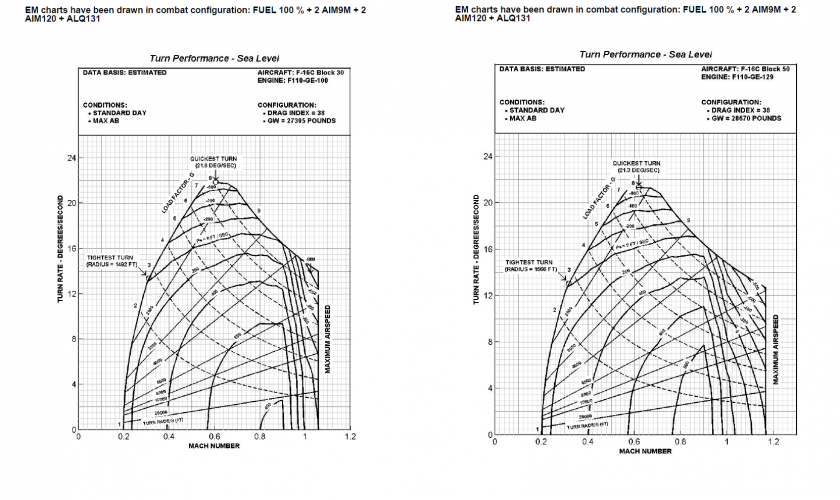
Using this chart you can calculate the true operational empty weight of both jets by retracting around 8692 lbs.
wile coyote
ACCESS: Restricted
- Joined
- 16 January 2025
- Messages
- 46
- Reaction score
- 17
My own 50 cents is the Raptor has a Subsonic Thrust to Weight Ratio around the F15c, Mostly a little lower. All Airshow Performnce Ive seen it appears kinda sluggish and doesnt seem to accelerate all that well.
Heres a comparison with the Mig 29A Fulcrum equipped with a drop tank:
Last edited by a moderator:
RadicalDisconnect
Tony F.
- Joined
- 28 April 2014
- Messages
- 240
- Reaction score
- 202
I know exactly where this source came from, it was in mid-2013 from purported “radioscanners”, first posted here by @flanker who even then cautioned to take it with salt and skepticism because of the dubious nature of the source.Citation of the colleague 'paralay' from the 81st page ( new Su-57's thread) :
"... So during tests this spring (2013), with a full load of fuel and mass-dimensional models of weapons, the 4th board (054) took off from 310 meters, reached a cruising speed of 2135 km / h and a maximum speed of 2610 km/ h (M = 2.46), at the same time, there was still a potential for acceleration, and I also climbed 24,300 meters - they didn't let me go any further"
Now as we can see this was achieved during one test flight from 2013.
https://www.secretprojects.co.uk/th...rations-2012-current.15626/page-7#post-190842
It turns out that this “radioscanners” claim was indeed false since data from Sukhoi about T-50 envelope expansion in 2014 directly contradict that information, and @flanker who originally posted that claim with some skepticism, later retracted that claim fully. But now you are again presenting this claim that directly contradict Sukhoi’s data on T-50 envelope expansion from 2014 after Предварительные испытания 1
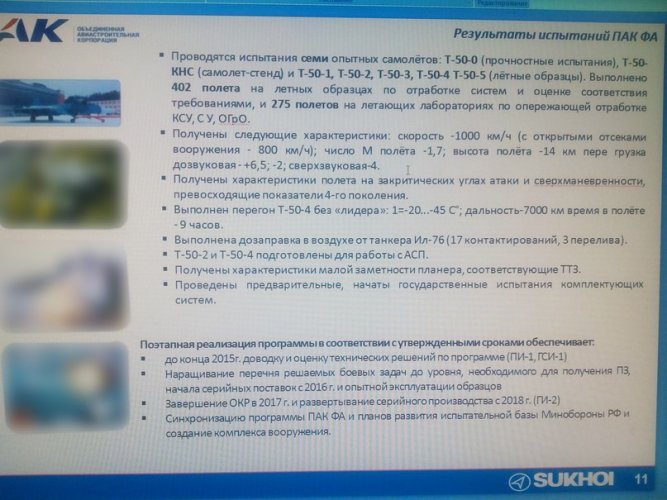
As of February 2014, envelope expansion was:
Altitude: 14,000 meters
Mach number: 1.7
Indicated airspeed: 1,000 km/h
Max g: +6.5
That climb rate claim from 2016 first appeared in the now defunct AirForces Sword of Sky, a Facebook page that is now gone. Later spread on Russian news sources without verifying the veracity.
RadicalDisconnect
Tony F.
- Joined
- 28 April 2014
- Messages
- 240
- Reaction score
- 202
Yes, my mistake, with the heavier F-16C Block 50+ it would be less. At 50% fuel the gross weight would be about 23,600lbs (empty weight 20,100lbs, 7,000lbs fuel capacity).Also, the F-16 Block 50 in the chart you have presented is not flying with 50% of fuel but with around 29-30% of fuel, so the performance numbers with 50% of fuel would be worse.
Maximum climb rate of F-16C Block 50 clean at 22,000lbs is about 1,250 ft/s, and comparing it with 26,000lbs and DI=50 is a decrease of about 200 ft/s (compare data point at Mach 0.68 and 1g), likely around 190 ft/s when clean. Interpolating, 23,600lbs would result in around 1,170 ft/s (357 m/s) or so climb rate.
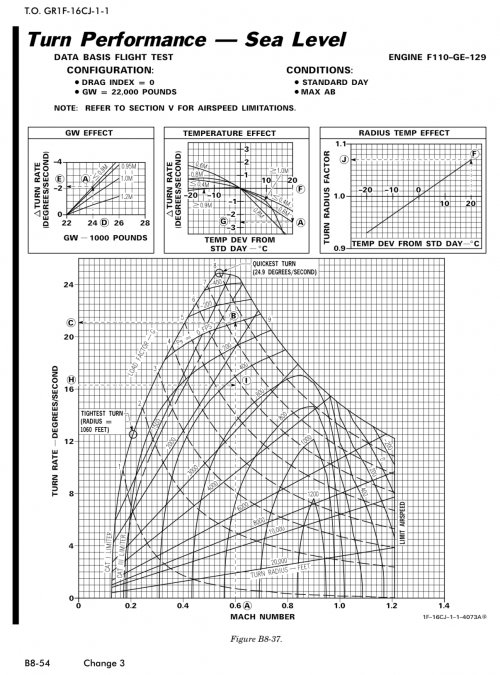
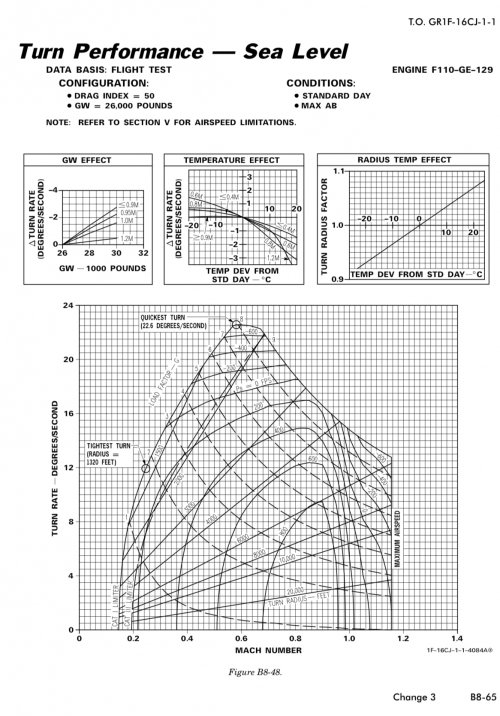
Either way, a clean F-16C has very low drag and even at a very low fuel state, still not quite matching 384m/s that’s been claimed. And it doesn’t include additional volume and weight of internal weapons bays.
At low speeds and without external tank, it’s not surprising that Eurofighter Typhoon can accelerate better than F-22. At low speeds, level acceleration is mainly determined by T/W ratio and induced drag (proportional to square of span loading), and here the Typhoon is ahead in both areas. Although by internal fuel, the Typhoon’s fuel fraction is lower than even the F-22, which itself is not great in that area because of weight growth.Here is the interview of the U.S. F-22 pilot who has extensive experience flying the EF2000:
As far as how fast the Su-57 climbs, all depends on how much fuel and payload it carries. On Flanker air shows, the wing tanks are empty because of the g-limit imposed, it’s likely the same case here. But in terms of span loading and T/W ratio I don’t see it beating the Eurofighter Typhoon either, especially if they’re loaded to similar fuel levels.
Because this is 'Su-27S vs F-15C in the climb' thread ,we have some interesting details from the Su-27SK F.M. (page 91) as only real, reliable data.
Программы полета на перехват воздушных целей.
''When intercepting air targets, depending on their speed and altitude, the following typical programs (profiles) may be used (Figs. 18, 19):
− Afterburner – for close-in interceptions;
− Non-afterburner or combined – for long-range interceptions.
Flight according to these programs (profiles) is performed using automatic, director, and manual aircraft control with guidance from the ground-based control system. These programs are optimized in terms of fuel consumption and time and are used to achieve maximum interception ranges for aerial targets.
When guiding a fighter to an air target using voice from the GCI, the interception flight profiles may differ from those specified.
5.4.2. The afterburner program is carried out at full afterburner until the end of the attack according to the following profile:
− Takeoff and climb to 11,000 m at Mach 0.9-0.95 (position 1-2-3);
Acceleration at H=11,000 m to Mach 1.3; 1.8; 2.0. Reaching Mach 2 is accomplished by accelerating to Vpr=1,200 km/h, then climbing at a constant speed of Vpr=1,200 km/h until reaching Mach 2.0.
−climb at Mach numbers = 0.9; 1.3; 1.8; 2.0, position d-e; a-b; c-d; 5-6 and fly until the VERTICAL command is issued (climb to Mach number 0.9 in MAXIMUM mode);
reach the target attack altitude upon the VERTICAL command before the homing phase.
The non-afterburning air interception flight program is used to achieve maximum interception limits and is executed according to the following profile:
−takeoff in MAXIMUM mode and climb to 11,000 m at Vist = 860 km/h;
−acceleration to Mach = 0.9, climb, and cruise at Mach = 0.9 (flight at ceilings) until the VERTICAL command.''
So as we can see Su-27S (SK) as armed can climb through troposphere with Mach number 0.9-0.95 in the Full AB mode ( Afterburner program). In the non AB mode/program ,climbing speed is 860km/h.
Now ,for the real,objective comparison ,we must find exactly these details about F-15C.
Программы полета на перехват воздушных целей.
''При перехвате воздушных целей, в зависимости от скорости и высоты их полета, могут быть использованы следующие типовые программы (профили), рис. 18, 19:
форсажные – при ближнем перехвате;
бесфорсажные или комбинированные – при дальнем перехвате.
Полет по данным программам (профилям) выполняется в автоматическом, директорном и ручном управлении самолетом при наведении с наземного АСУ. Указанные программы оптимальны по расходу топлива и времени и используются для достижения максимальных рубежей перехвата воздушных целей. При наведении истребителя на воздушную цель голосом с ПН профили полета на перехват могут отличаться от указанных.
Форсажная программа выполняется на полном форсаже до окончания атаки по следующему профилю:
взлет и набор высоты 11000 м на числе М = 0,9-0,95 (позиция 1-2-3);
разгон на Н=11000 м до числа М=1,3; 1,8; 2,0. Выход на числа М = 2 выполняется с разгоном до Vпр = 1200 км/ч, далее набором высоты на постоянной скорости Vпр = 1200 км/ч до достижения числа М = 2,0;
набор высоты на числах М = 0,9; 1,3; 1,8; 2,0 позиция д-е; а-б; в-г; 5-6 и полет до команды ВЕРТИКАЛЬ (набор высоты на М = 0,9 выполнять на режиме МАКСИМАЛ);
выход на высоту атаки цели по команде ВЕРТИКАЛЬ до этапа самонаведения.
Бесфорсажная программа полета на перехват воздушных целей применяется для достижения максимальных рубежей перехвата и выполняется по следующему профилю:
взлет на режиме МАКСИМАЛ и набор высоты 11000 м на Vист = 860 км/ч;
разгон до числа М = 0,9, набор высоты и крейсерский полет на М = 0,9 (полет по потолкам) до команды ВЕРТИКАЛЬ.''
Flight Programs for Intercepting Air Targets.форсажные – при ближнем перехвате;
бесфорсажные или комбинированные – при дальнем перехвате.
Полет по данным программам (профилям) выполняется в автоматическом, директорном и ручном управлении самолетом при наведении с наземного АСУ. Указанные программы оптимальны по расходу топлива и времени и используются для достижения максимальных рубежей перехвата воздушных целей. При наведении истребителя на воздушную цель голосом с ПН профили полета на перехват могут отличаться от указанных.
Форсажная программа выполняется на полном форсаже до окончания атаки по следующему профилю:
взлет и набор высоты 11000 м на числе М = 0,9-0,95 (позиция 1-2-3);
разгон на Н=11000 м до числа М=1,3; 1,8; 2,0. Выход на числа М = 2 выполняется с разгоном до Vпр = 1200 км/ч, далее набором высоты на постоянной скорости Vпр = 1200 км/ч до достижения числа М = 2,0;
набор высоты на числах М = 0,9; 1,3; 1,8; 2,0 позиция д-е; а-б; в-г; 5-6 и полет до команды ВЕРТИКАЛЬ (набор высоты на М = 0,9 выполнять на режиме МАКСИМАЛ);
выход на высоту атаки цели по команде ВЕРТИКАЛЬ до этапа самонаведения.
Бесфорсажная программа полета на перехват воздушных целей применяется для достижения максимальных рубежей перехвата и выполняется по следующему профилю:
взлет на режиме МАКСИМАЛ и набор высоты 11000 м на Vист = 860 км/ч;
разгон до числа М = 0,9, набор высоты и крейсерский полет на М = 0,9 (полет по потолкам) до команды ВЕРТИКАЛЬ.''
''When intercepting air targets, depending on their speed and altitude, the following typical programs (profiles) may be used (Figs. 18, 19):
− Afterburner – for close-in interceptions;
− Non-afterburner or combined – for long-range interceptions.
Flight according to these programs (profiles) is performed using automatic, director, and manual aircraft control with guidance from the ground-based control system. These programs are optimized in terms of fuel consumption and time and are used to achieve maximum interception ranges for aerial targets.
When guiding a fighter to an air target using voice from the GCI, the interception flight profiles may differ from those specified.
5.4.2. The afterburner program is carried out at full afterburner until the end of the attack according to the following profile:
− Takeoff and climb to 11,000 m at Mach 0.9-0.95 (position 1-2-3);
Acceleration at H=11,000 m to Mach 1.3; 1.8; 2.0. Reaching Mach 2 is accomplished by accelerating to Vpr=1,200 km/h, then climbing at a constant speed of Vpr=1,200 km/h until reaching Mach 2.0.
−climb at Mach numbers = 0.9; 1.3; 1.8; 2.0, position d-e; a-b; c-d; 5-6 and fly until the VERTICAL command is issued (climb to Mach number 0.9 in MAXIMUM mode);
reach the target attack altitude upon the VERTICAL command before the homing phase.
The non-afterburning air interception flight program is used to achieve maximum interception limits and is executed according to the following profile:
−takeoff in MAXIMUM mode and climb to 11,000 m at Vist = 860 km/h;
−acceleration to Mach = 0.9, climb, and cruise at Mach = 0.9 (flight at ceilings) until the VERTICAL command.''
So as we can see Su-27S (SK) as armed can climb through troposphere with Mach number 0.9-0.95 in the Full AB mode ( Afterburner program). In the non AB mode/program ,climbing speed is 860km/h.
Now ,for the real,objective comparison ,we must find exactly these details about F-15C.
These are Soviet diagrams that show the REAL Su-27 and the ESTIMATED (!!!) F-15 (TsAGI estimate from 80s). It was GREATLY overestimated, but this was discovered later. Now, anyone can compare the TsAGI estimate with the real F-15 (the manual is available).This is from a report on Su-27 turning performance vs F-15, F-16, and Tornado. I’ll try and attach the full study but it’s likely been shared here before
Below are two charts showing excess power at 3 and 5 G, the study goes into how this means that similar G the F-15 can gain more altitude faster. The last chart shows how far behind the Su-27 is in climb speed. Though this is only an estimate. If you compare this to American data I’m sure you can get a rather full picture. I believe it is for 20 t total weight and 2x R-27 and 2x R-73.
And don't forget that the P-42 smashed the Streak Eagle. It's wasnt just a slight advantage.
- Joined
- 3 June 2011
- Messages
- 20,989
- Reaction score
- 19,254
There was a story in Code One years ago where either LM or the USAF decided they wanted to go after some records with the F-16. They figured they could get some of the time to climb records and steal the low altitude record from the Red Baron Starfighter. The higher ups in the USAF shut it down.IMO people are getting too carried away. A completely clean F-16C Block 50 at 50% fuel, can manage just over 72,000 ft/min initial climb rate at sea level (1,200 ft/s, 366 m/s). Based on HAF F-16C doghouse plot.
View attachment 793720
I highly doubt an F-22 can do much better than that. For one max climb rate is achieved at subsonic/transonic region at low alatitude, and F-22 the aerodynamics optimized for supersonic, instead of that region. And the main benefit is with internal weapons, it can have maneuverability similar to clean 4th gen fighters even when armed. Same goes for Su-57 or J-20.
Similar threads
-
-
-
-
 How Piston Engined Bombers Can Outrun Jet Fighters (related to Douglas Model 416)
- Started by RyanC
- Replies: 3
