Does the Su-27S climb better than the F-15C?

wile coyote

ACCESS: Restricted
Joined
16 January 2025
Messages
46
Reaction score
16
Hey guys, I was looking at climb rates and to my surprise the original Su27S climbs better than the F15C. I was wondering how this is possible? The Flanker supposedly has a 300 ms-1 climb rate whereas the F15C has 254 ms-1. How is the difference so great especially considering the F15 has a much better TWR and its engines perform better at higher speeds. I believe the Flanker has a better wing Loading, but can it make such a difference? Is it due to difference in payload and fuel levels? Would really appreciate if you guys could share the graphs and stats to explain it.
Thanks
 
I was under the impression that the f-15 climbed better. The mig-29 was king in terms of climb rate. What chart is correct?
 
Do we know the condition of the aircraft in question? Did it carry half fuel, full fuel? Did it carry weapons? Did it achieve the climb rate after stripping out radar/non-critical avionics and even aircraft paint in an effort to set a “record”?
The engines were tweaked to nearly 31k on the Flanker, if that tells you anything. The F-15 used normal engines. Hell, F-15s with the -129s & -229s have more power than the Streak Eagle. IIRC the Streak Eagle kept the 20km climb record.
 
Why does this surprise you?
Interesting. But I was under the impression that the P42 was heavily lightened and even had its thrust levels increased. I didn't think the in service Flanker could do that. Very impressive if true
 
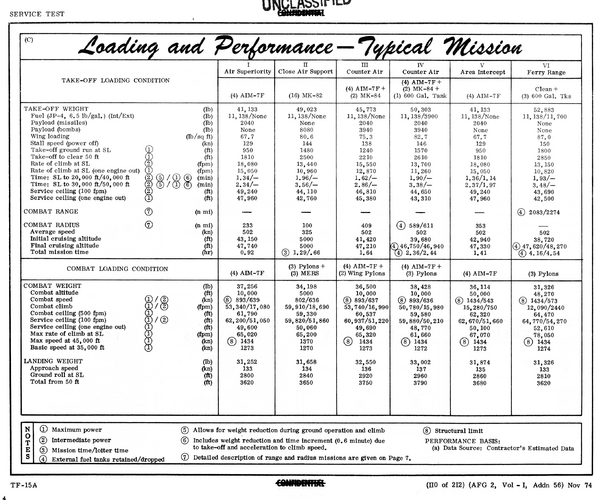
The data for F-15 seems to be drastically off. Here is the relevant page from F-15B SAC (empty weight of 26 289 lbs):
F15B.png
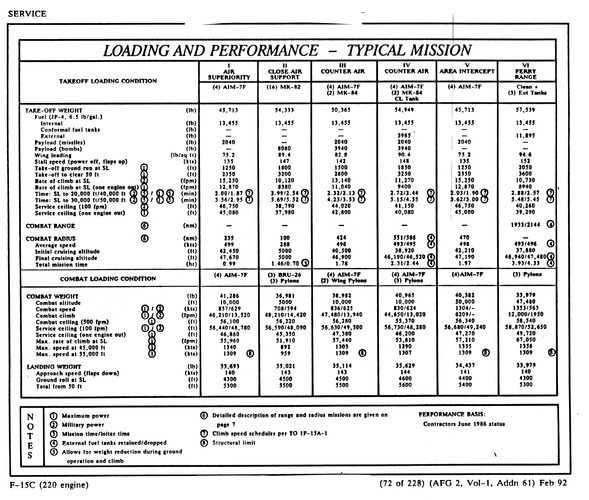
Even with the twin-seater penalty, for clean aircraft the rate of climb is ca. 396 m/s (although based on the weight the value is for ca. 30% of internal fuel, and the overall thrust-weight-ratio is in this case 1.5). For the slightly heavier F-15C (empty weight of 28 476 lbs), the values look as follows:
F15C.png
Again, for clean aircraft with ca. 30% of fuel the value is ca. 340 m/s (TWR of 1.38). Considering the astounding TWR of the F-15, I would find it very hard for Su-27S to match it. For reference, the typical value cited for MiG-29 is 345 m/s clean, for F-16 block 15 SAC provides a value of 60 288 fpm (306 m/s) with two AIM-9J with ca. 30% of internal fuel. Later, more powerful versions of F-16 are likely to exceed this value, as based on the manuals SEP of 1200 ft/s is perfectly achievable at sea level .
 
Last edited:
Do we know the condition of the aircraft in question? Did it carry half fuel, full fuel? Did it carry weapons? Did it achieve the climb rate after stripping out radar/non-critical avionics and even aircraft paint in an effort to set a “record”?
I was actually hoping to find some graphs and solid data that might confirm that. My guess is for Flanker it is approx 2700 Kg fuel and 2 R27R and 2R73
 
The data for F-15 seems to be drastically off. Here is the relevant page from F-15B SAC (empty weight of 26 289 lbs):
View attachment 760463
Even with the twin-seater penalty, for clean aircraft the rate of climb is ca. 396 m/s (although based on the weight the value is for ca. 30% of internal fuel, and the overall thrust-weight-ratio is in this case 1.5). For the slightly heavier F-15C (empty weight of 28 476 lbs), the values look as follows:
View attachment 760464
Again, for clean aircraft with ca. 30% of fuel the value is ca. 340 m/s (TWR of 1.38). Considering the astounding TWR of the F-15, I would find it very hard for Su-27S to match it. For reference, the typical value cited for MiG-29 is 345 m/s clean, for F-16 block 15 SAC provides a value of 60 288 fpm (306 m/s) with two AIM-9J with ca. 30% of internal fuel. Later, more powerful versions of F-16 are likely to exceed this value, as based on the manuals SEP of 1200 ft/s is perfectly achievable at sea level .
Impressive 396 seems insane, even the Mig 29 doesn't have anywhere near that
 
Interesting. But I was under the impression that the P42 was heavily lightened and even had its thrust levels increased. I didn't think the in service Flanker could do that. Very impressive if true
The P42 was stripped down and it's engines tweaked within an inch of their lives. Hell, they even replaced the radome with an aluminum one to reduce weight.
 
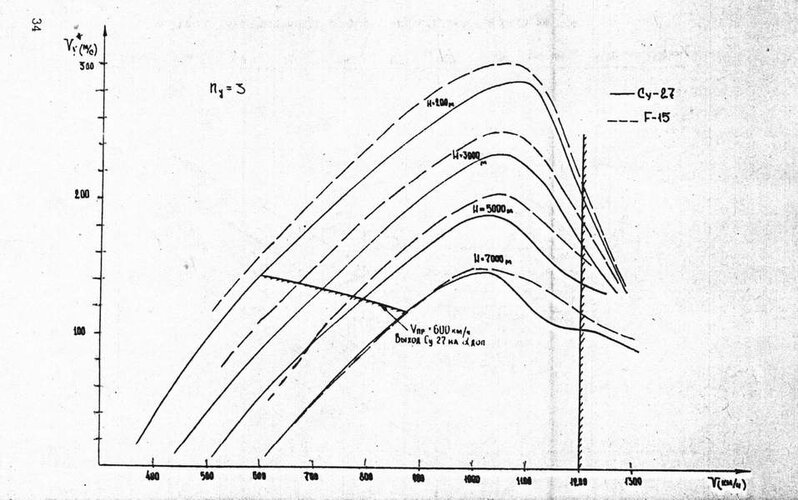
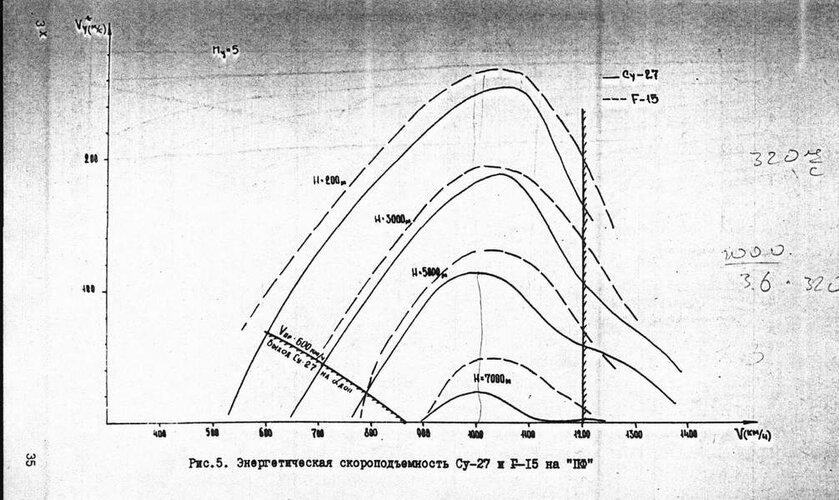
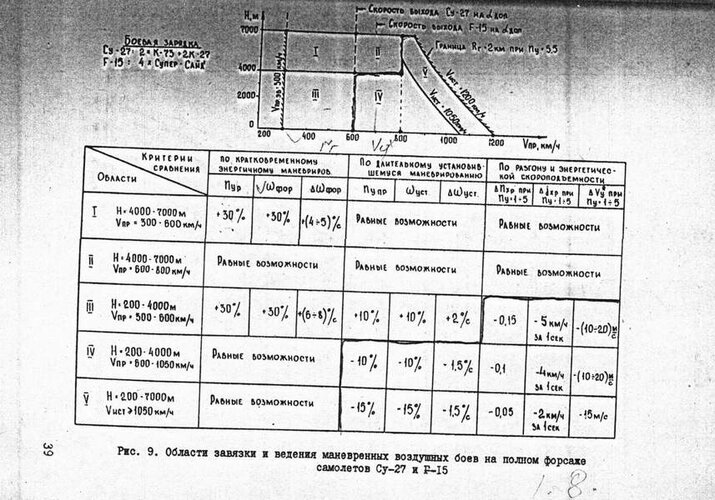
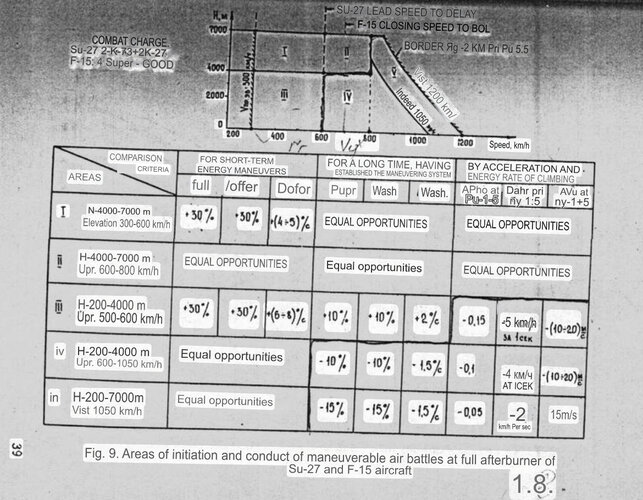
This is from a report on Su-27 turning performance vs F-15, F-16, and Tornado. I’ll try and attach the full study but it’s likely been shared here before

Below are two charts showing excess power at 3 and 5 G, the study goes into how this means that similar G the F-15 can gain more altitude faster. The last chart shows how far behind the Su-27 is in climb speed. Though this is only an estimate. If you compare this to American data I’m sure you can get a rather full picture. I believe it is for 20 t total weight and 2x R-27 and 2x R-73.
 

Attachments

  • IMG_0887.jpeg
    IMG_0887.jpeg
    77 KB · Views: 80
  • IMG_0888.jpeg
    IMG_0888.jpeg
    101.5 KB · Views: 63
  • IMG_0890.jpeg
    IMG_0890.jpeg
    113.7 KB · Views: 64
  • IMG_0892.jpeg
    IMG_0892.jpeg
    675.6 KB · Views: 85
  • TsAGI_SU27.pdf
    2.2 MB · Views: 19
T
This is from a report on Su-27 turning performance vs F-15, F-16, and Tornado. I’ll try and attach the full study but it’s likely been shared here before

Below are two charts showing excess power at 3 and 5 G, the study goes into how this means that similar G the F-15 can gain more altitude faster. The last chart shows how far behind the Su-27 is in climb speed. Though this is only an estimate. If you compare this to American data I’m sure you can get a rather full picture. I believe it is for 20 t total weight and 2x R-27 and 2x R-73
Thanks a lot buddy! That was incredibly informative!
 
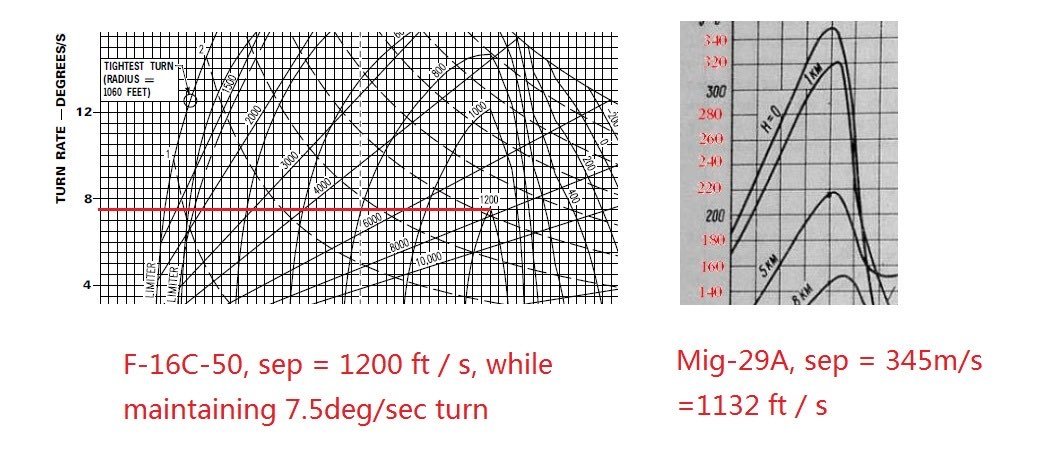
image0.jpeg

F-16 block 50 vs mig-29 manual data

365 M/S while turning 7.5 DPS shows how insane the extra thrust F110-GE-129 provides is, the other big engines are not far behind.

The fulcrums 345 M/S is also insane

The Eagle, Fulcrum, big engine viper, and probably the Eurofighter are in a class their own in terms of climbing and acceleration even compared to other fourth gen’s.
 
Hm.... What everyone discussed here is nothing but 'initial rate of climb' that is usually measured at 1000m of height.

E.g. MiG-29 with 50% of fuel and 4 x R-73 has 330m/s of initial rate of climb at 1000m where we must keep on mind that two RD-33 have max dynamic thrust on the Full AB mode of 11000 kgf ,each . Real vertical speed through troposphere is 0.85M and MiG-29 can climb to 11km of alt within less than 60 sec where
the angle of climbing in relation to the horizon is about 80 degrees.

AFAIK the MiG-29 holds no FAI climb records.


''26 апреля 1995 г. МиГ-29 установил свой первый мировой авиационный рекорд. Летчик-испытатель Р.П. Таскаев достиг на нем высоты полета 27460 м, что явилось рекордным достижением в классе реактивных самолетов взлетной массой от 12 до 16 т. Позднее летчиком О.В. Антоновичем были установлены еще два рекорда: высоты полета с грузом в 1 т и времени набора высоты 15 км с грузом 1 т.''

Transl:

''On April 26, 1995, the MiG-29 set its first world aviation record. Test pilot R.P. Taskaev reached a flight altitude of 27,460 m, which was a record achievement in the class of jet aircraft with a takeoff weight of 12 to 16 tons. Later, pilot O.V. Antonovich set two more records: flight altitude with a load of 1 ton and time to climb to 15 km with a load of 1 ton.''
 
Hey guys, I was looking at climb rates and to my surprise the original Su27S climbs better than the F15C. I was wondering how this is possible? The Flanker supposedly has a 300 ms-1 climb rate whereas the F15C has 254 ms-1. How is the difference so great especially considering the F15 has a much better TWR and its engines perform better at higher speeds. I believe the Flanker has a better wing Loading, but can it make such a difference? Is it due to difference in payload and fuel levels? Would really appreciate if you guys could share the graphs and stats to explain it.
Thanks
This single digit wiki climb rate values are totally useless.
In fact I'm 99% sure that a combat configured F-15 was better. Just check the difference between the Streak Eagle and the P-42...
The P-42 was seriously modified even airframe modification happened, while the F-15 was just simply lighten from avionics and was stripped from paint.

Ps or other kind of diagram is necessary.
 
Hm.... What everyone discussed here is nothing but 'initial rate of climb' that is usually measured at 1000m of height.

E.g. MiG-29 with 50% of fuel and 4 x R-73 has 330m/s of initial rate of climb at 1000m where we must keep on mind that two RD-33 have max dynamic thrust on the Full AB mode of 11000 kgf ,each . Real vertical speed through troposphere is 0.85M and MiG-29 can climb to 11km of alt within less than 60 sec where
the angle of climbing in relation to the horizon is about 80 degrees.


''26 апреля 1995 г. МиГ-29 установил свой первый мировой авиационный рекорд. Летчик-испытатель Р.П. Таскаев достиг на нем высоты полета 27460 м, что явилось рекордным достижением в классе реактивных самолетов взлетной массой от 12 до 16 т. Позднее летчиком О.В. Антоновичем были установлены еще два рекорда: высоты полета с грузом в 1 т и времени набора высоты 15 км с грузом 1 т.''

Transl:

''On April 26, 1995, the MiG-29 set its first world aviation record. Test pilot R.P. Taskaev reached a flight altitude of 27,460 m, which was a record achievement in the class of jet aircraft with a takeoff weight of 12 to 16 tons. Later, pilot O.V. Antonovich set two more records: flight altitude with a load of 1 ton and time to climb to 15 km with a load of 1 ton.''
It’s not always Mach 0.85. For example other manuals, And the practical aerodynamics manual give the same value of flanker which is Mach 0.9-0.95 climb in AB.

And that’s disregarding the faster time to altitude climb profile of 1350 kmh IAS until you hit Mach 1.65-1.7, which is also similar for Flanker with 1250 kmh IAS until Mach 1.6.
 
It’s not always Mach 0.85. For example other manuals, And the practical aerodynamics manual give the same value of flanker which is Mach 0.9-0.95 climb in AB.

And that’s disregarding the faster time to altitude climb profile of 1350 kmh IAS until you hit Mach 1.65-1.7, which is also similar for Flanker with 1250 kmh IAS until Mach 1.6.

Don't understand your comment.Point is that there is no serial/operational fighter ( especially armed with AAM's) that can climb through troposphere on supersonic speed.Maybe the first one will be Su-57 with AL-51F? That real speed of 1.6M-1.7M fighters like MiG-29 or Su-27 achieve at 11km but in the straight flight ( acceleration on Full AB ) ,then they continue to climb supersonicaly through stratosphere.
 
View attachment 773456

F-16 block 50 vs mig-29 manual data

365 M/S while turning 7.5 DPS shows how insane the extra thrust F110-GE-129 provides is, the other big engines are not far behind.

The fulcrums 345 M/S is also insane

The Eagle, Fulcrum, big engine viper, and probably the Eurofighter are in a class their own in terms of climbing and acceleration even compared to other fourth gen’s.
This is also inaccurate. Ps cannot be converted directly to climb rate.
 
The data for F-15 seems to be drastically off. Here is the relevant page from F-15B SAC (empty weight of 26 289 lbs):
View attachment 760463
Even with the twin-seater penalty, for clean aircraft the rate of climb is ca. 396 m/s (although based on the weight the value is for ca. 30% of internal fuel, and the overall thrust-weight-ratio is in this case 1.5). For the slightly heavier F-15C (empty weight of 28 476 lbs), the values look as follows:
View attachment 760464
Again, for clean aircraft with ca. 30% of fuel the value is ca. 340 m/s (TWR of 1.38). Considering the astounding TWR of the F-15, I would find it very hard for Su-27S to match it. For reference, the typical value cited for MiG-29 is 345 m/s clean, for F-16 block 15 SAC provides a value of 60 288 fpm (306 m/s) with two AIM-9J with ca. 30% of internal fuel. Later, more powerful versions of F-16 are likely to exceed this value, as based on the manuals SEP of 1200 ft/s is perfectly achievable at sea level .
Another inaccurate statement. Any plane only in dream have 1.38 T/W and you never can't forget the drag and thrust char.
I have the thrust char both the AL-31 and F100PW100....
 
Hm.... What everyone discussed here is nothing but 'initial rate of climb' that is usually measured at 1000m of height.

E.g. MiG-29 with 50% of fuel and 4 x R-73 has 330m/s of initial rate of climb at 1000m where we must keep on mind that two RD-33 have max dynamic thrust on the Full AB mode of 11000 kgf ,each . Real vertical speed through troposphere is 0.85M and MiG-29 can climb to 11km of alt within less than 60 sec where
the angle of climbing in relation to the horizon is about 80 degrees.


''26 апреля 1995 г. МиГ-29 установил свой первый мировой авиационный рекорд. Летчик-испытатель Р.П. Таскаев достиг на нем высоты полета 27460 м, что явилось рекордным достижением в классе реактивных самолетов взлетной массой от 12 до 16 т. Позднее летчиком О.В. Антоновичем были установлены еще два рекорда: высоты полета с грузом в 1 т и времени набора высоты 15 км с грузом 1 т.''

Transl:

''On April 26, 1995, the MiG-29 set its first world aviation record. Test pilot R.P. Taskaev reached a flight altitude of 27,460 m, which was a record achievement in the class of jet aircraft with a takeoff weight of 12 to 16 tons. Later, pilot O.V. Antonovich set two more records: flight altitude with a load of 1 ton and time to climb to 15 km with a load of 1 ton.''
Is that an FAI record?
 
Don't understand your comment.Point is that there is no serial/operational fighter ( especially armed with AAM's) that can climb through troposphere on supersonic speed.Maybe the first one will be Su-57 with AL-51F? That real speed of 1.6M-1.7M fighters like MiG-29 or Su-27 achieve at 11km but in the straight flight ( acceleration on Full AB ) ,then they continue to climb supersonicaly through stratosphere.
Apparently the F-22 can supercruise on the deck. If it can do that, there's no reason it couldn't light the burners and climb supersonic.
 
Don't understand your comment.Point is that there is no serial/operational fighter ( especially armed with AAM's) that can climb through troposphere on supersonic speed.Maybe the first one will be Su-57 with AL-51F? That real speed of 1.6M-1.7M fighters like MiG-29 or Su-27 achieve at 11km but in the straight flight ( acceleration on Full AB ) ,then they continue to climb supersonicaly through stratosphere.
  1. You did not specify the rate of climb. Any fighter since the '60s can climb with supersonic speed just with decreasing pitch.
  2. Why would be so special the Su-57 compared to the F-22 + F119?
 
Is that an FAI record?


Apparently the F-22 can supercruise on the deck. If it can do that, there's no reason it couldn't light the burners and climb supersonic.

No, F-22A can not do it. Max vertical speed in the troposphere is about 0.9M.

  1. You did not specify the rate of climb. Any fighter since the '60s can climb with supersonic speed just with decreasing pitch.
  2. Why would be so special the Su-57 compared to the F-22 + F119?

1.Yes ,I did. I gave the example for the MiG-29. Yes ,they can but in the stratosphere not in the troposphere.Besides all of that, max possible Mach number for one fighter can be measured at 11km or higher ,so only in the stratosphere.

2.Because F-22A is in the level of MiG-29 when we talk about initial rate of climb and the vertical speed through troposphere.

Here is the Polish AF MiG-29A with PTB-1500 underfuselage fuel tank.

View: https://www.youtube.com/watch?v=Oze1i4IQHMU


When we talk about Su-57,prototype T-50-4 (number 054 blue ,of course with AL-41F-1 ), achieved record-breaking initial rate of climb of 382m/sec in 2014 .Did it achieve that with normal load -63% or even full load- 100% of fuel on the tarmac before pre-flight check,really don't remember right now.

Because topic is Su-27S vs F-15C ( as operational fighters) in the domain of the initial rate of climb,climbing etc ...we must keep on mind that both of them will go to combat/patrol mission with 100% of fuel (on the tarmac before pre-flight check) and of course armed,Su-27S maybe with all of ten AAM's and F-15C with eight of them.Besides all of this Su-27S don't have drop fuel tanks,F-15C can carry three of them if it is necessary.

These two guys were only record-breakers....

 
Last edited:
You'll want to let the pilots know. They seem to be under the impression that it can.
In a long since deleted forum post, which resulted in a USAF wide OPSEC training, a now former Raptor pilot described a max performance vertical departure at ED. Full burner take off, gear up, hug the runway, acel to 500, pull vertical, bust altitude badly above assigned 30kft, max Mach # 0.99. Possible if the air is cold enough, I've seen that profile (from a Raptor) in cold air and it was impressive.
 
In a long since deleted forum post, which resulted in a USAF wide OPSEC training, a now former Raptor pilot described a max performance vertical departure at ED. Full burner take off, gear up, hug the runway, acel to 500, pull vertical, bust altitude badly above assigned 30kft, max Mach # 0.99. Possible if the air is cold enough, I've seen that profile (from a Raptor) in cold air and it was impressive.
Trying to remember where I saw the pilot mention breaking Mach 1 (or throttling back so he wouldn't) at low altitude without afterburner. Wasn't in a climb. Might have been on F-16.net.
 
Trying to remember where I saw the pilot mention breaking Mach 1 (or throttling back so he wouldn't) at low altitude without afterburner. Wasn't in a climb. Might have been on F-16.net.
Dozer got himself in trouble on an aviation photog site. One of my really good friends at the time was a photog on F-22 and knew Dozer. That said, F-16.net has a lot of in the know posters.
 
Dozer got himself in trouble on an aviation photog site. One of my really good friends at the time was a photog on F-22 and knew Dozer. That said, F-16.net has a lot of in the know posters.
I remember that.


No, F-22A can not do it. Max vertical speed in the troposphere is about 0.9M.


1.Yes ,I did. I gave the example for the MiG-29. Yes ,they can but in the stratosphere not in the troposphere.Besides all of that, max possible Mach number for one fighter can be measured at 11km or higher ,so only in the stratosphere.

2.Because F-22A is in the level of MiG-29 when we talk about initial rate of climb and the vertical speed through troposphere.

Here is the Polish AF MiG-29A with PTB-1500 underfuselage fuel tank.

View: https://www.youtube.com/watch?v=Oze1i4IQHMU


When we talk about Su-57,prototype T-50-4 (number 054 blue ,of course with AL-41F-1 ), achieved record-breaking initial rate of climb of 382m/sec in 2014 .Did it achieve that with normal load -63% or even full load- 100% of fuel on the tarmac before pre-flight check,really don't remember right now.

Because topic is Su-27S vs F-15C ( as operational fighters) in the domain of the initial rate of climb,climbing etc ...we must keep on mind that both of them will go to combat/patrol mission with 100% of fuel (on the tarmac before pre-flight check) and of course armed,Su-27S maybe with all of ten AAM's and F-15C with eight of them.Besides all of this Su-27S don't have drop fuel tanks,F-15C can carry three of them if it is necessary.

These two guys were only record-breakers....

This whole "troposphere" mantra is useless. It is too wide region.

Lets assume the diagram is true...

BTW the top speed with full AB is similar to any planes. Within the "troposphere" you can see M1.2-M2.4 top speed. Because "troposphere" means 0-40k ft of altitude.... Top speed of planes are typically are at 36-40k ft.
 
This whole "troposphere" mantra is useless. It is too wide region.

Lets assume the diagram is true...

BTW the top speed with full AB is similar to any planes. Within the "troposphere" you can see M1.2-M2.4 top speed. Because "troposphere" means 0-40k ft of altitude.... Top speed of planes are typically are at 36-40k ft.

Sorry but you didn't understand. In the vertical plane or during climbing ,there is no fighter that can fly supersonicaly in the troposphere ( maybe except the Su-57 with either AL-41F-1 /AL-51F? ) .Max possible Mach number at low altitude is 1.2-1.3 ( straight flight) , at 11.000m and higher can be 2.3-2.5 or higher ( MiG-31BM =2.8M).
 
Sorry but you didn't understand. In the vertical plane or during climbing ,there is no fighter that can fly supersonicaly in the troposphere ( maybe except the Su-57 with either AL-41F-1 /AL-51F? ) .Max possible Mach number at low altitude is 1.2-1.3 ( straight flight) , at 11.000m and higher can be 2.3-2.5 or higher ( MiG-31BM =2.8M).
 
I don’t think flankers are flying 100% fuel for their missions; that’s too much.
 

Again ,as a record-breaker just like P-42 ,'Streak Eagle' was capable to fly supersonicaly ( to climb in fact ) through troposphere. What about fully fueled and armed operational fighters?
 
Sorry but you didn't understand. In the vertical plane or during climbing ,there is no fighter that can fly supersonicaly in the troposphere ( maybe except the Su-57 with either AL-41F-1 /AL-51F? ) .Max possible Mach number at low altitude is 1.2-1.3 ( straight flight) , at 11.000m and higher can be 2.3-2.5 or higher ( MiG-31BM =2.8M).
Sorry, but you did not understand. I never talked about vertical climbing... Nobody. Planes never do vertical for long period. They never did not even during record breaking flights...
 
Again ,as a record-breaker just like P-42 ,'Streak Eagle' was capable to fly supersonicaly ( to climb in fact ) through troposphere. What about fully fueled and armed operational fighters?
With small pitch they can do without any issue even with drop tanks. Of course it does not have any sense to do it. It is never worth to fly faster during a climb then M0.9 because of increased wave drag. The impact of transonic and low supersonic wave drag is clearly seen on every Ps diagram...
 
I don’t think flankers are flying 100% fuel for their missions; that’s too much.
Nope, they do. That is the point. They have the internal fuel of an F-15C with two drop tanks. But with much less wave drag, for exchange larger cross section by default. But F-35A followed that way as the Su-27.
 
In a long since deleted forum post, which resulted in a USAF wide OPSEC training, a now former Raptor pilot described a max performance vertical departure at ED. Full burner take off, gear up, hug the runway, acel to 500, pull vertical, bust altitude badly above assigned 30kft, max Mach # 0.99. Possible if the air is cold enough, I've seen that profile (from a Raptor) in cold air and it was impressive.
So, Elmendorf winter intercepts are going to be impressive to watch. Gotcha.

I just don't want to freeze my nuts off to witness it!
 
Sorry, but you did not understand. I never talked about vertical climbing... Nobody. Planes never do vertical for long period. They never did not even during record breaking flights...

Hm ,my story from the beginning was can operational fighter climb supersonically through troposphere. I will repeat again what is MiG-29 capable of. After releasing the brakes(at 80%, rotation of turbine),and on the Full AB mode, it is capable to take off after 240m roll then accelerate to 600 km/h ,after that ,MiG-29 goes vertically with climb angle of 80° where real speed is M 0.85. It takes only 50-55 sec to climb at 11000m. What does it mean? It means that this fighter can reach stratosphere very fast in the possible emergency situation or in the real combat scenario.

It is crucial for one fighter to reach stratosphere 'asap', and e.g one heavy interceptor MiG-31BM can reach 21500m as fully armed with 8 AAM's within 7mins.

I don’t think flankers are flying 100% fuel for their missions; that’s too much.

Every Sukhoi fighter ( FFF or Flanker Family Fighter), goes to combat mission fully fueled ,or with about 12.000 lit of kerosene on the tarmac before pre-flight check.
 

Similar threads

Back
Top Bottom