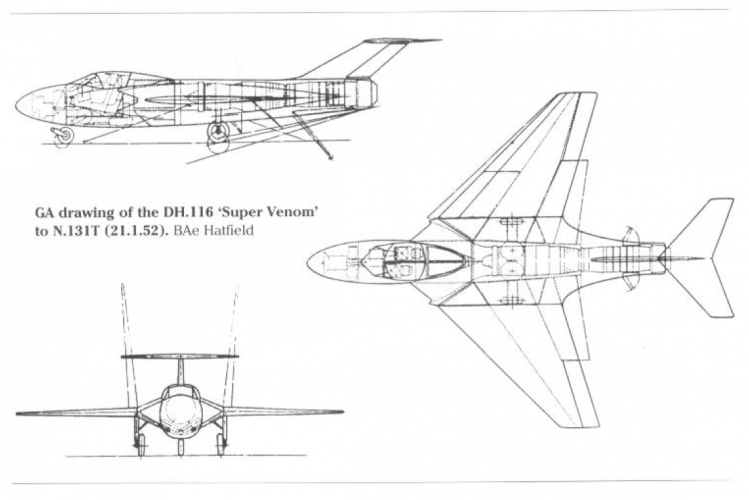
The DH.116 was the unfortunate consequence of Royal Navy pretentiousness and delusional thinking at de Havilland. It is a very long way from being the great missed opportunity that some have portrayed. I am generally sympathetic towards Royal Navy aircraft procurement in the Cold War, given the constraints they were operating under, e.g. it was a miracle they got the Buccaneer given the institutional hostility to it from the rest of government. However, their behaviour around N.114T makes the Navy alone responsible for their 1950s all-weather fighter farce.
The best place to start the DH.116 story is 1949. It had been planned to produce an improved version of the Sea Venom with the 6,000lb thrust de Havilland Ghost D.Gt.5. However, this was cancelled as part of the 1949 cuts only to be briefly resuscitated as an idea for an interim all-weather fighter in 1951. Unfortunately, whilst climb would have been improved speed wouldn't and endurance would be reduced, the biggest problem being the intake design of the Venom made it impossible to generate the full thrust potential of the engine. Anyway, RN interest was increasingly on reheat to achieve their desired sea level performance (
see here). De Havilland, in August 1951, came back with the DH.116 complete with a delusional production date of "by 1955". Some naval officers were willing to believe that date but nobody in the Ministry of Supply was - pointing out that de Havilland was proposing an all new aircraft.
This is where things collided with Royal Navy pretentiousness. When the RN had been discussing with the Ministry of Supply which firms should be invited to tender for N.114T (the then planned 1957 aircraft that would serve alongside the Scimitar), the RN only wanted notable fighter firms to bid - they didn't want the likes of Blackburn or Westland producing their next all-weather fighter. This was unfortunate as Blackburn and Westland came first and second in the N.114T tender evaluation and de Havilland didn't submit anything.
Whilst it was technically true that none of the tenders to N.114T fully met the requirement, RD Projects concluded that if the Navy accepted a slight reduction in sea level speed and a minor endurance decrease either the Blackburn or Westland designs could give the Navy what they wanted, except for the brand name. The Navy then dragged its feet for a while and concocted an argument that the DH.116 was what they really needed despite it not coming remotely close to meeting the N.114T requirement. RD Projects pointed out that the Blackburn and Westland N.114T designs and the DH.116 could all be scaled to about the same weight/performance. The Ministry of Supply, by this time annoyed with the Navy's behaviour, declared that the N.114T bidders should be allowed to tender for the Navy's new lightweight requirement so the Navy reluctantly began writing a new specification (N.131T) around the DH.116. De Havilland eventually realised they couldn't deliver the DH.116 on any sort of sensible timeline (thus proving TD Plans and RD Projects right) and the Navy ended up with the DH.110. The Navy had wasted a year, would get a less impressive aircraft, and Blackburn would go on to do an excellent job with the Buccaneer.