TRAGEDAC = R&D effort for passive detection via aircraft networking and triangulation.
CAPOEIRA = Not the first time I read that, but I don't remember what it is for.
MELBA was a R&D effort for AESA wide band.
DRAAMA and CARAA were for advanced modes for AESA radar.
DARTAGNAN, REMORA, THEO and TURENNES 1 & 2 were for engine improvements (temperature, shapes, controls...)
DEDIRA was for stealth increase.
GANIMEDE for GaN modules industrialization.
INCAS for spectra improvements including GaN and LEA active decoys
MASTRID for next gen laser pod

some are ended, some maybe not. And some new are on the way.
TURENNES 3, to improve engine, was annouced mid july 2025 !
 
Thales awards SFO Technologies RBE2 radar wired structures contract for Rafale under Make in India
  • First major order for high-value, technologically advanced complex wired structures —designed to withstand harsh environmental constraints— to be produced in India for the Dassault Aviation Rafale programme.
  • This strengthens Thales’ long-term partnership with SFO Technologies and enhances India’s indigenous defence manufacturing capabilities.
  • It supports India’s strategic localisation goals, expanding expertise from precision machining and wiring to complex systems integration.
15 December 2025, Bengaluru, India : Thales, in partnership with SFO Technologies, has taken a significant step forward in supporting India’s strategic vision for self-reliance in defence manufacturing. The latest contract, awarded for the production of high-value, technically advanced complex wired structures of the RBE2 AESA Radar of the Indian Rafale, reinforces SFO Technologies’ long-standing expertise and enduring partnership with Thales across multiple major programmes.
This first order marks an important milestone in Thales’ Make in India strategy for the localisation of advanced radar systems, which is expected to boost local manufacturing capabilities for critical Rafale sub-systems supplied to the Indian Armed Forces. Following the order of 26 Rafale aircraft for the Indian Navy, Thales, as a proud Dassault Aviation Rafale team member, continues to execute its ambitious localisation roadmap, partnering with the aeronautics and defence ecosystem in India. The scope of expertise delivered through this partnership ranges from precision machining and assembly/wiring to electronics, microelectronics, and complex system integration.

 
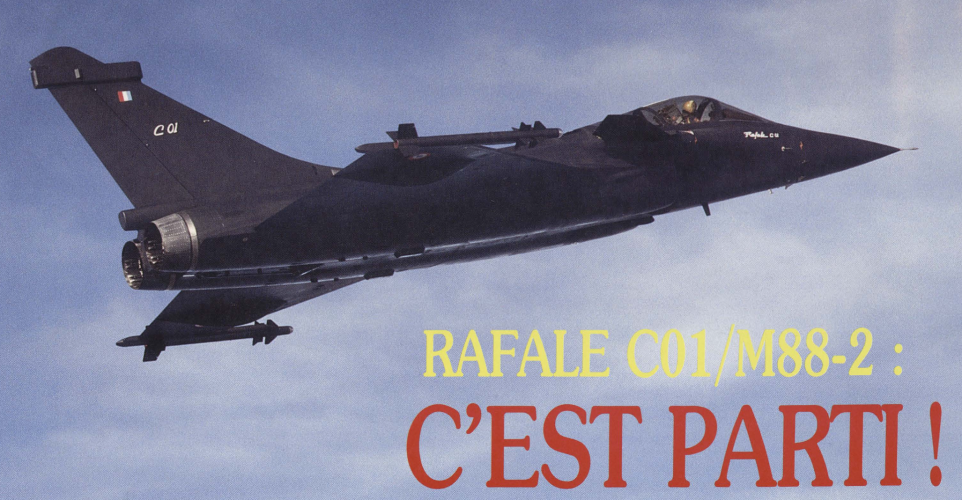
From the Snecma archives... celebrating the first flight of a Rafale prototype on 19 May 1991 (almost 25 35 years!).

Rafale C01 accelerated in dry thrust to Mach 1.2 @ 36,000ft. It was powered for the first time by 2x M88-2 engines (unlike the Rafale A demonstrator which had flown 85 times with a single M88 on the left side and a GE F404 on the right side).

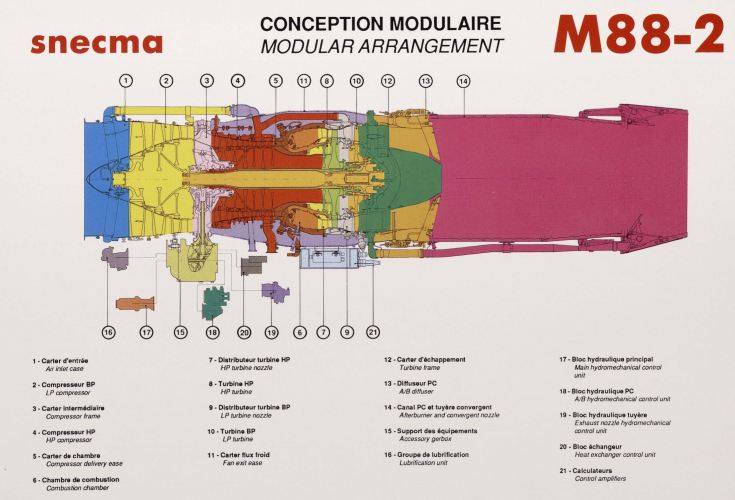
Also including a drawing of the M88 engine modules (1989).

Rafale C01 first flight.png

Snecma M88 modules.png
 

Attachments

  • Snecma - Rafale C01 2xM88 first flight 19 May 1991.pdf
    2.5 MB · Views: 31
  • Snecma M88 brochure.pdf
    1 MB · Views: 36
Last edited:
Long interview around the Rafale maintenance effort with the head of the DMAE. Non-French speaker can use the auto translate tool in Youtube that provides an adequate translation on overall.

Plenty of answers for those that had question around the availability rate, upgrade schedule, delays and impact on daily availability or even the discussed transition from the Rafale F1 to F3 ;)

(Quite a bit of chauvinism also but nothing that would take you aback)

Entretien exclusif du directeur de la Direction de la Maintenance Aéronautique et du colonel responsable de la division avions de combat. Ensemble, ils nous expliquerons comment les impératif de maintenabilité ont été inclus dés l'origine du programme, et comment les armées et les industriels ont répondu à ces exigence
------------//***///-------------------------------

Exclusive interview with the Director of Aeronautical Maintenance (DMAE) and the colonel in charge of the fighter jet division. Together, they will explain how maintainability requirements were incorporated from the outset of the program, and how the armed forces and manufacturers responded to these requirements.

View: https://youtu.be/AD7sA6shxWI
 
As per the report, the Indian government has clearly stated that all 114 Rafale jets must be integrated with Indian-made weapons, missiles, and ammunition. Along with this, Dassault will be required to provide secure data links that will allow the aircraft to digitally connect with Indian radars, sensors, and command systems. These requirements have been described as “non-negotiable clauses” in the manufacturing and procurement process.

To meet these conditions, Dassault Aviation will need to make changes to the software of the Rafale’s onboard computing systems. These changes are necessary to ensure seamless integration of Indian weapons and smooth transmission of operational data within India’s defence network.

The report further states that Dassault, along with its key partners, will provide transfer of technology (ToT) for manufacturing airframes in India. French engine manufacturer Safran and avionics company Thales are expected to participate in this technology transfer process, supporting India’s domestic defence manufacturing capabilities.

The Ministry of Defence is reportedly preparing to finalise an initial deal worth $8 billion

 
Face saving articles at this point, especially after X guard.
They failed to enforce it when they had choice, no way in hell they can enforce it when all IAF MWF eggs are in Rafale basket.

What IAF can even threaten Dassault with, gutting their own air force?


Not again ... India demands this and that!
These guys really have no clue what their role is and what they're entitled to demand!

It's truly embarrassing... and in the end, Dassault is supposed to guarantee the quality of the planes built in India by Indians, but they're not allowed any on-site access, and it all starts again.

It's so reminiscent of "Groundhog Day"!
 
Not again ... India demands this and that!
These guys really have no clue what their role is and what they're entitled to demand!

It's truly embarrassing... and in the end, Dassault is supposed to guarantee the quality of the planes built in India by Indians, but they're not allowed any on-site access, and it all starts again.

It's so reminiscent of "Groundhog Day"!
Yep, it is not Dassault who is quickly running out of fighter squadrons against China... just sayin' : there are not exactly in a position of strength ! (P.S : loved that movie. Some people calculated that Phil relived that day ten thousand times. Back to topic. )
 
The M791 cannon, manufactured at Nexter's Bourges site, is the latest in a long line of 30mm DEFA guns dating back to the post-war period. The capabilities of this single-tube gun are unrivalled to date. Thanks to numerous innovations, its rate of fire is the highest in the world: 2,500 rounds/minute [for a single barrel western cannon]. It fires 42 shells in one second, equivalent to 1.5kg of explosive. This performance enables a single M791 gun to be as effective as the Mirage 2000's two M550 guns, which each fire 1,200 rounds/minute. Designed for on-board use, the gun is gas-operated to limit the need for electricity on the aircraft.
(source KNDS)

View: https://youtu.be/fEZdd52lIk0
 
Last edited:
This gun was difficult to fine tune. Nexter had to reduce the max fire rate from 3000 to 2500 cps/minute. Now it is perfect.
If you compare it to 20 or 25mm gatling gun, main asset except bigger shell, is that the fire rate of the DEFA gun is immediatly at the top, where Gatling need a ramp to reach max rate.
 
Indonesia received its first three Rafale fighter-bombers

On January 26, the spokesperson for the Indonesian Ministry of Defense, Brigadier General Ricardo Sirait, confirmed to the press that the three Rafales had just arrived at Pekanbaru air base, located on the island of Sumatra.

 
Last edited:

According to this article, Vietnam may be among the next potential customers for the Rafale. A Vietnamese pilot has already discreetly flown the fighter jet, suggesting early familiarization.
 
Almost done:

India to get 114 Rafale jets as government clears Rs 3.25 lakh crore deal: Sources​


Unless there was a last minute surprise, technically, it would seem that the Indians did not have much faith in the official Pakistani and Chinese declarations, such as those of the Rafale's haters coming from the world wide web, after Operation Sindoor...
 
Last edited:
Keep in mind that the budget also includes 6 P-8I Poseidons (not that it makes a huge difference, but still).
The thing that is granted by India's DAC(defense acquisition council, chaired by Defence Minister ) is AON( acceptance of necessity) , after that usually vendors are chosen, trails, negotiations, acceptance by India's financial authority that takes years, which in this case were done before hand so now after AON , only CCS( cabinet committee on Security, chaired by Prime Minister) clearance remains, after which formal contract will be signed with Dassault.
 
Last edited:
Safran upgrades its 2028 ambitions to reflect the strong civil engines aftermarket and the positive momentum in Defense (notably new Rafale orders). It takes into account the net impact from US tariffs and the estimated impact from the French corporate surtax in 2025 and 2026. It also accounts for the following scope evolutions: the divestment of Safran Passenger Innovations and the transfer of Safran Ventilation Systems from Aircraft Interiors to Equipment & Defense:

Military aircraft engine revenue slightly increased year-over-year, led by services and a favorable OE customer mix. The M88 production continues to ramp up as per plan to fulfill the strong backlog, especially for export customers.

Safran Aircraft Engines has announced a project to expand its Le Creusot facility, which specializes in machining complex rotating parts.

Today, the Le Creusot site exclusively produces low-pressure turbine disks for CFM International’s1 LEAP and CFM56 engines, which power Airbus A320 and Boeing 737 aircraft. This expansion will add production lines for complex rotating parts for the M88 and GE90 engines, which power the Rafale fighter jet and Boeing 777 widebody airliner, respectively. The project represents a €70 million investment and will increase the workforce at the site from 200 to 300 people by 2032. Scheduled to be operational in 2029, the 9,000 sq.m (96,875 sq ft) expansion will bring total industrial floorspace to 26,000 sq.m (279,861 sq. ft).
With this expansion, the Le Creusot site will become the second production source for M88 complex rotating parts, alongside the Évry-Corbeil facility, supporting business continuity and a significant ramp-up in M88 engine deliveries. Machining operations for these parts will begin at the existing Le Creusot’s facility in 2026, before being transferred to the expanded area.

Safran is willing to open a M88 assembly line in India if they order 114 Rafale
View: https://x.com/VincentLamigeon/status/2022260037536665838
 
Last edited:
I suspect the Rafale has very good RCS for its generation but not necessarily enought to stand out drastically (as I understand it RCS is mostly significant as orders of magnitude rather then mild percentages, though every bit helps)

For example the RDI/RDY is more powerful then the base apg-68. Rbe2 (PESA) is described as roughly similar in detection range. Greek F-16s us the extended range Apg-68v9 giving it rough parity.

Now in this article (translation from an old Key.aero post) we see Hellenic F-16s do well in BVR against F1 and F2 Rafale aircraft. I don’t think this would be possible if the Rafale was a drastic outlier in RCS. Rather it’s more likely similar to HAVE GLASS, block 40, or the XL.


Given that Indian Rafale were shotdown by Chinese J-10CE from over 200 km, I think it is very unlikely that Rafale RCS is very small. It probably roughly similar to F-16 if not bigger
 
Given that Indian Rafale were shotdown by Chinese J-10CE from over 200 km, I think it is very unlikely that Rafale RCS is very small. It probably roughly similar to F-16 if not bigger
I assume it’s about the same. Have Glass Air to Air F-16 is 1.2sq meters and the Eurofighter is 1.5 from the UK national archive report. The Falcon Strike 2015 debrief give 2sq meters for the Gripen C air to air. So I assume the Rafale is in that grouping.
 
the Eurofighter is 1.5 from the UK national archive report. The Falcon Strike 2015 debrief give 2sq meters for the Gripen C air to air.
These two are certainly very interesting, can you send me those
 
These two are certainly very interesting, can you send me those
Eurofighter is from Flame’s post
Post in thread 'Eurofighter Typhoon Avionics'
https://www.secretprojects.co.uk/threads/eurofighter-typhoon-avionics.19/post-614846

Gripen is here


1-2sq meters seem a safe bet for late fourth gen
 

India might also order 31 additionnal Rafale M for it's Navy
36 + 114 = 150 for the Indian Air Force
26 + 31 = 57 for the Indian Navy

One order could be hiding another. According to our information, India has also asked France to supply it with additional Rafale Marine aircraft, on top of the mega-order for 114 fighter jets intended for the Indian Air Force (IAF). That would bring the total request to 145 Rafales. This is colossal, especially considering that India has recently signed two contracts with Dassault Aviation for the delivery of 62 Rafales (36 for the IAF in 2016 and 26 for the Indian Navy in April 2025).
 
If the Indians are indeed opting for more Rafale M, they seem to have abandoned their domestic efforts, or are not particularly optimistic considering the current order will only start to deliver in 2029, whatever the envisaged overall schedule is.
 
Given that Indian Rafale were shotdown by Chinese J-10CE from over 200 km, I think it is very unlikely that Rafale RCS is very small. It probably roughly similar to F-16 if not bigger
The Rafale A demonstrator, and the pre-series Rafales even more, have been modified, compared to the initial 1/1 model, to be “discreet” (not “stealthy”). This is why the production Rafale was initially called Rafale D. This difference can be seen in particular in the absence of jet air intake cones. It's kind of the same kind of improvement for stealth that there was between the F/A-18 A/B/C/D and the F/A-18 E/F.

Furthermore, if we consider that the downed Indian Rafale B was returning to its base and that the missile hit it from behind, the Rafale did not present its best RCS surface at that time.

And the fact that it was shot down at this distance does not mean that it has a RCS greater than that of the F-16. Missiles are evolving and there were Pakistani electronic warfare Saabs in flight.
 
Last edited:
If the Indians are indeed opting for more Rafale M, they seem to have abandoned their domestic efforts, or are not particularly optimistic considering the current order will only start to deliver in 2029, whatever the envisaged overall schedule is.
GjU-GjuWsAA21M6.jpg

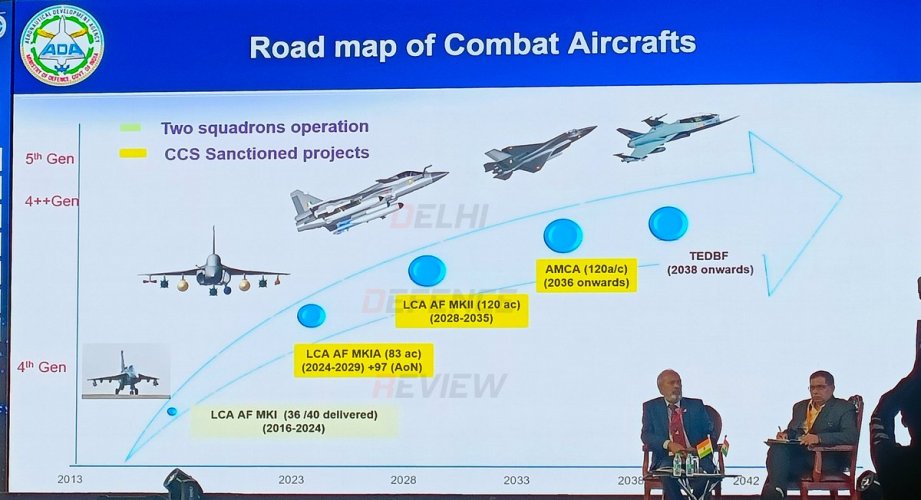
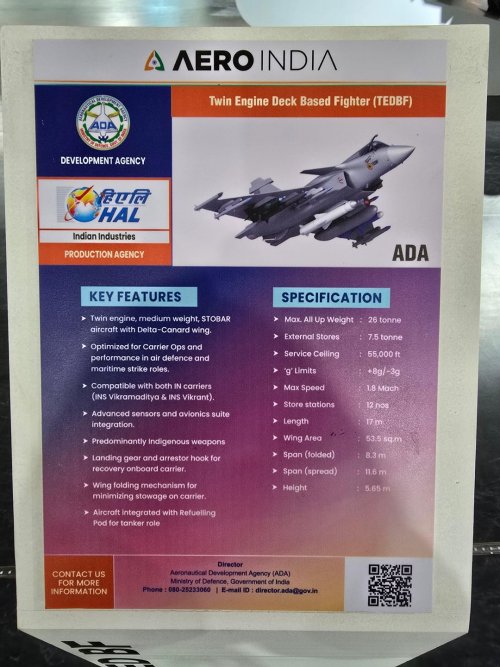
Good decision from Indian government i would say, Instead of getting non-stealth airframe based TEDBF from 2038 onwards( a -5 gen or -5.5gen jet in my words for simplicity), its much better to order more rafale-M's and then work on a stealthy carrier based fighter to be debuted in early-mid 2040's, well atleast hope to be debuted.

aero-india-2025-official-specs-on-amca-tejas-mk2-and-tedbf-v0-pzziyld60eie1.jpg
Basically looks like rafale with DSI, bigger nose tho.
 
Furthermore, if we consider that the downed Indian Rafale B was returning to its base and that the missile hit it from behind, the Rafale did not present its best RCS surface at that time.
I think it is unlikely that the Rafale was hit from the real, because of 2 reasons:
1- due to Doppler filter, retreating target are actually harder to detect/track compared to head on target
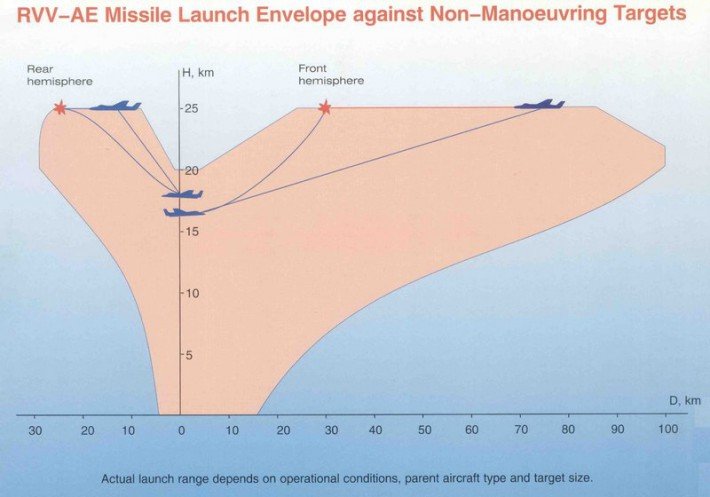
2- rear aspect shot is always much much shorter range compared to head on shot, because the missile have to catch up with the aircraft. A 200 km rear aspect shot is insane for something like PL-15.
Take for example, R-77 head on shot can reach 100 km but rear aspect shot is limited to around 30 km (or only 1/3 the range). If PL-15 can reach 200 km in rear aspect shot then its head on shot would be something like 600 km which honestly sound impossible, and if PL-15 can reach that distance, there would be no need for PL-17)
IMG_3718.jpeg

And the fact that it was shot down at this distance does not mean that it has a RCS greater than that of the F-16. Missiles are evolving and there were Pakistani electronic warfare Saabs in flight.
I also based on the exercrise between France Rafale and Greek F-16 block 52+. APG-68v9 (which is a relatively small mechanical scanned radar) were said to be able to detect Rafale from relatively long distance. If Rafale RCS were significantly better than F-16, I would expect it to dominate in BVR but it didn’t. And this was not even against F-16 block 60 with AESA
 
I think it is unlikely that the Rafale was hit from the real, because of 2 reasons:
1- due to Doppler filter, retreating target are actually harder to detect/track compared to head on target
2- rear aspect shot is always much much shorter range compared to head on shot, because the missile have to catch up with the aircraft. A 200 km rear aspect shot is insane for something like PL-15.
Take for example, R-77 head on shot can reach 100 km but rear aspect shot is limited to around 30 km (or only 1/3 the range). If PL-15 can reach 200 km in rear aspect shot then its head on shot would be something like 600 km which honestly sound impossible, and if PL-15 can reach that distance, there would be no need for PL-17)
View attachment 802171


I also based on the exercrise between France Rafale and Greek F-16 block 52+. APG-68v9 (which is a relatively small mechanical scanned radar) were said to be able to detect Rafale from relatively long distance. If Rafale RCS were significantly better than F-16, I would expect it to dominate in BVR but it didn’t. And this was not even against F-16 block 60 with AESA
The current arguments are all based on the assumption that this was *a relatively long-range A2A kill involving a PL-15 fired from a J-10*.


the reported location of the crashed Rafale is in the wheat fields of Akalia Kalan village near Bathinda, Punjab. That village is just a 20km (12.4 mile) drive from Bathinda Air Force Base, heading north from the base.

Air Force Station Bathinda is located approximately 224km from the Indo-Pakistan border.

The Rafale was most likely hit from behind at a much closer distance than people think. It definitely wasn't hit by an A2A PL-15, 200+km away from the border while flying right next to its own base. It seems the jet was barely in flying condition and managed to limp back toward the airbase, only to crash less than 20km away from the runway.
Whether it was an A2A or G2A kill is the question, but personally, I’m more of a believer that it was a G2A kill by an HQ-9 stationed in Lahore, Pakistan.

From Bhatinda to lahore is about ~250km from each other in north-west direction but only in a straight line.


While Pakistani J-10 are stationed in airforce base Kamra,Pakistan. Up north much closer to Kashmir, distance between kamra and Lahore is ~350-400km.
 
Last edited:
I think it is unlikely that the Rafale was hit from the real, because of 2 reasons:
1- due to Doppler filter, retreating target are actually harder to detect/track compared to head on target
2- rear aspect shot is always much much shorter range compared to head on shot, because the missile have to catch up with the aircraft. A 200 km rear aspect shot is insane for something like PL-15.
Take for example, R-77 head on shot can reach 100 km but rear aspect shot is limited to around 30 km (or only 1/3 the range). If PL-15 can reach 200 km in rear aspect shot then its head on shot would be something like 600 km which honestly sound impossible, and if PL-15 can reach that distance, there would be no need for PL-17)
View attachment 802171
If we combine your explanation with that of mokaete, the aircraft could therefore also have been hit from behind but closer to the border, only falling as it approached the base. Without further information, there is no possibility of judging.


I also based on the exercrise between France Rafale and Greek F-16 block 52+. APG-68v9 (which is a relatively small mechanical scanned radar) were said to be able to detect Rafale from relatively long distance. If Rafale RCS were significantly better than F-16, I would expect it to dominate in BVR but it didn’t. And this was not even against F-16 block 60 with AESA
Source ?
 
Last edited:
Here:
And also RBE2 is not even better than RDY-2 in term of detection range
 
Here:
And also RBE2 is not even better than RDY-2 in term of detection range
There is more to the effectiveness of a radar than just detection range though. The ability to withstand interference, ability to pick targets out from ground clutter, and how fast you can scan for targets are all important metrics.
 
Here:
And also RBE2 is not even better than RDY-2 in term of detection range
Also are you talking the pesa or aesa version of RBE2? The performance gap is quite big between them.
 
There is more to the effectiveness of a radar than just detection range though. The ability to withstand interference, ability to pick targets out from ground clutter, and how fast you can scan for targets are all important metrics.
Yes but you can have all of that along with good detection range
 
How much better the AESA RBE2 compared to PESA RBE2?
Btw in the second link, even the AESA RBE2 only closed the gap with RDY-2 and not surpased it
40%, it’s probably possible to calculate because peak power is listed at 9.6kw and we know tr module account from other sources


That extra 10 percent they are talking about would catch it up to apg-80

 
Iirc détection range increased about 50%

If you really think RDY-2 is better than RBE2-Aesa I have a bridge to sell you.
Well, I didn’t expect PESA RBE2 to be equal to APG-68v9 either but it was, so probably the issue is that Rafale nose is ways too small for an aircraft of that size and its RCS is not significantly smaller for an aircraft of that size.
Beside, despite being a mechanical array, Mirage radar is not bad either. I mean basic RDY could detect a target with RCS of 5 m2 from 70 nm (129 km) and RDY-2 was supposed to be 15% better than that, in short, it can detect the same target from 148 km.
 

Similar threads

Back
Top Bottom