Not 'battlecarrier' in the sense of putting heavy guns and a flight deck on the same ship, but in the sense of 'a heavily protected aircraft carrier'.

It's clearly not the same concept, but its' along the line of the 'ultracarrier' proposed in USNI Proceedings back in 1978:

ultracarrier3-jpg.446694


It was discussed on the forum back when Noah was a lad here.
I am also familiar with this deisgn. this is a quite completely different design, about twice as heavy; the 200,000 tonne ship is significantly less unwieldly. Note that this super-armored carrier has only 100 aircraft for air wing operations issues.

It's a semantic distinction, but Battlecarrier is usually used to refer to the Iowa refits with the harrier ski-jumps for the Marines.
 
Not 'battlecarrier' in the sense of putting heavy guns and a flight deck on the same ship, but in the sense of 'a heavily protected aircraft carrier'.
This was settled in 1945, there is no practical amount of armor able to stop a 1000lb shaped charge warhead.
 
this is a quite completely different design
Yes, that's why I said 'it's clearly not the same concept'. The point is that the dual flight deck has precedent.
It's a semantic distinction, but Battlecarrier is usually used to refer to the Iowa refits with the harrier ski-jumps for the Marines.
That concept significantly predates the 1980s, and just about everyone who studied it concluded it was an awful idea.

You can, though, find reference to the Midway class as 'battle carriers', and other similar concepts. Like many colloquial terms, it isn't really well defined.
This was settled in 1945, there is no practical amount of armor able to stop a 1000lb shaped charge warhead.
Which is why the post-1945 thoughts put more effort into designing the ship with defence in depth – redundant equipment, fragmentation bulkheads to confine damage, and so forth.

I don't believe it's a good concept, but it is a concept that's been pitched.
 
Not 'battlecarrier' in the sense of putting heavy guns and a flight deck on the same ship, but in the sense of 'a heavily protected aircraft carrier'.

It's clearly not the same concept, but its' along the line of the 'ultracarrier' proposed in USNI Proceedings back in 1978:

ultracarrier3-jpg.446694


It was discussed on the forum back when Noah was a lad here.
Am I seeing correctly that the Ultracarrier would had a CONAS powerplant?
Also any idea for armament?
 
Last edited:
This was settled in 1945, there is no practical amount of armor able to stop a 1000lb shaped charge warhead.

Air is armor when it comes to shaped charges.

I also don't see why you can't stop shaped charges if tanks were able to do it, and at much smaller masses than steel alone, tbh.
 
Which is why the post-1945 thoughts put more effort into designing the ship with defence in depth – redundant equipment, fragmentation bulkheads to confine damage, and so forth.

I don't believe it's a good concept, but it is a concept that's been pitched.
Ah, okay, I'm not the only one who thinks it's a fool's errand.


Air is armor when it comes to shaped charges.
That 1945 test traveled something like 32-40 feet and reached the equivalent of the magazine with enough energy to detonate 100lb aircraft bombs. Through the top of a turret.


I also don't see why you can't stop shaped charges if tanks were able to do it, and at much smaller masses than steel alone, tbh.
Composite armor is bulkier, and the best version of tank armor has a very heavy Depleted Uranium layer as well. Additionally, it's apparently a process with a high failure rate to pour silicate layers. Hence why the M60s did not have a silicate layer and instead just had two layers of steel with an air gap between them.
 
That 1945 test traveled something like 32-40 feet and reached the equivalent of the magazine with enough energy to detonate 100lb aircraft bombs. Through the top of a turret
And it needs to be point out that this bomb?

Was an unoptimized design with like 11 inches of Diameter to it with a pole through the center of it.

AKA the worse design you can do.

Which is to be expected of a 1940 era design.

A modern version?

Triple that distance from just using modern design techniques that the Army does.

For the same 11 inch diameter size warhead.

IE the Standard Harpoon size.

A Tomahawk warhead can fit a 20 inch diameter bomb for comparison.


And the Navy looked at doing this to Torpedoes and do so it to the 12 inch ASW ones like the MK54 for a fact, 21 inch MK48s are understandably hard to get information on. Will not surprise me if they do cause keel buster becomes unreliable on ships over 20k tons.

Eyeah...
 
That 1945 test traveled something like 32-40 feet and reached the equivalent of the magazine with enough energy to detonate 100lb aircraft bombs. Through the top of a turret.

Current IM munitions can resist direct shaped charge attack.

Composite armor is bulkier, and the best version of tank armor has a very heavy Depleted Uranium layer as well. Additionally, it's apparently a process with a high failure rate to pour silicate layers. Hence why the M60s did not have a silicate layer and instead just had two layers of steel with an air gap between them.

It doesn't need to keep the hollow charge out. It merely needs to degrade it to the point that the important part survives, whether that's a reactor, or a magazine, or whatever. It's not something the U.S. can do easily, but I'd suspect the Chinese might be integrating passive armor into their ships, at least in some form. They have the shipbuilding and design capacities and efficiency to experiment and do so.
 
Not 'battlecarrier' in the sense of putting heavy guns and a flight deck on the same ship, but in the sense of 'a heavily protected aircraft carrier'.

It's clearly not the same concept, but its' along the line of the 'ultracarrier' proposed in USNI Proceedings back in 1978:

ultracarrier3-jpg.446694


It was discussed on the forum back when Noah was a lad here.
When Noah was a lad, and when Pontius was a cadet at RAF Cranwell.
 
I kind of like the Aardvark from the video in post #129, but immediately recognize the missing angled deck. Cannot suddenly pivot on designs like that imho. His saying the so-called Aardvark was terrible without explaining much else was disappointing. Being able to catapult without interupting the upper deck is an advancement. Obviously the use of those side cats would be subjective to sea states.

Having coverings over the elevators is pretty nice in that design in post #130. But 5x the tonnage to get 50% more catapult is insane. It also sounds like there should be bridge space aft for aviators to line up on. If JPALS is down they need their visual marks. You would need to increase tonnage to a mere 50% increase to make it viable. But likewise, if you could squeeze a CVN down 50% and keep 50% sortie rate, you would seriously look at decreasing CVN size. But from the information out there, the current size is the optimal sweetspot.
 
Last edited:
terrible without explaining much else was disappointing
Couple major issues they discovered:
Aardvark is just terrible for deck operations, recovery in particular. Cycle rates are entirely reliant on getting aircraft onto elevators, down to the hangar deck, and the elevators returned to the recovery deck. If there are any stumbles (such as an aircraft launching on either cat preventing the elevator from moving aircraft down) means that aircraft in the holding pattern have to wait even longer.
On top of that the stealth panels to reduce launching aircraft RCS are horrible on deck crew. A carrier deck is loud, now try having that noise reflected back inside the hangar and reverberating around the deck. Your hearing loss will be unequivocally service related!
This is before we account for the lack of deck park, more difficult arming processes, etc.
Definitely a cool looking design and quite interesting but at the end of the day a lot more development is needed before a true "stealth" aircraft carrier. There are even rumors that the (ideal) redesigned Ford will deprioritize RCS reduction features as they have negligible benefits
But likewise, if you could squeeze a CVN down 50% and keep 50% sortie rate, you would seriously look at decreasing CVN size. But from the information out there, the current size is the optimal sweetspot.
CVN design (and CV design in general) benefits size. You can increase magazine capacity, maintain aircraft more easily, and deck operations become easier. This is why the QEs are better than other carriers operated by European navies; they have the requisite bulk for optimal operations, even if they are STOVL carriers. If you were to get the "best" design it would be larger again. The main restriction at this point is shipyard infrastructure.
It's also far better from an economic standpoint, iirc it was just an 8% reduction in cost from the 80 aircraft airwing studied in CVX to the 60 aircraft airwing.

 
Aardvark is [...] Definitely a cool looking design and quite interesting but at the end of the day a lot more development is needed before a true "stealth" aircraft carrier. There are even rumors that the (ideal) redesigned Ford will deprioritize RCS reduction features as they have negligible benefits
The Aardvark would definitely show up in an Ace Combat game or a scifi movie.


CVN design (and CV design in general) benefits size. You can increase magazine capacity, maintain aircraft more easily, and deck operations become easier. This is why the QEs are better than other carriers operated by European navies; they have the requisite bulk for optimal operations, even if they are STOVL carriers. If you were to get the "best" design it would be larger again. The main restriction at this point is shipyard infrastructure.
It's also far better from an economic standpoint, iirc it was just an 8% reduction in cost from the 80 aircraft airwing studied in CVX to the 60 aircraft airwing.
They do seem to reach a plateau at about 1100ft long, though. Even the Chinese Type 004 CVN seems to be aiming for roughly that size.
 
Even the Chinese Type 004 CVN seems to be aiming for roughly that size.
But why? USN carrier designs have historically been limited by shipyard size, not by diminishing capability returns. I’d wager that, if a bigger dock became available, China would build something even larger again. You can up aircraft stores, ease aircraft operations, and even expand airwing size (although that is a secondary concern compared to the first two)
 
I can remember Popular Science (or was it Popular Mechanics) magazines regularly reviving the idea of papercrete and aerated concrete floating mobile bases being towed around as floating islands with 2500 foot runways. Seems the chinese would have done that by now if the math worked out. I cannot imagine the mass makes sea state 5 and above any less traumatic on a sailor. I'm pretty sure the idea came out of the book 1984.
 
I’d wager that, if a bigger dock became available, China would build something even larger again. You can up aircraft stores, ease aircraft operations, and even expand airwing size (although that is a secondary concern compared to the first two)
Or alternatively maintain airwing size with individually larger, more capable aircraft, for example long range 6th generation fighters.
 
I can remember Popular Science (or was it Popular Mechanics) magazines regularly reviving the idea of papercrete and aerated concrete floating mobile bases being towed around as floating islands with 2500 foot runways. Seems the chinese would have done that by now if the math worked out. I cannot imagine the mass makes sea state 5 and above any less traumatic on a sailor. I'm pretty sure the idea came out of the book 1984.
Check out the thread below:

https://www.secretprojects.co.uk/threads/us-navy-usmc-us-army-sea-basing-concepts.10177/

JMOB is not designed for traditional aircraft carrier operations, it is a floating airbase more similar to Bagram than a Nimitz. The concept fills an entirely different niche (check out the CONOPS outlined in my post) and is reliant on complex, and ultimately unrealistic geopolitical happenings to make sense.

Larger SWATH carriers do indeed make sense from a capability standpoint but the cost of building all new infrastructure does not
 
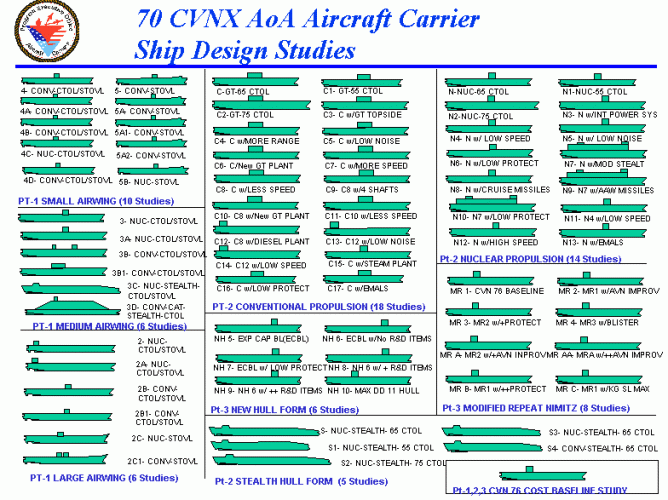
Since the CVX pages at the Navsea web site are gone and the CVX section at the FAS web site appears to be abandoned, I thought that I had better back up the CVX design concepts while I could.

Artist's impression of Study 2A (Study 2-Alt FLT DK) for nuclear-powered large air wing
(80 aircraft) CTOL (Conventional Take Off and Landing) aircraft carrier.

Source: http://www.fas.org/man//dod-101/sys/ship/docs/cvx-alt/index.html
I woiuld be interested to know the length, beam and draught for the CVX study 2A.
 

Similar threads

Back
Top Bottom