- Joined
- 3 June 2011
- Messages
- 20,908
- Reaction score
- 19,103
"Don't trust my lyin' eyes", eh?With due respect, you have not a bloody clue what you're talking about.


"Don't trust my lyin' eyes", eh?With due respect, you have not a bloody clue what you're talking about.
Yep.Wow, the Ohio Class relies purely on other means to reduce noise and detectability to sonar? I always thought it also used anechoic tiles/coating. What was the first USN sub to introduce the tech?
Well, look at the difference between submerged and surfaced displacement. An Ohio only takes on like 1200 tons of water!That the Ohio-class SSGNs (which operate in areas where active sonar would be a more considerable concern than for an SSBN) remain uncoated suggests to me that the class may not have the weight/stability margins to install a hull coating.

Decoupling works both ways. While originating around the Active threat, modern coatings do help with radiated noise.Anechoic coatings are there for active sonar damping, not really for internal self-noise
Correct, they do.Decoupling works both ways. While originating around the Active threat, modern coatings do help with radiated noise.
ALso not getting hit with the magnet flappers that NATO fucked around with in the... 70s?Correct, they do.
But the biggest part of the stealth of a sub is internal systems, not slapping anechoic tiles on the outside.

Hahah, SCAT!ALso not getting hit with the magnet flappers that NATO fucked around with in the... 70s?

Rickover said electric drives beat raftingCorrect, they do.
But the biggest part of the stealth of a sub is internal systems, not slapping anechoic tiles on the outside.

He said no such thing. Rickover was only really interesting in quieting when it aligned with his other priorities (creating new reactor plants, simplifying them, making them more reliable, etc.).Rickover said electric drives beat rafting
Bullshit he didn’t support nuclear-electric drive.He said no such thing. Rickover was only really interesting in quieting when it aligned with his other priorities (creating new reactor plants, simplifying them, making them more reliable, etc.).
Besides, an electric drive submarine also needs sound-isolation. Even if the motor is not resiliently mounted, the turbine generators will be.
That's quite incorrect: Rickover was responsible for the world's first turboelectric submarine, the Tullibee. He also lobbied congress to fund his Turboelectric Drive Submarine (TEDS), which became the Glenard P. Lipscomb. Rickover was very familiar with turboelectric drive because he had a Master's in electrical engineering and had a lot of experience with the turboelectric battleship propulsion plants when he headed the Electrical Section of the Bureau of Ships during WWII.He didn’t support nuclear-electric drive.
Yet both Tullibee and Glenard P were terrible. horribly slow compared to their steam turbine counterparts.That's quite rude and quite incorrect: Rickover was responsible for the world's first turboelectric submarine, the Tullibee. He also lobbied congress to fund his Turboelectric Drive Submarine (TEDS), which became the Glenard P. Lipscomb. Rickover was very familiar with turboelectric drive because he had a Master's in electrical engineering and had a lot of experience with the turboelectric battleship propulsion plants when he headed the Electrical Section of the Bureau of Ships during WWII.
You still gotta raft the electric motor, motor controller, and the turbine generators. All separately.Rickover said electric drives beat rafting
Remember that the counterpart to the Tullibee was not a nuclear submarine, but a diesel SSK. She could make 16 knots on 2,500 SHP, compared with about double the power required to propel a GUPPY or Tang to that speed (of course achievable only at the one-hour rate). She was exceptionally quiet and by all accounts was an excellent ASW and sonar test platform.Yet both Tullibee and Glenard P were terrible. horribly slow compared to their steam turbine counterparts.
My post was misunderstood. It’s bullshit that Rickover did not believe that nuclear electrica superior way to quiet than rafting.That's quite rude and quite incorrect: Rickover was responsible for the world's first turboelectric submarine, the Tullibee. He also lobbied congress to fund his Turboelectric Drive Submarine (TEDS), which became the Glenard P. Lipscomb. Rickover was very familiar with turboelectric drive because he had a Master's in electrical engineering and had a lot of experience with the turboelectric battleship propulsion plants when he headed the Electrical Section of the Bureau of Ships during WWII.
True but he believed according to books around here that nuclear electric was better than rafting aloneYou still gotta raft the electric motor, motor controller, and the turbine generators. All separately.
Bibliography, please? (not trying to be confrontational)True but he believed according to books around here that nuclear electric was better than rafting alone
She had hideous reliability, and was sarcastically referred to as "Building 597" at Groton due to how little she deployed. "Welded to the pier" was another description.Remember that the counterpart to the Tullibee was not a nuclear submarine, but a diesel SSK. She could make 16 knots on 2,500 SHP, compared with about double the power required to propel a GUPPY or Tang to that speed (of course achievable only at the one-hour rate). She was exceptionally quiet and by all accounts was an excellent ASW and sonar test platform.
Many of Rickover's one-off prototypes had similar problems, so I wouldn't read too much into that.Oops, missed this.
She had hideous reliability, and was sarcastically referred to as "Building 597" at Groton due to how little she deployed. "Welded to the pier" was another description.
For the 1960s-era Lipscomb, but certainly in recent decades lack of efficiency much less of a concern. They don't even use motor-generators anymore; everything is solid-state. You may find this article interesting: https://onlinelibrary.wiley.com/doi/abs/10.1111/j.1559-3584.1994.tb02824.xGlennard P showed that you needed a reactor plant designed around turbo-electric drive, backfitting it to an existing plant left you slow. turbo-electric drive is about 80% efficient in turning steam into shaft RPM, while turbines and gears are better than that.
Isn't this an argument in favor of eliminating reduction gears and replacing them with direct drive electric propulsion?In all honesty, the best sub of the 1960s or 70s was the Narwhal, with that crazy multimultistage single main engine directly driving the screw at up to ~350rpm. Reduction gears are the single greatest source of ship noise, as they're directly connected to the shaft and screw that go into the water.
Wow, that was a very fascinating study to read, thank you for linking to it!Many of Rickover's one-off prototypes had similar problems, so I wouldn't read too much into that.
For the 1960s-era Lipscomb, but certainly in recent decades lack of efficiency much less of a concern. They don't even use motor-generators anymore; everything is solid-state. You may find this article interesting: https://onlinelibrary.wiley.com/doi/abs/10.1111/j.1559-3584.1994.tb02824.x
See Friedman books on Subs. US and British.Bibliography, please? (not trying to be confrontational)
Glennard P showed that you needed a reactor plant designed around turbo-electric drive, backfitting it to an existing plant left you slow. turbo-electric drive is about 80% efficient in turning steam into shaft RPM, while turbines and gears are better than that.
In all honesty, the best sub of the 1960s or 70s was the Narwhal, with that crazy multimultistage single main engine directly driving the screw at up to ~350rpm. Reduction gears are the single greatest source of ship noise, as they're directly connected to the shaft and screw that go into the water.
Yes, now that the US can make a 65,000hp electric motor!Isn't this an argument in favor of eliminating reduction gears and replacing them with direct drive electric propulsion?
“Now leaving the 19th century.”Yes, now that the US can make a 65,000hp electric motor!
Very welcome.Thank you!
Yes, rafting is a serious pain. You can "short" a sound mount just by accidentally slopping paint onto the rubber instead of just the metal parts!
If it ain't broke, don't fix it. Though point of order, the style of reduction gears that the USN uses was invented in the 1920s. So only leaving the 20th Century ~50 years late.“Now leaving the 19th century.”
Is is this one?Yes, now that the US can make a 65,000hp electric motor!
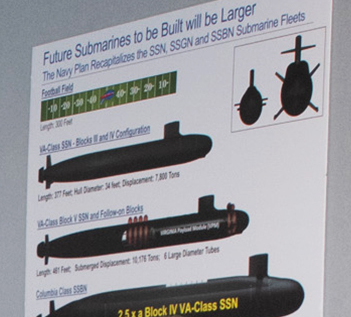
Come on, something a little more original than just a bigger VA for SSNX. Yeesh
The poster doesn't have anything to do with SSN(X).Come on, something a little more original than just a bigger VA for SSNX. Yeesh
HopefullyThe poster doesn't have anything to do with SSN(X).

The first Columbia-class submarine is approximately 65 percent complete and is expected for delivery in 2028.
https://breakingdefense.com/2026/02...-see-construction-ramp-up-navy-official-says/“On the lead ship, the District of Columbia, she is about 65, 66 percent complete,”
Good, they're finally getting the employee numbers up.Columbia-class submarines see construction ‘ramp up’, Navy official says
That's somewhat misleading as the SSN production rate is still stuck at ~1.3-1.4 hulls/year. So mathematically speaking some years they commission 1 SSN and some years 2 SSNs.they're accomplishing this ramp-up while also commissioning 2 Block IV SSNs this year
Deliveries will be the lagging indicator. The ramp up is visible in the increased workforce and increased output. Producing 2 Block V boats with VPM and 1 SSBN a year is about equivalent to producing 5 Block IVs. It's not going to happen overnight, but they're heading there.That's somewhat misleading as the SSN production rate is still stuck at ~1.3-1.4 hulls/year. So mathematically speaking some years they commission 1 SSN and some years 2 SSNs.
There is no discernable ramp-up in deliveries expected until ~2031+, which is their target date to hit ~2 SSNs/year. That plan is based on the hope that after the learning curve of the first 2-3 Virginia Block Vs with VPM they will find efficiencies that will allow them to build the larger Block Vs with VPM as fast as the current Block IVs... which might be a tad optimistic.

That would put roughly 3 more boats at sea at any given time.