There are lots of general layout similarities with the raider, of course, but let's look at the differences :
Pusher prop on Chinese craft has 7 blades. Raider's has 6.
Exhaust is simpler, seems to have mid tail left and right pointing exhausts. Raider has a upward pointing exhaust at the end of the tail. ?
Chinese help seems a bit more front heavy, as its rotor is a bit more forwrad than raider's.
Front landing gear on raider is more forward of the rotor. On Chinese helo it is closer to its rotor.
Rear vertical tails protrude more downward on raider. While Chinese helo has them going more upwards.
Chinese helo is generally more like an early concept demostrator, with less refined details. Extra support struts on the horizontal tail. More basic looking landing gear and so on.
 
So the chinese were telling everyone what they were doing, but no one paid attention. Any illustration as to what the final military tilt rotor product product is supposed to look like? The hints i've read is after the flights of these demonstrators which probably happened as early as last year, operational models should follow "soon".

PS: Huitong says the HSH flew as early as 12/23. And found this image of what the operational products are expected to look like.
View attachment 782288
Those are the V-280 and S-97.
 
Last edited:
All I can do is shrug again:)no surprise, the same old story just keeps replaying
 
All I can do is shrug again:)no surprise, the same old story just keeps replaying
If the same story hold true. Once they are comfortable with these technology then the fun begin. I suspect that will be when they start making their own contribution to these type of aircraft.
 
If the same story hold true. Once they are comfortable with these technology then the fun begin. I suspect that will be when they start making their own contribution to these type of aircraft.
Bats can fly, but they’ll never be birds. Over the past 30 years, China has leaned on Soviet tech transfers, Western dual-use imports, and some gray-area military deals to produce a whole range of weapons that look pretty “advanced.” Military aviation is probably the clearest example.

The pattern is always the same: on the outside, these systems resemble certain Western models. But look closer, and you’ll see major gaps in design quality, materials, engines, electronics, reliability, durability, and maintenance costs. This isn’t just coincidence—it’s the product of China’s military research system. Design bureaus survive on government funding and leaders’ trust, so to prove their worth, they keep a close eye on Western developments, borrow from those pioneers’ work, and then propose something similar.

There are clear upsides to this. Technically, it keeps costs down and helps avoid a lot of mistakes. Politically, it’s easy to pitch: “We can build things just as advanced as the Americans,” or “If they have it, we need it too—otherwise we can’t counter their threat.” But limited by their own capabilities, the end result usually turns out to be a kind of “monkey models” ,sometimes even worse.
 
Bats can fly, but they’ll never be birds. Over the past 30 years, China has leaned on Soviet tech transfers, Western dual-use imports, and some gray-area military deals to produce a whole range of weapons that look pretty “advanced.” Military aviation is probably the clearest example.

The pattern is always the same: on the outside, these systems resemble certain Western models. But look closer, and you’ll see major gaps in design quality, materials, engines, electronics, reliability, durability, and maintenance costs. This isn’t just coincidence—it’s the product of China’s military research system. Design bureaus survive on government funding and leaders’ trust, so to prove their worth, they keep a close eye on Western developments, borrow from those pioneers’ work, and then propose something similar.

There are clear upsides to this. Technically, it keeps costs down and helps avoid a lot of mistakes. Politically, it’s easy to pitch: “We can build things just as advanced as the Americans,” or “If they have it, we need it too—otherwise we can’t counter their threat.” But limited by their own capabilities, the end result usually turns out to be a kind of “monkey models” ,sometimes even worse.
I'm sorry you are either extremely ignorant on Chinese industries or you are one of those who are unable to accept the Chinese as anything but idiots who can't innovate.

Also do you even have anything to even back half the stuff you are claiming. I'm actually so curious where do you see the lack in quality? Chinese electronics are world class and have world leading telecommunications systems while they could produce CF up to T1100 level and are working on T1200 class. Mantaince cost and reliability are not public data so you legit just pulled that out of nowhere.
 
The pattern is always the same: on the outside, these systems resemble certain Western models. But look closer, and you’ll see major gaps in design quality, materials, engines, electronics, reliability, durability, and maintenance costs. This isn’t just coincidence—it’s the product of China’s military research system. Design bureaus survive on government funding and leaders’ trust, so to prove their worth, they keep a close eye on Western developments, borrow from those pioneers’ work, and then propose something similar.
What the hell are you talking about? Show me please tri-jet Western steatlh fighter, like the one Chinese demonstrated.
 
The history that PRC has of 'acquiring' technology from around the world can be difficult to get past. Looking at the tech around cars and you will see that 'getting past that view' is the only way to take seriously the challenge the PRC IS and do something about meeting that challenge.
Being a dinosaur or a tall flightless bird is not going to get anyone anywhere.
 
What the hell are you talking about? Show me please tri-jet Western steatlh fighter, like the one Chinese demonstrated.
This is a fun topic, so I think it’s worth jumping in. First off, that “monster” has nothing to do with sixth-gen fighters. To me, it’s basically just a bomber meant to hit U.S. carrier groups and bases from beyond the first island chain—a pretty clumsy answer to the B-21.

Honestly, I was kind of happy when I saw this plane. It shows that the post–Cold War “tech dividend” is pretty much used up. Three engines, a huge intake on the back—these conflicting design choices are a sign of limited tech, where they’ve had to give up the best solutions just to meet strategic needs. The Soviets went through this kind of thing over and over.

The J-20 is without question the closest China’s aviation industry has gotten to world class. But from here, the gap is only going to grow wider, a replay of the Soviet story.
 
@linbug in my eyes it's kinda disingenuous to make such claims. The chinese are running circles around anyone with regards to battery technology, UAV development, they are arguably leading the missile race, with only the Russians fielding comparable systems while the US and EU are stuck in the 1990s for whatever reason with regards to their thinking.

But the topic at hand is rotorcraft (or VTOLs). And yes, Chinese rotorcraft development leaned heavily on European designs (Z-8/18), Russian assistance (Z-10) or US bought designs (Z-20). However each of these examples became it's own distinct thing in the end. The Z-8L has nothing in common with the Super Frelon, the Z-10 evolved past it's Kamov assisted roots and the Z-20 may superficially look like a UH-60, it's internally not only full with domestic Chinese systems, it's arguably more modern too. Rotorcraft are rather complex machines and globally there are only a handful of established players who can deliver military grade rotorcraft. The Chinese moved from license production and assistance to essentially completely different and bespoke models in a mind boggling pace. No matter how you try to cut it, you can't belittle such progress.

Coaxials and Tiltrotors are novel pieces of tech, but let's not pretend like the US patented and is synonymous with coaxials.

Just look at that Raider, with its coaxial rotor, it's side-by-side seating and control surfaces at it's tail, phew, clearly a knock off of the Kamov helicopters. I bet it's all plastic inside

(sarcasm off)

It's quite honestly more surprising that it took China this long to look into tiltrotors, which have plenty of use cases for their military needs. To be fair though the Osprey might have served as something of scarecrow for that concept. While coaxials are something where both the US and China are late to the party.

Also, people moved past calling the J-36 a bomber within approximately two weeks after it's arrival, don't hold on to it.
 
Last edited:
This is a fun topic, so I think it’s worth jumping in. First off, that “monster” has nothing to do with sixth-gen fighters. To me, it’s basically just a bomber meant to hit U.S. carrier groups and bases from beyond the first island chain—a pretty clumsy answer to the B-21.

Honestly, I was kind of happy when I saw this plane. It shows that the post–Cold War “tech dividend” is pretty much used up. Three engines, a huge intake on the back—these conflicting design choices are a sign of limited tech, where they’ve had to give up the best solutions just to meet strategic needs. The Soviets went through this kind of thing over and over.

The J-20 is without question the closest China’s aviation industry has gotten to world class. But from here, the gap is only going to grow wider, a replay of the Soviet story.
If that's your opinion on the J-36. What about the "J-50" that was spotted? Twin engine heavy fighter, cranked lambda wing, all moving wingtips. Are there signs of limited tech in this example?
 
We in the west should remember that much of our rocket, missile and jet aircraft initial development came from "our" German scientist. The first US ballistic missile was a V2. Probably much the same for Russia. I am sure there are some here who can enumerate any number of historical examples of countries having started a capability from what they observed from other countries.

Verbal badminton has yet to do much more here than, at best, take up space, at worst, people get banned.

My 2 cents.
 
Last edited:
More likely the gap becoming wider in coming years as PRC. pulls ahead of the west technologically

However back on topic, it should be Interesting to see what new Chinese VTOL. aircraft and rotorcraft emerge over the next year or so and which are developed into service types (will we
we see an F-35B equivalent ?)
 
@TsrJoe - Agree but given the number of programs they have already begun, I might expect to see a VTOL version of one of the fighters tested, more so than yet other new start aircraft. Then again there is always fan-in-wing and ducted fan yet to appear.
 
The noise around the chinese STOVL fighter intensifies again. This was posted on SDF, from a chinese poster/insider via 00CuriousObserver.
The STOVL aircraft has folding wings.

That tells us quite a lot.

Under the JSF A/B/C model, the B variant’s overall dimensions are necessarily the same as the A variant’s. It has no folding wings, and its wingspan is not large enough, which means somewhat less lift during takeoff and therefore limits its maximum takeoff weight.

Ours has folding wings, which indicates that it should generate more lift during takeoff and therefore be able to carry more fuel and ordnance.

This also fits its status as an independent aircraft design, rather than something confined within the JSF framework.

The STOVL aircraft now has official status.

[doge] Indeed. Look at the F-35B more often and get used to its appearance in advance. [laughing through tears] [laughing through tears]

[picture of F-35B]

[someone asks “Other than the wings, is everything else the same?”]

More or less.

The big yellow T was not painted on Little Six [076]. That means the opposite is true: for now, the drone really does have nothing to do with the big yellow T. If it had been painted on, that might actually have been strange, since that thing simply is not needed yet.

Where and when the big yellow T appeared was ultimately for something else. Even I did not expect it to happen this quickly...

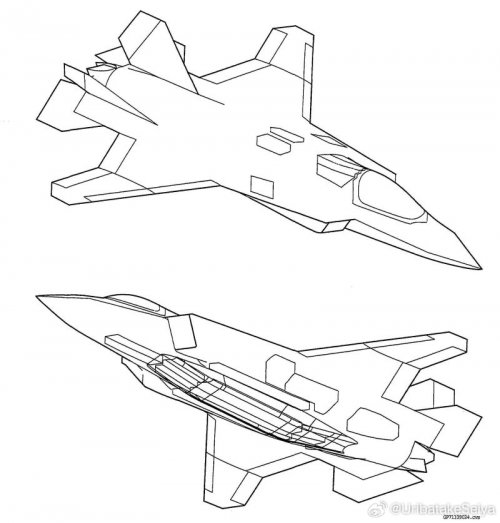
In addition, this drawing was posted by hkvaryag, but i'm not sure yet if it's actually a western project (reminds me of the McDD JSF) or an actual speculative depiction of the chinese STOVL fighter?
PS: Found the answer to the last question, it is indeed a McDD JSF project.
 

Attachments

  • 007SfbzCgy1ifqq3xuu5hj30m80n8whx.jpg
    007SfbzCgy1ifqq3xuu5hj30m80n8whx.jpg
    133.9 KB · Views: 78
The noise around the chinese STOVL fighter intensifies again. This was posted on SDF, from a chinese poster/insider via 00CuriousObserver.


In addition, this drawing was posted by hkvaryag, but i'm not sure yet if it's actually a western project (reminds me of the McDD JSF) or an actual speculative depiction of the chinese STOVL fighter?
PS: Found the answer to the last question, it is indeed a McDD JSF project.
So basically it’ll look like a F-35B with extra steps. Wonderful, don’t understand the point of the McDD JSF photo concept.
 
The noise around the chinese STOVL fighter intensifies again. This was posted on SDF, from a chinese poster/insider via 00CuriousObserver.


In addition, this drawing was posted by hkvaryag, but i'm not sure yet if it's actually a western project (reminds me of the McDD JSF) or an actual speculative depiction of the chinese STOVL fighter?
PS: Found the answer to the last question, it is indeed a McDD JSF project.
Decided to go with the N/McDD/BAE variant, eh?
 
Last edited:
The McDD JSF design still has bottom weapons bay. If it's side weapons bay then it may look like X-32? But with a lift fan.?
The Chinese poster also said it looks basically the same as F-35B except the wings.. So? F-35B with extra steps..
 
Last edited:
I suspect it's just going to look like a fat F-35 like fuselage with a naval J-35 like folding wing and tail surfaces or possibly lambda wing like on J-XDS. Given the contractor is allegedly SAC, they should have plenty of experience with lambda wings with their 6th gen project.

Anyhow from current available info, this new jet is going to be more X-32/35 like demonstrator instead of a full prototype. It's also going to be a dedicated design for STOVL operations unlike JSF. IMO, it may be a dedicated STOVL stealthy striker designed to launch off LHD/LHAs instead of a full fighter and hence may possibly be designated with the prefix "JH" for fighter bomber or "Q" for attacker.
 
Interesting to see that the contractor for the STOVL aircraft is alleged to be SAC Tomboy, though it will be interesting to see if that is true and whether any proof of the matter is going to be revealed anytime soon.
 
Interesting to see that the contractor for the STOVL aircraft is alleged to be SAC Tomboy, though it will be interesting to see if that is true and whether any proof of the matter is going to be revealed anytime soon.
Though strangely enough all tenders I could find goes back to Guizhou instead of Shenyang, plausibly meaning GAIC might in fact be the manufacturer. Given GAIC's most recent big thing was basically just license manufacturing export J-10Cs and the last thing they've designed was the JL-9 which was a J-7 mod, IMO it could be another case of GJ-11 where the design was contracted to somewhere else (AFAIK in this case SAC).

It could also be fully designed by GAIC given that China has been trying to get smaller firms up to standard with modern combat aircraft, similar thing has happened with Hongdu recently with their new JL-XX LIFT trainer but a naval stealthy jump jet seems like an extremely difficult task for a firm who has no experience with stealthy manned aircraft and who's last project was the conservative JL-9.
 
They finally get the download from RR?
There's really only 2 ways to assemble a counter-rotating fan with a 90deg drive input, and the only question is whether that input goes in between the two fans or puts both fans on one side. I think your overall fan efficiency is better if you put the two fans close together.

Or were you referring to fan blade shape?
 
There's really only 2 ways to assemble a counter-rotating fan with a 90deg drive input, and the only question is whether that input goes in between the two fans or puts both fans on one side. I think your overall fan efficiency is better if you put the two fans close together.

Or were you referring to fan blade shape?
Referring to the mode of VTOL of which there are many. But only one that uses a shaft-driven lift fan, patented by Lockheed Martin. I'd be more impressed if they'd come up with something original that was better.
 
Referring to the mode of VTOL of which there are many. But only one that uses a shaft-driven lift fan, patented by Lockheed Martin. I'd be more impressed if they'd come up with something original that was better.
It's the best known way to get a working VTOL... And a first ever Chinese VTOL is not the right moment to start inventing...

Given what @Tomboy just wrote, China is right in the process of getting back 4 fighter factories (with GAC making a borderline fighter LIFT, and here GAIC working with SAC to get a 5th generation VTOL). GAIC(Guizhou) is not exactly a leading aircraft manufacturer in China (JJ-9; WZ-7), so it's probably a bit foolish for them to go elegant. Being too elegant (i.e. risky/expensive/protracted) is what killed the original VTOL makers (British, and then Soviets), after all.

On a grand scheme of things, PLAN Navy's amphibious capability is on a trajectory to match - or exceed - USN(USMC) within one decade from now. That's where the "better" part will be.
 
Last edited:
They don't need to reinvent the lift fan however they are in a unique position in that they "could" operate it off all 3 carrier variants ( Ski-jump, LHD EMALS, 004 Carrier EMALS )

Wouldn't that be something? Would allow it to launch with greater fuel from the EMALS LHD, burn off the fuel for a VTOL recovery and still be able to inter operate with all the other carriers.
 
Referring to the mode of VTOL of which there are many. But only one that uses a shaft-driven lift fan, patented by Lockheed Martin. I'd be more impressed if they'd come up with something original that was better.
Huh? The only alternative is bleed air driven fan and we all know the JSF downselect made the SDLF king.

But if LM actually got a bunch of key docs leaked then that's pretty much insanity.
 
Another interesting aspect is size.

China doesn't have F135. And while it's likely possible/beneficial to make a higher bypass/higher thrust, is there a point in making an aircraft in exact same class as J-35?

If it isn't enforced by unification, can it be not just a larger wing, but also somewhat lighter?


P.s. ironic how little interest a literal vtol 5.5ish gen aircraft generates. Chinese 5th gen fighter overcapacity, soon on your market!
 
Last edited:
Chinese 5th gen fighter overcapacity, soon on your market!
Not to mention their J-10-sized, tailless, lambda/trapezoidal-winged, fighter-esque UADFs powered by WS-10C/C2s...

Acc. to Guancha (the only private media company in China that can get news from within the military), the PLAAF has flown 1 J-20 coupled with numerous simple UADFs ("CCA"s in American terms) against 2 J-20s multiple times. Each time, the 2 J-20s won.

Therefore, they don't believe that something like a simple CCA is effective in air-to-air missions. If it's going to be simple, it should be expendable. If it's not that simple, it should be equivalent to nearly a 5th generation or even a bit ahead, like a 6th generation jet. Their views are this:

UADF.jpg
CCA9.jpg
 
Another interesting aspect is size.

China doesn't have F135. And while it's likely possible/beneficial to make a higher bypass/higher thrust, is there a point in making an aircraft in exact same class as J-35?

If it isn't enforced by unification, can it be not just a larger wing, but also somewhat lighter?


P.s. ironic how little interest a literal vtol 5.5ish gen aircraft generates. Chinese 5th gen fighter overcapacity, soon on your market!
They built an entirely new engine based on the WS-15 core for this, it'll probably be F-135 class if not a bit larger and higher thrust to meet their requirement.
 
They built an entirely new engine based on the WS-15 core for this, it'll probably be F-135 class if not a bit larger and higher thrust to meet their requirement.
Also from AEC 606th i'd presume? Or Guizhou?
 

Similar threads

Back
Top Bottom