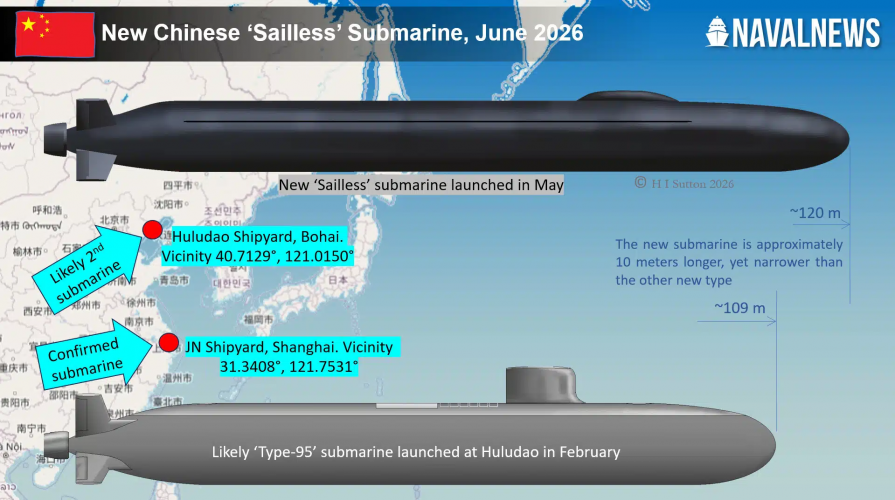
It took the Soviets quite a while to catch up on quieting. It is an extremely difficult engineering problem that required billions in investment and several decades to perfect. The Chinese Navy has been far, far slower than the Soviet Navy in designing and building submarines.
I treat this topic with a bit of caution and reservation in general, but one could also argue that it has actually been over a couple decades since the original pair of 09IIIs were built in the late 90s, the arguably the PRC has seen a much greater rate of advancement of industry, technology (not to mention finances) than what the Soviets had done in the middle to late Cold War, relative to its leading competitors --- and they had also produced small batch runs (2-3) of 09IIIA iterations in the 2010s (as well as their 09IV SSBNs), which would fit the pattern of iterative improvement and small batch production of classes/hulls which they know are needed to verify new technologies or subsystems but which they know within an individual boat itself is not yet competitive (thus not worth mass producing).
We saw that with their destroyer production/development between 051B/052, 052B, 052C, 051C, to an extent, before they were comfortable with 052D doing serial production fairly off the bat.
Of course, the very opaque nature of submarines and PLAN nuclear submarines in particular mean we don't really know what the actual rate of R&D and applied development/systems development has been, and we also don't know the extent of modifications and improvements that 09IIIA subvariants had based on a handful of external images.
However I do think just as the most technically correct answer is "we don't know" if we talk about the actual capabilities inside a 09V or 09IIIB are, we should also be saying "we don't know" in terms of what the rate of advancement of requisite technologies, subsystems, and upstream relevant industries are (as well as what the nature of 09IIIA subvariant improvements have been).
I would not assume that just because a submarine has turboelectric drive or a larger pressure hull, it will be quieter. Propulsion machinery is not even necessarily the primary acoustic vulnerability of nuclear submarine; often auxiliaries are. Also, contrary to popular belief, electric motors and generators are very much not inherently silent and need to be specially designed to be low-noise. Sound-isolation is so much more than just having more space to do it. The Virginia was able to match the quieting of the Seawolf with a beam six feet narrower.
I agree with this -- imo (and I direct this to
@Tomboy), the biggest way of thinking about how much much "potential" improvement in acoustic silencing 09V (and 09IIIB) may have, is not due to some single system or characteristic, but the totality of the industry and technology providing all of the subsystems to the boat and the wisdom of the sound isolating design (and sophistication of those sound mitigating features).
Something like pressure hull size is important, but it's what you do inside to use that potential which matters.