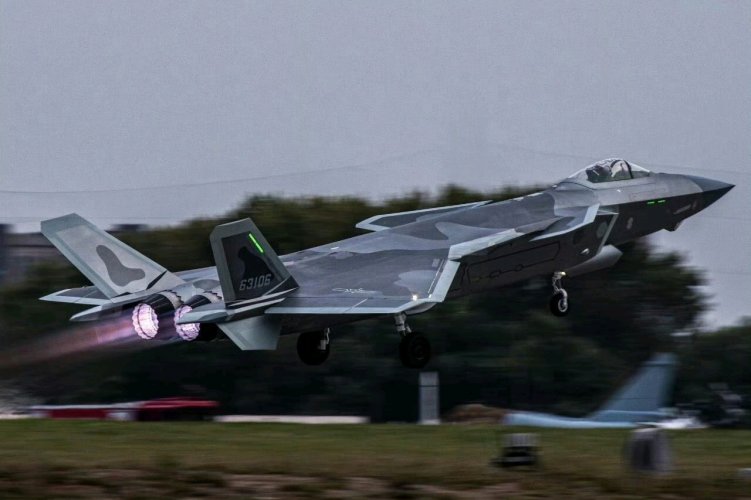
What a baffling string of words. Again, I cannot, in good conscience, believe you as an actual human being.

The fact that the government has never officially disclosed the performance figures for the WS-10 does not mean those numbers do not exist.
The thrust figures obviously exist. Nobody denied that lmao. But they certainly aren't publically revealed, and you quite literally made everything up.

Given that both are derived from the CFM-56 core, are we to believe that China's WS-10 can somehow outperform America's F110?
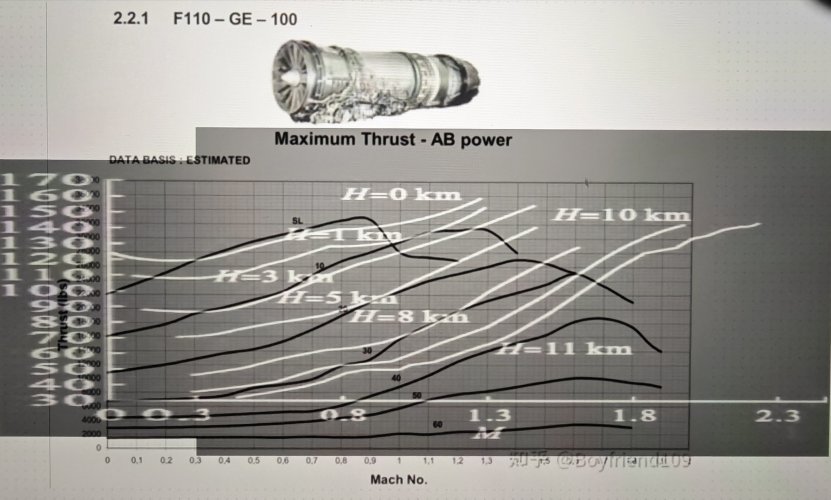
Except that's not true. The F110 is not derived from the CFM56 but rather the F101. And yes! The WS-10 is quite a sophisticated machine with contra-rotating spools. The core might be vaguely based on the CFM56, but everything else is so different that at this point it's basically a thing of it's own. The vanilla WS-10 is quite comparable to the F110-GE-100 with superior thrust curves before M0.3 and past transonic speeds.

IMG_20260531_163542_edit_219875995649873.jpg

It's not like the Chinese doesn't know how to do R&D and upgrades... Except you might be one of those who unironically believe that. Nevermind.

If that were the case, the narrative should be flipped: it would be the United States stealing the core of China's CJ-1000A engine to develop its own F120,
and the US would be importing commercial aircraft engines from China, wouldn't it? This is the most fundamental rule of dialectical reasoning.
Hilarious chain of thought. First of all, there's already a (Y)F120. Second, high BPR airliner engines are a completely different ballgame than low BPR afterburning fighter engines. Engineering is far more complex than simple dialect reasoning. You're nonsensical.

In fact, even with America’s formidable industrial capacity and aviation expertise, they were only able to push the CFM-56 core to a maximum special afterburning thrust of 32,129 pounds(14.5t) at the expense of engine lifespan, a standard-lifespan thrust of 29,100 pounds(13.2t), and an intermediate thrust of 17,155 pounds(7.8t)-------it is F110-GE-132
These figures are significantly inferior to those of the AL-41F1S(14.5t of afterburning thrust、intermediate thrust of 8.8t).
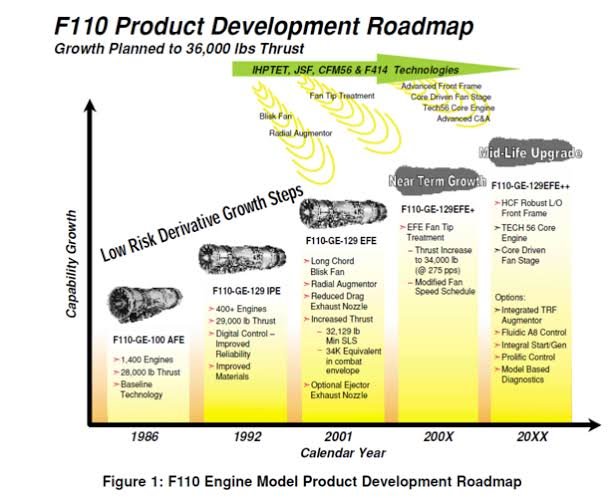
Lol. Someone didn't read the F110-EPE thread here and it sure as hell ain't me.

1780209954455.jpeg

You know why they didn't invest much into make these a reality? Because there's simply no need. Unlike the Russians, P&W/GE can just whip out the F119/YF120 instead of milking the AL-31F architecture again because their R&D capabilities aren't dogwater and have money, unlike the Russians.

If your expertise carries more authority than that of an industry professional—such as an employee at Guizhou Aviation Engine Co.—it would stand to reason that you would be the one publishing reference materials online for others to learn from. However, that does not appear to be the case.
Lol, I'm certain that I know more than a mere janitor, I can tell you that.
 
What a baffling string of words. Again, I cannot, in good conscience, believe you as an actual human being.


The thrust figures obviously exist. Nobody denied that lmao. But they certainly aren't publically revealed, and you quite literally made everything up.


Except that's not true. The F110 is not derived from the CFM56 but rather the F101. And yes! The WS-10 is quite a sophisticated machine with contra-rotating spools. The core might be vaguely based on the CFM56, but everything else is so different that at this point it's basically a thing of it's own. The vanilla WS-10 is quite comparable to the F110-GE-100 with superior thrust curves before M0.3 and past transonic speeds.

View attachment 814023

It's not like the Chinese doesn't know how to do R&D and upgrades... Except you might be one of those who unironically believe that. Nevermind.


Hilarious chain of thought. First of all, there's already a (Y)F120. Second, high BPR airliner engines are a completely different ballgame than low BPR afterburning fighter engines. Engineering is far more complex than simple dialect reasoning. You're nonsensical.


Lol. Someone didn't read the F110-EPE thread here and it sure as hell ain't me.

View attachment 814026

You know why they didn't invest much into make these a reality? Because there's simply no need. Unlike the Russians, P&W/GE can just whip out the F119/YF120 instead of milking the AL-31F architecture again because their R&D capabilities aren't dogwater and have money, unlike the Russians.


Lol, I'm certain that I know more than a mere janitor, I can tell you that.
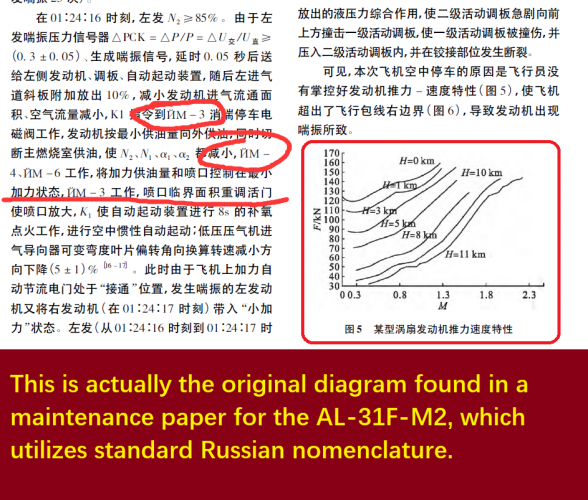
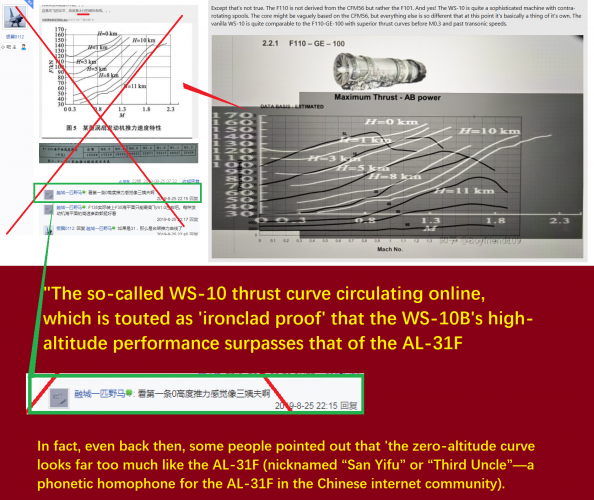
Hello. The background diagram in your first image actually originates from a thrust envelope chart posted on the CD (China Defense) "超大”forum、Tieba“贴吧”forum back in 2019, where it was 'speculated' to be the WS-10B/C to prove that the WS-10 possesses ultra-high high-altitude thrust.


AL-31FM2.png
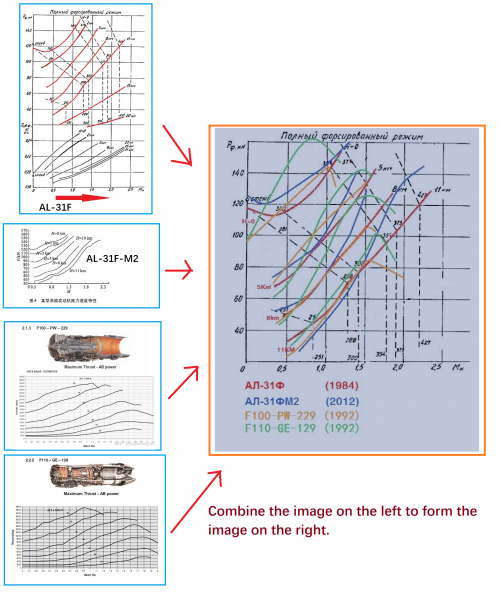
In reality, this was a false-flag incident. This image is actually the thrust curve of the imported Russian AL-31F-M2 engine; the original diagram is attached below. I rigorously critiqued and debunked this on other forums back in 2022. This is a classic case of malicious fabrication. The underlying paper was published around 2016 by the Shenyang Aircraft Corporation, and the text explicitly used Russian to describe the engine's fault commands.
A Chinese engine could not possibly utilize Russian engine throttle commands; therefore, this couldn't postively be a Chinese engine.

Image_1731036505825.png


You should constantly update your knowledge base to avoid making such embarrassing blunders.
As you know, what you are aware of, others have certainly seen;
but what you are unaware of, others may very well have uncovered
Image_1731036513243.png

↑↑↑↑↑↑↑↑↑↑↑↑↑↑↑↑↑↑↑↑↑↑↑↑↑↑↑↑↑↑↑↑↑↑↑↑↑↑↑↑↑↑↑↑↑↑↑↑↑↑
AL-31FM2-S.jpg
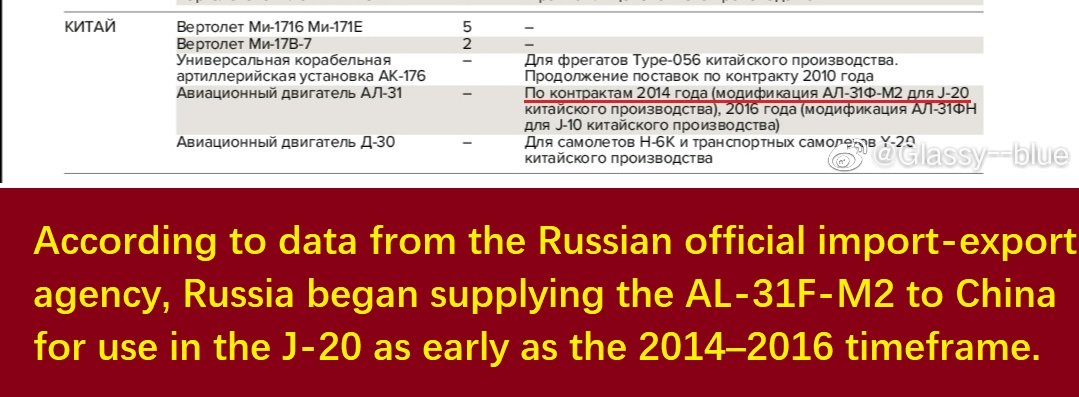
The truth has long been laid bare to the world. I am quite curious as to why Certain ______ forum users continue to misrepresent the parameters of the AL-31F-M2 as those of the WS-10 (B), all while smugly claiming that the performance of the WS-10 even surpasses that of the F110-GE-129/132.

In fact, the performance of the AL-31F-M2—particularly its high-altitude, high-speed capabilities—far exceeds that of the CFM56 and its derivatives. If the J-20 stops ordering the AL-31F-M2 and switches to the domestic WS-10s engine instead, its performance ceiling will, at the very most, only reach the level of the F110-GE-129. This is a matter of pure laws of physics.
 
Last edited:
Goodbye, mwefc. You shined brightly for one day and were banned, the fastest turnaround achieved by any poster who wasn''t hawking CBD gummies or penis enlarging cream.

Not sure what you were saying, half the time, but it was hard to look past your atitude.
 
Last edited:
Goodbye, mwefc. you shined brightly for one day and were banned, the fastest turnaround achieved by any poster who wasn''t hawking CBD gummies or penis enlarging cream.

Not sure what you were saying, half the time, but it was hard to look past your atitude.
1780229183495.jpeg

Btw, early WS-10s were rumoured to use a Russian-derived FADEC system. I'm unsure how credible this is but that could explain it.
 
@Alfa_Particle you reacted to @mwefc in a way that escalated things. Counter rudeness with politeness, not more rudeness.

I am inclined to say that there's fair chance he was right about people posting mislabelled graphs. Internet denizens constantly do this, either misinterpreting the meaning of journal articles or downright faking things.
 
@Alfa_Particle you reacted to @mwefc in a way that escalated things. Counter rudeness with politeness, not more rudeness.

I am inclined to say that there's fair chance he was right about people posting mislabelled graphs. Internet denizens constantly do this, either misinterpreting the meaning of journal articles or downright faking things.
Ha! Fair. He couldn't even interpret the graphs that he himself put out, so don't throw stones in a glass house is what I would say. I'll politely do so next time.
 
@Alfa_Particle you reacted to @mwefc in a way that escalated things. Counter rudeness with politeness, not more rudeness.

I am inclined to say that there's fair chance he was right about people posting mislabelled graphs. Internet denizens constantly do this, either misinterpreting the meaning of journal articles or downright faking things.

I don't want to continue the meta-discussion too much in derailing the thread, but I think a bit of an after-action observation might be useful for future readers who might come across the prior conversation, to explain why things became so contentious and so bizarre so quickly (leaving aside the obvious parts like posting/replying etiquette).

There were some fundamental, somewhat basic knowledge differences for matters that were non-controversial and part of established, non-debatable public record such as:
- the idea that J-20 used PL-12 as its primary BVRAAM rather than PL-15 (and suggesting the latter has not been in service for many years on J-20)
- the idea that J-20 has not already moved on from using Al-31 engines to WS-10C engines since 2019, and speaking of it as if J-20 in production today continues using Al-31 variants
- interpreting an obviously doctored image of F-35 with three AMRAAMs in a side bay as if it was genuine real world evidence of said capability

(And this is leaving aside some of the more odd arguments like WS-15 is derived from R79 or debating interpretations of engine performance curves.)

That all formed an underlying foundation where it was impossible to ascertain just what that user's base of knowledge/understanding actually was.
Things like J-20's primary BVRAAM, J-20's active production engine in use, and F-35's BVRAAM loadout, are such basic, fundamental and verifiable pieces of information that should be entry-level stuff, that it getting those so confidently wrong casts doubt onto the understanding and judgement that feeds into everything else one may write or argue a position from.


In any case, I think I speak for more than a few of us to express appreciation of the prompt moderator intervention here.
 
Goodbye, mwefc. You shined brightly for one day and were banned, the fastest turnaround achieved by any poster who wasn''t hawking CBD gummies or penis enlarging cream.

Not sure what you were saying, half the time, but it was hard to look past your atitude.
Welcome to the era of AI internet trolls? Seeing how many bit, it did pretty well unfortunately.
 
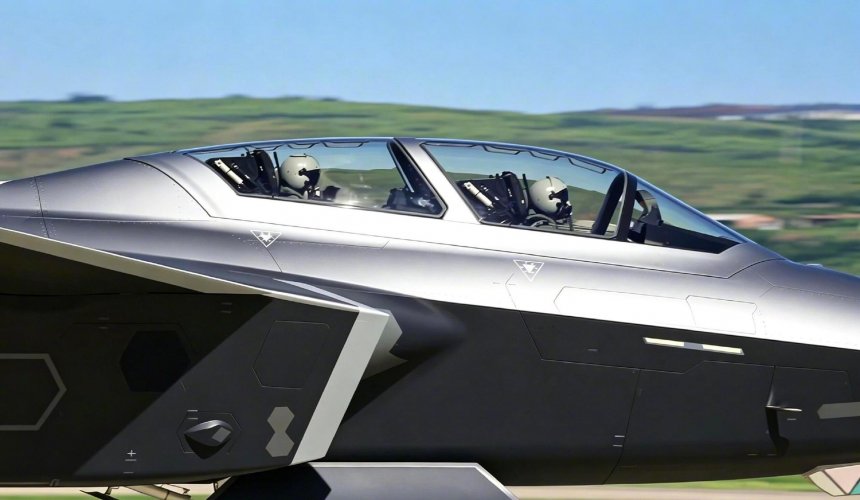
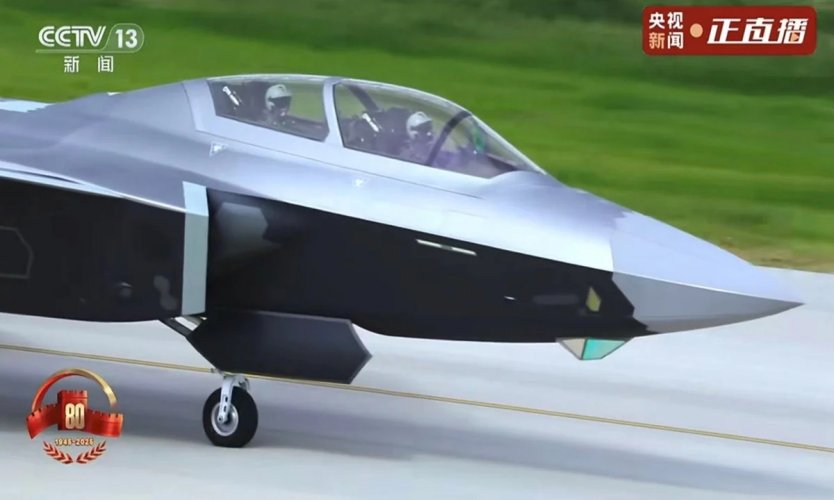
Even the best finished aircraft can cast shadows on tiny imperfections if the light is at the right angle, to obtain super smooth finish on a military aircraft that is a war machine is not practical or necessary. These things need to be repairable too; you can’t have panels without rivets and screws unless you have some alien tech to make micro tolerance joints. The constant discussion of not stealthy enough is pointless if you are not a radar operator trying to spot all these aircraft being Chinese, Russian or American.
 
Closeup of J-20S, though is likely just a zoomed in crop of a wider picture
 

Attachments

  • 001iJz7Kly1idnji8p11lj621c16nag002.jpg
    001iJz7Kly1idnji8p11lj621c16nag002.jpg
    146.2 KB · Views: 158
Last edited by a moderator:
China, meanwhile, assessed Yugoslavia’s victory over the Nighthawk as a technology failure, he said. That drove the PLA’s interest in developing a counter-stealth ability, as they believed that a technology “silver bullet” could negate the U.S. advantage over targeting radars.

This is the most absurd part of the article.
 
Many times, some public figures cannot freely express their own opinions. On one hand, this is due to their responsibilities, and on the other hand, it concerns political stance issues. So I will look at the general content of what they say, but I do not hope to get any useful information from it.

I have no particular opinion, after all, these are people from the U.S. military. It would be very strange to expect them to set aside their political stance and make comparisons.
 
The J-20 isn't stealthy, Iran has no missiles left, North Korea can't develop the bomb. Guys calm down, people with funny titles said so, why won't you believe them and their government funded think tank? Did I mention that Oceania has always been at war with Eastasia?
 
I'm going to put the entire article here.

if you are going to dismiss someone's opinion on stealth, you should at least acknowledge his relevant experience.
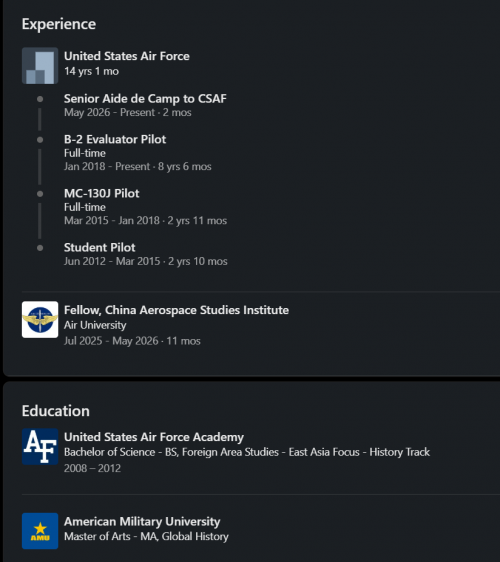
When analyzing the technology prowess of the Chinese People’s Liberation Army, U.S. Air Force Maj. Derek Ecklebe talks about a problem with his golf swing.

Ecklebe, a military fellow at the China Aerospace Studies Institute (CASI), invested in an expensive driver to solve a problem with his swing, but his annoying tendency to slice the ball off the fairway remained. “I still have a slice,” he said at the CASI annual conference at the National Defense University here May 21. “If I don’t figure out how to use that new technology, it’s kind of worthless.”

Ecklebe, who previously managed stealth signatures for the Air Force’s Northrop Grumman B-2 bombers, detects a similar problem with the People’s Liberation Army’s (PLA) approach to acquiring technology to make their own aircraft stealthy and to countering adversaries’ stealth technology.

“Looking at what the Chinese own today, and looking at how they approach it and how they think about it, I would argue that they have some really good technology in some respects,” Ecklebe said. “They just have a really nice, brand-new driver, [but] they still don’t know how to throw their hands through and stop the slice.”


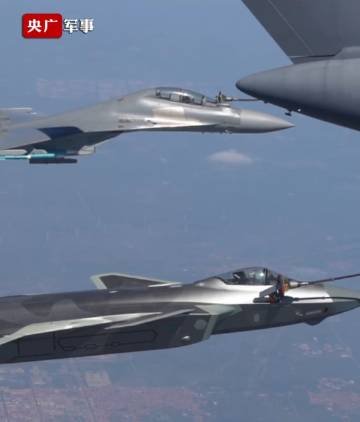
No one doubts that China’s military power has improved dramatically in two decades. In 2011, the country fielded its first stealth fighter, the AVIC Chengdu J-20 Mighty Dragon. Prototypes for two more radar-evading combat aircraft—the Chengdu J-36 and AVIC Shenyang J-50—entered flight testing at the end of 2024. The AVIC Xian H-20 crewed stealth bomber remains in development, its shape shrouded in official secrecy. Several more stealthy uncrewed aircraft—designated the GJ-11, CS5000T, CH-7, GJ-X and WZ-X—have broken cover.

China’s National Defense Ministry often refers to the canard-delta, twin-engine J-20 as a “stealth fighter.” In a Jan. 11 news release hailing the 15th anniversary of the fighter’s unofficial unveiling, the ministry said the event marked “the end of an era in which China lacked [a] domestically developed stealth fighter.” But the J-20’s stealthy features do not impress Ecklebe.

The JY-27 radar, China’s counter-stealth system
The low-frequency JY-27 radar is touted on the export market as China’s most advanced counter-stealth system. Credit: ZUMA Press/Alamy Stock Photo
“The J-20 is really bad from a signature perspective,” he said. “Calling it ‘stealth’ is very generous to the Chinese engineers that made it.”

Fourteen years after the J-20 arrived, China showed off two apparent candidates for the PLA’s first sixth-generation combat aircraft. Featuring no vertical tails—a necessity for minimizing detection by low-frequency, early warning radars—the J-36 and J-50 represent the next evolution in Chinese stealth technology. Still, Ecklebe is skeptical. Although both represent an improvement over the J-20, some features raise red flags, he said.

“Having run [the B-2 squadron’s] signature [management] shop for three years, knowing every single nook and cranny of the airplane, of the materials, of the shape of the signature down to every angle, frequency and polarization, I have some huge questions about why they decided to do what they did,” Ecklebe said. “I think they are going to run into some massive signature regrets here in a couple years as they try to modernize these airplanes.”


China’s next stealth aircraft to emerge will be the H-20 bomber. A Chinese general revealed the existence of the development program in 2016. The U.S. intelligence community assesses that Beijing’s first crewed, long-range stealth bomber will enter service in the 2030s. Sarcasm dripped into Ecklebe’s voice when he mentioned this aircraft.

“Frankly, my favorite is the H-20,” he said. “I can’t wait to see this thing. Based off of what I’ve read, [and] what I’ve been able to see—at this level [of classification]—I’ll say: I can’t wait.”

Ecklebe challenged statements that the PLA possesses a “counter-stealth” capability that negates decades of U.S. investment in stealthy bombers, fighters and munitions. During the 2025 World Radar Expo in China, Chinese defense electronics company CETC reportedly called the low-frequency JY-27V a “master artist” in detecting stealth aircraft, according to the state-run Global Times. The company also displayed the ultra-high-frequency-band YLC-8B radar as an “anti-stealth” sensor at the event.

These Chinese announcements spooked observers even within the U.S. military, Ecklebe said, but he said they should not be alarmed.

“As a community, we have to get a better understanding that low frequency is not counter-stealth,” he said.

Low-frequency radars have the ability to detect stealth aircraft, he conceded. But detection is not the same as targeting. The accuracy of a low-frequency radar is limited by the physics of the wavelength, which ranges from 1 m to 10 cm (39.4 in. to 3.9 in.). To guide a missile to a target accurately, the low-frequency radar must pass those coordinates to a high-frequency radar, which stealthy designs are optimized to defeat.

“There are times where I don’t really care [about being detected],” Ecklebe said. “Because if they can find me with a low-frequency radar but then they have to switch over to another radar to be able to close that kill chain . . . the higher in frequency they go, they’re going to have harder and harder problems trying to find me.”

Fundamentally, the Chinese military and defense industry’s approach to stealth and counter-stealth technology rests on a misperception, Ecklebe argued. In his view, technology is only part of what drives a U.S. advantage in stealth. With 35 years of stealth aircraft in combat operations, the U.S. has learned to package the technology with procedures, tactics and planning.

They are putting less of an emphasis on doctrine, on training and on integration, and that is really going to bite them here in a couple of years,” Ecklebe said.

The PLA’s interest in stealth intensified after the 1999 shootdown of a U.S. Air Force Lockheed Martin F-117 Nighthawk during the Kosovo War. A Yugoslav Army SA-3 surface-to-air missile battery is credited with intercepting the stealthy combat aircraft in what proved to be a watershed moment for stealth technology for both Washington and Beijing.

In the U.S., the loss of the F-117 was blamed on poor mission planning, leading to a procedural adjustment, Ecklebe explained. “We are very, very, very good [at] being highly adaptive in our mission planning and our execution, particularly post-F-117 shootdown,” he said. “Never fly the same route twice, right? Well, that was a lesson learned out of Serbia because of this event.”

China, meanwhile, assessed Yugoslavia’s victory over the Nighthawk as a technology failure, he said. That drove the PLA’s interest in developing a counter-stealth ability, as they believed that a technology “silver bullet” could negate the U.S. advantage over targeting radars.

“This was the precipitating event for the Chinese,” Ecklebe said. The PLA believed they could defeat stealth aircraft because “they viewed the shootdown as a failure of the technology, which is why, I have argued, they have been hyperfocused on the technological solution to counter-stealth.”
As far as I can understand the key points, he is emphasising that

1) J-20 has some very questionable features for a stealth aircraft, and even J-50/XDS have what he thinks are some undesirable features.

2) A low RCS airframe is only one aspect of US stealth technology, and other operational technologies and factors (stealth operational doctrine, mission planning, for example) are equally important parts that China is neglecting. He's not saying China in neglecting doctrine in general.

Now, you can disagree with him, but he does at least have relevant operational knowledge of stealth. How many of the people commenting on this topic can say the same?

Major Derek J. Ecklebe currently serves as a Fellow at the China Aerospace Studies Institute, providing expert research and analysis supporting decision and policy makers in the Department of Defense and across the U.S. government. He is responsible for reading, translating, analyzing, and publishing Chinese publicly available information, ensuring government wide dissemination. Prior to his current assignment, he served as the B-2 Chief of Survivability & Special Programs and Assistant Director of Operations of the 509th Operations Support Squadron, Whiteman Air Force Base, Missouri. He was responsible for the combat mission planning of the nation’s only stealth bomber, including the management of advanced programs, signature protection, and current and future capabilities. He served as the chief B-2 tactical advisor to the 509th Bomb Wing Commander, as well as NAF, MAJCOM, and COCOM leadership. Major Ecklebe is a senior pilot with more than 2,000 flying hours in the T-38C, C-130J, HC-103J, MC-130J, MC- 130H, T-38A, and B-2A.
 
I'm going to put the entire article here.

if you are going to dismiss someone's opinion on stealth, you should at least acknowledge his relevant experience.

As far as I can understand the key points, he is emphasising that

1) J-20 has some very questionable features for a stealth aircraft, and even J-50/XDS have what he thinks are some undesirable features.

2) A low RCS airframe is only one aspect of US stealth technology, and other operational technologies and factors (stealth operational doctrine, mission planning, for example) are equally important parts that China is neglecting. He's not saying China in neglecting doctrine in general.

Now, you can disagree with him, but he does at least have relevant operational knowledge of stealth. How many of the people commenting on this topic can say the same?

I don't think their service record is necessarily what's being called into question, but rather what information and intelligence has been consumed and how that was interpreted by the interviewee in question.

This isn't beyond the pale btw; it wasn't too long ago that a USAF Chief of Staff (also an ex-F-117 pilot, among many other aircraft) opted to compare J-20 with F-117 rather than F-35 on the basis that the latter was a fully networked aircraft with a full suite of sensors, which was wild even for 2016 and frankly bizarre to look back on in 2026.
And while I wouldn't challenge Goldfein's service record -- again, the same question of what information pipeline and what set of cognitive processes led to XYZ conclusions, applied there too.


https://www.businessinsider.com/comparing-f35-china-j20-2016-8


The most concerning part in the article is that Trimble really should have followed up on some of the remarks with questions of his own -- or at least make some comments around how they jived with the existing base of knowledge on those topics. Taking things at face value has some use in journalism of course, but sparing some of the word count on the Major's golf swing and applying it for "does this actually reflect what we know about modern PLA approaches to air power" might have been indicated as well.
 
The criticism and incredulity should lie less with the interviewee and more to the interviewer/author for their reception of the answers.

There are entire swathes of answers which are either at odds with what we know about PLAAF practice, or the nature of systems, or even their perception of history.
It’s entirely possible that he’s wrong, I don’t believe it’s unreasonable to dispute his statements. At the same time, he is somebody with relevant real world experience and I don’t believe it is fair to outright dismiss his comments or the comments of two recent CSAFs with insults.
I initially responded to this thread because I’ve noticed some objectionable behavior from a certain demographic on this forum in which any criticism/skepticism of the PLAAF is immediately shut down as if it is blasphemy. I don’t really have a dog in this fight as I have no data or expertise on this subject. But I believe people should be able to speak their mind and freely discuss things. We are not on SDF after all
 
It’s entirely possible that he’s wrong, I don’t believe it’s unreasonable to dispute his statements. At the same time, he is somebody with relevant real world experience and I don’t believe it is fair to outright dismiss his comments or the comments of two recent CSAFs with insults.
I initially responded to this thread because I’ve noticed some objectionable behavior from a certain demographic on this forum in which any criticism/skepticism of the PLAAF is immediately shut down as if it is blasphemy. I don’t really have a dog in this fight as I have no data or expertise on this subject. But I believe people should be able to speak their mind and freely discuss things.

For the record, I am not opposed to voicing such statements at all -- I've always felt it valuable to get insights from service or ex-service members on topics that they may have direct or indirect experience on.
Even if I disagree with them, they tend to be useful in helping compare notes and explore where the divergences in understanding come from.


But for the author of the article, it feels like such a missed opportunity to actually reflect on the statements being said. Even if follow up questions were not possible (or subsequent answers unable to be published) due to clearance, taking it all at face value in the way the article framed it is odd in context of... everything else we know about the PLAAF and PLA approach to air warfare today.
 
It's not controversial to say that J-20's basic layout has some compromises for VLO stealth, which gradual refinements to the shape have helped alleviate to some extent. @quellish has definitely raised his doubts for example.

J-20 is certainly the same fighter class as the F-22, but that doesn't mean every aspect of capability is identical between them, just like the F-15 and Su-27 each had specific areas where one design was superior to the other.

I don't think even the most ardent J-20 fan believes its got better stealth in all directions than an F-22 does.
 
The moment a former Western military officer makes a claim, it is accepted at face value, as though decades of service automatically grant him divine insight into a military he has never served in and an aerospace industry he has neither worked in nor demonstrated any serious effort to understand.
I'm pretty sure a guy who was in charge of managing B-2 radar signatures would have access to intelligence assessments about foreign fighter capabilities. Now, his knowledge might be out of date if he's no longer in that position.

Its a valid datapoint, you seem super touchy about it for some reason.
 
It's not controversial to say that J-20's basic layout has some compromises for VLO stealth, which gradual refinements to the shape have helped alleviate to some extent. @quellish has definitely raised his doubts for example.

J-20 is certainly the same fighter class as the F-22, but that doesn't mean every aspect of capability is identical between them, just like the F-15 and Su-27 each had specific areas where one design was superior to the other.

I don't think even the most ardent J-20 fan believes its got better stealth in all directions than an F-22 does.

I think if the Major had phrased things like you did there would be less confusion than what was written.

Especially if it was more specific say, to any intelligence or readings of earlier batch J-20s. But as it was phrased and written, in context of the overall article, is really really odd. But who knows, seeing as the exchange happened at a conference maybe it was in the evening after the bar was open for a little while and it was cavalier conversation.


As for Ecklebe, being an experienced USAF officer qualifies him to discuss the USAF. It does not automatically qualify him to make definitive statements about an organization whose internal processes he has never been part of.

Has he sat in on PLA planning sessions? Has he observed their training cycles? Has he reviewed their classified doctrine? Has he had access to Chengdu's design decisions, engineering trade-offs, or operational testing data? If not, then on what basis is he making these declarations with such certainty?

What strikes us is not that he's critical of Chinese stealth programs. It's that he speaks as though he possesses knowledge that, by all appearances, he simply does not have...
Gee, I dont know, what would an active duty USAF officer in charge of studying the PLAAF be basing his claims off of? Almost like he has access to intel that you dont have.

This below is in reply to by snee and njiaaf.

So, this exchange partly relates to what I was talking about earlier -- i.e.: the relevance and credibility and accuracy of understanding that active service or ex-servicemen may have on topics that are relevant to their day to day job.

IMO, a level of automatic deference applies at baseline for these individuals, and much greater degree of credibility is of course bestowed upon them than any person on the street.
But depending on what is stated, it is also reasonable to question things like how up to date certain intelligence might be for a specific domain of conversation, or the wisdom behind their deductions or conclusions, or sources of information/intelligence.

For example, given the Major's background I would be not be inclined to challenge whatever their takes on recent USAF B-2 TTPs are... but for specific PLA projects, PLA historical perceptions/reactions to events (like the F-117 shootdown), or modern PLA training/doctrine as a field of academic study, mileage varies a bit for each and depends on what they are reading.
 
Its a valid datapoint, you seem super touchy about it for some reason.
Are you actually trying to get me banned, lol :D (jk)

I agree with @Blitzo 's broader point. What I have consistently questioned is not Ecklebe's competence as a B-2 pilot, but his claimed insight into the PLA, the Chinese aerospace industry, and Chinese military development more broadly. And as a B-2 pilot, it is hardly surprising that he views the J-20's RCS-reduction measures as inadequate, or that he is skeptical of so-called "counter-stealth" efforts based on what he was taught at the time...

Screenshot 2026-06-06 101547.png

The thing is, as a relatively junior member of CASI (just another infamous government funded think tank!), he does not have access to information that is substantially different from what the rest of us have access to. While many dedicated members across various forums have spent decades meticulously analyzing the PLA's strengths and weaknesses, observing developments, and steadily expanding their knowledge base, none of us would dare make claims of that magnitude. And when we do make claims, nobody accepts them at face value as some form of divine insight the way they do his.

Over the years, I've seen countless military "experts" make increasingly grandiose claims about Chinese/American/Russian/etc. military capabilities or shortcomings (often to win favor with their audience and in part generate clicks), only to produce little more than speculation backed by credentials. The pattern is always the same.

Since my old posts were deleted (along with @njiiaf 's posts insulting me), I can only refer to the ones that others happened to quote. I also don't have the time to rewrite arguments I've already made at length, so this will be my final post on this issue. This particular quote more or less captures everything I wanted to say (amusingly it was deleted):

As for Ecklebe, being an experienced USAF officer qualifies him to discuss the USAF. It does not automatically qualify him to make definitive statements about an organization whose internal processes he has never been part of.

Has he sat in on PLA planning sessions? Has he observed their training cycles? Has he reviewed their classified doctrine? Has he had access to Chengdu's design decisions, engineering trade-offs, or operational testing data? If not, then on what basis is he making these declarations with such certainty?

What strikes us is not that he's critical of Chinese stealth programs. It's that he speaks as though he possesses knowledge that, by all appearances, he simply does not have...
 
Last edited:
Are you actually trying to get me banned, lol :D (jk)

I agree with @Blitzo 's broader point. What I have consistently questioned is not Ecklebe's competence as a B-2 pilot, but his claimed insight into the PLA, the Chinese aerospace industry, and Chinese military development more broadly.

View attachment 814646

The thing is, as a relatively junior member of CASI, he does not have access to information that is substantially different from what the rest of us have access to. While many dedicated members across various forums have spent decades meticulously analyzing the PLA's strengths and weaknesses, observing developments, and steadily expanding their knowledge base, none of us would dare make claims of that magnitude. And when we do make claims, nobody accepts them at face value as some form of divine insight the way they do his.

Over the years, I've seen countless military "experts" make increasingly grandiose claims about Chinese/American/Russian/etc. military capabilities or shortcomings (often to win favor with their audience and in part generate clicks), only to produce little more than speculation backed by credentials. The pattern is always the same.

Since my old posts were deleted (along with @njiiaf 's posts insulting me), I can only refer to the ones that others happened to quote. I also don't have the time to rewrite arguments I've already made at length, so this will be my final post on this issue. This particular quote more or less captures everything I wanted to say (amusingly it was deleted):

Ecklebe is also (to my understanding) an active serving Major in the USAF, and likely does have recent and relevant experience in the various roles relevant to active warfighting -- and arguably it is access to those intelligence sources as part of his active military service (rather than being a CASI fellow) which is of greater weight in terms of his opinions that he is sharing.

The more specific question is whether his active military service (current or recent past), and/or his CASI fellowship can confer specific confidence/relevance to the statements he has made...
.... and I wrote before that I tend to give service members/recent ex-service members the benefit of doubt on most relevant topics, but imo it also does depend on how much it departs from a known base of knowledge.

So in a way people's differing reaction to his "credibility" is more of a reflection of what one's own existing "base of knowledge" on the relevant topics are.

E.g.:

The idea that J-20 has certain signature management aspects that are less optimized in certain aspects than say, F-22 or B-2, is certainly not too controversial if one is being specific to say, earlier batch J-20s. It wasn't phrased so carefully in the article, but maybe it was being casual for the sake of conversation.
The idea that the PRC has only emphasized technological development without emphasizing advancements in training, doctrine and tactics also strikes me as different to everything else we've observed (and also somewhat stereotypical).
The description of the PRC stating their anti-stealth radars as being some sort of genuine "anti-stealth" solution strikes me as mis-reading tradeshows and mis-reading what the PLA has said about them (i.e.: very little).
The takes on J-36 and J-XDS? That seems a bit more like eyeballing, unless the interviewee was involved in some serious modelling work on those aircraft.

And the worst part is, most of what was said, and most of what was written by the author, could also just be explained by "having a yarn" where the specificity of things weren't meant to be that consequential to begin with.
 
The AW&ST article subtly reads somewhat like a rage-bait piece from abstract perspective - especially this part:

“Frankly, my favorite is the H-20,” he said. “I can’t wait to see this thing. Based off of what I’ve read, [and] what I’ve been able to see—at this level [of classification]—I’ll say: I can’t wait.”

As @Blitzo has noted, it's a missed opportunity on the interviewee's side not to "push back", or rather follow up with more specific questions. The article lacks substance, which reminds me, that I would rather read a multi-page, technical deep dive on the subject written by someone knowledgeable like Quellish.
 
Last edited:
In Ecklebe's article, a aircraft mysteriously disappeared.

The J-35, doesn't he know this aircraft exists? I don't think so. Then why doesn't he comment on the stealth capability of the J-35?

He believes the J-35 is a copy. There are two possibilities: First, he believes the J-35 copied the F-35, but the J-35 is still not good enough. I think this possibility is relatively small — after all, no one can reject a 'twin-engine F-35,' not even Donald would want to. Second, he believes the J-35 copied the F-35, but the J-35 is just as good as, or even better than, the F-35. I think this possibility is more likely. He cannot openly admit that China's capabilities have reached or exceeded the mainstream level of the United States, so he has no choice but to avoid the topic altogether.

As for the J-20, it did make compromises and sacrificed stealth performance. And those two 6th-gen? Oh, just talk, just talk. Although he knows very little about them, well, who doesn't?
 
Are you actually trying to get me banned, lol :D (jk)

I agree with @Blitzo 's broader point. What I have consistently questioned is not Ecklebe's competence as a B-2 pilot, but his claimed insight into the PLA, the Chinese aerospace industry, and Chinese military development more broadly. And as a B-2 pilot, it is hardly surprising that he views the J-20's RCS-reduction measures as inadequate, or that he is skeptical of so-called "counter-stealth" efforts based on what he was taught at the time...

View attachment 814646

The thing is, as a relatively junior member of CASI (just another infamous government funded think tank!), he does not have access to information that is substantially different from what the rest of us have access to. While many dedicated members across various forums have spent decades meticulously analyzing the PLA's strengths and weaknesses, observing developments, and steadily expanding their knowledge base, none of us would dare make claims of that magnitude. And when we do make claims, nobody accepts them at face value as some form of divine insight the way they do his.

Over the years, I've seen countless military "experts" make increasingly grandiose claims about Chinese/American/Russian/etc. military capabilities or shortcomings (often to win favor with their audience and in part generate clicks), only to produce little more than speculation backed by credentials. The pattern is always the same.

Since my old posts were deleted (along with @njiiaf 's posts insulting me), I can only refer to the ones that others happened to quote. I also don't have the time to rewrite arguments I've already made at length, so this will be my final post on this issue. This particular quote more or less captures everything I wanted to say (amusingly it was deleted):
I also want to point out that while Ecklebe certainly has more than adequate experience and understanding of the B-2 airframe and its signature characteristics (both from his career experience as well as his own words regarding the Signature Shop), we should keep in mind that throughout his career he has been with the Air Force and not Northrop’s design team.

No doubt he is knowledgeable in the field of stealth, but how much of his knowledge is specific to the B-2, and how much is in regard to more general aircraft design is uncertain. Note that he himself talks about his time at the Signature Lab and “knowing every single nook and cranny of the airplane, of the materials, of the shape of the signature down to every angle, frequency and polarization” which seems to be all about the B-2 and not very much about any other aircraft.

I would expect someone at his (prior) position to have some links to Northrop and lots of experience wrt B-2, but he does not necessarily have enough experience or knowledge on aircraft design nor how VLO designs other than B-2 work to make serious evaluations regarding the stealth designs of other aircrafts, especially ones about which very little is publicly known and the best everyone can do is probably eyeballing and crude 3D models based on limited visual reference. Similar things can be said with respect to his views on PLA’s tactics, training and integration, since again as a prior test pilot handling technical aspects of the B-2 fleet he isn’t really in a position to have studied these areas in detail.

I do agree with Blitzo that the context of when Ecklebe said what he said is missing and somewhat important, we don’t know how serious the conversation was nor how grounded the entire context really is, so making judgements either way (taking his words as gospel or outright dismissing everything he said) seems ill-advised to say the least.

Edit: damn snne quoted someone who said what I said much better and more concisely, I should really try out this thing called “reading” that everyone’s been talking about
 
Last edited:
I'm going to put the entire article here.

if you are going to dismiss someone's opinion on stealth, you should at least acknowledge his relevant experience.

As far as I can understand the key points, he is emphasising that

1) J-20 has some very questionable features for a stealth aircraft, and even J-50/XDS have what he thinks are some undesirable features.

2) A low RCS airframe is only one aspect of US stealth technology, and other operational technologies and factors (stealth operational doctrine, mission planning, for example) are equally important parts that China is neglecting. He's not saying China in neglecting doctrine in general.

Now, you can disagree with him, but he does at least have relevant operational knowledge of stealth. How many of the people commenting on this topic can say the same?

The thing which bothers me about this analysis isn't the expertise - it is the heuristic. He's only pushing back against over-estimation of Chinese capabilities, while providing no criticism of under-estimation of Chinese capabilities. Obviously, there will be bad estimates both ways - and even sophisticated estimates will be likely to disagree slightly... so one should expect there to be at least one area under which some account has underestimated Chinese capabilities.

I think there is also a bit of a mistake here in terms of thinking about only existing capabilities. China has at least four manned airframes (that we've seen) with at least some low observable features, as well as something like a dozen drones. They've also been investing a lot in radars and cross-platform sensor fusion... so they will be in a position to have a lot of hard data about what works or what doesn't work - both for things like improving stealth and for things like simulating B-2 hunting tactics.

He might well be right that the J-36 and J-XDS have been rushed out with flaws that means they won't be as significant a jump as one might expect (and might fall behind American 6th generation platforms in stealth as a result) though.

...but I find it a bit alarming whenever someone is pushing only one way (in their arguments)... rather than critiquing potential misestimations in both directions.
 
Honestly, I don't know of any fighter jets in the world that are flawless. I'm sure the world's first stealth fighter, the F-22, also has many compromises, and in some aspects, the F-35 actually does much better than the F-22. Saying that the J-20, J-35, J-36, or J-50 have flaws in certain areas is basically saying nothing.

Also, it's a bit odd for an excellent truck driver to be evaluating a race car. He might indeed have some authority in the field of stealth bombers, but that doesn't necessarily give him expertise in stealth fighters, especially since the differences between stealth fighters and stealth bombers could be even bigger than the differences between a truck and a race car.

Of course, due to the varying industrial capabilities of each country, each nation naturally has different materials science, and with different materials, there will naturally be different stealth effects. Because of these different stealth effects, the design of certain parts of a stealth fighter may differ from other stealth fighters. There's nothing surprising about that. Didn't the Soviets have an old saying that there are many paths to the top of the mountain, but the view from the top is the same?

Lastly, I'm not trying to deny his professional ability, but just like a truck driver advising a car manufacturer on how to build a race car, I think using his knowledge within his profession to criticize China's stealth fighters across industries isn't professional.
 
Lastly, I'm not trying to deny his professional ability, but just like a truck driver advising a car manufacturer on how to build a race car, I think using his knowledge within his profession to criticize China's stealth fighters across industries isn't professional.
He's literally part of China Aerospace Studies Institute (CASI) - a United States Department of the Air Force think tank which examines all facets of the People's Republic of China and Chinese Communist Party's efforts to project power in the air and space domains. So its his job right now to analyse the Chinese aircraft industry.
 
So did he and his colleagues anticipate that there would be two triangles flying in the sky by the end of 2024? Frankly, some people had hinted that something would appear after a while even before these two flights appeared. If this think tank were more reliable, they should have had related reports. Moreover, think tanks generally serve politics first, not technology.
 
You seemed to suggest he shouldn't be commenting on Chinese aircraft. I pointed out that his current day job in the USAF is analysis of the Chinese aerospace industry. Now, you can disagree with his opinions, but I fail to see why he shouldn't express them. He is providing a counterpoint to the "look, China's catching up, might overtake us, give us all the money right now" argument of other sections of the USAF.
 
He's literally part of China Aerospace Studies Institute (CASI) - a United States Department of the Air Force think tank which examines all facets of the People's Republic of China and Chinese Communist Party's efforts to project power in the air and space domains. So its his job right now to analyse the Chinese aircraft industry.

I do have doubts about the credibility of all of CASI's reporting given how the director of that institute speaks in public. He is prone to fawning over a certain key political leader, saying things that are obviously not true to curry political favor. The culture flows from the top.
 
You can read their public publications. It all seems to be OSINT.

https://www.airuniversity.af.edu/CASI/Publications/

CASI's mission is to advance the understanding of the strategy, doctrine, operating concepts,capabilities, personnel, training, organization, of China’s aerospace forces and the civilian andcommercial infrastructure that supports them.CASI supports the Secretary, Chief of Staff of the Air Force, the Chief of Space Operations,and other senior Air and Space leaders. CASI provides expert research and analysis supporting decision and policy makers in the Department of Defense (DoD) and across the U.S. government.CASI can support the full range of units and organizations across the United States Air Force(USAF), U.S. Space Force (USSF), and the DoD. CASI accomplishes its mission through conducting the following activities:
• CASI primarily conducts open-source native-language research supporting its five main topic areas.
• CASI conducts conferences, workshops, roundtables, subject matter expert panels, and senior leader discussions to further its mission.
• CASI personnel attend such events, government, academic, and public, in support of its research and outreach efforts. CASI publishes research findings and papers, journal articles, monographs, and edited volumes for both public and government-only distribution as appropriate.
• CASI establishes and maintains institutional relationships with organizations and institutions in the People’s Liberation Army (PLA), the People’s Republic of China(PRC) writ large, and with partners and allies involved in the region.
• CASI maintains the ability to support senior leaders and policy decision makers across the full spectrum of topics and projects at all levels, related to Chinese aerospace.CASI supports the DoD and the broader China research community by providing high quality,unclassified research on Chinese aerospace developments in the context of U.S. strategicimperatives in the Asia-Pacific region.

Primarily focused on China’s military air, space, and missile forces, CASI capitalizes on publicly available native language resources to gain insights as to how the Chinese speak to and among one another on these topics.
 

Similar threads

Back
Top Bottom