- Joined
- 26 May 2006
- Messages
- 38,276
- Reaction score
- 20,412
But this is an internal information you got or was there already something officially confirmed "from high level" and even published?
I can't tell more,we will just wait.

But this is an internal information you got or was there already something officially confirmed "from high level" and even published?

I can't tell more,we will just wait.

Does Bronk have any sort of relationship with any defense contractor?

Does Bronk have any sort of relationship with any defense contractor?
I ask because he seems to go at length to down play the J-10C and cast doubt the shoot down occurred inspite of pretty good evidence at least at this point one Rafale was lost (TWZ to their credit do post this)
He makes a point that this is good for the Chinese and European defense industries at the expense of the Russian and American ones yet the 800lb gorilla in the room is at least one, maybe more, European jets were lost to its Chinese counterpart that costs half as much. Regardless of your feelings on what occurred, I kind of expected more form an expert then him trying to push a narrative.
It just feels like everytime he’s consulted it’s a brochure for BAE. He’s not an engineer, pilot or SME he gets most of his knowledge second hand like most of us.


expert
Ok ... but at least a guess how long?
It just feels like everytime he’s consulted it’s a brochure for BAE. He’s not an engineer, pilot or SME he gets most of his knowledge second hand like most of us.
Check Justin Bronk’s works with RUSI to understand from where he gets his information. Definitely, he has different sources than majority of us.


From what I heard 5alert was quoting Intelligenceonline which from I heard from people on SDF to be decently credible and has been around for a while. They are supposed to announce the deal a little over 2 weeks from now, so we'll see if this deal turns out to be true.how reliable is this piece? I haven´t seen any official quotation in this report for somethings as radical as 40 jets from a country that hasn´t yet sold them any jets.
https://www.globalmilitary.net/air_forces/idn/#gsc.tab=0
Aren't they also invested in the KF-21?
Aren't they also invested in the KF-21?
Where does Indonesia get all the money from to pay for such a diverse and still decent quality air force?
Indonesia and Qatar have a lot in common...yeah it does seem like every year there's some news article linking Indonesia with some new warplane.
Su-35s, KF-21s, Rafales, F-15EX, and now J-10s.
I think a country like Indonesia is large and influential enough to successfully pursue an independent foreign policy, and should ideally be more self reliant in various areas of defense whenever possible. Sticking to the KF-21 is what I would prioritize, as despite troubles, Indonesia is still a partner in its development and receiving some degree of tech transfer. South Korea and Indonesia, despite the recent controversies, has been partners on a number of projects in the past and I think that should continue.
Alternatively, Kaan might be something to look into, given the growing Turkish-Indonesian collaboration, such as one of their recent armored vehicles.
And perhaps one more source that can help provide numbers now, while the KF-21 and Kaan are still being developed, whether that's the J-10s, Rafales, etc.
but they certainly need to improve logistics as they are potentially needing to keep stocks of missiles and spares from US, France, Russia, and China
A lot of Indonesian arms sales are paid for with commodities including palm oil...Aren't they also invested in the KF-21?
Where does Indonesia get all the money from to pay for such a diverse and still decent quality air force?
Can you give us a timescale Hesham, and any hints as to what the surprise is? Another combat type, or maybe AEW?
A lot of Indonesian arms sales are paid for with commodities including palm oil...


or at least laser guided rockets.View: https://www.youtube.com/watch?v=7ESj4X5Cyec
Always felt nostalgic when I see modern fighters still shooting rockets from pods directly at targets in demo flights (1:42)..... I thought this has no place in modern battlefield unless you are doing CAS, where stand-off weapons are the norm these days ......
1. TVC
3. Rearward CG can vary starting from an inch of offset. Good luck seeing that with the naked eye
However, the figures performed at airshow with that aircraft showed pretty clearly that China had aquired a top of the crop level In FCS.
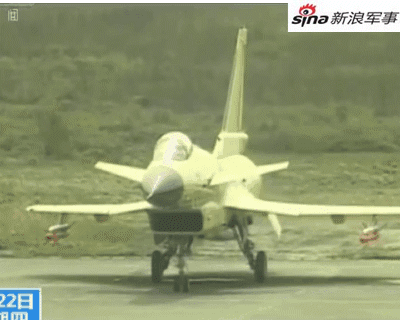
You do realise these aircraft deflect their control surfaces on the ground for FCS checks. Also first time I've seen someone claim Su-27 is a stable design. Probably do some basic research first.Those figures done at airshows can be done with a very simple FCS even if the aircraft is stable (e.g. Su-27). Regarding how "state-of-the-art" Chinese FBW systems are I've seen videos of J-10's taxiing with the FBW trying to compensate the pitch angle on the ground!
You do realise these aircraft deflect their control surfaces on the ground for FCS checks. Also first time I've seen someone claim Su-27 is a stable design. Probably do some basic research first.
Regarding FBW on the ground, well, that's a mistake all Canards design bureau did, including those in Europe...
Regarding the other parts of your comment, I think you misunderstood me yourself, and I am very surprised reading back my post, I am specifically talking about that demonstrator unless when stating otherwise.
When the J-10 first entered service I remember pretty consist antidotes that it was superior horizontally to the J-11A and Su-30. I think it would have to be unstable to achieve that.
View attachment 776496
The applause gave Song Wencong great encouragement. He cleared his throat and continued, "In the last meeting, I briefly talked about the idea of a canard-type aircraft layout. Afterwards, experts raised many questions to me, and we conducted special research. Of course, it is no secret that the canard-type layout also has its shortcomings. When we adopt a statically stable layout, the lift-to-drag ratio is not more advantageous than that of a conventional layout." Song Wencong took a sip of water and continued, "According to our research on the tactical performance of the canard-type layout, in order to give full play to the advantages of this layout, we must adopt static instability, because it is the opposite of static stability and is something that a normal statically stable layout does not have... "
"We have been studying this issue for many years and have acquired a large amount of test data. When designing the new J-3, we intend to relax the static stability, reduce the wing area, and reduce the weight. In this way, the maneuverability can be improved. This is our new J-3 plan... Of course, we still need to do a lot of work."
There was warm applause again in the meeting hall.
"As far as I know, there is no theoretical and practical basis for statically unstable aircraft in my country's aircraft development, and most countries in the world dare not adopt it. How confident are you in proposing this design?" An expert raised this question at the discussion meeting.
"According to data from the United States, Britain and other countries, static instability designs carry considerable risks. Even in their third-generation aircraft designs, the stability is merely relaxed to zero. Mr. Song, if our static instability technology fails to pass the test, won't all your efforts in this design be wasted?" another expert asked.
"We are also very cautious about this issue. If others don't do it, we can't say we can't try it. Of course, in addition to having to overcome this difficulty, we have also arranged a plan with a way out." Song Wenting picked up the small aircraft model again and gestured, "If the static instability technology cannot pass the test at that time, we can only reduce the canard area on the basis of this plan, and keep the rest unchanged. Then we can change this plan to static stability transition. This is our new J-V plan. When the conditions for relaxing the static stability of the flight control system are mature, we will restore the static instability plan."
And no, "all Canard design bureau did" is wrong:

Assumption is the mother of all fuck ups. From @AndersJ 's website:you are probably too young to remember how this was corrected afterward
From J-10A designer biography
you are probably too young to remember how this was corrected afterward but it stayed like that for a considerable time until most manufacturers became aware of FBW flaws flapping canards and tailplanes on the ground.
When Dynamic lift surged in the piper of Fluid Flow engineers, particularly those working on Canard airplanes, people became aware of many design flaws and variables that they had wrongly discarded (any engineers with a rotorcraft experience would have pointed at the problem but the industry at that time (and today) was/being so sectarian, nobody heard the call), and that was part of it.
During the "13th Five-Year Plan", a series of key technologies were conquered through the implementation of the thrust vector demonstration and verification project of the J-10B fighter jet in China, and fully realized the verification of over-air stall flight, completing the research content completed by many projects over the country for many years. On November 6, 2018, the J-10B axial symmetric thrust vector verification aircraft (single-shot, duck layout, relaxed static stability) completed five internationally recognized typical stall mover flight displays such as "Cobra" in one go at the 12th Zhuhai Air Show, marking the core key of the thrust vector of Chinese fighter jets. Major breakthroughs have been made in technical and engineering capabilities, and have reached the international leading level in key technologies such as comprehensive flight/engine control.
China adopts static instability, duck layout, single-engine aircraft J-10B as the platform, and is equipped with advanced axial symmetrical thrust vector engine. For the first time and comprehensively, it has completed the flight verification of many fields such as large-angle over-stall maneuver flight, forward matching, integrated flight/engine control, etc., which fully reflects China's field. Technical advancedness and technical maturity; On November 6, 2018, the J-10B thrust vector verification machine successfully demonstrated five internationally recognized typical stalled maneuver flights such as "Cobra", "Large Angle 360° Rolling", "Hummmer", "Herbst" and "Falling Leaves" at the 12th Zhuhai Air Show. (Figure 3 ~ Figure 7, picture from the Internet), which marks that China's thrust vector fighter design technology has broken through the long-standing technical bottleneck and reached the level of engineering application, laying a solid technical foundation for the subsequent development of a series of tactical uses and even advanced platform concepts.
If they didn't bother changing it then it probably doesn't matterLook at the canard trying to "compensate" for the change in pitch angle while still on the ground.
You cannot outright equate that to being Chinese FBW systems being bad though. They probably didn't see much value in their use case for implementing a system that prevents the canards from moving on the ground. Without a good FBW system airframes like the J-36 or J-XDS wouldn't even be able to take to the skies, and they already have gone through multiple test flights (some with the gear retracted and flying at higher speeds) and the J-XDS especially with the variable wingtips would require an especially good FBW.Regarding how "state-of-the-art" Chinese FBW systems are I've seen videos of J-10's taxiing with the FBW trying to compensate the pitch angle on the ground!
It is typical of delta designed fighter : they have a big instantaneous turn rate, but they loose energy in doing so.A PAF pilot commented that in the first 30 seconds of an BFM engagement between the J-10CE and their F-16s, the J-10CE firmly held an massive advantage while the F-16 was completely left defensive, and only after 30 seconds could the F-16 slowly crawl back (provided that the J-10CE does not have a HOBS PL-10 slaved to HMD to use.) The only thing is we don't know if it's a F-16A/B or a F-16C/D.
You cannot outright equate that to being Chinese FBW systems being bad though. They probably didn't see much value in their use case for implementing a system that prevents the canards from moving on the ground. Without a good FBW system airframes like the J-36 or J-XDS wouldn't even be able to take to the skies, and they already have gone through multiple test flights (some with the gear retracted and flying at higher speeds) and the J-XDS especially with the variable wingtips would require an especially good FBW.
Regarding the J-10's potential aerodynamic deficiencies this is an airframe developed in late 80s-early 90s China. Western nations during this era had access to much more advanced wind tunnels, software, etc. While in China's case it was literally engineers with ragged tank-tops with holes in them trying to do the best that they could. It's also possible that there is differing design requirements compared to a typical Eurocanard, which makes sense as their operating theater is vastly different. There are benefits and drawbacks to any aerodynamic design.
With the J-10B and J-10C they've already compensated with much more powerful engines as well as varying degrees of controlling the weight and building new airframes out of composites, but they cannot change the fundamental airframe design itself or CG because it wouldn't be the J-10 anymore and the costs aren't worth it, especially as there are new jets already slaved to eventually phase them out (See J-35).
Still, the J-10 was definitely good enough for what China wanted at the time. The J-10A was reported to destroy Sino-Flankers in DACT back when they were first introduced in BFM, and also the later J-11B which was lighter and with more powerful engines also lost against the J-10B. In addition to winning BVR, the J-10C also won decisively against the export Su-35S in WVR scenario in the Golden Helmet DACT exercises. Actually, a J-10C won the Golden Helmet for three consecutive years flying against fighters like the Su-35S and J-16, and these are Flankers that have upgraded engines and newer, lighter airframes (in the J-16's case.)
A PAF pilot commented that in the first 30 seconds of an BFM engagement between the J-10CE and their F-16s, the J-10CE firmly held an massive advantage while the F-16 was completely left defensive, and only after 30 seconds could the F-16 slowly crawl back (provided that the J-10CE does not have a HOBS PL-10 slaved to HMD to use.) The only thing is we don't know if it's a F-16A/B or a F-16C/D.
And after being embarrassed by the Gripen in Falcon-Strike 2015 flying with the J-11A, the PLAAF later sent J-10s which apparently had much more desirable results, especially with the J-10C in 2019.
Regarding the FBW quirk, the J-20 does the same thing when taxiing, so does the J-20 have a bad FBW system?