On to the boring stuff! Cessna Citations may be beauties, and probably a joy to fly in when you can afford it, but in terms of versions and variants, they are not especially interesting... Series 500 was reserved for light turbofan jets, Series 600 for medium turbofan jets, and Series 700 for large ones. This hasn't kept Cessna from drawing a Model 850 out of their hat... not to mention the fact that the 560XL series is way bigger than the regular 560 series and might be more appropriately designated in the 600 series... A few oddities: the 1956 Model 620 (we have seen that this stand-alone designation was not the original one)... the Model 526 JPATS contender which somehow retained the name Citation Jet... I've also added the odd Series 1000 of what seems like random prototypes, and the short-lived Cessna helicopters.

500Fanjet 500 > 500 Citation I
501501 Citation I/SP
510510 Citation Mustang > Mustang
525525 Citation Jet (CJ1), 525 Citation CJ1+, 525 Citation M2, 525 Citation M2 Gen2, 525A Citation CJ2, 525A Citation CJ2+, 525A Citation Alpine Edition CJ2+, 525B Citation CJ3, 525B Citation CJ3+, 525C Citation CJ4, Citation CJ4 Gen 3
526526 Citation Jet (JPATS trainer)
530E530 Scorpion (trainer)
550550 Citation II, 550? ATPTB, S550 Citation S/II, 550B Citation Bravo
551551 Citation II/SP
552552 Citation II (T-47A)
560560 Citation V, 560 (OT-47B Tracker), 560U Citation Ultra, 560U (UC-35A), 560U (UC-35C), Citation Ultra Encore (prototype), 560E Citation Encore, 560E (UC-35B), 560E (UC-35D), 560E Citation Encore+, 560XL Citation Excel (XL), 560XLS Citation XLS, 560XLS+ Citation XLS+, 560? Citation Ascend
600600 Fanjet 600 (project)
620620 (1956 prototype)
650650 Citation III (2), 650 Citation VI, 650 Citation VII
660660 Citation VI
670670 Citation IV
680680 (Citation) Sovereign, 680 Sovereign+, 680A Citation Latitude
700(1)700 Citation III (1) (1994 trijet project)
700(2)700 Citation Longitude
750750 Citation X, 750 Citation X+
850850 Citation Columbus
?Citation Hemisphere
10081008 (prototype of Model 177RG)
1014XMC (Experimental Magic Carpet)
1019SM-1019, SM-1019A (SM.1019E.I), SM-1019B
10231023 (variant of 177 with CW Wankel engine)
1029XMC (Experimental Magic Carpet, unidentified modification)
1034XMC (Experimental Magic Carpet, "Flo-Fan" modification)
CH-1CH-1, CH-1A, CH-1B (YH-41 Seneca), CH-1C, CH-1C (UH-41A Seneca) (all named Skyhook)
CH-3CH-3 Kinedyne (project)
?Kinedyne 2 (project)
CH-4CH-4 (LOH proposal)
TZR-2(unidentified 1957 project)
NOTES:
  • Despite Aerofiles' mention of Model 561 as being the Citation Excel, I haven't been able to find any evidence to support it, although it is possible that the designation was applied initially, then replaced by 560XL, or perhaps was it used internally. Likewise, the Citation VI appears as both a Model 650 and a Model 660; I guess the latter was an afterthought to differentiate it from the Citation III.
  • I haven't been able to find the model designations for the Citation Ascend and Citation Hemisphere.
  • I have included the ATPTB twin-prop pusher modification of the Cessna 550 prototype for the sake of completion, although it is likely that it didn't get a designation in Series 500, if any at all.
  • I haven't been able to locate profile views for the Citation Ascend, Citation Latitude, Citation Hemisphere and Citation Columbus.
  • I do not know what the CH-2 designation refered to.
  • TZR-2 is listed in the Richard Ten Eyck papers with no details at all.
1750449583503.png
 
Amazing work up to know Stargazer,and when you start the list
of Models,I want to ask about two designations in my files,without
any reference to the sources.

The two designs are Cessna Model-675,also Model-170 (New) was
a low-wing replacement to Model-170,project only.
 
The two designs are Cessna Model-675,also Model-170 (New) was a low-wing replacement to Model-170,project only.
Both of these are wrong, and I strongly suggest you cross them out from your list:
  • About the would-be "new Model 170", it never says on the documents that it would also have been called a 170. The February 1955 company drawings just say "Model 170 replacement". The blogger who shared them (Jared Zichek?) took an unfortunate shortcut by writing this caption "Low wing Cessna 170 drawing" and "Cessna 170 low wing", which give the reader the impression it may have been another Model 170 (which is impossible, Cessna would have given it a different designation).
  • About the would-be "Model 675", it is simply a misinterpretation of the name "Caravan 675", a version of the Model 208. You can see an excerpt from JAWA 2000 here that clearly reads: "Cessna Caravan 675 with side views, top to bottom, of 208 Caravan 675, 208 wheeled floatplane and 208B Super Cargomaster (1992)." So just another 208. Besides, these aircraft have constructor's numbers beginning in 208-... They are just Model 208 aircraft. Unfortunately, there are always some f**kers who will spread mistakes, as shown in the attached plan which says "Cessna 675 Caravan". Just a mistake but of course some people will think it's true....
 

Attachments

  • 170 low 1.png
    170 low 1.png
    90.8 KB · Views: 24
  • 170 low 2.png
    170 low 2.png
    62.3 KB · Views: 9
  • 170 low 3.png
    170 low 3.png
    59.7 KB · Views: 9
  • 1750460853139.jpeg
    1750460853139.jpeg
    39.3 KB · Views: 15
Digging into Cessna documents further brought some additional tidbits of information that I thought deserved sharing here:
  • Since the company itself calls Cessna's first (or second) aircraft the "Silver Wings" (and not "Silverwing"), and because it seems to be the generally accepted spelling, I guess it must be the original spelling.
    1750505117834.png

  • Before Cessna adopted the "Model A"/"Model B" system, an interim model designation system was briefly used (but already gone by Summer 1928): it consisted of a single digit to indicate seating, and the engine power hyphenated to it. This resulted (in chronological order) in Models 4-200 (later BW), 3-120 or 4-120 (AA), 4-125 (AS) and 4-150 (AF). This system clearly shows that the BW, the earliest of all versions, was not considered by Cessna as a different model, just the most powerful of the series. It's only after a separate TC was required for the increased weight that Cessna allocated it a distinct model letter.
    1750503687692.png

  • When the letter system started, the last examples of the former Model 4-200 were designated BW-5 (c/n 142-144, 147), in the same fashion as the CW-6 and DC-6). However, this probably remained a paper designation.
    1750503756285.png

  • Interestingly, one aircraft is listed in Cessna records as the Model "AAX": c/n 149 used an Axelson engine (the company had taken over the Floco company, so the designation AF used in the two Floco-powered aircraft must have seemed inappropriate).

  • The CM-1 "Mid-Wing" racer was overlooked even in internal Cessna chronologies (although it does appear in early records).
    1750505686575.png

  • Why was the prototype of the Airmaster series designated C-3? The possible answer lies in the fact that it was a product of the second Cessna company, which had only produced the CR-series racers before it. Since the "CR" designations were not official (at least at first), it is likely that the CR-1/CR-2 was known internally as the C-1, and the CR-3 as the C-2. Unfortunately I haven't found any documents to confirm that.

  • Although it was only used starting with the C-38, it is interesting to see that a 1960 model recap from Cessna gives the name Airmaster retroactively to the entire series. Perhaps that was also done casually in those days for the earlier versions?
    1750503946434.png

  • As I explained earlier, the C-145/C-165 were known internally as the C-39. What I didn't know is that the 1940 C-145/C-165 Aimaster was also known internally as the C-40.
    1750504721107.png

  • An internal document written by Cessna company president Dwane Wallace in 1938 clearly states that the new twin design should be "similar in effect to the Lockheed 12, Beech Model 18, only, of course, on a smaller scale." And indeed the earliest three-view of the project shows a twin-fin design very similar to its competitors... probably the reason why a single tail fin was prefered, to make the Cessna model stand out as different and not just a copycat's work.
    1750504799252.png

  • The designation P-260 is NEVER used in Cessna documents for the C-106A Loadmaster; it is only used for the first prototype (which can be seen in some sources as plain C-106). The internal designation of the second prototype is not known (see attachment).
    1750504906301.png

  • Unless there's something I've missed, there seems to be more of a mystery to the "Model 350" designation than I thought. A photo found on the web claims to depict a "Cessna Model 350" derived from the Citation Mustang (top), and indeed it shows what seems to be a prop-powered Model 510. However it is a very different aircraft from the E350 we previously knew (bottom), which is a lot shorter. Could it be that the same prototype was extensively reworked? Was there a 350 distinct from the E350? (and why the E prefix, anyway, also found on the E530 Scorpion?)
    1750502701031.png

  • Although some claim the Model 407 was built for real and flown, this is not validated by any of the Cessna documents I've reviewed, which all show only a full-scale mockup, and always on the ground.
Also note that I failed to include the NGP prototype since I didn't have its model number (though in all logic it should be included in Series 100), and the COAX prototype, a modified Model 340 (I will soon add them to the infographics).


And in case someone wondered... my whole Cessna research was based extensively on documents found online, mainly from:
  • Dwayne Wallace Papers (University of Wichita)
  • Dwane and Velma Wallace Digital Collection (University of Wichita)
  • Cessna Aircrafter Yearbooks (University of Wichita)
  • Wallace Cessna Aircraft Company Collection (University of Wichita)
  • Richard Ten Eyck papers finding aid (Art Institute of Chicago)
  • University of Wichita engineering reports
 
Amazing work of course,many thanks.
Thanks. When I tackle a subject I like to dig deep and really exhaust all possible sources at my disposal.
Speaking of which, I just had confirmation from the AAHS website that the CR-2 and CR-3 racers had construction numbers 2 and 3.
 
Great work, bringing all this together in one place. I have an addition to the 500 Citation entry from above.

500Fanjet 500 > 500 Citation I

The first certified Citation was a modification of the Fanjet 500 prototype that first flew in 1969. By the time the 500 Citation was certified there were significant changes from the original Fanjet prototype, and it was rebranded as the Citation (after the Triple Crown winning race horse of the same name).

These two Wikipedia articles do a pretty good job of explaining the difference between the Model 500 Citation (certified 1971) and the Model 500 Citation I (1976). The wingspan increase in 1976 is the easiest way to identify the two versions. The increased span was implemented by adding a little over a foot and a half of wingtip extension outboard of each aileron.

https://en.wikipedia.org/wiki/Cessna_Citation_Ihttps://en.wikipedia.org/wiki/Cessna_Citation_family
So, I think your 500 entry should look like this:

500Fanjet 500 > 500 Citation > 500 Citation I

Respectfully,
cd
 
This photo of N500CC is from its 4th flight in 1969. Note the "tufts" of yarn over the inboard section (flaps) and fuselage. The vertical tail is also tufted and the airplane appears to be in slow fight, based on the elevator deflection. Tufts are used to study airflow patterns on airplane surfaces.
The airfield below is Sunflower (SN76), Kansas, now known as Sunflower Aerodrome Gliderport.

C-500Proto-N500CC-small.jpg
 
This photo of N500CC is from its 4th flight in 1969. Note the "tufts" of yarn over the inboard section (flaps) and fuselage. The vertical tail is also tufted and the airplane appears to be in slow fight, based on the elevator deflection. Tufts are used to study airflow patterns on airplane surfaces.
The airfield below is Sunflower (SN76), Kansas, now known as Sunflower Aerodrome Gliderport.

View attachment 776253
Correcting to the horizon, I'd say yes, that's a pretty respectable AOA!

1751233087504.jpeg
 
Great work, bringing all this together in one place. I have an addition to the 500 Citation entry from above.

500Fanjet 500 > 500 Citation I

The first certified Citation was a modification of the Fanjet 500 prototype that first flew in 1969. By the time the 500 Citation was certified there were significant changes from the original Fanjet prototype, and it was rebranded as the Citation (after the Triple Crown winning race horse of the same name).

These two Wikipedia articles do a pretty good job of explaining the difference between the Model 500 Citation (certified 1971) and the Model 500 Citation I (1976). The wingspan increase in 1976 is the easiest way to identify the two versions. The increased span was implemented by adding a little over a foot and a half of wingtip extension outboard of each aileron.

https://en.wikipedia.org/wiki/Cessna_Citation_Ihttps://en.wikipedia.org/wiki/Cessna_Citation_family
So, I think your 500 entry should look like this:

500Fanjet 500 > 500 Citation > 500 Citation I

Respectfully,
cd

Thanks a lot, Craig! Yes, I failed to distinguish between the prototype and the production model.
Also I forgot to mention two things: 1°) the name Citation Eagle was considered at some point; 2°) there was also a Fanjet 600 project. Maybe you could tell us more? Thanks again!
 
Thanks a lot, Craig! Yes, I failed to distinguish between the prototype and the production model.
Also I forgot to mention two things: 1°) the name Citation Eagle was considered at some point; 2°) there was also a Fanjet 600 project. Maybe you could tell us more? Thanks again!

I didn't hear about either of those projects, sorry.

cd
 
I have not visited the forum in a while, so it is nice to see all the "new" material that has been posted. Back in post #65, regarding the Cessna 210 lineage (screen shot attached), there is an incorrect detail: the 210, 210A, 210B and 210C were never officially called "Centurion." These are 4 seater models. With the introduction of the 1964 model year 210D (4+2 seating; "child seats") Cessna adopted the Centurion moniker. The 210D was the first variant to have the 285 hp engine, plus other significant technical details--revised wing with longer flaps, shorter (wide chord) ailerons, larger horiz. stabilizer, etc. Brochures and operating manuals from the 210-210C range only refer to the aircraft as a "210."

The popular name Centurion has become a defacto label for all variants. Even early models have been painted with new style color schemes and adopted the (garish, IMHO) Centurion crest.
The original 1960 210 is nothing like the final T210R, so its unique identity should be simply 210, to distinguish it from the larger 6 seat Centurion.
 

Attachments

  • 210D_manual_cover.jpg
    210D_manual_cover.jpg
    151.5 KB · Views: 11
  • 1962 brochure_210B.jpg
    1962 brochure_210B.jpg
    141.6 KB · Views: 9
  • 210B_Manual.jpg
    210B_Manual.jpg
    95.2 KB · Views: 12
  • Cessna 210_variants.jpg
    Cessna 210_variants.jpg
    107.1 KB · Views: 19
I have not visited the forum in a while, so it is nice to see all the "new" material that has been posted.
Glad you appreciated it!
Back in post #65, regarding the Cessna 210 lineage (screen shot attached), there is an incorrect detail: the 210, 210A, 210B and 210C were never officially called "Centurion."
You are absolutely right, of course. And it's pretty much the same thing that happened with people casually refering to all Model 175 airplanes as "Skylark" or all Model 172 airplanes as "Skyhawk", while those names normally only applied originally to the deluxe versions.
 
Last edited:
Glad you appreciated it!

You are absolutely right, of course. And it's pretty much the same thing that happened with people casually refering to all Model 175 airplanes as "Skylane" or all Model 172 airplanes as "Skyhawk", while those names normally only applied originally to the deluxe versions.
Oops, the Cessna 175 was sold in a basic version and later in a deluxe version which was called the Skylark. The 182 deluxe version was called Skylane.
 
Oops, the Cessna 175 was sold in a basic version and later in a deluxe version which was called the Skylark. The 182 deluxe version was called Skylane.
:eek: I think I need some sleep...:rolleyes: Thanks for correcting me!
 
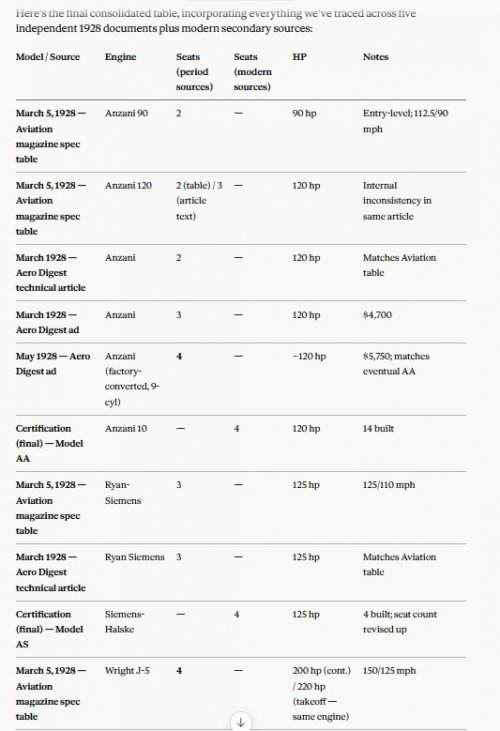
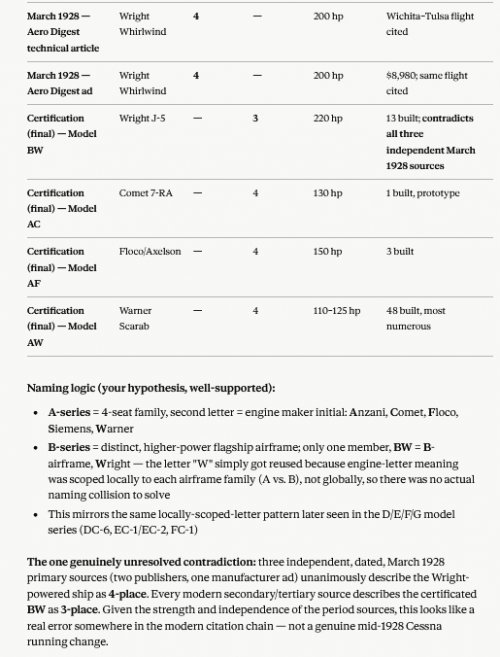
So, I have been mulling over the A and B series. Have quite a few original articles AND Cessna ads from 1928. I had some in depth conversation with my 'friend' Claude AI and came up with this list. I know I am late to the table but the gist is. The AA was 2, 3 or 4 seat and the BW was a 4 seat and not a 3 seat like many later documents tell you. The ads from Cessna contradict that statement.
Here is the evidence with the source references
 

Attachments

  • 1928 Cessna A and B series 20260718-001.jpg
    1928 Cessna A and B series 20260718-001.jpg
    167.9 KB · Views: 13
  • 1928 Cessna A and B series 20260718-002.jpg
    1928 Cessna A and B series 20260718-002.jpg
    167.4 KB · Views: 11

Similar threads

Back
Top Bottom