True, it's not as is if Montreal and Toronto are on the coast.

It's a long way from Halifax to the Northwest Passages, could the subs go to somewhere in Hudson Bay to resupply and do a crew swap to increase productivity?
There is Nanisivik, on Baffin Island. Which is what I expect would be used for that. Though anything that is supplied from there first needs to be supplied to there, which is a logistical job of its own.
 
A Sub tender could be an alternative option given the bottlenecks would be crews and transit distance/time.
 
... Esquimalt is not really much worse of a posting than Halifax, AIUI.

Based on what? Costs of base housing? Number of annual hurricanes? Ferocity of cherry-blossom blizzards?

CFB Halifax - January weather = average temp 0°C/-8°C; precip 11 days; humidity 73%
-- Snow depths of greater than 1 cm are seen on about 85 days each year in the HRM
CFB Halifax -- August weather = average temp +23°C/14°C; precip 11 days; humidity 84%-100%
-- Halifax has over 100 days of mist or fog each year.

CFB Esquimalt - January weather = average temp +8°C/+5°; precip 12 days; humidity 87%
-- Measurable snowfall (of any depth) on average about 4 days per year in the CRD
CFB Esquimalt - August weather = average temp +20°C/+13°C; precip 3 days; humidity 69%

All relative creature comforts aside, Fleet Maintenance Facility Cape Breton at CFB Esquimalt already specialises in submarine support. The question should be: Is it worth transferring all those specialities to FMS Cape Scott in order to reduce transit times to either NWP entrance? That should be the deciding question, not the perceived quality of basing.
 
Based on what?
Equal level of moaning by the guys I know who have been posted to both.

CFB Halifax - January weather = average temp 0°C/-8°C; precip 11 days; humidity 73%
-- Snow depths of greater than 1 cm are seen on about 85 days each year in the HRM
CFB Halifax -- August weather = average temp +23°C/14°C; precip 11 days; humidity 84%-100%
-- Halifax has over 100 days of mist or fog each year.

CFB Esquimalt - January weather = average temp +8°C/+5°; precip 12 days; humidity 87%
-- Measurable snowfall (of any depth) on average about 4 days per year in the CRD
CFB Esquimalt - August weather = average temp +20°C/+13°C; precip 3 days; humidity 69%
Good night, man you’re in Canada. Try saying either of those are a problem to someone based in Cold Lake. ;)
 
Australia has to invest over $3 billion in expanding US nuke sub yards as one of the prerequisites for being allowed to buy some. Is Canada willing to pay that sort of price

Australia's investing $3B into the US sub building industry to bring construction capacity up to the 2.33 boats a year necessary to cover both the USN's requirements AND Australia's 3 to 5 subs.

There are real questions as to whether the US yards can actually achieve that build rate, even with the extra investment. So increasing it even more to cover a Canadian buy might not be possible.
 
The western basing has caused problems with crew retention in the RAN, it might be the same for Canada.
Should be fine, they're right next to Victoria BC.


It's a long way from Halifax to the Northwest Passages, could the subs go to somewhere in Hudson Bay to resupply and do a crew swap to increase productivity?
Conceptually, absolutely. The US has done that for decades. Crew rotations in Rota or Holy Loch or La Maddelena or Guam or...

There is Nanisivik, on Baffin Island. Which is what I expect would be used for that. Though anything that is supplied from there first needs to be supplied to there, which is a logistical job of its own.
You've got plenty of warning for when it needs to arrive, it's not a huge problem to have it hauled up by ship.


A Sub tender could be an alternative option given the bottlenecks would be crews and transit distance/time.
I would absolutely expect a Sub Tender/repair ship to be based there. In addition to whatever shore-side repair facilities there are. Basically, same setup as on Guam, just up in Hudson Bay so a lot less tropical.
 
I worked in development and test of ARCI for Victoria back during initial install and spent a great deal of time with RCN submariners.

They are remarkably capable--but some of you guys are throwing out some crazy numbers. As I understand it, recruitment and retention numbers have been abysmal for at least a decade. Housing availability for many of these sailors is poor. Shoreside support is ehhh, lackluster at best.

They're really going to need a solid forward plan to resolve these issues before worrying about what fancy new boat to buy.
 
I worked in development and test of ARCI for Victoria back during initial install and spent a great deal of time with RCN submariners.

They are remarkably capable--but some of you guys are throwing out some crazy numbers. As I understand it, recruitment and retention numbers have been abysmal for at least a decade. Housing availability for many of these sailors is poor. Shoreside support is ehhh, lackluster at best.

They're really going to need a solid forward plan to resolve these issues before worrying about what fancy new boat to buy.
Yes, RCN/Canadian Armed Forces in general need to fix their recruitment and retention issues, badly!

But my numbers are what you'd need to have 1-2 subs out at sea in each ocean all the time (and therefore getting crews experienced in doing things). Strictly the strategic/operational/tactical level of "what Canada needs." Edit: Admirals saying "this is the area Canada needs to defend, what is required?" and then wishlisting if money was no object.

I'm not addressing how to pay for that many, or how to crew them, or how to keep them well-maintained; fixing those systemic issues will not be cheap or quick. And it will require cultural changes in DND as well, not shitting all over someone only enlisting for the standard 4 years active duty.

[consider there to be a full Sailor's vocabulary of profanity in just how bad the issues are, how urgently the fix is needed etc. several terabytes worth of profanity in each general concept.]
 
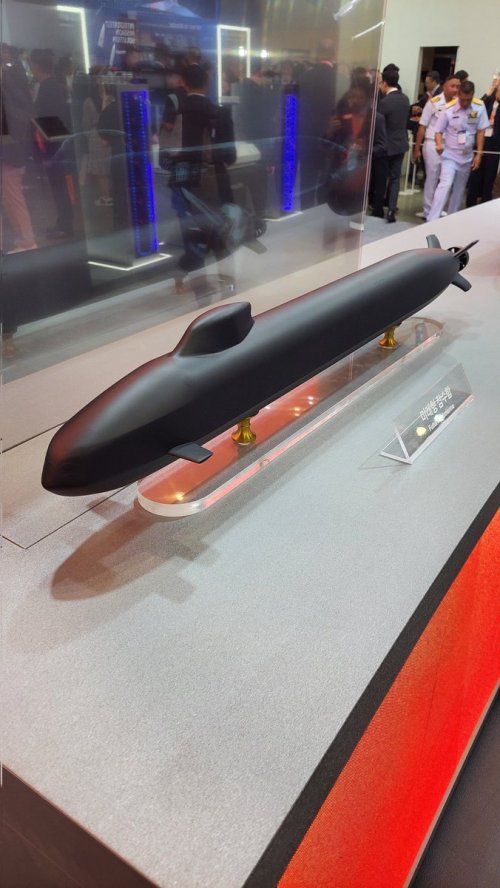
CANSEC is coming up and the South Koreans will have some major displays up. I think we'll héar a fair bit about their sub offering.
Between the RoK KSS-III and the Japanese Soryu/Taigei classes, I think Canada has some excellent options for Diesel-electric or AIP boats.

Conventional Barracuda would be another option, but I don't think DCNS has any spare production capacity.

Zero chance that the US would sell nuclear boats to Canada. Not when the two countries are technically in competition in the Arctic.
 
Between the RoK KSS-III and the Japanese Soryu/Taigei classes, I think Canada has some excellent options for Diesel-electric or AIP boats.
Japanese pulled out a while ago to focus on RAN frigate programme.


Japan also made it clear in late November, 2024 that it was not interested in competing with its various designs for the CPSP tender. This brings the realistic contenders down to Germany, France and South Korea, with the Swedish and Spanish trailing behind.
Unfortunate, the Soryu and Taigei class subs would probably be really good for Canada's needs.
 
Hanwha and Sth Korea in genaral experienced defence exporters these days, used to dealing with the requirements, demands and quirks of foreign countries. I doubt they freak out when the customer wants something, even if it sounds strange to them.

This was my concern when PM Abbott decided Australia would buy off the shelf subs from Japan back in 2013. Not that the subs were bad or unsuitable, but that Japan would have a constitutional crisis every time we wanted something. They'd agonise and delay rather than immediately work towards a solution, because they were not experienced dealing with complex arms exports.

 
Last edited:
Hanwha and Sth Korea in genaral experienced defence exporters these days, used to dealing with the requirements, demands and quirks of foreign countries. I doubt they freak out when the customer wants something, even if it sounds strange to them.

This was my concern when PM Abbott decided Australia would buy off the shelf subs from Japan back in 2013. Not that the subs were bad or unsuitable, but that Japan would have a constitutional crisis every time we wanted something. They'd agonise and delay rather than immediately work towards a solution, because they were not experienced dealing with complex arms exports.
Case in point: some years back the RN was looking for Speys for some of their older ships. IHI in Japan was still making them, RR not. IHI was approached, but the Japanese govt refused to allow the engines to be exported, due to their understanding of the postwar constitution.
 
Japan has since, relaxed a number of export restrictions but hasn't been largely successful in exports of major weapon systems.
I feel that by the time Japan began relaxing these restrictions, South Korea had already began establishing itself as the East Asian alternative for "western" weapons and is now even entering competitions in markets traditionally dominated by European or US options.
 
Japan has since, relaxed a number of export restrictions but hasn't been largely successful in exports of major weapon systems.
I feel that by the time Japan began relaxing these restrictions, South Korea had already began establishing itself as the East Asian alternative for "western" weapons and is now even entering competitions in markets traditionally dominated by European or US options.
And SK seems to have everything a modern military needs, in volume, and with reasonable delivery dates.
 
The ongoing political instability in South Korea may be eating into those seeming advantages though. And that is assuming the new president isn't a total disaster.
 
According to Japan's Ministry of Defense, the Self-Defense Forces' equipment was not developed to attack or kill.
 

Babcock has allied with Hanwha to provide maintenance and sustainment services for the submarines (It is the existing Canadian sustainment provider) while Norway has allied with the German bid offering to assist with parts and sustainment. Interesting also Korean Minister of Trade asked the Canadian government about a rumour that Canada would purchase six of each with the the Korean submarines based in the Pacific and the German submarines based in the Atlantic but the Canadians denied it.
 
a rumour that Canada would purchase six of each with the the Korean submarines based in the Pacific and the German submarines based in the Atlantic
That's not logistically terrible, but it's going to be significantly more expensive than buying a dozen of either one. Since you're basically buying at least one additional submarine in spare parts for each one.
 
Does Canada have any unique requirements for subs? Does the 212CDs meet these requirements?
Ideally, they'd like to be able to operate in the Artic and under the ice. But to make that a reality, they really need nuke boats. But since the US has a vested interest in Canada not being able to effectively operate in those waters, they've blocked every effort Canada has made to get nuke boats.
 
Are the operational areas in the north particularly distant from naval bases, so that Canada needs a huge sub like Australia's Collins? Or would a sub designed for the Baltic be good enough?
 
Are the operational areas in the north particularly distant from naval bases, so that Canada needs a huge sub like Australia's Collins? Or would a sub designed for the Baltic be good enough?
Some 90% of the Canadian population is within 100 miles of the southern border. Below 51degN.
 
Some 90% of the Canadian population is within 100 miles of the southern border. Below 51degN.

There's a naval base in Halifax, by sea it's about 4,000km from there to the mouth of Hudson Bay. This is a long way and would require a big conventional sub to conduct Arctic patrols in summer.

That said, Churchill might be used as a forward port in summer to reduce transit times for seasonal Arctic submarine patrols, which would reduce the extreme range requirement.
 
There's a naval base in Halifax, by sea it's about 4,000km from there to the mouth of Hudson Bay. This is a long way and would require a big conventional sub to conduct Arctic patrols in summer.

That said, Churchill might be used as a forward port in summer to reduce transit times for seasonal Arctic submarine patrols, which would reduce the extreme range requirement.
Yeah, RCN is going to have to set up or use a forward port for east-coast Arctic access, if not actively base subs up there (not entirely recommended due to effects on morale and recruitment).

They're SOL for a west coast forward base, what with how far south Alaska goes. Prince Rupert is the northernmost port town, and it's about 1000km from Victoria by boat. Then you have to get all the way around Alaska to get to the Arctic and that's a long haul.

So that 6+6 idea just took another hit, as you'd need to base long-range subs on the Canadian east coast for arctic access. And "long range" is not how I'd describe a Type 212. Now you'd be talking 8+4 or so. 4x boats on the Pacific, 4x "pacific boats" for Arctic work, and 4x Atlantic boats.
 
The tender requirement was submarines with a minimum range of 7,000 NM at 8 knots under diesel. Both should comfortably exceed that, the KSS 3 has a range of 10,000 NM while the range of the 212CD isn't known the much smaller 212A had a range of 8,000 NM.
 
The tender requirement was submarines with a minimum range of 7,000 NM at 8 knots under diesel. Both should comfortably exceed that, the KSS 3 has a range of 10,000 NM while the range of the 212CD isn't known the much smaller 212A had a range of 8,000 NM.

Did the tender requirements state an indiscretion rate?
 

Similar threads

Back
Top Bottom