Triton

Donald McKelvy
Senior Member
Joined
14 August 2009
Messages
9,704
Reaction score
3,626
Website
deeptowild.blogspot.com
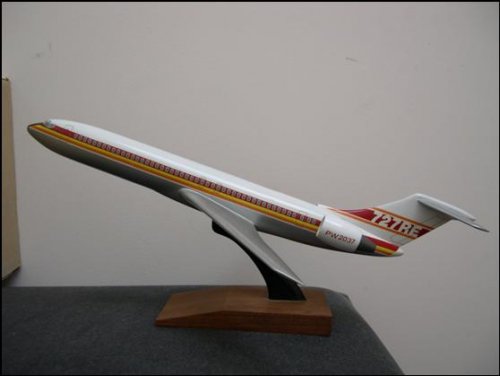
Model of Lockheed 727 RE circa 1980.

1/100th Pacmin Lockheed 727-RE Proposal c. 1980

A Pratt & Whitney proposal for a re-engine program of the 727-200 ADV using the PW2037 engine. The program was initiated by Lockheed, but never got off the ground primarily due to lack of support from Boeing. The PW2037 is an option on the 757-200, which is a much larger, albeit replacement aircraft for the 727-200

Source:
http://www.doraplane.com/index_files/Page1209.htm
 

Attachments

  • image12051.jpg
    image12051.jpg
    19 KB · Views: 412
Did Lockheed have in 1980 after the L-1011 any interest in developing a 727/MD-80 type airliner or was upgrade packages all they were up for
 
Boeing would have a word to say in that. Not sure a reworked 727 makes sense in a world of 737s ?
 
Some pictures showing a Model of the Lockheed (former Convair Division?) 727 RE were posted at SDASM Flickr Archives today on 2025-05-12 .
Here two appetisers in colour.
[...]
After looking at those pictures again, they show a "re-engine concept" for the Boeing 727, developed by Rohr, Inc., an aerospace manufacturing company based in San Diego at that time.
In my humble opinion, this concept does not originate from Lockheed or Convair. I sincerely apologize for any misunderstanding or inconvenience caused.
 
Last edited:
Still looks like a interesting concept though with the Boeing 737 and MD-80 later 737-NG very much available in the 80s and future MD-90 and MD-95/717 I'd imagine the market for a 727 RE would be minimum unless they could be completed under the mid/late 80s early 90s asking parice for a new 737 or MD-80/90 unless am missing something about the 727 they were popular
 
Rohr, Inc., an aerospace manufacturing company based in San Diego
As an example, they were to manufacture the Boeing SST (massive) engine nacelles, for the monster GE4 engines.
 
Still looks like a interesting concept though with the Boeing 737 and MD-80 later 737-NG very much available in the 80s and future MD-90 and MD-95/717 I'd imagine the market for a 727 RE would be minimum unless they could be completed under the mid/late 80s early 90s asking parice for a new 737 or MD-80/90 unless am missing something about the 727 they were popular
727s still had a lot of airframe life left (a good 20-30 years from 1980), but their engines made it difficult to comply with the proposed noise regulations at the time. Airlines later successfully negotiated staged noise regulations that would only come into effect when the 727s were pretty much out of life. My job as an A&P was doing heavy checks on 727s, and installing the hush-kits with the mixing chamber in the tailpipes of the new engines. So in 1998-99, 727s were still valuable enough to replace the engines for another 10+ years service!

Also, remember that 727s filled the same roles that 757s did.

Re-engining a 727 in general makes sense, even though the paperwork for that is a nightmare.
 
Too be honest I didn't think the 727 engine noise issue was a problem until 90/92
I think that there were proposals out there lurking, and actively getting fought by airlines and makers then. But the noise standards weren't codified until the 1990s.
 
727s still had a lot of airframe life left
Ah ok, I see the point: milking out 727 airframe to the last drop, by secondary airlines.

Volotea did something similar with 717s and MD-90 when they started. They bought the old aircraft at bargain prices and used them (almost) until the wings fell out. Nowadays they have switched to A319s.
 
Model of Lockheed 727 RE circa 1980.

Source:
http://www.doraplane.com/index_files/Page1209.htm
Wow.

My first assignment at Boeing-Seattle was to conduct and evaluate high-alpha wind tunnel testing (at the large Boeing-Vertol tunnel near Philth-adelphia) of a proposed 727-400 featuring aft-mounted twin engines. And then to assess the flight performance. In 1979!

Two candidate engines were examined: one was a derated PW2037 and the other, a GE CF6 variant. They had slightly different nacelle geometries hence the reason to assess the corresponding installation effects on aerodynamic drag and stability & control.

The 727-400 configuration had a stretched fuselage, but if memory serves, the stretch was different than the earlier 727-300 design concept, due to unique balancing requirements for the twin-engine arrangement, which included the removal of the 727 center intake, S-duct, and exhaust.

As far as I recall, Boeing had not yet addressed if the 727-400 would be offered as a retrofit change or only new production.

This 1979 Boeing project has not been discussed publicly as far as I can tell. The "727-400" concept mentioned on Wikipedia occurred a few years prior as the 7N7 program was evolving, and was a wing-mounted twin-engine configuration.

While I was working on the 727-400 preliminary design, full-scale 757 development was underway (in a nearby building at the Renton plant) following the launch orders from British Airways and Eastern Airlines in August 1978. Our team's analysis found that the operating cost per seat mile of the 727-400 was quite close to the 757, with a unit cost substantially less.

Not surprisingly, I was told that airlines were showing significant interest in the 727-400 instead of the 757, which Boeing had already committed big $$$ to develop.

The obvious question is why were Boeing's marketing folks showing the 727-400 concept to airlines in 1979? My guess is that the 727-400 was Plan B, if Boeing decided to cancel 757 development. Orders for the 757 had stalled -- the next major order would not be until November 1980 by Delta Airlines.
https://www.yesterdaysairlines.com/airline-history-blog/the-757-story-pt2-engines-sales

Sometime in 1980, Boeing management told my supervisor to stop work on the 727-400 activity. We worker-bees assumed the reason was that our effort was a direct threat to the 757, but that begs the question "why did Boeing leadership sponsor our project in the first place"? Cold feet due to bad 7N7 market analysis? Or did Boeing execs over-commit financially, with the concurrent development of the 757 down in Renton and the 767 up in Everett?

From reading the current postings, it looks like Pratt & Whitney approached Convair-San Diego (and maybe others like Douglas-Long Beach or Lockheed-Burbank?) about the same time Boeing halted its work. Fascinating.

 
Back
Top Bottom