
You are using an out of date browser. It may not display this or other websites correctly.
You should upgrade or use an alternative browser.
You should upgrade or use an alternative browser.
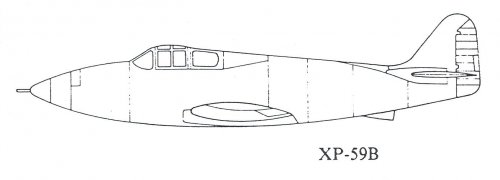
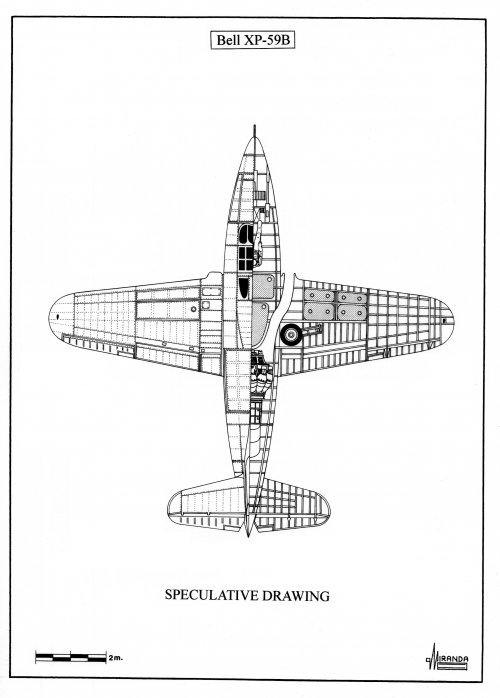
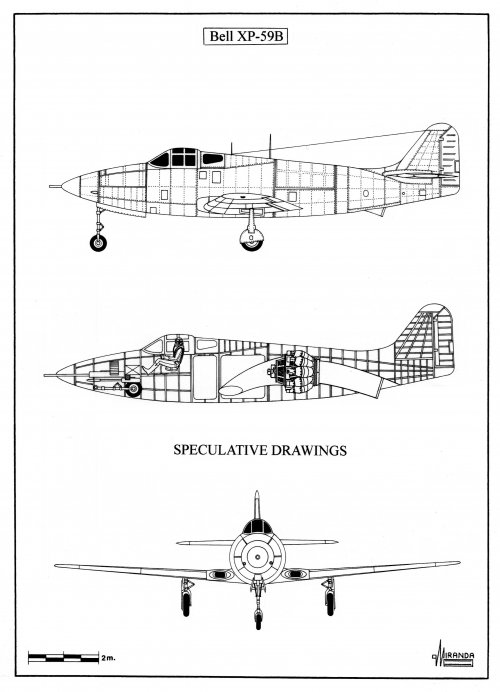
Bell XP-59B
- Thread starter Justo Miranda
- Start date

- Joined
- 25 July 2007
- Messages
- 4,916
- Reaction score
- 5,538
The story is widely circulated that the contract for, and data on, the GE I-63-powered* XP-59B design was transferred to Lockheed. The Skunk Works then applied that data to a refined concept powered by the Halford H.1 (later DH Goblin). The end result was the Lockheed L 140/XP-80.
Can anyone validate this story or know its origin?
[* Baugher says a single GE I-16/J31 ]
Can anyone validate this story or know its origin?
[* Baugher says a single GE I-16/J31 ]


Steve Pace
Aviation History Writer
- Joined
- 6 January 2013
- Messages
- 2,266
- Reaction score
- 271

- Joined
- 25 June 2009
- Messages
- 15,515
- Reaction score
- 9,447
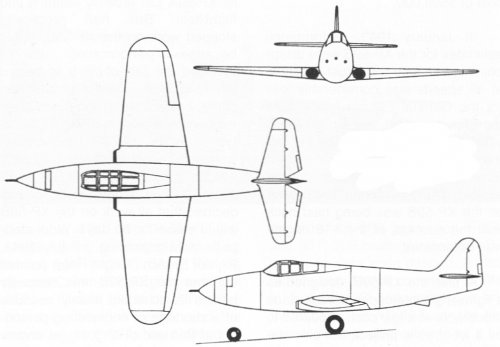
Steve Pace said:I found this online - anyone know who drew it? -SP
I could be wrong, but this looks like typical Green/Swanborough material to me.

- Joined
- 6 November 2010
- Messages
- 6,359
- Reaction score
- 8,240
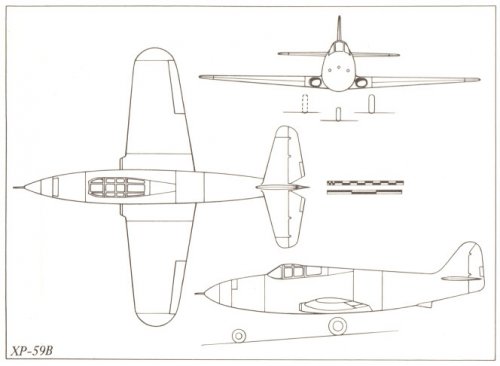
It looks very much like the XP-59B 3-view from 'Bell Aircraft since 1935' by Alain J Pelletier, Putnam, 1992.
Identical relative positions of front, upper and side view.
Solid black air intakes in front view, solid black tires, absence of wheel positions in front view and Putnam's size bar are the only differences.
Identical relative positions of front, upper and side view.
Solid black air intakes in front view, solid black tires, absence of wheel positions in front view and Putnam's size bar are the only differences.
Attachments
Steve Pace
Aviation History Writer
- Joined
- 6 January 2013
- Messages
- 2,266
- Reaction score
- 271
Thanks Skyblazer and Arjen. -SP
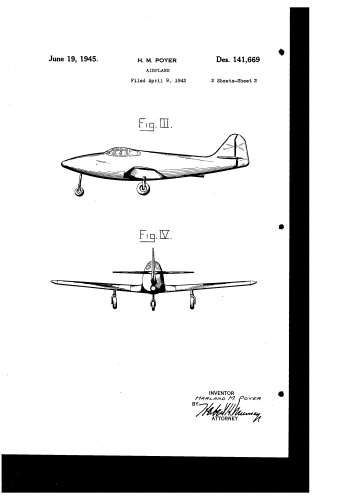
Steve Pace
Aviation History Writer
- Joined
- 6 January 2013
- Messages
- 2,266
- Reaction score
- 271
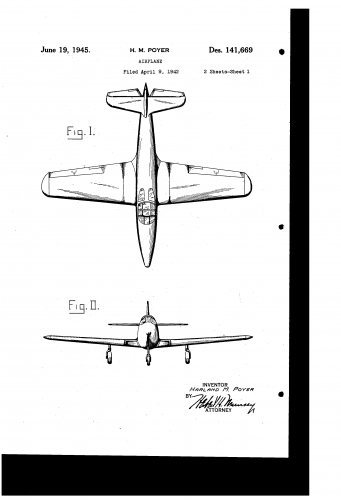
WOW! How cool is this!! Thanks so much!!! -SPsienar said:Related patent

- Joined
- 8 March 2009
- Messages
- 1,173
- Reaction score
- 1,744
Steve Pace said:WOW! How cool is this!! Thanks so much!!! -SPsienar said:Related patent
There is another from the same time and same people. Probably an alternate layout that was studied.
Attachments
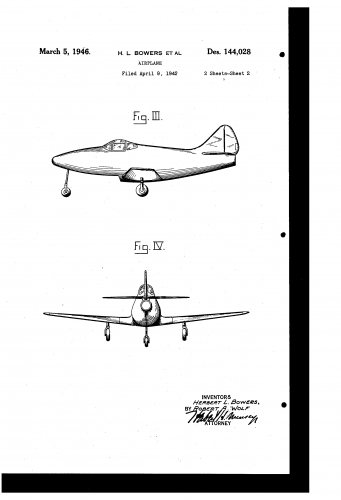
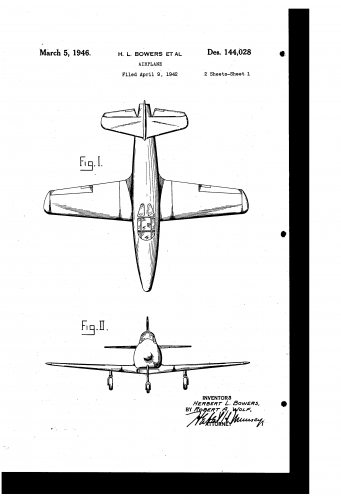
Steve Pace
Aviation History Writer
- Joined
- 6 January 2013
- Messages
- 2,266
- Reaction score
- 271
Very interesting, indeed. Thank you! I need your full name for proper crediting. -SPsienar said:Steve Pace said:WOW! How cool is this!! Thanks so much!!! -SPsienar said:Related patent
There is another from the same time and same people. Probably an alternate layout that was studied.
- Joined
- 25 June 2009
- Messages
- 15,515
- Reaction score
- 9,447
Steve Pace said:Very interesting, indeed. Thank you! I need your full name for proper crediting. -SP
Not that I mean to diminish anyone's contribution here, but all this patent art can easily be found on Google Patents with the proper keywords. It's not like somebody actually researched library archives and dug it out for all to see...
Anachronus
I really should change my personal text
- Joined
- 5 June 2013
- Messages
- 15
- Reaction score
- 14
That intake under the wing would have been a very bad idea me thinks.
The drawing Steve Page is askin' for more info (rep#4) is taken
from : Air Force Legends number 208 "Bell P-59 Airacomet"
Page 25 . A lot of contributors are mentioned but not
a particular one for the drawing.
from : Air Force Legends number 208 "Bell P-59 Airacomet"
Page 25 . A lot of contributors are mentioned but not
a particular one for the drawing.
- Joined
- 25 June 2009
- Messages
- 15,515
- Reaction score
- 9,447
lark said:The drawing Steve Page is askin' for more info (rep#4) is taken
from : Air Force Legends number 208 "Bell P-59 Airacomet"
??????
The book you're mentioning is on my bookshelf and it was written by... Steve Pace himself!!!
So why would he ask for more info about his own book?
Steve Pace
Aviation History Writer
- Joined
- 6 January 2013
- Messages
- 2,266
- Reaction score
- 271
Mr. Ginter inserted it after the fact and I asked him who it was by and he said he can't remember...."SO DON'T CREDIT IT."
- Joined
- 6 November 2010
- Messages
- 6,359
- Reaction score
- 8,240
Apart from the 1992 Bell title, Alain J Pelletier also wrote Putnam's 'Beech Aircraft and their Predecessors' in 1994.
Peter W Brooks wrote Putnam's 'Zeppelin: Rigid Airships 1893-1940' in 1992.
John Wegg wrote Putnam's 'General Dynamics and their predecessors' in 1990.
Hans G Andersson wrote Putnam's 'Saab Aircraft since 1937' in 1989.
In the Beech, Zeppelin, General Dynamics and Saab prefaces, the authors thank Carl G Ahremark for producing most/all of the general arrangement drawings.
Who drew the image - I believe that would be Carl-Gustaf Ahremark.
Peter W Brooks wrote Putnam's 'Zeppelin: Rigid Airships 1893-1940' in 1992.
John Wegg wrote Putnam's 'General Dynamics and their predecessors' in 1990.
Hans G Andersson wrote Putnam's 'Saab Aircraft since 1937' in 1989.
In the Beech, Zeppelin, General Dynamics and Saab prefaces, the authors thank Carl G Ahremark for producing most/all of the general arrangement drawings.
Who drew the image - I believe that would be Carl-Gustaf Ahremark.
- Joined
- 25 June 2009
- Messages
- 15,515
- Reaction score
- 9,447
Steve Pace said:Mr. Ginter inserted it after the fact and I asked him who it was by and he said he can't remember...."SO DON'T CREDIT IT."
Oh, okay... Thanks for explaining, it didn't seem very logical from the outside but now it makes sense!

Bell XP-59B
On August 27, 1939, the German jet prototype Heinkel He 178 V-1 was flown, powered
by one Heinkel-Hirth HeS 3B centrifugal flow turbojet, with 500 kgf static thrust and 3.9 feet of diameter.
Late in 1939, the Heinkel team in Rostock was working on the development of the
HeS 8 centrifugal turbojet, which was expected to be used to propel the He 280 fighters.
With a planned thrust of 700 kgf and a diameter 20 per cent shorter than the HeS 3, the
new turbojet required a great research effort and an extensive test program. Numerous
technical problems had to be solved before starting its large-scale production and the
HeS 8 suffered numerous delays. By March 1941, it only produced 500 kgf static thrust,
550 kgf by early 1942, and 600 kgf in early 1943.
The root cause was the reduction of the diameter, recommended by the aerodynamicists
to minimize the drag produced by the engine nacelles when installed under the wings of
the He 280. Trials experience revealed that the most effective way to increase thrust in
this type of turbojets was to also increase their diameter, to improve the performance of
the centrifugal compressor.
The British jet prototype Gloster E.28/39 (W4041/G) made its first flight on May 15,
1941, powered by one Power Jets W1 centrifugal flow turbojet, with 390 kgf static
thrust and 3.5 feet in diameter. In March 1942, the Power Jets W1A produced 525 kgf.
In early 1943, the Power Jets W2/500 produced 734 kgf and 770 kgf in August.
By mid-1943 it became clear that the future Bell P-59A fighter would not be able to compete in dogfight and speed with the piston fighters of the time, let alone the new Luftwaffe’s jet and rocket fighters.
In June 1943, the British turbojet de Havilland Halford H.1, with 4.2 feet in diameter, produced 1,225 kgf static thrust. With this power, it was possible to build a single-engined jet fighter, with the centrifugal turbojet installed inside the fuselage.
Bell's design team proposed the XP-59B, a single-engined derivative of the YP-59A with the wingspan reduced to 65 percent and the tail surfaces reduced to 93 percent.
The proposed armament for the new light fighter was one nose mounted 37-mm M4 cannon and two 0.5-in machine guns, but the USAAF decided to entrust its development to Lockheed.
Attachments

- Joined
- 26 May 2006
- Messages
- 38,288
- Reaction score
- 20,425
My dear Justo,
why you always repeat the same topic ?!,
https://www.secretprojects.co.uk/threads/bell-xp-59b.8075/
why you always repeat the same topic ?!,
https://www.secretprojects.co.uk/threads/bell-xp-59b.8075/

T. A. Gardner
ACCESS: Top Secret
- Joined
- 18 February 2021
- Messages
- 2,024
- Reaction score
- 3,576
With German turbojets in general, it didn't help that the engineers designing them had only limited access to turbine blade profile libraries as Germany didn't have any leading steam turbine / gas turbine manufacturers at the time. Their only source once the war started was Brown Boveri in Switzerland.
The US and Britain on the other hand, had a number of companies with vast turbine experience like Vickers, GE, Westinghouse, and de Havilland. This gave them a clear advantage in designing turbojets when they turned to it.
v. Ohain at Henkel took what might be called a Solomonic approach to the problem combining a centrifugal compressor section with an axial one to get the necessary compression ratios. BMW, after their near disastrous flight of the Me 262 V1, turned to Brown Boveri and spent about two years redesigning the compressor section on their 003 engine.
In the US, you had Nathan Pierce at Lockheed--Pierce was a protégé of Abner Doble a wizard in steam engineering--design the incredibly complex J 37 with 2 16 stage axial compressors (after trying mixed centrifugal, reciprocating, and even gear driven compressor sections) to get fuel economy close to what piston engines of the era gave but ended up being a complex failure.
So, these early jet engine developers all met with their problems, but the advantage lay with the Allies who had access to better materials and far more basic research than the Germans did.
The US and Britain on the other hand, had a number of companies with vast turbine experience like Vickers, GE, Westinghouse, and de Havilland. This gave them a clear advantage in designing turbojets when they turned to it.
v. Ohain at Henkel took what might be called a Solomonic approach to the problem combining a centrifugal compressor section with an axial one to get the necessary compression ratios. BMW, after their near disastrous flight of the Me 262 V1, turned to Brown Boveri and spent about two years redesigning the compressor section on their 003 engine.
In the US, you had Nathan Pierce at Lockheed--Pierce was a protégé of Abner Doble a wizard in steam engineering--design the incredibly complex J 37 with 2 16 stage axial compressors (after trying mixed centrifugal, reciprocating, and even gear driven compressor sections) to get fuel economy close to what piston engines of the era gave but ended up being a complex failure.
So, these early jet engine developers all met with their problems, but the advantage lay with the Allies who had access to better materials and far more basic research than the Germans did.

If Linnaeus had not been so obsessed with classification, he might have discovered evolutionmerged topics
Similar threads
-

-
-
-
Bell Aircraft's twin-boom fighter projects (XP-52, XP-59, etc.)
- Started by Jschmus
- Replies: 55
-
some photo or artist impression about CURTISS xP-60
- Started by blue max
- Replies: 23