Bell L-39
On March 17, 1947, the U.S. Navy cancelled the contract of the STOL flying saucer Chance Vought XF5U-1.
The year 1947 was incredibly special. Just five days before the cancellation of the program, the doctrine to contain the Soviet expansion was announced to Congress by President Harry S. Truman.
The Cold War had started.
On May 22, the President signed an Act of Congress that implement the Truman Doctrine.
On June 4, the first Mogul balloon was launched, five days later the U.S. attaché in Moscow informed the War Department that the Soviets had begun the serial construction of the Horten Ho VIII flying wing bomber.
On June 26, the U.S. newspapers first began using the term flying saucer.
The Roswell incident occurred on July 8.
On July 26, the President signed the National Security Act (NSA 47) creating the Central Intelligence Agency (CIA) and the National Security Council (NSC).
The first North American F-86 swept wing fighter was flown on October 1, thirteen days later the Bell X-1 experimental rocket plane flew faster than the speed of sound, but it was a record that was kept secret.
On December 30, the Soviet swept wing fighter MiG-15 made its first flight.
While the USAF might have been enthusiastic with the swept wings of the F-86 jet fighter, the U.S. Navy had concerns about the low-speed handling characteristics of this configuration in carrier operations, because approach to the deck must be as low as a speed is possible.
During the invasion of Japan ‘Operation Olympic’, planned for May 1946, the Allies expected to suffer a high number of causalities by the suicide jet bombers of second generation Kawanishi Baika (740 km/h-460 mph) and Kugisho Ohka 43 (596 km/h-370 mph).
The U.S. Navy needed fast interceptors to protect the invasion fleet, but the high fuel consumption, low power at take-off and poor reliability of early jet engines did not make them attractive for use in carrier-borne planes.
On May 28, 1945, the Navy approved a production contract for 100 North American FJ-1 Fury jet fighters. The XFJ-1 prototype was flown on September 11, 1946, powered by one General Electric GE-2 (TG-180) axial flow turbojet rated at 1,730 kgp (3,820 lbf) thrust. The first production FJ-1, with 4,000 lbf. Allison J-35 axial flow turbojet was delivered in October 1947 but only 30 airplanes were built.
On March 10, 1948, one FJ-1 made the first carrier landing in the U.S.S Boxer (CV-21). Five months later the Fury entered service with the VF-5A (VF-51) naval squadron for a jet familiarization program. In May 1949, the VF-51 started an operational training trip aboard the U.S.S. Princeton (CV-37), the results were not good, one of the aircraft was destroyed and the rest were damaged.
The disastrous evaluation led to a quick retirement from active service by July 1949. The Essex-class carrier deck was 862 feet long and the Fury had a take-off run of 840 ft.
The deck takeoff performance would be critical, early jet engines had a low thrust-to-weight ratio and a slow response to throttle in contrast to the rapid response of the piston engines. Poor acceleration requires long takeoff rolls and high approach speeds.
The U.S. Navy concluded that slower acceleration by jets during the take-off was not recommended and flush deck catapult departures became standard practice, but the old escort carriers might be unable to accommodate jets.
Vought also offered its VS-340 model in the fall 1944 competition; the design proposal was accepted, and the Navy ordered three prototypes under the denomination XF6U-1 Pirate. The first prototype was flown on October 2, 1946, underpowered by one Westinghouse 24C axial turbojet with 3,000 lbf static thrust, and 30 production aircraft were ordered in February 1947.
The Pirate development was slow, the first production airplane was flown on July 29, 1949, powered by one J 34-WE-30 axial turbojet, rated at 4,224 lbf, with afterburner and excessive fuel consumption rate. The aircraft was entirely inadequate for carrier operation, because of its low performance and 0.3:1 thrust-to-weight ratio. The available takeoff thrust would be less than that of propeller-driven fighters, a problem that forced the cancellation of production.
The introduction to squadron service of the McDonnell FH-1 Phantom on August 11, 1947, could have solved the problem helping to dispel the belief that a jet was unsuitable for carrier operations. The FH-1 was a very safe airplane, powered by two J 34-WE-30 turbojets, with 370 ft take-off run and 360 ft took-off run. The Phantom could fly at low speed for carrier operation but had a top speed of 485 mph only, against the 647 mph of the MiG-15 Soviet fighter. All the 62 airplanes produced were out of service in 1949.
The Soviet Union started the first major crisis of the Cold War with the Berlin Blockade on June 24, 1948.
Confronted with the Chinese revolution, the 1948 presidential election and the end of American atomic monopoly in 1949, the Truman administration moved to escalate its containment doctrine and quadrupled its spending on defense.
On July 29, 1948, the President approved construction of five supercarriers, with 68,250-ton displacement and 1,090 ft (330 m) length, able to carry a group of large nuclear bombers, the most effective weapon of the day, and a new type of swept wing fighters of the F-86 class.
The construction of the USS United States (CVA-58) started on April 19, 1949, with an estimated cost of US $ 189 million, but the USAAF managed to cancel the entire program in favor of the B-36 intercontinental bomber, at the cost of US $ 5.76 million for each plane.
With this operation, the Strategic Air Command kept its monopoly on nuclear weapons delivery until the approval by the Congress of the new USS Forrestal (CVA-59) in April 1950.
During that time, the US Navy was forced to operate with the Essex and Midway-class carriers, straight wing fighters and Lockheed P2V-3C Neptune medium bombers.
The straight wings permitted better handling at lower speeds necessary for carrier operations, but the U.S. Navy needed faster fighters and had no flight data to indicate that this could be done with a swept wing fighter.
In early 1946 the U.S. Navy Bureau of Aeronautics issued a specification calling for a flying aerodynamic demonstrator to explore the behavior of swept wings in the low end of the speed range.
Grumman proposed a modified Wildcat with elongated fuselage and nose landing gear; Bell proposed a modified P-63 that offered lower development costs.
A contract was awarded to Bell Aircraft Corp. for the construction of two prototypes.
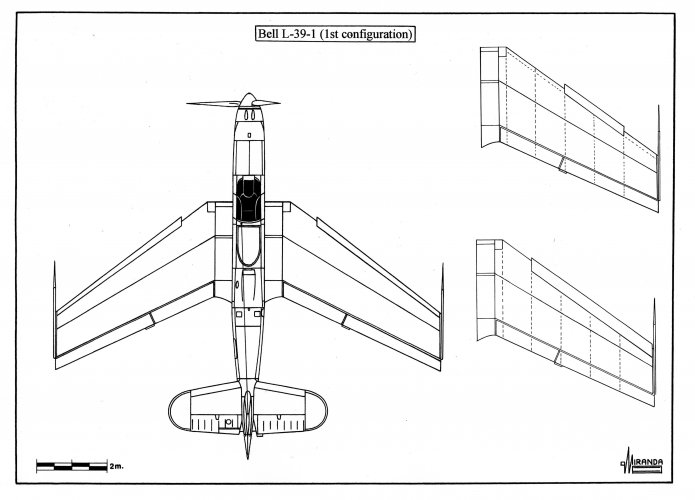
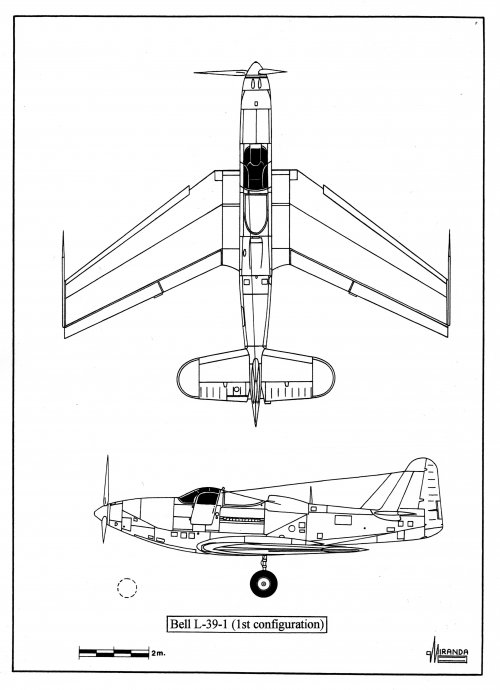
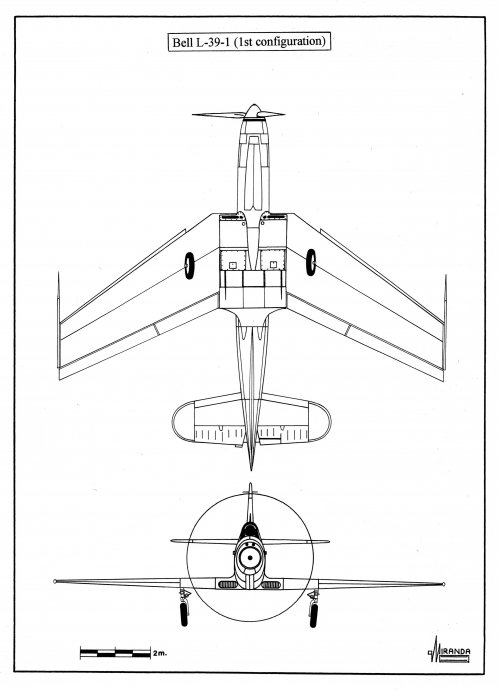
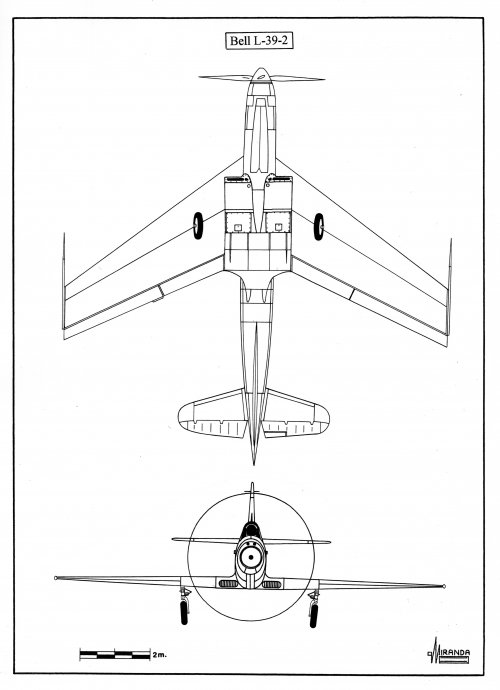
The L-39-1 (Bu Aer nº 90060) was a P-63N modified with outer wing panels from a P-63 E wedge mounted with 35-degrees swept back along the 25 percent chord line, 33-degrees at the leading edge, 25-degrees at the trailing edge and zero dihedral angle. Squared wingtips, parallel to the line of flight, were added. These new wings were attached to an unswept center stub section. A flight instrumentation boom was mounted in each wingtip.
The nose leg was still retractable but the main undercarriage members were fixed down, canted inward due to zero dihedral angle of wings, and the wheel wells were skinned over.
Leading-edge slats could be bolted open or closed, in five positions along the full length of the outboard panel, before each tests flight.
Both wings were tufted with white cotton strings to visualize the air flow, that were photographed by means of two 16-mm cameras mounted on the top of the canopy.
To maintain the c.g. position, ballast was added in the rear fuselage, nose armament was deleted, and the four bladed airscrew was replaced by a lighter one seized from a P-39Q, saving nearly 360 kg.
Plexiglass canopy aft the pilot seat was replaced by a metal sheet.
The prototype was flown on April 23, 1946, showing heavy longitudinal stability and unacceptable stall characteristics at low speeds, that caused the aircraft to roll to one side. This led to standard use of leading-edge slats.
The aircraft may be difficult to fly during takeoff and landing. At low speeds, the wing generates high dihedral effect and large ailerons deflections being required to correct the effects of rudder movement.
Different leading-edge slots configuration was tested, and the best stall characteristics were found between 60 and 80 percent slotted wings, but with 100 percent results were unsatisfactory, with dangerous rolls.
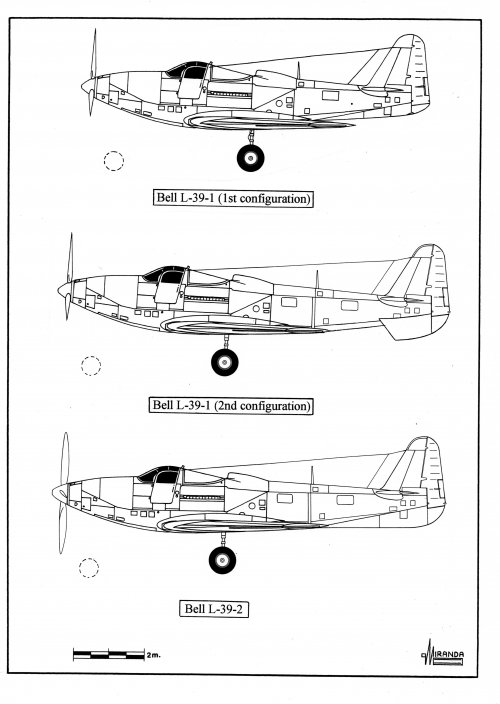
After the first several flights, the fuselage was stretched by introducing an additional monocoque section, 1.2 meters long, mounted behind the engine. The entire aft portion of fuselage was tilted up 4-degrees with a reduction in angle of incidence. This modification increased the moment arm of the tailplane to provide more pitch authority.
To help alleviate the dutch roll tendencies, the aircraft was fitted with a very large ventral keel.
Bell L-39-1 technical data
Wingspan: 11.21 m, length (1st): 9.96 m, length (2nd): 11.23 m, height: 3.21 m, wing area: 23.2 sq. m., max weight: 3,460 kg, max speed: 565 km/h, service ceiling: 7,900 m, power plant: one Allison V-1710-93 liquid cooled V-12 engine rated at 1,325 hp.
Painting scheme: Overall Glossy Sea Blue (FS 15042) with Flat Black wing walks, star and bars insignias applied in four positions.
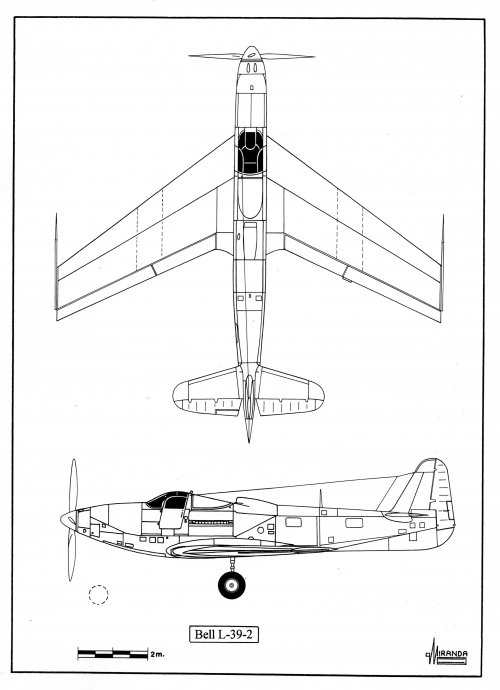
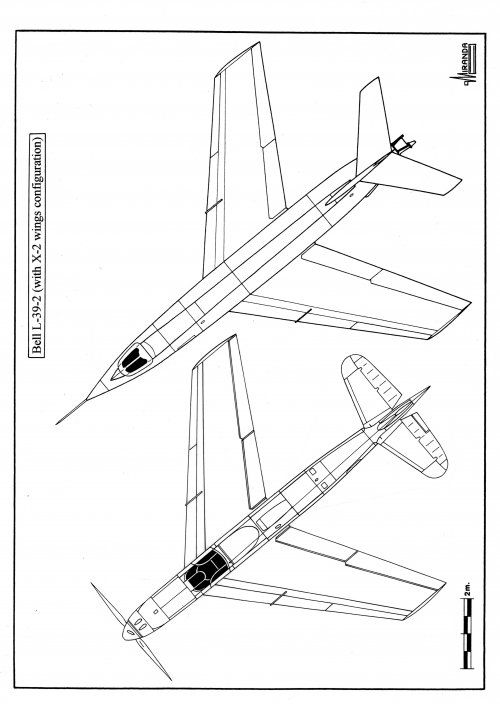
The second prototype L-39-2 (Bu Aer nº 90061) was a P-63-A-9-BE with the same modifications as the L-39-1, but with a four-bladed propeller and an even larger ventral keel.
This aircraft was flown in the spring of 1946 equipped with an automatic fuel equalizer designed to maintain a constant c.g. in flight. Several configurations of leading edges were tested on both prototypes to retain airflow over the wings at low speeds, increasing controllability.
On August 26, 1946, both prototypes were delivered to Langley Field for more comprehensive flight tests performed by pilots of the National Advisory Committee for Aeronautics (NACA).
This extensive program included many gathering flights, engine checks, stability, stall and aileron rate of roll investigations, tuft photography and airspeed calibration.
Aircraft were tested with 40 to 80 percent span fixed slats to improve the airflow over the aileron region at high angles of attack.
In September, the L-39-2 was fitted with a new supersonic wing under USAF sponsorship. Modifications included the addition of a sharp leading-edge made of wood and glued in place, which gave a bi-convex section like the supersonic wing of the Bell X-2 experimental rocket plane.
Between September and December 1946, the prototype was tested and the was also used to train X-2 pilots in stable landings at low speed.
During the first flight with the new wings, it was found that the position of the c.g. had changed due to the increase in the wing chord and it was necessary to make further modifications to regain longitudinal stability. Tests showed that the X-2 wing was safe at low speed and the program was canceled on August 26, 1947.
Both prototypes were scraped in 1955.