
Johnbr
ACCESS: Top Secret
- Joined
- 6 May 2007
- Messages
- 753
- Reaction score
- 385
Last edited by a moderator:



Yes. New phone and fingers of a fool!Harrier, did something go wrong when you posted your previous reply? All I see is a quote from Zootycoon...
So all the wings were fine?PA1 wing center section was fitted to Fuselage on a (Thursday, I think) afternoon/evening overrunning it’s original allocated time by about six hours due to problems with tool access to the forward/aft tie rods pins. It’s absurd to claim you could see this moment in a photo. Equally it’s absurd to claim that a six hour build time overrun was responsible for a ten year delay. Please consider:- (not so) Smart Procurement, Unrealistic initial assumption of cost/as to where the engineers were coming from, leading to a slow ramp up in manpower, poor decision making during delays, leading to missed timing of production capacity, hence an inability to get parts to the assembly line, when built the flight test finding of an aileron control circuit that was too heavy leading to it being designed/made/qualified/flown two further times <each of these cycles taking about 18 months >and finally the referencing of the refuelling safety case to MR2 experience. = ten years of delay
(note also many of those involved knew that when this project was delivered they were redundant)
So many people have repeatedly claimed such nonsense about various aspects of the project it’s now very difficult for people to see truth.
And I only want to know the real story. I don't think we have it, but I did do some work with the Nimrod design team at the time and saw some things too. For getting things like Team Tempest right this stuff needs to come out so I am very happy to hear about what you saw.Harrier
I don’t really care about what you’ve told, I’m only telling you what I saw.


but there again welcome to the deep joy of component obsolescence.


Don't get me started... my exceptionally brief brush with the project was in 2006. A friend of my then girlfriend was working on the maintenance e-learning materials at Warton and as I was then heavily involved in e-learning design a visit to have a look at the system in development was arranged during the 2006 Friends and Family day. I was somewhat shocked to discover the system had been written in a programme (Adobe/Macromedia Authorware*) that hadn't been updated in over three years and was widely expected in the community to be for the chop, in fact being end of lined less than 12 months later...but there again welcome to the deep joy of component obsolescence.
Not to mention software development!

Do you really kitnut617; it's such a odd-looking aircraft (subjectively). I worked on the MR.4 presentation models in 1/100 scale in a previous career; I recall we had to produce new moulds for the entire model as it was impossible design the new wings to fit our existing Nimrod fuselage mouldings. We also produced the MR.4s in 1/24 (or was it 1/36?) scale, it was a long time ago now......Thanks Chris and that is a pity, I would really like to convert one of my models into the MR.4
Robert

You might like to read AM Sir Richard Johns' comments on the MRA.4 in the latest RAF Historical Society Journal.
Chris
After all they had previously drawn up a Nimrod with four externally hung RB.410s. The question that should be asked here is why was burying the 30% larger engines considered a good idea?
Chris
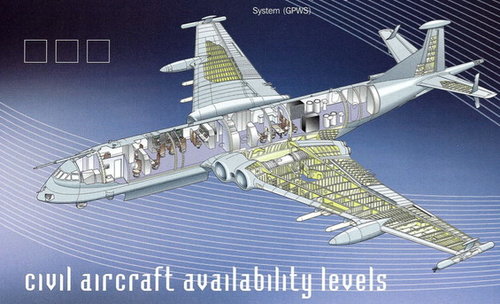
As far as I was aware wing fit was never a problem - tabloid bolleaux like the Typhoon name - and I say nothing about that in Nimrod's Genesis. Was never mentioned on my visits to Woodford. However, burying BR710s and fitting around them was. You'd think that the feature that killed the Comet (aside from metal fatigue, discuss) as an airliner and made the 707 and DC-8 (and every other airliner since) successful would have had some influence on the design team. After all they had previously drawn up a Nimrod with four externally hung RB.410s. The question that should be asked here is why was burying the 30% larger engines considered a good idea?
Chris
Do you really kitnut617; it's such a odd-looking aircraft (subjectively). I worked on the MR.4 presentation models in 1/100 scale in a previous career; I recall we had to produce new moulds for the entire model as it was impossible design the new wings to fit our existing Nimrod fuselage mouldings. We also produced the MR.4s in 1/24 (or was it 1/36?) scale, it was a long time ago now......Thanks Chris and that is a pity, I would really like to convert one of my models into the MR.4
Robert
Terry (Caravellarella)

Plus styrene is easily cut up and modified

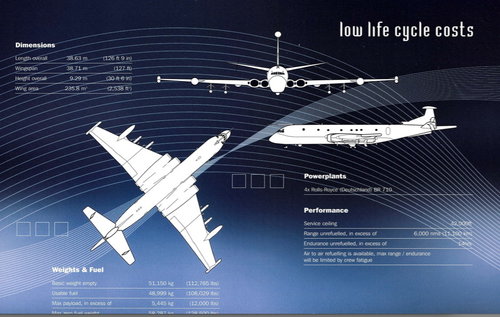
I've read that the MR.4 was designed to take Spey engines, I've also read that the Nimrod R.1 also was powered by Speys but that aircraft didn't need new wings --
Dear Boys & Girls, is there any truth in the "story" (recounted by my late best friend) that one of the MR.4 airframes was dropped onto the floor of an anechoic chamber/hangar at Woodford. It fell some height and was damaged beyond repair; perhaps it fell from a hoist or was knocked-off trestles/stands (I don't know the correct jargon).
Terry (Caravellarella)
As I recall, the MRA.4 was to have new wings with the parts outboard of the engines built to the same external shape as the original Nimrod, ie 1940s Comet vintage. This was because by the time that Plan A to re-use the original wings was abandoned, there wasn't time to do an aerodynamic redesign. This did not sit well with the BAe wing aero designers who had produced the state-of-the-art Airbus wings. In 1999, I was in line to do a complete drag audit of all the MRA.4 aerials and other bits and bobs, rather a lot of those, but was shifted to another job in the nick of time.
What company did you work at when you built the models Terry ? if you don't mind me asking.
I've read that the MR.4 was designed to take Spey engines, I've also read that the Nimrod R.1 also was powered by Speys but that aircraft didn't need new wings --
As far as I was aware wing fit was never a problem - tabloid bolleaux like the Typhoon name - and I say nothing about that in Nimrod's Genesis. Was never mentioned on my visits to Woodford. However, burying BR710s and fitting around them was. You'd think that the feature that killed the Comet (aside from metal fatigue, discuss) as an airliner and made the 707 and DC-8 (and every other airliner since) successful would have had some influence on the design team. After all they had previously drawn up a Nimrod with four externally hung RB.410s. The question that should be asked here is why was burying the 30% larger engines considered a good idea?
Chris
Bill Gunston's book, 'Nimrod, the centenarian aircraft' says the underwing engines were rejected as 'the tailplane couldn't handle the increase in pitch moment from the lower thrust lines'.
why did it need four engines anyway (rhetorical question, but I'm interested in the answers)