Part 1 - December 1969 to August 1972
In 1965, the technical research department at OKB-51 Sukhoi received the first information about the start of development of a prospective tactical fighter programme for the US Air Force from US periodicals. No specific details were published of what its characteristics might be, so a file was created, but no more action taken.
The second half of the 1960s saw the US get increasingly embroiled in a war in Vietnam. The Soviet VVS watched with interest the clashes between the F-4 Phantom and older MIGs. The VVS was working hard on a new fighter, the MiG-23, which was intended to match the F-4 Phantom's technical capabilities with radar and beyond-visual-range (BVR) missiles.
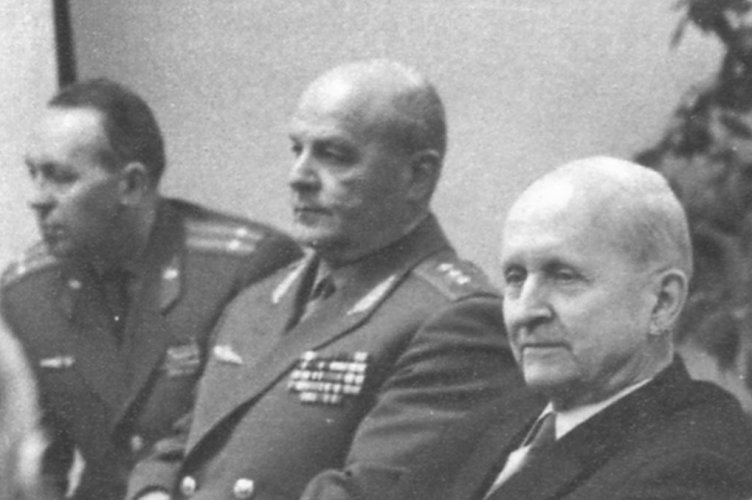
In March 1969, with the first MiG-23s on the cusp of entering service, the newly appointed head of the Soviet Air Force, P.S. Kutakhov - a decorated World War II fighter ace - instructed his first deputy, Colonel General A.N. Efimov, to explore the topic of the future development of fighter aircraft after the MiG-23.
The task of drafting the requirement or "tactical and technical specifications" (TTZ) for a new frontline fighter was assigned to Major General-Engineer V.R. Ephraim, head of the Air Force’s 1st Directorate.
Within the USSR’s military-industrial complex, the responsibility for both foreign aircraft intelligence and defining new aircraft TTZ fell to the Central Research Institute of Aviation and Space Technology (TsNII-30). Ephraim therefore referred the matter to TsNII-30 for action. TsNII-30 was at that time led by Z.A. Joffe, who was replaced later in 1969 by Aviation Lieutenant General A.P. Molotkov. Oversight of the new fighter initiative was also provided by Colonel General A.N. Ponomarev, deputy chief of the Air Force Committee (himself later replaced in 1971 by M.N. Mishuk).
TsNII-30 had already gathered and analysed extensive data on new and planned foreign supersonic, all-weather, multirole fighters as part of its standard intelligence gathering remit. The developers of the TTZ focused particularly on the Saab Viggen, the VFX program (which led to the F-14), the FX program (resulting in the F-15), and Northrop’s private-venture P.530 lightweight fighter. Common features of these aircraft included:
The following key requirements were established early on:
The draft TTZ was forwarded to the 2nd Central Scientific-Research Institute of the Ministry of Defense (2 TsNII), which handled development of requirements for PVO air defence equipment including fighters. Lieutenant General A.E. Borovyov, who became head of 2 TsNII in May 1969, was supportive of the idea of a unified aircraft for the VVS and PVO provided it did not interfere with his Ye-155MP (MiG-31) program, this program already having been approved in April 1968. Colonel B.M. Dolzhenko, head of the Aviation Department at 2 TsNII, largely endorsed TsNII-30’s basic specifications but introduced some modifications and additional requirements specific to PVO needs:
This internal debate delayed the PVO’s response to the TTZ proposal for several months, prompting the General Staff to intervene in mid-1969. The issue was escalated to the Council of Ministers, which involved the Ministry of Aviation Industry (MAP) and other Government departments, to speed things up.
In mid-1969 Sukhoi’s technical research department noted a sharp increase in articles in Western, primarily American periodicals on the progress of the US FX program which provided for the creation of a new tactical fighter and air defense interceptor. At that time, it was believed that this aircraft would replace all aircraft of this class already in service with the US Air Force, and the articles described some of the intended characteristics of the design. Some details and pictures of the competing designs were published.
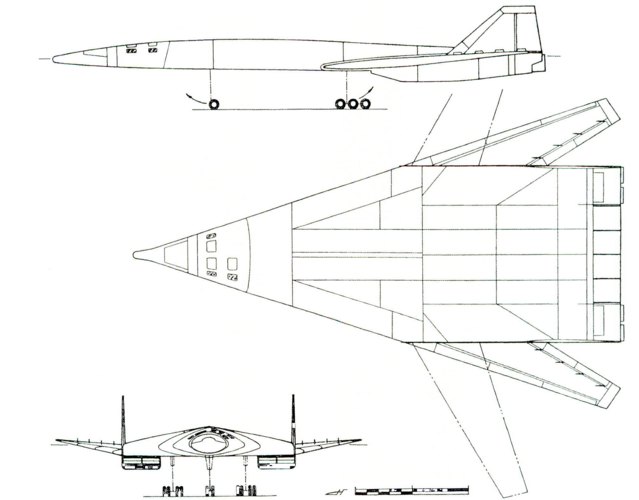
However, Sukhoi were fully occupied with other design work on T-4, T-6 and T-8, and again no action was taken on a new fighter. Sukhoi did however develop a very novel layout for the T-4MS bomber design which achieved an unheard lift/drag ratio of 17.5 in TsAGI wind tunnel tests where the entire fuselage was a lifting wing surface with engines slung underneath in widely spaced nacelles and outboard VG wing panels. This layout was patented in July and August 1969.

Finally, in the autumn of 1969, an interagency meeting was held at TsNII-30 with representatives from the Ministry of Defence and Ministry of Aviation Industry (MAP) and other research intitutes. This meeting was a preliminary one, as the requirement was still not finalised and no aircraft design bureaus (OKBs) were present at this meeting. MAP supported the idea of a unified fighter for VVS and PVO, as it would streamline production and reduce costs. Unexpectedly, however, A.M. Batkov, deputy head of the Research Institute of Aviation Systems (GoNIIAS), argued against full unification of requirements, but not on the division of VVS/PVO but on size. He proposed rather the development of two classes of fighters:
In November 1969, Oleg Samoilovich, head of the design department, perhaps knowing of the still-brewing TTZ, judged that it would be prudent to start work on a potential counter design to the US FX. Workload remained high on existing programs, so initially Vladimir Antonov was the only engineer tasked with looking into the topic alongside his standard duties on the T-6.


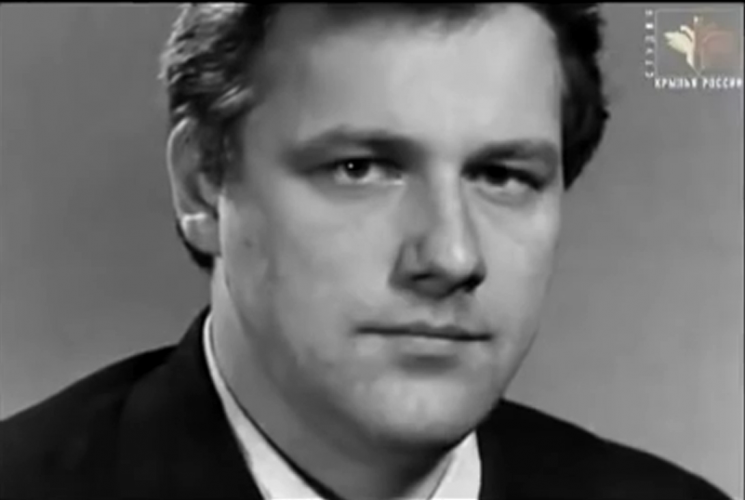
Vladimir Antonov was initially working largely alone on the new fighter design. His initial wing sketches were inspired by a 1960 British report into a sinusoidal wing shape.
Now, technically the Soviet OKBs were expected to rely on TsAGI for basic research into aerodynamics, but in Sukhoi there was a belief that TsAGI was often just replicating work already done by NASA and other Western scientific establishments. Sukhoi's technical research division was adept at keeping engineers up to date with the latest foreign reports and trends, so there was a general feeling that one could get basic research 'from the horses mouth' without waiting for TsAGI to repeat things. This would cause some animosity on both sides, and Sukhoi increasingly worked with the SIBNIA institute for wind tunnel testing.
In December 1969, Oleg Samoilovich suggested to Antonov to consider the T-4MS lifting body or 'integral' layout due to its demonstrated high lift/drag capability, and also mentioned a 1960 British Technical Report into sinosoidal (ogival) wings. Antonov started drawings based around combining these two core ideas.
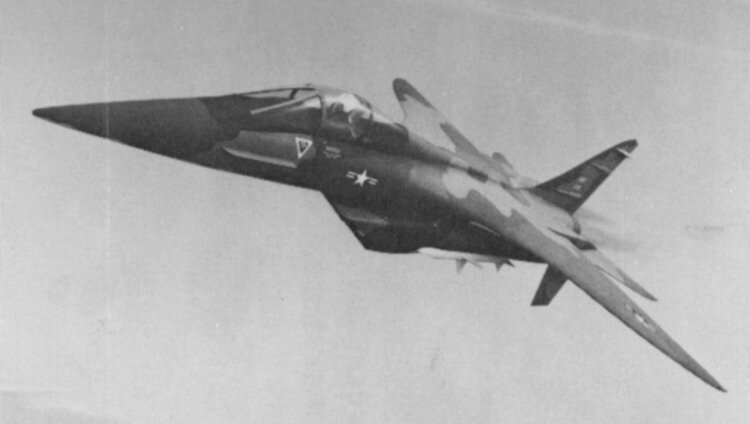
In his memoirs Oleg Samoloivich noted that "During the design process, we had quite detailed information from the open foreign press about the layout schemes developed in the USA under the F-15 program. Frankly speaking, I liked the layout scheme of the Northrop [sic - he means North American Rockwell] company, which was similar to ours, and I was afraid that this particular project of theirs would win the competition. And when it was announced that the McDonnell company had won the competition, I breathed a sigh of relief".


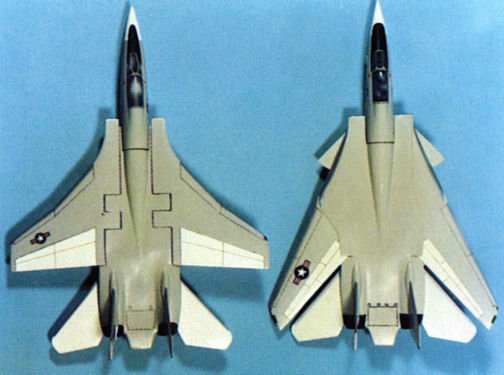
These artist's impressions of North American Rockwell (left) and McDonnell-Douglas (centre, right) F-15 designs were published in Western publications around the time of the F-15 contract award
Mikoyan OKB likewise started investigations into a new fighter towards the end of 1969, likely again triggered by the award of the FX contract to McDonnell-Douglas. Traditionally, Mikoyan had very close links with TsAGI, and so early on engaged with TsAGI on recommended aerodynamic configurations.

Aerodynamic designs considered by Mikoyan for the Ye-155MP / MiG-31. The second from left design has folding LERX for supersonic stability, not subsonic agility.518-55, fourth from left, strongly resembles the initial MiG-29 design.
It appears that Mikoyan reused their 518-55 Ye-155MP design as the starting point for their "Counter-FX" MiG-29.


Mikoyan's 518-55 Ye-155MP (left) and 1970 MiG-29 design (center, right) are rather similar, though the MiG-29 was smaller and lighter weight.
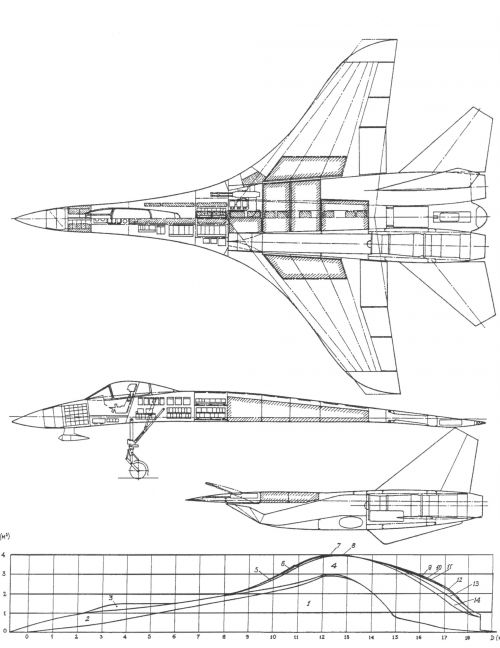
Antonov was struggling to integrate the different ideas of wing shape and integral layout into a design. In January 1970, Antonov, Oleg Samoilovich, Valery Nikolayenko (T-6 / Su-24 Chief Designer) and Leonid Bondarenko (T-4 Chief Designer) worked together over a weekend to come up with a coherent new fighter design layout. This formed the basis of the initial T-10-1 design.
In February 1970, the new Sukhoi fighter’s layout drawings and calculations were done. Models were built for initial wind tunnel tests.


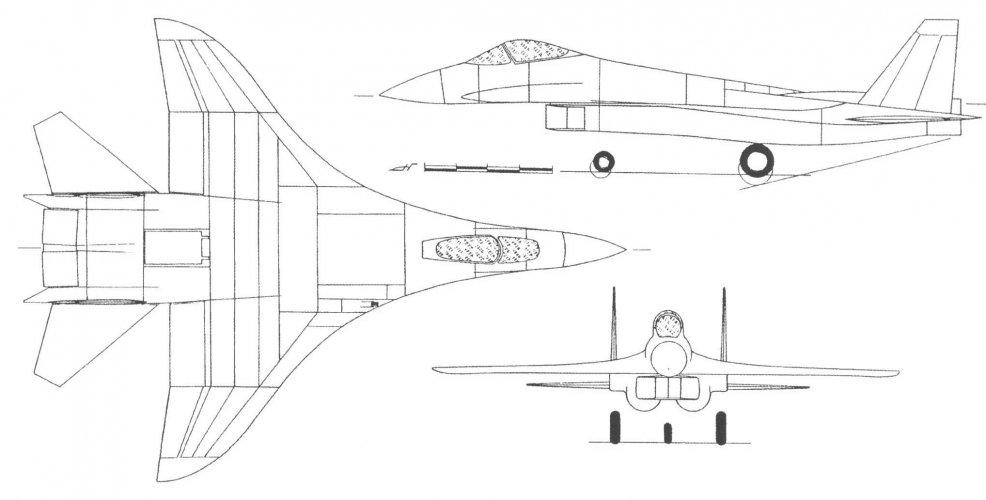
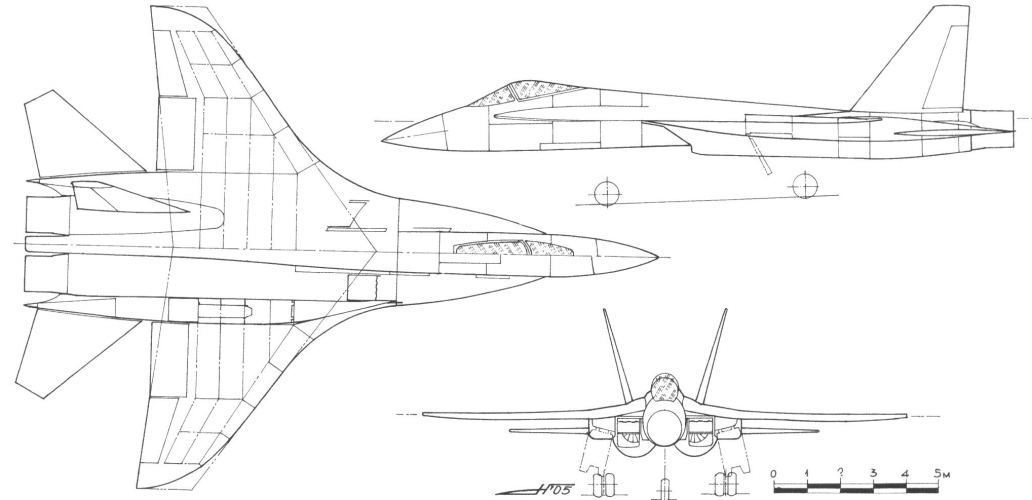
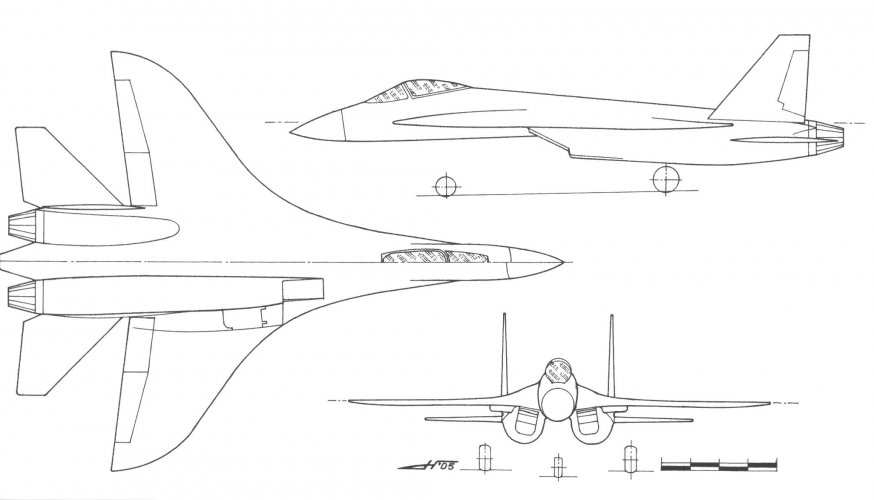
The first T-10 layout from March 1970. Wing area was 57 m2, with a normal take-off weight of about 22 tons.
By March 17, 1970, Marshal Batitsky had responded to the General Staff’s inquiry, endorsing the creation of a unified fighter in two variants. He suggested that such an aircraft could replace the Su-15 interceptor in PVO service (avoiding the need to adopt the MiG-25P) and counter the U.S. F-14 and F-15. However, concerns about meeting the TTZ requirements led to yet further studies by TsNII-30 and 2 TsNII.
The detailed TTZ development was divided among various TsNII-30 specialists:
The program was officially named "Prospective Frontline Fighter" (PFI), though the aircraft was intended for both Frontline (VVS) and Air Defense (PVO) roles, in addition to replacing the then-planned carrier aircraft designs of MiG-23A and Su-24K.
In spring of 1970, the PFI TTZ draft was signed by Lieutenant General A.P. Molotkov (TsNII-30) and Colonel General I.D. Gaidaenko (TsNII-8), approved by the Air Force’s Scientific-Technical Committee, and submitted to the Ministry of Aviation Industry (MAP) for further action.
In June 1970, TsAGI held a conference with the Air Force and discussed the merits of normal, swing wing and tailless layouts as well as powerplants and control systems.
Yakovlev had completed initial design on a new lightweight fighter and attack aircraft of their own in July 1970, the Yak-45.
At Sukhoi, momentum on the T-10 design gradually built, though as yet there was no formal requirement given to them. Visitors from TsAGI, GosNIIAS and other institutes were shown the T-10 early design.

TsAGI research in 1966 to 1971 looked at vortex lift and concluded with a recommended design with root extensions and moderately swept trapezoidal wings.
During 1970 Sukhoi worked closely with TsAGI on the wing design and selection of an appropriate profile. They agreed to use the TsAGI P-44 section with good supersonic characteristics. TsAGI advised the use of a moderate sweep trapezoidal wing with leading and trailing edge flaps. Sukhoi ignored this part of the advice.
In December 1970, the Military-Industrial Commission (MIC) held a special meeting on the problem of creating a new generation frontline fighter with a higher thrust-to-weight ratio and high manoeuvrability characteristics.[1] A decision was made (unusual in the Soviet Union) to launch a competition for the conceptual design.
According to TsAGI, preliminary studies into integral aerodynamic layouts for fighters started in this timeframe.
By early 1971, three competitors for the airframe had been selected – the fighter OKBs of Sukhoi, Mikoyan and Yakovlev - and three engine OKBs - the design bureaus of S.K. Tumansky, A.M. Lyulka and P.A. Soloviev - to compete on the engine.
TsAGI preliminary work on the integral concept was reported to the NTS MAP in February 1971. The official assignment for the competitive development of preliminary designs was announced by the decision of the Military-Industrial Commission No. 41 of March 3, 1971 (MAP order No. 77 of March 18). OKBs were tasked with preparing a design to the PFI specification for submission by September 30, 1971.
PFI Specification, March 1971
In addition to the performance goals, the specification was very detailed in terms of required avionics, including two different targeting subsystems. Long range (BVR) subsystem was to comprise a radar with IFF and an IRST, while the short range (Close Combat) subsystem comprised an optical sight, laser rangefinder and two independent TV channels. The radar was to have multiple target tracking (8 targets) and engagement (2 targets) capability and use pulse-doppler and digital signal processing.
In March 1971, Sukhoi decided to create a conventional fighter design to compare to the T-10-1 and validate its technical decisions, with veteran ex-Polikarpov designer A M. Polyakov. The aerodynamic layout was created by A A Andrianov and the first version T-10/2 was finalised in March.

T10/2 conventional design with K-25 and K-60 missiles
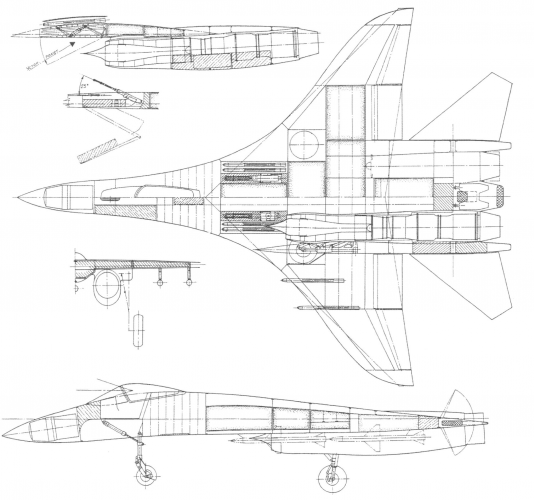
T10/2 was 19.1m in length, 12.24m span with takeoff weight of 22,000kg. This compared to 18.41m and 12.8m or the integral design. No specific engine information was available yet, but the thrust was assumed to be 10,400kg and rough dimensions assigned. The rear view was not good, this seems to be due to the volume behind the ejection seat here being required partly for the elements of the landing gear.
In late March, MAP scheduled a series of Scientific and Technical Council meetings (without the ‘customer’) with its various design bureaus. The first was as early as late March, less than a month after the PFI requirement was circulated.
Gleb Lozino-Lozinsky, Mikoyan’s PFI director, presented their preliminary design worked on since late 1969. Initially it was quite large, with 3000km/h maximum speed, normal takeoff weight of 25.4 tonnes including 7 tonnes of fuel. This was subsequently scaled down to


Next Oleg Samoilovich presented the T-10-1 design. He disagreed with the idea of two different fighter designs.
Yakovlev himself presented their Yak-45I, which was a fighter derivative of an existing 1970 light supersonic strike aircraft design.

The Yak-45I weighed 13,500kg with 2900kg fuel load for a startlingly low fuel fraction of 0.21. BVR missiles are notably absent.
The meeting was just consultative - all three OKBs had only just started defining their designs, and no real conclusions were drawn. Therefore, work continued at all three OKBs. The next meeting on the PFI programme was held in May 1971.
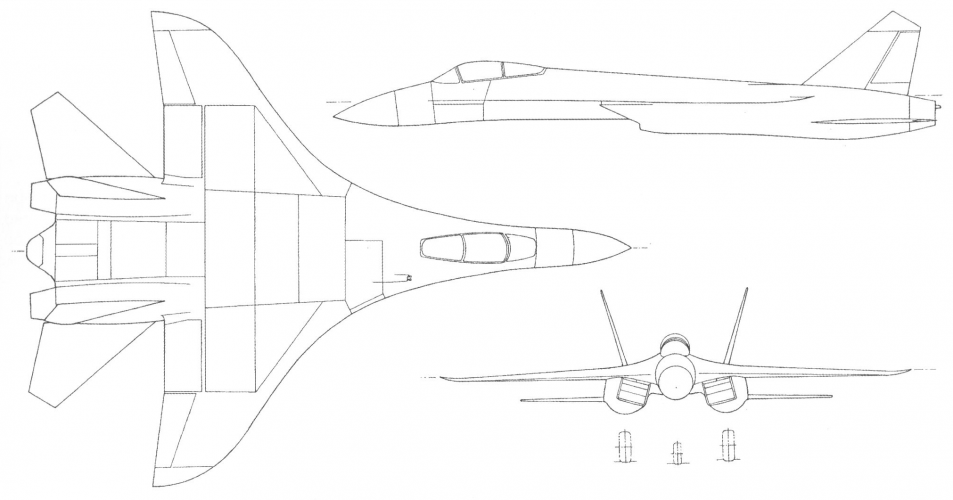
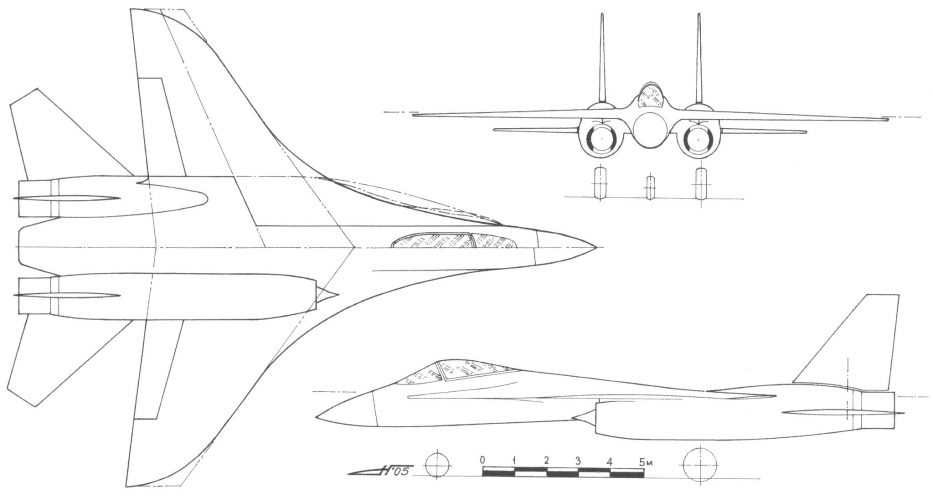
Refinement had continued on the T-10/1 layout. The Kuchemann carrots were removed and small wing fences added, and the landing gear arrangement was thought though a bit more.


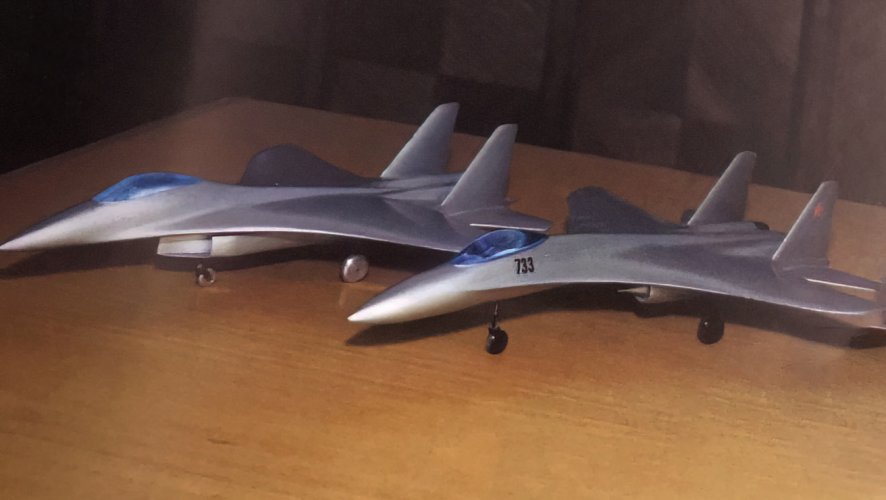
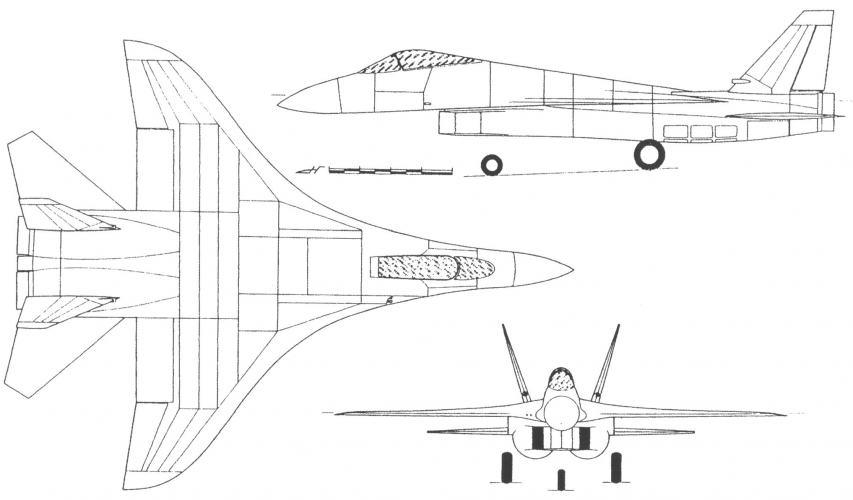
Left: T-10/1 (2nd edition) Right: T-10/2 (2nd edition) - note that both gained wing fence devices for vortex control
In May 1971 the T-10/1 (2nd edition) layout was presented to Sukhoi for approval. Antonov was promoted from 'designer engineer of the second category' to 'designer engineer of the first category and a given a pay rise to 185 roubles.


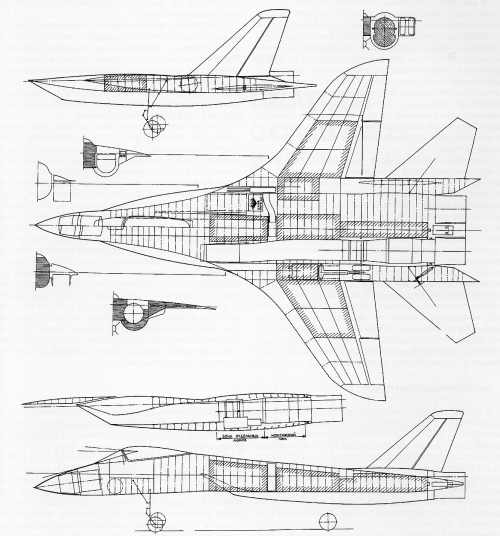
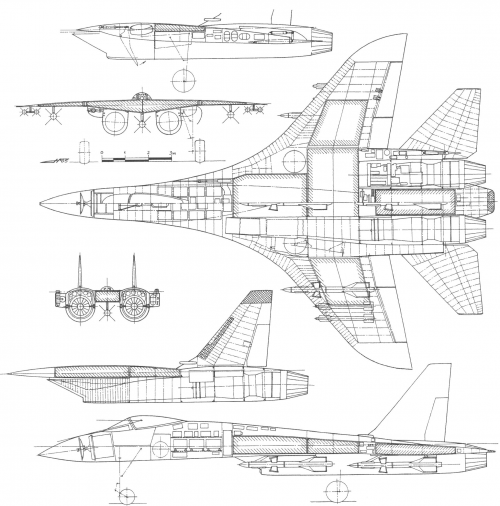
An original drawing of T-10/1 (2nd edition), which was attributed to Antonov, Nikolayenko and Samoilovich
May 25, 1971, P.O. Sukhoi approved it with the wording "For the development of a preliminary design". In-depth development of the T-10 in both integral and conventional designs commenced in earnest.


13T10-1 wind tunnel model of the T-10-1 was tested from June 1971 at TsAGI
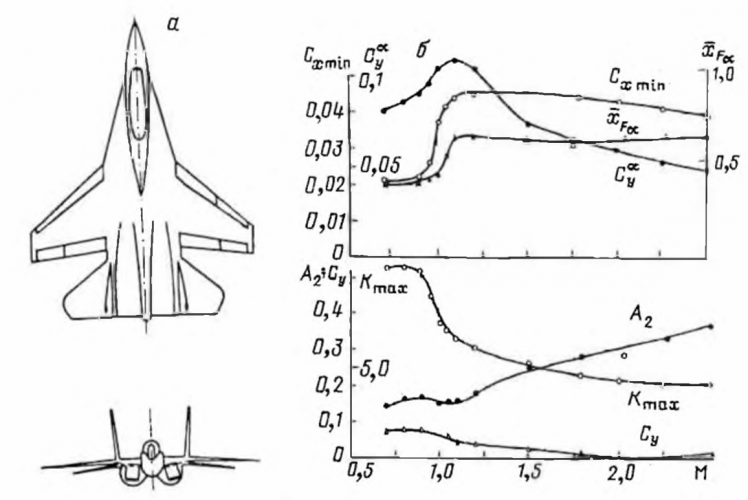
Sukhoi built a wind tunnel model of the integral T-10-1 designated 13T10-1 and on 9 June 1971 shipped it to TsAGI for testing, and the resulting report was sent back in September 1971. Initial test gave encouraging results: with a moderate wing aspect ratio (3.2), an aerodynamic quality of 12.6 was obtained.
Mikoyan seem to have been have sufficiently impressed with Sukhoi's T-10 design presentation in March 1971 that they started discussions with TsAGI on the topic, but like Sukhoi received an initial pushback and direction to stick with the conventional layout.
Sukhoi engineers considered this was due to innate conservatism at TsAGI and a bit of resentment at design bureaus encroaching on their domain. TsAGI were supposed to do the aerodynamic research and give recommended configurations to the OKBs, not the other way around, so the integral layout initially suffered from 'not invented here' syndrome.
According to G S Bushgens, TsAGI worked very actively with MiG who accepted the wing design that TsAGI had developed. "In contrast Sukhoi had its own vision of a new wing. They came to their decision, which seemed doubtful to us". Sukhoi’s T-10-1 had an ogival wing with LERX, and with fixed leading edges as used on the F-15.
Sukhoi and Mikoyan OKBs also both contained many of their own sceptics on the integral layout. Sukhoi had designed a conventional alternative design, and Mikoyan persisted for now with the conventional layout.


13T10-2 was a wind tunnel model of the alternative conventional T-10-2 design.
In August 1971, a wind tunnel model of the conventional T-10/2 was sent to TsAGI for testing.


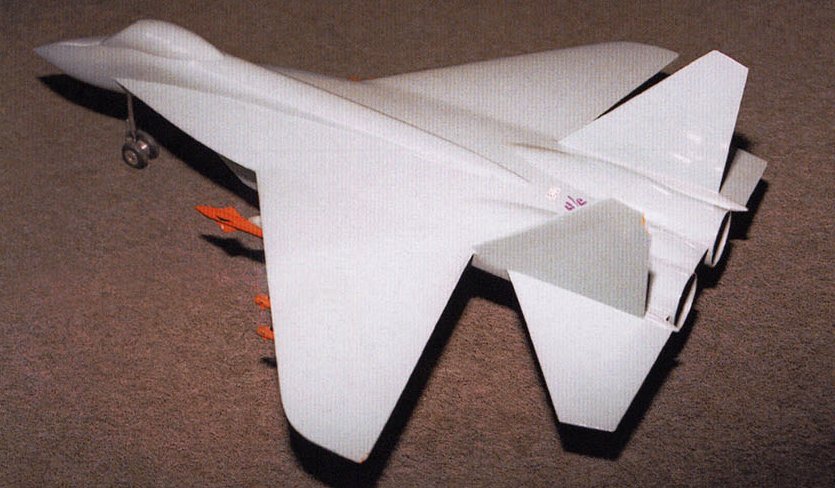
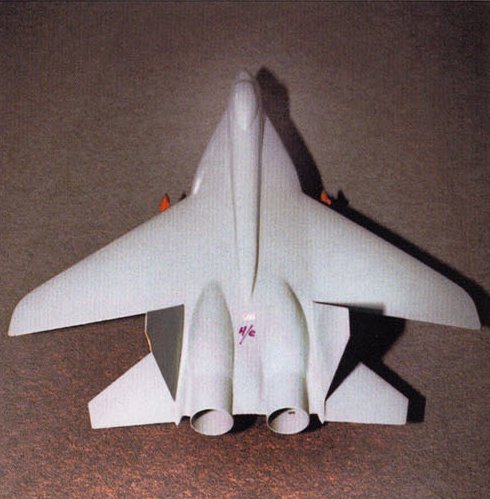
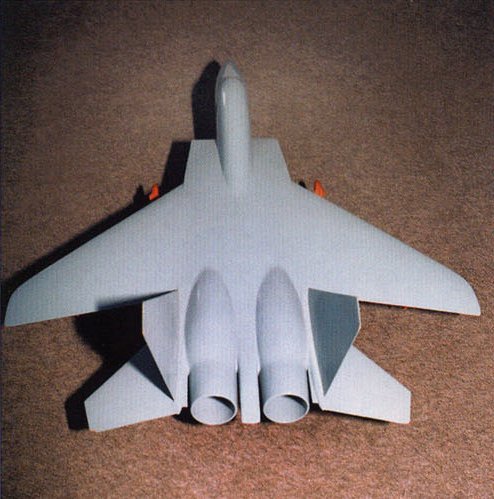
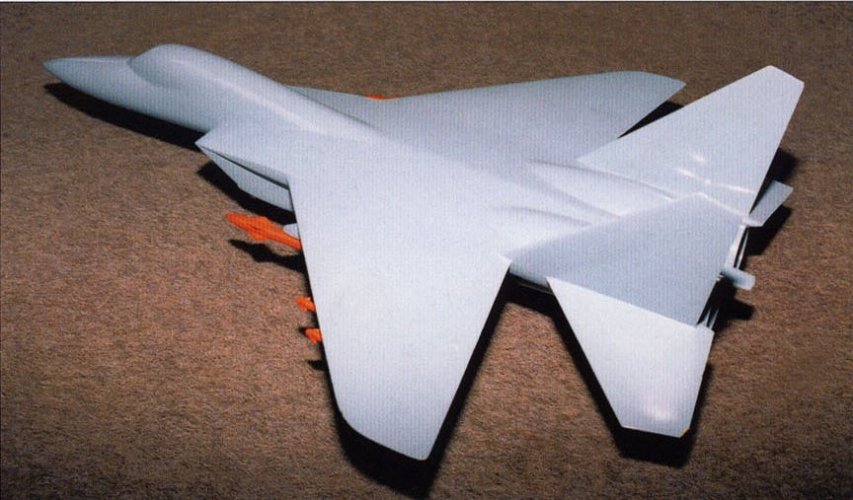
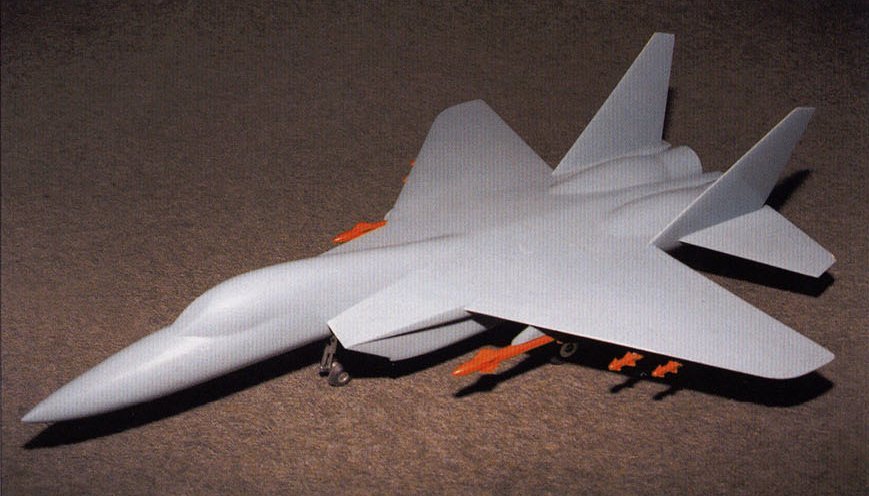
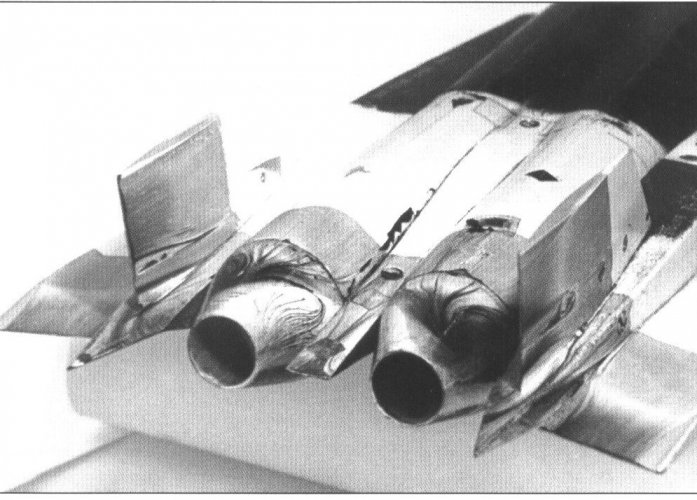
T-10/2 3rd edition. The model is a modern reconstruction by John Hall - no original T-10/2 design models seem to have survived.
A 3rd edition layout of the T-10/2 was issued in September 1971, before the final report was received on the earlier layout wind tunnel testing. The wing fences were gone, and it was a very attractive design, but the rear of the canopy being opaque meant the rear view was significantly worse.
September 1971 saw Mikoyan, Sukhoi and Yakovlev submit their initial proposals for analysis.
The T-10/2 wind tunnel test report was made available back to Sukhoi in November 1971. It showed the T-10/2 had one major advantage over the T-10/1 in that the midsection was narrower, giving better area ruling and lower drag.
Sukhoi continued to refine the T-10 design and by December 1971 had a new version T-10-3 which sought to address some shortcomings of the T-10-1 found in wind tunnel testing including trying to improve area ruling and reduce midsection size to reduce drag. According to Antonov, T-10-3 was aerodynamics-focused and didn't worry overmuch about the practical implications of the volume changes.

The final PFI meeting of 1971 took place on 23 December. GosNIIAS again spoke in favour of a mixture of heavy and light fighters to fulfil the requirement, but now suggested a larger lightweight design (10-14 tonnes) in addition to the heavyweight (20-25 tonnes).
According to E A Fedosov,
"Having worked on this approach at the institute, we created the concept of two aircraft - heavy and light. The first was to have a significant fuel supply, an increased range of operation and carry a large combat load in order to accompany the strike groups of our aircraft and cover them during raids along the entire depth of the front line. Or, as we say, the strike aircraft provide isolation of the battlefield, and these heavy fighters must cover them from the counteraction of enemy machines that are trying to repel the raid of bomber aviation. In general, "clearing" the airspace along the entire depth of the strike aviation was to become the basis for the existence of a heavy aircraft."
And the light aircraft should work as a frontline fighter, conducting air defense of the battlefield, covering its troops from enemy air strikes.
In our opinion, both of these machines should be built as pure fighters, which should not combine the functions of an attack aircraft or a fighter-bomber. We also calculated what specific weight each of these fighters should have in the air groupings. It turned out that their ratio should be 70 percent light aircraft and 30 percent heavy. From the very beginning, we proceeded from the fact that a heavy aircraft would be more expensive. At the same time, we relied on a linear relationship between the weight of the machine and its cost, which, looking ahead, I will say, did not come true.
All of our justifications were joined by specialists from the 30th Air Force Institute [TsNII-30], who conducted research similar to what we did and came to similar conclusions. Thus, the positions of the representatives of the aviation industry and the customer coincided, and it was decided to build these two aircraft simultaneously - heavy and light fighters.
G S Bushgens from TsAGI presented their research into the integral layout. He spoke in favour of a 14 tonne design only with no heavy fighter. The customer, in the person of Deputy Air Force chief A N Yefimov, was adamant that what was needed first and foremost was "an anti-F-15 aircraft" and that substituting a lightweight design was 'impossible in principle".
The VVS were open to getting a lightweight fighter in addition to their 'Anti-F15' heavy fighter, but would not accept the lightweight fighter alone.
Nothing much eventuated from this meeting. Work was to continue with all three OKBs.
Sukhoi submitted 4 large volumes in February 1972 on T-10/2 and T-10/3.

The Yak-47 had 4 hardpoints each of which could be armed with a K-25 or a triple launcher for K-60 short range AAMs. It used 2 x 12,500kg thrust R53F-300 turbofans with takeoff weight being 22,800kg.
Yakovlev hedged its bets and submitted two design, the lightweight Yak-45 and the scaled-up Yak-47, which had identical aerodynamic configurations.
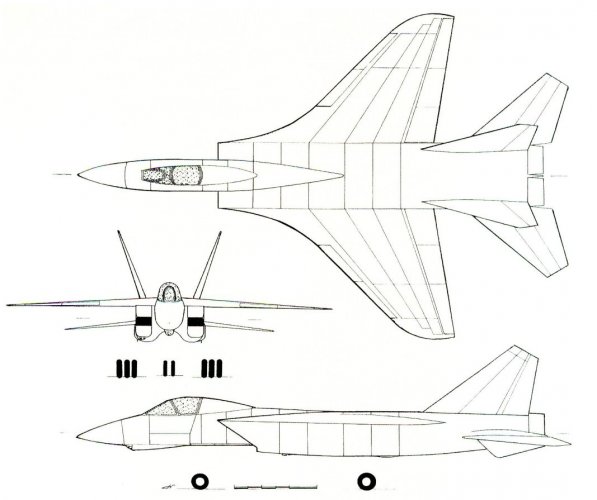
Mikoyan submitted its new MiG-29A in March 1972 exactly matching Bushgen's 14 tonne fighter proposal (given how closely MiG worked with TsAGI it is possible this was Mikoyan's idea from the start). It was still conventional in layout with a single vertical tail and avionics included an undernose KIT-P IRST and Sapfir-23M radar with R-23 and K-13 missiles.


The conventional layout lightweight MiG-29 here was specified with two Tumansky R67F-300 turbojets.
In March 1972 Sukhoi shipped the 13T10-3 wind tunnel model of the T10-3 to TsAGI for testing.
In Spring 1972, after closing out work on the T-10/2 for the PFI submission the 'conventional' team started work on the T-10/4, with the ambition of combining the best features of the integral T-10/1 and conventional T-10/2.
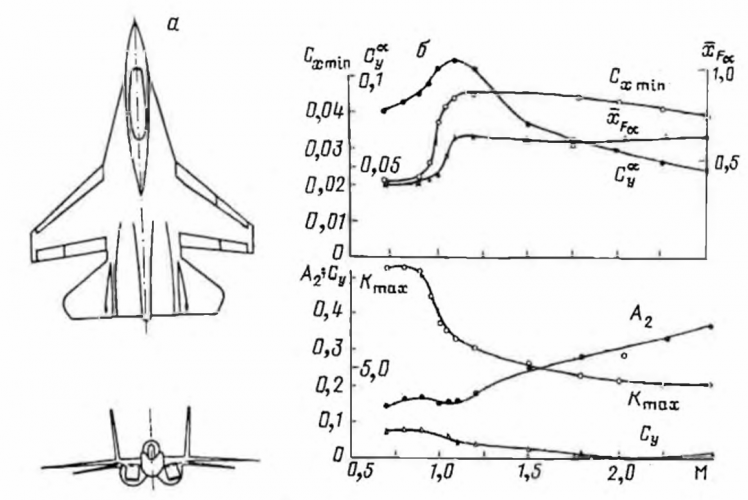
TsAGI handed over to Mikoyan the results of its investigations into an 'integral' lightweight fighter configuration in early 1972. Initial results were returned in May, with the full report arriving in July.


TsAGI 'integral' studies ran from 1970 to 1975 and were compared against a single engine conventional layout quite similar to the Vought V-1100.
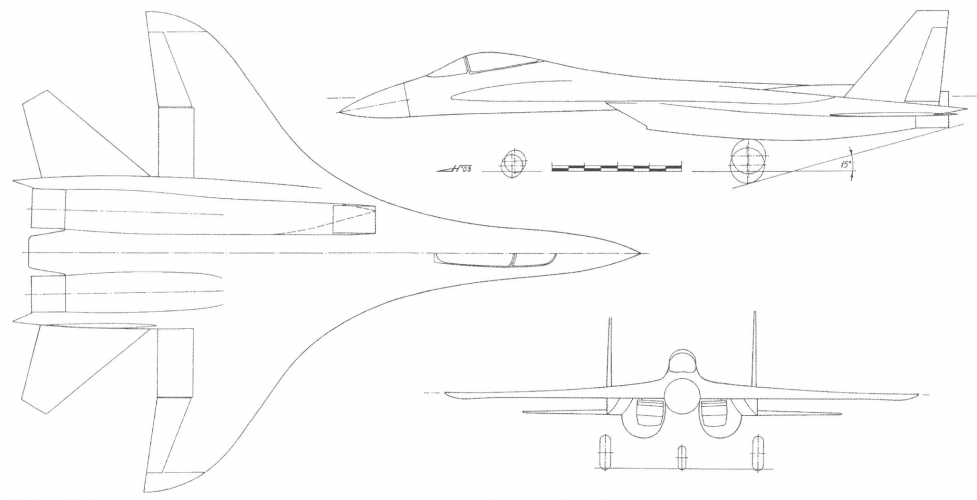
In May a 13T10-4 model based on the T-10/4 was built and sent to TsAGI for analysis. The reports received back in summer 1972 showed Iit was better in some areas than the T-10/3 but worse in others.


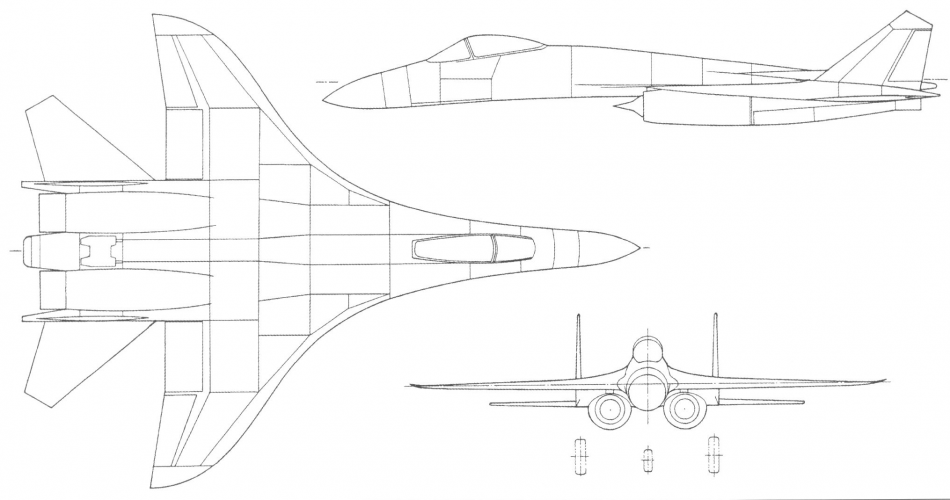
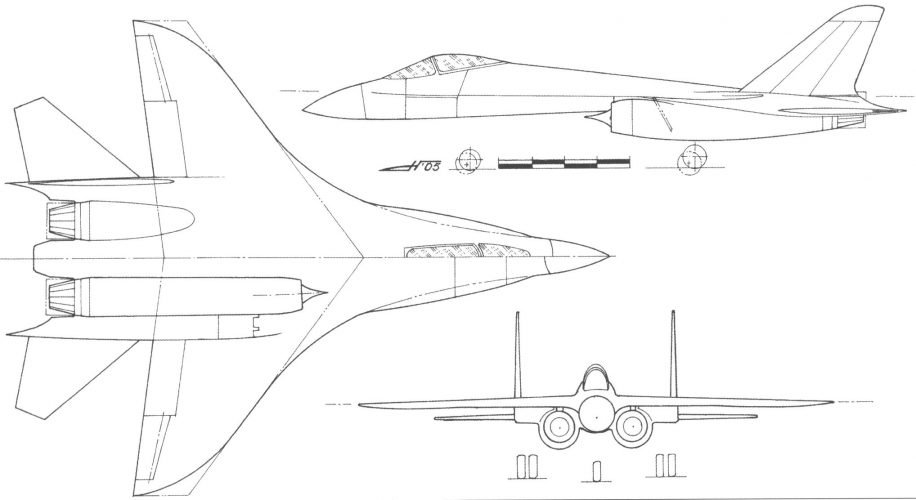
Left: This T-10/4 layout from June 1972 has folding wings for a naval variant. Right: T-10/3 (2nd edition) from August 1972
On 28 June, the Prospective Lightweight Mass-produced Fighter (PLMI) requirement was finalised. The official response to the spring 1972 PFI submissions came the next day. MiG-29A and T-10 were both highly regarded, Yakovlevs designs needing more work.
On 13 July an order was given to Yakovlev and Sukhoi to keep working and submit updated submissions on 1 September 1972.
In August 1972 the T-10-3 (2nd edition) layout was finalised. The required KIT-P IRST was awkwardly mounted on a pylon under the nose and the wing shape was refined further in light of wind tunnel testing. 1
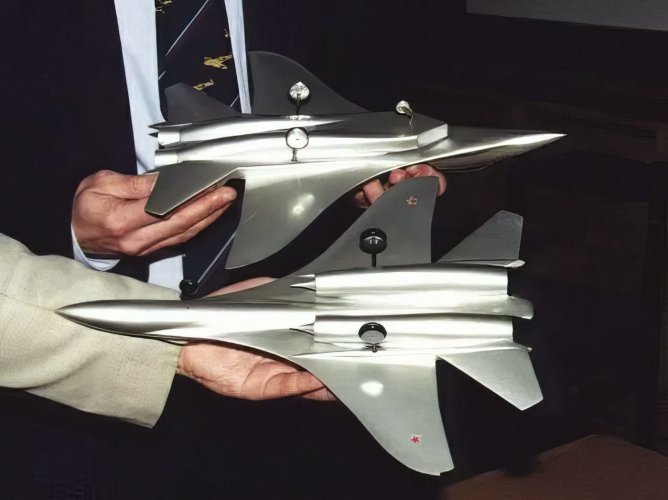
Also in August 1972, Mikoyan debuted a new integral version of the MiG-29 design in response to the PLMI requirement. This was a remarkable departure from their original conventional designs. By order of the minister No. 264 of August 7, 1972, the General Designer of the A.I. Mikoyan MMZ R.A. Belyakov was instructed to complete a preliminary design by the 4th quarter of 1973, and to build and begin flight tests of the aircraft by the end of 1975. Thus Mikoyan got a go ahead before Sukhoi.
After the September submissions were considered, Yakovlev were dropped and Sukhoi were tasked with building the PFI.


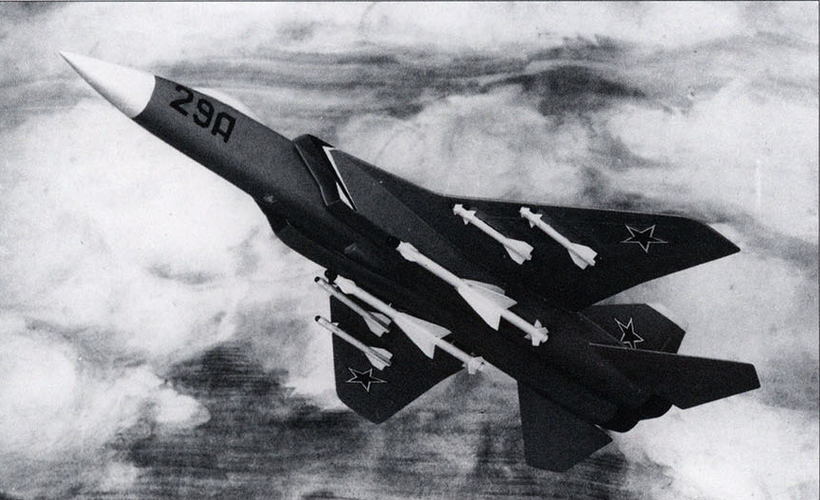
This early MiG-29 model seems to be the same one featured in archival footage from Mikoyan below. Note the R-23 and R-13 AAMs.


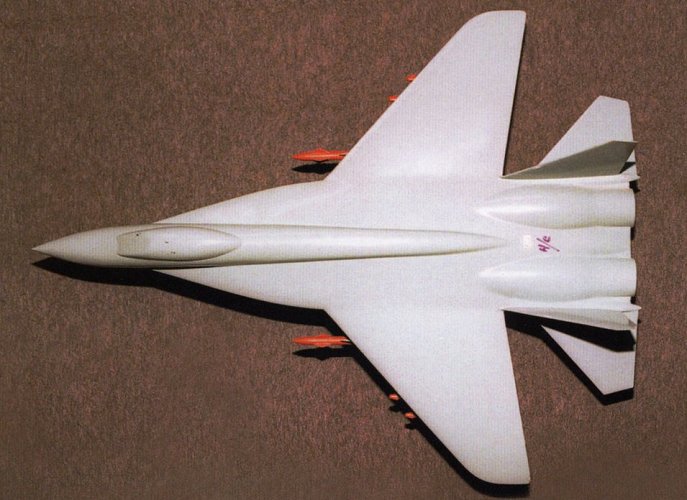
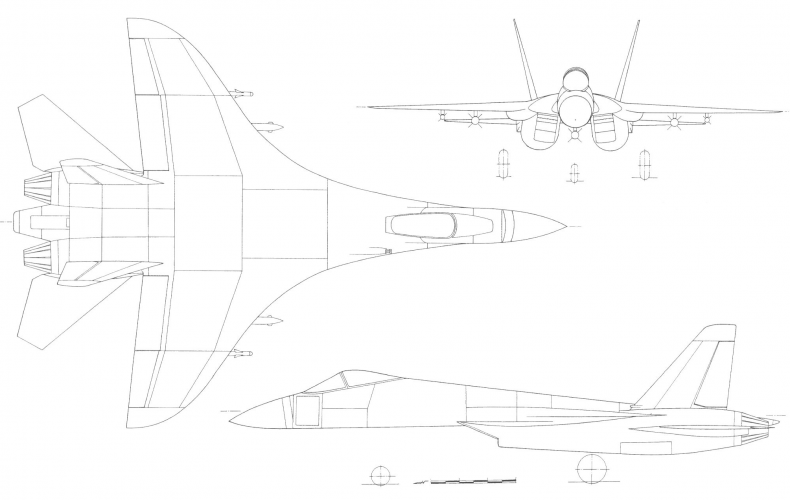
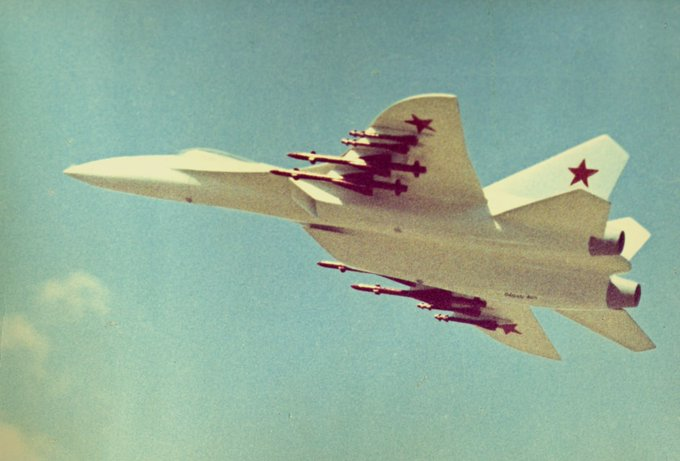
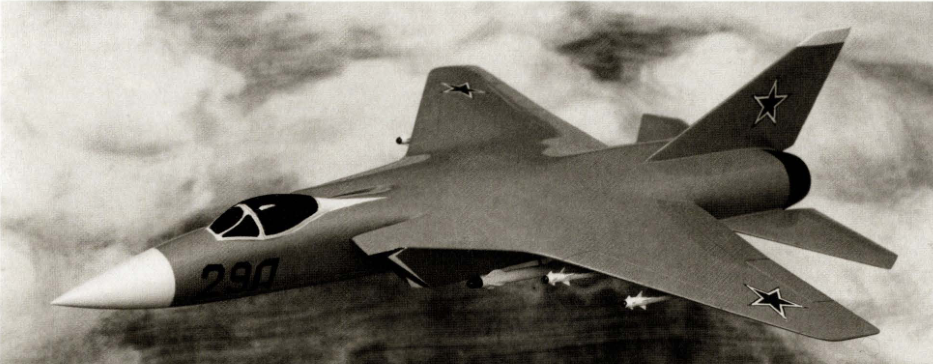
The exact sequence of MiG-29 configuration development still isn't clear, but this version is apparently from August 1972. Note the armament has switched to more modern K-25 and K-14 AAMs.
Part 2 -
Sources
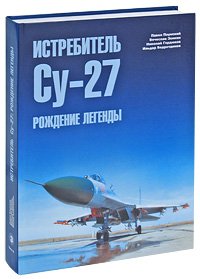
V A Antonov, Ildar Bedretdinov et al Su-27 Fighter: Beginning of Story (Bedretdinov & Co, 2005)
E V Arsenyev, N O Valuev, Yu F Polushkin MiG - Flying Through Time Vol. 2 (2020) [Russian text]
G S Bushgens, E.L.Bedrzhitsky TsAGI- Center of Aviation Science (Nauka 1993) [Russian text]
E A Fedosov Half a century in aviation. Notes of an academician: Literary and artistic work (Drofa, 2004) [Russian text]
Andrei Fomin Su-27 Flanker Story (Intervestnik, 1999)
Yefim Gordon, Andrei Fomin, A.Mikheev MiG-29 (Polygon, 1998) [Russian text]
Yefim Gordon Famous Russian Aircraft MiG-29 (Midland 2006)
Yefim Gordon Famous Russian Aircraft MiG-31 (Midland 2006)
Yefim Gordon Famous Russian Aircraft Su-27 (Midland 2007)
Andrei Jurgenson, Yak-45: Attack aircraft & fighter in Aerospace Review, Issue 5 & 6, 2005 [Russian text]
Stanislav Kashafutdinov 'Siberian Hardening of Su-27' in Aviapanorama Issues 4 & 5,1997 [Russian text]
Victor Litovkin 'Wings for Sukhoi' [with G S Bushgens] article on https://nvo.ng.ru/history/2007-07-20/5_wings.html
N.N. Prokofiev, T.S.Smirnov (ed) TsAGI—the main stages of scientific activity (1968—1993) (Physical and Mathematical Literature 1996) [Russian text]
Oleg Samoilovich Next to Sukhoi (Ot Vinta!, 1999) [Russian text]
Oleg Samoilovich 'The best fighter in the world' in Mir Aviatsii 1999 01 [Russian text]
Nikolay Yakubovich MiG-29: "Stealth" Fighter (Eksmo, 2010) [Russian text]
Nikolay Yakubovich MiG-31: The Ultimate Interceptor Fighter (Eksmo, 2018) [Russian text]
OKB Sukhoi - 80 Years (2019) [Russian text]
OKB Sukhoi (2024) [Russian text]
Yak-45 - Unknown competitor of MiG-29 in Aero Magazyn Lotniczy 05 2007 [Polish text]
In 1965, the technical research department at OKB-51 Sukhoi received the first information about the start of development of a prospective tactical fighter programme for the US Air Force from US periodicals. No specific details were published of what its characteristics might be, so a file was created, but no more action taken.
The second half of the 1960s saw the US get increasingly embroiled in a war in Vietnam. The Soviet VVS watched with interest the clashes between the F-4 Phantom and older MIGs. The VVS was working hard on a new fighter, the MiG-23, which was intended to match the F-4 Phantom's technical capabilities with radar and beyond-visual-range (BVR) missiles.
In March 1969, with the first MiG-23s on the cusp of entering service, the newly appointed head of the Soviet Air Force, P.S. Kutakhov - a decorated World War II fighter ace - instructed his first deputy, Colonel General A.N. Efimov, to explore the topic of the future development of fighter aircraft after the MiG-23.
The task of drafting the requirement or "tactical and technical specifications" (TTZ) for a new frontline fighter was assigned to Major General-Engineer V.R. Ephraim, head of the Air Force’s 1st Directorate.
Within the USSR’s military-industrial complex, the responsibility for both foreign aircraft intelligence and defining new aircraft TTZ fell to the Central Research Institute of Aviation and Space Technology (TsNII-30). Ephraim therefore referred the matter to TsNII-30 for action. TsNII-30 was at that time led by Z.A. Joffe, who was replaced later in 1969 by Aviation Lieutenant General A.P. Molotkov. Oversight of the new fighter initiative was also provided by Colonel General A.N. Ponomarev, deputy chief of the Air Force Committee (himself later replaced in 1971 by M.N. Mishuk).
TsNII-30 had already gathered and analysed extensive data on new and planned foreign supersonic, all-weather, multirole fighters as part of its standard intelligence gathering remit. The developers of the TTZ focused particularly on the Saab Viggen, the VFX program (which led to the F-14), the FX program (resulting in the F-15), and Northrop’s private-venture P.530 lightweight fighter. Common features of these aircraft included:
- New aerodynamic design features to enhance lift and reduce drag (canards, LERX, etc)
- Advanced control systems providing improved artificial stability.
- Twin-spool bypass turbofans for efficient subsonic cruise and extended range.
- Improved weight management through modern materials and new methods of structural strength calculation.
- Enhanced avionics for navigation, communication, and weapons control.
- Increased automation.
The following key requirements were established early on:
- Range: At least 2,500 km.
- Maneuverability: Capable of sustaining +8-9g at subsonic speeds and +7g at supersonic speeds.
- Performance: Superior acceleration, agility, and speed, with a combat thrust-to-weight ratio of 1.1.
- Speed: Maximum speed of at least 2,700 km/h at high altitude and supersonic capability at low altitudes.
- Powerplant: Twin engines for reliability and survivability.
- Avionics: An advanced navigation and targeting system for both frontline and rear air defence roles.
- Armament: Medium- and short-range air-to-air missiles, plus a 30mm cannon with superior ballistic performance to the existing GSh-23L.
The draft TTZ was forwarded to the 2nd Central Scientific-Research Institute of the Ministry of Defense (2 TsNII), which handled development of requirements for PVO air defence equipment including fighters. Lieutenant General A.E. Borovyov, who became head of 2 TsNII in May 1969, was supportive of the idea of a unified aircraft for the VVS and PVO provided it did not interfere with his Ye-155MP (MiG-31) program, this program already having been approved in April 1968. Colonel B.M. Dolzhenko, head of the Aviation Department at 2 TsNII, largely endorsed TsNII-30’s basic specifications but introduced some modifications and additional requirements specific to PVO needs:
- Maximum speed should be at least 3200 km/h at a greater height;
- Requirement should added for extended patrol times;
- A time requirement for reaching the interception line was needed;
- Use of Long-range air-to-air missiles e.g. R-33 was mandatory.
This internal debate delayed the PVO’s response to the TTZ proposal for several months, prompting the General Staff to intervene in mid-1969. The issue was escalated to the Council of Ministers, which involved the Ministry of Aviation Industry (MAP) and other Government departments, to speed things up.
In mid-1969 Sukhoi’s technical research department noted a sharp increase in articles in Western, primarily American periodicals on the progress of the US FX program which provided for the creation of a new tactical fighter and air defense interceptor. At that time, it was believed that this aircraft would replace all aircraft of this class already in service with the US Air Force, and the articles described some of the intended characteristics of the design. Some details and pictures of the competing designs were published.
However, Sukhoi were fully occupied with other design work on T-4, T-6 and T-8, and again no action was taken on a new fighter. Sukhoi did however develop a very novel layout for the T-4MS bomber design which achieved an unheard lift/drag ratio of 17.5 in TsAGI wind tunnel tests where the entire fuselage was a lifting wing surface with engines slung underneath in widely spaced nacelles and outboard VG wing panels. This layout was patented in July and August 1969.
Finally, in the autumn of 1969, an interagency meeting was held at TsNII-30 with representatives from the Ministry of Defence and Ministry of Aviation Industry (MAP) and other research intitutes. This meeting was a preliminary one, as the requirement was still not finalised and no aircraft design bureaus (OKBs) were present at this meeting. MAP supported the idea of a unified fighter for VVS and PVO, as it would streamline production and reduce costs. Unexpectedly, however, A.M. Batkov, deputy head of the Research Institute of Aviation Systems (GoNIIAS), argued against full unification of requirements, but not on the division of VVS/PVO but on size. He proposed rather the development of two classes of fighters:
- Lightweight fighters (6,000 -10,000 kg) for operations near the frontlines.
- Heavyweight fighters (20,000 -24,000 kg) for deep strikes, escort missions, and air defense tasks.
In November 1969, Oleg Samoilovich, head of the design department, perhaps knowing of the still-brewing TTZ, judged that it would be prudent to start work on a potential counter design to the US FX. Workload remained high on existing programs, so initially Vladimir Antonov was the only engineer tasked with looking into the topic alongside his standard duties on the T-6.

Vladimir Antonov was initially working largely alone on the new fighter design. His initial wing sketches were inspired by a 1960 British report into a sinusoidal wing shape.
Now, technically the Soviet OKBs were expected to rely on TsAGI for basic research into aerodynamics, but in Sukhoi there was a belief that TsAGI was often just replicating work already done by NASA and other Western scientific establishments. Sukhoi's technical research division was adept at keeping engineers up to date with the latest foreign reports and trends, so there was a general feeling that one could get basic research 'from the horses mouth' without waiting for TsAGI to repeat things. This would cause some animosity on both sides, and Sukhoi increasingly worked with the SIBNIA institute for wind tunnel testing.
In December 1969, Oleg Samoilovich suggested to Antonov to consider the T-4MS lifting body or 'integral' layout due to its demonstrated high lift/drag capability, and also mentioned a 1960 British Technical Report into sinosoidal (ogival) wings. Antonov started drawings based around combining these two core ideas.
In his memoirs Oleg Samoloivich noted that "During the design process, we had quite detailed information from the open foreign press about the layout schemes developed in the USA under the F-15 program. Frankly speaking, I liked the layout scheme of the Northrop [sic - he means North American Rockwell] company, which was similar to ours, and I was afraid that this particular project of theirs would win the competition. And when it was announced that the McDonnell company had won the competition, I breathed a sigh of relief".


These artist's impressions of North American Rockwell (left) and McDonnell-Douglas (centre, right) F-15 designs were published in Western publications around the time of the F-15 contract award
Mikoyan OKB likewise started investigations into a new fighter towards the end of 1969, likely again triggered by the award of the FX contract to McDonnell-Douglas. Traditionally, Mikoyan had very close links with TsAGI, and so early on engaged with TsAGI on recommended aerodynamic configurations.

Aerodynamic designs considered by Mikoyan for the Ye-155MP / MiG-31. The second from left design has folding LERX for supersonic stability, not subsonic agility.518-55, fourth from left, strongly resembles the initial MiG-29 design.
It appears that Mikoyan reused their 518-55 Ye-155MP design as the starting point for their "Counter-FX" MiG-29.
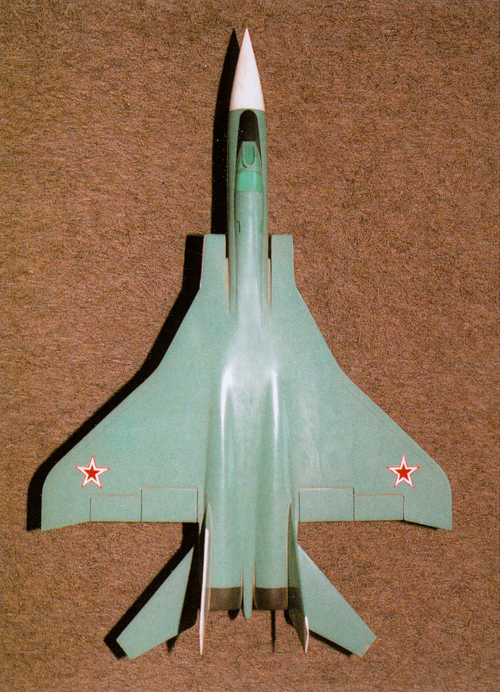
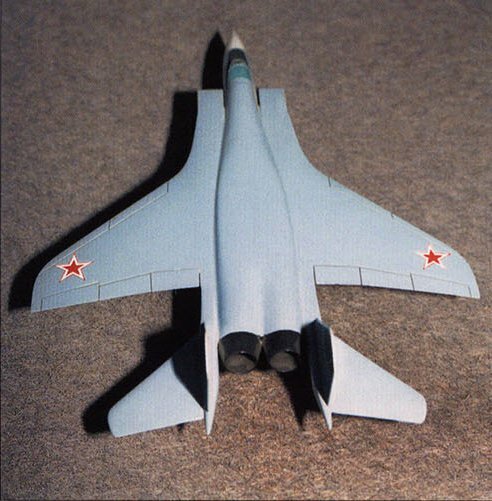
Mikoyan's 518-55 Ye-155MP (left) and 1970 MiG-29 design (center, right) are rather similar, though the MiG-29 was smaller and lighter weight.
Antonov was struggling to integrate the different ideas of wing shape and integral layout into a design. In January 1970, Antonov, Oleg Samoilovich, Valery Nikolayenko (T-6 / Su-24 Chief Designer) and Leonid Bondarenko (T-4 Chief Designer) worked together over a weekend to come up with a coherent new fighter design layout. This formed the basis of the initial T-10-1 design.
In February 1970, the new Sukhoi fighter’s layout drawings and calculations were done. Models were built for initial wind tunnel tests.
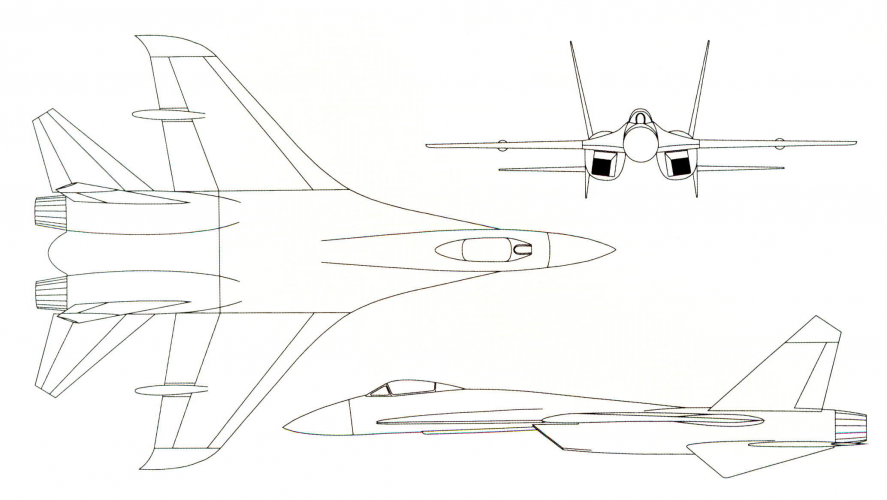
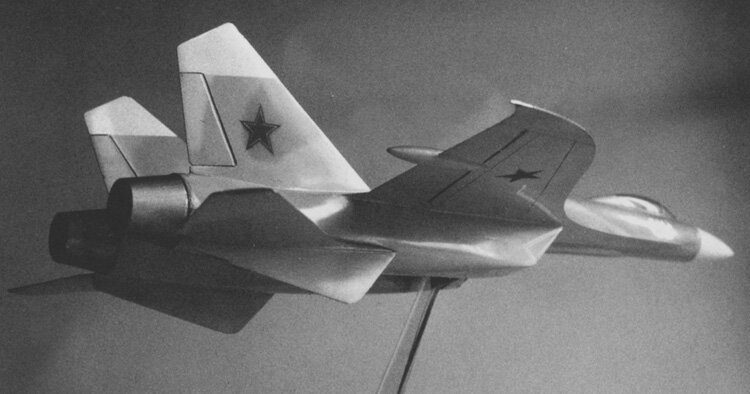
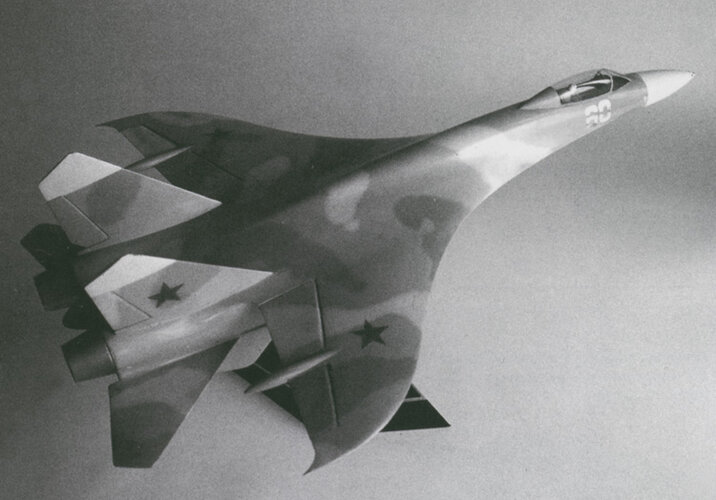
The first T-10 layout from March 1970. Wing area was 57 m2, with a normal take-off weight of about 22 tons.
By March 17, 1970, Marshal Batitsky had responded to the General Staff’s inquiry, endorsing the creation of a unified fighter in two variants. He suggested that such an aircraft could replace the Su-15 interceptor in PVO service (avoiding the need to adopt the MiG-25P) and counter the U.S. F-14 and F-15. However, concerns about meeting the TTZ requirements led to yet further studies by TsNII-30 and 2 TsNII.
The detailed TTZ development was divided among various TsNII-30 specialists:
- Overall TTZ and operational requirements: Colonel V.N. Lutsenko.
- Flight performance: Colonel A.A. Bako.
- Powerplant: Colonel V.A. Pashkov.
- Avionics and radar: Colonel K.V. Kulkov.
- Armament: Colonel V.I. Demouh.
The program was officially named "Prospective Frontline Fighter" (PFI), though the aircraft was intended for both Frontline (VVS) and Air Defense (PVO) roles, in addition to replacing the then-planned carrier aircraft designs of MiG-23A and Su-24K.
In spring of 1970, the PFI TTZ draft was signed by Lieutenant General A.P. Molotkov (TsNII-30) and Colonel General I.D. Gaidaenko (TsNII-8), approved by the Air Force’s Scientific-Technical Committee, and submitted to the Ministry of Aviation Industry (MAP) for further action.
In June 1970, TsAGI held a conference with the Air Force and discussed the merits of normal, swing wing and tailless layouts as well as powerplants and control systems.
Yakovlev had completed initial design on a new lightweight fighter and attack aircraft of their own in July 1970, the Yak-45.
At Sukhoi, momentum on the T-10 design gradually built, though as yet there was no formal requirement given to them. Visitors from TsAGI, GosNIIAS and other institutes were shown the T-10 early design.
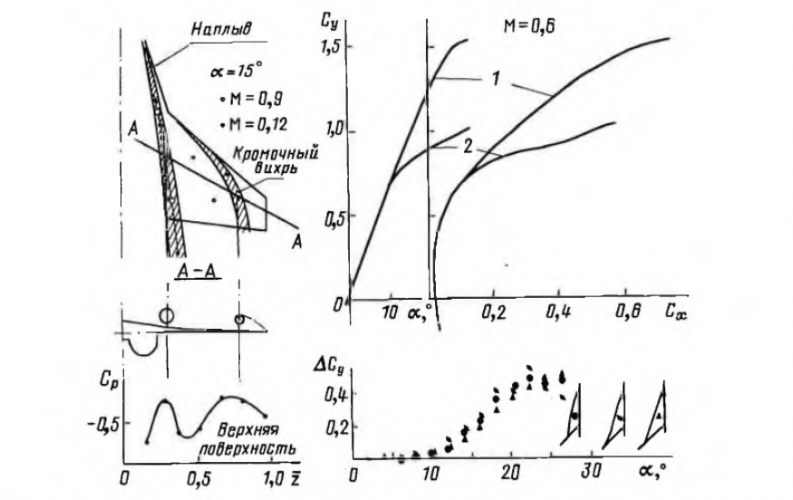
TsAGI research in 1966 to 1971 looked at vortex lift and concluded with a recommended design with root extensions and moderately swept trapezoidal wings.
During 1970 Sukhoi worked closely with TsAGI on the wing design and selection of an appropriate profile. They agreed to use the TsAGI P-44 section with good supersonic characteristics. TsAGI advised the use of a moderate sweep trapezoidal wing with leading and trailing edge flaps. Sukhoi ignored this part of the advice.
In December 1970, the Military-Industrial Commission (MIC) held a special meeting on the problem of creating a new generation frontline fighter with a higher thrust-to-weight ratio and high manoeuvrability characteristics.[1] A decision was made (unusual in the Soviet Union) to launch a competition for the conceptual design.
According to TsAGI, preliminary studies into integral aerodynamic layouts for fighters started in this timeframe.
By early 1971, three competitors for the airframe had been selected – the fighter OKBs of Sukhoi, Mikoyan and Yakovlev - and three engine OKBs - the design bureaus of S.K. Tumansky, A.M. Lyulka and P.A. Soloviev - to compete on the engine.
TsAGI preliminary work on the integral concept was reported to the NTS MAP in February 1971. The official assignment for the competitive development of preliminary designs was announced by the decision of the Military-Industrial Commission No. 41 of March 3, 1971 (MAP order No. 77 of March 18). OKBs were tasked with preparing a design to the PFI specification for submission by September 30, 1971.
PFI Specification, March 1971
| Speed, ground level | 1500km/h |
| Speed, high altitude | 2700km/h |
| Loiter time 100km from base and 5 mins air combat | 1 hr |
| Ceiling | 21-22,000m |
| Range internal fuel, ground level | 1000km |
| Range internal fuel, high altitude | 2500km |
| Thrust to weight ratio at least | 1.1:1 |
| Max Operating load | 9-10g |
| Takeoff run | 500-600m |
| Landing roll | <600m |
| Acceleration, 600-1100km/h | 12-13s |
| Acceleration, 1100-1300km/h | <6s |
| Normal takeoff weight | <18,000kg |
In addition to the performance goals, the specification was very detailed in terms of required avionics, including two different targeting subsystems. Long range (BVR) subsystem was to comprise a radar with IFF and an IRST, while the short range (Close Combat) subsystem comprised an optical sight, laser rangefinder and two independent TV channels. The radar was to have multiple target tracking (8 targets) and engagement (2 targets) capability and use pulse-doppler and digital signal processing.
In March 1971, Sukhoi decided to create a conventional fighter design to compare to the T-10-1 and validate its technical decisions, with veteran ex-Polikarpov designer A M. Polyakov. The aerodynamic layout was created by A A Andrianov and the first version T-10/2 was finalised in March.
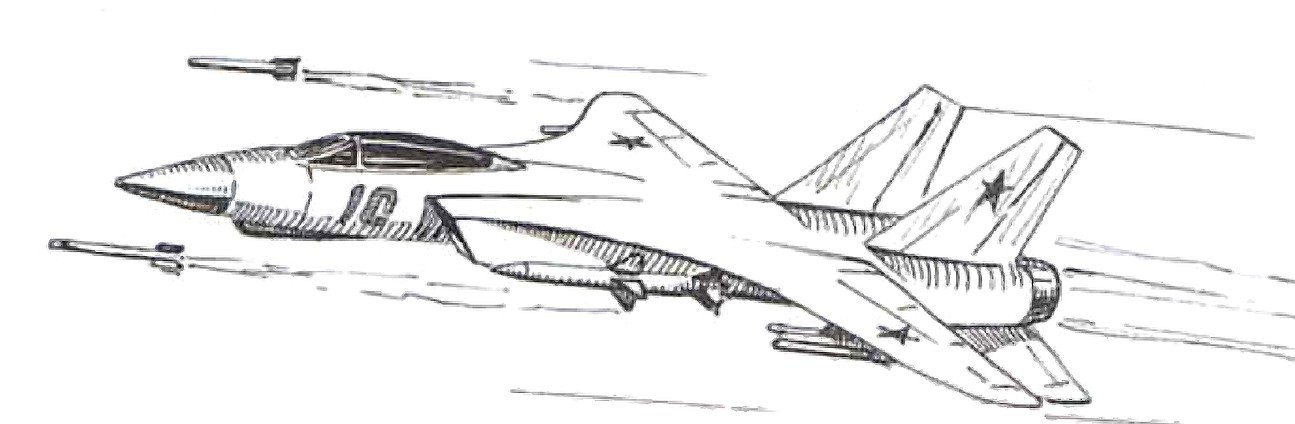
T10/2 conventional design with K-25 and K-60 missiles
T10/2 was 19.1m in length, 12.24m span with takeoff weight of 22,000kg. This compared to 18.41m and 12.8m or the integral design. No specific engine information was available yet, but the thrust was assumed to be 10,400kg and rough dimensions assigned. The rear view was not good, this seems to be due to the volume behind the ejection seat here being required partly for the elements of the landing gear.
In late March, MAP scheduled a series of Scientific and Technical Council meetings (without the ‘customer’) with its various design bureaus. The first was as early as late March, less than a month after the PFI requirement was circulated.
Gleb Lozino-Lozinsky, Mikoyan’s PFI director, presented their preliminary design worked on since late 1969. Initially it was quite large, with 3000km/h maximum speed, normal takeoff weight of 25.4 tonnes including 7 tonnes of fuel. This was subsequently scaled down to


Next Oleg Samoilovich presented the T-10-1 design. He disagreed with the idea of two different fighter designs.
Yakovlev himself presented their Yak-45I, which was a fighter derivative of an existing 1970 light supersonic strike aircraft design.

The Yak-45I weighed 13,500kg with 2900kg fuel load for a startlingly low fuel fraction of 0.21. BVR missiles are notably absent.
The meeting was just consultative - all three OKBs had only just started defining their designs, and no real conclusions were drawn. Therefore, work continued at all three OKBs. The next meeting on the PFI programme was held in May 1971.
Refinement had continued on the T-10/1 layout. The Kuchemann carrots were removed and small wing fences added, and the landing gear arrangement was thought though a bit more.
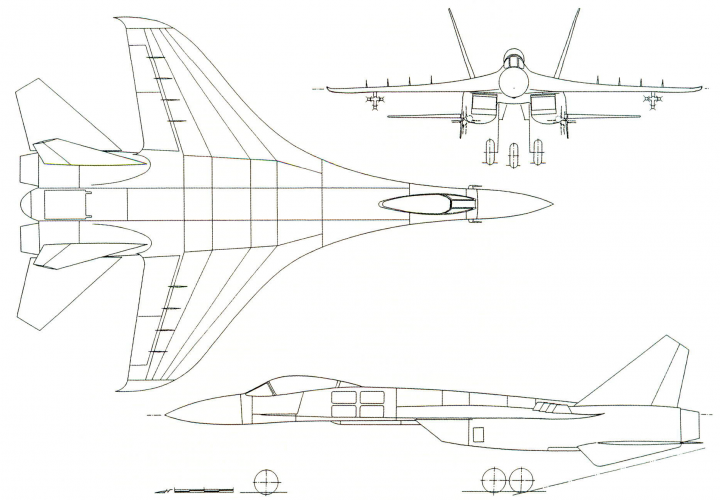
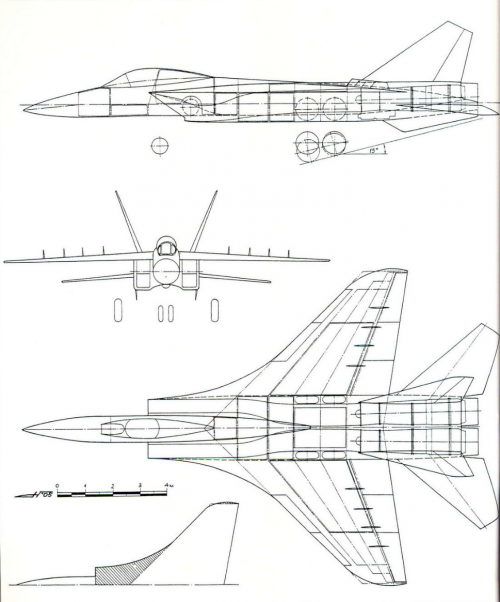
Left: T-10/1 (2nd edition) Right: T-10/2 (2nd edition) - note that both gained wing fence devices for vortex control
In May 1971 the T-10/1 (2nd edition) layout was presented to Sukhoi for approval. Antonov was promoted from 'designer engineer of the second category' to 'designer engineer of the first category and a given a pay rise to 185 roubles.
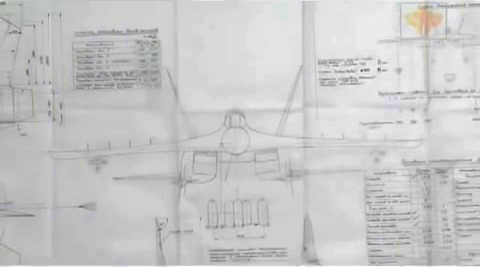
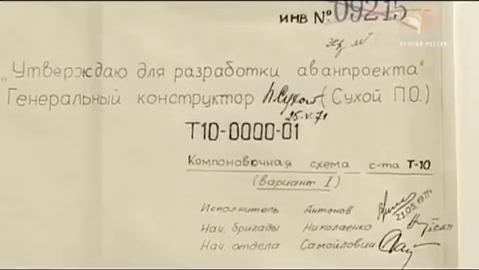
An original drawing of T-10/1 (2nd edition), which was attributed to Antonov, Nikolayenko and Samoilovich
May 25, 1971, P.O. Sukhoi approved it with the wording "For the development of a preliminary design". In-depth development of the T-10 in both integral and conventional designs commenced in earnest.
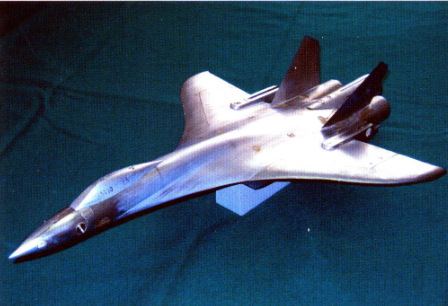
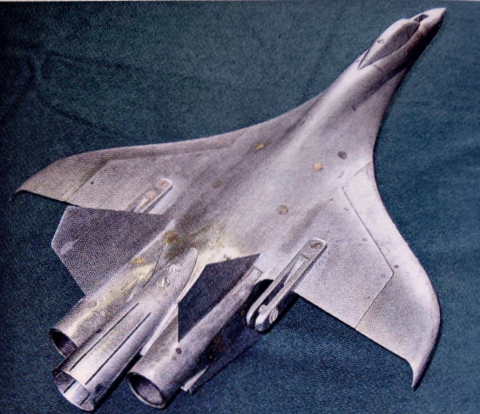
13T10-1 wind tunnel model of the T-10-1 was tested from June 1971 at TsAGI
Sukhoi built a wind tunnel model of the integral T-10-1 designated 13T10-1 and on 9 June 1971 shipped it to TsAGI for testing, and the resulting report was sent back in September 1971. Initial test gave encouraging results: with a moderate wing aspect ratio (3.2), an aerodynamic quality of 12.6 was obtained.
Mikoyan seem to have been have sufficiently impressed with Sukhoi's T-10 design presentation in March 1971 that they started discussions with TsAGI on the topic, but like Sukhoi received an initial pushback and direction to stick with the conventional layout.
Sukhoi engineers considered this was due to innate conservatism at TsAGI and a bit of resentment at design bureaus encroaching on their domain. TsAGI were supposed to do the aerodynamic research and give recommended configurations to the OKBs, not the other way around, so the integral layout initially suffered from 'not invented here' syndrome.
According to G S Bushgens, TsAGI worked very actively with MiG who accepted the wing design that TsAGI had developed. "In contrast Sukhoi had its own vision of a new wing. They came to their decision, which seemed doubtful to us". Sukhoi’s T-10-1 had an ogival wing with LERX, and with fixed leading edges as used on the F-15.
Sukhoi and Mikoyan OKBs also both contained many of their own sceptics on the integral layout. Sukhoi had designed a conventional alternative design, and Mikoyan persisted for now with the conventional layout.
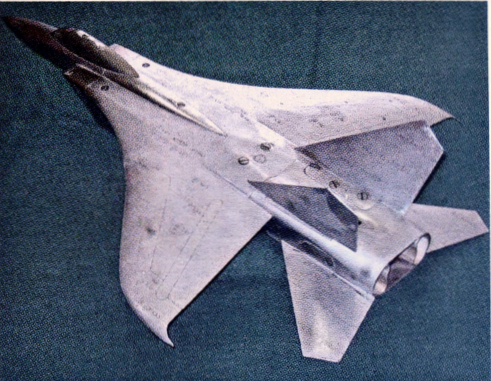
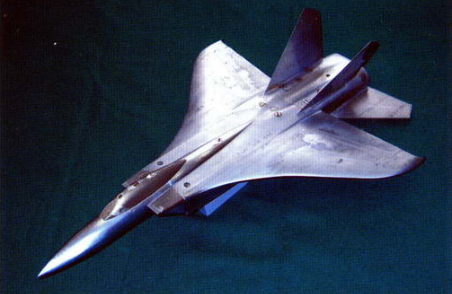
13T10-2 was a wind tunnel model of the alternative conventional T-10-2 design.
In August 1971, a wind tunnel model of the conventional T-10/2 was sent to TsAGI for testing.
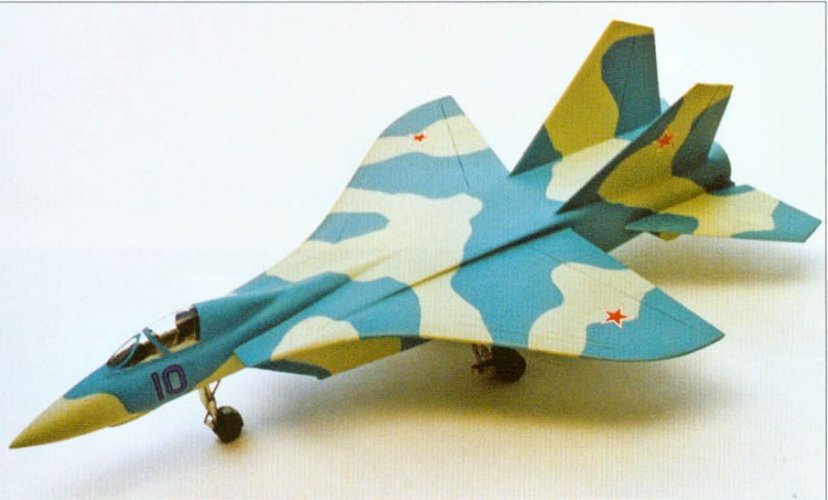
T-10/2 3rd edition. The model is a modern reconstruction by John Hall - no original T-10/2 design models seem to have survived.
A 3rd edition layout of the T-10/2 was issued in September 1971, before the final report was received on the earlier layout wind tunnel testing. The wing fences were gone, and it was a very attractive design, but the rear of the canopy being opaque meant the rear view was significantly worse.
September 1971 saw Mikoyan, Sukhoi and Yakovlev submit their initial proposals for analysis.
The T-10/2 wind tunnel test report was made available back to Sukhoi in November 1971. It showed the T-10/2 had one major advantage over the T-10/1 in that the midsection was narrower, giving better area ruling and lower drag.
Sukhoi continued to refine the T-10 design and by December 1971 had a new version T-10-3 which sought to address some shortcomings of the T-10-1 found in wind tunnel testing including trying to improve area ruling and reduce midsection size to reduce drag. According to Antonov, T-10-3 was aerodynamics-focused and didn't worry overmuch about the practical implications of the volume changes.

The final PFI meeting of 1971 took place on 23 December. GosNIIAS again spoke in favour of a mixture of heavy and light fighters to fulfil the requirement, but now suggested a larger lightweight design (10-14 tonnes) in addition to the heavyweight (20-25 tonnes).
According to E A Fedosov,
"Having worked on this approach at the institute, we created the concept of two aircraft - heavy and light. The first was to have a significant fuel supply, an increased range of operation and carry a large combat load in order to accompany the strike groups of our aircraft and cover them during raids along the entire depth of the front line. Or, as we say, the strike aircraft provide isolation of the battlefield, and these heavy fighters must cover them from the counteraction of enemy machines that are trying to repel the raid of bomber aviation. In general, "clearing" the airspace along the entire depth of the strike aviation was to become the basis for the existence of a heavy aircraft."
And the light aircraft should work as a frontline fighter, conducting air defense of the battlefield, covering its troops from enemy air strikes.
In our opinion, both of these machines should be built as pure fighters, which should not combine the functions of an attack aircraft or a fighter-bomber. We also calculated what specific weight each of these fighters should have in the air groupings. It turned out that their ratio should be 70 percent light aircraft and 30 percent heavy. From the very beginning, we proceeded from the fact that a heavy aircraft would be more expensive. At the same time, we relied on a linear relationship between the weight of the machine and its cost, which, looking ahead, I will say, did not come true.
All of our justifications were joined by specialists from the 30th Air Force Institute [TsNII-30], who conducted research similar to what we did and came to similar conclusions. Thus, the positions of the representatives of the aviation industry and the customer coincided, and it was decided to build these two aircraft simultaneously - heavy and light fighters.
G S Bushgens from TsAGI presented their research into the integral layout. He spoke in favour of a 14 tonne design only with no heavy fighter. The customer, in the person of Deputy Air Force chief A N Yefimov, was adamant that what was needed first and foremost was "an anti-F-15 aircraft" and that substituting a lightweight design was 'impossible in principle".
The VVS were open to getting a lightweight fighter in addition to their 'Anti-F15' heavy fighter, but would not accept the lightweight fighter alone.
Nothing much eventuated from this meeting. Work was to continue with all three OKBs.
Sukhoi submitted 4 large volumes in February 1972 on T-10/2 and T-10/3.

The Yak-47 had 4 hardpoints each of which could be armed with a K-25 or a triple launcher for K-60 short range AAMs. It used 2 x 12,500kg thrust R53F-300 turbofans with takeoff weight being 22,800kg.
Yakovlev hedged its bets and submitted two design, the lightweight Yak-45 and the scaled-up Yak-47, which had identical aerodynamic configurations.
Mikoyan submitted its new MiG-29A in March 1972 exactly matching Bushgen's 14 tonne fighter proposal (given how closely MiG worked with TsAGI it is possible this was Mikoyan's idea from the start). It was still conventional in layout with a single vertical tail and avionics included an undernose KIT-P IRST and Sapfir-23M radar with R-23 and K-13 missiles.



The conventional layout lightweight MiG-29 here was specified with two Tumansky R67F-300 turbojets.
In March 1972 Sukhoi shipped the 13T10-3 wind tunnel model of the T10-3 to TsAGI for testing.
In Spring 1972, after closing out work on the T-10/2 for the PFI submission the 'conventional' team started work on the T-10/4, with the ambition of combining the best features of the integral T-10/1 and conventional T-10/2.
TsAGI handed over to Mikoyan the results of its investigations into an 'integral' lightweight fighter configuration in early 1972. Initial results were returned in May, with the full report arriving in July.

TsAGI 'integral' studies ran from 1970 to 1975 and were compared against a single engine conventional layout quite similar to the Vought V-1100.
In May a 13T10-4 model based on the T-10/4 was built and sent to TsAGI for analysis. The reports received back in summer 1972 showed Iit was better in some areas than the T-10/3 but worse in others.


Left: This T-10/4 layout from June 1972 has folding wings for a naval variant. Right: T-10/3 (2nd edition) from August 1972
On 28 June, the Prospective Lightweight Mass-produced Fighter (PLMI) requirement was finalised. The official response to the spring 1972 PFI submissions came the next day. MiG-29A and T-10 were both highly regarded, Yakovlevs designs needing more work.
On 13 July an order was given to Yakovlev and Sukhoi to keep working and submit updated submissions on 1 September 1972.
In August 1972 the T-10-3 (2nd edition) layout was finalised. The required KIT-P IRST was awkwardly mounted on a pylon under the nose and the wing shape was refined further in light of wind tunnel testing. 1
Also in August 1972, Mikoyan debuted a new integral version of the MiG-29 design in response to the PLMI requirement. This was a remarkable departure from their original conventional designs. By order of the minister No. 264 of August 7, 1972, the General Designer of the A.I. Mikoyan MMZ R.A. Belyakov was instructed to complete a preliminary design by the 4th quarter of 1973, and to build and begin flight tests of the aircraft by the end of 1975. Thus Mikoyan got a go ahead before Sukhoi.
After the September submissions were considered, Yakovlev were dropped and Sukhoi were tasked with building the PFI.
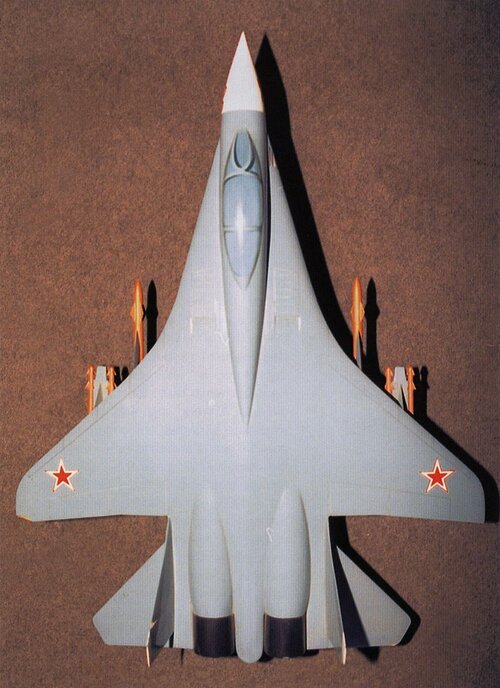

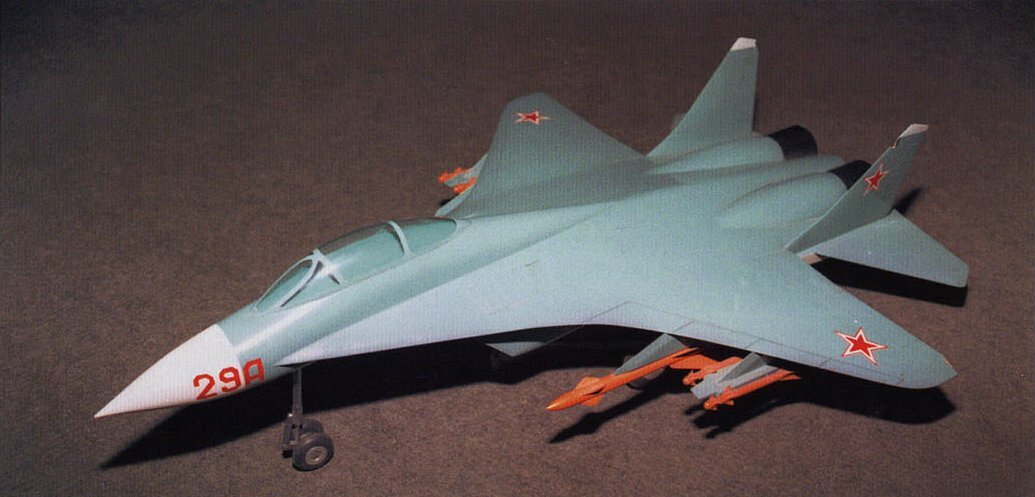
This early MiG-29 model seems to be the same one featured in archival footage from Mikoyan below. Note the R-23 and R-13 AAMs.


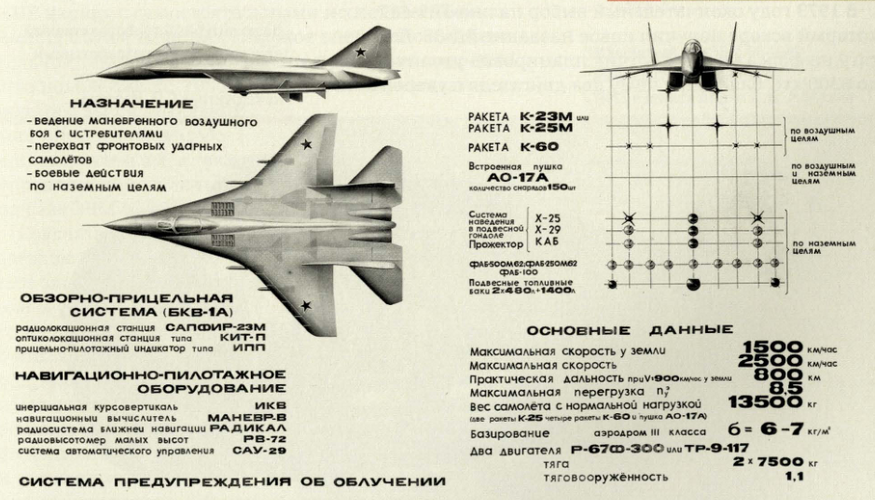

The exact sequence of MiG-29 configuration development still isn't clear, but this version is apparently from August 1972. Note the armament has switched to more modern K-25 and K-14 AAMs.
Part 2 -
Sources
V A Antonov, Ildar Bedretdinov et al Su-27 Fighter: Beginning of Story (Bedretdinov & Co, 2005)
E V Arsenyev, N O Valuev, Yu F Polushkin MiG - Flying Through Time Vol. 2 (2020) [Russian text]
G S Bushgens, E.L.Bedrzhitsky TsAGI- Center of Aviation Science (Nauka 1993) [Russian text]
E A Fedosov Half a century in aviation. Notes of an academician: Literary and artistic work (Drofa, 2004) [Russian text]
Andrei Fomin Su-27 Flanker Story (Intervestnik, 1999)
Yefim Gordon, Andrei Fomin, A.Mikheev MiG-29 (Polygon, 1998) [Russian text]
Yefim Gordon Famous Russian Aircraft MiG-29 (Midland 2006)
Yefim Gordon Famous Russian Aircraft MiG-31 (Midland 2006)
Yefim Gordon Famous Russian Aircraft Su-27 (Midland 2007)
Andrei Jurgenson, Yak-45: Attack aircraft & fighter in Aerospace Review, Issue 5 & 6, 2005 [Russian text]
Stanislav Kashafutdinov 'Siberian Hardening of Su-27' in Aviapanorama Issues 4 & 5,1997 [Russian text]
Victor Litovkin 'Wings for Sukhoi' [with G S Bushgens] article on https://nvo.ng.ru/history/2007-07-20/5_wings.html
N.N. Prokofiev, T.S.Smirnov (ed) TsAGI—the main stages of scientific activity (1968—1993) (Physical and Mathematical Literature 1996) [Russian text]
Oleg Samoilovich Next to Sukhoi (Ot Vinta!, 1999) [Russian text]
Oleg Samoilovich 'The best fighter in the world' in Mir Aviatsii 1999 01 [Russian text]
Nikolay Yakubovich MiG-29: "Stealth" Fighter (Eksmo, 2010) [Russian text]
Nikolay Yakubovich MiG-31: The Ultimate Interceptor Fighter (Eksmo, 2018) [Russian text]
OKB Sukhoi - 80 Years (2019) [Russian text]
OKB Sukhoi (2024) [Russian text]
Yak-45 - Unknown competitor of MiG-29 in Aero Magazyn Lotniczy 05 2007 [Polish text]
Last edited: