Two thoughts, very, very late launch, operator caught napping. Possibly outside of coverage too. The missiles don't even seem to be targeting the first warhead, assuming that's what it is.
I can imagine that the battery was probably targeting missiles that were still further out, or engaging other types of ordnance. Leaving only the last Interceptors being launched at the incoming missile, at which point it was way to late.

What I find interesting is that the Russian forces are seemingly rather content with prioritizing their designated target rather than diverting missiles to engage the battery itself, despite its position having been known prior (most likely). They are, I assume, keenly aware that their output of Iskander far exceeds the supply of Interceptors Ukraine received/is receiving. So they just focus on higher priority targets. I just found this bit rather fascinating.
 
I can imagine that the battery was probably targeting missiles that were still further out, or engaging other types of ordnance. Leaving only the last Interceptors being launched at the incoming missile, at which point it was way to late.

What I find interesting is that the Russian forces are seemingly rather content with prioritizing their designated target rather than diverting missiles to engage the battery itself, despite its position having been known prior (most likely). They are, I assume, keenly aware that their output of Iskander far exceeds the supply of Interceptors Ukraine received/is receiving. So they just focus on higher priority targets. I just found this bit rather fascinating.
The missiles aren't accurate enough to take out Patriot batteries in Kyiv, possibly as a result of jamming. If they could they would, the cost of replacement would be large.
 
The missiles aren't accurate enough to take out Patriot batteries in Kyiv, possibly as a result of jamming. If they could they would, the cost of replacement would be large.

Cluster Munitions compensate pretty easily for any sort of jamming.

But far more importantly, Iskander uses Digital Scene Matching Area Correlators and Inertial Guidance on top of GLONASS. You cannot really interfere with the first two, thus Iskander cannot really be jammed effectively.

So it's really just that these batteries aren't priority targets for Iskander strikes. Probably due to low interception rates and overall a decrease in the number of interceptors available. I wouldn't really be concerned with targeting SAM systems either when they are wasting like 2-3 Interceptors per individual missile. It's a good way to deplete the stockpile and degrade air defenses while simultaneously hitting other valuable targets.
 
Cluster Munitions compensate pretty easily for any sort of jamming.

But far more importantly, Iskander uses Digital Scene Matching Area Correlators and Inertial Guidance on top of GLONASS. You cannot really interfere with the first two, thus Iskander cannot really be jammed effectively.

So it's really just that these batteries aren't priority targets for Iskander strikes. Probably due to low interception rates and overall a decrease in the number of interceptors available. I wouldn't really be concerned with targeting SAM systems either when they are wasting like 2-3 Interceptors per individual missile. It's a good way to deplete the stockpile and degrade air defenses while simultaneously hitting other valuable targets.
The radars cost as much as dozens of missiles. DSMAC can be jammed too, much like any radar system. The fact that the missile strike makes a smaller flash than the Patriot launch tells you it was much further away.
 
Aftermath of an Iskander-M strike on a pipe factory in the Dnepropetrovsk Oblast

On that note, what would be so flammable in a pipe factory to cause such large scale damage. Given that I assume the warhead alone isn't completely responsible for the damage seen.
 
Aftermath of an Iskander-M strike on a pipe factory in the Dnepropetrovsk Oblast

On that note, what would be so flammable in a pipe factory to cause such large scale damage. Given that I assume the warhead alone isn't completely responsible for the damage seen.
Oxy-acetylene as used in welding perhaps.
 
Hmm, only 30km from front line (river), wonder why they didn't use a cheaper glide bomb?

My guess would perhaps be reaction time? As in getting a strike aircraft airborne with the ordnance to strike the target may have been considered too long for what seems a somewhat time sensitive target? While Iskander basically gets the location, verification and then launches, which is said to be a speedy process these days (only a couple minutes from target ID to launch, something that used to take far longer before and early on in the war).
 
Lacking the necessary payload, probably.
240kg should have been enough, especially if 2 were fired. It was an ordinary building. I think the likely reason is that they couldn't get such equipment near enough to the front without it being destroyed.
 
240kg should have been enough, especially if 2 were fired. It was an ordinary building. I think the likely reason is that they couldn't get such equipment near enough to the front without it being destroyed.
Certainly a valid reason as well.

Although Tornado-S for example, which is often mistaken for Iskander upon impact, has decent range. They're stretched thin though, even if production increased since the beginning of the war. So ironically Iskander is the more numerous and thus available system.
 
Last edited:
Looks to be a very small puff of smoke (almost missed it), so probably nothing too interesting. Annoyingly reddit asks for photo ID when I try view fullscreen.
 
I know, I know, not post every usage of the missile and so on.

But I considered the quality of the footage to be rather outstanding compared to most, so I thought it might be worth posting what looks to be an Iskander-M double tap. It's even possible to get glimpses of the missiles descending in some of the frames, coming down from the left side.

View: https://www.reddit.com/r/UkraineRussiaReport/comments/1n24b3a/ua_pov_ballistic_missile_strike_on_some_office/?share_id=FPEExpgWoCbrhzD_g51mX&utm_content=1&utm_medium=android_app&utm_name=androidcss&utm_source=share&utm_term=1
 
Last edited:
I think that one of the Mods should edit the title of this thread to include the US DOD/NATO reporting name of this missile which is the SS-26 Stone, please.
 
https://t.me/Slavyangrad/150713

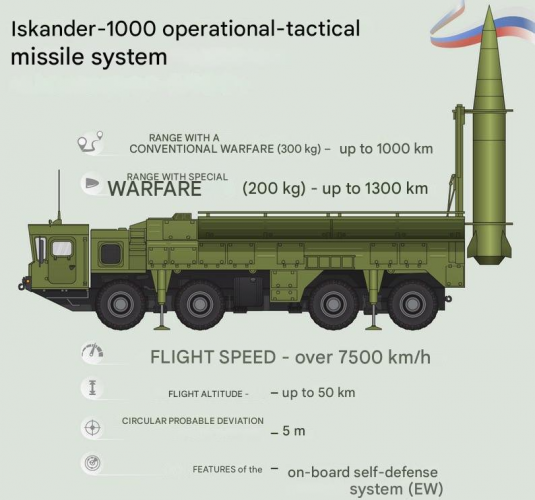
"Western monitoring services for the first time recorded 2 days ago a targeted launch of an Iskander-M missile at a range of 800 km. This means that the “Iskander-1000” has now de facto been deployed with active troops.

What advantages does this give to our armed forces?

Talk about the Russian short-range missile system Iskander-1000 began in May 2024. At that time, in an anniversary film about the Kapustin Yar test range, tests of a “thick” Iskander missile briefly appeared for the first time, launched from the same transporter-launcher used by its more compact counterparts. The video quality was poor, but even so it made a strong impression on Western experts

The latest “Iskander-1000” will be able to reach the launchers of the Gryphon and LRHW “Dark Eagle” missile systems in Germany, and will also deny the U.S. infrared reconnaissance satellite constellation, as well as Patriot PAC-3 MSE and SAMP-T air defence battalions deployed in Ukraine, the necessary time “window” to arrive at firing positions and deploy

This is hardly surprising, since modified MiG-31K aircraft carrying the Kh-47M2 medium-range aeroballistic missiles are detected almost immediately after takeoff from their home airfields by U.S. optical-electronic reconnaissance satellites in the visible/IR bands, both by the aircraft’s optical silhouette and by the IR signatures of the exhaust plumes of the D-30F-6 afterburning turbofan engines

As a result, personnel at strategically important Ukrainian Armed Forces facilities often receive warning of MiG-31K aircraft reaching Kh-47M2 launch lines 15–20 minutes before a strike. In the case of the Iskander-1000, warning time will vary between 2 and 7 minutes (depending on the distance of the target from the Iskander-100 firing positions), since enemy infrared-reconnaissance satellites with wide-angle, high-resolution IR sensors will detect the high-contrast exhaust plumes of the solid-fuel rocket motors of operational-tactical quasi-ballistic missiles during the boost phase of flight.

As for the presumed ballistic parameters of the Iskander-1000 missile, based on the first photo of an experimental prototype filmed at the Kapustin Yar test range in May 2024, one can conclude that the classic layout of the 9M723-1/K5 missile family has been retained, but with a 10–15% increase in solid-propellant volume, extending the burn time. Combined with a higher-impulse propellant charge (up to 480 seconds) based on octogen (HMX), the new solid-fuel rocket motor could provide the prospective operational-tactical quasi-ballistic missile with speeds of 2,700–3,100 m/s (comparable to the Kh-47M2 Kinzhal). This would allow delivery of a 300–350 kg high-explosive fragmentation or cluster payload to ranges of approximately 900–1,000 km, and 200–230 kg to 1,250–1,300 km, with a trajectory apogee of about 120–130 km.

The missile would also feature tail-mounted gas-dynamic control units and aerodynamic control surfaces for maneuvering in the stratosphere and troposphere with available overloads of up to 25–30 g. It would be equipped with an inertial navigation system and a GLONASS/GPS correction module and a decoy-dispensing module with dipole reflectors and an onboard electronic warfare suite operating in the X/J/Ka bands. The terminal dive angle could reach 90 degrees, with speeds of 1,900–1,600 m/s in the stratospheric segment and 1,600–1,400 m/s in the tropospheric segment of the trajectory.

And now, if reports from various NATO observers are to be believed, that moment has arrived. As well-known analyst Howard Altman of The War Zone (TWZ) wrote:

Last night was marked by one notable event. Russia used an Iskander-M ballistic missile in a short-range ballistic missile configuration at a distance of more than 500 miles for the first time. There is a small chance it was a KN-23, but the nature of the flight clearly indicates that the ‘big Iskander’ is now a reality, and reliable means of countering this extremely deadly threat must be urgently sought.

 

Attachments

  • 1765940038630.png
    1765940038630.png
    359.3 KB · Views: 189
Last edited by a moderator:
Is this anything new? The Iskander-M's range was always about 700km with a 500kg warhead and hence likely 1000km with a 300kg warhead. 480s specirfic impulse is an interesting claim though, didn't know that was possible with solid propellant.
 

Similar threads

Back
Top Bottom