Right, but they are only over one place on earth every 24hrs.

As I understand it, depending on what you mean by "over", it can be more than 24 hours or less than 24 hours (imagine a sensor with >5000km range and useable at high slant/obliquity), you'll be able to sense a target multiple times per day, on multiple passes (but remember, at 450nm, distance to horizon is 3300km, so that is your limit!). Or, ya know, imagine a target at the north pole (and assume your sensor has that 3000km range). You'll pass over that like 15 times per day if you are in a polar orbit.

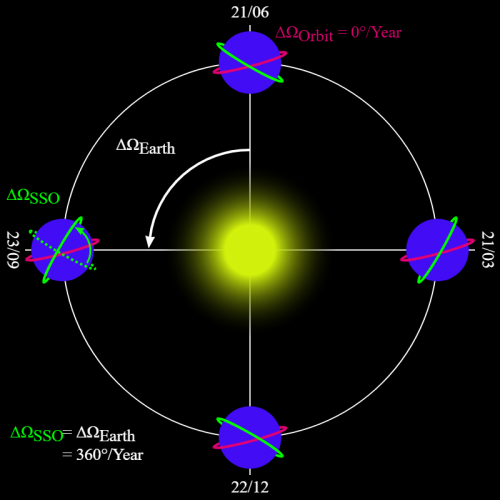
The key is that they are "over" a target at the same set of solar times each day, with the same set of illumination conditions for a given season, all year round. They do this by precessing to follow the sunward side as the earth goes around the sun (usually without precession the orbit will shift relative to the terminator/sunward side as the seasons change, just like how the pole of the earth points in a fixed direction wrt to distant stars as it goes around the sun, like a big spinning top thingy).

There is a large family of sunsynchronous orbits at different altitudes as I understand it, and as Kraft Ehricke pointed out and exploited in his treatise on space light soletta/lunetta reflectors.
1789876775506.png

I think red is a typical orbit, green is following the sun.
 
Last edited:
As I understand it, depending on what you mean by "over",
What I meant was that for any given satellite, it appears over one primary observational target every single day.

IF that satellite is available for surprise oblique shots yes you can grab some fun shots. But depending on where other objects of interest are relative to the ground path, and what your reaction-mass budget to repoint the spysat is, that specific satellite may not be available.

Yes, if the satellite is in a polar orbit and the area of interest is close to the pole it'd be easier to get a whole pile of oblique images, depending on field of view of the Spy Sats. It's my understanding that field of view of Hubble is not too far from the KH11.
 
I'm trying to wrap my brain around the tentacular maze of organisations handling 'aerospace inteligence' by large, say in the 1960s.

I know there was not a clear, linear hierachy among them: there was some overlap plus the many civilian and military organisations (CIA, DIA and co.)

So far I have
PFIAB
DCI
USIB
COMOR
NSAM 156
NRP
NRO
NPIC
 
Last edited:
So far I have
PFIAB
DCI
USIB
COMOR
NSAM 156
NRP
NRO
NPIC

First, you should spell them out. Second, you should sort them into producers of intelligence and analyzers of intelligence, as well as users of intelligence. Of course, there was some overlap.

But you're also mixing up some things in your list. DCI was Director of Central Intelligence. DCI was a position (a person) not an organization. NRP is the "National Reconnaissance Program," which was the program managed by the National Reconnaissance Office. NRP was not an organization either.

COMOR and USIB established requirements. PFIAB was an advisory board that used the intelligence and provided advice to the president. But they in effect provided advice to the intelligence organizations when asked.

So rather than a list, you need to start with the categories and functions. And you could look all this up. If it is not explained on the CIA's website or Wikipedia, you could get an edition of Jeff Richelson's book "The U.S. Intelligence Community" and it will be explained there.

Finally, note that some of these organizations no longer exist, and were either discontinued or absorbed into other organizations. COMOR and NPIC are long gone. I think that PFIAB might technically exist, but I don't know if it is active. I think USIB was changed into something else a long time ago.
 
Last edited:
A solar panel down the length of the tube. Doubling as a thermal shade?
At a presentation about the development of Hubble’s solar panels, given by one of designers, it was mentioned that there was a problem. When Hubble passed from the dark side of the earth into the sunlight, asymmetrical heating of the panels, being widely spaced induced a vibration that blurred the camera images. Without reference to the KH11 he noted that after this had been found, a US colleague mentioned that it was a known problem, which had a proven fix by emboding a single panel. At the time the KH11 was so secret operational information couldn’t be passed to civilian programs. Given there was no way that a single panel could be retrofitted in orbit an extremely clever suspension system had to be invented, qualified so it could be installed on the Hubble rescue mission.
 
Last edited:
At a presentation about the development of Hubble’s solar panels, given by one of designers, it was mentioned that there was a problem. When Hubble passed from the dark side of the earth into the sunlight, asymmetrical heating of the panels, being widely spaced induced a vibration that blurred the camera images. Without reference to the KH11 he noted that after this had been found, a US colleague mentioned that it was a known problem, which had a proven fix by emboding a single panel. At the time the KH11 was so secret operational information couldn’t be passed to civilian programs. Given there was no way that a single panel could be retrofitted in orbit an extremely clever suspension system had to be invented, qualified so it could be installed on the Hubble rescue mission.
just stiffer structure, not a big deal.

"To fix the jitter, ESA engineers added cylindrical thermal shields over the deployable support booms and completely redesigned the tensioning mechanism with a simpler system of springs and brakes"

https://ntrs.nasa.gov/api/citations/19950021793/downloads/19950021793.pdf
 
At a presentation about the development of Hubble’s solar panels, given by one of designers, it was mentioned that there was a problem. When Hubble passed from the dark side of the earth into the sunlight, asymmetrical heating of the panels, being widely spaced induced a vibration that blurred the camera images. Without reference to the KH11 he noted that after this had been found, a US colleague mentioned that it was a known problem, which had a proven fix by emboding a single panel. At the time the KH11 was so secret operational information couldn’t be passed to civilian programs. Given there was no way that a single panel could be retrofitted in orbit an extremely clever suspension system had to be invented, qualified so it could be installed on the Hubble rescue mission.

That story has been around awhile, but I suggest we remain a bit skeptical. Lockheed built Hubble and the KH-11. We have to assume that some of the people who worked on designing Hubble already had experience with the KH-11. They would have known what worked and did not work. Of course, you also have the different timelines, and the different requirements. Hubble flew in a different orbit and had much higher pointing requirements. So if the KH-11 had a jitter problem, it might have been acceptable considering the mission.

I'm not saying that the story is untrue. I'm saying that until more is declassified about the KH-11 (which could happen in two months, or never), we should be wary. I try to include qualifying language whenever I write about something like this.
 
A few years ago I talked to some former Kodak guys who worked on KH-11 and other programs. They didn't really talk about KH-11, but they told me some interesting stories about mirror production and related things. One of the interesting stories was about why Kodak did not win the bid for the Hubble Space Telescope. As it was explained to me, Kodak's experience with the KH-11 actually hurt them. The reason was that they were already aware of the difficulties of developing a large mirror telescope, so whey they put in their bid to NASA, they bid what they believed it would actually require to do it right. The problem is that NASA did not ask for all of those things, so they included things that drove up the cost and they lost the bid to Perkin-Elmer. P-E then screwed up on the Hubble mirror.

I may write up some of this someday. I really wish NRO would just declassify something about the KH-11. But it's possible that the last ones in that series are still operating, so they may not want to do that.
 
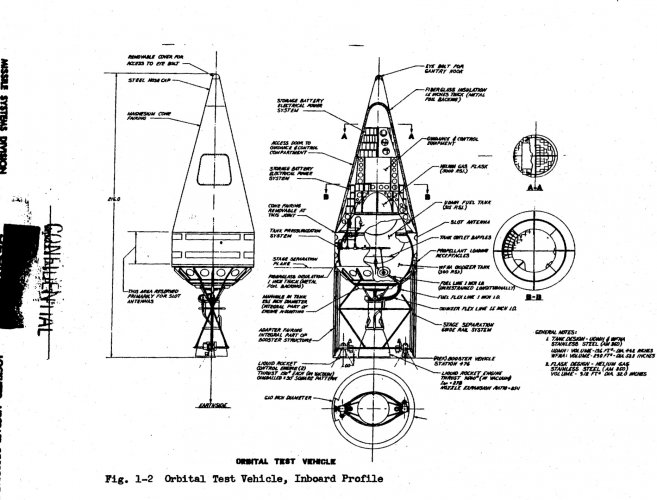
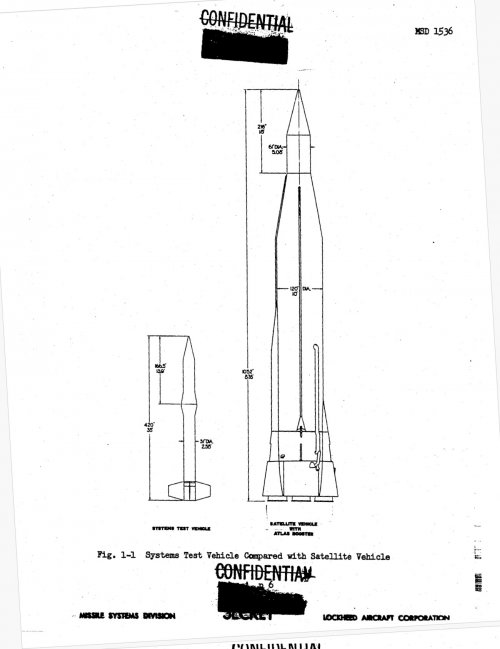
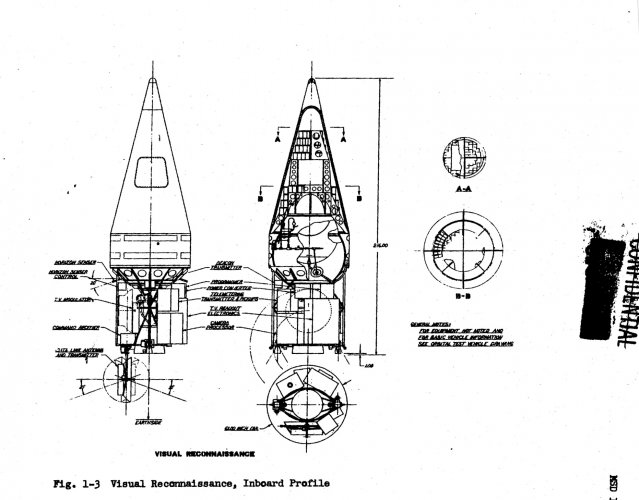
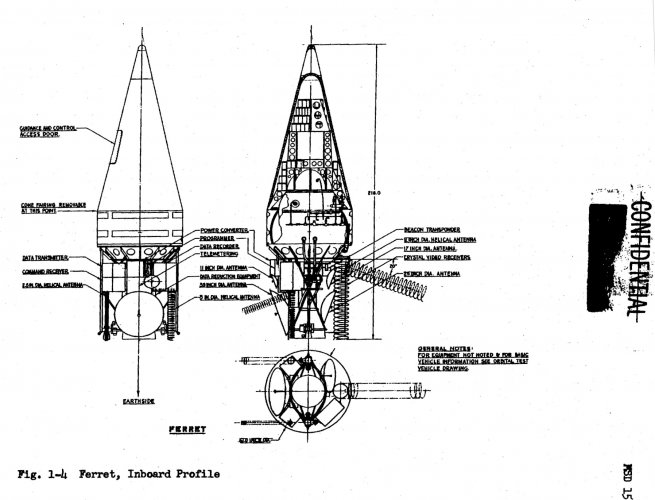
So here's a flashback. This is from the 1956 Pied Piper report. Pied Piper was Lockheed's winning proposal to build a visual and signals intelligence reconnaissance satellite.
 

Attachments

  • Screenshot 2026-09-19 at 8.07.36 PM.jpeg
    Screenshot 2026-09-19 at 8.07.36 PM.jpeg
    348.7 KB · Views: 16
  • Screenshot 2026-09-19 at 8.07.23 PM.jpeg
    Screenshot 2026-09-19 at 8.07.23 PM.jpeg
    451.7 KB · Views: 19
  • Screenshot 2026-09-19 at 8.07.05 PM.jpeg
    Screenshot 2026-09-19 at 8.07.05 PM.jpeg
    188.7 KB · Views: 17
  • Screenshot 2026-09-19 at 8.07.34 PM.jpeg
    Screenshot 2026-09-19 at 8.07.34 PM.jpeg
    365.1 KB · Views: 18
That story has been around awhile, but I suggest we remain a bit skeptical. Lockheed built Hubble and the KH-11. We have to assume that some of the people who worked on designing Hubble already had experience with the KH-11. They would have known what worked and did not work. Of course, you also have the different timelines, and the different requirements. Hubble flew in a different orbit and had much higher pointing requirements. So if the KH-11 had a jitter problem, it might have been acceptable considering the mission.

I'm not saying that the story is untrue. I'm saying that until more is declassified about the KH-11 (which could happen in two months, or never), we should be wary. I try to include qualifying language whenever I write about something like this.
The issue was ESA supplied the solar arrays
 
different pointing requirements. Body mounted wouldn't cut it and wouldn't provide enough power. Also would have covered panels needed for access to instruments and LRUs.

Ah, I had not thought about that. Hubble had to be serviceable.
 
Would the early KH-11s have been designed to be serviceable as well, given the dreams of the Shuttle era?
KH-11 were designed to be retrieved and serviced on the ground. There were facilities built at Vandenberg specifically for this.

HST has 5 instruments that could be swapped for newer ones. 4 of the locations occupied the whole aft shroud of the spacecraft.

Body mounted arrays work for RST because it would keep that side pointed at the sun. This would limit what RST could observe for that day. but as the spacecraft completes an orbit of the sun, it has been able to see the whole celestial sphere.
But as HST orbits the earth and its fixed on a subject, the arrays must be able to rotate and track the sun.
 
KH-11 were designed to be retrieved and serviced on the ground. There were facilities built at Vandenberg specifically for this.
Now that's interesting. I presume it was related to Shuttle flying out of Vandenberg, which was to happen from 1986.
So let me ask: was KH-11 designed to be serviceable from 1976 onwards, right off the first one - or would serviceability be introduced into the design sometime in the mid-1980s, with a specific Block ? https://en.wikipedia.org/wiki/KH-11_KENNEN#Block_I

And the CONOPS: Titan III launched, Shuttle serviced ? or Shuttle doing both ?
 
Lockheed still could have said "only one solar array" in the design spec, though.
Hubble’s solar panel architecture was frozen only shortly after the first KH11 first flight. Remember most of Hubble’s time on earth was spent in storage awaiting a launch. The KH11 at the time was above top secret and any operational issues would have known to very few. With issues such as this it doesn’t work in a manner of “just said”.
 
Now that's interesting. I presume it was related to Shuttle flying out of Vandenberg, which was to happen from 1986.
So let me ask: was KH-11 designed to be serviceable from 1976 onwards, right off the first one - or would serviceability be introduced into the design sometime in the mid-1980s, with a specific Block ? https://en.wikipedia.org/wiki/KH-11_KENNEN#Block_I

And the CONOPS: Titan III launched, Shuttle serviced ? or Shuttle doing both ?
Not the Titan IIID/34D launched versions. And I doubt the 34D versions were shuttle launch compatible.
 
Yes - because a Titan fairing isn't a Shuttle payload bay, by a long shot. Vertical loads only, vs horizontal in the Shuttle case ?

So two major changes for the retrievable KH-11s a) modified for horizontal loads, because Shuttle landings and b) modified for handling by astronauts in space for retrieval (plus ground servicing) ?
 
Would another benefit of a bigger mirror be higher operating altitude, for more frequent revisits?
This is ofc, assuming that atmospheric effects limit resolution and in addition to IR benefits.
Image resolution is a direct calculation from aperture..... More aperture=more resolution
 
https://www.thespacereview.com/article/5318/1

Damn interesting. You mention RCA at some point, and I wonder something about them.

“Breadboard designs of this camera have already been built and tested by Radio Corporation of America

Perry history of satellite reconnaissance is available here.
https://www.google.fr/books/edition/A_History_of_Satellite_Reconnaissance/KiD7TsLU4z0C?hl=fr&gbpv=0
CHAPTER NINE
PHOTO-READOUT, 1960-1963
(E-1 , E-2, SUBSYSTEM I, AND TAPE)
In that chapter Perry mentions RCA & readout too, but long after SAMOS E-3 was canned: 1961-1964. Exact name was: electrostatic tape.

So I wonder whether the RCA electrostatic tape, 1962-1964, was the same technology as SAMOS E-3 readout, 1959; or something entirely different.

Situation of readout by late 1962
Anything that promised to satisfy such requirements
would have to come from work supported by the
Reconnaissance Laboratory at Wright Field. When
interest suddenly spurted, in October 1962, the project
could look back, on four independent efforts to develop
an electronic camera having significant advantages
over a conventional silver halide image device. RCA
had devoted considerable effort to developing a photo-
conductive tape system and Westinghouse to photo-
emissive tape. General Electric touted the virtues of a
thermoplastic tape system. Chance-Vought had explored
the potential of a modification of the Xerox process.
The Navy, which had provided virtually all funds for the
Chance-Vought investigation, dropped the project in
1962. Even earlier, the Reconnaissance Laboratory had
given up on the General Electric system and was then in
the process of closing out the Westinghouse activity. RCA
remained , “lion its merits,” to quote the project officer.
Seems that RCA electrostatic tape readout limped out until 1964, they got studies and a little funding as "Project 73". But in the end it went nowhere. Seems it was an evolutionary dead end.
After the furor died down, RCA was modestly
financed for another year of development. (There
was clear understanding, this time, that the technical
objective was a demonstration of 75 cycles per second
resolution—a “cycle” meaning line and space to both
the television industry and the Air Force.) The goal of
the revised program was demonstration of the desired
functional utility by March 1964, a possibility that the
project engineer thought somewhat uncertain because
of continued poor management at RCA. The contractor
was considerably more conservative in his goals and
claims; his immediate objective now was a flyable system
that could resolve 50 cycles at 1.0 (ASA) film speed by
mid-1965.
The goal seemed not unrealistic. On the other
hand, it had no particular technical appeal.47
In a sense, Project 73 died at birth

RCA electrostatic tape truly was the last of the first generation readout era, 1958-1964.

Readout would not return until early FROG history, in 1965-66.
 
Last edited:
Yes - because a Titan fairing isn't a Shuttle payload bay, by a long shot. Vertical loads only, vs horizontal in the Shuttle case ?

So two major changes for the retrievable KH-11s a) modified for horizontal loads, because Shuttle landings and b) modified for handling by astronauts in space for retrieval (plus ground servicing) ?
And bigger mirrors

RMS would have been used for retrieval, no EVA
 

Similar threads

Back
Top Bottom