

chimeric oncogene
ACCESS: Secret
- Joined
- 23 May 2019
- Messages
- 460
- Reaction score
- 726
Right, but they are only over one place on earth every 24hrs.
As I understand it, depending on what you mean by "over", it can be more than 24 hours or less than 24 hours (imagine a sensor with >5000km range and useable at high slant/obliquity), you'll be able to sense a target multiple times per day, on multiple passes (but remember, at 450nm, distance to horizon is 3300km, so that is your limit!). Or, ya know, imagine a target at the north pole (and assume your sensor has that 3000km range). You'll pass over that like 15 times per day if you are in a polar orbit.
The key is that they are "over" a target at the same set of solar times each day, with the same set of illumination conditions for a given season, all year round. They do this by precessing to follow the sunward side as the earth goes around the sun (usually without precession the orbit will shift relative to the terminator/sunward side as the seasons change, just like how the pole of the earth points in a fixed direction wrt to distant stars as it goes around the sun, like a big spinning top thingy).
There is a large family of sunsynchronous orbits at different altitudes as I understand it, and as Kraft Ehricke pointed out and exploited in his treatise on space light soletta/lunetta reflectors.
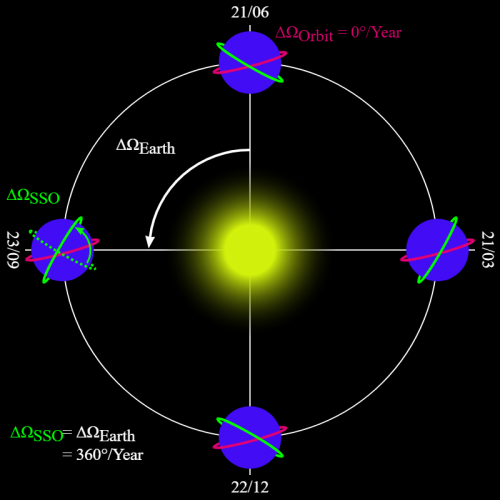
I think red is a typical orbit, green is following the sun.
Last edited:
