
Right, but they are only over one place on earth every 24hrs.

As I understand it, depending on what you mean by "over", it can be more than 24 hours or less than 24 hours (imagine a sensor with >5000km range and useable at high slant/obliquity), you'll be able to sense a target multiple times per day, on multiple passes (but remember, at 450nm, distance to horizon is 3300km, so that is your limit!). Or, ya know, imagine a target at the north pole (and assume your sensor has that 3000km range). You'll pass over that like 15 times per day if you are in a polar orbit.

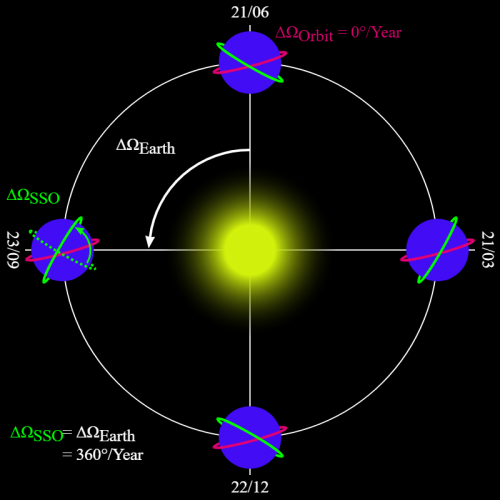
The key is that they are "over" a target at the same set of solar times each day, with the same set of illumination conditions for a given season, all year round. They do this by precessing to follow the sunward side as the earth goes around the sun (usually without precession the orbit will shift relative to the terminator/sunward side as the seasons change, just like how the pole of the earth points in a fixed direction wrt to distant stars as it goes around the sun, like a big spinning top thingy).

There is a large family of sunsynchronous orbits at different altitudes as I understand it, and as Kraft Ehricke pointed out and exploited in his treatise on space light soletta/lunetta reflectors.
1789876775506.png

I think red is a typical orbit, green is following the sun.
 
Last edited:
As I understand it, depending on what you mean by "over",
What I meant was that for any given satellite, it appears over one primary observational target every single day.

IF that satellite is available for surprise oblique shots yes you can grab some fun shots. But depending on where other objects of interest are relative to the ground path, and what your reaction-mass budget to repoint the spysat is, that specific satellite may not be available.

Yes, if the satellite is in a polar orbit and the area of interest is close to the pole it'd be easier to get a whole pile of oblique images, depending on field of view of the Spy Sats. It's my understanding that field of view of Hubble is not too far from the KH11.
 
I'm trying to wrap my brain around the tentacular maze of organisations handling 'aerospace inteligence' by large, say in the 1960s.

I know there was not a clear, linear hierachy among them: there was some overlap plus the many civilian and military organisations (CIA, DIA and co.)

So far I have
PFIAB
DCI
USIB
COMOR
NSAM 156
NRP
NRO
NPIC
 
Last edited:
So far I have
PFIAB
DCI
USIB
COMOR
NSAM 156
NRP
NRO
NPIC

First, you should spell them out. Second, you should sort them into producers of intelligence and analyzers of intelligence, as well as users of intelligence. Of course, there was some overlap.

But you're also mixing up some things in your list. DCI was Director of Central Intelligence. DCI was a position (a person) not an organization. NRP is the "National Reconnaissance Program," which was the program managed by the National Reconnaissance Office. NRP was not an organization either.

COMOR and USIB established requirements. PFIAB was an advisory board that used the intelligence and provided advice to the president. But they in effect provided advice to the intelligence organizations when asked.

So rather than a list, you need to start with the categories and functions. And you could look all this up. If it is not explained on the CIA's website or Wikipedia, you could get an edition of Jeff Richelson's book "The U.S. Intelligence Community" and it will be explained there.

Finally, note that some of these organizations no longer exist, and were either discontinued or absorbed into other organizations. COMOR an NPIC are long gone. I think that PFIAB might technically exist, but I don't know if it is active. I think USIB was changed into something else a long time ago.
 
A solar panel down the length of the tube. Doubling as a thermal shade?
At a presentation about the development of Hubble’s solar panels, given by one of designers, it was mentioned that there was a problem. When Hubble passed from the dark side of the earth into the sunlight, asymmetrical heating of the panels, being widely spaced induced a vibration that blurred the camera images. Without reference to the KH11 he noted that after this had been found, a US colleague mentioned that it was a known problem, which had a proven fix by emboding a single panel. At the time the KH11 was so secret operational information couldn’t be passed to civilian programs. Given there was no way that a single panel could be retrofitted in orbit an extremely clever suspension system had to be invented, qualified so it could be installed on the Hubble rescue mission.
 
Last edited:
At a presentation about the development of Hubble’s solar panels, given by one of designers, it was mentioned that there was a problem. When Hubble passed from the dark side of the earth into the sunlight, asymmetrical heating of the panels, being widely spaced induced a vibration that blurred the camera images. Without reference to the KH11 he noted that after this had been found, a US colleague mentioned that it was a known problem, which had a proven fix by emboding a single panel. At the time the KH11 was so secret operational information couldn’t be passed to civilian programs. Given there was no way that a single panel could be retrofitted in orbit an extremely clever suspension system had to be invented, qualified so it could be installed on the Hubble rescue mission.
just stiffer structure, not a big deal.

"To fix the jitter, ESA engineers added cylindrical thermal shields over the deployable support booms and completely redesigned the tensioning mechanism with a simpler system of springs and brakes"

https://ntrs.nasa.gov/api/citations/19950021793/downloads/19950021793.pdf
 

Similar threads

Back
Top Bottom