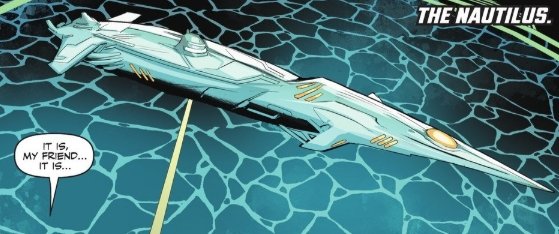
Did [Herbert's Under Pressure] contain any specifications for the ship contained within?
Dive depth on the order of 8,000ft (boat dives to ~7900ft in story, though that may exceed test depth), oddly enough the reactor compartment is in the bow.
All torpedoes stored externally.
I believe only one hull penetration, the bridge access trunk. The propeller is powered inductively.
A crew of 4.

Less an attack sub than an armed towboat.
 
A small update, Post #950 covering the J. E. MacDonnell novel 'Eagles Over Taranto' has been updated with a recently discovered cover to the 1963 reprinting of the novel.
 
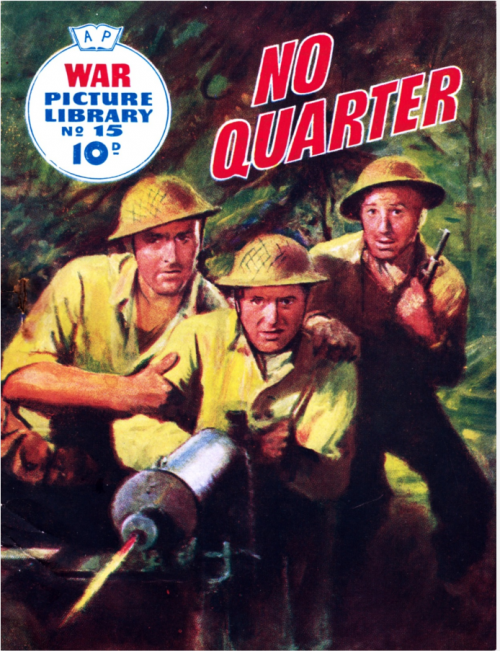
Anon., No Quarter, published as War Picture Library, Nº. 15, 1959

United Kingdom

HMS Culverley
Hunt Class (Type IV (Modified)) Destroyer
Details as per the real ships.
Armament has been fictionally modified. Main battery is 6 x 4.7inch guns in twin mounts rather than 6 x 4inch guns in twin mounts.
Note: Class identity determined with the help of Hood, based on the illustrations. The Type IV Hunt Class Destroyers were a pair of ships built to a private venture design by Thornycroft, pictures of those ships were presumably used by the artist to create the ship. Hood has confirmed that the name does fit the overall Hunt Class Destroyer naming scheme.

Japan

Various unnamed warships including a Hosho Class Aircraft Carrier.

Plot summary: The year is 1941 A team of specialists, sent to Hong Kong to oversee the setting up of a radar installation find themselves caught up in the Japanese offensive that started after the attack on Pearl Harbour. Chased from pillar to post they and their escort find themselves trapped on a small island along with the crews of two crippled ships. As a small boat heads off to arrange a rescue those left behind hurriedly improvise fortifications in the hope that they can hold off the Japanese until help can arrive or at the very least give them a bloody nose before the end.

Note: The stories climactic action was probably inspired by either the US defence of Wake Island, or possibly something that happened during the Napoleonic Wars. Between 1803 and 1805 the Royal Navy occupied Rocher du Diamant, a small basalt island off the coast of Martinique, commissioned as HMS Diamond Rock. This position was a thorn in the side of the French on Martinique until it was recaptured by Admiral Villeneuve in his only successful combat action and the artwork used for the island the characters find themselves on has a slight resemblance to Rocher du Diamant.
 

Attachments

  • No_Quarter.png
    No_Quarter.png
    1.5 MB · Views: 16
Last edited:
Mary Chapman, Danger Money, 2007

Admiral (ex-Victoria)
Q-Ship (Armed Fishing Smack)
Armament: (As Admiral) 1 x 13pdr gun (Concealed), other armament not specified. Armament: (As Victoria) 1 x 5pdr gun (Concealed), other armament not specified.
No other specifics given.

Summary: For Bob Thompson, taking a position on an armed fishing boat was 'easy money', but when push came to shove, would he prove worthy of earning it.

Note: This was published as part of a Young Adult fiction series entitled 'Shades 2.0', the authors note indicate that during the WW1 the RN fitted concealed armament to a number of fishing boats, what she does not make clear in the story is if they were commissioned into the RN, she also has a character claim that the names of these fishing boats were changed from time to time to confuse the Germans.
 
Tim Chant, Vengeance In The Falklands (Marcus Baxter: 5), 2025

United Kingdom

HMS Astute
Active Class Scout Cruiser
Details as per the real ships
Note: Author refers to the ship as a member of the 'Fearless Class' in the endpapers. HMS Fearless was the third member of the Active Class.

Germany (WWI)

SMS Kassel
Koenigsberg (WWI) Class Cruiser
Details as per the real ships.
Note: Explicitly identified as being of this class by the author in the novels endpapers. The ship is sunk by HMS Astute during the Battle of the Falkland Islands.

SMS Ludovic (ex-SS Ludovic aka SS San Francisco)
Armed Merchant Cruiser
Engines: Quadruple Expansion Steam.
Speed: 22knots (Max)
No other specific details provided.
Note: Conversion is incomplete. The crew has been sworn into naval service but the armament has not been fitted. Currently acting as a covert supply ship for the East Asia Squadron for it's anticipated breakout into the Atlantic. The ship is captured by members of the Astute's crew while coaling in Montevideo.

Plote summary: The year is 1914, the Battle of Coronel was the RNs first defeat in over a century, this cannot be allowed to stand. As a powerful squadron heads into the South Atlantic, a newly comissioned light cruiser is sent across the Atlantic carrying important messages for Britains representatives in South America

Notes: This is the fifth in a currently five book series featuring an RN officer who's path has been entwined with Naval Intelligence since the Russo-Japanese war. The author does a nice job slotting his plotline into the 'gaps' in the 1914 Falklands Naval campaign.
 
Last edited:
An update has been made to the entry for the J. E. MacDonnell novel 'Escort Ship' (1960) (Post #1200). A better quality version of the footage shot of the sinking of the USS Edsall (DD-219) has been added to the entry.
 
An update has been made to the entry for the 'J. E. MacDonnell' novel 'Repel Boarders' (1963) (Post #158) to incorporate the rather odd cover created for it as part of the Piccadilly Publishing 'Blue Cover' reprint series.
 
Irving A. Greenfield, Rush To Judgement, 1995

United States ('Present Day' (e.g. 1995))

USS Utah (BB-64)
Iowa Class Battleship
Details as per the real ships
Note: The pennant is that of the fourth member of the Iowa Class USS Wisconsin. The name given to the ship is that of a Florida Class Dreadnought that was converted to a target ship and sunk at Pearl Harbor and not subsequently salvaged. The name was not revived until it was used for a Virginia Class submarine in the 2000's. The novel is inconsistent with the pennant number giving it as BB-64 initially and then changing it to BB-46 later.

USS Normandy
'Heavy Cruiser', class not specified
No other details provided.
Note: Name clash with the Ticonderoga Class Cruiser of the same name. Mentioned in a characters backstory so it is unlikely to be that ship.

Japan (WWII)

HIJMS Yamamoto
Yamato Class Battleship
Details as per the real ships
Note: Given the context in which it's mentioned (A collection of warship models.) it's probably meant to be Yamato herself. In any case the Japanese named their battleships after historic provinces, not naval personalities.

Plot summary: An explosion has occurred on a re-activated US Battleship, the inquiry into the event starts to lead in disturbing directions.

Note: This novel is very loosely based on the USS Iowa explosion and subsequent inquiry and the controversial conclusions it came to, the story adds drug smuggling into the mix, it's also very poorly edited.
 
Last edited:
Vincent Formosa, No Way Back, 2023

Norway

HNoMS Drammen
'Destroyer' class not specified.
No other details provided

United Kingdom

HMS Achillia
Flower Class Corvette
Built: 1940 (Author does not make it clear if this was launched in that year or commissioned in that year)
Details as per the real ships
Note: Explicitly identified as a Flower Class Corvette by the author. The name is the feminine form of Achilles and would thus not fit the class naming scheme.

HMS Eucharis
Flower Class Corvette
Details as per the real ships
Note: Class determined by name only. The name in question was that given to the family of Amazonian Lilies now known as Urceolina.

HMS Quince
Flower Class Corvette
Details as per the real ships
Note: Class determined by name only.

HMS Narcissus (K74)
Flower Class Corvette
Real ship, details as in service 1941 - 1946.

HMS Saint Oak
'Destroyer', class not specified.
No other details provided.

HMS Sea Holly
'Warship', class/type unspecified
No other details provided.

HMS Magi
'Warship', class/type unspecified
No other details provided.

HMS Saint Kitts
Armed Merchant Cruiser
Displacement: 15,000 tons.
Details as per typical ships of this type.
Note: Post WWII the name HMS St Kitts was used for a Battle Class Destroyer in service 1946 - 1957.

HMS Longbow
Long Island Class Escort Carrier
Details as per the real ships.
Note: Author stated he based her details on those of HMS Archer (D78) a Long Island Class Escort Carrier in service 1943 - 1946.

SS Empire Constellation
CAM Ship
Displacement: 7000 tons.
Details as per typical ships of this type.
Note: At the time the novel was set this name was not in use. In 1945 it was applied to a captured 1925 built German freighter formerly named Memel (ex-Reval). The ship was in British hands until 1946 when it was transferred to the Russians as the Ivan Sechenov.

SS Empire Jocasta
CAM Ship
Displacement: 10,000 tons.
Details as per typical ships of this type.
Note: This name was not used by the Ministry of War Transport for an Empire ship.

SS Empire Emerald
CAM Ship
Details as per typical ships of this type.
Note: Name clashes with an 8,000 ton Oil Tanker that was operated by the Ministry of War Transport 1941 - 1946. It was never used as a CAM Ship.

SS Empire Pella
CAM Ship
Displacement: 10,000 tons.
Details as per typical ships of this type.
Note: This name was not used by the Ministry of War Transport for an Empire ship.

Plot summary: It is the early phases of WWII, the combined air/sea threat to the trans-Atlantic convoys is growing, the solution, Escort Carriers are a way off, so other more desperate methods are used to provide air cover over the convoys.
 
Last edited:
Re: HMS Achillia , while this is indeed not a flower name , there is a flower known as AchillEa , aka the common yarrow . . .

cheers ,
Robin .
Thanks for the tip, but you often have to go by the names the author uses.
 
There's been an update to Post #491 covering the novel 'North Star Crusade' (1976) by William Katz. The artwork for a Japanese edition has surfaced online and been added to the entry.
 
W. J. Saber (Pseud?), Find And Destroy The NAZI's Secret Wolf-Pack Base, published in Stag Magazine (September 1962), republished in War Cry (1962), Noah Sarlat (Ed.)

United Kingdom

HMS Dauntless
Submarine, class not specified
No other details provided.
Note: This name clashes with a D Class Cruiser in service 1918 - 1946.

Plot summary: A secret agent, using the identity of a dead Norwegian is sent into the country to pin down the location of a concealed U-Boat base in the vicinity of Namsos.

Note: During the 1960s a number of anthologies were created from the contents of various 'Man Adventure' publications for sale through newsagent and drug store spinner racks. It is known that many of the stories credited authors are pseudonyms, but the identities of the actual authors has been hard to determine.
 
Anthony M. Strong, Black Tide (John Decker: 6), 2021

Germany

U-909
Type VIIC/41 U-Boat
Real ship, history fictionally altered.
Details as per the real ships.
Note: Actual history is as follows, Construction Ordered: 22 Sept. 1942, Construction Suspended: 22 July. 1943, Construction Cancelled: 30 Sept. 1944. In the novel the submarine is completed in secret and fitted with a device recovered from a mysterious crash in February 1943. A device of similar origin was tested by the United States aboard the USS Eldridge (DE-173) during 1943 in what became known as 'The Philadelphia Experiment'.

Plot summary: An incredibly well preserved U-Boat has been discovered sitting on the ocean floor off the coast of South America, as a team investigates the find strange things start happening....

Note: This is a tale that makes use of a 'weird science' idea known as the Philadelphia Experiment which first surfaced in 1957, I've covered other stories inspired by this in the thread. They are 'Thin Air' (1977), 'Dive To Oblivion' (1993), 'Thunderfish' (1999), 'Whisper' (2010), 'The Displaced' (2017), 'Operation Paradox' (2018) and 'The Voyage of the Ling Cod' (2020). The story that became known as 'The Philadelphia Experiment' may have been inspired by a 1942 short story entitled 'The Phantom Armada'.
 
Been looking for a book with the following plot for months now and it’s been driving me crazy.

Plot: military sealift command ship attacked by helicopters, missiles stolen off ship and ship is sunk to cover heist, sealift command investigates ship as missing, missiles were put on passenger/cargo plane to use in assassination attempt against president.
 
Been looking for a book with the following plot for months now and it’s been driving me crazy.

Plot: military sealift command ship attacked by helicopters, missiles stolen off ship and ship is sunk to cover heist, sealift command investigates ship as missing, missiles were put on passenger/cargo plane to use in assassination attempt against president.

Could it be 'The Panjang Incident' (1989) by Charles Ryan, I covered that one in Post #63
 
C. Anthony Boot, Odonata (Fallen Leaves: 1), 2018

United States

USS Lonestar (DDG-???)
Thomas Jefferson Class Destroyer
Described as a 'Littoral Combat Stealth' destroyer and as the "...most recent addition..." to her class.
No other specifics provided.
Note: Ships name does not fit the USN naming scheme for destroyers, which is naval heroes.

Plot summary: The year is 2005, a project to create a time machine has succeeded, but now the consequences must be dealt with.
 
A small update, the entries for 'Subsmash' (1960) and 'Close and Investigate' (1965) have been updated to incorporate the covers created for the Piccadilly Publishing 'Red Cover' reissues of the 'Jim Brady' novels.

New posts for the thread are currently being worked on.
 
J. E. MacDonnell, The Pawn, 1964

Australia

HMAS Wind Rode (G46) (Given as G42 in this story, The same pennant number is also used in the authors fiction for HMAS Scimitar, and clashes with that of HMS Lincoln (ex-USS Yarnall (DD-143)), a Town Class Destroyer.)
Tribal Class Destroyer
Details as per the real ships
Note: The ships name does not fit the Tribal Class naming scheme. It is apparently named after a V & W Class destroyer that also appears in the authors fiction. The transition between the two ships is not clear in the authors writing. In earlier posts in the thread covering this authors fiction I referred to this ship as a 'J,K & N' Class destroyer, which is my term for the nondescript term 'Fleet Destroyer' the author often uses in his fiction when referring to the ships his heroes serve upon. It's actual class identity was given in 'The Gunner' (1959) and as far as I've read nowhere else in the authors fiction.

Japan

HIJMS Satuki
Yamato Class Battleship
Details as per the real ships.
Note: This ship and the events of this novel is later referenced in the authors 1964 novel 'Sabotage!', thought the title of this novel was not mentioned in the later novel. The ship is sunk by HMAS Wind Rode (G46) during the course of this novel.

When I posted the original entry for 'Sabotage!' I was not completely certain that the Satuki was in fact a Yamato Class Battleship. The later discovery of the freelanced Japanese super-battleship HIJMS Satsuma in the 1958 novel 'Coffin Island' opened up the possibility that the Satuki would prove to be another freelanced creation or a repeat Satsuma. Details provided in this novel make it explicitly clear that the Satuki is in fact a 'stock' Yamato Class Battleship.

Plot summary: The plan was simple, have a destroyer conceal herself near the location Japan's latest super-battleship is working up and have her alert the fleet upon that ships departure, but even simple plans can go wrong. When that happens it becomes a contest of raw power verses hard earned skill.

Note: In many ways this is a reworking of the authors earlier novel 'Coffin Island' (1958). The author has the characters acknowledge to the reader when they are given their orders that this is not the first time they've had a run in with a Japanese super-battleship but the reference relies on the readers familiarity with the authors fiction.

As to when this story is set in the authors version of the WWII Pacific Campaign, it's after the fall of Truk (Something that never happened in WWII as it actually occurred.), and after the creation of the British Pacific Fleet in November 1944.

J. E. MacDonnell was a prolific Australian writer of action fiction for newsstand paperbacks. Some of the novels by him covered in this thread include, 'Gimme the boats!' (1953), 'Coffin Island', (1958), 'The Frogman' (1958), 'Night Encounter' (1958), 'Dive,Dive,Dive!' (1959), 'The Gunner' (1959), 'The Surgeon' (1959), 'The Secret Weapon' (1959), 'Target Battleship' (1959), 'Subsmash' (1960), 'Convoy' (1960), 'Escort Ship' (1960), 'Find and Destroy' (1960), 'The Coxswain' (1960), 'The Recommend', (1960), 'The Captain' (1960), 'The Blind Eye' (1961), 'The Lesson' (1961), 'The Ordeal' (1961), 'The Rocky' (1961), 'Away Borders!' (1962), 'Sainsbury VC' (1962), 'U-Boat' (1962), 'Not Under Command' (1963), 'Collision Course' (1964), 'Course To Intercept' (1964), 'Killer Group' (1964), 'Sabotage!' (1964), 'Close And Investigate' (1965), 'Under Sealed Orders' (1965), 'Hell Ship' (1966), 'Point of Departure' (1966), 'The Snake Boats' (1967), 'Approved to Scrap' (1968), 'Full Fathom Five' (1968), 'Judas Rat' (1968), 'The Hammer of God' (1968), 'Mission Hopeless' (1968), 'Petty Officer Brady' (1968), 'Hunter-Killer' (1968), 'To The Death' (1969), 'The Last Stand' (1970), 'Blind Into Doom' (1972), 'The Kill', (1974), 'Standoff' (1977) 'Breaking Point' (1979), 'The Killers' (1982), 'Command Decision' (1985), 'Jim Brady, Able Seaman' (1985) & 'The Glory Hunter' (c. 1980s) .

He also wrote a series of 'James Bond' style superspy thrillers featuring an agent named Mark Hood, novels in this series that have appeared in the thread are 'Come Die With Me' (1965), 'Carribean Striker' (1967), 'Operation Octopus' (1968) and 'Operation: Ice Cap' (1969).
 
Tim Chant, The Straits of Tsushima (Marcus Baxter: 1), 2021

Russia

Vsevolod Yaroslavich
2nd Vladimir Monmakh Class Cruiser
Details as per the real ship
Note: The Armoured Cruiser Vladimir Monmakh was a one-off ship in reality, this is a fictional second member of the class.

All other Russian, British and Japanese ships mentioned by name in the novel are real.

Plot summary: The year is 1905 and a beached RN Officer is made an offer hard to refuse by British Naval Intelligence, take a schooner out into the North Sea and shadow the Russian 2nd Pacific Squadron as it makes it's way south. Things of course do not go according to plan...

Note: This is the first book in a currently five book series following the career of a RN Officer who's life becomes entangled with British Naval Intelligence around the start of the Russo-Japanese War.

Later: Dilandu advised that the name of the warship had been misspelled. A quick re-read of the novel revealed that I had transcribed the name incorrectly, the author had got the spelling correct. The name of the ship has now been corrected.
 
Last edited:
Tim Chant, The Straits of Tsushima (Marcus Baxter: 1), 2021
[...]
Note: This is the first book in a currently five book series following the career of a RN Officer who's life becomes entangled with British Naval Intelligence around the start of the Russo-Japanese War.
Story any good?
 
Vesvolod Yaroslavich
As typical for Western author, he was unable to google a five second and wrote the name of Russian warship right. It's "Vsevolod", not "Vesvolod".

Also, while Vsevolod Yaroslavich was a historical person (the first Great Knyaz who started to title himself as "Great Knyaz of All Russia"), he is generally not hold in such reverence as Vladimir Monomakh and very unlikely to have ship named after him. There were several ships-of-the-line in Imperial Navy named "Vsevolod", but they were named in honor of saint Vsevolod Mstislavovich.
 
Ball Lightning, a Chinese novel by sci-fi writer Liu Cixin, 2003
(Personally, I prefer to translate it as Kugelblitz.)

PLAN ZhuFeng (meaning Mount Everest)
Nuclear-powered fleet carrier, class undetermined
Powered by two pressurized water reactors
Speed approximately 60 km/h, or 32 kt
Possibly equipped with some kind of directed-energy weapon (uncertain)
In the novel, it is the core of the Chinese Navy's carrier battle group

The carrier does not have much of a role in the story and is basically the plot target of the enemy forces in the work (obviously referring to the US).

Spoilers:
The enemy forces launched several unidentified subsonic cruise missiles at the Chinese carrier battle group. These missiles detonated before being intercepted by the Chinese fleet's air defense systems, and then produced several waterspouts at sea with speeds exceeding 700 km/h. These tornadoes quickly rushed into the Chinese fleet and broke the hulls of several ships. The main deck of the ZhuFeng collapsed, and it sank half an hour later, killing more than 2,000 Chinese sailors aboard. Because the CVBG was almost completely destroyed by the enemy's tornado weapon, China nearly lost command of the sea and had to retreat to the coast in an attempt to stop the enemy fleet from landing.
 
As typical for Western author, he was unable to google a five second and wrote the name of Russian warship right. It's "Vsevolod", not "Vesvolod".

Also, while Vsevolod Yaroslavich was a historical person (the first Great Knyaz who started to title himself as "Great Knyaz of All Russia"), he is generally not hold in such reverence as Vladimir Monomakh and very unlikely to have ship named after him. There were several ships-of-the-line in Imperial Navy named "Vsevolod", but they were named in honor of saint Vsevolod Mstislavovich.

I've fixed the name it turned out I had made a mistake when I copied the ships name from the novel.
 
Story any good?
I enjoyed it, as the author notes there is not much English language fiction about this conflict. Hood covered a novel from 1905 that was clearly written as a quick cash in on the events of the war. The details of that novel can be found in Post #315

The only other novel I can think of that covers it in the English language is Alexander Fullerton's 'The Floating Madhouse' (2000) which I need to find a copy of.
 
Tim Chant, Mutiny On The Potemkin (Marcus Baxter: 2), 2022

Russia

Zataka
Yalta Class Torpedo Boat
Details as per the real ships.

All other ships in the story are real, one, the transport Vehka has it's history fictionally altered. It's stats as it appears at the end of the novel are below:

Vehka
Transport Ship
Details as per the real ship
Armament (As modified in the novel): 1 x 6-inch gun (replaces fwd 3pdr gun) all other armament as per the real ship
Note: In the novel after the ship is abandoned by the revolutionaries it is taken over by members of the Okhrana (The Tsar's secret police.), the armament modified as shown above and used in an attempt to spark a war between the Ottoman Empire and Russia to distract the populace from the defeat of Russia by Japan.

Plot summary: Following his escape from the aftermath of the Battle of Tsushima the hero tries to return home via the Trans-Siberian express only to find himself and his companions diverted to Odessa where the Okhrana intend of interrogate him over his role in the battle, instead he finds himself caught up in the revolt that breaks out in the town in the aftermath of the Russian defeat.

Note: This is the second book in a currently five book series following the career of a RN Officer who's life becomes entangled with British Naval Intelligence around the start of the Russo-Japanese War.
 
Back
Top Bottom