Hi Anders,


Here's an older post with a quote from a USAAF P-38 pilot who also pointed out the advantages of centreline armament:

https://www.secretprojects.co.uk/th...52-projects-variants.3603/page-10#post-656219

Regards,

Henning (HoHun)

Yes, that's even more evidence supporting the importance of centralized guns.

But of course, even better than four 30 mm cannon for a bomber interceptor like the Shinden would have been a Japanese variant of the R4M. One wonders if that was ever on the drawing board for the J7W1?

Seeing other German tech transfer that the Japanese were getting, for the type of B-29 interception missions that the J7W1 was probably designed for, R4Ms seems like just the thing they needed.
 
Japan certainly had its own domestic projects in that regard (including ones that were deployed in combat). This forum thread is a bit sparse, but some of the links still work: https://www.secretprojects.co.uk/threads/japanese-anti-aircraft-rockets-ww2.6390/

P.S. Speaking of armament configuration - I do wonder if exchanging the gun battery for a radiator and mounting a pair of guns in blisters where the radiator was located would have been a good idea (e.g. for the second prototype). They would still have been relatively centrally located (similar to a wing-root gun configuration), but it would have possibly allowed for a lower development risk design.
 
Hi Anders,

But of course, even better than four 30 mm cannon for a bomber interceptor like the Shinden would have been a Japanese variant of the R4M.

Unguided rockets do indeed seem to have been the answer to the heavy bomber thread, judging by post-war developments.

However, what's your take on the high-altitude performance of the Shinden? An effective counter might have pushed the B-29s back up to their originally intended operating altitude, and I wonder if the Shinden would have been up it ...

Regards,

Henning (HoHun)
 
Hi Anders,

Unguided rockets do indeed seem to have been the answer to the heavy bomber thread, judging by post-war developments.

However, what's your take on the high-altitude performance of the Shinden? An effective counter might have pushed the B-29s back up to their originally intended operating altitude, and I wonder if the Shinden would have been up it ...

Regards,

Henning (HoHun)

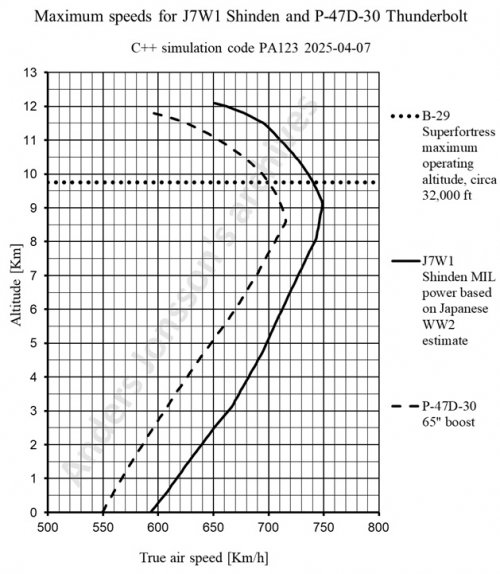
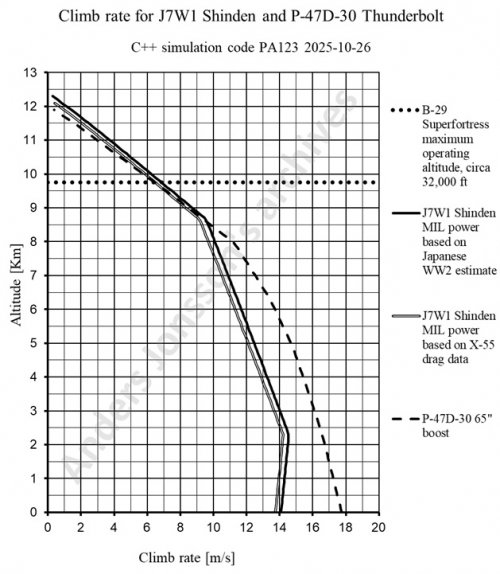
I did the two attached simulation a while back and the J7W1's performance is indeed impressive on paper.

However, I think one needs to stress that last part: On paper: Because as we know, the J7W1 Shinden only made few short hops at low speeds and at low altitudes towards the end of the war, and the whole project has a whiff of "Wunderwaffe" hanging over it IMO.

But then the Japanese were in much the same position as the Germans towards the end of the war IMO: And since the writing was on the wall, and winning by continuing to compete with "conventional" weapons was no longer an option, the allure of wonder weapons must have been great, and led to things like the Shinden and Bachem Natter etc.

But what I've done is to reverse engineer the Shinden's performance from Japanese numbers on engine power and projected top speeds, and the below figures is what I got. So on paper, it does indeed look like it was quite well suited to tackle high flying B-29s.

But again, they had much to fix before getting there, and I think these numbers are very much on the optimistic side. This is especially true if one looks at what flat plate drag area would have been needed to get to those speeds. And when I first saw what Cdo the estimated top speed would have required, I was skeptical, since it was far better than the P-51 IIRC.

But I have also modeled the XP-55 Ascender, and that did go through real flight trials, and the XP-55 does indeed also seem to possess a remarkably low Cdo. So who knows? Maybe the Shinden would have been real fast and a good interceptor? But a turn fighter like we see in all those Manga comics? I doubt it. ;)

1788766459897.jpeg

1788766491116.jpeg
 
Hi Anders,

I did the two attached simulation a while back and the J7W1's performance is indeed impressive on paper.

However, I think one needs to stress that last part: On paper: Because as we know, the J7W1 Shinden only made few short hops at low speeds and at low altitudes towards the end of the war, and the whole project has a whiff of "Wunderwaffe" hanging over it IMO.

Thanks a lot, that's quite interesting! :)

I was wondering how much the lack of exhaust thrust affected the Shinden, since at high true airspeeds and low shaft horsepower in a mechanically supercharged engine a lot of the engine's power has to be diverted to drive the superchargers, so normally, exhaust thrust contributes heavily to total propulsive power.

The Shinden, however, seems to be using the exhaust thrust to pump cooling air through the engine, extractor style. It's my impression that this is a good technique to ensure proper cooling even at lower airspeeds, but I wonder if it might actually be detrimental for top speed up high.

In any case, I could imagine that at the very least, it contributed to the development risks associated with the Shinden, which combined a number of new and innovative aspects in one airframe. Risks tend to lengthen development times, so not only the question if the Shinden would have been a failure remains open, but also the question how quickly it could have been introduced into service if it had turned out to be a basically sound design with some teething problems.

But I have also modeled the XP-55 Ascender, and that did go through real flight trials, and the XP-55 does indeed also seem to possess a remarkably low Cdo. So who knows?

So there are real-world test data for the XP-55, not just company projections? I've seen Curtiss specifications for the P-36 which I would consider to be quite optimistic ...

Regards,

Henning (HoHun)
 
Unguided rockets do indeed seem to have been the answer to the heavy bomber thread, judging by post-war developments.

I do wonder about this though - I don't think a single intercept actually took place after 1945 against a fixe wing target outside of training. So it might go into the category of largely 'untested' when it comes to real world combat conditions. It is also worth noting that radar ranging and prediction was used on most of these early cold-war interceptors.
 
Hi Anders,


Thanks a lot, that's quite interesting! :)

I was wondering how much the lack of exhaust thrust affected the Shinden, since at high true airspeeds and low shaft horsepower in a mechanically supercharged engine a lot of the engine's power has to be diverted to drive the superchargers, so normally, exhaust thrust contributes heavily to total propulsive power.

The Shinden, however, seems to be using the exhaust thrust to pump cooling air through the engine, extractor style. It's my impression that this is a good technique to ensure proper cooling even at lower airspeeds, but I wonder if it might actually be detrimental for top speed up high.

In any case, I could imagine that at the very least, it contributed to the development risks associated with the Shinden, which combined a number of new and innovative aspects in one airframe. Risks tend to lengthen development times, so not only the question if the Shinden would have been a failure remains open, but also the question how quickly it could have been introduced into service if it had turned out to be a basically sound design with some teething problems.


So there are real-world test data for the XP-55, not just company projections? I've seen Curtiss specifications for the P-36 which I would consider to be quite optimistic ...

Regards,

Henning (HoHun)

Hi Henning,

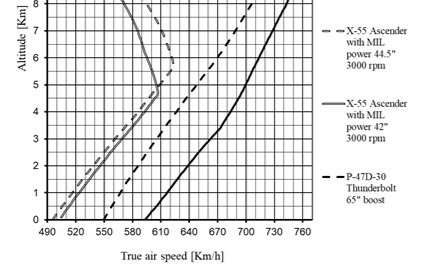
OK, so I went back and checked, and it looks like I misremembered: There unfortunately does not seem to be any high speed flight trial data, and the XP-55 tuning points I've used are 377 mph with 42", and 390 mph with 44" boost.

Now what I liked about those two numbers, was that they both work with the same Cdo and the engine power curves I had for the Allison at those boosts, and produced the below speed/altitude plots.

But for sure, given that I misremembered and that there actually is no flight trials data, these numbers for the XP-55 may indeed be optimistic.

However, while canard pushers do have many other drawbacks, something definitely on their side is that you can maintain laminar and undisturbed flow for far longer of the fuselage and inner wing sections given you have no propeller wash, so that pushers have low drag in relation to their whetted area makes sense I think.

But in summary, would these aircraft (if they had ever rolled of a production line) really have been as good as these numbers indicate?

Well since they both seem to stem from engineering/marketing estimates (the only flight trial data for these aircraft I know of are at low speeds and involve handling) they probably lean more towards the optimistic.

Best wishes

Anders

XP55 Ascender speed with 42 and 44 point 5 boost detail.jpg
 
I do wonder about this though - I don't think a single intercept actually took place after 1945 against a fixe wing target outside of training. So it might go into the category of largely 'untested' when it comes to real world combat conditions. It is also worth noting that radar ranging and prediction was used on most of these early cold-war interceptors.
You sure about that? As in R4Ms never having been used to shoot down any Allied bombers in WW2? I listened to the audiobook "The German aces speak" a while back and as I recall it, some of those interviewed did shoot down bombers with them and were quite enthusiastic. But then again, my memory was off regarding the flight trials, so I may have misremembered this as well. :)
 
Hi,

I do wonder about this though - I don't think a single intercept actually took place after 1945 against a fixe wing target outside of training. So it might go into the category of largely 'untested' when it comes to real world combat conditions. It is also worth noting that radar ranging and prediction was used on most of these early cold-war interceptors.

Fair point. I would think that with especially the US investing so much in unguided rocket interceptors, there would be a solid engineering basis to be reasonably confident in the weapon in a peacetime context though, but of course peacetime testing is not combat proof.

Radar ranging and prediction certainly was a way to improve the effectiveness of the rocket batteries, but I think they also were seen as technologies necessary to adopt to new requirements, such as staying out of the range of radar-aimed large-calibre defensive guns, operating under bad visibility and at night, and for making collision-course attacks possible, which were one way to deal with the relatively higher speeds post-war bombers had compared to contemporary fighters (using WW2 aircraft as a baseline).

So, I'd see them as supporting technologies, and not as enabling ones.

Regards,

Henning (HoHun)
 
I do wonder about this though - I don't think a single intercept actually took place after 1945 against a fixe wing target outside of training. So it might go into the category of largely 'untested' when it comes to real world combat conditions. It is also worth noting that radar ranging and prediction was used on most of these early cold-war interceptors.
Aside from the bomber shooting back, how much dodging can a bomber actually do? 1940s-50s bombsights needed time to line up and correct the bomber's course, zeroing out all the various movement vectors but gravity.

Even the old Mk4 Mighty Mouse FFARs had a maximum effective range of about 3500m. Well outside the range of defensive guns mounted on bombers, even in a tail chase situation.
 
Aside from the bomber shooting back, how much dodging can a bomber actually do? 1940s-50s bombsights needed time to line up and correct the bomber's course, zeroing out all the various movement vectors but gravity.

Even the old Mk4 Mighty Mouse FFARs had a maximum effective range of about 3500m. Well outside the range of defensive guns mounted on bombers, even in a tail chase situation.

Good points. And while calling the R4M a "tac driver" may be a bit on the steep side, it does seem to have been quite accurate, and when all 24 rockets are salvo fired, they will all hit within a rectangle of 2.9 by 4.4 m at 300 m as I understood it from a German WW2 evaluation/estimate.

And while this would be roughly 10 by 15 mils, which may not sound that impressive, we have to remember that this is the area that encompasses ALL rockets, and if we instead assume a Gaussian distribution, this would mean a dispersion of only about 2.4 by 3.7 mil for one standard deviation which is quite good, and actually not that far from what a cannon like the Mk108 can mange.

So my conclusion here is that it's not the "poor accuracy of unguided rockets" as was previously suggested in this thread that is the problem. But that just as for the cannons, the human factor and how well you aim is. And given the choice to close up to about 400 m with Mk 108 cannon, or doing the same with R4M, or salvo firing 6 or 12 of them from double that distance with a good hit probability, the choice seems simple.

So in conclusion: For me it seems that the R4M would have been the perfect weapon for the J7W1 Shinden, for example with the 12 plus 12 rails system used on the Me 262.
 
Back
Top Bottom