I don't think a missile test with prior announcement is problematic. China is just more limited in what trajectories their at-sea tests can travel to relevant test sites. Not really an issue for the US or Russia when they test missiles, although Scandinavia still gets regularly upset regardless.
 
In reality, the missile did not fly over South Korea or Japan; a live round was fired only along the trajectory heading south from the Bashi Channel toward Tonga and Nauru.

This particular instance has caused more of a stir than usual. This is because, although a NOTAM regarding "falling space debris" was issued initially, it was changed to a ballistic missile launch NOTAM just before the event.
I, too, find this questionable. Had a ballistic missile launch NOTAM been issued from the start, they likely wouldn't have faced such criticism.

I felt my post had become a bit too political, so I’ve tidied it up slightly.
When it comes to demonstrating nuclear capabilities, the hurdles for conducting exercises differ between countries facing the open ocean and those surrounded by other nations, don't they?
 
Last edited:
I don't think a missile test with prior announcement is problematic. China is just more limited in what trajectories their at-sea tests can travel to relevant test sites. Not really an issue for the US or Russia when they test missiles, although Scandinavia still gets regularly upset regardless.
The problem isn't the prior announcement.

The problem is the very short time before the launch.

Give a week's warning like the rest of the world and nobody will protest.
 
View: https://x.com/NNSANews/status/2074868023421194444?s=20

From what I've read so far, most say it's JL-2, not the newer JL-3.

Analysis: China’s Pacific SLBM Test Signals Shift Toward Continuous At-Sea Deterrence​

https://www.navalnews.com/naval-news/2026/07/china-pacific-slbm-test-casd-nuclear-deterrence/
The missile reportedly traveled about 7,300 kilometers from the South China Sea, with the warhead believed to have landed in open waters outside Japan’s exclusive economic zone but within the broader South Pacific Nuclear Free Zone established by the Treaty of Rarotonga.

JL-2 or JL-3? The Identification Debate Continues​


Uncertainty persists over which missile was actually fired. Some Chinese analysts have suggested the newer JL-3, believed to have a range exceeding 10,000 kilometers. But both Marcuz and independent Australian naval analyst Alex Luck point to the JL-2 as the leading hypothesis.
 
Last edited:
https://thebulletin.org/premium/2026-03/united-states-nuclear-weapons-2026/
https://thebulletin.org/premium/2026-05/russian-nuclear-weapons-2026/
https://thebulletin.org/premium/2026-07/chinese-nuclear-weapons-2026/

Changes noticed:
Russia - Number of Yars down from 206 to 204, Topol-Ms down from 78 to 68, R-36s up from 34 to 40, extra Bulava sub, taking total subs to 13.
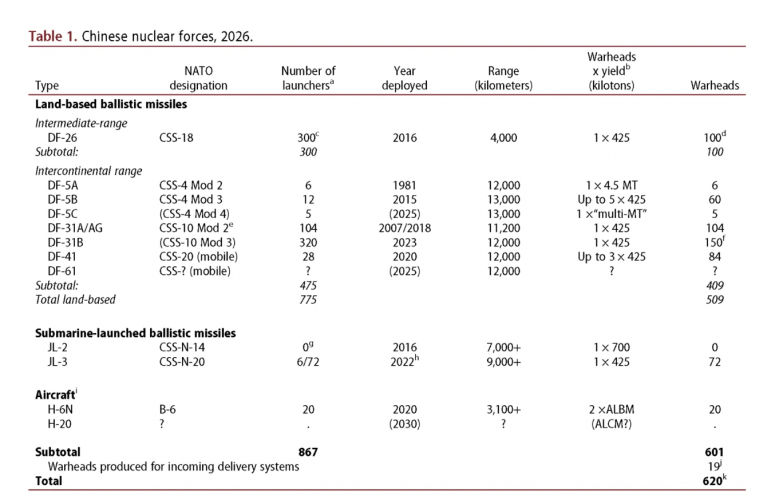
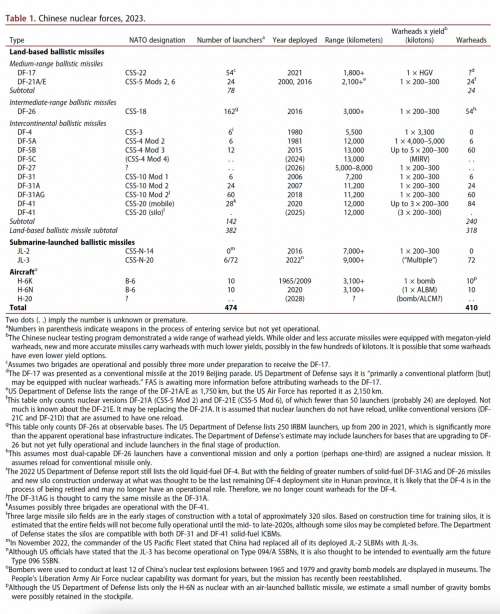
China - Increase to 620 (officially), mostly on upgraded older missiles, DF-41s remain oddly at 28. DF-61 added but no mention of quantity.
US - Increase in B-2 delivered B61s.
 
There’s was an article in the LANL National Security magazine that disclosed we underestimated the size of the Soviet arsenal by about 15,000 warheads.

Notwithstanding them being “a closed off security state” they were the most spied upon and monitored country on earth.

That’s what worries me when it comes to China. I don’t think we ultimately have any idea about the extent of their nuclear program. That same article disclosed they have about 5x as many workers in the entirety of their nuclear weapons enterprise than we do.

Although vastly different industries, yes only somewhat comparable, but when you see them building hundreds of km of high speed rail in a year well……..what are they capable of with this focus and drive on nuclear expansion.
 
It looks like China is moving in the same direction that the US and USSR did in the second half of the Cold War: a larger number of smaller, more accurate warheads
The driver is accuracy. If you can put your warhead within 100m of target reliably you need a much smaller warhead than if you can only put the warhead within 1,000m. See also the absolutely tiny reported booms of the B61-12, 5-10kt instead of 100+.

Plus if you are doing general area destruction 6-7 warheads in a circle (maybe with one in the center) cover more area than one multimegaton boom.
 
Plus if you are doing general area destruction 6-7 warheads in a circle (maybe with one in the center) cover more area than one multimegaton boom.

IIRC that's why the Polaris A3 used three 200KT W-58s in Mk-2 RVs instead of a single 1.2MT W-47Y2 in a Mk-1 RV to bracket its' target (They were MRVs not MIRVs).
 
That’s what worries me when it comes to China. I don’t think we ultimately have any idea about the extent of their nuclear program. That same article disclosed they have about 5x as many workers in the entirety of their nuclear weapons enterprise than we do.

Although vastly different industries, yes only somewhat comparable, but when you see them building hundreds of km of high speed rail in a year well……..what are they capable of with this focus and drive on nuclear expansion.

That's a valid concern.

Good read from 2012 -
https://www.belfercenter.org/public...nd-great-wall-subterranean-ballistic-missiles
 
The driver is accuracy. If you can put your warhead within 100m of target reliably you need a much smaller warhead than if you can only put the warhead within 1,000m. See also the absolutely tiny reported booms of the B61-12, 5-10kt instead of 100+.

Plus if you are doing general area destruction 6-7 warheads in a circle (maybe with one in the center) cover more area than one multimegaton boom.
But when you're limited by treaty to how many you can have. . .you'd probably want to be able to perform almost any operation with one warhead.
 
But when you're limited by treaty to how many you can have. . .you'd probably want to be able to perform almost any operation with one warhead.
What do you mean by "operation"? Because most of your targets are going to be miles apart and guaranteeing the destruction of more than one with a single bomb would require absurdly large warheads.
 
True SUPER=BUG, but trying to get Russia to agree to reduce it's current nuclear stockpile while Putin is currently president is next to impossible I would think.
 
Figured I'll summarize some thoughts of mine regarding developments in India's weapons program...

Not entirely sure what the implications are but the country's new PFBR (500 MWe fast breeder reactor) that went critical a few months ago, is entirely outside IAEA safeguards. The 'prototype/test reactor' designation enables the option to keep it outside safeguards as per the separation agreement.

Before this, the amount of Pu-239 production in India was about ~25kg/year (Dhruva only, now that CIRUS is shut down). The PFBR, assuming there's a 'strategic' reason for keeping it outside safeguards, pumps that up to about ~170kg/year, a near 600% increase. That's a pretty huge spurt.

https://en.wikipedia.org/wiki/Prototype_Fast_Breeder_Reactor

There's two more FBRs based on this design that have been approved for construction, if those are also kept outside safeguards & configured for breeding Pu-239, that number could reach ~500kg/year in under a decade.

But the question will be how much WG Pu is actually needed, considering all of India's uranium-enrichment capacity (including expansion at the Rare Materials Plant) is now pretty much dedicated for marine propulsion needs only (read: fuel for nuclear submarines), now that purchasing U from other countries (Russia, Kazakhstan & more recently Canada & Australia) is being ramped up. India never seemed to be interested in a U-based weapons program anyway. Too inefficient.

The latest SIPRI report estimates India to have a 190-warhead arsenal. But this is a slow buildup from 160 about a decade ago. Given the new larger SSBN program beginning construction & MIRV tech maturing, I had previously estimated an eventual need for 275-350 warheads, around ~200 of which would go on the 4 x "S5" class SSBNs, assuming 12 tubes per boat and a modest 4-RV configuration per missile.

That number (275-350, over the next decade) would NOT necessitate putting all three FBRs outside safeguards. It's likely they'll consider the current ~170kg/year capacity as sufficient as there are already about ~190 in hand so only need to build about 90-160 more. Just the one PFBR combined with the older Dhruva can be enough to produce sufficient Pu for 28-56 pits per year, depending on efficiency of warhead design.

So the two non-prototype follow-on FBRs may indeed be put under safeguards and be dedicated for civilian use...but the option remains to vastly enhance production of WG Pu should the need arise i.e. if forced to compete with China's plan for a ~1,000+ warhead arsenal in some way. In that case, these FBRs could be quite the trump card considering India doesn't believe in nuclear umbrella-sharing and other such fairy tales.

 
But the question will be how much WG Pu is actually needed, considering all of India's uranium-enrichment capacity (including expansion at the Rare Materials Plant) is now pretty much dedicated for marine propulsion needs only (read: fuel for nuclear submarines), now that purchasing U from other countries (Russia, Kazakhstan & more recently Canada & Australia) is being ramped up. India never seemed to be interested in a U-based weapons program anyway. Too inefficient.
As I understand it, the outer tamper of a megaton-class thermonuclear weapon is best made from Uranium. U238, in fact. You use Pu239 in the fission primary to squeeze the fusion into ignition, and then the outer tamper gets converted from U238->Pu239 through the usual transformation under neutron bombardment from the primary and secondary before it is inertially compressed to supercritical and goes KABOOM.

TLDR?

Uranium is good for making really big booms.
 
As I understand it, the outer tamper of a megaton-class thermonuclear weapon is best made from Uranium. U238, in fact. You use Pu239 in the fission primary to squeeze the fusion into ignition, and then the outer tamper gets converted from U238->Pu239 through the usual transformation under neutron bombardment from the primary and secondary before it is inertially compressed to supercritical and goes KABOOM.

TLDR?

Uranium is good for making really big booms.
Yes, basically fission of U238 is possible with the very high energy neutrons and extreme heat released from a fusion reaction and then the further fission feeds the fusion.
 
As I understand it, the outer tamper of a megaton-class thermonuclear weapon is best made from Uranium. U238, in fact. You use Pu239 in the fission primary to squeeze the fusion into ignition, and then the outer tamper gets converted from U238->Pu239 through the usual transformation under neutron bombardment from the primary and secondary before it is inertially compressed to supercritical and goes KABOOM.

TLDR?

Uranium is good for making really big booms.

Hmm... I didn't know that. Thanks for the info!

The reason I decided to write "pretty much dedicated" was because, as per what I've heard, the expanded RMP is meant to allocate most of its capacity for military LWR fuel, but not all of it. I did not understand why they would want to keep a fraction of the U for non-fuel needs as a purely U-based fission/boosted fission program (where U235 is the only fissile core) is just not pursued in India, where Pu-239 was always preferred. So I assumed that portion could be for some research purposes or otherwise.

But with your explanation, it starts to make more sense as to why a portion of enriched U could be kept aside even for weapons use, despite having a nominally Pu-based program.

I'm just guessing though, it's also possible they chose not to go for any tamper due to lack of sufficient reliable testing data. I'm not aware if the fusion design tested in '98 had a tamper or not. They could go for simulations but without enough accurate data to feed into the sim, the results could be suspect. In such a case, it's probably safer to fall back on methods on which you have high design confidence.

====

Some French members on other forums have hinted that India was granted access to this facility for advanced simulations:

https://en.wikipedia.org/wiki/Laser_Mégajoule

Obviously, there's nothing to confirm or deny this, and probably never will be. All I can say is that, folks in DRDO are probably looking forward to whenever the world collectively decides to resume live testing.
 
As I understand it, the outer tamper of a megaton-class thermonuclear weapon is best made from Uranium. U238, in fact.

Largely true but some of the lower end megaton weapons had a non-fissile Lead tamper such as the 1.1MT Mk/B-28Y1 also a clean version of the Mk-21 was tested in the Redwing Navaho shot (4.5MT yield at 95% fusion yield).
​
and then the outer tamper gets converted from U238->Pu239 through the usual transformation under neutron bombardment from the primary and secondary before it is inertially compressed to supercritical and goes KABOOM.​

Not quite, the U-238 atoms are fissioned directly by fusion spectrum neutrons (14.1MeV neutrons generated by the D+T fusion reaction and to a lesser degree D+D fusion reaction), while U-238 can be fissioned it's an endothermic reaction with a fission threshold of 4MeV (Which basically rules out most neutrons generated in fission reactions).​
 
As I understand it, the outer tamper of a megaton-class thermonuclear weapon is best made from Uranium. U238, in fact. You use Pu239 in the fission primary to squeeze the fusion into ignition, and then the outer tamper gets converted from U238->Pu239 through the usual transformation under neutron bombardment from the primary and secondary before it is inertially compressed to supercritical and goes KABOOM.
This is not quite accurate.

For modern small, compact, lightweight warheads (of any yield), the most critical attribute is the amount of U235 in the secondary's pusher-tamper.

U238 is better than lead (ie "absolutely nothing") at boosting yield, but it's quite impressively pathetic compared to U235. The difference is literally night and day.

Time to quote from the Bible of Sublette:

The advantage in using a fissionable material as the fusion tamper was recognized very early, many years before the first thermonuclear test. The highly energetic neutrons produced by fusion are capable of fissioning isotopes that are normally considered non-fissile, like U-238 and Th-232.

The early high yield fission weapon designs all used natural or depleted uranium as the tamper material. At the time large, inexpensive, high yield weapons were the main design objective so a cheap fissionable material was necessary. U-238 can only be fissioned by neutrons above about 1.5 MeV however. A 14.1 MeV neutron can undergo up to three average collisions with deuterium and still have sufficient energy. the 2.45 MeV D-D fusion neutrons, up to half the fusion neutrons produced in Mike, cannot be scattered even once and still be able to fission the tamper. Most of the fusion neutrons produced were thus unable to fission the tamper after they escaped the fusion fuel mass.

If all of the excess neutrons had caused fission, then the expected fission fraction for Mike (assuming no subcritical multiplication took place in the tamper) would be 89.3% (10.4-1 fission-fusion energy production ratio), instead of the observed 77% (3.35-1 ratio). Isotopic analysis of Mike fallout shows a very high percentage of the tamper material that was not fissioned was transmuted to higher isotopes of uranium by these slower neutrons (~93% of the U-238 in the inner most layers was transmuted).

If the uranium tamper is significantly enriched in U-235 however, a much higher percentage of the neutrons released can be harnessed since this isotope is fissioned by neutrons of all energies. The superior fissile properties of U-235 boost yield in other ways also. It has a higher fission cross section than U-238 even for fast neutrons, so a thinner tamper can be equally effective in capturing these as well. U-235 also can achieve much higher subcritical multiplication factors in the tamper - making use of the fission neutrons to cause more fissions.

Using enriched uranium as the tamper material drives up the cost of the weapon, but reduces its weight and size for a given yield. As enriched uranium became relatively abundant in the US weapons program, the use of HEU (20-80% U-235) instead of natural or depleted uranium became common. A large portion of uranium produced by the US for weapons use has been in this intermediate range of enrichment. Most or all light weight strategic weapons probably use HEU tampers today.

(Source: https://nuclearweaponarchive.org/Nwfaq/Nfaq4-4.html#Nfaq4.4.5.4 – see sub-section 4.4.5.4.1 titled "Fissionable Tampers")
 
Was not the B-41 the only weapon to use a fully weapons grade 235 tamper?
 
https://www.nytimes.com/2026/07/21/us/politics/trump-saudi-nuclear-deal.html
The Trump administration plans to announce Wednesday that it has reached a broad nuclear agreement with Saudi Arabia that could lead to the country enriching its own fuel for nuclear reactors, U.S. officials said.
Nonetheless, debate over the accord is likely to be fierce. To get the deal done with Crown Prince Mohammed bin Salman, the country’s 40-year-old de facto leader, Mr. Trump had to agree to terms that may limit international inspectors from going to any sites in the country that they think could be a pathway to diverting fuel to weapons projects.
And he agreed that, after a joint study with Saudi Arabia on the economics of producing nuclear fuel, the Saudis may be allowed to enrich uranium or reprocess plutonium on their soil.
Prince Mohammed has vowed he would build nuclear weapons if Iran does so, even insisting in one interview he would do so “without a doubt.”
It seems that nuclear proliferation may occure sooner rather than later in Saudi Arabia.
 
Was not the B-41 the only weapon to use a fully weapons grade 235 tamper?

Aside from the above mentioned W-88, the W-47Y1 PICCOLO secondary also used large amounts of Oralloy to get a compact high-yield TN-warhead.

https://www.nytimes.com/2026/07/21/us/politics/trump-saudi-nuclear-deal.html


It seems that nuclear proliferation may occure sooner rather than later in Saudi Arabia.

Israel will definitely not like such a deal going through.
 
https://www.nytimes.com/2026/07/21/us/politics/trump-saudi-nuclear-deal.html


It seems that nuclear proliferation may occure sooner rather than later in Saudi Arabia.

I think what this shows more than anything is the slow acceptance of the fact that Iran is eventually going to nuclearize, despite everything.

Planning for a MidEast with a nuclear-armed Iran, giving the Saudis a roadmap to acquire their own deterrence to counterbalance Tehran is probably par for course at this point.

I also see South Korea & Japan getting their own nukes eventually.
 
I think what this shows more than anything is the slow acceptance of the fact that Iran is eventually going to nuclearize, despite everything.

Planning for a MidEast with a nuclear-armed Iran, giving the Saudis a roadmap to acquire their own deterrence to counterbalance Tehran is probably par for course at this point.

I also see South Korea & Japan getting their own nukes eventually.

The Saudi deal is to keep them onside in the now open ended war over the strait, not an acknowledgment of Iran’s inevitable nuclear status. It was not something remotely considered pre war. As pointed out, Israel will likely be furious.
 
As pointed out, Israel will likely be furious.
And what will they do? Bomb Saudi Arabia? Lol.

It is commonly assumed that Saudi Arabia previously secured access to Pakistans stockpile, furthermore they operate Chinese IRBMs, now open desire to enrich. It is clear that Saudi Arabia has the desire to be the third regional nuclear power with Iran and Israel.
 

Similar threads

Back
Top Bottom