time to kill and probability of kill. iirc initial aim120 tests scored a 85% PK at operational ranges which was very high for the timeTTK? PK?

You are using an out of date browser. It may not display this or other websites correctly.
You should upgrade or use an alternative browser.
You should upgrade or use an alternative browser.
Lockheed Martin AIM-260 Joint Advanced Tactical Missile (JATM)
- Thread starter Jeb
- Start date
time to kill and probability of kill. iirc initial aim120 tests scored a 85% PK at operational ranges which was very high for the time
Thanks, in regards to PK the term I'm familiar with is the SSKP (Single Shot Kill Probability).


Forest Green
ACCESS: USAP
- Joined
- 11 June 2019
- Messages
- 14,499
- Reaction score
- 31,531
Those ranges are probably aimed at manoeuvring targets and possibly likely launch conditions, rather than simply maximum range at optimum launch condition against an AWACS or cargo plane or similar.
It's from a slide briefing on future operations at the Eglin test and training range. Basically shows the areas that airspace etc. needs to be closed when they are testing various weapons. Since it was cleared for release, it likely only shows representative requirements for airspace closures when testing various weapons, not the actual envelope of the missiles themselves.

- Joined
- 3 June 2011
- Messages
- 20,895
- Reaction score
- 19,084
Still, it would be interesting to see the entire slide. "Future Booster" and other larger circles?It's from a slide briefing on future operations at the Eglin test and training range. Basically shows the areas that airspace etc. needs to be closed when they are testing various weapons. Since it was cleared for release, it likely only shows representative requirements for airspace closures when testing various weapons, not the actual envelope of the missiles themselves.
https://www.militaryfriendlynwf.com/documents/EGTTR_Strategic_Fourfold-96TW_14Mar23.pdfStill, it would be interesting to see the entire slide. "Future Booster" and other larger circles?
https://iadc.org/wp-content/uploads/2018/05/DOD-Offshore-Report.pdf
It seems the "Future booster development" is the ARRW.

Forest Green
ACCESS: USAP
- Joined
- 11 June 2019
- Messages
- 14,499
- Reaction score
- 31,531
Scott Kenny
ACCESS: USAP
- Joined
- 15 May 2023
- Messages
- 19,515
- Reaction score
- 27,963
So, getting a good stockpile of the "good enough" AMRAAM-D3 while slowly acquiring a small number of exquisite JATMs.
Storable liquid oxidizers are not well thought of by the Navy
I do believe the USN's issues are specifically with hypergolic-propellants and IIRC there are storable non-hypergolic liquid oxidisers.
So, getting a good stockpile of the "good enough" AMRAAM-D3 while slowly acquiring a small number of exquisite JATMs.
I have no doubt that the AIM-120D3 will still stay in production for the foreseeable future for foreign countries that can't afford and/or aren't trustworthy enough to have the AIM-260A.

Claudiovict
ACCESS: Restricted
- Joined
- 13 March 2026
- Messages
- 19
- Reaction score
- 33
Given that US is rapidly increasing the budget for AIM-260's production, it is likely that they already have some amount of them saved for a big need in a short time (like a war against China)?
aim120 isnt leaving production until atleast 2030 where the design is ultimately outdated
While the AIM-120D3 has been surpassed by the AIM-260A it is likely to still continue to be production and sale to foreign country that either can't afford the AIM-260A and/or are less than trustworthy. I can also still see them being retained in the US armed forces inventories for use against targets where the use of an AIM-260A isn't justified.
I have no doubt that the AIM-120D3 will still stay in production for the foreseeable future for foreign countries that can't afford and/or aren't trustworthy enough to have the AIM-260A.
The U.S. will continue to produce AIM-120 for itself as well. It appears AIM-260 is a $3-4 million missile and AIM-120 is half the cost.

EmoBirb
ACCESS: Top Secret
- Joined
- 18 January 2025
- Messages
- 2,693
- Reaction score
- 6,919
According to?- The AIM-260 is considered the most lethal missile ever built to date, and the nomenclature used implies it is not a small jump in lethality.

- Joined
- 21 April 2009
- Messages
- 14,350
- Reaction score
- 9,432
AIM-260s parents.According to?
EmoBirb
ACCESS: Top Secret
- Joined
- 18 January 2025
- Messages
- 2,693
- Reaction score
- 6,919
I figured, of course the people that make it would claim it's the most super duper missile of all time. I was just wondering if @Shusui could back up that strange claim with something else than marketing material.AIM-260s parents.

Shusui
Antikythera
- Joined
- 17 August 2015
- Messages
- 91
- Reaction score
- 252
You guys doubted me once before.I figured, of course the people that make it would claim it's the most super duper missile of all time. I was just wondering if @Shusui could back up that strange claim with something else than marketing material.

- Joined
- 6 August 2007
- Messages
- 4,530
- Reaction score
- 10,226
You guys doubted me once before.
Not everyone did.
8245xiaoyao
ACCESS: Restricted
- Joined
- 11 July 2024
- Messages
- 14
- Reaction score
- 33
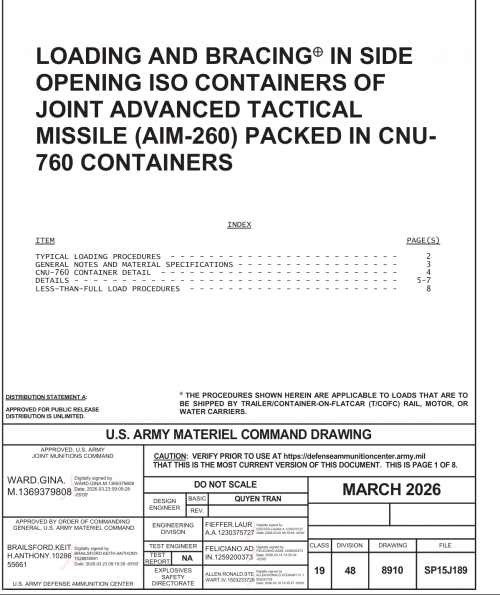
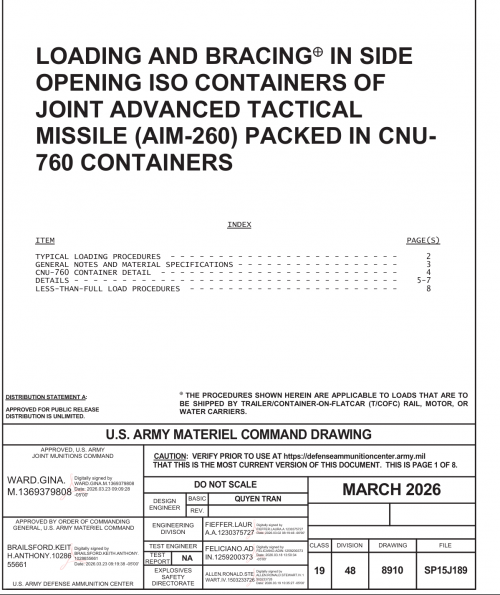
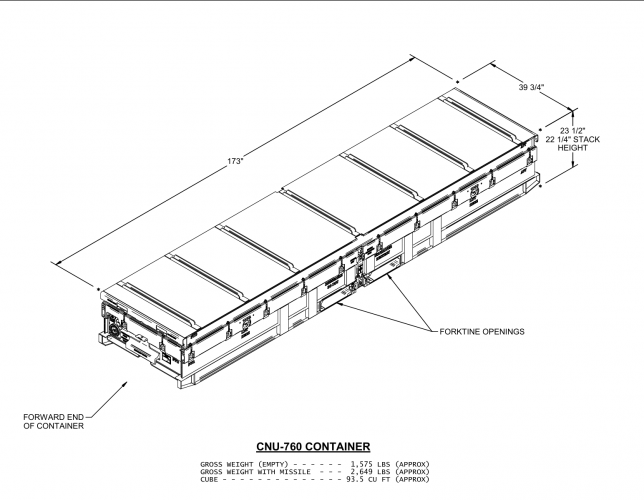
So um there are some weird parts in this file.If we assume that you have four missiles in each container(same as the 120 containers,i mean CNU-415 and CNU-431),you can easily caculate that each missile weighs just about 268 pounds,that's way lighter than 120.But if we consider it only have three missiles in the box then each missile weighs 358 pounds,that's fine compare to the 120.
Then the second weird part is the dimension of the container,1575lbs is about twice the weight of CNU-415! Maybe they just add something in the container to protect some optical parts on JATM.....
https://defenseammunitioncenter.army.mil/usatces/capdraw/drawings/pdfs/8910.pdf
Then the second weird part is the dimension of the container,1575lbs is about twice the weight of CNU-415! Maybe they just add something in the container to protect some optical parts on JATM.....
https://defenseammunitioncenter.army.mil/usatces/capdraw/drawings/pdfs/8910.pdf
Attachments
Last edited by a moderator:
- Joined
- 3 June 2011
- Messages
- 20,895
- Reaction score
- 19,084
Could be two.So um there are some weird parts in this file.If we assume that you have four missiles in each container(same as the 120 containers,i mean CNU-415 and CNU-431),you can easily caculate that each missile weighs just about 268 pounds,that's way lighter than 120.But if we consider it only have three missiles in the box then each missile weighs 358 pounds,that's fine compare to the 120.
Then the second weird part is the dimension of the container,1575lbs is about twice the weight of CNU-415! Maybe they just add something in the container to protect some optical parts on JATM.....
8245xiaoyao
ACCESS: Restricted
- Joined
- 11 July 2024
- Messages
- 14
- Reaction score
- 33
That'll be too heavy i think,537 pounds is even heavier then 8'' AAMCould be two.
- Joined
- 3 June 2011
- Messages
- 20,895
- Reaction score
- 19,084
Maybe. Will be interesting to see.That'll be too heavy i think,537 pounds is even heavier then 8'' AAM
Claudiovict
ACCESS: Restricted
- Joined
- 13 March 2026
- Messages
- 19
- Reaction score
- 33
way too heavy for AMRAAM form factor, unless they're using pure tungsten on the airframe, for comparison AMRAAM-ER (254mm diameter) is 615lbs and it has 2,03x the volumeCould be two.

TerraFirma
ACCESS: Restricted
- Joined
- 18 April 2026
- Messages
- 31
- Reaction score
- 62
One thing I'd like to add as a thought to ponder: There are now miniature AEHF antenna that are small enough to be put onto an air-to-air missile for satellite-to-missile guidance.
Those lumps and bumps mid-missile sure look like an antenna array that would be insanely useful for an extremely long ranged shot that could be handed off in a daisy-chain (And yes, to factor in the roll of the missile, multiples would be needed in a collar around the body as each antenna has a specific 'window'.).
Would make a 'cold shot' a very, very terrifying reality if that were the case. Lofted, cruise 130 miles, terminal X-band guidance from an off-board source, and a hit-to-kill with the enemy never even knowing that there was a threat as they were never illuminated.
Those lumps and bumps mid-missile sure look like an antenna array that would be insanely useful for an extremely long ranged shot that could be handed off in a daisy-chain (And yes, to factor in the roll of the missile, multiples would be needed in a collar around the body as each antenna has a specific 'window'.).
Would make a 'cold shot' a very, very terrifying reality if that were the case. Lofted, cruise 130 miles, terminal X-band guidance from an off-board source, and a hit-to-kill with the enemy never even knowing that there was a threat as they were never illuminated.
My estimation was ~470 lb for 8".
Basic physics says antenna size = wave lenght λ = c/f . In this case 6.8mm so any high RF could fit. The problem is the gain and quality of the signals. This is where tons of similation calculation are invested. Ofc the electronics are the other bigger size problem.One thing I'd like to add as a thought to ponder: There are now miniature AEHF antenna that are small enough to be put onto an air-to-air missile for satellite-to-missile guidance.

- Joined
- 30 May 2023
- Messages
- 664
- Reaction score
- 1,436
One thing I'd like to add as a thought to ponder: There are now miniature AEHF antenna that are small enough to be put onto an air-to-air missile for satellite-to-missile guidance.
Those lumps and bumps mid-missile sure look like an antenna array that would be insanely useful for an extremely long ranged shot that could be handed off in a daisy-chain (And yes, to factor in the roll of the missile, multiples would be needed in a collar around the body as each antenna has a specific 'window'.).
Would make a 'cold shot' a very, very terrifying reality if that were the case. Lofted, cruise 130 miles, terminal X-band guidance from an off-board source, and a hit-to-kill with the enemy never even knowing that there was a threat as they were never illuminated.
Yes. There are at least three sets of patch antennae on JATM. Two may be related to some integrated seeker / fuzing mechanisms and the other might well relate to what you wrote about. That’s my take at least.
Scott Kenny
ACCESS: USAP
- Joined
- 15 May 2023
- Messages
- 19,515
- Reaction score
- 27,963
Not hugely so. Sparrrows are ~510lbs, and the new solid rockets (like used in SM6) are denser than the old ones.That'll be too heavy i think,537 pounds is even heavier then 8'' AAM
So AIM-260s could be an 8" tube with ~5.5" tall fins and still be the same box size as AMRAAMs.

Colonial-Marine
UAVs are now friend, drones are the real enemy.
- Joined
- 5 October 2009
- Messages
- 1,714
- Reaction score
- 1,820
The Japanese AAM-4B which is 8" and same length as AMRAAM is just under 490 lb

- Joined
- 27 December 2005
- Messages
- 19,225
- Reaction score
- 35,635
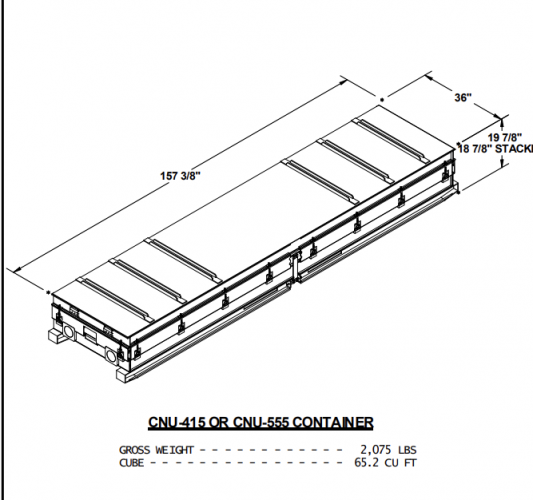

Its longer, wider and taller than the CNU-415. Volume is 47% larger overall, gross weight 27% higher.
The length of CNU-415 is 13.475 inches longer than AIM-120. Assuming the same basic container geometry on the CNU-760 would suggest an absolute upper limit to length of 159.5 inches or 4.05m for AIM-260. However, increases in width and height of the container suggest a general volume increase hard to reconcile with the wingless design, so maybe it has bunch of extra padding or something?
Last edited:
TerraFirma
ACCESS: Restricted
- Joined
- 18 April 2026
- Messages
- 31
- Reaction score
- 62
Shielding for sensors that are exposed (aesa panels and the such that require no radome) would call for a lot of extra protection - Case in point for modern missiles (can be seen in footage from frontline in the Ukraine) that require explosive ordinance personnel to be present when first opened for use.
Last edited by a moderator:
Shusui
Antikythera
- Joined
- 17 August 2015
- Messages
- 91
- Reaction score
- 252
AIM-260 is 7" diameter. Length similar to AIM-120. Control surfaces take up less space. There are probably three per box, weight of 360 pounds is expected from something that is denser in both electronics and propellant.Not hugely so. Sparrrows are ~510lbs, and the new solid rockets (like used in SM6) are denser than the old ones.
So AIM-260s could be an 8" tube with ~5.5" tall fins and still be the same box size as AMRAAMs.
8245xiaoyao
ACCESS: Restricted
- Joined
- 11 July 2024
- Messages
- 14
- Reaction score
- 33
That gross weight 2075lbs(or they change it to 2191lbs later) is actually weight with four missiles,the real empty weight of CNU-415 is 795lbs......so not 27% but about 50% higher,and if we consider AMRAAM's large box like CNU-431,which has similar dimension like the 760 but less weight than 415(only 617lbs empty weight)it'll be even more ridiculous.View attachment 810333
Its longer, wider and taller than the CNU-415. Volume is 47% larger overall, gross weight 27% higher.
The length of CNU-415 is 13.475 inches longer than AIM-120. Assuming the same basic container geometry on the CNU-760 would suggest an absolute upper limit to length of 159.5 inches or 4.05m for AIM-260. However, increases in width and height of the container suggest a general volume increase hard to reconcile with the wingless design, so maybe it has bunch of extra padding or something?
Forest Green
ACCESS: USAP
- Joined
- 11 June 2019
- Messages
- 14,499
- Reaction score
- 31,531

Similar threads
-

-

-
Lockheed Martin F-16 Fighting Falcon News and Developments
- Started by seruriermarshal
- Replies: 882
-
-
 The (rigged?) ACEVAL/AIMEVAL air combat evaluations 1975 -1978
- Started by overscan (PaulMM)
- Replies: 53