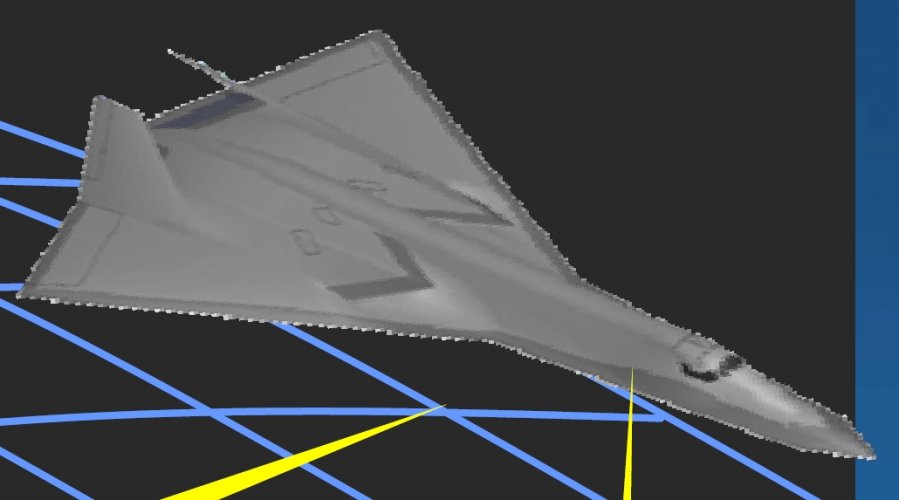
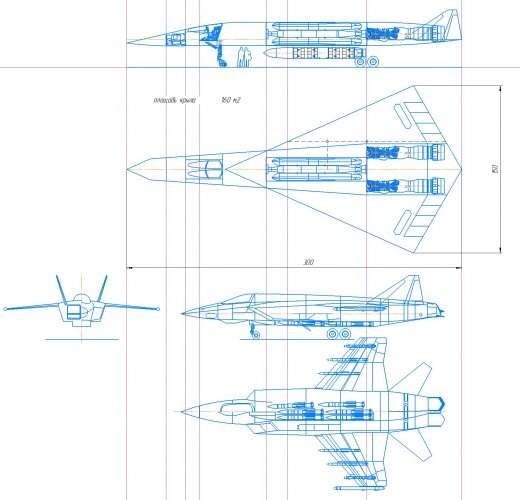
MiG PAK DP (Prospective Airborne Complex of Long-Range Intercept) Program (MiG-41)

Any idea as to what long-range missile the replacement interceptor would carry? A new version of the R-37 or the Novator long-range missile (it has been that long I have now forgotten the designation).
 
Jock1 said:
Regards LR AAMs Izd.810 would be a likely candidate

Thanks Jock1. In regard to Izd.810 are there any diagrams/photos of said missile available or is it too early in the design stage?
 
according this sources

It's called the MIG-41
MiG Corporation CEO Ilya Tarasenko told Zvezda TV channel.

"The jet, will not be just a modernisation of MiG-31, it will be an entirely new machine, having the ability to operate in space, new weapons, new speeds, new operational range ”

“It will be an entirely new plane, where entirely new technologies to operate in the Arctic zone will be utilised. This plane will safeguard the whole border of our homeland. Later, the project will become unmanned.”

Rumors claim that the Mig-41 will use an anti-missile laser and also will be a supersonic reconnaissance aircraft.
 
Deino said:
Hmmm?? ???

https://twitter.com/FG_STrim/status/1030407539345776640

I've been skeptical such a project exists, but MiG CEO Ilya Tarasenko says the PAK DP (aka MiG-41), a high-speed MiG-31 replacement, is not "mythical" and will be "presented to the public soon."
 
Prob the study and some conceptual models.

Seems the aircraft itself still have "rubber" specifications.
 
Any recent news about this project?


Only latest news I received. https://bmpd.livejournal.com/3760814.html

"Prospects for the creation of a new generation aviation complex

In a special issue of the Krasnaya Zvezda newspaper dated July 29, 2019, an interesting article was published by the Deputy Director for Development of Sukhoi Design Bureau, Deputy Chief Designer Viktor Popik. The bmpd blog cites the text of this material.


Scientific and technical reserve for the future

In aviation, they say that there was a design situation for creating a promising next-generation complex, after the necessary scientific and technical groundwork (NTZ) was created for all the most important technologies.

Consider these areas starting with materials and technologies. Speaking about the fighter, or about the next generation aircraft in general, all world and domestic experts agree that one of the main features of the aviation complex of the future is the presence of the so-called smart design, which is a power composite or metal panel with integrated control systems. It will be equipped with appropriate sensors, which will allow in the process of flying online to measure the level of stresses of elements, calculate and predict their resource. In the event of a defeat by enemy weapons, according to the built-in control system, the affected area will be determined, and the aircraft’s onboard central computer will make the necessary changes to the aircraft’s control system to continue the flight. Thus, the combat survivability of the aircraft is seriously increased.

Regarding the internal power frame of the aircraft - its future lies in designs created according to the principle of bionic design using additive technologies and 3D printing. Designed using specialized software, the design of the aircraft resembles the skeleton of a living organism. Due to this design, it will be easier and more rigid, and thanks to the use of 3D printing, the products will become more technological.

The second direction of NTZ formation is non-traditional aerodynamic configurations. In particular, foreign specialists in their activities show interest in aircraft with gas-dynamic aircraft control systems.

Attractive layouts with adaptive mechanization, which allows you to "smoothly" change the contours of the aircraft for specific flight conditions while maintaining their smoothness. These technologies make it possible to obtain an aerodynamic design of an airplane with adaptive elements. It attracts designers from the point of view of the ability to provide a combination of high maneuverability of the aircraft with an extremely low level of radar visibility.

The third area of research is related to the improvement of on-board equipment. Here, first of all, it is worth noting the development of electronic systems.

In the framework of studies of the future airplane, the possibility of creating a radio-photon radar is most actively discussed in print. It also examines no less interesting prospects for the development of distributed radio systems, in which electronic sensors are distributed over all the edges and surfaces of the aircraft complex, providing a circular electronic view.

We are studying, in particular, the simultaneous integration in the airborne radar station (BRL) of the functions of today independent systems: radar, electronic intelligence, jamming, communications and navigation. This option is not accidental.

The 6th generation aircraft should be even more inconspicuous. If we talk about ways to achieve this goal, it is necessary to take into account that one of the significant contributions to the visibility of the aircraft is its antenna compartments. The more there are, the higher the radar visibility of the aircraft, in addition, the antennas of the connected radio stations are omnidirectional. When transmitting information on air, the aircraft unmasks itself. One way to solve the problem of ensuring low visibility in this case may be the transmission of information by a narrow beam. Abroad, one of the options is the use of a phased array antenna. In this case, distributed phased array antennas are required, including those operating in the rear hemisphere of an aircraft. Such an antenna array can simultaneously solve all the previously mentioned tasks.

Intellectualization of the aircraft

Currently, there is an active development of the complex of on-board equipment (BWC) of the aircraft, which gives very serious positive results. For example, the Su-35 is built on the basis of a modernized airframe and fourth-generation engine. However, in its combat characteristics, it significantly surpasses classmates due to its developed avionics.
Therefore, speaking of medium-term prospects for the development of the potential of the combat complex, three directions should be noted.

The first is the improvement and development of its computing systems. At this stage, each new system is several times, or even an order of magnitude superior to its predecessors in performance. With more powerful computing tools integrated into a single computer network, it is possible to program a large number of tasks and accelerate the transfer of information between all aircraft systems to solve the most complex and costly tasks using all available on-board computing tools.

If before each system had its own calculator, which solved a certain range of tasks, now the designers have come to the stage when there will be a unified computer network on board. It will begin to independently distribute its resources to solve problems, depending on their priority and the workload of aircraft systems.

The next direction is the intellectual support of the crew. Su-57 already has such a powerful system, which can be called a full-fledged second "electronic pilot." It suggests options for battle tactics, automatically distributes targets, calculates various scenarios and gives recommendations for improving the effectiveness of actions.

Further development of such systems will lead to the possibility of creating an intelligent board that can effectively operate and even fight in an automatic mode without human intervention.

The third important direction is the creation of network-centric weapons systems, when the aircraft becomes one of the elements of a single network on the battlefield and exchanges information with all its participants in real time.

The solution to all these problems realigns the design bureau.

Since the beginning of this century, Sukhoi Design Bureau has been actively working on the integration of on-board equipment and the development of on-board software. Today, there are 50 percent more specialists in units dealing with issues related to on-board equipment than in traditional aircraft departments that solve the problems of creating a glider, a power plant and general aircraft systems.

It should be noted that even now at the 5th and subsequent generation air carriers, when creating a unified aircraft network, the emphasis is on the domestic element base, in particular on Elbrus processors.

Promising next-generation aviation systems will have to unite a whole group of new promising technologies, which should bring it to a qualitatively new technological level, significantly surpassing today's military aircraft systems."
 
I got better news than the last news that was posted.


"MiG-31 interceptor will be equipped with new ultra-long-ran

Russia is not only developing hypersonic weapons, but also creating means of protection against them. As sources in the military-industrial complex told Izvestia, domestic engineers are now designing an ultra-long-range air-based missile capable of intercepting high-speed and maneuvering targets. According to experts, this work is extremely relevant today: the Pentagon has already announced plans to test four new hypersonic munitions in 2020. And the day before, US President Donald Trump said that Americans already have super-fast missiles that can move 5-7 times faster than conventional ones. The novelty will also come in handy for the fight against modern aircraft and cruise missiles. Today, only our country has hypersonic weapons, but many foreign countries are actively engaged in their creation.

{}

Long-range interception
The Ministry of Defense made a fundamental decision to develop for the MiG-31 fighter and the promising MiG-41 multifunctional long-range interceptor missile system (MPKR DP), capable of hitting hypersonic ammunition. According to Izvestia sources familiar with the situation, theoretical studies have already been carried out on an ultra-long-range air-to-air missile with a multiple warhead. Now determine the characteristics and composition of the complex. According to Izvestia, one of the candidates for the role of submunition (head blocks) is a promising medium-range missile K-77M.

{}

The complex under development is one of the options for such protection. Airborne heavy ammunition will deliver a warhead with several modern air-to-air missiles over a distance of several hundred kilometers. Then they will separate from the carrier and begin to search and attack targets on their own. An active homing head with its own radar will help them in this.

Such a system makes it possible to destroy objects at long range, said military expert Dmitry Kornev. This is necessary, for example, in order to hit the carrier before it launches its missiles.

{}

“ An ordinary anti-aircraft missile has one warhead,” he told Izvestia. - The probability of a miss on a hypersonic maneuvering target is very high. But if one ammunition carries several homing shells, then the chances of hitting a high-speed object are significantly increased.

According to the expert, in the case of firing IFRK DP at hypersonic targets, all warheads will be displayed at a pre-calculated point on the trajectory of a flying munition and attack it in the forehead. The use of ultra-long-range missiles will expand the area of destruction of the interceptor.

Especially effective is the use of the complex during aircraft operations as part of a single information space. Aerial targets, cruise or hypersonic missiles can be detected by ground-based radars, early warning radars, or an attack warning system. The fighter will only need to launch an ultra-long-range missile in the desired area. At the same time, the interceptor will not have to risk it himself, entering into an air battle."


Main Takeaways From My Perspective.

1. Several air to air missiles are being carried away at 700kms, the sub munitions like the K-77M are candidates to be carried by it. https://militarywatchmagazine.com/a...l-be-a-game-changer-for-the-russian-air-force So if we include the range of the sub-munition candidates like the K-77M the range is pretty close to 900kms according to this source among others.

2. Serious radar performance might be needed if you want that 900km range with air to air missiles included to go for an aerial target, so a very high altitude is needed http://members.home.nl/7seas/radcalc.htm although we have yet to hear about the flight ceiling for this aircraft, instead of settling for a lower range. Although it was listed having a certain special radar in development, it is including other sources to help the aircraft launch the missile at a certain area where the aerial threat is and the carrier ultra long range missile holding those air to air missiles will definitely try to reach the aerial threat's area ASAP before dispersing a group of medium range air to air missiles like the K-77M.

A cool name for such a missile like this, I would call it the honey comb, or in russian соты (soty). Because it is literally like throwing a honeycomb at someone to get attacked by bees or medium range air to air missiles to be the case.
 
Last edited:
Работы по созданию нового "стратега" ПАК ДА находятся на стадии изготовления отдельных агрегатов - первый зампред коллегии ВПК РФ - (militarynews.ru)

The development of a sixth generation fighter and a promising helicopter can be included in the new state armament program for 2024-2033

Вице-премьер России рассказал первые подробности о разработке российского истребителя шестого поколения - его построят за 5-7 лет (avia.pro)

Deputy Prime Minister of Russia told the first details about the development of the Russian sixth generation fighter - it will be built in 5-7 years:

The first details of the development of the Russian sixth generation fighter have been announced.

Deputy Prime Minister of Russia Yuri Borisov told in an interview to the Russian news agency "RBK" the first details about the work carried out by Russian developers to create the latest domestic sixth generation fighter. According to Borisov, the newest fighter will have little resemblance to those ideas about combat aircraft with wings, but will be an innovative complex.

According to Yuri Borisov, when developing a new fighter, the course will be taken towards the use of unmanned technologies, which, by the way, is a key point that allows the combat aircraft to be classified as a new generation.

“Most likely, we will move more towards unmanned technologies. At least at some stage the work of manned and unmanned vehicles will be combined , ”Borisov said.

The Deputy Prime Minister of Russia stressed that at the moment research work in this direction is already underway and the Russian defense department is extremely interested in them.

“Research and development work is being carried out by order of the Ministry of Defense. Various options are being considered and evaluated at the level of engineering notes. Future performance is calculated. Then a lot of money is spent on this. You have to understand from the very beginning what will happen in the end , ”the Deputy Prime Minister stressed.

As for the timing of the creation of the Russian sixth generation fighter, according to Borisov, this may take from five to seven years, however, before this period all the necessary research and development work must be completed, which indicates that the Russian promising sixth generation aviation complex will not appear in any way not earlier than 2030.
 
Nothing new but anyway: from Rostec press-release dedicated to Day of Aviation of Air Defence Forces, January 22, 2021

Development of the next generation interceptor fighters has already begun. The project of the Perspektive Aviation Complex for Long-Range Interception (ПАК ДП) under the designation "MiG-41" is at the stage of development work.
 
Nothing new after more than 2 years?
Information on many projects has dried up due to the current situation.
Not to mention the complex and expensive nature of such a weapon system which demands political stability and economic resources. Research is going to be kept secret and hardware products aren’t likely to materialize
 
There is no reason for the appearance of a high-speed interceptor. There is everything you need to create a long-range multi-purpose aircraft
Why do you think that there is no reason for that? I would say, as faster an interceptor is as better it is. So you think the Su-57 is going to replace the MiG-31?
 
There is no reason for the appearance of a high-speed interceptor. There is everything you need to create a long-range multi-purpose aircraft
Absolutely agree, it would be better to just purchase more Su-30s and additional aerial tankers. And knowing MiG is in fact a zombie company (they hadn’t develop a new project since 1.44 was cancelled), it’s highly unlikely they would be able to design something new at all (another Fulcrum derivative or some weird looking mock-ups aren’t new projects).
 
When developing an aircraft, first of all they look at what the enemy creates. So far, no one is making hypersonic aircraft. Accordingly, the Russian Ministry of Defense will not give money for development. Before the appearance of the PAK DP, the Su-57 will perfectly cope with the role of an interceptor. In air combat, it surpasses the MiG-31 of the 1982 model by 5.6 times, the Su-35S by 1.5 times.

Some time ago, Sukhoi and MiG firms were merged into one
 
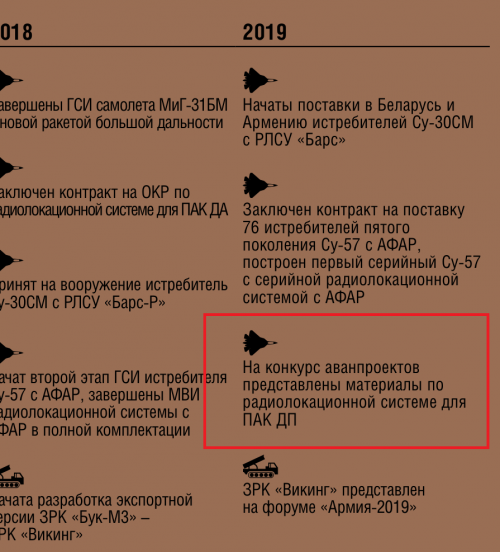
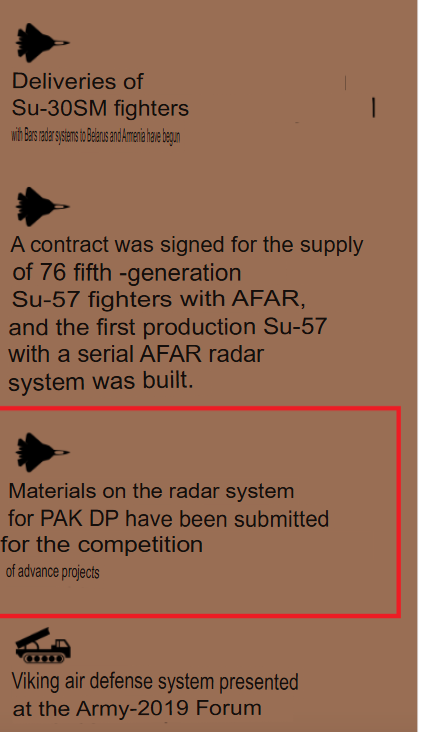
NIIP Tikhomirova handed out its proposal on PAKDP radar system design competition. An outdated news.
'Take off' 1-2/2020
Although this is an older report, it is important to clarify the chronology. Thank you.
The PAK DP program was still in its early stages in 2019-2020.
 
Is there any info anywhere and especially any images/sketches about the proposed PAK DP configuration? George on X hints that it might have been a tailless triangular configuration, so perhaps vaguely like J-36?
 
There's little to no concrete information about it, because unlike PAK DA and PAK VTA it's much further down the priority list. If one were to make a guess, it would probably be a modern evolution of the 70.1 proposal. I doubt it'll be tailless. It isn't well suited for a high speed interceptor. A hypothetical Su-57 successor may be tailless, but we're talking 2040s timeframe here.
 
I would have thought that PAK-DP should have been higher up the list of priorities than say PAK VTA EmoBirb as it is a successor to the MiG-31 interceptor and so being an important part of the Russian air defence system.
 
-Bars
-AFAR
-materials

finally, some optimistic news that suggests what I think is planned for their PAK-DP radar then whatever news we received on Su-57 and Su-75 radars.
 

Attachments

  • 1770495125927.png
    1770495125927.png
    88.2 KB · Views: 227
Last edited by a moderator:
I would have thought that PAK-DP should have been higher up the list of priorities than say PAK VTA EmoBirb as it is a successor to the MiG-31 interceptor and so being an important part of the Russian air defence system.
PAK VTA provides strategic mobility and takes away work load from legacy soviet airframes. It's arguably more useful/needed than PAK DA even, simply because of the utility it offers.

PAK DP may be the direct successor to the legendary MiG-31, but when it comes to interceptor duties these can also be fulfilled in large part by the Su-35 and the Su-57 as well. PAK FA being the way it is gives a lot of wiggle room in that regard, it has good flight performance, it has a strong radar assemble and it can carry much of the same missiles but with the added bonus of stealth. PAK DP seeks to improve on the inherent qualities (flying higher, longer, carrying more and better missiles, preferably internally, some aspects of signature reduction and an even more powerful radar) that distinguished the MiG-25 and MiG-31, but these qualities are not urgently needed. Especially not in comparison to other aviation related programs (PAK DA, PAK VTA, Minoga, S-70, LTS and many others), which are all in varying stages of progress.

The strike role via Kinzhal, which has seen lots of use and success, is also to be considered and I imagine that seeing how useful that capability is has certainly raised questions about integrating this or a similar capability into the PAK DP from the start. Or if it's ultimately left to other airframes and focusing on PAK DP being a high speed, high altitude, long range, big stick interceptor.
 
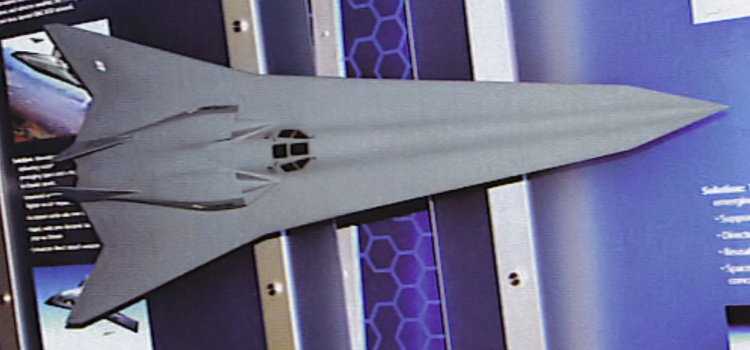
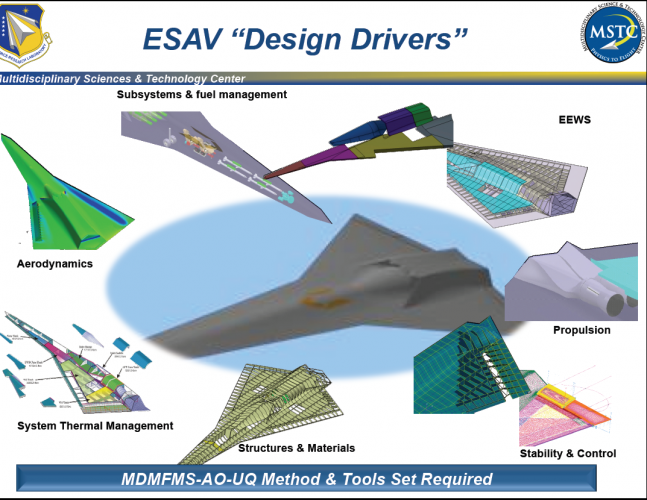
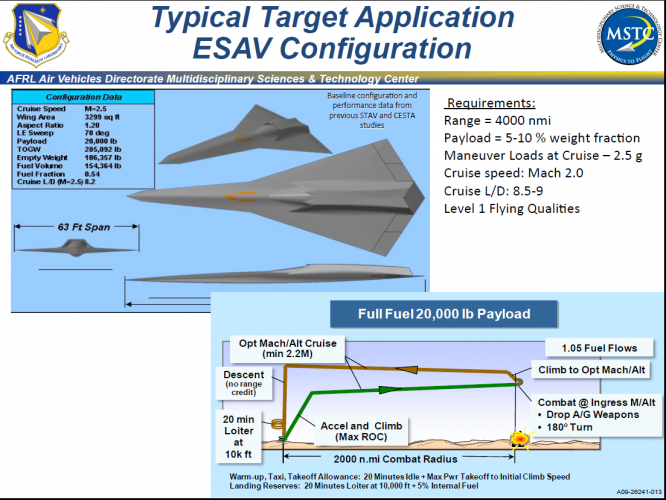
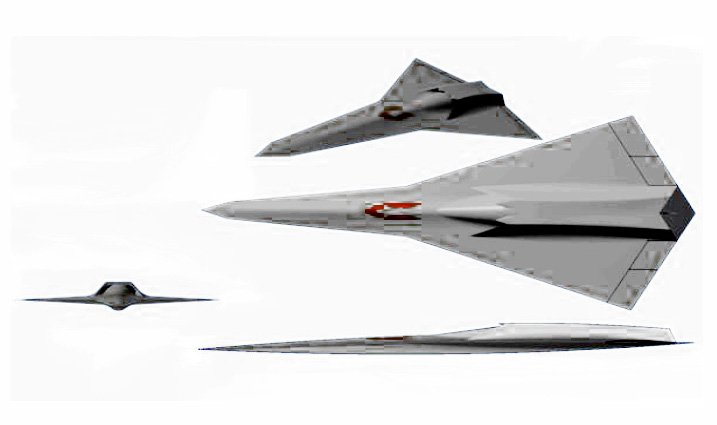
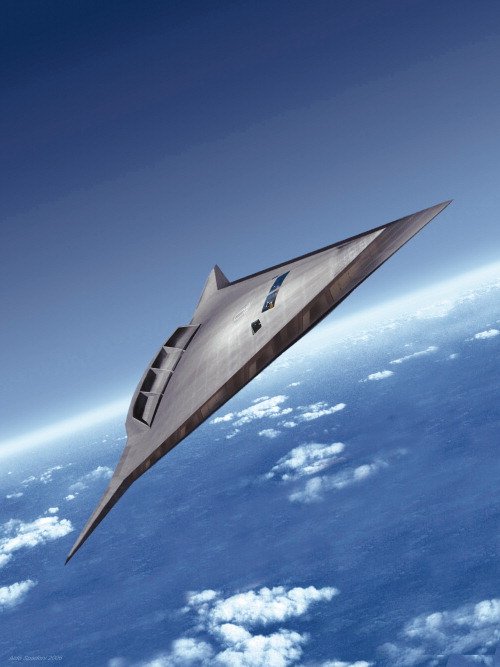
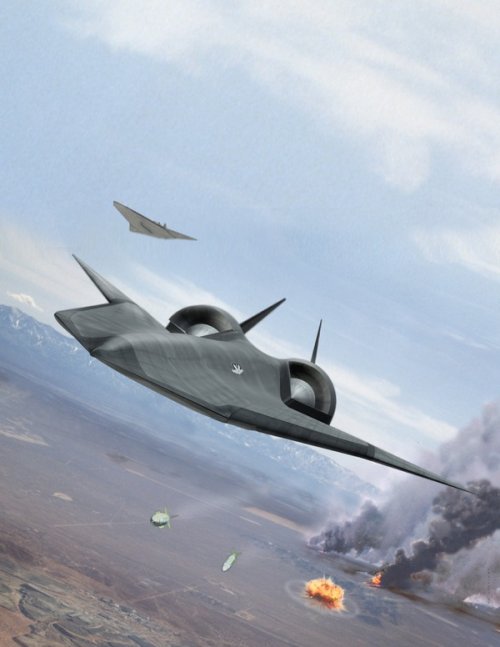
For reference only. The laws of physics and aerodynamics are the same everywhere. These are ARFL and Northrop studies of long-range strike aircraft. A stealthy strike aircraft designed to carry a medium-sized payload over long distances with sustained supersonic speed is not that different from MiG-31 successor carrying hypersonic missiles and asats that would be deployed to cover long ranges over the Russian Federation.
 

Attachments

  • northrop_grumman_long_range_strike_3 2.jpg
    northrop_grumman_long_range_strike_3 2.jpg
    101.3 KB · Views: 123
  • LRSB2.png
    LRSB2.png
    554.8 KB · Views: 127
  • LRSB1.png
    LRSB1.png
    351.9 KB · Views: 136
  • LRSB1 copy 2.jpg
    LRSB1 copy 2.jpg
    57 KB · Views: 125
  • 32bb9e93362c3d665df1ba083492acd2.jpg
    32bb9e93362c3d665df1ba083492acd2.jpg
    81.2 KB · Views: 108
  • NGLRS - supersonic unmanned.jpg
    NGLRS - supersonic unmanned.jpg
    112 KB · Views: 119
Makes me wonder where the J36 would insert itself.

Design wise I doubt this is coincidental.
 
Makes me wonder where the J36 would insert itself.

Design wise I doubt this is coincidental.

Internal volume and good supersonic lift-to-drag ratios require a certain design... see T-4MS for example. If you want to push into a higher super-cruise a somewhat different optima appears (higher sweep etc.) Convergent evolution, homoplasy. As Flateric put it - a good planform is timeless.
 
The aircraft's dimensions are insufficient for a cruise missile compartment
I mean, the faster you fly, the less fuel your missiles need for equivalent kinetic performance, so I would imagine the missiles and the payload bay could be shorter.
 
This an actual project? not a ghost one like the mig 1.44? I mean we havent heard anything officially so how do we know its still active?
 

Similar threads

Back
Top Bottom