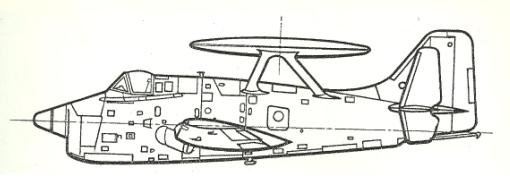
I'd assumed that the APS-82 radar would be repackaged to be like the APS-20, with the radar slung underneath so the aircraft doesn't have to undergo a whole new regime of flight testing.
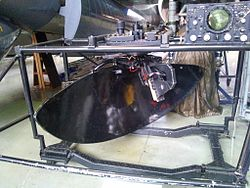
However, the APS-20 radar antenna is 8'4" which is less than half the APS-82s 17'6" antenna, which pretty much knocks the idea on the head.
Plan B, which likely is a better plan anyway, would be to fit the Gannets with the Searchwater LAST, a simple development of Searchwater radar fitted to Nimrod MR2 from 1975. IIUC the idea of the Searchwater as a helicopter AEW predated the Falklands by several years, so likely could be fitted to the Gannet from the mid-late 70s. The Searchwater LAST in the Sea King AEW2 has an antenna of 54" (4'6"), which could be doubled in size for the Gannet. The Sea King lacked the electrical and computer power to do much onboard and I suspect this would likely be similar with the Gannet.
I'd assumed that the APS-82 radar would be repackaged to be like the APS-20, with the radar slung underneath so the aircraft doesn't have to undergo a whole new regime of flight testing.
However, the APS-20 radar antenna is 8'4" which is less than half the APS-82s 17'6" antenna, which pretty much knocks the idea on the head.
Plan B, which likely is a better plan anyway, would be to fit the Gannets with the Searchwater LAST, a simple development of Searchwater radar fitted to Nimrod MR2 from 1975. IIUC the idea of the Searchwater as a helicopter AEW predated the Falklands by several years, so likely could be fitted to the Gannet from the mid-late 70s. The Searchwater LAST in the Sea King AEW2 has an antenna of 54" (4'6"), which could be doubled in size for the Gannet. The Sea King lacked the electrical and computer power to do much onboard and I suspect this would likely be similar with the Gannet.
I found this little gem on the history of the Sea King AEW2/Searchwater.
In the years after the Gannet AEW3 was retired (1978), Directorate Naval Air Warfare (DNAW) gave quiet encouragement to radar manufacturer Thorn EMI and Westland Helicopters to undertake studies exploring the feasibility of installing the ARI 5980 Searchwater radar in a Sea King as a means to provide the ASW strike group with a means of organic airborne surveillance.
Searchwater was a new high-power pulse compression radar entering production for the RAF’s Nimrod MR2 maritime patrol aircraft. Thorn EMI and Westland came as far as putting forward a proposal for a trials installation, but lack of funds in the wake of the 1981 Nott defence review killed the plan.
~1980 is probably too late to do much with the Gannet, which pushes me back to the E1s AN/APS-82. Can the aerial be cut down to 8'4" from 17'6"? If so, are there other compensations for the reduced performance this would cause, perhaps more power?
[...] which pushes me back to the E1s AN/APS-82. Can the aerial be cut down to 8'4" from 17'6"? If so, are there other compensations for the reduced performance this would cause, perhaps more power?
If I understand the old-school radar math correctly, if you shoved 4x the watts through the small antenna it'd equal the detection ranges of the big one.
But you're shoving 4x the watts through a small antenna, with all the heat that implies.
If I understand the old-school radar math correctly, if you shoved 4x the watts through the small antenna it'd equal the detection ranges of the big one.
But you're shoving 4x the watts through a small antenna, with all the heat that implies.
In addition 1971 was when the Shackelton AEW2, using APS20s scrounged from RN Gannets, entered service. Perhaps there could be a joint RAF/RN interim AEW project.
A keen as I am on an updated Gannet AEW I can't imagine that rotodome as anything other than than a delusion, slapping the Hawkeye's radar onto the Gannet because it what the Hawkeye and E3 Sentry have. Adding a rotodome to a Gannet would completely change it's flight characteristics and require a complete programme of flight tests just to see if it could actually fly properly. This is not the sort of thing that a country does in the with an aircraft that entered service in 1953.
We already know the big belly Gannet AEW3 can fly, it had changes like extra fins on the tailplanes to give it more stability for example. If the RN can arrange an interim updated AEW hotting up the existing AEW3s would be the best bet.
The AN/APS-20 search radar in the EC121 was replaced by AN/APS-95 radar, but IIUC the 95 was bigger, it certainly required more power and had a very different antenna; which consisted of a group of 24 horn radiators mounted side by side and fed in parallel. Very different from the 20, pictured above, so likely not interchangeable.
One thing I've considered is how the radar of the TSR2 was a transistorised version of the Lighting/Buccaneer's AIRPASS/Blue Parrot, fed to the VERDAN digital computer. I also believe that the British considered a transistorised version of the Type 984 3D naval radar. Perhaps the British could do the same with the old APS20 in the Gannet.
Amen to that, bro. I've been thinking about it since 2006 at least. I even forged a name for it: TurboTracer.
Neat things with Tracker and co: they fit even on Colossus / Majestic. From there they fit on Hermes, Clemenceaus, Victorious, and all the bigger carriers thereafters.
Cherry on the cake, turboprop-ing Trackers has been done many times, for example for firefighting variants. Which the french flying firemen (La Sécurité civile) used for decades.
TurboTracer with APS-82 could have been big. A possible POD I unhearted from Google books a while back: the French aéronavale considered E-1B circa 1965. In parallel with joint AEW contraptions with the british. Breguet was on that AEW case with planes even uglier than the P.139B, which says something.
The issue in going with the Tracer is that the airframe went out of production in 1965, so the UK is committing to a foreign aircraft with limited or finishing support. The British can control the basic Gannet airframe/engine, they cannot control the Tracer airframe, once it leaves US service supporting it becomes difficult.
Gannet production ended in 1959 [correction: aew version in 1963], if I see that correctly....
For Tracer spares you'd have to go the FN crusader way: loot the USN boneyards. With new engines and new electronics it woule essentially concern the airframe and the radar.
Gannet production ended in 1959, if I see that correctly....
For Tracer spares you'd have to go the FN crusader way: loot the USN boneyards. With new engines and new electronics it woule essentially concern the airframe and the radar.
The issue as I see it is that going forward with a scenario where Britain has Ark until 1975-76, Eagle until 1981-84 and CVA 01&02 until the 2000s and beyond Britain will need from the early 70s; 3 embarked AEW flights, a HQ AEW flight, a CoD flight, training flight and ECM flight. That's about 20 AEW aircraft in good enough condition and with whatever spares they need to fly with ~80% daily availability plus another ~15 aircraft for the other roles. As Britain built some 303 AS Gannets and 44 AEW Gannets maintaining this large-ish fleet would be practical enough, but to replace it would be a big job requiring Britian to buy dozens of E1, C1 and S2 aircraft and a huge stock of spares.
There seems a potential scope for some sort of tactical aircraft here, beyond just AEW.
Comprising COD, ASW, ECM, tactical STOL transport etc.
HS.139 is mostly let down by the desire to package FASS based AEW.
Other options were examined including a rotordome as per Hawkeye etc.
BAC examined a variety of configurations. As did Brough.
Including rotordomes of at least two sizes and even conformal electrically scanned arrays based in sidescan radar developments.
The issue as I see it is that going forward with a scenario where Britain has Ark until 1975-76, Eagle until 1981-84 and CVA 01&02 until the 2000s and beyond Britain will need from the early 70s; 3 embarked AEW flights, a HQ AEW flight, a CoD flight, training flight and ECM flight. That's about 20 AEW aircraft in good enough condition and with whatever spares they need to fly with ~80% daily availability plus another ~15 aircraft for the other roles. As Britain built some 303 AS Gannets and 44 AEW Gannets maintaining this large-ish fleet would be practical enough, but to replace it would be a big job requiring Britian to buy dozens of E1, C1 and S2 aircraft and a huge stock of spares.
With two big carriers they'd go e-2. MN has 3 for cdg, so 6 should do. Can't afford usn style luxuries.
Turbo e-1 or improved gannet aew maybe for transition, probably not at all.
With two big carriers they'd go e-2. MN has 3 for cdg, so 6 should do. Can't afford usn style luxuries.
Turbo e-1 or improved gannet aew maybe for transition, probably not at all.
Yes, but they can't do that until the Eagle retires in the early-mid 80s and by then the Gannet's radar will be long superseded. This musing is all about getting a reasonable AEW capability before the inevitable E2 buy.
So Gannet aew was in production until 1963. We'd need an improved version just for Eagle and that for maybe 10 years? Very much doubt this would happen.
Was Gannet aew7 planned specifically for CVA-01?
So Gannet aew was in production until 1963. We'd need an improved version just for Eagle and that for maybe 10 years? Very much doubt this would happen.
Folks, even here,in the alternative section, staying on topic should be self-evident.
The theme are F-4 Phantom in British service, but with minimal changes to the original design, now we're down to RN AEW for more, than one page.
So, please, back to topic.
Someone mentioned improved AEW on the UK carriers that couldn't carry Phantoms due to size restrictions, and away we went!!!
Sadly, I think such diversions are almost inevitable in a group of people who understand that air groups on a carrier have to be considered as an integrated package - people invariably split off into talking about other elements of the package as being equally important to the main component/topic.
The objective of the thread was find if a MOTS Phantom could operate from RN carriers, or if the whole Spey saga was necessary. The Spey was a requirement because of the bow cats on Ark and Eagle.
That was nearly 15 months ago. The thread is now 17 pages long with 667 messages and will celebrate its second birthday three days hence. Yet we are no nearer the objective of the thread than we were 2 years ago.
The objective of the thread was find if a MOTS Phantom could operate from RN carriers, or if the whole Spey saga was necessary. The Spey was a requirement because of the bow cats on Ark and Eagle.
Move Eagle's forward lift back 50 feet during her 1959-64 refit and move Ark Royal's forward lift back 50 feet during her 1967-70 refit. That allows full-length BS.5 catapults to be fitted in their bows. Although this shortens their main hangars by 50ft their hangar extensions are 50 feet longer to compensate.
Move Eagle's forward lift back 50 feet during her 1959-64 refit and move Ark Royal's forward lift back 50 feet during her 1967-70 refit. That allows full-length BS.5 catapults to be fitted in their bows. Although this shortens their main hangars by 50ft their hangar extensions are 50 feet longer to compensate.
And while they're at it they can make the new lifts longer so the Phantoms don't need folding noses. (I know the aft lift will have to be made at least 4 feet longer too.) That has the bonus that Hawkeyes will fit the longer lifts too.
Move Eagle's forward lift back 50 feet during her 1959-64 refit and move Ark Royal's forward lift back 50 feet during her 1967-70 refit. That allows full-length BS.5 catapults to be fitted in their bows. Although this shortens their main hangars by 50ft their hangar extensions are 50 feet longer to compensate.
A question for @EwenS because you're our expert on OTL aircraft carrier construction and reconstruction.
Is that feasible? It doesn't matter about the cost as we're expecting to save in the region of £350 million 1965-75 by buying MOTS Phantoms instead of Spey Phantoms. Is it feasible technically? And if it is, how long do you think it would take?
I think it may be because Victorious had her lift moved back 36ft from its original position and had its length increased to 58ft. I appreciate that she was also dismantled to her hangar deck and then rebuilt from said hangar deck upwards with a completely new upper hull and superstructure.
That was nearly 15 months ago. The thread is now 17 pages long with 667 messages and will celebrate its second birthday three days hence. Yet we are no nearer the objective of the thread than we were 2 years ago.
Due to the Spey not meeting its expectations in the Phantom a J79 F4J with extended nose oleo, drooping ailerons and folding radar was a practical option for the Eagle and Ark.
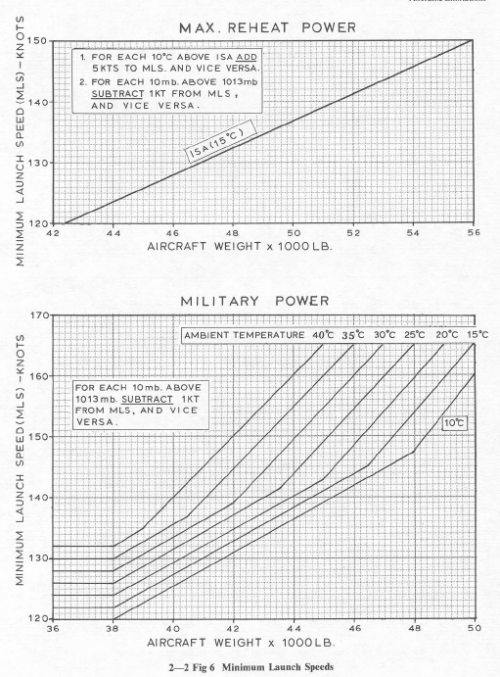
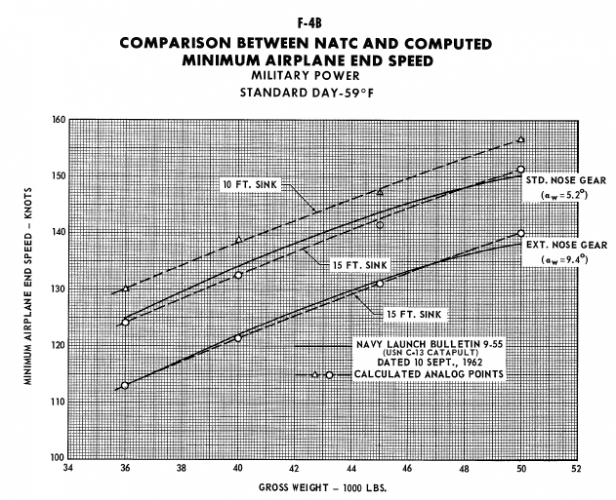
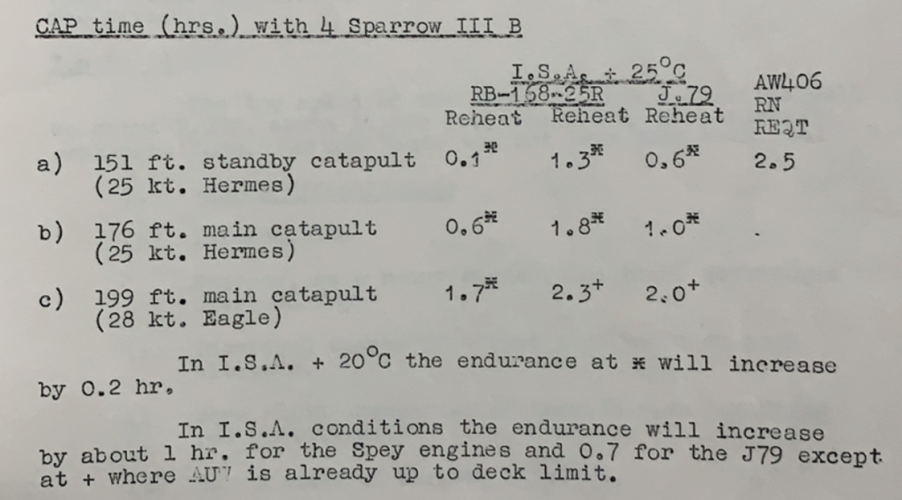
Minimum launch speed from the manual 1969 for Spey F-4K:
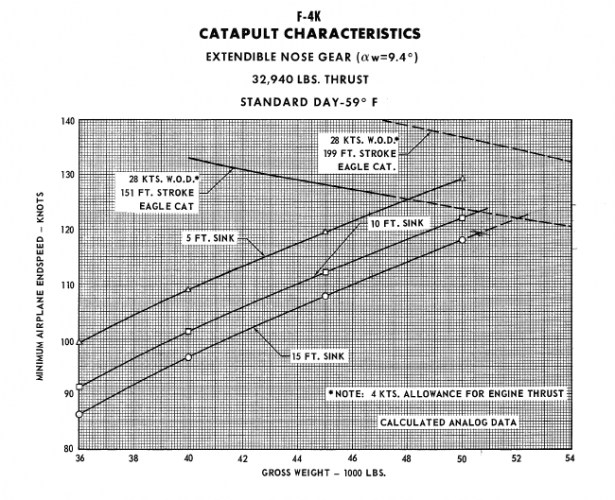
Compared to McD report 1964:
So at 50k lbs, the manual gives 137 kts mls (not entirely clear, probably with 6 ft sink - this would be the best case scenario). From other sources like Cagill, Phantom, it would be about 140 kts.
The hoped-for number was 129 kts.
Short bow cat + thrust + 28 kts ship speed produces 124 kts from the 2nd graph. So we are at least 13 kts short, needing to accept more sink/less weight. With 15 ft of sink - assuming the delta from the graph is roughly correct and we are calculating from 6ft sink - we are pretty much there with ~125 kts.
Here is the F-4B with the extended nose gear:
Correcting for F-4J improvements (~3 kts) and use of afterburner (3-5kts), this gives about ~130 kts.
So best case, the F-4K Spey version was worth ~5 kts or about 2000 lbs launch weight.
But for the procurement decision, the hope was for ~12 kts, worth about 4000-5000 lbs. Translating into the expected improvements below. This is difficult to butterfly away.
A question for @EwenS because you're our expert on OTL aircraft carrier construction and reconstruction.
Is that feasible? It doesn't matter about the cost as we're expecting to save in the region of £350 million 1965-75 by buying MOTS Phantoms instead of Spey Phantoms. Is it feasible technically? And if it is, how long do you think it would take?
I think it may be because Victorious had her lift moved back 36ft from its original position and had its length increased to 58ft. I appreciate that she was also dismantled to her hangar deck and then rebuilt from said hangar deck upwards with a completely new upper hull and superstructure.
As money is specified to be no object, then anything is possible.
Note the lift had already been moved aft by 50ft in March 1943 during the design phase, with the hangar area then left forward of the lift being intended thereafter as an aircraft maintenance space, out of the way of day to day hangar movements where aircraft wings could be spread. This proposal doubles the length of that space (45ft to 95ft) to the detriment of hangar space for day to day aircraft movements if indeed that was how the space was utilised after 1964.
II don't have detailed deck by deck plans but given what I do have I would note the following.
1. The existing forward lift was 54ft long & 44ft wide. So roughly speaking you are moving it aft by its own length. Upper hangar width was 67ft. Lower hangar width was 54ft, with the "lost" width being on the in board side next to the island. Hangars were not on the ship's centre line but offset slightly to port, with the hangar "boxes" being aligned on their port side. But lifts were on the upper hangar centre line. So there does not seem to be an opportunity to move the lift inboard towards the island. Also note that the aft end of the lift can't be moved back so far that it would place the new lift well and lift balance tubes into the forward boiler room spaces the tops of which lie directly under the hangar deck amidships (they extend a bit forward of the funnel). So I'm not sure it buys the specified 50ft or not.
2. Cut through 4in of armoured steel and 1in of DW supporting steel to create a new opening in the flight deck.
3. Cut through the upper hangar floor
4. Cut through the 2.5in armoured steel lower hangar floor.
5. All the above was structural steel supported by girders that also require cut and removed. The decks then require all the stress paths to be re-routed. Does putting them across the old lift well restore all the structural rigidity required?
6. Create a new lift well under the lower hangar deck.
7. Create new "tubes" to contain the lift balance weights running deep into the ship. In Victorious as completed these penetrated 2 decks below the hangar deck. As reconstructed it was at least one deck (I don't have plans for her reconstructed structure below that). IIRC in an Implacable they also ran two decks below the hangar deck they served.
So far so simple!
Now think about what is being displaced from this new lift location. Can it be simply swapped for the "new" space created in the old lift location?
There were 5 decks below the lower hangar deck. The lower 3 were taken up by bomb rooms and magazines for rocket motors, bofors ammo and aircraft ammo. These were within the armoured citadel. (4.5in side armoured belt, two void spaces sandwiching a liquid space and a 2x50lb (2.5in of steel in total) inner holding bulkhead). But the armoured belt protection ended with those magazine spaces.
How are these magazine spaces able to be accessed with the lift in its new position? Or is it considered safe to move those spaces out from behind the armoured belt to be left only with the protection of the triple layer and holding bulkhead of the TDS?
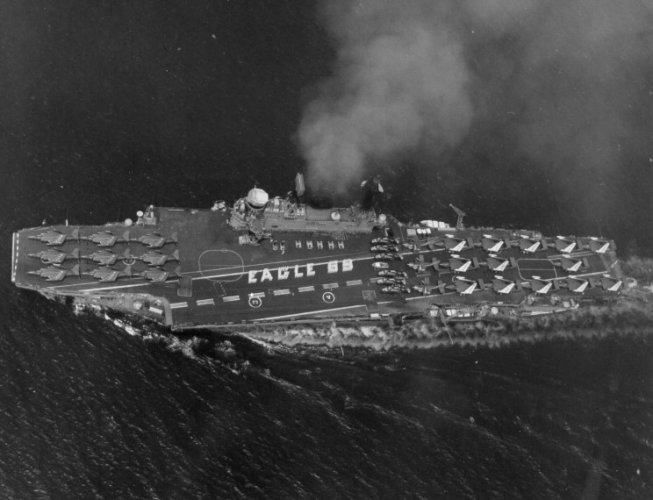
Then look at the flight deck layout with the lift in its new position. This is Eagle in 1969.
Move the lift aft (as noted I don't believe it can be moved inboard) and note how it interferes with the landing area to a far greater extent.
It also seems that an extended forward catapult would need realigned to starboard to reduce / stop interference with the waist catapult. So more work required under the flight deck to move equipment around and repurpose compartments etc.
As for time required, who knows. The work involved is extensive amounting to a virtual rebuild of the bow end of the ship back to somewhere forward of the funnel and down at a minimum, two decks below the lower hangar.
But hey, money is specified to be no problem! So why not? Wonder why it wasn't thought of in late 1950s? Or was it and the problems to be solved outweighed the benefits even if the money was available?
@orlovsky I've interpreted your graphs in this thread to mean that in hindsight the modified J79 F4J could operate from the bow cats of Eagle and Ark, was this wrong?
I understand that when the decision was being made the Spey offered better margins and "conservative because they have to be" decision makers decided on the Spey, which also met a lot of other requirements.
The Spey then didn't meet its advertised performance, which I thought meant it was in practice equal to the J79. Are you saying that the Spey; despite not meeting it's advertised performance, still had an advantage over the J79 and this advantage was a critical requirement?
Yeah, that does require a pretty significant rebuild.
Likely a second rebuild after installing the angled flight deck in 1952 like what happened to the US Midway class.
Move the bits of the island around the stack/uptakes so that the entire island structure is forward of the uptakes, forward lift gets out of the hull entirely and goes where the aft end of the island is now on the deck edge. Then two deck-edge lifts go in aft, parallel-ish to where the existing one is. One lift starboard, one lift port.
@orlovsky I've interpreted your graphs in this thread to mean that in hindsight the modified J79 F4J could operate from the bow cats of Eagle and Ark, was this wrong?
I understand that when the decision was being made the Spey offered better margins and "conservative because they have to be" decision makers decided on the Spey, which also met a lot of other requirements.
The Spey then didn't meet its advertised performance, which I thought meant it was in practice equal to the J79. Are you saying that the Spey; despite not meeting it's advertised performance, still had an advantage over the J79 and this advantage was a critical requirement?
I think the modified J79 F-4J would work from the bow cats. The question is rather, how well - safety margins, weight limitations etc. But that was a problem for the F-4K, too.
How much of a problem in comparison is difficult to say as it's based on 60 year old bits of data and we lack details - eg, the minimum launch speed from the manual is based on how many ft of sink? But I think it is quite plausible that the advantage of the Spey, if any, was 5 kts at best.
I do not think that was critical. Also to consider, the F-4K was 500-1000 lbs heavier, so a part of the advantage would be eaten up by that.
Yeah, that does require a pretty significant rebuild.
Likely a second rebuild after installing the angled flight deck in 1952 like what happened to the US Midway class.
Move the bits of the island around the stack/uptakes so that the entire island structure is forward of the uptakes, forward lift gets out of the hull entirely and goes where the aft end of the island is now on the deck edge. Then two deck-edge lifts go in aft, parallel-ish to where the existing one is. One lift starboard, one lift port.
I do wish those from the US side of the pond would stop looking at the US carriers like the Essex and Midway, and believing that the same extensive modifications done to them could be done to RN carriers.
The point that keeps getting ignored / forgotten is that the basic designs of the carriers in the two navies were fundamentally different. In the USN ships the top of the hull girder that provided the hull strength was the hangar deck. Everything above that was superstructure. And the "open hangar" design meant that the hangar itself was carried all the way to the ship's side (barring obstructions like girders to support the flight deck, bollards etc). Modifications above the hangar deck were therefore relatively straightforward.
In the RN carriers the flight deck was the main strength deck. The double story hangars were therefore part of the hull girder. The armoured box hangars sat within the hull spaced away from the ship's side but were an integral part of the hull structure playing a part in its overall rigidity. It was therefore much harder to make changes to fight deck and hangars as that meant cutting into / through load bearing areas. Hull strength removed in doing so, needed to be put back by some means. The more holes you cut, the weaker the hull becomes and the more load bearing structural reinforcement needs to be put back in.
There are two areas of note with this proposal that make it, IMHO, completely unworkable.
1. The uptakes from the aft boiler rooms, which started under the aft end of the historical island, were trunked across the ship, then upwards and forwards alongside the hangar spaces, then up again into the island and then angled to join the funnel. The forward boiler rooms were inboard of, and below the funnel itself when the ship is viewed in profile. About half the island structure aft off the funnel itself is occupied by funnel uptakes from the after boiler room. So the clear space you imagine exists by rearranging the island as you propose does not create the free space for moving the historical forward lift aft and outboard to a deck edge position.
Carrying the cross ship funnel uptakes higher in the ship than in previous carrier designs was probably the single biggest single lesson learned from the loss of Ark Royal III in Nov 1941. It was learned in just enough time to incorporate into the Audacious class during its design process. The unit machinery layout adopted also pushed the aft boiler rooms further aft. (Ark Royal III and the 4 Illustrious class had the three boiler and engine rooms across the beam of the ship).
2. Due to a lack of freeboard at the lower hangar deck level, the side lift on Ark Royal as fitted on completion only accessed the upper hangar. With your proposal all the lifts are of the deck edge type. How do you propose to access the lower hangar?
A second hangar problem to tackle is that these are "closed hangar" ships. The hangar did not extend all the way to the ship's side as in a US "open hangar" design such as an Essex or a Midway. The depth of the "cut" to reach the port wall of Ark Royal's upper hangar wall can be seen here. https://www.gettyimages.co.uk/detai...eet-aircraft-carrier-hms-news-photo/702436211
Due to the offset arrangement of the hangars within the ship's hull, the starboard upper hangar wall was about double the distance in board from the ship's side than on the port side as illustrated above. The starboard lower hangar wall was even further from the ship's side and nearer the ship's centre line. Carrying the starboard side of the historical lift aft will give you an idea of how deep the cut into the ship would require to be to reach the starboard wall of the lower hangar.
So your plan is, so far as I can see, completely unworkable for an Eagle / Ark Royal modernisation.
I do wish those from the US side of the pond would stop looking at the US carriers like the Essex and Midway, and believing that the same extensive modifications done to them could be done to RN carriers.
The point that keeps getting ignored / forgotten is that the basic designs of the carriers in the two navies were fundamentally different. In the USN ships the top of the hull girder that provided the hull strength was the hangar deck. Everything above that was superstructure. And the "open hangar" design meant that the hangar itself was carried all the way to the ship's side (barring obstructions like girders to support the flight deck, bollards etc). Modifications above the hangar deck were therefore relatively straightforward.
In the RN carriers the flight deck was the main strength deck. The double story hangars were therefore part of the hull girder. The armoured box hangars sat within the hull spaced away from the ship's side but were an integral part of the hull structure playing a part in its overall rigidity. It was therefore much harder to make changes to fight deck and hangars as that meant cutting into / through load bearing areas. Hull strength removed in doing so, needed to be put back by some means. The more holes you cut, the weaker the hull becomes and the more load bearing structural reinforcement needs to be put back in.
There are two areas of note with this proposal that make it, IMHO, completely unworkable.
1. The uptakes from the aft boiler rooms, which started under the aft end of the historical island, were trunked across the ship, then upwards and forwards alongside the hangar spaces, then up again into the island and then angled to join the funnel. The forward boiler rooms were inboard of, and below the funnel itself when the ship is viewed in profile. About half the island structure aft off the funnel itself is occupied by funnel uptakes from the after boiler room. So the clear space you imagine exists by rearranging the island as you propose does not create the free space for moving the historical forward lift aft and outboard to a deck edge position.
Carrying the cross ship funnel uptakes higher in the ship than in previous carrier designs was probably the single biggest single lesson learned from the loss of Ark Royal III in Nov 1941. It was learned in just enough time to incorporate into the Audacious class during its design process. The unit machinery layout adopted also pushed the aft boiler rooms further aft. (Ark Royal III and the 4 Illustrious class had the three boiler and engine rooms across the beam of the ship).
2. Due to a lack of freeboard at the lower hangar deck level, the side lift on Ark Royal as fitted on completion only accessed the upper hangar. With your proposal all the lifts are of the deck edge type. How do you propose to access the lower hangar?
A second hangar problem to tackle is that these are "closed hangar" ships. The hangar did not extend all the way to the ship's side as in a US "open hangar" design such as an Essex or a Midway. The depth of the "cut" to reach the port wall of Ark Royal's upper hangar wall can be seen here. https://www.gettyimages.co.uk/detai...eet-aircraft-carrier-hms-news-photo/702436211
Due to the offset arrangement of the hangars within the ship's hull, the starboard upper hangar wall was about double the distance in board from the ship's side than on the port side as illustrated above. The starboard lower hangar wall was even further from the ship's side and nearer the ship's centre line. Carrying the starboard side of the historical lift aft will give you an idea of how deep the cut into the ship would require to be to reach the starboard wall of the lower hangar.
Hangar decks of Audacious class were both increased to 17ft 6in during the design process to match those of US carriers (Essex & Midway) given that in 1942 the RN expected to be reliant on US aircraft for a few years. Why would you want to reduce that?
The point of this exercise as proposed by @NOMISYRRUC in his last posts was NOT to raze the ship to the lower hangar deck floor but simply to play with the positions of forward lift and catapult.
Upper & lower port hangar walls were aligned, so loss of hangar width was on the starboard side as previously noted.
Forward lift (L x W as previously noted) 54ft x 44ft
After Lift (L x W) 54ft x33ft
As for fitting two deck edge lifts aft of the island to starboard, you are ignoring the boiler trunking alongside the hangars aft of the island. It is not just those inside the island proper that you need to find a solution for.
For comparison
Essex class per Friedman
Waterline beam 93ft
Hangar width 70ft (that must be inside the superstructural girders supporting the flight deck or more likely abreast the island)
Midway class per Friedman
Waterline beam 113ft
Hangar width 95ft
But cost according to @NOMISYRRUC was not to be an issue for his proposal.
Your proposal takes everything to a whole different level, and to a point where there are impracticalities you seem to want to ignore i.e that unit machinery layout with its funnel trunking and freeboard to lower hangar deck level (both hangars are required for the number of aircraft to be carried). The only solution I can see for the first would be a second island and funnel, but that limits the side space for lifts and ignores the freeboard issue.
The Victorious rebuild still left the flight deck as the strength deck and did not involve the need for any rerouting of the funnel trunking.
It was only with the Forrestals that the USN moved to making the flight deck the strength deck and that had much to do with their sheer size.
This site uses cookies to help personalise content, tailor your experience and to keep you logged in if you register.
By continuing to use this site, you are consenting to our use of cookies.