Attachments

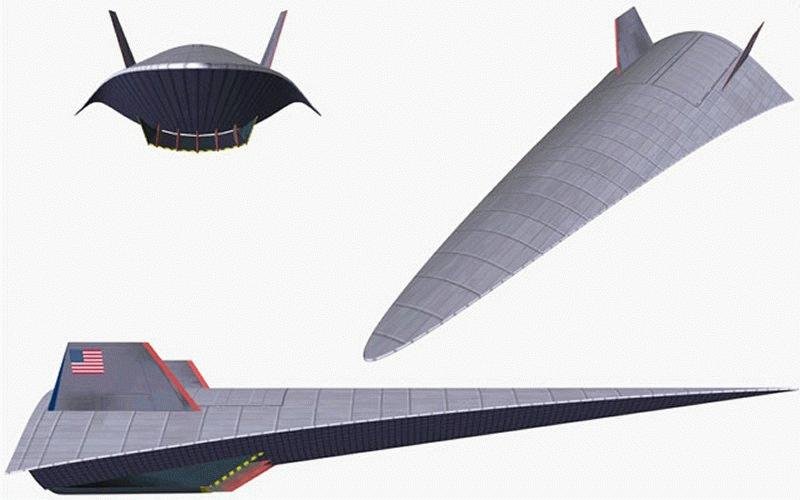
  • Hypersoar3View.jpg
    Hypersoar3View.jpg
    32 KB · Views: 51
I know. Its strange. But that is what the USN mentioned in work its previously funded to Castelion. We could be looking at a surface launched version with a booster and an air launched system without one so that's also something to consider.
Air-Launched Blackbeard likely won't have the booster.
That or they're planning on developing a smaller booster for the Navy version...
 

Here Is What Trump’s Gargantuan $1.5T Defense Budget Has In It​

https://www.twz.com/air/here-is-what-trumps-gargantuan-1-5t-defense-budget-has-in-it
 
(Sry for going off on a tangent)...I'm still puzzled how guidance works on a hypersonic missile? Not only the nose shape on scramjet missiles, but the problem of plasma. USN wants anti ship scramjet missile. Which means targeting moving ships. Don't they have to slow down to below mach 5 in terminal phase of the attack?
 
(Sry for going off on a tangent)...I'm still puzzled how guidance works on a hypersonic missile? Not only the nose shape on scramjet missiles, but the problem of plasma. USN wants anti ship scramjet missile. Which means targeting moving ships. Don't they have to slow down to below mach 5 in terminal phase of the attack?

I doubt that plasma is an issue at ~Mach 5. A lot of AAMs and SAMs enter that speed range, although usually only briefly at their max velocity. A high altitude missile might simply mount it’s terminal sensor in a ventral, look down position - on something like HACM I would think the compression ramp between the tip and the intake would be a relatively cool piece of the airframe (compared to the nose or control surfaces) where you might locate a sensor. Alternatively, have some kind of cover that ejects in the terminal dive to the target. Pretty much every hypersonic becomes supersonic in the dive through the thicker lower atmosphere.
 
(Sry for going off on a tangent)...I'm still puzzled how guidance works on a hypersonic missile? Not only the nose shape on scramjet missiles, but the problem of plasma. USN wants anti ship scramjet missile. Which means targeting moving ships. Don't they have to slow down to below mach 5 in terminal phase of the attack?
This has been figured out...
The US has weapons that reach well into the Hypersonic realm.
THAAD 's max speed can reach something like Mach 9+, as it's sensor's guide itself into the incoming missile. The SM-3(IIA), I've read can go over Mach 12, so..!
 
This has been figured out...
The US has weapons that reach well into the Hypersonic realm.
THAAD 's max speed can reach something like Mach 9+, as it's sensor's guide itself into the incoming missile. The SM-3(IIA), I've read can go over Mach 12, so..!
I would suspect that those kinds of speeds are attained at altitudes high enough that there enough atmosphere to create a strong plasma shell. The SM-3 is entirely exoatmospheric, so it doesn't even try to deal with plasma. In BMD terms, plasma is probably only a significant problem for low-altitude, high-speed interceptors like SPRINT, which was externally controlled.
 
This has been figured out...
The US has weapons that reach well into the Hypersonic realm.
THAAD 's max speed can reach something like Mach 9+, as it's sensor's guide itself into the incoming missile. The SM-3(IIA), I've read can go over Mach 12, so..!
They're both IR seekers. They're not trying to get RF through plasma. (Which you'd have to do if you were using a radar seeker.) Pershing II used a radar DSMAC but I seem to recall reading something like "it's eyes didn't open" until it got below certain speed.
 
This has been figured out...
The US has weapons that reach well into the Hypersonic realm.
THAAD 's max speed can reach something like Mach 9+, as it's sensor's guide itself into the incoming missile. The SM-3(IIA), I've read can go over Mach 12, so..!
Yeah maybe I should have clarified as to how it's actually done, THAAD & SM-3 utilize IR guidance with the ground radar/FCS sending periodic updates as to the positions of both target and Interceptor I think (THAAD has an IR window made from heat resistant mineral I can't remember, and SM-3 has fairings that pop off releasing the KV near to or completely outside the atmosphere)...
 
Confirmed by Fiscal Year 2027 U.S. Navy budget documentation, the Multi-mission Affordable Capacity Effector (MACE) is to serve as the most numerous Hypersonic strike option available to U.S. Naval Aviation, with a limited service entry date sometime in 2027.


Budgetary details followed shortly after Castelion’s Blackbeard came out on top as the MACE program’s winner. Blackbeard’s selection and procurement comes at a breakneck pace, as the Request for Information was first published by NAVAIR just over two years ago, with the first budgetary mention last year.


FY 2027 will serve as the first year the U.S. Navy will buy MACE rounds in bulk, totaling out to 353 all-up-rounds (AURs) for lot 1

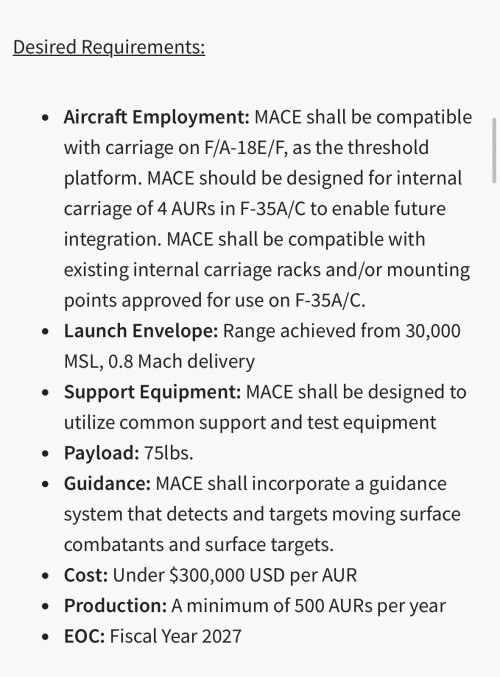
https://www.navalnews.com/naval-new...u-s-navys-primary-hypersonic-strike-munition/ IMG_4555.jpeg

Is it just me or this sound ways too good to be true?. Am I dreaming? . USN will have a hypersonic weapon that is small enough to fit 4 round inside F-35, yet still massively cheaper than the average cruise missile?. And they already intended to buy over 350 round next year ( an not some paper project that will never leave the power point stage?).
I have always want USN to purchase something like air launched PRSM or MAKO but damm, this is like 10 times better new
 
https://www.navalnews.com/naval-new...u-s-navys-primary-hypersonic-strike-munition/View attachment 810204

Is it just me or this sound ways too good to be true?. Am I dreaming? . USN will have a hypersonic weapon that is small enough to fit 4 round inside F-35, yet still massively cheaper than the average cruise missile?. And they already intended to buy over 350 round next year ( an not some paper project that will never leave the power point stage?).
I have always want USN to purchase something like air launched PRSM or MAKO but damm, this is like 10 times better new
This is basically an ALBM, although I doubt those original MACE requirements are fulfilled. Especially the internal carriage part.
 
The article says four rounds internally on the F-35, based on their understanding of size or a otr comment. They might be wrong or clueless but it’s a tantalizing possibility.
 
Why?!! 70lb of payload is nothing extraordinary. Think AIM-54 (nearly twice heavier payload), R-37 (idem), AIR-2 Genie ...
But none of them can fit inside F-35, that the point. Like if they managed to fit 4 hypersonic inside F-35 then what the point of AARGM-ER anymore? Should cancel it and buy blackbeard instead.
 
Without accounting for their fins, they well might ;)
(See how their outside diameters compare with that of an Mk84 bombs)
 
Last edited:
Sorry for the speculation but with this apparent real full court press from multiple systems I’m wondering if there were missed “fleeting” targets in this most recent conflict that hypersonics would have been able to hit?
 
Sorry for the speculation but with this apparent real full court press from multiple systems I’m wondering if there were missed “fleeting” targets in this most recent conflict that hypersonics would have been able to hit?
All the ballistics that were fired perhaps. Not sure if they were detected before launch, though.
But it should apply to the current mine laying speed boat.
 
But none of them can fit inside F-35, that the point. Like if they managed to fit 4 hypersonic inside F-35 then what the point of AARGM-ER anymore? Should cancel it and buy blackbeard instead.
I thought this is exactly what’s happening? Didn’t AARGM-ER get paused within a few months of the Castelion Blackbeard award?
 
I thought this is exactly what’s happening? Didn’t AARGM-ER get paused within a few months of the Castelion Blackbeard award?
To be fair, I used to think it horrible that they cancel AARGM-ER, but if Blackbeard can full fill all MACE requirement then indeed AARGM-ER seem pointless
 

Similar threads

Back
Top Bottom