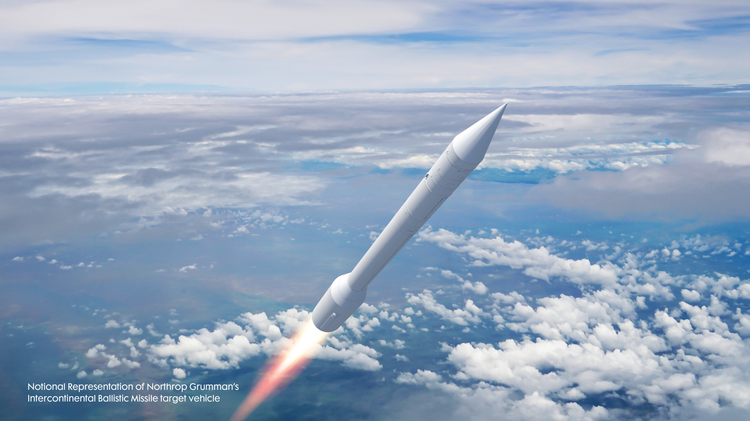
New Target Vehicle for Missile Defense Tests Makes First Flight​


A rendering of Northrop Grumman’s new ICBM target design, which replaces the vehicle’s heritage Trident 1 C4 first stage motor with the SR119 solid rocket motor. Credit: Northrop Grumman
1768037585370.png
 
Range for what? I'm still waiting to see what the 13,000lb thrust scramjet is for, and this was five years ago.

 
GE Aerospace (NYSE:GE) and Lockheed Martin (NYSE: LMT) completed a series of engine tests demonstrating the viability of a liquid-fueled rotating detonation ramjet for use in hypersonic missiles, the first initiative between the companies under a broader joint technology development arrangement...
WHY IT MATTERS
This fuel-efficient rotating detonation ramjet promises to fly missiles faster—including at hypersonic speeds—and farther while decreasing costs compared to other ramjet options. Here’s how:


  • The compact design enables increased fuel or payload capacity and lowers the cost of production.
  • Improved fuel efficiency and thrust generation extends range.
  • Ignition is achieved at a lower speed, so smaller boosters can be used for ramjet start.

HOW IT WORKS

  • The rotating detonation ramjet combusts fuel and air through detonation waves instead of the traditional combustion methods used in ramjet engines today.
  • This propulsion system generates high thrust for super- and hypersonic speeds to engage high-value, time-sensitive targets, with a smaller engine size and weight that boosts range.
 

US Navy Seeks to Proliferate Hypersonic Missiles Across the Fleet​

Makes me wonder if there will be a "Flight IIIA" Arleigh-Burke DDG which will ditch the forward VLS in favor of CPS hypersonic missiles. Or if the ships will remain completely Air-Warfare focused.
 
Makes me wonder if there will be a "Flight IIIA" Arleigh-Burke DDG which will ditch the forward VLS in favor of CPS hypersonic missiles. Or if the ships will remain completely Air-Warfare focused.
I would guess no, the whole raison d'etre for the BBG(X) over the DDG(X) was that they didn't wanted to have to drop guns in favour of CPS cells. The A-Bs will be kept for air-defence and Tomahawk/ASM strikes. The railgun on the BBG(X) will be used as a final defensive layer against hypersonic/ballistic missiles after the SM-3/GPI and Compact Agile Interceptor layers, whilst the CPS cells on the BBG(X)s, Zumwalts, Ohio SSGNs and Virginia Block IVs and land-based Dark Eagle launchers (and maybe air-launched ARRWs) provide the ability to return fire against anything anywhere at any time.
 
I still think it is inefficient to try to force the CPS onto hulls whose main roll is air defense. CPS requires none of the same facilities as a AAW platform and has nothing like the envelope.
 
Makes me wonder if there will be a "Flight IIIA" Arleigh-Burke DDG which will ditch the forward VLS in favor of CPS hypersonic missiles. Or if the ships will remain completely Air-Warfare focused.

Unmanned hypersonic pack mule ships wouldn't be a bad idea.
 
I wouldn't want to put my $50 million missiles that are also the fleet's single most important weapon anywhere but the most heavily defended place in the fleet. I don't think USV acceptance is anywhere near the point where they are willing to risk an unmanned boat breaking down or loosing a critical comms link while carrying weapons like that. Also, I think heavy bombers with hypersonic weapons or long-range cruise missiles are a safer and more useful option for a strike platform than a USV. I do think USVs could be useful as optionally manned adjuncts to surface combatants for air and missile defense or as sensor platforms.
 
I wouldn't want to put my $50 million missiles that are also the fleet's single most important weapon anywhere but the most heavily defended place in the fleet. I don't think USV acceptance is anywhere near the point where they are willing to risk an unmanned boat breaking down or loosing a critical comms link while carrying weapons like that. Also, I think heavy bombers with hypersonic weapons or long-range cruise missiles are a safer and more useful option for a strike platform than a USV. I do think USVs could be useful as optionally manned adjuncts to surface combatants for air and missile defense or as sensor platforms.

There are plenty of manned options that are possible; I personally favor a converted T-AKO hull. A alternative might be a TEU solution simply hoisted onto existing Ro/Ro ships normally tasked with the expeditionary support role as a temporary fix until there are purpose built hulls. But more importantly all of your target information for an intermediate ranged ballistic missile is offboard anyway, as are your firing orders- it is not a tactical weapon. So working communications with shore will be an absolute prerequisite regardless of what you stick them on.
 
There are plenty of manned options that are possible; I personally favor a converted T-AKO hull. A alternative might be a TEU solution simply hoisted onto existing Ro/Ro ships normally tasked with the expeditionary support role as a temporary fix until there are purpose built hulls. But more importantly all of your target information for an intermediate ranged ballistic missile is offboard anyway, as are your firing orders- it is not a tactical weapon. So working communications with shore will be an absolute prerequisite regardless of what you stick them on.
Auxiliary hulls, just like most USV concepts, are still going to lack the self-defense capability and damage control that carrying around such valuable weapons should entail. The CPS is not going to out-range all Chinese ASBMs, so it will still need to be defended against ballistic and hypersonic missile attacks, as well as submarines. Also, fixing communications issues is much easier with people on both ends to troubleshoot and perform repairs. If something needs to be manually repaired, a crew might take minutes or hours while getting personnel onboard a USV could take hours or days during which the missiles are unavailable.
 
Auxiliary hulls, just like most USV concepts, are still going to lack the self-defense capability and damage control that carrying around such valuable weapons should entail. The CPS is not going to out-range all Chinese ASBMs, so it will still need to be defended against ballistic and hypersonic missile attacks, as well as submarines. Also, fixing communications issues is much easier with people on both ends to troubleshoot and perform repairs. If something needs to be manually repaired, a crew might take minutes or hours while getting personnel onboard a USV could take hours or days during which the missiles are unavailable.

What self defense weapons and damage control are going to be effective against ASBMs? And if a defense against ABSMs is necessary, does it not make more sense to just escort the CPS ships when needed but otherwise divorce those two requirements from each other? Trying to squeeze those two requirements on one hull is just asking for another failed program that gets cancelled before it hits the water. Moreover if you want more CPS on a shorter timeframe, that is entirely doable. We could have some by end of decade, no matter which option was selected, so long as that requirement was not paired with DDGX or the to be cancelled in 2029 BBGX.
 
USAF Researchers Plan New Wave Of Hypersonic Demonstrators

The U.S. Air Force (USAF) will soon ask companies to propose new ideas for long-range hypersonic weapons that can be demonstrated rapidly.

The Air Warfare Directorate within the Air Force Research Laboratory (AFRL) plans to open the solicitation process within 30 days, an acquisition notice released Jan. 15 says.

The concepts call for weapons that can sustain Mach 5 speed and fly farther than 500 nm. Additional requirements and evaluation criteria will be detailed in the solicitation.

A vehicle capable of sustaining speed at Mach 5 or higher tends to refer to air-breathing propulsion systems, such as a supersonic combustion ramjet (scramjet), a rotating detonation ramjet or a turboramjet.

The selection process will begin with a request for white papers.

The proposed solicitation would continue a long series of hypersonic vehicle concepts sponsored by AFRL. The Boeing X-51A, which was partly supported by DARPA, demonstrated a scramjet-powered, waverider vehicle fueled by traditional kerosene nearly 13 years ago. Another project—a hypersonic strike-reconnaissance aircraft called Mayhem—was suspended in 2024.


HALO Hypersonic Missile Program Returns With New Options and Realistic Expectations​

he Offensive Anti-Surface Warfare Increment 2.0 (OASuW 2.0) program is underway once again. The effort brings back a program that originally planned to field the once-cancelled Hypersonic Air Launched Offensive (HALO) missile.
Gordon LoPresti, Northrop Grumman’s Senior Director of Propulsion Systems and Controls, spoke to Naval News about the future of Northrop Grumman’s 21-inch motor and how additional motor development programs in Northrop Grumman could contribute to the OASuW 2.0 program.
The 21-inch motor has potential applications across air, sea, surface, and land engagements beyond the new SM-6 Block IB.

View: https://x.com/AirPowerNEW1/status/2016950354223497599?s=20

This has to be the best name every, the designation team needs a raise. 29inch - about 737mm. No idea what that's for?? ARRW or OpFires?

View: https://x.com/AirPowerNEW1/status/2017039372395123070?s=20

Northrop Grumman’s SMART Demo Tests Second Advanced Solid Rocket Motor and Achieves Successful Firing in Two Months​

 
Last edited:
Northrop Grumman’s SMART Demo Tests Second Advanced Solid Rocket Motor and Achieves Successful Firing in Two Months
If only there were a missile that used it and a cell it would fit in. :(
 
I think HALO is probably something like air launched SM-6 block IB :)
HALO resurrected, maybe this time with solid rocket motor
 
I think like the ACME…paper? Soft RFI?…it is propulsion agnostic if cost and performance goals can be met. My guess is that the speed requirement has been relaxed to allow a number of more cost effective motors to be options.
 
But then it would displace CPS. It would fit in a K-VLS II cell just fine.
It be highly dependent on mission needs.

Some missions you may need the long range of the CPS, others the shear over whelming numbers of Demo or Tomahawks.

Honestly I wonder if you can replace the CPS motor for Demo to get even more range or throw weight from each missile.
 

Former STRATCOM boss urges Pentagon to develop maneuvering hypersonic nuke​


Similar threads

Back
Top Bottom