Naval Gun Projects

Friedman "US Amphibious Ships and Craft - An Illustrated Design History", pg 404:
"By 1969 a long-range gun system (LRGS), approximately a 12-in/70, was in the advanced development stage. According to a 1 July 1969 Op-36 point paper, this 300,000-lb weapon could throw a 100-lb projectile 70 nm."

Found this while looking for more info on the US Marines' quest for a new fire support ship, and I'm...intrigued. Does anyone know any more about this thing?
Not much at all, but some very limited information from here:

The objective of the LRGS is given as ' To provide a lightweight gun system to the fleet hich will have the capability of: (1) Shore bombardment for area neutralization out to approximately 25 nautical miles; (2) Landing force fire support out to approximately 50 nautical miles; (3) Long Range ship-to-shore weapon support to the landing force out to ranges of approximately 100 miles. Accuracy at these ranges will be provided through the use of terminal guidance in conjunction with the inherent gun launch accuracies.'

The 8-inch MCLWG came out of this project, but it does also seem like the guided projectile was seen as a technology demonstrator for the LRGS. The best that was hoped for from MCLWG was a 40 nautical mile range with rocket assistance, so something else would be needed for the long-range requirement.

There's even a reference to possible anti-radiation and passive IR guided projectiles, as well as semi-active laser.
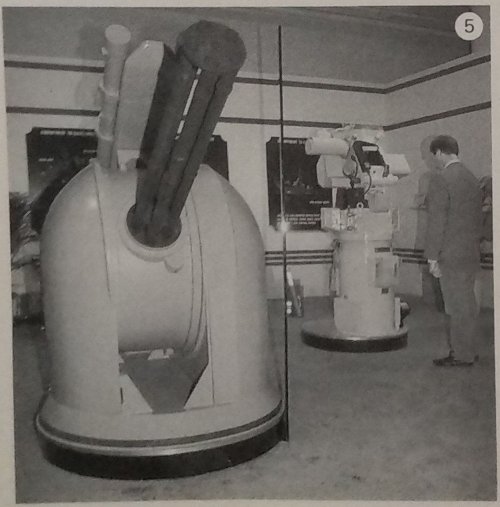
From IDR 1/1991: [60mm ETC gun on Phalanx mount]
I wonder if this was related to the Phalanx Block II / CIWS 2000 efforts?
 
20-30 years later.. 155mm
Gun that doesnt work well.

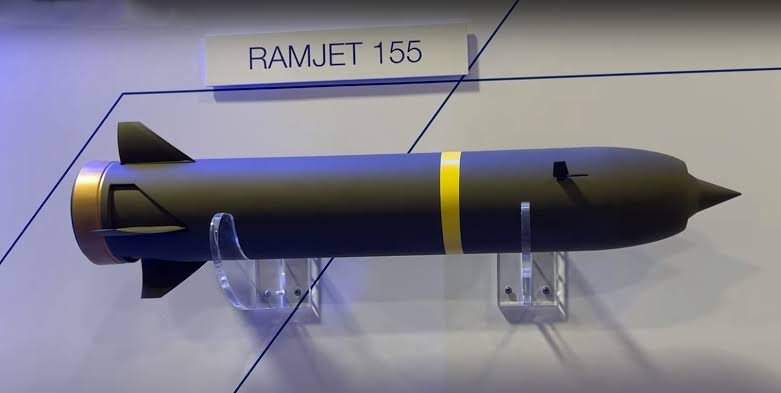
Now next development is application Ramjet artillery.
1000034566.jpg
 
Ramjet artillery makes sense on land harassment from land. Maybe exempt the tradeoffs are too inapplicable at sea so it poses no benefit for Navy to adopt. Unless range drastically increased.
- A range of 150 km is 93 miles. Impressive...except its not. Ships participate in amphibious warfare bombardment are in danger in age as we saw Ukraine widely accessible anti-ship missiles. Or terror attacks like Cole. Expeditionary warfare requires stand off ranges to protect it from land borne threats. US Ships maintain expeditionary distances of 60-100 miles. Leaving it out range guns to fire. Even if ship is just a mile off shore that only leaves 90 miles or so to exploit and some targets are far too inland. Baghdad was over 120 miles inland. As most Iran major cities like Tehran
- Ships that close to shore with deep drafts operate dangerously close littoral zones, vulnerable to running aground, hitting Shoals or underwater infrastructure, mines, anti ship missiles, hell even harassment. Even 50 caliber bullets well placed or cheap recoiless rockets can be very dangerous as they can rupture fuel lines, strike magazine or hit or damage sensitive electronics leaving ship blind or unable communicate. Most AN/designated electronics are highly visible.
- ramjet artillery sounds great til practicality set in. Typical 155mm round weighs 70-100 lbs (35-55 kg) most of the mass is the explosive; Adding a ramjet, fuel for a ramjet and guidance package doesnt leave much room for a warhead.
- With smaller warhead round accuracy has to be very High. Close with 1-2 meters. GPS even military GPS is only accurate within 10-30 meters making a 10-20 lb warhead not very effective. A small diameter bomb weighs 285 lbs of which its warhead is 200 lbs.
- Naval ships haven't been equipped guns this large for years even if they did ad hoc or modification. Relegating a large gun for naval bombardment activities compared to higher rate of fire but smaller naval guns like Bofors 57, OTO 76mm that have multiple uses like point defense and anti boats which requires ship carry multiple caliber rounds aboard. The largest modern ship to have 155mm guns is zumwalt at 600 feet long few navies can afford. Surely smaller magazine and stiffening armature for recoil for smaller vessels is possible. One strategy is integrate gun vertically like a mortar against its superstructure like a mast. This allows a longer barrel and loaded by sailors on deck. Far less complicated than automated volume intensive loading machinery.

Only way sufficient naval gunfire requires range 250 miles. 100 miles standoff distance and 150 miles range. That would probably need larger round caliber (175-203 mm), longer rounds or barrel length
1000034567.jpg
 
Your explosive estimates are inflated. Most artillery warheads are a fraction of the weight in explosive and are designed for the shell to fragment or direct the energy.
 
Ramjet artillery makes sense on land harassment from land. Maybe exempt the tradeoffs are too inapplicable at sea so it poses no benefit for Navy to adopt. Unless range drastically increased.
- A range of 150 km is 93 miles. Impressive...except its not. Ships participate in amphibious warfare bombardment are in danger in age as we saw Ukraine widely accessible anti-ship missiles. Or terror attacks like Cole. Expeditionary warfare requires stand off ranges to protect it from land borne threats. US Ships maintain expeditionary distances of 60-100 miles. Leaving it out range guns to fire. Even if ship is just a mile off shore that only leaves 90 miles or so to exploit and some targets are far too inland. Baghdad was over 120 miles inland. As most Iran major cities like Tehran
Roughly 90% of the world's population is located within 100nmi/200km of the coastline.

That a couple locations aren't that close merely makes them outliers in the target index.


- ramjet artillery sounds great til practicality set in. Typical 155mm round weighs 70-100 lbs (35-55 kg) most of the mass is the explosive; Adding a ramjet, fuel for a ramjet and guidance package doesnt leave much room for a warhead.
- With smaller warhead round accuracy has to be very High. Close with 1-2 meters. GPS even military GPS is only accurate within 10-30 meters making a 10-20 lb warhead not very effective. A small diameter bomb weighs 285 lbs of which its warhead is 200 lbs.
US M107 shell has a filler than weighs all of 6.86kg. 15.1lbs of Composition B.
US M584A1 HERA round also contains 15.1lbs of CompB.
M795 contains 10.8kg/24lbs of TNT or IMX-101.
M982 Excalibur contains 5.4kb/12lbs of PBXN-9.
And all of those have a ~150m lethal radius.


SDB1/GBU-39 only has 36lbs of boom in that 200lb warhead.


Only way sufficient naval gunfire requires range 250 miles. 100 miles standoff distance and 150 miles range. That would probably need larger round caliber (175-203 mm), longer rounds or barrel length
View attachment 806056
I'm sure the various naval powers are working on that range.
 
Also there's need to be considered that the Newest Shells?

They are made of High Density Reactive Material.

IE the Shell itself is explosive and makes shraplen that explodes on impact.

This includes the ramjet shell.

So the entire 100 pound deal is explosives that explode TWICE.


Also the 100 mile range?

That's From the 39 caliber 155s on the M109/M777.

The AGS had a 64 caliber barrel, basically twice as long, meaning you looking at a range closer to 180 miles.

Then there's that new shell that basically a glide bomb with a rocket motor that can go just as far but has more payload so...

Eyeah.

Oh then you have the Railgun which is expected to reach 200 miles and the shell is made of the same HDRM stuff mix with Tungsten as well...
 
Not much at all, but some very limited information from here:

The objective of the LRGS is given as ' To provide a lightweight gun system to the fleet hich will have the capability of: (1) Shore bombardment for area neutralization out to approximately 25 nautical miles; (2) Landing force fire support out to approximately 50 nautical miles; (3) Long Range ship-to-shore weapon support to the landing force out to ranges of approximately 100 miles. Accuracy at these ranges will be provided through the use of terminal guidance in conjunction with the inherent gun launch accuracies.'

The 8-inch MCLWG came out of this project, but it does also seem like the guided projectile was seen as a technology demonstrator for the LRGS. The best that was hoped for from MCLWG was a 40 nautical mile range with rocket assistance, so something else would be needed for the long-range requirement.

There's even a reference to possible anti-radiation and passive IR guided projectiles, as well as semi-active laser.

I wonder if this was related to the Phalanx Block II / CIWS 2000 efforts?
ETC gun was proposed to counter Constant Soviet upscaling of its tank guns caliber without having design new weapon. Its cancelation had more do with post cold war, also by late 80s Strategic defense initiative gobbled up most project funding.

ETC project didn't last long to the Navy it wasn't advantageous, had servicing and expense issues and its overall rate of fire wasn't decent enough to be deemed suitable CIWS. Likely 60mm was chosen for role fulfillment of programmable ammunition which at time was still new. Radio fuses as far back 2nd world war the digital proximity fuse with distance measured detonation was still fairly tricky.
 
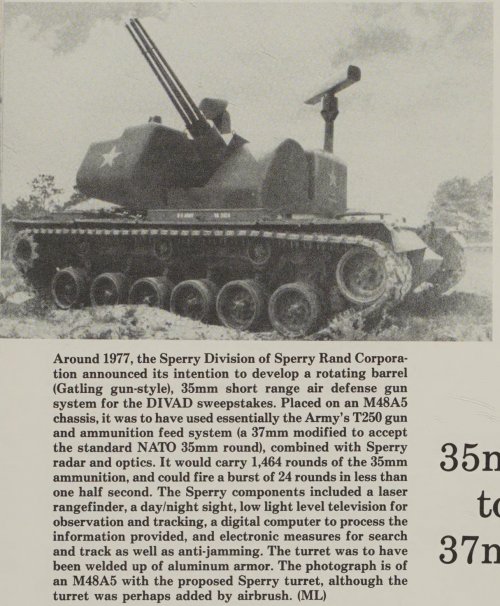
If Sperry 35mm DIVADS program had been more successful over Sgt Uork. Might have seen its variant as Naval CIWS supplement. 35mmx228 has decent range 4,000 meters creating stand off distance more sufficient prevent collateral damage from high speed debris or whats left of the missile. 1000034823.jpg
 
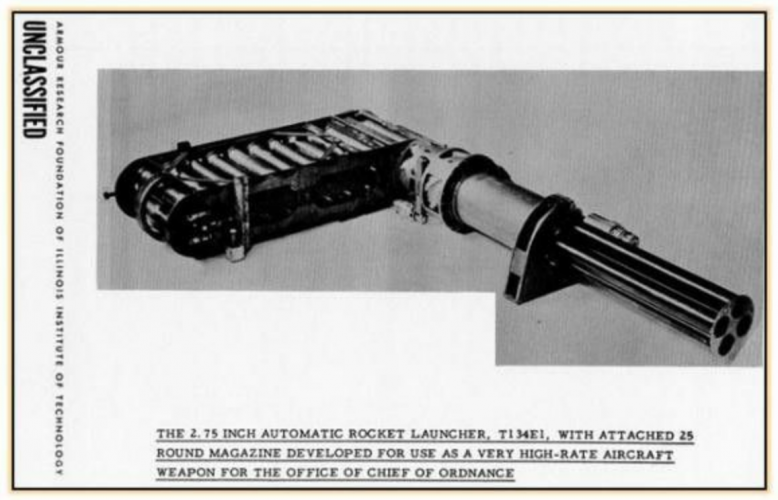
Back during A-X attack aircraft development project. Which would yield A9 and A10. Development of gatling rocket firing system.
Not bad idea though a magazine filled rockets sounds dangerous for plane it might be Ideal concept for CIWS.
They can carry superior warhead sizes than bullets, achieve supersonic velocities thru gradual but quick acceleration and proximity fused to explode on target. In essence a Gun fires miniature guided missiles.


1000034855.png
 
Phalanx prototype installed, USS Coontz, 1973View attachment 806988

That's not Phalanx. It's the Vulcan Air Defense System, basically an adaptation of the land-based M163 under Hip Pocket II.


The actual first Phalanx prototype at sea was on USS King, a year later.

 
As announced recently Raytheon begun program upgrade Phalanx. Would be a block II? Scenarios include
- improved batteries run auxiliary
- better liquid cooling to supplant seawater because corrosion.
- improved radar for sea skimming discrimination.

But Real changes would entail
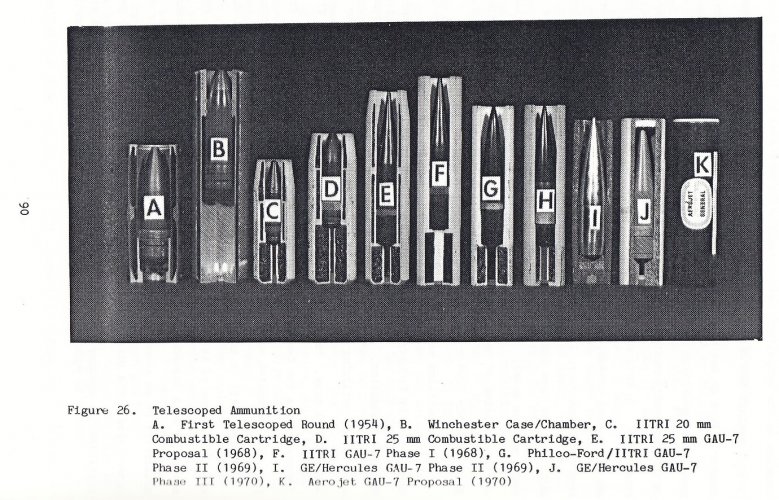
- caliber conversion? (25mm NATO.. or possible cased telescope ammunition)
- higher velocity cartridge (submunition in superior propellant)
- one new technology optical color discrimination
- Spectroscopy cameras like those on space probes to segregate Oxygen/hydrogen from metal/plastics.
1000035618.jpg
 
- caliber conversion? (25mm NATO.. or possible cased telescope ammunition)
- higher velocity cartridge (submunition in superior propellant)
I would do this as a single thing. Replace the M61 with a GAU-12 or GAU-22, and give it the APDS ammo from the Bradleys.


- one new technology optical color discrimination
- Spectroscopy cameras like those on space probes to segregate Oxygen/hydrogen from metal/plastics.
I'm not sure "color" is as valuable as spectroscopy would be.


That said, it's looking like SeaRAM is a better defense against high-subsonic and especially against supersonic antiship missiles. CIWS is just destroying the missiles too close to the ship that the fragments are taking out antennas etc.

So, SeaRAM with the FLIR etc off Phalanx 1B is what I'm really expecting.
 
As announced recently Raytheon begun program upgrade Phalanx.
"As part of the contract, Raytheon will provide upgrades, conversions, overhauls, and related equipment."

Provide, not develop. Sounds to me like they've been contracted to cover any remaining Block 0/1/1A to Block 1B upgrades alongside overhauls etc. $205m isn't nearly enough to cover a major development programme as well as ongoing sustainment.
 
Defending a ship with 1-2 Phalanx is the bigger issue. I'm surlrised nobody has peed on their monopoly and introduced alternatives. There should be 3-4 guns per side, with at least 2 each fore and aft. And there should be a SeaRAM type of system on each quadrant, preferably a minimum one each side and one each end. Attacking a ship at a 45 degree angle puts you under CIWS fire from 3-4 guns and a minimum of 2 missile launchers. You need redundancy.
 
Defending a ship with 1-2 Phalanx is the bigger issue. I'm surlrised nobody has peed on their monopoly and introduced alternatives. There should be 3-4 guns per side, with at least 2 each fore and aft. And there should be a SeaRAM type of system on each quadrant, preferably a minimum one each side and one each end. Attacking a ship at a 45 degree angle puts you under CIWS fire from 3-4 guns and a minimum of 2 missile launchers. You need redundancy.

Most ships struggle to find enough deck space to carry more.
 
Most ships struggle to find enough deck space to carry more.
As light as CIWS and SeaRAM are, you'd think it'd be relatively trivial to add an upper-level sponson or expand a little deck space to make room for more. (yes, topweight may be an issue)


Defending a ship with 1-2 Phalanx is the bigger issue. I'm surlrised nobody has peed on their monopoly and introduced alternatives. There should be 3-4 guns per side, with at least 2 each fore and aft. And there should be a SeaRAM type of system on each quadrant, preferably a minimum one each side and one each end. Attacking a ship at a 45 degree angle puts you under CIWS fire from 3-4 guns and a minimum of 2 missile launchers. You need redundancy.
IIRC there usually are 4x+ Mk38s plus the CIWS plus SeaRAM. And in theory the Mk38Mod4s are AA capable but could use an on-mount radar to help with that instead of pure EOTS.

But for the most part, the Mk38s are your anti-USV/small boat guns, CIWS and SeaRAM are for incoming air threats.

The way it's usually laid out, Mk38s are on the corners of the ship. I would place CIWS amidships, and place lasers/RAM/SeaRAM bow and stern.
 
IIRC there usually are 4x+ Mk38s plus the CIWS plus SeaRAM.
That's a CVN sort of outfit. The DDGs have 1 or 2 CIWS/SeaRAM/Mk 49 RAM (the specifics vary depending on the Flight, AEGIS baseline, and other factors) and 2 Mk 38.
 
Defending a ship with 1-2 Phalanx is the bigger issue. I'm surlrised nobody has peed on their monopoly and introduced alternatives. There should be 3-4 guns per side, with at least 2 each fore and aft. And there should be a SeaRAM type of system on each quadrant, preferably a minimum one each side and one each end. Attacking a ship at a 45 degree angle puts you under CIWS fire from 3-4 guns and a minimum of 2 missile launchers. You need redundancy.
In general yes, but for most of Cold War and post-Cold War era the general consensus was, that if more than one-two enemy missiles came into CIWS engagement envelope, then the ship is toast anyway. CIWS were mostly to defend against single missiles, that slipped through outer defenses. Putting more CIWS on warship weren't viewed as practical, because the benefits would be limited to narrow set of situations - like "more than one, but not more than three missiles slipped through". So it was assumed that putting efforts into area defense capabilities would be more practical than in CIWS.

To summarize, one-two CIWS is a reasonable improvement over zero, because they provide a quantative advantage - a new capability. But subsequent increase of CIWS numbers add little advantages. The area defenses are synergetic; a ship squadron with overlapping SAM coverage is stronger than merely a sum of its parts. But CIWS aren't synergetic, they add nothing to other ships defense.
 
Your ship spacing should be where CIWS use is a non-issue to peers.

Where ships bunch up, they die. Right, HMS Coventry?
 
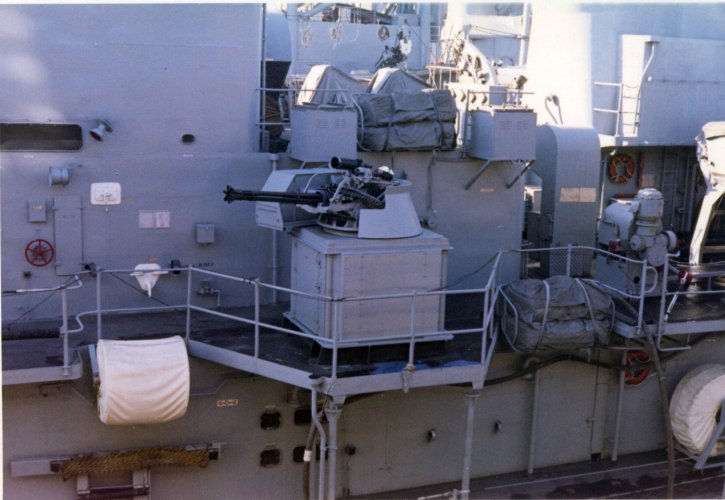
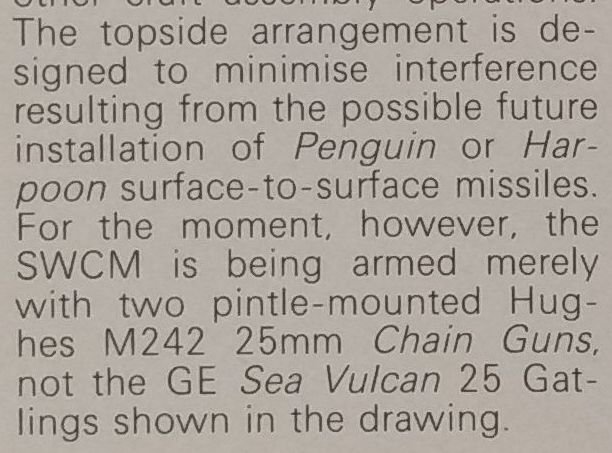
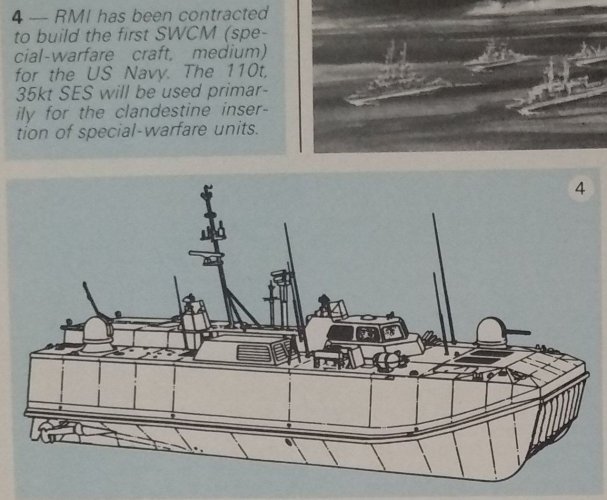
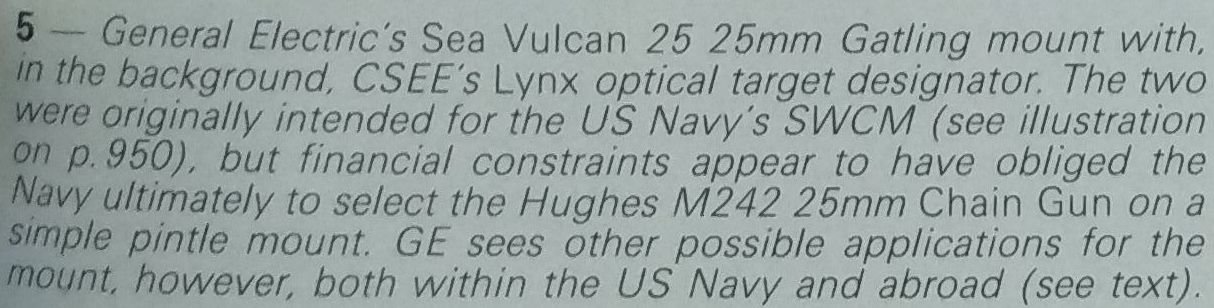
While browsing through skylancer-3441s collection of scans, looking for something else, I came across this bit of trivia on the Sea Vulcan 25 from IDR 6/1985.

So apparently the USN SWCM - Special Warfare Craft, Medium - was planned to to mount two Sea Vulcans 25, which were then changed to pintle-mounted M242 Bushmasters on cost grounds.

Makes me wonder if that applies only to this SWCM or if the Sea Vulcan 25 was actually looked at for all the other ships that ended up with the Mk38.

Note also that the Stinger launcher mounted on the Sea Vulcan 25 might be stackable, but I don't know if the mount would support that.
 

Attachments

  • Sea Vulcan 25 03.jpg
    Sea Vulcan 25 03.jpg
    55.7 KB · Views: 47
  • Sea Vulcan 25 02.jpg
    Sea Vulcan 25 02.jpg
    166.7 KB · Views: 266
  • Sea Vulcan 25 01.jpg
    Sea Vulcan 25 01.jpg
    77.1 KB · Views: 44
  • Sea Vulcan 25 00.jpg
    Sea Vulcan 25 00.jpg
    109.1 KB · Views: 37
I'm surlrised nobody has peed on their monopoly and introduced alternatives.
Goalkeeper
Meroka
Sea Zenith
Millennium
Gokdeniz
Myriad
CIWS II (South Korea)
Dardo
Fast Forty
RapidFire
RAM
SeaRAM
Kortik
Kashtan
Sea Oryx
HQ-10
and so on.

There's no shortage of CIWS systems, just re-read the start of this thread for some of the ones that failed to gain traction
 
Your ship spacing should be where CIWS use is a non-issue to peers.

Where ships bunch up, they die. Right, HMS Coventry?
You misunderstood me. My point was exactly that CIWS do not offer any group defense advantages. While long-range SAM sums up for the whole group - providing total capability "greater than the sum of its parts" - the CIWS protect only the unit they are installed on. They add nothing to other units defense. So from practical point of view, investing into long-range SAM's is more efficient than investing in CIWS, since long-range SAM's add to the group defense as a whole.
 
At $1.4 billion for an FF(X), it is time to rethink the need to self defend. Sure the VLS missiles are good for supporting other ships, but your VLS missiles the US Navy buys are honestly gold-plated relics of the cold war. Sea CAMM and other smaller missiles tend to be LOAL and capable of ripple firing in a way neither ESSM nor Standard can. Until we have such options better lean on CIWS because there will be leakers.
 
At $1.4 billion for an FF(X), it is time to rethink the need to self defend. Sure the VLS missiles are good for supporting other ships, but your VLS missiles the US Navy buys are honestly gold-plated relics of the cold war. Sea CAMM and other smaller missiles tend to be LOAL and capable of ripple firing in a way neither ESSM nor Standard can. Until we have such options better lean on CIWS because there will be leakers
Well, its a result of arising drone threat of latest years mostly. Before that, the main concern was a high-end threats - cruise & ballistic missiles with sophisticated autonomous seekers.
 
Your ship spacing should be where CIWS use is a non-issue to peers.
Someone better tell the USN then, because there have been at least two instances of USN vessels being hit by friendly CIWS fire (Iwo Jima during an exercise and Missouri off Iraq).
 
At $1.4 billion for an FF(X), it is time to rethink the need to self defend. Sure the VLS missiles are good for supporting other ships, but your VLS missiles the US Navy buys are honestly gold-plated relics of the cold war. Sea CAMM and other smaller missiles tend to be LOAL and capable of ripple firing in a way neither ESSM nor Standard can. Until we have such options better lean on CIWS because there will be leakers.
ESSM Block 2 is active radar with mid-course guidance, so should be LOAL capable.
 
Ai tempi del progetto di sviluppo dell'aereo d'attacco AX, che avrebbe portato alla realizzazione degli A9 e A10, si sviluppò un sistema di lancio di razzi Gatling.
Non è una cattiva idea, anche se un caricatore pieno di razzi sembra pericoloso per un aereo, potrebbe essere un concetto ideale per un CIWS.
Possono trasportare testate di dimensioni superiori a quelle dei proiettili, raggiungere velocità supersoniche grazie a un'accelerazione graduale ma rapida e alla prossimità della miccia, esplodendo sul bersaglio. In sostanza, un cannone spara missili guidati in miniatura.


View attachment 806372
Il progetto risale al 1952, poco prima del programma AX...
 
At $1.4 billion for an FF(X), it is time to rethink the need to self defend. Sure the VLS missiles are good for supporting other ships, but your VLS missiles the US Navy buys are honestly gold-plated relics of the cold war. Sea CAMM and other smaller missiles tend to be LOAL and capable of ripple firing in a way neither ESSM nor Standard can. Until we have such options better lean on CIWS because there will be leakers.

CAMM/SeaCeptor whatever hell they rename it... has been development since 2004. It has relatively small warhead (22 lbs) and modest range and top speed mach 3.
ESSM has top speed Mach 4, an 87 lb warhead.

These Cold War relics have been phased out with Block Upgrades. SM2 will slowly be phased out by SM6 .
Tomahawk remains an expensive but versatile weapon most European air defense destroyers/frigates typically do not have.

CIWS guns do require upgrades, issue is not sensors but ballistics. Bullets simply lack distant hitting power. So sufficient hitting power can come new aerodynamic design sub-munition from larger case.

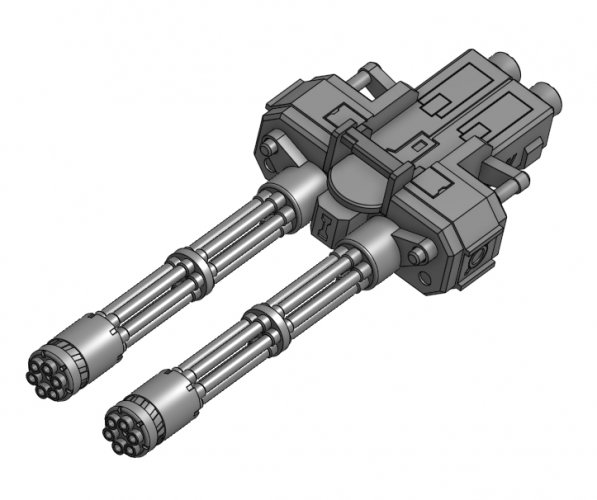
This can be solved by incorporating dual cannon. One fires APFS and one firing HEI. 1000036110.jpg

2nd issue for high rate of fire weapons is ammunition consumption. Since ammo drum is limited . Thats a more easy fix.
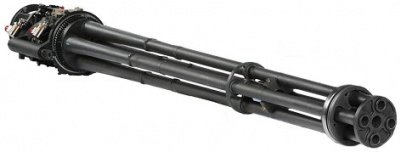
Place drum up and behind so it can still pivot. And move sensors forward underwrap the gun. This can accommodate a larger caliber gun 1000036113.jpg In essence gun look like Umbrella or Music note turned sideways
 
Someone better tell the USN then, because there have been at least two instances of USN vessels being hit by friendly CIWS fire (Iwo Jima during an exercise and Missouri off Iraq).
How long ago was that? If the USN hasn't learned from Missouri off Iraq in 1991, can't help them.
 
CIWS guns do require upgrades, issue is not sensors but ballistics. Bullets simply lack distant hitting power. So sufficient hitting power can come new aerodynamic design sub-munition from larger case.

This can be solved by incorporating dual cannon. One fires APFS and one firing HEI.
You don't need two guns for mixed APDS and HEI, you don't even need two barrels, just pattern-load the magazine, or if you want the option to choose, have the ammunition feeds go through a selector (the revolver section of a revolver cannon's breech could be set up to do this just by having two feed positions instead of one, and so could a gatling).

And ultimately this doesn't solve the problem that gun-based CIWS* underperforms in comparison to missile-based CIWS in kill-distance. More reliably reducing a missile to fragments is still going to leave you shotgunned by those Mach 3-4 fragments.

* Which is itself of course a Cold War left-over, but one far more clearly outdated.

2nd issue for high rate of fire weapons is ammunition consumption. Since ammo drum is limited . Thats a more easy fix.

Place drum up and behind so it can still pivot. And move sensors forward underwrap the gun. This can accommodate a larger caliber gun In essence gun look like Umbrella or Music note turned sideways
You're increasing the revolving and elevating mass and doing it high in the ship, with all that implies for mount size and weight and metacentric height. If you want to seriously increase the magazine size, drop it down a deck and fix it in place. Just as happens with larger calibre guns.
 
Well, they don't seem to have learned they need an FFG, so....
Fair point.

issue with CIWS is lack there of.
For destroyer/Frigate have Four. Carrier a dozen.
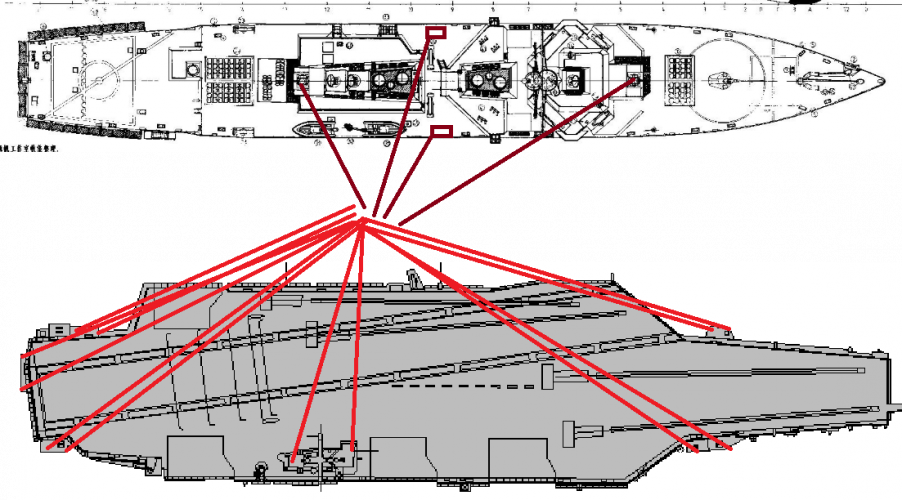
It's relatively easy to move the Mk38 guns around, and a destroyer should have 4 of them to deal with small boat/USV swarms (2 at the corners of the helo deck aft, 2 forward of the bridge, widest possible fields of fire).

If you have CIWS on the forward centerline and RAM on the aft centerline, you're forced to maneuver to give a broadside to the incoming missiles, and that broadside is your largest RCS and thermal signature. It does give you the greatest crossing velocity, but IIRC proportional navigation doesn't care about crossing targets.

I would put RAM/SeaRAM on the centerlines and CIWS on the sides amidships of a destroyer. This means you can maneuver to an angle to the oncoming threat and still have RAM and CIWS available to engage it. Likely lower RCS, definitely lower thermal, but lesser crossing velocity.

IIRC the ODIN laser (might have been HELIOS) was appreciated more for the big optics and high magnification it could get than the laser effects. So I'd want lasers on the centerline and as high as possible, atop the bridge above the RAM launchers.

HPM emitters then go on broadsides.

Oh, side note: the Navy will probably curse that the CIWS uses different ammunition caliber than the Mk38s, but the Mk38s are using PFF/AHEAD type ammunition while CIWS wants APFSDS-DU.
 
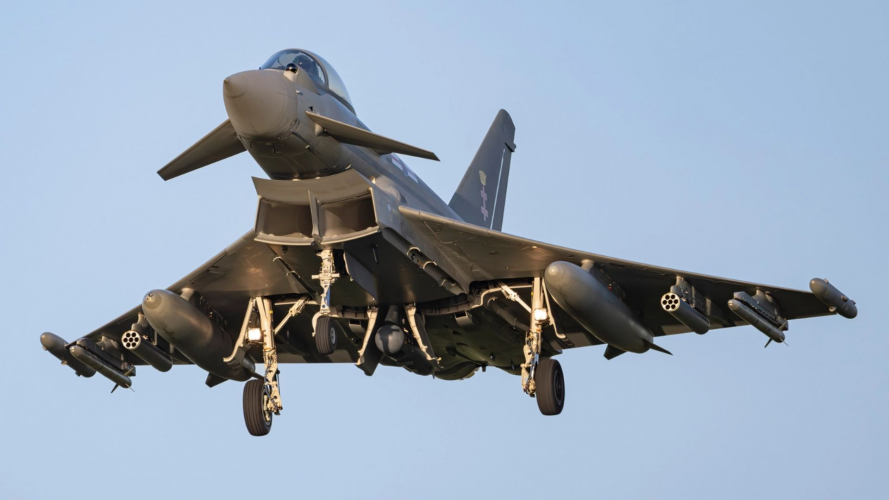
Alternative is application of Rocket's. Europe's Typhoon is experimenting laser guided rockets. 1775826969536.png
The Navy simply needs revive ASROC rocket launcher With Cell capacity quad packed dozens of rockets can be adopted
 
Fair point.


It's relatively easy to move the Mk38 guns around, and a destroyer should have 4 of them to deal with small boat/USV swarms (2 at the corners of the helo deck aft, 2 forward of the bridge, widest possible fields of fire).

If you have CIWS on the forward centerline and RAM on the aft centerline, you're forced to maneuver to give a broadside to the incoming missiles, and that broadside is your largest RCS and thermal signature. It does give you the greatest crossing velocity, but IIRC proportional navigation doesn't care about crossing targets.

I would put RAM/SeaRAM on the centerlines and CIWS on the sides amidships of a destroyer. This means you can maneuver to an angle to the oncoming threat and still have RAM and CIWS available to engage it. Likely lower RCS, definitely lower thermal, but lesser crossing velocity.

IIRC the ODIN laser (might have been HELIOS) was appreciated more for the big optics and high magnification it could get than the laser effects. So I'd want lasers on the centerline and as high as possible, atop the bridge above the RAM launchers.

HPM emitters then go on broadsides.

Oh, side note: the Navy will probably curse that the CIWS uses different ammunition caliber than the Mk38s, but the Mk38s are using PFF/AHEAD type ammunition while CIWS wants APFSDS-DU.
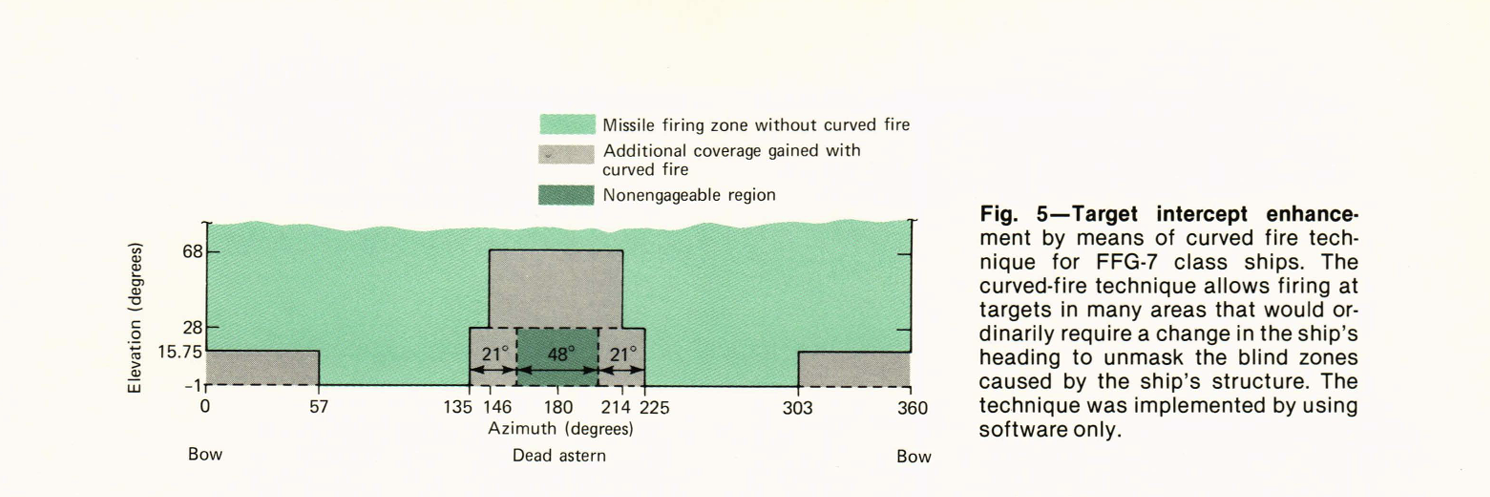
I'm pretty sure RAM Block 2 can do over the shoulder, the guidance logic has been a thing since JHU APL cooked it up for SM-1 on the OHPs.


1775831211135.png
 
I'm pretty sure RAM Block 2 can do over the shoulder, the guidance logic has been a thing since JHU APL cooked it up for SM-1 on the OHPs.


View attachment 808657
Right, now look at that arc: can't engage anything across the stern below 30deg. That is one hell of an improvement in arc over the "no OTS shots" version, though.

But okay, let's say a RAM launcher gives us 21 shots in a full 360 or close enough to it. CIWS and Mk38s still need direct lines of sight/fire. DEWs need direct lines of sight/fire.

Alternative is application of Rocket's. Europe's Typhoon is experimenting laser guided rockets.
APKWS needs a separate laser designator, I'm not sure that the Mk38s have one of those. But yes, surface ships should have the equivalent (if not physically the same sensors) as the F-35 DAS and EOTS.
 

Similar threads

Back
Top Bottom