To bring the topic back to Iskander, is it generally accepted that to reach a range of 450+ kilometers it has to break the commonly quoted 50km apogee and go to 80 or higher? Does the missile have an option for a purely ballistic trajectory?
I'm not sure what you mean by the so-called "50km apogee." If you are indeed referring to the concept of apogee, then it should be obvious that the ballistic apex of the 9M723—which is not even a hypersonic missile—being only 50km is impossible.
This sentence is invalid, but the following remains true.
According to internet sources, the 9M723 missile's burnout velocity may be approximately 2,600 m/s, with a burnout altitude of around 15 km. Additionally, assuming a drag coefficient of Cd = 0.285, the trajectory apex could reach an altitude of 225 km under minimum-energy ballistic conditions, with the range extending to 790 km. Considering that the Iskander requires terminal pull-up for its onboard seeker to acquire and track the target, this margin should be sufficient to meet the 500 km range requirement.
I am confident that a purely ballistic trajectory can be employed. Referencing the OTR-23 missile's CEP of approximately 30 meters, the Iskander missile's accuracy at a range of 790 km might be around CEP = 60 m. At this range, the terminal velocity would exceed that of a terminal pull-up condition, and it is expected to achieve a terminal velocity greater than 1.5 km/s. This implies ample energy to support terminal normal maneuvering—whether the accuracy of the laser gyroscope would be affected under maneuvering conditions is a question. In fact, the penetration capability would not decrease but rather increase.
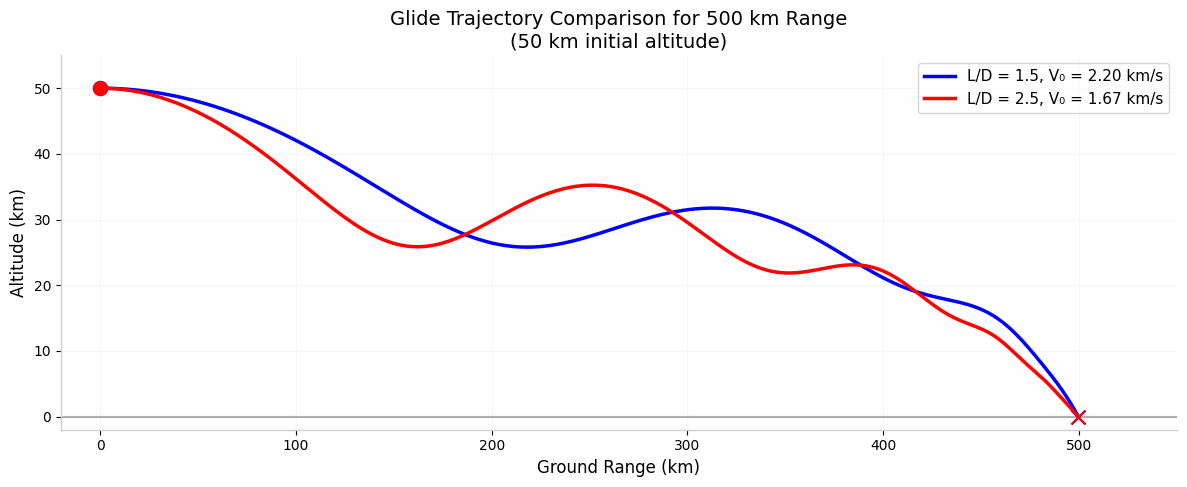
Correction: I calculated the scenario accounting for quasi-ballistic glide and aerodynamic lift flight, limiting the trajectory apogee to approximately 50km. To achieve a 500km range, a burnout velocity of approximately 2.2–2.4 km/s may be required. Considering the Iskander's burnout velocity of 2.6 km/s, achieving a 500km range while maintaining comparable terminal velocity is feasible. However, I must still point out that a 50km trajectory apogee is not the limit for the Iskander missile—this is a trade-off made for penetration purposes.