1700

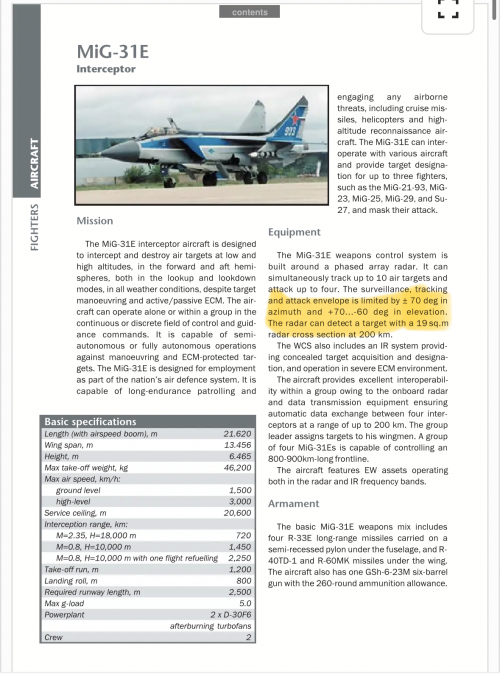
View attachment 807426

This is from "Survey of Russian low cost Phased Array". The MiG-31 part have error in FOV which supposed to be 35 degrees, not 70.

View attachment 807432

The beamsteering angle is curiously mentioned in a catalogue, as "possible shift of view center"
How does it have a scan zone/fov greater than +-35 if its max beam steering angle is +-35?


Like, it has a scan zone of 90 degrees which is +-45?

Only way I can think is if it was on a mechanical gimbal like n011m but that’s obviously not true for zaslon.

Also, wouldn’t its max beam steering angle be +-70 as it did have +-70 gimbal limits?
1774958815713.png
 
Last edited:
How does it have a scan zone/fov greater than +-35 if its max beam steering angle is +-35?

Maybe it's something that missing in literature yet no one really bothers to correct. The only other possibility is the beamsteering angle is +-45 degrees. That still put the frequency well within X-band (8 GHz) The larger the beamsteering angle, one may notice the frequency become lower. If it's 70, then the frequency is 7 GHz, exactly 7030 MHz, which kind of hard to believe for airborne radar, wont this frequency interfere with communications ?

70 Degrees (which makes it total 140 degrees) Is militarily irrelevant as antenna gain decreases as the beamwidth increases due to aperture foreshortening phenomenon as well as emergence of grating lobe. Thus typical phased array stops scanning at 60 degrees. However the phase shifters that steers the beam will have "margin" which can be 7-10 degrees extra phase shift capability to prevent mismatch.
 
That is so much lower than I expected, I would have thought Zaslon have at least 2500 T/R modules, doesn't Su-57 already have 1500 T/R module eventhough its radar is much smaller?

This is from "Survey of Russian low cost Phased Array". The MiG-31 part have error in FOV which supposed to be 35 degrees, not 70.

View attachment 807432

The beamsteering angle is curiously mentioned in a catalogue, as "possible shift of view center"
I think the 70° refers to the total field of view (covering both left and right), while ±35° indicates the range from the center boresight, 35° to each side, which also sums to a total of 70°.
Thought to be fair, Zaslon FoV seem very narrow, normal PESA/AESA seem to have 120 degrees total FoV.
 
I think the 70° refers to the total field of view (covering both left and right), while ±35° indicates the range from the center boresight, 35° to each side, which also sums to a total of 70°.
Thought to be fair, Zaslon FoV seem very narrow, normal PESA/AESA seem to have 120 degrees total FoV.
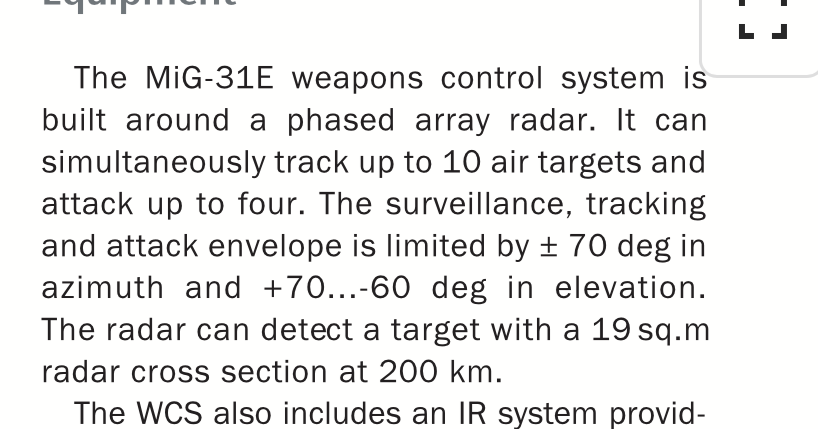
i Just have one question, what’s the difference between field of view and gimbal limit?
Because the brochure for mig-31e says that it can detect, acquire and track targets within a +-70 degrees zone in azimuth and +70…-60 in elevation.
So that would be 140 degrees in azimuth and 130 degrees vertically.
 

Attachments

  • 1775068454909.png
    1775068454909.png
    838.3 KB · Views: 120

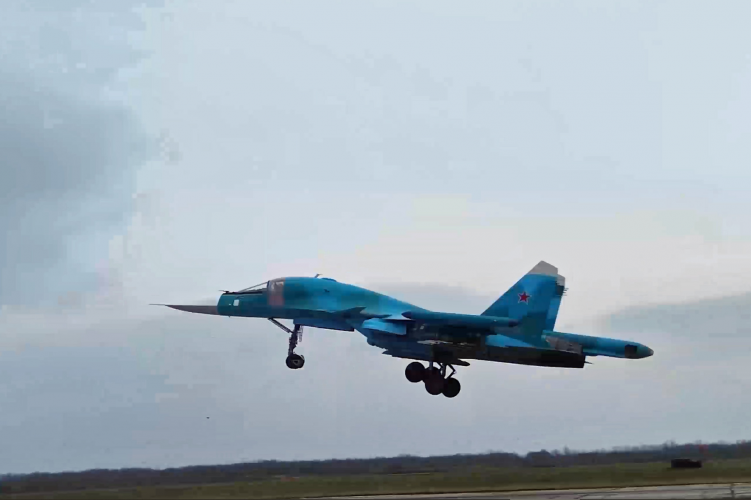
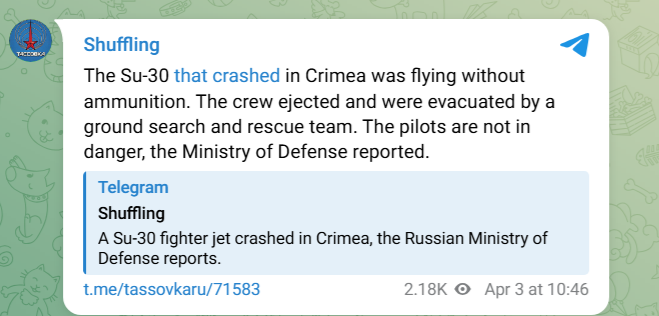
"The crew of the Su-30SM abandoned the aircraft in Crimea due to an engine fire. An attempt to extinguish the engine was unsuccessful.
The crew was evacuated.
All are alive.

A state commission will investigate the cause of the fire."


Fighet_bomber
 
It seems that the last years of wartime operations are starting to put a toll on the aging airframes. This is a quite high rate of attrition due to non-combat causes.
 
I think the 70° refers to the total field of view (covering both left and right), while ±35° indicates the range from the center boresight, 35° to each side, which also sums to a total of 70°.
Thought to be fair, Zaslon FoV seem very narrow, normal PESA/AESA seem to have 120 degrees total FoV.

One can sacrifice FOV for lower weight and cost. 120 deg or 60 deg or "Full FOV" array, means more elements, more elements means more weight.

Kalinigrad 8B antenna for Zaslon already weighs 300 Kg with total radar set weighs some 1495 Kg, that's with that 35 deg steering and 1700 elements. a full FOV array would need 2351 Elements, and thus the antenna might grow to 339 Kg, and total radar weight grow to 1884.5 Metric tonne.
 
Hm, really don't understand details about the N007 'Zaslon' but the things are clear.

''The phased array scanning angles were +70° in azimuth and from -60° to +70° in elevation. ''

Posts 71,93 and 94 ....

https://www.secretprojects.co.uk/threads/mig-31-avionics.153/page-3
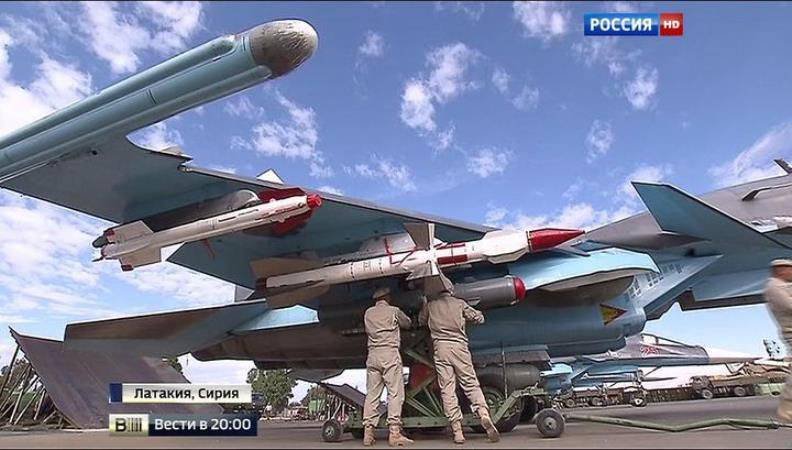
Su-34 armed with the AAM's type R-27R and R-74 in the Khmeimim air base-Latakiya/Syria.
 

Attachments

  • Su-34 with R-27R and R-74.jpg
    Su-34 with R-27R and R-74.jpg
    59.6 KB · Views: 96
Last edited by a moderator:
Good find, wonder what the fairing is for, is it the long awaited MAWS or something else? If it is MAWS one would expect a similar fairing somewhere on the underside of the plane.

Interesting comment from the last year :

''Russian sources claim this to be the most advanced variant of the Su-34 Fighter-Bomber to date, reportedly equipped with both a Radar Warning Receiver (RWR) and a Missile Approach Warning System (MAWS).
Btw, the Russian Su-34M isn’t equipped with a MAWS, which is pretty strange for a frontline bomber — but in the end, it all depends on the Russian Aerospace Forces (VKS)’s operational needs.''

View: https://x.com/OSINTWarfare/status/1953441944417292312


It seems that VKS oper. needs changed in the meantime? Also we must keep in mind that Su-24M/M2 has that IR detector/ MAWS known as L-083 'Mak-UL' only on the upper side of the fuselage.
 
Quick question, do we know if Su-30SM or indeed other Su-27 family variants can carry that twin R-77 launcher between the engine nacelles, like Su-35 does?

Very possible that Su-30SM and SM2 especially can carry those twin launchers for the R-77-1. Su-27SM3 can be armed with the R-77-1 but I'm not sure for the Su-27SM ( of course ,older S/P/UB can not carry them).
 
Quick question, do we know if Su-30SM or indeed other Su-27 family variants can carry that twin R-77 launcher between the engine nacelles, like Su-35 does?
The only confirmed fighter with them is su-35s.
Technically space between nacelles is the same, but this is a long way from capability.
 
A very strange loadout. The R-27ER is semiactive, that means that the launching aircraft would need to illuminate the target for the entire flight duration of the missile. It is quite optimistic to hope that you will meet during one flight eight enemy aircrafts which will allow you to illuminate them for one minute or so, without taking evasive maneuvers or/and electronic countermeassures. For drones interception semiactive radar missiles are also the least effective type of missile, the small and composite made airframes of drones are poor radar reflectors. You would need to close in which puts the target drone in the range of shorter range infrared AA missile.
 
A very strange loadout. The R-27ER is semiactive, that means that the launching aircraft would need to illuminate the target for the entire flight duration of the missile. It is quite optimistic to hope that you will meet during one flight eight enemy aircrafts which will allow you to illuminate them for one minute or so, without taking evasive maneuvers or/and electronic countermeassures. For drones interception semiactive radar missiles are also the least effective type of missile, the small and composite made airframes of drones are poor radar reflectors. You would need to close in which puts the target drone in the range of shorter range infrared AA missile.
Illumination (and as such, the effectiveness of the seeker) is connected to available radar; bars is a powerful illuminator.
A good way to utilize the available stock of missiles, not particularly useful for A2A combat anymore.
 
The R-27ER is semiactive, that means that the launching aircraft would need to illuminate the target for the entire flight duration of the missile.

Keep in mind that even newer R-37M and R-77-1 have also SARH ( works in X band) in the terminal phase ,yet combined with the ARH ( works in Ku band). With the SARH , missile's seeker can lock on given target from the much greater distance in comparison with ARH. Illumination can come from some other fighter in the combat group not only from the fighter which launched those AAM's.

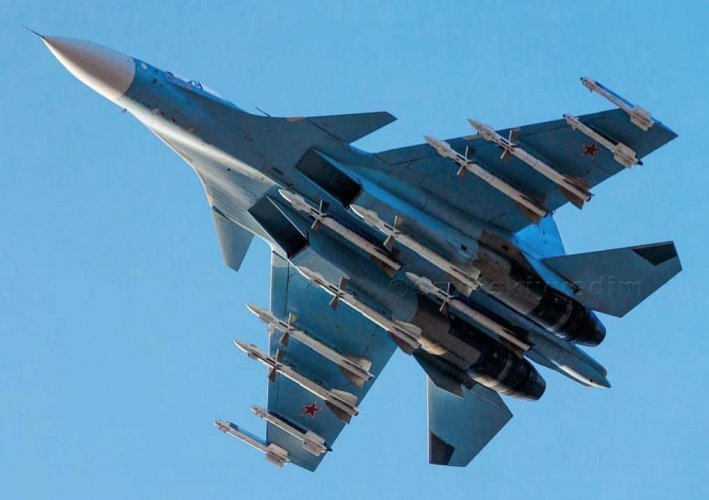
Su-30SM/SM2 ( also Su-35S) can carry e.g. four R-27ER (under the fuselage) and four R-27ET (under the wings).
 
Illumination (and as such, the effectiveness of the seeker) is connected to available radar; bars is a powerful illuminator.
A good way to utilize the available stock of missiles, not particularly useful for A2A combat anymore.
If the image is untampered with, perhaps these particular examples have been modified to home in on command datalinks?

Looks a bit PS'ed imo.
To illustrate a proposed loadout, do you think?
 
If the image is untampered with, perhaps these particular examples have been modified to home in on command datalinks?
I don't think so, just vanilla rocket: CLOS is a major development. V drones they're being used from relatively short range due to the necessity of positive visual ID.

At most they're going to play with fuze.
 
Something from FB about Su-34 :

''That's exactly what I was talking about.
It's impossible to carry six UMPKs on an aircraft, but four UMPKs and two UMPBs is possible. The missiles are dropped at different ranges, but these are all solvable issues. All six can be dropped in a single pass.
Thus, we will begin to drop on the enemy’s head not 10,000 bombs a month as usual, but 15-16 thousand.''

https://t.me/bomber_fighter/25120?f...h1cakTL9qgXjQZ1B_c_aem_Qu-FgqdM4Cfab_zIbCIXQw
 
Thus, we will begin to drop on the enemy’s head not 10,000 bombs a month as usual, but 15-16 thousand.

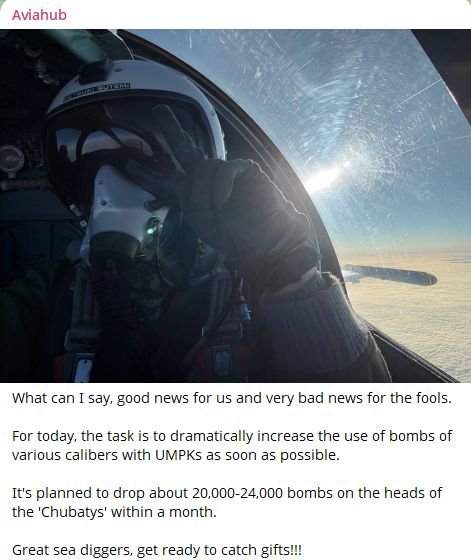
Something related, from Aviahub...

A new goal has been set to triple KAB glide-bomb production rates in order to be able to launch 20,000-24,000 KABs per month.

20260428_160201.jpg
 

Similar threads

Back
Top Bottom