moin1900

ACCESS: Top Secret
Joined
28 January 2008
Messages
875
Reaction score
1,059
Hi everybody

Chevaline MRV and Polaris
http://en.wikipedia.org/wiki/Chevaline
http://www.astronautix.com/lvs/polaris.htm

Poseidon and Trident with 14 MIRVs
http://www.fas.org/nuke/guide/usa/slbm/c-3.htm
http://www.astronautix.com/lvs/trident.htm

ICBM-X with 20 MIRVs or more ?
http://www.secretprojects.co.uk/forum/index.php/topic,4860.0/highlight,icbm-x.html
ANY DRAWINGS ? Pictures, etc ?

R-36MUTTH with 38 warheads
http://russianforces.org/blog/2006/08/multiple_as_in_up_to_38_warhea.shtml
http://de.wikipedia.org/wiki/SS-18_Satan
http://www.palba.cz/viewtopic.php?t=1860
ANY DRAWINGS ? Pictures, etc ?

Are there any other such crazy projects ?

Pershing II with MARV
http://www.astronautix.com/lvs/pershing.htm

TOPOL-M with MARV
http://www.secretprojects.co.uk/forum/index.php/topic,2832.0.html

OGCH FOBS
http://space.skyrocket.de/index_frame.htm?
http://www.skyrocket.de/space/doc_sdat/ogch.htm
http://www.astronautix.com/craft/ogch.htm
http://www.palba.cz/viewtopic.php?t=1859

N11GR with six FOBS warheads
http://www.astronautix.com/lvs/n1.htm

Are there any other Missle Projects with more than 14 MRV ?
Are there any other Missle Projects with more than 14 MIRVS ?

Many greetings and THANKS in advance
 
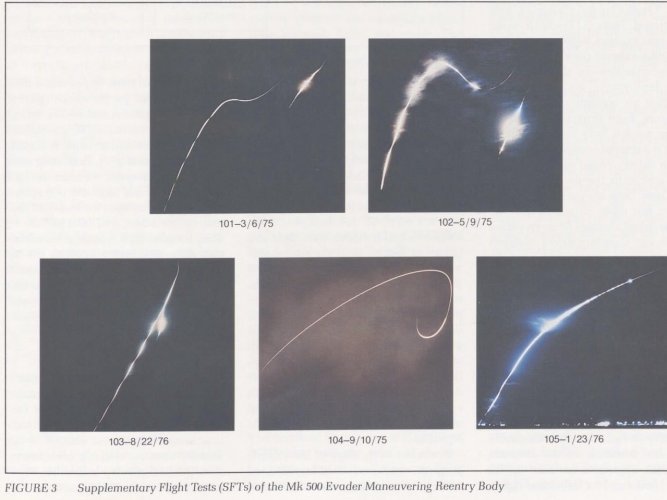
There was a project to equip the Trident I D-4 with 8 MARVs, the RVs would have been the Mk.500 Evader. Don't know the yield though. I'll post the source as soon as I've located the book in question.
 
https://www.nytimes.com/1983/02/15/science/new-generation-of-warheads-just-around-the-bend.html?smid=tw-share

WASHINGTON THE United States is about to enter a new age of missile technology in which nuclear warheads will be designed to maneuver in flight, either to dodge enemy defenses or to home in on a target with unparalleled accuracy.

The first such maneuvering warheads are expected to be deployed on the Pershing 2 intermediate-range missiles, which are at the center of the current Soviet-American negotiations over medium-range missiles in Europe. The Reagan Administration is offering to forego plans to deploy 572 new Pershing 2 and cruise missiles in Western Europe if the Russians dismantle 540 missiles in Eastern Europe and Asia.

If the new American warheads work as well as the proponents expect, which is not yet certain, they will make the Pershing 2 the most accurate missile of its range ever produced. And other research projects are under way to develop advanced maneuvering warheads for possible use on a range of intercontinental and submarine-launched missiles.
 
These days there are lots of missiles with MARVs (though none in the US).
 
Maury Markowitz said:
WS-120A/BGM-75 was a "smaller" version of ICBM-X with "10 to 20" warheads.

https://en.wikipedia.org/wiki/BGM-75_AICBM
My understanding was the WS-120A was to be a large solid rocket and weigh about 400,000 pounds, over twice as big as MX ended up.

Although with the STRAT-X study ICBMs up to 120" to 156" diameter and weighting much more so maybe a reference to one of these beasts.

I'd love for someone to write a book on large US ICBMs built and unbuilt.
 
Out of curiosity, how exactly do ICBMs carry something like 24 or 38 warheads?

Are they carrying two sets of 12 or 19 back-to-back or something?
 
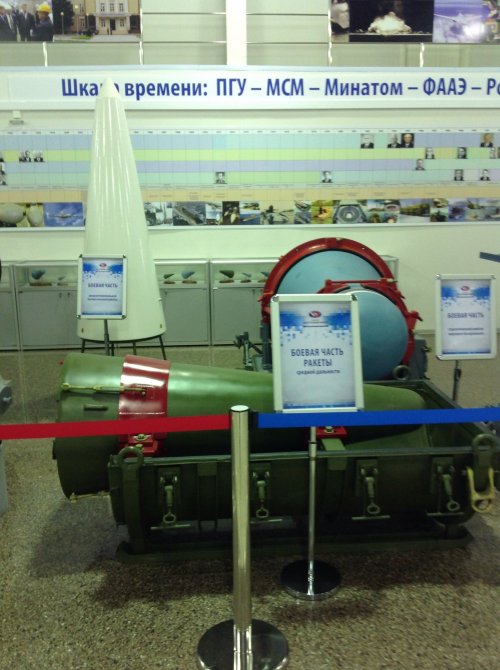
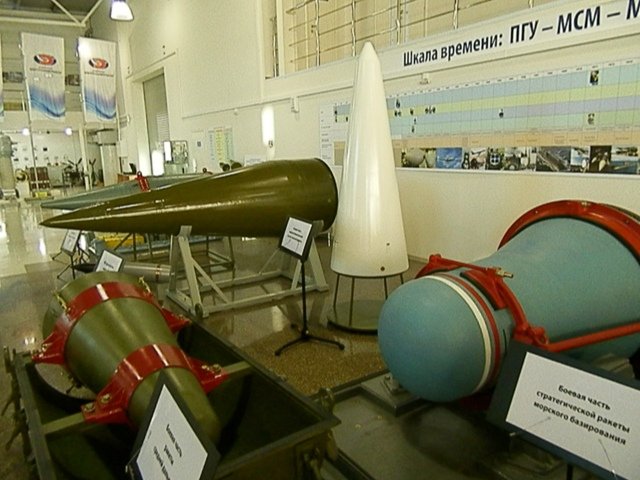
Here are a few photos of an unknown Soviet/Russian MaRV in the Elektrokhimpribor Museum in the city of Lesnoy. It is the white biconic reentry vehicle (RV); the other two in the first photo are from the SS-20 (green RV in the foreground) and the SS-N-8 (blue RV on the right side of the photo). The second photo also has a Scud-B warhead. The museum placard is not very informative--it just says "warhead of intercontinental ballistic missile." There are tiny gold-colored circular covers at the base of the RV, which may be openings for maneuvering jets, but that is just my speculation. Any thoughts as to which MaRV project this might be? My only thought is that it is unlikely to be the 15F178 MaRV for the SS-18. That project used a moveable skirt at the base of the RV, and I see no evidence of that on this MaRV.
 

Attachments

  • Elektrokhimpribor-twitter2.jpg
    Elektrokhimpribor-twitter2.jpg
    686.3 KB · Views: 197
  • EhKhP_info-people3.jpg
    EhKhP_info-people3.jpg
    131.8 KB · Views: 190
Out of curiosity, how exactly do ICBMs carry something like 24 or 38 warheads?

Are they carrying two sets of 12 or 19 back-to-back or something?
Depends on diameter and setup.

IIRC the Poseidon carried 11 small warheads in a circle, with 3 in the center on a raised platform. (There used to be a picture showing that setup.)

Trident lost the center area on the bus to the 3rd stage rocket motor, so both Tridents have all their warheads/RBAs around the outside of the bus in a circle.
 
Out of curiosity, how exactly do ICBMs carry something like 24 or 38 warheads?

Are they carrying two sets of 12 or 19 back-to-back or something?
I thought I saw pictures of the SS-18 MIRV bus on this forum where there were two levels of warheads that fit together bottom and top almost interlocking? I also thought Poseidon’s 14 “full up” MIRV configuration did this?
 
I thought I saw pictures of the SS-18 MIRV bus on this forum where there were two levels of warheads that fit together bottom and top almost interlocking? I also thought Poseidon’s 14 “full up” MIRV configuration did this?
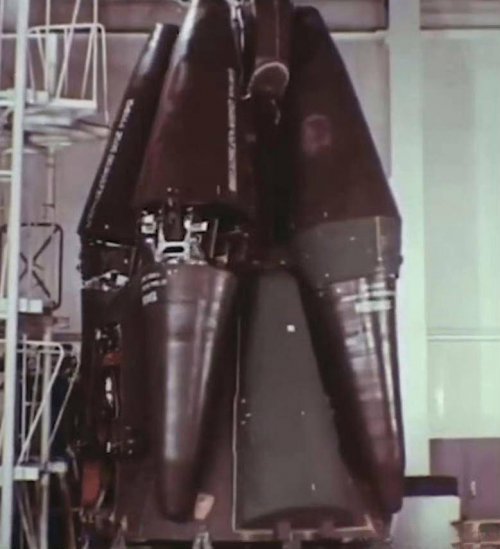
That would be the SS-18 Mod 2. This was an attempt to deploy a MIRVed warhead without a shroud. The warheads had to be lifted away from their "stowed" positions by mechanical arms in order to be separated from the "combat stage" (the post-boost propulsion system). The upper-tier RVs had the designator 15F144, and had a 1 megaton yield each. The lower-tier RVs (15F158U) had a 400 Kt yield each.
 

Attachments

  • 15F143U_15F158U_militaryrussia1.jpg
    15F143U_15F158U_militaryrussia1.jpg
    495.7 KB · Views: 169
  • 15F143U_gcores2.jpg
    15F143U_gcores2.jpg
    204.5 KB · Views: 175
IIRC the Poseidon carried 11 small warheads in a circle, with 3 in the center on a raised platform. (There used to be a picture showing that setup.)
I thought it was 10 and 4, but it doesn't really matter.
There were R-36 derivatives proposed with as many as 38 RVs. Quite apart from how you physically fit that many, I'm not quite clear how you debus them in the time available.
The upper-tier RVs had the designator 15F144, and had a 1 megaton yield each. The lower-tier RVs (15F158U) had a 400 Kt yield each.
I'm not sure whether that arrangement would have been more frustrating to US intelligence, or to Soviet targeteers. No doubt there was a good reason for the differential yields, though.
 
There were R-36 derivatives proposed with as many as 38 RVs. Quite apart from how you physically fit that many, I'm not quite clear how you debus them in the time available.
Perhaps like teeth…fittingly enough.
Cone pointed up, cone pointed down.

Maybe sunflower out and release in some way—a helix?
 
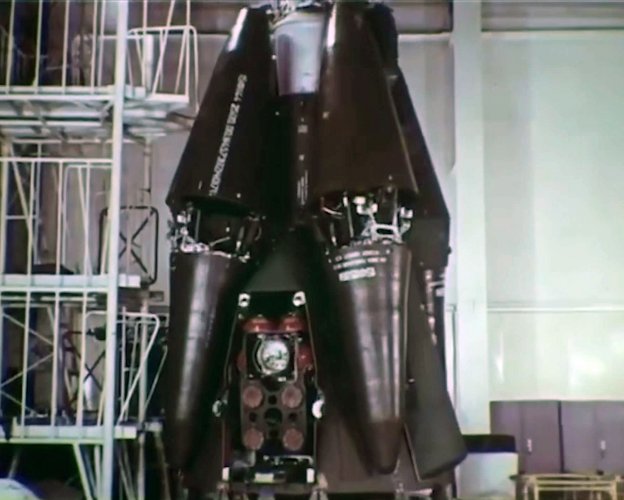
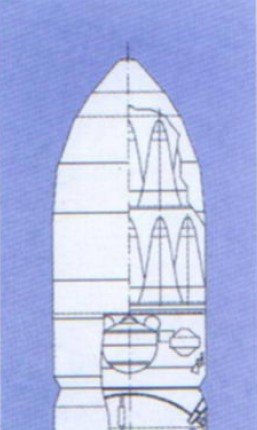
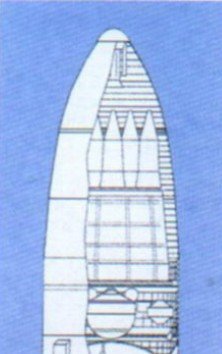
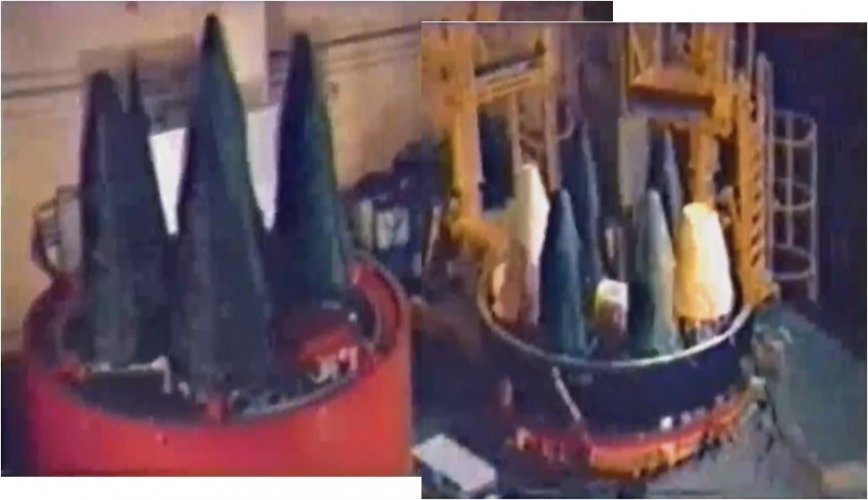
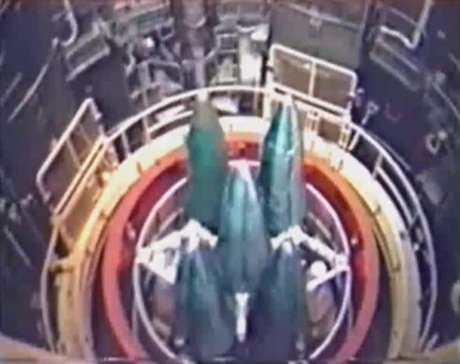
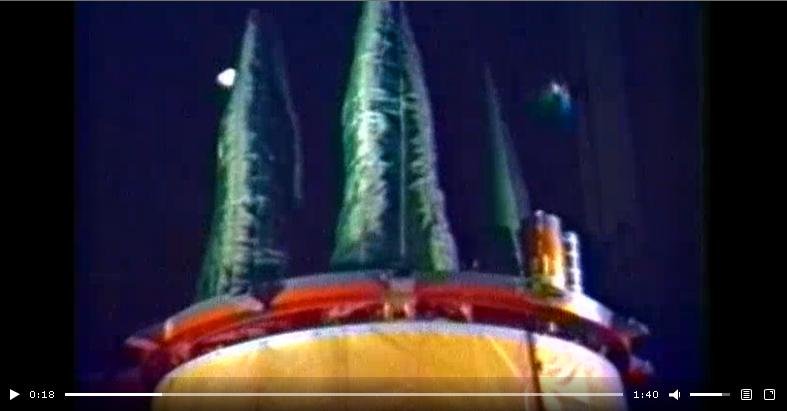
The Soviet SS-18 Mod 4 (15A18) and Mod 5 (15A18M) both had two tiers of RVs, according to a book on the Yuzhnoye Design Bureau that is available online. In the Mod 4, the shroud was divided in two, with the lower portion holding the lower tier of RVs. In the Mod 5, the upper tier was on a separate inner shroud, to increase protection of the lower tier against nearby nuclear explosions. A couple of remarkable videos have shown both tiers. In the montage showing both tiers, there is a sharp conical object in the upper tier that likely is a decoy RV. Two penaid packages in the lower tier were covered. The RVs have some kind of covering, probably to reduce their thermal and/or radar signatures.
 

Attachments

  • 15A18_yuzhnoye1.jpg
    15A18_yuzhnoye1.jpg
    21.8 KB · Views: 153
  • 15A18M_yuzhnoye1.jpg
    15A18M_yuzhnoye1.jpg
    18.1 KB · Views: 133
  • 15A18M_combined_youtube1.jpg
    15A18M_combined_youtube1.jpg
    98.4 KB · Views: 136
  • 15A18M_upper_tier.jpg
    15A18M_upper_tier.jpg
    52 KB · Views: 151
Last edited:
Nice having that big diameter to work with.

Think how many of these you could fit with 120” diameter missile.
 

Attachments

  • 360D454D-4EFB-4AD5-8F84-D6DB3AC094D9.jpeg
    360D454D-4EFB-4AD5-8F84-D6DB3AC094D9.jpeg
    82 KB · Views: 158
Last edited:
The RVs have some kind of covering, probably to reduce their thermal and/or radar signatures.
I'd honestly expect that covering to be an ablative thermal protection coating.


Nice having that big diameter to work with.

Think how many of these you could fit with 120” diameter missile.
~20" base diameter, call it a 24" center-to-center distance. You could pack a row of 5 across through the center. 3 + 4 + 5 + 4 + 3 = 19 warheads.

Without multi-stacking, say if you were somehow length-limited.

If you're stacking additional layers, you might add another 7 on top of this, 2 + 3 + 2, for a total of 26.
 
Interesting!.. Is this video from youtube?.. It will be great to see this.
The original video was called "Техника и вооружение РВСН." There was a rather poor copy on Youtube a long time ago, but the owner removed it. Hopefully, I will forgive him one day. It was available for sale in DVD form in Russia and I found a few websites that still offer it (if you can trust them!):

https://uilomsk.ru/profobrazovanie/voennoe_delo/filmi/https://shop.armpress.info/catalog/...ooruzenie-rvsn-20/?ysclid=mehugxz3gs922139305
There was a PBS documentary called "Avoiding Armageddon" that briefly showed the two tiers in the episode titled "Nuclear Nightmares," around 45 minutes into the program. I could not find that one on Youtube, but the set of four DVDs is on sale at PBS at:

https://www.pbs.org/avoidingarmageddon/meetThePeople/meet_03_04.html
I hope that helps!
 
Last edited:
I'd honestly expect that covering to be an ablative thermal protection coating.


~20" base diameter, call it a 24" center-to-center distance. You could pack a row of 5 across through the center. 3 + 4 + 5 + 4 + 3 = 19 warheads.

Without multi-stacking, say if you were somehow length-limited.

If you're stacking additional layers, you might add another 7 on top of this, 2 + 3 + 2, for a total of 26.

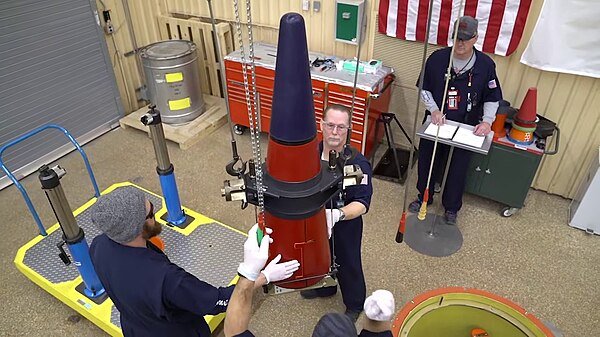
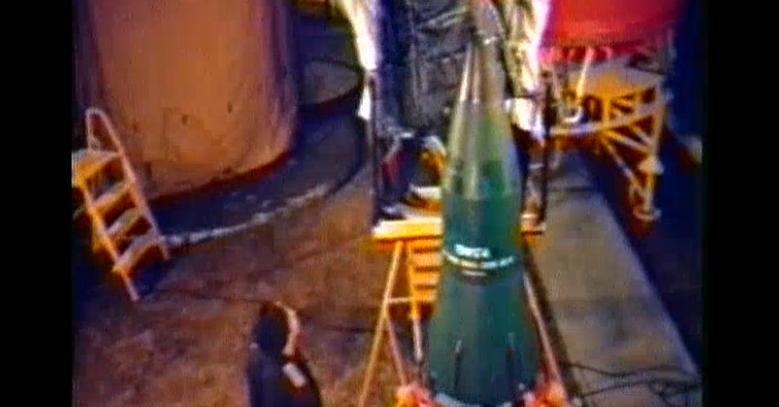
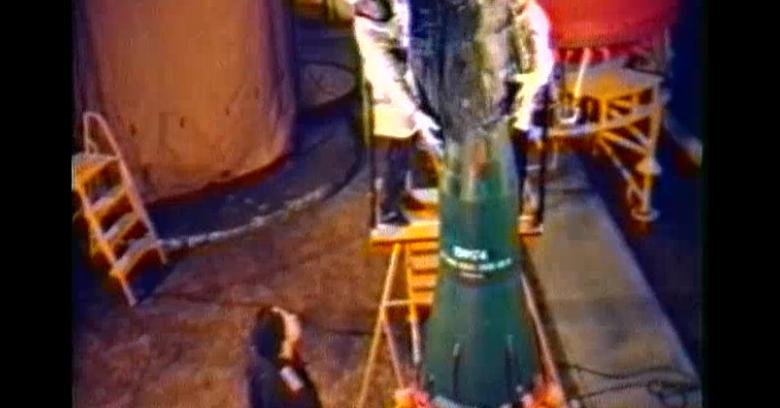
Scary numbers! The RVs have separate heat shields; the additional coverings almost certainly would burn off early in reentry. Here are a few video stills showing the cover being put on one RV and the covered RVs in place on the upper tier (from the video "Tekhnika i Vooruzheniye RVSN").
 

Attachments

  • 15A18M_RVs_videoru3.JPG
    15A18M_RVs_videoru3.JPG
    34.4 KB · Views: 124
  • 15A18M_RVs_videoru4.JPG
    15A18M_RVs_videoru4.JPG
    34.6 KB · Views: 91
  • 15A18M_RVs_videoru1.JPG
    15A18M_RVs_videoru1.JPG
    28.3 KB · Views: 130
The RVs have some kind of covering, probably to reduce their thermal and/or radar signatures.
The Mk.3 Reentry Bodies of Poseidon had an ablative shield to protect from X-rays caused by the detonations of Exoatmospheric ABM interceptors. Might these coverings for the R-36M RVs be similar?
 
The Mk.3 Reentry Bodies of Poseidon had an ablative shield to protect from X-rays caused by the detonations of Exoatmospheric ABM interceptors. Might these coverings for the R-36M RVs be similar?
I think I have the answer, from the book "Rockets and Spacecraft of the Yuzhnoye Design Bureau." Here is a machine translation of a portion of the page on the SS-18 Mod 5 (R-36M2):

"A new one-piece ogive-shaped GO [aerodynamic shroud] has been developed for the missile, providing reliable protection of the warhead from nuclear weapons, including large soil particles, and improving aerodynamic characteristics.

The TTT provided for the missile to be equipped with four types of warheads:

— two monoblock warheads with a “heavy” and “light” warhead;

— MIRV with ten unguided warheads;

— Mixed MIRV consisting of six unguided and four guided BBs with a homing system using terrain maps.

The combat equipment includes highly effective missile defense systems (TLTs, LLC, DO [heavy decoys, light decoys, dipole reflectors]), which are placed in special cassettes, and heat-insulating BB [боевой блок, or "combat block"] covers are used."

The "heat-insulating," or better "thermal-insulating" covers are listed as part of the missile defense systems, and this probably means that the covers are to reduce the infrared signatures of the RVs. The rough surface of the covers is inconsistent with being part of the RV heat shielding. This book is posted with chapters on separate pages here:

https://rvsn.ruzhany.info/umz_2000_00.html

The rvsn.ruzhany.info website has a wide variety of publications and articles on the RVSN (Strategic Rocket Forces), and the Yuzhnoye book is one of the best of these.
 
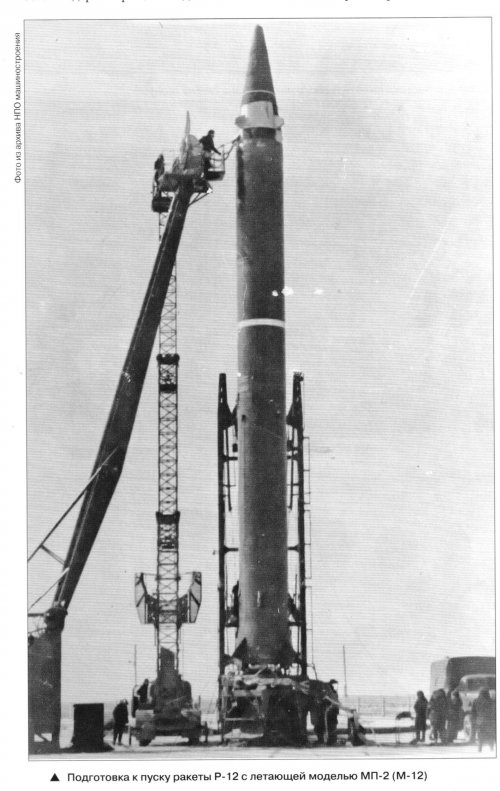
Here is one of the earliest Soviet MaRV projects, the MP-2 or M-12. It was test-flown on the R-12 (SS-4) medium-range ballistic missile, but it was not further developed or deployed. I would be very interested in any information on whether it was ever intended to carry a military payload, or whether it was just a research project.
 

Attachments

  • MP-2_M-12_militaryrussia1.jpg
    MP-2_M-12_militaryrussia1.jpg
    437.9 KB · Views: 131
  • MP-2_M-12_militaryrussia2.jpg
    MP-2_M-12_militaryrussia2.jpg
    394.5 KB · Views: 136
Here is one of the earliest Soviet MaRV projects, the MP-2 or M-12. It was test-flown on the R-12 (SS-4) medium-range ballistic missile, but it was not further developed or deployed. I would be very interested in any information on whether it was ever intended to carry a military payload, or whether it was just a research project.
Iirc it was a tech demonstrator for Chelomei's Raketoplan.
 
That would be the SS-18 Mod 2. This was an attempt to deploy a MIRVed warhead without a shroud. The warheads had to be lifted away from their "stowed" positions by mechanical arms in order to be separated from the "combat stage" (the post-boost propulsion system). The upper-tier RVs had the designator 15F144, and had a 1 megaton yield each. The lower-tier RVs (15F158U) had a 400 Kt yield each.
Are those warheads pointing both up and down or is it just me?
 
That is correct--the result is that you have something like area-rule...narrow-wide-narrow.

No nosecone needed?
 
That is correct--the result is that you have something like area-rule...narrow-wide-narrow.

No nosecone needed?
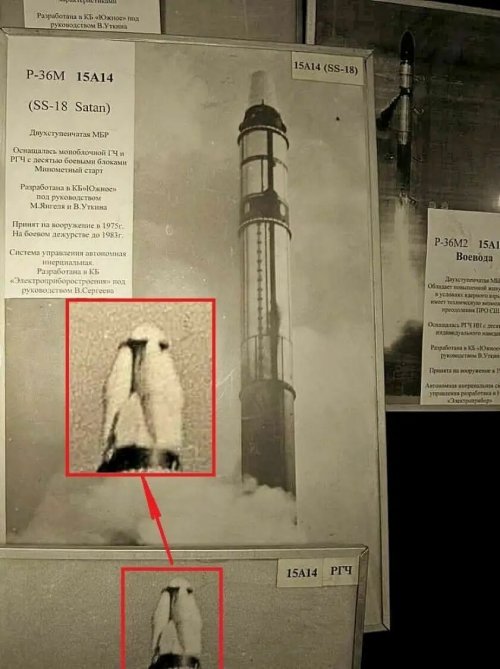
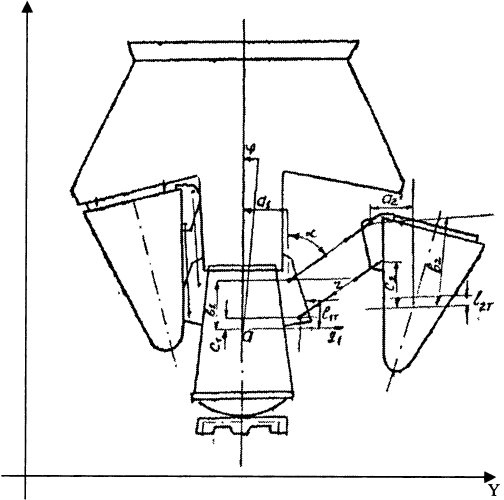
Yes, the whole idea was to avoid the extra weight of the nosecone, which the Soviets also did with the SS-N-6, the SS-9 Mod 4, and the SS-20. There is a Russian book available online that discusses this warhead, including that mechanical arms were employed to lift the RVs away from the post-boost vehicle structure for separation. The warheads pointing downward would have to be rotated about 90 degrees out to clear the PBV, and almost 180 degrees if the RVs were spun upon separation (i.e. spinning RVs would be oriented at approximately the correct angle to enter the atmosphere, which would not matter if the RVs were just left to tumble). There is another photo showing the warhead from a different angle that gives a slightly better look at one of the mechanisms for swinging one of the lower-tier RVs. I also attached a rather unrealistic drawing from the book that shows the mechanism for swinging out one of the forward-pointing RVs. In the drawing, the solid propellant engine of the post-boost vehicle is at the bottom; in the photos it is at the top.
 

Attachments

  • 15A14_sohu2.jpeg
    15A14_sohu2.jpeg
    45 KB · Views: 91
  • 15A14_MIRV_raketabook2.jpg
    15A14_MIRV_raketabook2.jpg
    486 KB · Views: 111
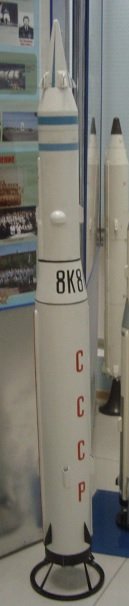
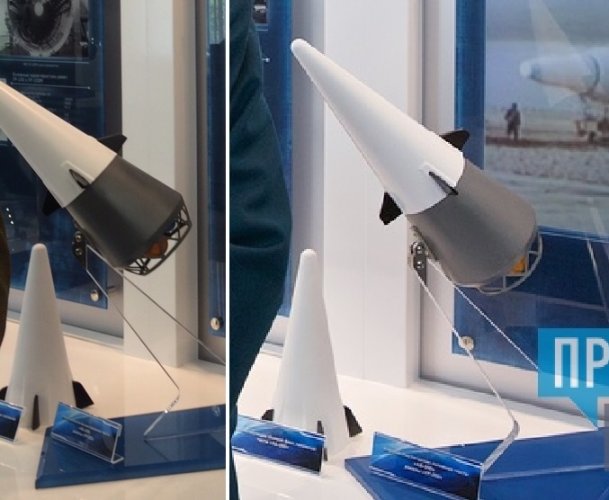
Another early Soviet MaRV project was the AB-200, which had a single MaRV on Chelomei's failed UR-200 ICBM. Attached is a photo of an AB-200 in the NPO Mashinostroyeniya Museum (from a book on the Proton SLV), along with a MaRV model that may be the same warhead. It is doubtful that the AB-200 would have worked; even today, aerodynamic fins on an ICBM warhead would be a major engineering challenge.
 

Attachments

  • AB-200_mirknig1.jpg
    AB-200_mirknig1.jpg
    30 KB · Views: 102
  • MaRV_NPOM_facebook-FBCB2_1.jpg
    MaRV_NPOM_facebook-FBCB2_1.jpg
    100.4 KB · Views: 110
Something interesting: Soviet belief (1974-77, approximately) that the Space Shuttle was some kind of secret FOBS system; bringing some unique advantages to the baseline concept.

https://www.thespacereview.com/article/3873/1
Okhotsimsky and Sikharulidze stated in their report that the shuttle would offer several advantages over intercontinental ballistic missiles, as well as so-called “global missiles,” the term the Russians used for rockets that would place nuclear weapons into orbit, after which they would de-orbit themselves and approach US territory from the south = FOBS).

While an ICBM needs just 30 or 40 minutes to reach its target, it spends much of its time at high altitudes (up to 800–1000 kilometers), making it easy to detect.

In contrast, because it flies over the South Pole, the shuttle would need 70–80 minutes to reach its target, but flying at an altitude of 185–200 kilometers and approaching the Soviet Union from the south, it would be much harder to detect by Soviet early warning systems.

An orbiting nuclear weapon ( = FOBS) is also easy to detect and its trajectory can be quite easily predicted, making it easy to take countermeasures. It also has a much lower strike accuracy, so they thought the shuttle would be better for this mission.
Okhotsimsky and Sikharulidze stated that the shuttle’s crew would make it possible to increase flexibility and even to call off the operation at the last moment. Strike accuracy would be increased by the ability to accurately determine the position of the orbiter before the de-orbit burn. With the help of the US Air Force’s Global Positioning System (GPS) then in development, that accuracy was expected to improve to 50 meters by 1981, and to 10 meters by 1984.

Okhotsimsky and Sikharulidze then provided an alarming scenario for the American shuttle: a mission with the aim of dropping a “special payload” (in other words, a bomb) on Moscow.

So, theoretical advantages of a Shuttle for the FOBS mission
A-not in a fixed orbit like FOBS
B-aerodynamic lift allowing a quick dive trajectory over Moscow to nuke the place
C-crew added advantages
.....1-can be recalled or decide to cancel the strike at the last moment;
.....2-can determine their position very precisely thanks to GPS (hence improved accuracy compared to classic FOBS)
.....3-can drop countermeasures more efficiently than a dumb automated system

That was from Keldysh math institute. Other Soviet analysis of the Shuttle focused on 60 missions per 30 tons up and 14 tons down, hence 1700 by 800 tons in orbit every year - but for what ??!! Their conclusions: can only be for chemical lasers and particle beam weapons. Somewhat amusingly, they were thinking of SDI in 1974, almost a decade before Reagan.
 
Depends on diameter and setup.

IIRC the Poseidon carried 11 small warheads in a circle, with 3 in the center on a raised platform. (There used to be a picture showing that setup.)

Trident lost the center area on the bus to the 3rd stage rocket motor, so both Tridents have all their warheads/RBAs around the outside of the bus in a circle.
Trident C-4s were actually deployed with 14 50kT warheads in the 1980s. Poseidon could carry 14 too.

https://www.nuclearinfo.org/wp-cont...al_nuclear_weapons_William_Arkin_May_1988.pdf
 
Trident C-4s were actually deployed with 14 50kT warheads in the 1980s. Poseidon could carry 14 too.

https://www.nuclearinfo.org/wp-cont...al_nuclear_weapons_William_Arkin_May_1988.pdf
Sorry, but this is a common misconception.

The Poseidon C3 was indeed capable of carrying up to 14 Mk3/W68 RBs, although in actual operational use, it usually only carried 6–10 RBs.

However the Trident I C4 was only capable of carrying a maximum of up to 8 Mk4/W76 RBs, and was never capable of carrying the Mk3/W68 RB. With the Mk4/W76 RB and the extremely compact size of the Trident I C4 relative to the Trident II D5, it is unsurprising that the Trident I C4 simply lacked enough space within its annulus to fit more than eight RBs, let alone as many as 14 RBs. Even the Trident II D5 (which is MUCH larger than the Trident I C4) tops out at a maximum of 12 Mk4/W76 RBs.

There was no real serious discussion of deploying the Mk3 onto the Trident I C4, as the Mk3 was seen as a miserable failure from start to finish. It was a very poor design, notoriously difficult to maintain, and created a long-lasting animosity between the Navy and LLNL. The Navy had been promised a 100 kt warhead in the Mk3. What they got instead was a warhead that eventually after numerous redesigns, delays, and extensive rework managed to deliver no more than a miserly 40 kt, and was excessively difficult to maintain to boot.

The Navy's procurement for the Mk4's warhead actually considered both LLNL and LANL design proposals, despite the recent disaster with LLNL and the W68. Unfortunately, the LLNL design suffered from issues that the Navy had been quite clear about being deal-breakers for the Mk4, and the relationship with LLNL was already heavily tainted from the disastrous experience with the Mk3/W68. The LANL design on the other hand addressed all of the navy's concerns, was explicitly designed for greatly improved ease of maintenance (in stark contrast to LLNL's proposal or the Mk3/W68), and was from a laboratory that was viewed as being easier to work with, more receptive to Navy input in the design process, and more likely to actually be able to deliver something that could achieve the claimed performance.

There have been a number of claims that the Trident II D5 is capable of carrying as many as 13, 14, or even 15 RBs. However each of these claims trace their origins back to unattributed estimates released by third party organizations at a time before the final Trident II D5 concept had been formally defined. Indeed, some of the developmental concepts for the D5 (in particular the clear deck D5 concept) would have likely been capable of carrying more than 12 Mk4 RBs, but the final concept selected retained the use of an annulus design, which meant that the available space on the final design was far too tightly constrained to cram more than a maximum of 12 Mk4 RBs into the annulus. Similarly, while some sources inaccurately claim that the D5 could carry 12 Mk5/W88 RBs, in reality the missile was never capable of carrying more than a maximum of 8 Mk5 RBs.
 
There was no real serious discussion of deploying the Mk3 onto the Trident I C4, as the Mk3 was seen as a miserable failure from start to finish. It was a very poor design, notoriously difficult to maintain, and created a long-lasting animosity between the Navy and LLNL.

What type of design was the Mk-3 RV?
 
Marginally accurate only good for blasting cities.

Okay, so counter value use only. What I meant was the RV a sphere/cylinder/flare (Like the Polaris A3's Mk-2 RV) or sphere/cone type RV (Like the Mk-4/5 RVs)?
 

Similar threads

Back
Top Bottom