By the way, an interesting point for speculation.

Around ~2010(left or right), when premier heavy fighter families of the world looked at how to adapt to the stealth age, went for opposite things.

J-16, F-15C and F-15e went for maximum possible search range v low RCS target - including their radars, but also(a bit later) their IRSTs. Later networking developed towards effective triangulation for fire control via IRST(at least for eagles, J-16 is a bit of enigma).

Su-35s went for maximum possible engagement range and kept fire control optimized IRST ball, but "finding" part(wide angle search v low rcs target) was effectively outsourced to GCI. Later development went towards adding more primary guidance sources (most prominently Su-57, but also the new generation of surface asset mesh).
 

Hm ,which Sukhoi ? Su-30,33,34 or 35 ? Sorry but don't understand.

Sure.
The entire Indian Air Force of the future will consist of 150 Rafales.

Almost twice as less than Su-30MKI.

Su-35s went for maximum possible engagement range and kept fire control optimized IRST ball, but "finding" part(wide angle search v low rcs target) was effectively outsourced to GCI. Later development went towards adding more primary guidance sources (most prominently Su-57, but also the new generation of surface asset mesh).

To repeat some data, Su-35S vs Su-27S:

N035 Irbis has three times greater detection distances than N001/V Myech ( Yuriy Beliy). E.g. '3sqm' MiG-21 can be detected from 150km away in PPS-DO mode of N001V but also from about 400 km away in the same mode of N035. OLS-35 has four time greater detection distances than OLS-27 ( Nikolay Rakitin).

From the Su-27SK F.M. :

N001/E Myech...

''Дальность действия РЛПК в свободном пространстве и на фоне земли практически одинакова и зависит от высоты полета самолета, полусферы атаки и составляет по истребителям (σ = 3 м2):
a)при полете самолета на больших высотах: в ЗПС: при атаке сверху вниз: Добн = 30 – 40 км;
Дзахв = 30 – 35 км; при атаке снизу вверх: Добн = 50 – 55 км; Дзахв = 45 – 50 км; в ППС: Добн = 80 – 100 км, Дзахв = 65 – 80 км;
б) при полете самолета на средних высотах (более 1000 м): в ППС: Добн = 80 – 100 км, Дзахв = 65 – 80 км; в ЗПС: Добн = 25 – 35 км, Дзахв = 25 – 30 км;
в) при полете самолета на малых в ысотах (200 м) :в ЗПС: Добн = 20 – 25 км, Дзахв = 18 – 20 км; в ППС: Добн = 35 – 40 км, Дзахв = 28 – 32 км ''​

''The radar's range in free space and against the ground is virtually identical and depends on the aircraft's altitude and attack hemisphere. For fighters, this range is (σ = 3 m2):

a)when flying at high altitudes:
In the rear hemisphere: When attacking from the top to bottom : detection range = 30–40 km; lock on range = 30–35 km; When attacking from the bottom to up: detection range = 50–55 km;lock on range 45-50km
In the forward hemi. : det. range = 80–100 km, lock on range = 65–80 km;
b) when flying at medium altitudes (above 1000 m):
in forward hemi, : det. range = 80 – 100 km, lock on range = 65 – 80 km; in the rear hemi.: det. range = 25 – 35 km, lock on range = 25 – 30 km;
c) when flying an aircraft at low altitudes (200 m): in the rear hemi.: det range = 20 – 25 km, lock on range = 18 – 20 km; in the forward hemi. : det range = 35 – 40 km, lock on range = 28 – 32 km.''

OEPS-27/E ,OLS-27/E :

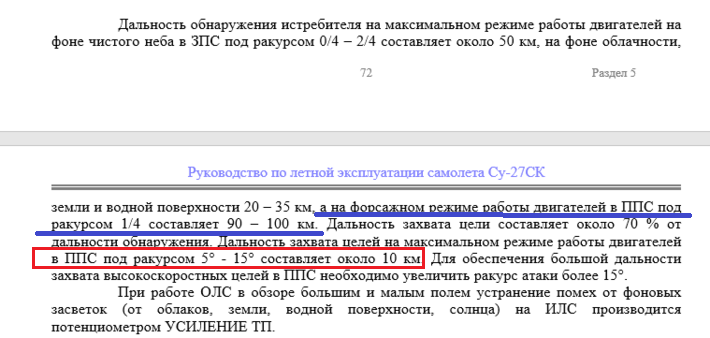
''Дальность обнаружения истребителя на максимальном режиме работы двигателей на фоне чистого неба в ЗПС под ракурсом 0/4 – 2/4 составляет около 50 км, на фоне облачности, земли и водной поверхности 20 – 35 км, а на форсажном режиме работы двигателей в ППС под ракурсом 1/4 составляет 90 – 100 км. Дальность захвата цели составляет около 70 % от дальности обнаружения. Дальность захвата целей на максимальном режиме работы двигателей в ППС под ракурсом 5° - 15° составляет около 10 км. Для обеспечения большой дальности захвата высокоскоростных целей в ППС необходимо увеличить ракурс атаки более 15°.''

''The detection range of a fighter at maximum engine operation mode against a clear sky in the rear hemi. at an angle aspects of 0/4 – 2/4 is about 50 km, against a background of clouds, land and water surface 20 – 35 km, and at afterburner engine operation mode in the forward hemi. at an angle of 1/4 is 90 – 100 km.The target acquisition range is approximately 70% of the detection range. The target acquisition range at maximum engine power in the forward hemi.at an angle of 5° - 15° is approximately 10 km. To ensure a longer acquisition range for high-speed targets in the forward hemi., the angle of attack must be increased to more than 15°.''


If you don't mind to repeat some details about N035 Irbis and OLS-35,tnx.

From +/-60° ( total 120°) by azimuth/elevation to +/- 120° (240° total with capability to scan only in 120° cone in the given period of time).

View: https://www.youtube.com/watch?v=MseFZThRirc


Take a look at deflection angle of the OLS-35 optical block. It is +/- 90°, total 180° vs +/-60° ( total 120°) of the old OLS-27. Sequencies from 0:04 min on video.
Also keep in mind combat mode 'Vzamodeystviye' or the Cooperation mode where radar or IRST can be either leading or trailing FCS channel.E.g. if IRST is the leading one, than radar can work in KVO or Quasi search mode where measures distance to target every 5 sec ( if I remember well).It also can be get via data- link.

Main source of valuable data for the Su-35S especially when flying in the complete radio-silence mode can be AWACS A-50U as the first asset than MiG-31BM.

 
The fact that most of the increase consists of types that are on their way out (Su-25, Su-24) could also imply that this is the windfall from increased Su-34 production.

That and also many of them having to be retired because their fatigue-life has expired (The VKS has been riding its fighters, fighter-bombers and attack jets hard since 2022).
 
Last edited:
Massive problems with the spare parts.

If there was/is massive problem with 'spare parts' than all VKS first-line fighters would stop flying several years ago.

Simply,new Su-34NVO's replace old Su-24's, new Su-30SM2 replace old MiG-29( 9.12/9.13/9.13S/9.19R) and Su-27( S/SM/P). They are also replaced by the new Su-35S and Su-57. That's it.Until 2030 ,from older fighters there will be only Su-27SM3 (24pcs) and Su-30M2 (about 20) .

Replacement of the right engine of one Su-35S in the 'war regime'. Sequences are here in this video :

View: https://www.youtube.com/watch?v=_4X21bsn0NQ


P.S. This is not the thread about the MiG-31's and Su-25's.
 
Last edited:
''A still image from a new Russian MoD video showing a VKS Su-34 (NVO) strike fighter, armed with four UMPK-equipped FAB-500T bombs, beginning to taxi to the runway. In the background, a VKS Su-35S multirole fighter is seen taking flight. The latter, armed with several R-77-1 medium-range AAMs, a single Kh-31PM ARM and, possibly, also an R-37M long-range AAM, was likely tasked with providing air-to-air and SEAD cover for the former.''

View: https://x.com/GuyPlopsky/status/2026319972981707209
 
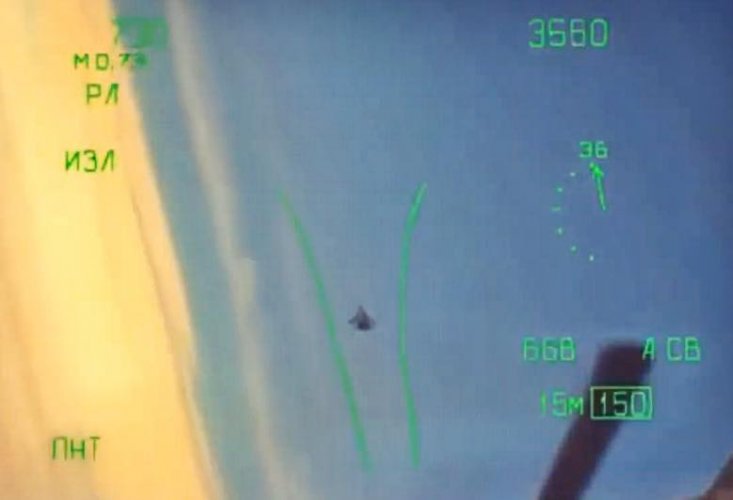
Su-35S / IKSh-1M in the Gun mode called ПРОГНОЗ-ДОРОЖКА / 'Prognoz Dorozhka',something like 'flight path predicting' . It is used in the situation of the absence of target range measurement or lock -on by the IRST. Note: radar is turned on ( РЛ , ИЗЛ ) .

IKSh-1M Gun mode.jpg
 
Last edited:
It is usually called synchronous mode in western sources or English translations as it requires to maintain same G and flight path as target

When quoting OLS-27 ranges we must also remember these are specifically Su-15 when mentioning a fighter in Mil power. It is for a MiG-25 at Mach 2.35-2.8 at high altitude for the 100 km “high altitude supersonic” figure.
 
''A VKS Su-35S from the 237th Aviation Technology Demonstration Center's (TsPAT) "Russian Knights" aerobatic team is seen here armed with R-77-1 and R-73/74M air-to-air missiles. Though rare to see, TsPAT jets do occasionally conduct such escort missions.''
Getting some sweet flight hours
 
When quoting OLS-27 ranges we must also remember these are specifically Su-15 when mentioning a fighter in Mil power. It is for a MiG-25 at Mach 2.35-2.8 at high altitude for the 100 km “high altitude supersonic” figure.

OLS-27/E can detect any fighter flying on MP mode from behind at 50km ( temp from engine jet stream), than 15-20km in head-on (also flying in MP mode and temp from skin friction,airframe) and from 100km away in head -on , fighters which flies in the Full AB mode ( angle aspect 1/4) ,so with jet stream from the engines.

2011 during state military- technical trials in the Akhtubinsk air base ,OLS-35 detected Su-30 which flew in MP mode from 80 km away in the head-on aspect.
 
OLS-27/E can detect any fighter flying on MP mode from behind at 50km ( temp from engine jet stream), than 15-20km in head-on (also flying in MP mode and temp from skin friction,airframe) and from 100km away in head -on , fighters which flies in the Full AB mode ( angle aspect 1/4) ,so with jet stream from the engines.

2011 during state military- technical trials in the Akhtubinsk air base ,OLS-35 detected Su-30 which flew in MP mode from 80 km away in the head-on aspect.
Fighters that focus highly in reducing IR signature, Environmental conditions and especially sun can affect the detection range significantly, especially if adversary fighter is coming head from the direction of the sun.
 
Last edited:
OLS-27/E can detect any fighter flying on MP mode from behind at 50km
Just no. As mentioned, fighter ir signature (F-16 is very low) and environmental conditions such as sun, clouds, air temperature, moon, heat from ground, the wavelength it’s optimized for and the aspect (the more head on. The more you need longer wavelength to detect skin friction instead of engine), all these will effect IRST range. Not to mentions engine state.

The manual does not list these ranges for any fighter but as an average to expect.

What the manual doesn’t say unless you read the electronics manual is that they used Su-15 for the mil power tests and MiG-25 for high flying AB target. So it’s not “detect any fighter in rear hemisphere at 50 km!” It’s “on average we were able to detect a Su-15 on mil power in rear aspect during day light conditions with low clouds 10-15 degrees from the sun and with sky background at 50 km on average.”

It’s not “hey we can detect any high flying AB plane at 100 km” but “we can detect a MiG-25 going Mach 2-3 at 100 km from its enormous engines and skin friction with sky background and little clouds.”

It will be same for OLS-30, OLS-35 in regards to factors influencing detection range. InSb sensor is just usually better at all aspect detection in Mil power then a PbSe sensor like KOLS/R-3S/R-13M/R-60 that mostly sees afterburner or usually needs direct look at engines.

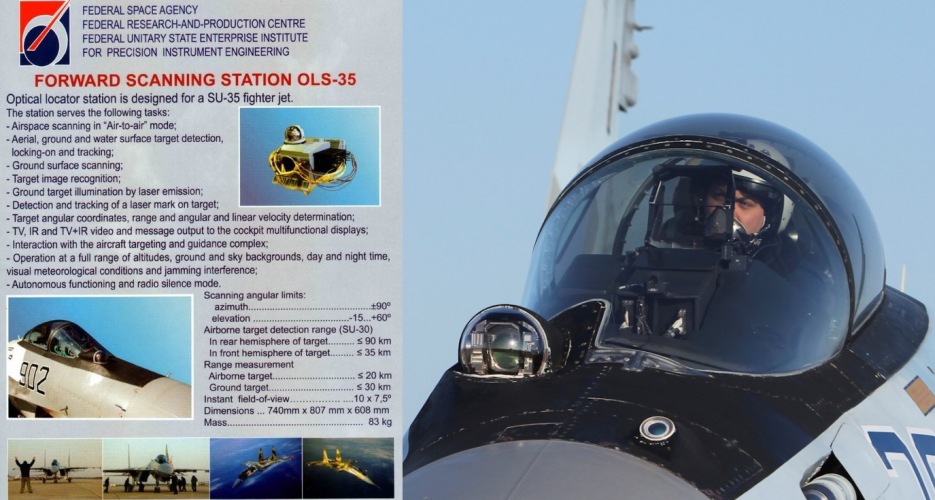
Any IR sensor has a range of 1 AU by detecting the sun goes the saying. 80 km on Su-30 in Mil power with its big engines? I’m not surprised. OLS-35 quotes 35 km front aspect and 90 km rear aspect. So I would say 80 km was a very rare case.

IRST Is far more situational then radar, far weaker to ground clutter, less reliable due to changes in target signature, these are reasons the west largely ignores it. I love IRST, but I cannot deny its weaknesses of being a temperamental sensor.

Hell even humidity can effect the propagation of the IR radiation I believe. Atmospheric attenuation.

Su27 has switch to lock first thing it sees, I always wondered if this worked at all with IRST lmao. One weakness of KOLS/OLS-27 is also need to set gain. I’m sure OLS-35 eliminates this with an AGC circuit. The original OLS-30 on Su-30MKK, MK2, MKI and others is identical to OLS-27 in every performance metric.
 
Last edited:
Any IR sensor has a range of 1 AU by detecting the sun goes the saying. 80 km on Su-30 in Mil power with its big engines? I’m not surprised. IRST Is far more situational then radar, far weaker to ground clutter, less reliable due to changes in target signature, these are reasons the west largely ignores it. I love IRST, but I cannot deny its weaknesses of being a temperamental sensor.

Hell even humidity can effect the propagation of the IR radiation I believe. Atmospheric attenuation.
Rafale, eurofighter have IRST, even Americans have pod based systems.

F22's upgrade model shown by L.M. ,shows stealthy IRST pod.
 
Rafale, eurofighter have IRST, even Americans have pod based systems.

F22's upgrade model shown by L.M. ,shows stealthy IRST pod.
Yes they do. And from what I hear most pilots of Eurofighter agree with the Germans that IRST was unnecessary as by the time it can acquire they are well inside their normal timelines.

Pod based systems are a bandaid and will always be considered less practical than something onboard. Now with R-37, Meteor, IRST is becoming less useful as time goes on

I love IRST so goddamn much but I think it’s what’s happening. For the Americans it is essentially based on the development of MAWS sensors and the lineage of F-14D IRST to EOST. I have never seen IRST functionality demonstrated on cockpit demonstrators or F-35 pilots talk about other then situational awareness and warning rather then targeting.

Europe was focused on something to best MiG-29 they had access to in Germany, so IRST was considered more important, but with longer ranged AMRAAMs and meteor I don’t think any operators really care about it except as future anti stealth tool that has yet to be proven since stealth jets are usually IR shielded also.

Radar technology by comparison keeps improving at break neck pace and there is a natural limit to IRST based on the atmosphere absorbing IR wavelengths so well, distorting it, weather, etc.

Not much else you can do for IRST once you have a good enough Focal plane array except increase aperture, processing, search speed……
 
@Aeria Gloria

IRST working in SWIR,MWIR band ,can't see fighters or any aircraft at all ( their shapes,airframe). They can only see some 'temp values' on the sky, nothing else. So 'temp. spot.' Example, temp. value of 100°C can be detected from that or that range, temp of 500°C from some range and temp of 1000 or more °C from some range ,in troposphere or stratosphere ,under that or that conditions. Temp. value of almost all fighters flying on MP mode is 'give or take' same as it is the case when they flying on the AB mode. Yes, there can be some differences between single and twin engine fighters.

''Environmental conditions''are mentioned in the SU-27SK F.M. so ...


OLS-35 quotes 35 km front aspect and 90 km rear aspect. So I would say 80 km was a very rare case.

That is from some broshure and has nothing to do with the real capabilities. 80 km is some 'standard' detection range against incoming fighters fluying in the MP mode. Just as Nikolay Rakitin from UOMZ said once that OLS-35 has four times greater detection/tracking ranges than old OLS-27.

The original OLS-30 on Su-30MKK, MK2, MKI and others is identical to OLS-27 in every performance metric.

OLS-30 ( Izd. 52Sh) is better. 150 km in the head- on against fighters flying on AB mode.
 
80 km is some 'standard' detection range against incoming fighters fluying in the MP mode.
And where is this claimed? The brochure is from UOMZ.

Does it not seem mostly vindicated as correct if someone says “OLS-35 has 4x range of OLS-27!” And that 35 km is almost exactly 4x 10 km head on range? I think he meant “UP TO four x range”

IRST working in SWIR,MWIR band ,can't see fighters or any aircraft at all ( their shapes,airframe)
I never said anything different. This doesn’t change that InSb sensors of 3-6 microns wavelength are optimized to see skin friction as well as engine heat and thus do better in front aspect then older PbSe but range still varies on exactly how much skin friction and engine heat it can see.

OLS-30 ( Izd. 52Sh) is better. 150 km in the head- on against fighters flying on AB mode.

And which planes have this? Surely not Su-30MKK/MK2 or original MKI. MK2 states exact same ranges as OLS-27.
 
Bottom of the sack?

rusii-au-ajuns-la-fundul-sacului-avioane-su-35-de-acrobatie-aeriana-folosite-in-misiuni-de-lupta-208603.jpg


They seem to be out of functional airframes.
 
Last edited:
Bottom of the sack?

rusii-au-ajuns-la-fundul-sacului-avioane-su-35-de-acrobatie-aeriana-folosite-in-misiuni-de-lupta-208603.jpg


They seem to be out of functional airframes.
You realize that these pilots have to get their minimal amount of flight hours as well, right?

Furthermore, you realize that the Su-35 fleet is actively growing, right?

Lastly, you realize that if they'd be "out of functional airframes" these bomber escorts would be conducted by different aircraft or without escort at all.

It's worth noting than unlike the Blue Angels or Thunderbirds, the Russian Knights fly more or less unmodified aircraft. Meaning, these could perform at an air show at 9 and shoot down a MiG-29 at 11. Exaggerated, but you will understand the point.

In short, these are regular Su-35s and the pilots need their flight hours anyway, so this is a no-brainer.
 
And where is this claimed? The brochure is from UOMZ.

Does it not seem mostly vindicated as correct if someone says “OLS-35 has 4x range of OLS-27!” And that 35 km is almost exactly 4x 10 km head on range? I think he meant “UP TO four x range”

Brochure is only brochure .....

Not exactly .... lock-on range of OLS-27,head-on, MP mode ,about 10km. Detection range is greater. Than that four times in the case of OLS-35 ( so, four times greater detection ranges).

''Дальность захвата целей на максимальном режиме работы двигателей в ППС под ракурсом 5° - 15° составляет около 10 км.''

And which planes have this? Surely not Su-30MKK/MK2 or original MKI. MK2 states exact same ranges as OLS-27.

OLS-30/E is in all Su-30 family fighters ( 30M2,MKK,MK2(V),MKA,MKI,MKM ,SM) .Even Su-27SM3 has OLS-30.
 
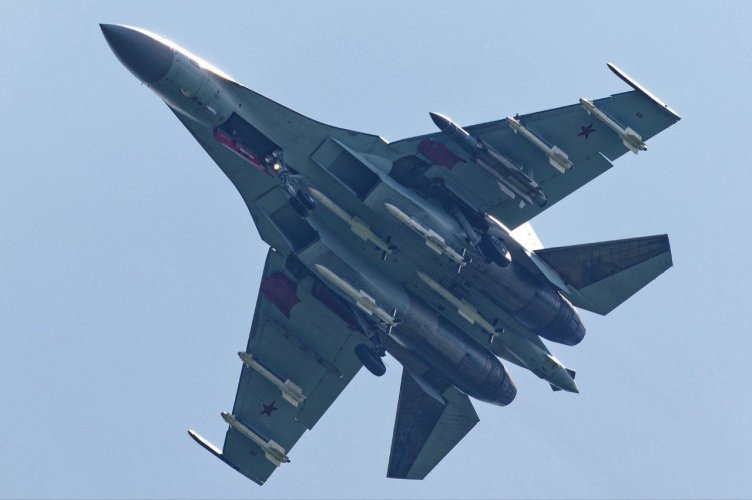
Su-35S can carry max 12 AAM's type R-77-1/Izd. 170-1. Six under the fuselage ( four between air intakes/engine nacelles and two under the air intakes ) and six under the wings.

Question is, how many AAM's type R-37M can (practically/possibly) carry as max.

Two under the fuselage ( between air intakes/engine nacelles).

View attachment 771687

Two under the air intakes .

View attachment 771688

Two under the inner wing pylons.

View attachment 771689

I suppose that R-37M's can be carried under the mid underwing pylons? Maybe Su-35S can carry(practically) max of eight R-37M's (the same applies for the Su-30SM2) ???
Wow, I did not know Su-35 can have R-37 on its inlet. This is certainly new to me.
Btw, do you know if Su-30SM2 get its IRST upgraded to OLS-35? Or does it still use OLS-30?
 
Brochure is only brochure .....
If you want to believe “hey this is the maximum range we got one day!” Over the brochure from the manufacturer giving a rough average from their testing then be my guest!

Also remember this about brochure and your beloved 80 km figure. It is for Su-30 target. A target with two of the largest class of fighter engines and extremely large skin surface area.

What’s wrong you love believing brochure numbers for other things? If data should be ignored it should be becuase it is either an outlier or is illogical not becuase it disagrees with the maximum range a Russian pilot got once (was it even 5-15 degrees aspect?)
Detection range is greater. Than that four times in the case of OLS-35 ( so, four times greater detection ranges).
If head on lock range is 10 km then detection distance is around 13 km. Times four for 10 km lock distance is 40 km which is around 35 km front aspect range from brochure. Detection range of 13 km x 4 is 52 km. If 35 km was 70% of detection range also we get 50 km detection range so difference of 2 km. Your point?

OLS-30/E is in all Su-30 family fighters ( 30M2,MKK,MK2(V),MKA,MKI,MKM ,SM) .Even Su-27SM3 has OLS-30.
And I am telling you that Su-30MK2 manual lists identical performance and features and modes as OLS-27. It has exactly one difference from OLS-27, its laser can designate X-29L with 10hz mode.

It’s possible the laser range was doubled, but I have only suspicion,
 
Last edited:
@Aeria Gloria

IRST working in SWIR,MWIR band ,can't see fighters or any aircraft at all ( their shapes,airframe). They can only see some 'temp values' on the sky, nothing else. So 'temp. spot.' Example, temp. value of 100°C can be detected from that or that range, temp of 500°C from some range and temp of 1000 or more °C from some range ,in troposphere or stratosphere ,under that or that conditions. Temp. value of almost all fighters flying on MP mode is 'give or take' same as it is the case when they flying on the AB mode. Yes, there can be some differences between single and twin engine fighters.
Bro, IIR system whether they work in Mwir or SWIR can all see target shape.
 
Wow, I did not know Su-35 can have R-37 on its inlet. This is certainly new to me.
Btw, do you know if Su-30SM2 get its IRST upgraded to OLS-35? Or does it still use OLS-30?

Judging by the photos ,Su-35S can carry R-37M's under the fuselage ( between the air intakes/engine nacelles) and under the inner ( very possible under the middle) ,underwing pylon.
Uf ,hard to say ,but if Su-30SM2 really got N035 Irbis there is big probability that it got OLS-35.


If you want to believe “hey this is the maximum range we got one day!” Over the brochure from the manufacturer giving a rough average from their testing then be my guest!

Sorry but some brochures on some airshows are one thing, practical results of some practical testing like those in 929GLITs is something different. That's it.

If head on lock range is 10 km then detection distance is around 13 km

What about tracking distance ?


Su-30MK2 manual lists

This is that Manual ?

Тактико-технические характеристики СУВ самолета Су-30МК2

Now some real details about those OLS-27/30. From the beginning,it was OEPS-27 or OLS-27 as IRST with the LD/LR type Izdeliye 36Sh.As we know ,they were integrated in that position which is on the middle part of the windscreen ,ahead of Su-27S/SK, P, UB/UBK and UBP versions .For the SK/UBK from 1992 it was of course export version OLS-27E ( Izd 36Sh-E).During 1990's ,UOMZ decided to modernise OLS-27. OLS-27M,( for Su-30 fighter family it was renamed into OLS-30) , so OLS-30 had/has greater detection distances and max detection distance for the fighter flying on AB mode in the head-on was increased from 100km to 150km.First fighter which received that modernize OLS were several serial Su-30 for the VVS than version K/MK which were exported for IAF ( 18 pcs in total ). That OLS in fact had Izd 36Sh LR/LD, not Izd 52Sh. There is also that version Su-30KN etc. What was specific for the OLS-30 ? It was integrated on the right side of the windscreen. In the meantime ,serial Su-33 got OLS-27K,also on the right side .Of course on the other was IFR probe.

After that , VVS decided to modernise some S to SM level with the N001V Myech ,than RWR SPO-32 Pastel/ Izd L150 and also modernized OLS-27M but with older LD/LR Izd. 36Sh ,also on the right side and w/o IFR probe on the other. So we have old LD/LR Izd 36Sh as part of the old OLS-27/E/M and newer,modernised Izd 52Sh as part of OLS-27MK or '30' were passive IR detector was also modified.

What’s wrong you love believing brochure numbers for other things?

As wrote ,brochure is only brochure. We can learn more things from e.g. interviews like one with N.Rakitin.

its laser can designate X-29L with 10hz mode.

Exactly that is 'Izd 52Sh' capability ( and not only Kh-29L ) and it is integrated in almost all OLS-30 of the Su-30 'FF' .


Bro, IIR system whether they work in Mwir or SWIR can all see target shape.

IIR ( teplovizor on Russian) is one thing ,IRST ( passive IR sensor/detector or on Russian 'teplovoy pelengator') is something else.
 
Sorry but some brochures on some airshows are one thing, practical results of some practical testing like those in 929GLIT
“This is the max range we got once on a highly situational sensor that may exceed vastly or vastly under perform depending on local conditions” is not practical result of practical testing. The brochure is made from an average of literal practical testing. 4x 10 km is not 80 km. As usual you ignore anything that is not the highest possible figure.

“This is the literal best range we got once” is not practical testing. It is a range they got once with a highly situational sensor that can even detect the sun 150 million km away and can’t see through clouds, does 20-30% worse at night and the difference between 75 degrees front aspect and 5-15 degrees is HUGE. I think you underestimate just how much IRST range can vary depending on conditions.

UPMZ has zero motivation to put a smaller figure then necessary in their brochure, in fast especially since it is against Su-30 it is likely to be the lower 50% end of probability.

What about tracking distance ?
Lock = tracking. 10 km for OLS-27.

This is that Manual ?
Hard to say by only seeing a quote of max performance

OLS-30 had/has greater detection distances and max detection distance for the fighter flying on AB mode in the head-on was increased from 100km to 150km
Again you have no proof of this

Exactly that is 'Izd 52Sh' capability ( and not only Kh-29L ) and it is integrated in almost all OLS-30 of the Su-30 'FF' .
So my research has the correct result? Shocker. And I can assure you the only laser guided weapon in Su-30MK2 manual is X-29L so I. That case it absolutely is only X-29L.
IIR ( teplovizor on Russian) is one thing ,IRST ( passive IR sensor/detector or on Russian 'teplovoy pelengator') is something else.
The only Russian aircraft using IIR/FPA is Su-57.

Even R-73 can map the target and all IR radiation around it in order to map flares see their trajectory and reaction to gravity and then filter out those not on the same trajectory as the target. Nowhere did I say that anything needed to see the shape, if you think “something that sees skin friction sees the shape” you are wrong. Skin can get hot and this can be seen by an IRST good in 4-5 micron wave very far away.
 
“This is the max range we got once on a highly situational sensor that may exceed vastly or vastly under perform depending on local conditions” is not practical result of practical testing. The brochure is made from an average of literal practical testing. 4x 10 km is not 80 km. As usual you ignore anything that is not the highest possible figure.

“This is the literal best range we got once” is not practical testing. It is a range they got once with a highly situational sensor that can even detect the sun 150 million km away and can’t see through clouds, does 20-30% worse at night and the difference between 75 degrees front aspect and 5-15 degrees is HUGE. I think you underestimate just how much IRST range can vary depending on conditions.

UPMZ has zero motivation to put a smaller figure then necessary in their brochure, in fast especially since it is against Su-30 it is likely to be the lower 50% end of probability.


Lock = tracking. 10 km for OLS-27.


Hard to say by only seeing a quote of max performance


Again you have no proof of this


So my research has the correct result? Shocker. And I can assure you the only laser guided weapon in Su-30MK2 manual is X-29L so I. That case it absolutely is only X-29L.

The only Russian aircraft using IIR/FPA is Su-57.

Even R-73 can map the target and all IR radiation around it in order to map flares see their trajectory and reaction to gravity and then filter out those not on the same trajectory as the target. Nowhere did I say that anything needed to see the shape, if you think “something that sees skin friction sees the shape” you are wrong. Skin can get hot and this can be seen by an IRST good in 4-5 micron wave very far away.
I remember video Venezuela Su-30MK2 shot Kh-29L, most likely using the OLS-30 laser sight the position angle to down

View: https://youtu.be/nqtsVncJ1mQ?si=yNITlM6oyboamuAC

1:45
 
“This is the max range we got once on a highly situational sensor that may exceed vastly or vastly under perform depending on local conditions” is not practical result of practical testing. The brochure is made from an average of literal practical testing. 4x 10 km is not 80 km. As usual you ignore anything that is not the highest possible figure.

“This is the literal best range we got once” is not practical testing. It is a range they got once with a highly situational sensor that can even detect the sun 150 million km away and can’t see through clouds, does 20-30% worse at night and the difference between 75 degrees front aspect and 5-15 degrees is HUGE. I think you underestimate just how much IRST range can vary depending on conditions.

UPMZ has zero motivation to put a smaller figure then necessary in their brochure, in fast especially since it is against Su-30 it is likely to be the lower 50% end of probability.

Read Nikolay Rakitin interviews ,do not read some brochures.From one of his interviews ( can find also on one Russian site) ...

''Дальность обнаружения бесфорсажной воздушной цели, истребитела Су-30 в переднюю полусферу, с q<15° была 80 км ,в ходе первого этапа ГСИ в 2011 г.''

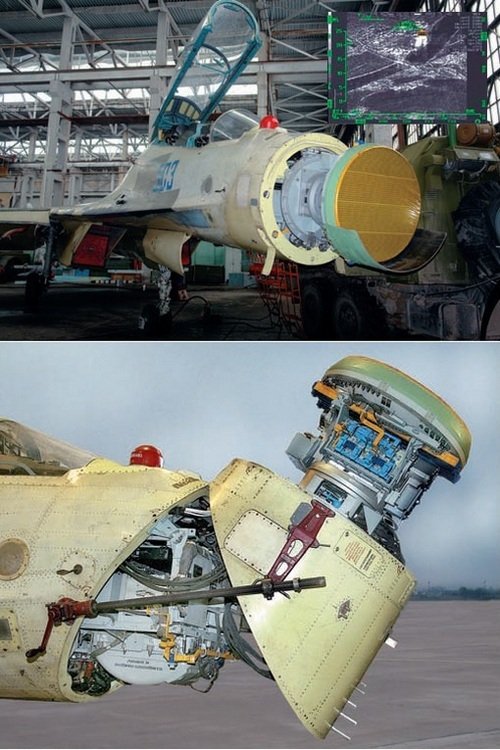
Btw, OLS-35 was first tested in flight on Su-30MK2 '503 blue' during 2006/2007 together with N035 Irbis.

Su-30MK2 Bort br 503 plavi sa N035 Irbis i OLS-35.jpeg

Lock = tracking. 10 km for OLS-27.

No, detect-automatic track-lock on. There is ADT ( automatic detection and tracking).

Hard to say by only seeing a quote of max performance

But you mentioned the Su-30MK2 Manual ...

Again you have no proof of this

Again, find and read N.K. stories.He was one of the 'heads' in the UOMZ. OLS-30 has 50% greater detection ranges than old OLS-27.

So my research has the correct result? Shocker. And I can assure you the only laser guided weapon in Su-30MK2 manual is X-29L so I. That case it absolutely is only X-29L.

As I wrote ,LD/LR Izd. 52Sh can provide usage of laser guided weapons and not only Kh-29L .What about KAB-500L/1500L etc ?

The only Russian aircraft using IIR/FPA is Su-57.

Even R-73 can map the target and all IR radiation around it in order to map flares see their trajectory and reaction to gravity and then filter out those not on the same trajectory as the target. Nowhere did I say that anything needed to see the shape, if you think “something that sees skin friction sees the shape” you are wrong. Skin can get hot and this can be seen by an IRST good in 4-5 micron wave very far away.

My answer was to Ronny .

How one target can be seen in the TV, IR ( IIR or IR camera) and UV -channel, we can see here from 31st min .

View: https://www.youtube.com/watch?v=J-6maSMa4sU
 
Read Nikolay Rakitin interviews ,do not read some brochures.From one of his interviews ( can find also on one Russian site) ...

''Дальность обнаружения бесфорсажной воздушной цели, истребитела Су-30 в переднюю полусферу, с q<15° была 80 км ,в ходе первого этапа ГСИ в 2011 г.''
And pilots aren’t perfect either. I believe him but saying a pilot is more reliable than the company that made the equipment is laughable. Everyone is fallible. Pilots can give excellent insight but also be wrong.

In this I totally believe him, but he also does not say how much the target was in look up, or atmospheric conditions. Think, if you are a pilot, are you going to say “through many trials we got this average” or becuase you are talking to the press are you gonna say “this is the best range we got with a highly circumstantial sensor.”

He said the max range he got basically, not the average. Yes I believe the company that made it in giving me an overall average which they explicitly say is based on testing and the pilot who boasted about the max range they got once is simply providing an outlier.

I have never known a Soviet or Russian to underestimate their brochure numbers. It is almost always “this is the upper end of what’s possible.”

For example, if this Su-30 was going supersonic and merely shut off the afterburner, the skin friction would be very high and increase detection range. If it was cold out and/or sun hidden it could increase sensor performance by 20-30% or more (German manual for KOLS “expect 20-30% higher range at night time.)

There are simply so many variables. You can believe it, but if I was flying a plane with OLS-35, you can bet I am going to assume a less then 35 km front aspect range since I will be fighting F-15/16/18/EF/Rafale which all have lower heat signature then Su-30. Looking down at ground? Decrease range by 25-50%. Clouds? Expect nothing. Hot day? Even less range due to lack of contrast from heat.

Go into war expecting 80 km and you would die. It is not even FPA like AIM-9X or any modern western IR imager in 21st century. It probably uses a 14 element InSb sensor just like OLS-27.

F-14A IRST quoted anywhere from basically nothing to 100s of kms and nms and it is 14 element InSb sensor. IRST range varies by a lot depending on tons of things you can’t control, this is fact of life.

Also, PoD is a thing. You might be able to lock it, but for how long? If it’s less then PoD of 0.9, the lock will not be permanent. If less then 0.5 the detection will not be permanent and the pilot here says detection not lock. If detection is 80 km that’s a lock range of 56 km, which is far closer to 35 km in brochure.

At PoD below 0.9 the lock would eventually break. He does not say how long he was able to lock or even if he did lock, only detect. It is very possible the Su-30 gave off “glint” at high enough level to show detection. This is not noteworthy and totally normal at low PoD for IRST or radar.

Just like with radar you will see Target appear and disappear one scan cycle later at anywhere from 0.01-0.49% PoD. Perhaps it appeared for a scan cycle or to at 80 km and went away. We do not know.

No, detect-automatic track-lock on. There is ADT ( automatic detection and tracking).
Does not mean lock would happen as far as detection would. Even Su-27 has such feature.

In addition I was reading pilot testimony of this switch, they said that it was unusable with IRST unless gain was at minimum and without any sources of clutter as it would lock onto the first source of clutter it saw. The same weakness if talked about automatic locking modes with Pursuit radar mode at low altitude where it shows clutter (this is basically the only reason for
The compensation switch.)

But you mentioned the Su-30MK2 Manual ...
Yes becuase I have it. The link you showed me only has a brief quote about max performance so it’s impossible to say if it’s from the same manual.

Again, find and read N.K. stories.He was one of the 'heads' in the UOMZ. OLS-30 has 50% greater detection ranges than old OLS-27.
Again I ask for evidence despite being skeptical of its existence. Su-30MK2 manual quotes same ranges as OLS-27. Perhaps there is a better OLS-30 variant but it was not in Su-30MKK/MK2 and likely early MKI variants or even to this day on some perhaps.

I wrote ,LD/LR Izd. 52Sh can provide usage of laser guided weapons and not only Kh-29L .What about KAB-500L/1500L etc ?
The manual does not list them. Tell me how will you employ a guided bomb from an aircraft with a laser that can only look 15 degrees down?
 
Last edited:
There are simply so many variables. You can believe it, but if I was flying a plane with OLS-35, you can bet I am going to assume a less then 35 km front aspect range since I will be fighting F-15/16/18/EF/Rafale which all have lower heat signature then Su-30. Looking down at ground? Decrease range by 25-50%. Clouds? Expect nothing. Hot day? Even less range due to lack of contrast from heat.

What about F-22A which can supercruise with 1.5M or more ( in the stratosphere of course) ??? Skin friction temp. value?

Does not mean lock would happen as far as detection would. Even Su-27 has such feature.

Lock-on range is 70% of the detection range.It is described in the Su-27SK F.M.

Yes becuase I have it. The link you showed me only has a brief quote about max performance so it’s impossible to say if it’s from the same manual.

Su-30MK2 Manual ? Real one Flight Manual?

Again I ask for evidence despite being skeptical of its existence. Su-30MK2 manual quotes same ranges as OLS-27. Perhaps there is a better OLS-30 variant but it was not in Su-30MKK/MK2 and likely early MKI variants or even to this day on some perhaps.


''Вместо использовавшихся на Су-27 оптико-локационной станции ОЛС-27(«36Ш») и нашлемной системы целеуказания «Щель-3УМ» на самолете Су-30МККприменяются новые ОЛС-30 («52Ш») иНСЦ «Сура-К» с новым программно-алгоритмическим обеспечением и более широкими боевыми возможностями. Например,ОЛС «52Ш» (разработка ЦКБ «Геофизика») имеет увеличенную с 50 до 90 км дальность сопровождения воздушной цели по ее тепловому излучению и возросшие до 6 и10 км дальности измерения расстояний довоздушной и наземной цели.''

''Instead of the OLS-27 ("36Sh") optical-location station and the Shchel-3UM helmet-mounted target designation system used on the Su-27, the Su-30MKK aircraft uses the new OLS-30 ("52Sh") and Sura-K target designation system with new software and algorithmic support and broader combat capabilities.
For example, the OLS "52Sh" (developed by the Central Design Bureau "Geophysics") has an increased range of tracking an air target based on its thermal radiation from 50 to 90 km and an increased range of measuring the distance to air and ground targets to 6 and 10 km.''

It was twenty years ago ....

Source,page No23 : http://www.take-off.ru/pdf/11_2006.pdf

So as we can see, OLS-30 with Izd 52Sh has greater tracking range of fighter flying on non AB ( MP ) mode in the rear hemisphere with increase from 50 to 90km. That is almost 100% !

From Su-27SK F.M.

OLS-27 detection range mod.png

So, detection range from the rear, clear sky, angle aspect: 0/4-2/4 is 50km, with clouds,above ground and sea level only 25-30km.

OEPS-30 with OLS-30/Izd 52Sh in the Su-30 F.F. has certainly greater detection/track and lock-on ranges then old OEPS-27/E with its OLS-27/E ( Izd 36Sh).

Now some brochure data for the OLS-35 :

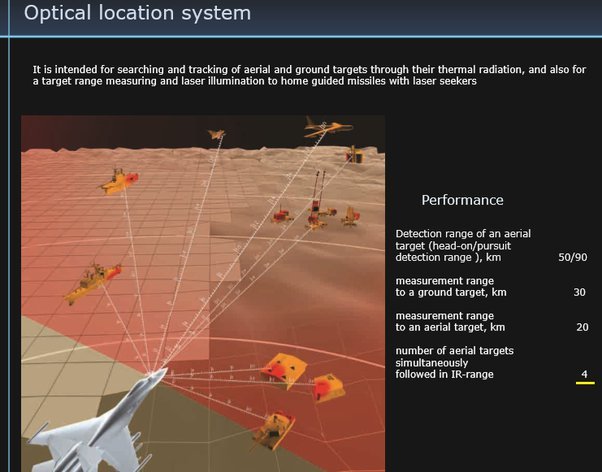
This example: forward hemisphere -50km, rear hemisphere -90km

OLS-35 promo.jpg

Front/forward hemi... -35km, rear hemi... -90km ( Su-30 case).


ols35 collage.png

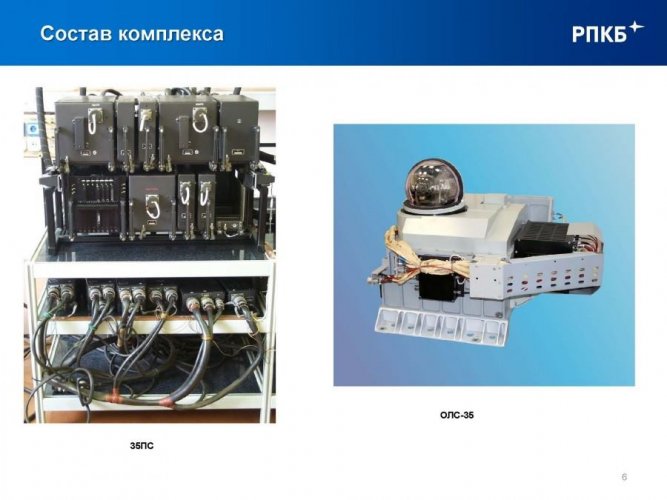
It seems that every brochure has its own values. OLS-35 is definitely better and more capable than OLS-27 and OLS-30.

OLS-35 1.jpg


The manual does not list them. Tell me how will you employ a guided bomb from an aircraft with a laser that can only look 15 degrees down?

Just like that ...

''Назначение:
поиск, обнаружение и сопровождение целей по их тепловому излучению на всех высотах, под любым ракурсом цели на фоне земли, облаков и водной поверхности в дневное и ночное время, при наличии организованных помех
измерение дальности лазерным дальномером до воздушных или наземных целей
подсвечивание наземных целей для наведения управляемых ракет с лазерными головками самонаведения.''

''Purpose:
search, detect, and track targets based on their thermal radiation at all altitudes, from any angle, against the ground, clouds, and water surface, day and night, in the presence of jamming.
measurement of the range of air or ground targets with a laser rangefinder.
illumination of ground targets for guiding laser-homing missiles.''
 

Similar threads

Back
Top Bottom