Ukrainian Ballistic Missile Development and Deployment

A mobile cruise-and-ballistic-missile launch platform; firing destruction on all cylinders. Interesting idea albeit with one major caveat: if it eats an Iskander, lots of firepower is lost in just one strike. Plus it makes a fatter target, harder to conceal. Better not to put too many eggs into a single basket, as the proverb says...
Same number of eggs in basket, just different (free range) eggs. Mobility and bunker storage should prevent that and the same risk applies the other way to Iskanders, except with US satellite GMTI support, which will soon have global coverage 24/7.
 
Last edited:
Operator Starsky has uploaded a video concerning this latest FP-9 missile strike:


Back in 2022, developing homegrown weapons capable of devastating enemy strikes seemed impossible. Today — it's reality.
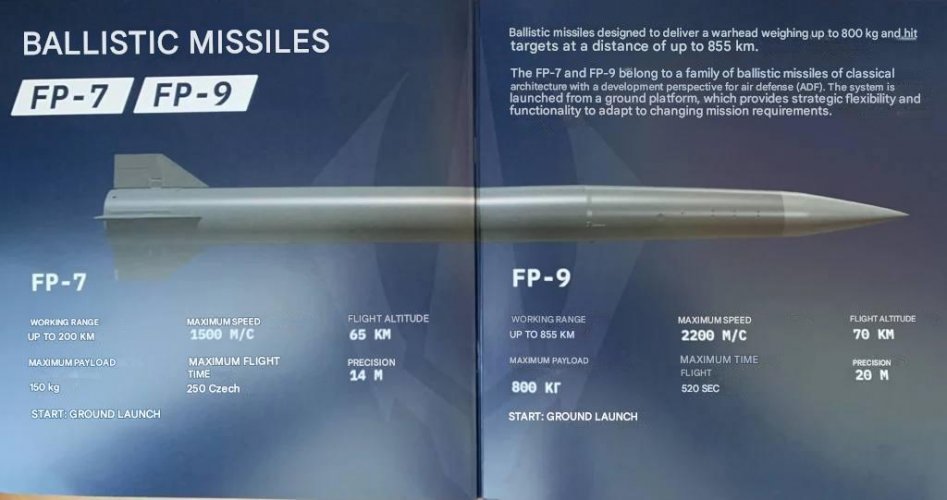
The FP9 ballistic missile is positioned as a key element of Ukraine's new deep-strike capabilities, complementing drones and cruise missiles while making the war far more dangerous for Russia. Per stated specs, the missile boasts a range of about 800–855 km/500-534 mi, high speed, and a powerful warhead.​
FP9's emergence marks a logical evolution of Ukraine's strike arsenal — from improvised drones to cruise and now ballistic missiles. The mere threat of Ukrainian missile use forces Russia to stretch its air defenses and resources across its territory, creating new vulnerabilities.​
 
Looking at this video seems Russia has been on the receiving end of these systems already. How accurate they are and how many they can produce is going to be a major question. Looking at the video its interesting about the launcher platform or test launch platform. Its very simple hot launch system at an angle. Looking forward to seeing the FP-9 but as well very surprised we have seen the FP series of ballistic missiles before Sapsan
 
Isn't the FP-7 basically the SA-12 Gladiator design modified into an SRBM (I suppose the FP-9 is a similar modification of the SA-20 Gargoyle design)?
 
Unless Russia is building some bunkers, an 800kg warhead seems redacted, meaning it's a sussy endeavor.
If you're trying to hit factories, bigger is better. Heavy equipment can be remarkably resilient to nearby explosions. We've known this since WWII.

If you're trying to hit munition dumps, bigger is ALSO better. I know Russia has a habit of having stuff just lying around, but on occasion you want to be sure you get whatever is in that munitions bunker.

So, not sus.
 
If you're trying to hit factories, bigger is better. Heavy equipment can be remarkably resilient to nearby explosions. We've known this since WWII.

If you're trying to hit munition dumps, bigger is ALSO better. I know Russia has a habit of having stuff just lying around, but on occasion you want to be sure you get whatever is in that munitions bunker.

So, not sus.
Possible. But do they have anything in the 500kg warhead category before making the jump?
 
I assumed the FP-7 would be Vilkha-M launched.

What's interesting about the FP-9 is the relatively low speed given the range, which seems to suggest an MET rather than aeroballistic trajectory.
 
Last edited:
Possible. But do they have anything in the 500kg warhead category before making the jump?
No, not "possible", fact. Bigger IS better against a lot of targets that Ukraine is already hitting.

Mate, if you have evidence of malfeasance, spit it out. Don't play silly buggers.
 
No, not "possible", fact. Bigger IS better against a lot of targets that Ukraine is already hitting.

Mate, if you have evidence of malfeasance, spit it out. Don't play silly buggers.
So you disagree with me agreeing with you?

Make up your mind.
 
I'm sorry, first you call an 800 kg warhead retarded (let's not mince words here) and sus, then I point out that bigger IS better, and then you go "but what about 500 kg warheads".

This is not you agreeing with me.

Make up your mind.
No, I agreed and then asked a question about whether there are 500kg category weapons in Ukrainian service, that can be described as long range.
You're reading too much into it. That question also wasn't directed specifically at you.

If it really makes it better then I accept the apology and now revert back to thinking an 800kg warhead is excessive. I hope you're happy now.
 
Ukraine is continuing development of its domestically produced FP-7 ballistic missile, described as a lower-cost analogue to the U.S.-made ATACMS system, according to Denys Shtilerman, co-founder and chief designer of defense company Fire Point.

In comments to Channel 24, Shtilerman said the missile has a strike range of up to 300 kilometers (about 186 miles), depending on the weight of its warhead. He noted that the Ukrainian system is not as compact as its American counterpart.

Shtilerman said Fire Point manufactures all key components in-house, while the warhead is produced separately under contract.

“There has already been a flight. We are now moving to testing on our ‘favorite’ neighbors,” he said, referring to Russia.

He acknowledged that bureaucratic procedures affect the missile’s final cost but described such processes as standard practice in large-scale defense manufacturing.

To accelerate development, he said the company is codifying its missile systems as unmanned aerial vehicles.

“That’s why we codify everything as drones — FP-5 is a drone, and FP-7 as well. We don’t have time to follow old codification methods. If we adhered to the traditional military bureaucracy, we would still be testing the FP drone,” Shtilerman said.

The FP-7 is a conventionally designed ballistic missile intended to strike enemy targets at medium ranges.

According to Fire Point, the missile’s aerodynamic layout and control principles are modeled on the Soviet-era 48N6 missile, which Russia currently uses in its S-400 air defense systems. However, the FP-7 features a different guidance system and flight-control equipment. It is also made from composite materials, which the company says reduce the missile’s weight and increase its range.

 
Last edited:
So with this we can see the relative pace of providing solid fuel plant if the will is there.

Fire Point aims to produce enough solid rocket fuel to fully cover Europe’s shortage

https://odessa-journal.com/fire-point-a ... s-shortage
The Ukrainian company Fire Point plans to produce solid rocket fuel in Denmark for the whole of Europe.

This was reported by LIGA.net, citing the Danish publication Berlingske.

The enterprise, being built near the Skrydstrup airbase, where Royal Air Force F-35 fighters are stationed, plans to start partial production by the end of 2026, and from next year to reach full capacity.

“Given current needs, production in Denmark can cover the entire European deficit of solid rocket fuel,” Terekh said.

Exact production volumes remain confidential.

“Solid rocket fuel is the main bottleneck in missile production worldwide,” Terekh added.

The director of Fire Point is convinced that production in Denmark will bring the country direct benefits — primarily in the form of strategic autonomy, meaning the ability to independently supply itself with necessary resources.

For Ukraine and the company itself, production under the NATO “umbrella” is also crucial, since defense enterprises inside the country are constantly under attack.

“From a business perspective, production in Denmark does not make sense — it is much more expensive and logistically complex than in Ukraine. But from the point of view of strategy, security, and politics — it is a very correct decision,” Terekh said.

Fire Point is a Ukrainian defense company whose flagship products are long-range drones and “Flamingo” cruise missiles.


So I asked AI how long this is taking
June 2025: Denmark and Ukraine sign an agreement on joint weapons production.

September 2025: Danish Defense Minister Troels Lund Poulsen announces that Fire Point will open a factory in Vojens, near Skrydstrup Air Base.

Late 2025: Construction begins on the site (FPRT), with early reports indicating an ambitious target for initial production by 1 December 2025.

March 2026: Reports confirm construction is underway and that the facility is going through the permitting process, with the first phase planned to open in 2026.

April 2026: Fire Point reports that the plant is expected to come online later in the year, as it awaits final approvals, and that the main production phase is projected for 2027.
 
Last edited:
It looks like Ukraine is developing an ALBM based on its' FP-9 ballistic missile:


Ukraine’s air-launched ballistic missile program could give Kyiv a weapon NATO doesn’t even field, and that changes how Russia has to defend its own territory. In this video, I break down Fire Point’s FP-9 concept, why launching a ballistic missile from an aircraft rewrites the physics and the geometry of the fight, and what that means for deep strike inside Russia.​
This video explores the potential for Ukraine to develop its own intercontinental ballistic missile, a significant military technology advancement not even NATO possesses. This development would mark a major shift in the russia ukraine war and in current events, presenting Russia with new challenges from unpredictable directions. I also discuss the strategic importance of range for Ukraine due to Russia's vast size.​
 

Similar threads

Back
Top Bottom