"Always wondered how the silo doors would work for the super-hard concepts..."

Shades of the Pyramid builders...
Who had generational 'Arms Race' with thieves, unto sliding mega-blocks etc etc

FWIW, the 'Valley of Kings' thing, where tomb entrance was often off the side of a much deeper pit ?
Wasn't to keep people out, it was to divert / soak-away once-a-generation flash-floods lest inundate site...
--
I still wonder why 'Mobile MX' did not further consider LCAC-style hovercraft..
On alert, they would come roaring out of their bases, disperse overland towards perimeter of compass rose...
 
Heavily guarded doesn't stop an IED or ATGM.
Or even a guy with a hunting rifle capable of firing out to several hundred yards and poking holes in sensitive parts, which would be a very easy task for Soviet special forces in the US in the 70s/80s.
 
Perhaps institutional embarrassment due need to get another hovercraft license from the Brits ??

IIRC, took a long, long time before said license was paid for LCACs...
 
The biggest reason that "road mobile" was rejected was the assumption in some quarters that the missiles would be out on the interstate. Which makes for no exclusion zone while the things are in motion because they're in public.

And a relatively easy intercept, the expedient being to use a heavy truck to ram the missile carrier off the road. If you time it right, the missile truck would be heavily damaged (most importantly the missile). Say, forcing the missile carrier off right before a bridge. Crunch.

If we're assuming the missiles moving inside a government-controlled area, that's a more difficult thing but not impossible.
Living in suburban SoCal and casually watching local news including real time accident coverage on a near daily basis, deploying a strategic weapon system on Western coastal highways might make for a watchable B-movie plot, but would constitute sheer insanity IRL.
 
Or even a guy with a hunting rifle capable of firing out to several hundred yards and poking holes in sensitive parts, which would be a very easy task for Soviet special forces in the US in the 70s/80s.
Good luck trying to sneak up on a hovercraft out in the middle of the desert in the 70s / 80s.
 
Living in suburban SoCal and casually watching local news including real time accident coverage on a near daily basis, deploying a strategic weapon system on Western coastal highways might make for a watchable B-movie plot, but would constitute sheer insanity IRL.
It was apparently said of the Peacekeeper Rail Garrison that putting them on the back of Amtrak trains would quickly result in the Soviets being unable to find them. The problem was that the Americans wouldn't be able to, either.

Something rather similar would apply to road mobile weapons.
 
Or even a guy with a hunting rifle capable of firing out to several hundred yards and poking holes in sensitive parts, which would be a very easy task for Soviet special forces in the US in the 70s/80s.
The nasty thing about Peacekeeper is that they used class 1.1 detonable propellant in the third stage. So a bullet from a high powered hunting rifle could conceivably detonate the third stage, which would instantly destroy the entire missile (and its launcher).

The SICBM was even worse. Similar to naval missiles, all three stages used class 1.1 detonable propellant. But unlike naval missiles, it would be fully exposed to land-based hazards. Again, one bullet from a high powered rifle would be enough to detonate the propellant on any of its three stages. As this was an all-detonable-propellant missile, the detonation of whichever stage was struck would cause the other two stages to immediately detonate as well. This would instantly destroy the entire missile, its launcher, and any hapless civilian or military personal close enough to be caught up in the blast.

There is a noteworthy paper where they tested what would happen if just two of the three stages of the SICBM detonated. The objective was to see if detonating one stage would lead to sympathetic detonation of the other stage, if said stages were stored in somewhat close proximity (such as in a missile depot storage bunker, or on adjacent missile trailers). The results were quite disturbing, and poignantly illustrate the extreme hazards associated with the use of class 1.1 propellants, especially so for mobile missiles:


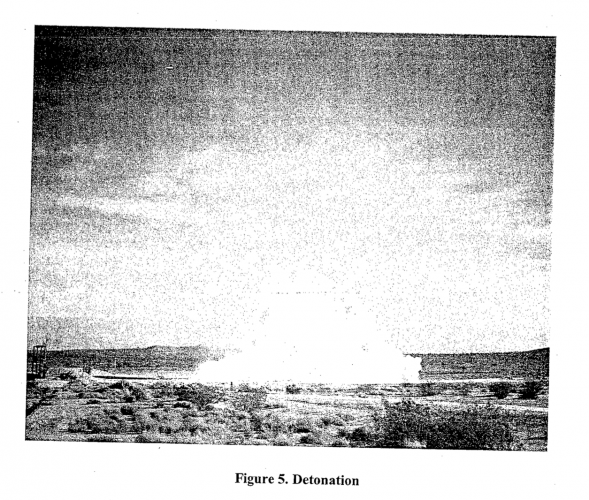
The Stage 1 motor was detonated at 1415 PST on 13 December 2002. The detonation was detected by seismograph readings at the Cahfomia Institute of Technology (CalTech) 60 miles away (96 kilometers). The event registered a magnimde of 1.61 on the Richter scale. A photo of the detonation is shown in Figure 5.

1771896948141.png

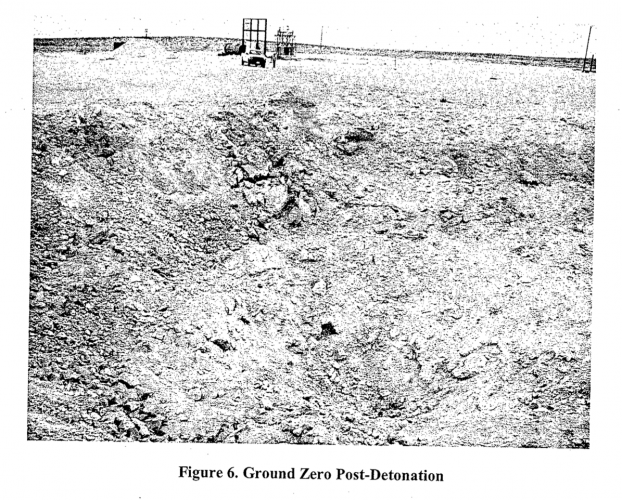
When the Red Crew arrived at ground zero, they found a crater 65 feet (20 meters) across and approximately 15 feet (4.5 meters) deep. The Red Crew verified that the Stage 3 motor was detonated by the Stage 1 acceptor motor detonation.

The only recognizable component of the Stage 3 motor recovered was the solid aluminum forward polar boss found, (mostly intact but distorted) in the crater. Pre-detonation, the forward polar boss was facing downward, 1/2-in (1.3-cm) from the plywood support on which the motor was resting. The post detonation crater at Ground Zero is shown in Figure 6.

1771897015613.png
 
The biggest reason that "road mobile" was rejected was the assumption in some quarters that the missiles would be out on the interstate. Which makes for no exclusion zone while the things are in motion because they're in public.

And a relatively easy intercept, the expedient being to use a heavy truck to ram the missile carrier off the road. If you time it right, the missile truck would be heavily damaged (most importantly the missile). Say, forcing the missile carrier off right before a bridge. Crunch.

If we're assuming the missiles moving inside a government-controlled area, that's a more difficult thing but not impossible.
Luckily, the Federal Government owns a massive amount of land out west so there's no need for mobile launchers to go on public roads.
 
NATO did deploy a road mobile nuclear missile system; the Gryphon. And they were planning on dispersing those into the English countryside in a time of crisis, which would be far easier for Spetsnaz to get to
 
The nasty thing about Peacekeeper is that they used class 1.1 detonable propellant in the third stage. So a bullet from a high powered hunting rifle could conceivably detonate the third stage, which would instantly destroy the entire missile (and its launcher).

The SICBM was even worse. Similar to naval missiles, all three stages used class 1.1 detonable propellant. But unlike naval missiles, it would be fully exposed to land-based hazards. Again, one bullet from a high powered rifle would be enough to detonate the propellant on any of its three stages. As this was an all-detonable-propellant missile, the detonation of whichever stage was struck would cause the other two stages to immediately detonate as well. This would instantly destroy the entire missile, its launcher, and any hapless civilian or military personal close enough to be caught up in the blast.
And, the Russians have been fielding 7.62mm HEI ammunition since before WW2.

Nevermind what happens if they brought in 12.7mm rifles.

Side note: I suspect that a detonation of the third stage of the Peacekeeper would detonate the lower stages.


There is a noteworthy paper where they tested what would happen if just two of the three stages of the SICBM detonated. The objective was to see if detonating one stage would lead to sympathetic detonation of the other stage, if said stages were stored in somewhat close proximity (such as in a missile depot storage bunker, or on adjacent missile trailers). The results were quite disturbing, and poignantly illustrate the extreme hazards associated with the use of class 1.1 propellants, especially so for mobile missiles:

Looks about right.

And if anything, too small. I've seen what happens when Trident stages are decomissioned. Leaves one hell of a crater in desert hardpan.
 
Even without the boom on impact, wouldn’t a large bullet hole or two be very much a case of “You will not go to space today”?
 
Even without the boom on impact, wouldn’t a large bullet hole or two be very much a case of “You will not go to space today”?
You have to get close enough to do that. Easier said than done. Everybody but the US puts ICBMs on land mobile platforms. Ask yourself why.
 
There is a way to do road-mobiles, just mix it with MPS shell game system. During peacetime, you just rotate them between shelters which are easy to guard and can survive most conventional attacks. You only disperse them into the highway system during wartime, when alot of the issues go away. Say go with 10 shelters (you can even use minuteman land for them) per mobile system and make the missile fit into into a standard tractor trailer. Need decoys? Just buy a ton of tractor trailers.

The key is the shelters should be spaced out so no one nuke can take out two at a time and they are hard enough that conventional attacks cant kill them easily. In peacetime the missiles are in well know easy to guard locations, and the number of shelters means you need more warheads to make sure you kill a missile.
 
You have to get close enough to do that. Easier said than done. Everybody but the US puts ICBMs on land mobile platforms. Ask yourself why.

It was a mostly rhetorical question following on the propellant explosion stuff but: Because the ability to know where you are launching from has improved quite a bit since the last time the US went through an ICBM building frenzy back in the 1960s as has the ability of conventional weapons to defeat precise targets like silos. Those currently deploying also don’t seem to have a reliably survivable SSBN capability so it’s an additional means of ensuring second strike capability that the US doesn’t need.
 
It was a mostly rhetorical question following on the propellant explosion stuff but: Because the ability to know where you are launching from has improved quite a bit since the last time the US went through an ICBM building frenzy back in the 1960s as has the ability of conventional weapons to defeat precise targets like silos. Those currently deploying also don’t seem to have a reliably survivable SSBN capability so it’s an additional means of ensuring second strike capability that the US doesn’t need.
And yet both China and Russia are building road-mobile ICBMs as we speak.
 
If we're assuming the missiles moving inside a government-controlled area, that's a more difficult thing but not impossible.

In the modern era, constricting movement makes attack easier not harder. It would be fairly trivial to observe this tiny patch of land with a commercial radar satellite constellation to track every mobile missile in 10 or 20 years time when those come online.

Meanwhile, nobody has rammed the NNSA transporters off the road nor attacked them with armed groups seeking fissionables, and they operate on public roadways and interstates with (or without) escort all the time. A missile truck would need a much smaller ICBM than MX, but it is doable, given that the historic mission set has a lot of overlap.

Survivability isn't granted through mobility alone anymore. You actually need to be externally indistinguishable from ordinary traffic.

The actual outcome of this is that silo fields are just as survivable as a TEL force that isn't operated like NNSA's warhead transporters i.e. in normal traffic. Said TEL force that mobilizes on roadways may also not be survivable, as proven by Israeli strikes against Iranian disguised TELs in June of last year, but that would require the enemy be able to achieve air supremacy over your heartland first at least. Both are probably necessary going forward, but the road mobile missile should ideally be a bit smaller than the silo one, I suppose. Silo missiles seem useful for HGV delivery at least.
 
Meanwhile, nobody has rammed the NNSA transporters off the road nor attacked them with armed groups seeking fissionables, and they operate on public roadways and interstates with (or without) escort all the time.
In fairness, nobody's tried to start a strategic nuclear exchange with the United States yet either.
 
The nasty thing about Peacekeeper is that they used class 1.1 detonable propellant in the third stage. So a bullet from a high powered hunting rifle could conceivably detonate the third stage, which would instantly destroy the entire missile (and its launcher).

The SICBM was even worse. Similar to naval missiles, all three stages used class 1.1 detonable propellant. But unlike naval missiles, it would be fully exposed to land-based hazards. Again, one bullet from a high powered rifle would be enough to detonate the propellant on any of its three stages.
I'll bet you think they never thought of that. Jesus.
 
The SICBM was even worse. Similar to naval missiles, all three stages used class 1.1 detonable propellant. But unlike naval missiles, it would be fully exposed to land-based hazards. Again, one bullet from a high powered rifle would be enough to detonate the propellant on any of its three stages.
In fairness, SICBM had a fairly strong container.
1772026135053.png
 
If it fired Hafnium rounds, then sure.
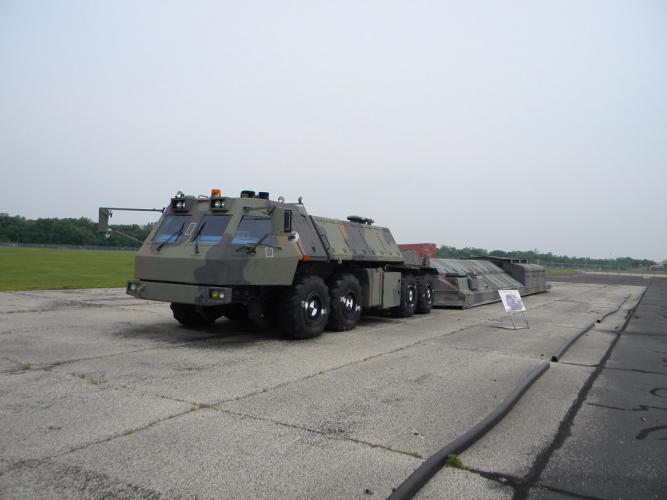
"Hardened Mobile Launcher" was just a catch phrase. It didn't actually mean it was hardened. It was designed to survive a near miss and not flip, or be disabled, but a bullet? No problem. /sarc

"The Small ICBM Hard Mobile Launcher in Random Movement basing mode employs missile-carrying mobile launcher vehicles randomly dispersed over Department of Defense and Department of Energy land. The survivability of the Hard Mobile Launcher system is a function of the vehicle hardness and mobility. Each mobile launcher is "hardened" to withstand high levels of blast and radiation. Vehicle positions are changed frequently enough to deny an attacker useful knowledge of specific Hard Mobile Launcher locations. Because each Hard Mobile Launcher can be anywhere within an area, the Hard Mobile Launcher in Random Movement system provides stability and contributes to deterrence by complicating the enemy's targeting task."
 
Last edited:
In fairness, nobody's tried to start a strategic nuclear exchange with the United States yet either.

Well, you'd only need to keep the TELs alive for a few minutes or an hour at most, so dispersing them on public roadways seems an excellent way to achieve this. Even Iran managed it for a few days despite total opposition air supremacy.

I'll bet you think they never thought of that. Jesus.

I'm fairly certain HML was bulletproof. Even the Pershings had bulletproof armor plates for anti-ambush protection against Scud hunters, but even if it wasn't, being stationed inside the ICBM fields made it difficult to attack with small arms anyway.
 
Wait wait wait . . . we’ve crossed a couple of theses here, as we’re wont to do on SPF. Are we talking about HMLs on Federal lands or thin-skinned Freuhauf trailers seeing the USA in their Chevrolet? Because the former are going to be pretty resistant to soft attacks and the latter are not.

Open road dispersal is one of the dumbest ideas possible. These “trailers” will by necessity have a depot and be tracked by the National Lesbian Disarmament Alliance from the moment they start to roll. Eventually, the driver will have to stop at Buc-ee’s to take a leak, where the local Antifa idiots will be live-streaming on Facebook. This is the Achilles heel of the concept: American citizens will do OSINT for free. There will be no way on earth that these vehicles could be secured on American roads.

Let’s face it: unless you can wall off millions of acres of public lands and use deceptive shelter basing, the best mobile ICBMs are probably SLBMs.
 
Wait wait wait . . . we’ve crossed a couple of theses here, as we’re wont to do on SPF. Are we talking about HMLs on Federal lands or thin-skinned Freuhauf trailers seeing the USA in their Chevrolet? Because the former are going to be pretty resistant to soft attacks and the latter are not.

Open road dispersal is one of the dumbest ideas possible. These “trailers” will by necessity have a depot and be tracked by the National Lesbian Disarmament Alliance from the moment they start to roll. Eventually, the driver will have to stop at Buc-ee’s to take a leak, where the local Antifa idiots will be live-streaming on Facebook. This is the Achilles heel of the concept: American citizens will do OSINT for free. There will be no way on earth that these vehicles could be secured on American roads.

Let’s face it: unless you can wall off millions of acres of public lands and use deceptive shelter basing, the best mobile ICBMs are probably SLBMs.
Not if you do it properly it proper D&D and MPS shell-games. You need to make sure the trucks look just like commercial trucks and you release a bunch of decoys out at the same time. If there are ten trucks out there and only one of them has a nuke, the enemy has to target all ten to be sure they got the nuke. The benefit is that theres already a bunch of trucks running around US highways, so you have a ton of ready made and "free" decoys and for every American doing "OSINT" on the right truck there will be five following the wrong one.
 
Both Russia and China have significantly worse SSBN capabilities. For them road-mobiles are primary and subs secondary. For the US its the inverse, subs are primary and land-based systems secondary.
Our land based missiles do serve an important purpose: to absorb large numbers of warheads that would otherwise be used on cities. That's fine enough, but hardened silos would have to be groundburst and create enormous amounts of fallout. Mobile launchers would need to be destroyed by airbursts, which produce no fallout
 
Our land based missiles do serve an important purpose: to absorb large numbers of warheads that would otherwise be used on cities. That's fine enough, but hardened silos would have to be groundburst and create enormous amounts of fallout. Mobile launchers would need to be destroyed by airbursts, which produce no fallout
Much less fallout, thank you.
 
Our land based missiles do serve an important purpose: to absorb large numbers of warheads that would otherwise be used on cities. That's fine enough, but hardened silos would have to be groundburst and create enormous amounts of fallout. Mobile launchers would need to be destroyed by airbursts, which produce no fallout
The "sponge" effect is theoretical rather than practical, and large parts of it have been discredited. The only real tangible product of the "sponge" lies in its deterrent effect. It exists to make the cost of a first strike insurmountably expensive for any adversary, to such an extent that nuclear deterrence is ensured to be maintained under all conceivable conditions.

This effect is not created by the "absorption" effect – it is created by the "arsenal" effect, ie the fact that we have 400 land based missiles on continuous alert with their guidance systems spun up which can be launched in a matter of minutes. Because we have coupled these missiles with a global early warning IR satellite constellation, we have the luxury of obtaining early warning the instant an attacker lights off the first missile's first stage motor, which is shortly followed by trajectory projections based on computational analysis of IR track data. This can give us early warning of attack fast enough to prepare to act on launching missiles pending final confirmation. Because we have an extensive early warning radar system, we can obtain dual-phenomenology confirmation of attack beyond any reasonable doubt swiftly enough to allow for a launch decision to be made with confidence rapidly enough to ensure our land based missiles fly well before the inbound missiles strike their targets.

The critical factor is that if we launch the land-based missiles, it costs us virtually nothing. We can afford to expend the entire land based missile force with minimal damage to our capability to fight a nuclear war. We can afford to perform our choice of counterforce or countervalue strikes. We can even afford to perform a limited strike. In the worst case, even if we fail to launch under attack, enough missiles are likely to survive to offer a guaranteed limited deterrent capability. What the land based missile force gives is us a luxury – the luxury to choose how we want to respond to an attack, the luxury to offer ambiguity about our response to an attack, the luxury of options.

The point that most people miss is that the primary mission of these weapon systems is not to be used. Their entire existence is justified on the basis that these weapon systems guarantee the nuclear deterrence of the United States and its allies by their very existence.

In the event that these weapons systems were to actually be used, we would not be seeing enemies targeting US missile silos. They would target US cities. Don't worry, these would be nice clean tidy airbursts. Sure, they'd kill off a sizable percentage of the population of the United States, and set the country back by 100+ years, ensuring that much of the remaining population succumbs to famine in short order. But don't worry, they'd do it nice and cleanly!

My point is, who cares about airburst vs groundburst? If nukes are hitting US ICBM silos, then deterrence has failed, and the US will swiftly cease to exist as a world power, as there is no scenario where the silos get hit but the cities get preserved. In fact, it is extremely unlikely that the silos would ever get targeted in the first place.

 
Ting ting ting! The sponge is a failed theorem. There’s no conceivable possibility where the US missiles silos get attacked first in a total exchange scenario. Not least because of the refined orbital early warning systems and the fact that the American war machine lies in its vast industrial grounds and housing stretches. Pearl Harbor happened but wartime industry finished WW2!
 
Not if you do it properly it proper D&D and MPS shell-games. You need to make sure the trucks look just like commercial trucks and you release a bunch of decoys out at the same time. If there are ten trucks out there and only one of them has a nuke, the enemy has to target all ten to be sure they got the nuke. The benefit is that theres already a bunch of trucks running around US highways, so you have a ton of ready made and "free" decoys and for every American doing "OSINT" on the right truck there will be five following the wrong one.
Good luck with that. MX weighs in at 190,000lbs and is 7.7ft in diameter by 72 feet long.

That is solidly in "oversized load" category by both weight and length.

By weight alone, you'd need an 8-10 axle trailer, and probably a tractor comparable with a modern M1070 HET: 4 powered axles and 600+hp.

So you'd need to have filed all the paperwork for the DOT/State Troopers, and can be expected to be pulled over at least daily for a paperwork check.

Bluntly, there just isn't anything in the same size class that traveled by road at the time. At least not that looked like a basic semi-trailer.
 
I'm not saying fill them all, just that if you wanted two or three missiles per circuit it would b easy to do.

Although now that I think about it, that would work against the economics of needing a greater than 2/1 ratio of warhead committed to the attack to warheads attacked. If you expanded to 33 you could expand to two MXs per set of shelters while still making a first strike "uneconomical". I guess this basing system is a way to counteract MIRVing of missiles by "MIRVing" missile silos. One warhead per missile means more than one missile is needed to take out each missile, MIRVing means one missile can take out multiple missiles, multiply the launch sites and you're back to needing more than one missile to take out each missile. Of course this only works if the cost of the launch sites and missile is less than the cost of additional missiles.
it's a cost exchange problem
the shelter has to be cheaper than the warhead
 
Our land based missiles do serve an important purpose: to absorb large numbers of warheads that would otherwise be used on cities.

The nuclear sponge is just an argument literally invented to shift investments from wide area population defense via civil infrastructure and ABM to investment in ICBM forces and infrastructure like REACT II and Peacekeeper/MX. There is no evidence anyone would attempt to hit America's nuclear arsenal and not simply go straight for the cities. It certainly wasn't the Soviet plan, which was to focus all nuclear firepower on the cities and their stock exchanges and factories, because that's where America's strengths are. Pavel Podvig has some articles about this.

Besides, who would want to bomb an empty silo?
 
Good luck with that. MX weighs in at 190,000lbs and is 7.7ft in diameter by 72 feet long.

That is solidly in "oversized load" category by both weight and length.

By weight alone, you'd need an 8-10 axle trailer, and probably a tractor comparable with a modern M1070 HET: 4 powered axles and 600+hp.

So you'd need to have filed all the paperwork for the DOT/State Troopers, and can be expected to be pulled over at least daily for a paperwork check.

Bluntly, there just isn't anything in the same size class that traveled by road at the time. At least not that looked like a basic semi-trailer.
You dont use MX, you use Midgetman. MX was the biggest missile you could stuff into a Minuteman silo, if you are going road-mobile, you go with a very different design. Something that if one gets taken out you lose 1 warhead, not 10.
 
Back
Top Bottom