Incorrect, SNP supports automatic lock on in any MiG-29 manual you read. This occurs just before the calculated maximum range of the R-27R for N-019. The whole point of SNP is to give some of the functions of Lazur but with voice GCI as described by the combat manual.
For N-019/019M there is for single target attack. How else do you guide a R-27R/ER without STT the target and sending datalink signals. Gaps in the sequence for datalink and illumination does not mean it isn’t STT. It sends out datalink at 1 hz rate and the standard STT+datalink+illumination pattern as described in MiG-29B technical manual and the translated PowerPoint means that the update rate for the missile would reach more then 15-20 hz once the seeker locks on if we take into account the 2-4 ms gap between radar STT/illumination/datalink. Is that not STT? It needs to intercept an 8 G target.
I can't believe what did you write. Friend, there is no more STT after AAM is launched. STT is nothing but lock-on mode,nothing else. STT mode works only with monopulse tracking and if you had read a MiG-29 FM ,R-27R/R1 uses quasi-continuous tracking and illuminaton of the engaged target. Quasi-continuous mode is used during search/scan.
Again ,mode DNP is not STT mode,wrote that several time. Even US radars in all 4th gen fighters with mech. scanning did not use STT after old AIM-7 was launched.AAM's with INS+SARH do not need STT after launch.
Then the 5-6 sources I gave you are wrong and the MiG-29SMT a huge downgrade in this respect. I have yet to see a source that says all missiles rather then “allows dual target attack.” We have to be realistic here and not pie in the sky. And the 5-6 sources I sent you saying specifically for R-77.
As I wrote,we must find real source,military source ( FM/TM) to find is there possibility to launch two INS+SARH R-27R/R1/ER/ER1 on two differ targets ( for N019M,ME or M1 of course).
I've deliberately wrote that from the 'airwar. ru ' because something like that is not possible especially in the BVR. ''Simultaneously'' ,no way. How to lock- on two differ targets in the same period of time ? With two differ beams? During WVR with use of the HMS also no way,maybe in the so called 'φ0' or Fi zero but I dought.
Notice it says more then 8 degrees azimuth and more then 10 km away, becuase that’s the limits of the TDC box in SNP (when target is gated/soft locked box expands by 1.5 times) and the range in accuracy in SNP is up to 10 km.
I 've already commented that and wrote it is wrong. No more than but exactly 8 degrees because we have that pre lock -on ''box pattern limited by 8x4 degrees''. 8 degrees by azimuth ( so it can be more than 10 km) and 4 degrees by elevation.
It is saying here that lock is automatic at max missile range or manually initiated. I.e, pilot doesn’t need to press lock button. As I said, this is a feature of SNP you will find described in almost every MiG-29 manual.
Tnx but I know what was described ,know Russian,know English. I even commented that pilot can override auto mode lock -on with pressing the button SBROS.
could you provide link to this manual from German source?
Fragments you provided seems to provide some hint, but are too narrowly cut to understand context
Edit: I noticed link several posts earlier, but still , could you provide some more text? Or page?
I have not found them so far, in German manual…
Edit 2:
I found this . I post result in separate post.
"
Im Gegensatz zu anderen Funkmeßvisieren der Jagdflugzeuge der NVA
bleibt beim Funkmeßvisier N-019 nach dem Übergang zum Zielbetrieb
auf eines der im Ortungsbereich vorhandenen Luftziele die Information über die anderen Luftziele erhalten, was die Beurteilungder Luftlage auch in dieser Betriebsart gewährleistet. Das trifft
auch dann zu, wenn eine Rakete R-27R gestartet wurde, weil dann
ein ständiger schneller Wechsel zwischen Zielbeleuchtung und
Zielbetrieb erfolgt, der sich auf die Darstellung nicht auswirkt."
"
Unlike other radar sights used on NVA fighter aircraft,
the N-019 radar sight retains information about other targets within its detection range after switching to target mode, thus ensuring accurate assessment of the air situation even in this mode. This also applies
even when an R-27R missile has been launched, because then
a constant, rapid switching between target illumination and target operation occurs, which does not affect the display."
"
Im Gegensatz zu anderen Funkmeßvisieren der Jagdflugzeuge der NVA
bleibt beim Funkmeßvisier N-019 nach dem Übergang zum Zielbetrieb
auf eines der im Ortungsbereich vorhandenen Luftziele die Information über die anderen Luftziele erhalten, was die Beurteilungder Luftlage auch in dieser Betriebsart gewährleistet. Das trifft
auch dann zu, wenn eine Rakete R-27R gestartet wurde, weil dann
ein ständiger schneller Wechsel zwischen Zielbeleuchtung und
Zielbetrieb erfolgt, der sich auf die Darstellung nicht auswirkt."
"
Unlike other radar sights used on NVA fighter aircraft,
the N-019 radar sight retains information about other targets within its detection range after switching to target mode, thus ensuring accurate assessment of the air situation even in this mode. This also applies
even when an R-27R missile has been launched, because then
a constant, rapid switching between target illumination and target operation occurs, which does not affect the display."
How this might be accomplished ?- this is just another story. To know for sure - another technical manual (from War-Pac /Soviet version) is needed.
Warning: long , speculative, boring
MY understanding might be :
1) N-019(EA) works in SNP mode: tracking up to 10 targets: this means finds its position, closure speed (those are primary data). Algorithm from 3 scans - estimates (very roughly) target vector, and provides some box where target should appear in the next scan. This is more or less track while scan type of processing.
In case of not detecting target in extrapolated box, target it is not "removed" from track - it is just extrapolated (mentioned before algorithm "prognoz - dorozka"). And up to 3 missing scans needs to occur before removing target from display. And this takes about up to ~10-12 seconds
2) There is found the most dangerous target. Pilot can override selection and goes to tracking the main target manually (pres button ZAHVAT), or tracking may start automatically. In either case there is accomplished procedure for switching to tracking mode:
Antenna is moved (with the maximum angular speed) to the position of the selected target -> there is done precise scan in small area (8x4 degs) with angular speed 20degs. This take about 0.8 sec for a single scan. Radar tries up to 3 scans. As you can calculate: all this can take no longer than 3s : let say 0.5 sec to move antenna, and up to 3 scans by 0.8s.
- if target is not acquired - radar returns to normal scanning almost without impact on other targets tracked in SNP.
-if target is found - antenna is moved to its position, and radar switch to mono pulse tracking - estimating precisely its angular position, distance , and closure speed. By means precisely I understand error in distance not more than 200m, angular position less than 0.25 deg and so on.... Target is probably tracked, several seconds, to estimate angular speed. Having angular speed - there is estimated quite precisely vector of speed. It is enough to pass all necessary information to missile. If pilot decides missile is launched.
All this might take slightly more: in worst case up 3 s for finding target (3 scans), and up to 3 seconds for precise position and vector estimation. Other targets are extrapolated that time.
3) After that - radar goes to mixed mode, with interleaving in time : precise tracking/(missile update/illumination*) of main target and scanning/tracking with SNP.
Here is just pure speculation, but example implementation might be:
- one full scan cycle for SNP interleaved with monopulse track of main target. Number of bars, scan zone can be reduced (for example only 4 bars and 30 degrees) antenna speed - may be increased (for example to 70 deg). This way scanning phase can take up to 2 seconds. Next radar returns to estimated position of main target - and once again - estimates precisely its position - this can take up to 1s - 1.5s max. Refresh rate ,both for main target and other targets would be the same: 3 -3.5 s. Scan area might be reduced as well as detection range (due to higher scanning range), but new targets can be detected.
- another possible solution: it can be scan only one bar at time (for example from left to right) (approx less than 1s ). Next antenna moves with to position of the main target; updates precisely its position using mono-pulse technique(missile update/illumination*) This might take let say ~less than 1s. Next antenna goes to the scanning of the next bar.
This way the position of the main target is updated every 2s, and other 6-8 s (depending on scanning parameters: scan zone, antenna speed and so on). Detection of new targets is still possible.
- another possible solution is:
->antenna goes to the main target - for precise measuring (missile update/illumination*)., As position and movement vector of the main target is precisely and frequently measured, antenna goes to the right (within antenna beam, 3.5 deg), extrapolated position - just to update precise tracking algorithm. This can take 0.5-1s
-> then antenna goes to the estimated position of target "no 2" for rough position update, just to update SNP algorithm and (If target is not detected first time ) / or do small ( 4x4 or 8x8..) search, just to cover "extrapolated gate". (This can take ~1s or less.)
If target is detected - SNP algorithm is updated; if not - SNP algorithm just extrapolate track (until 10..12 seconds, or 3 cycles ... or so)
-> then once again to main target - for precise measuring (missile update/illumination*) -> then to target No3 -> and so on..
This way the main target is updated (illuminated) with rate ńo worse than 1...2 seconds. Other targets are updated with rate, depending on number of tracked targets - from 2 ... 10 seconds...or more... So maybe not all 9 other targets is still tracked. Radar does not detect new targets - only existing.
4) And might work well until R-27R needs to be semi-actively illuminated. R-27 is said to be launched from distance 2.5x greater than missile can detect target. In other words , at least of 40% of its flight time is in semi-active mode. But this not means that illumination is need to be uninterrupted. (We see example of AWG-8/AIM-54 : targets are consecutively illuminated, while TWS scan.) The same interleave mode can be used for periodically illuminate the main target. And this might work, at least until several seconds before impact. So at least 3s (and better slightly more let say ...5... 8s) before estimated impact - radar switches to illumination of the main target, until impact. Other targets are just extrapolated during that time.
This is just pure speculation:
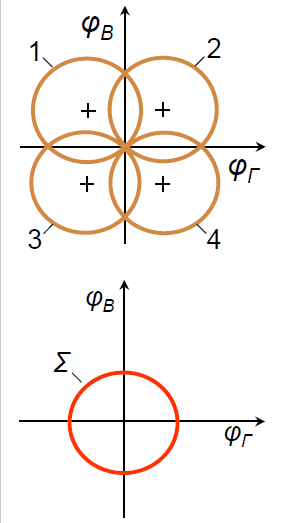
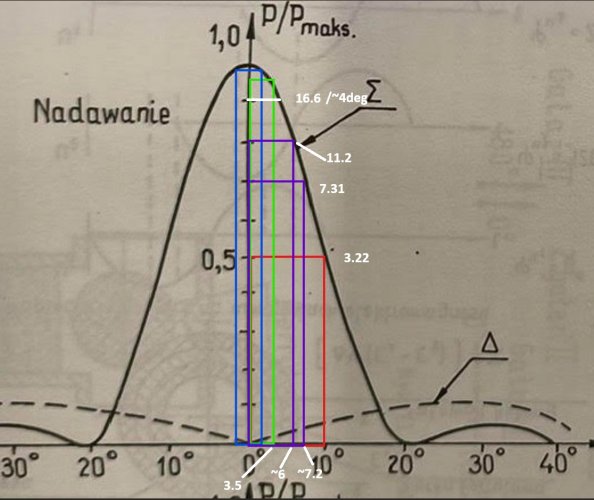
Other option is that interleaved mode works until impact. Refresh rate 1s is enough several km before impact. But as missile is closer and closer to target signal is much more stronger. For example signal in range 5km is 25x (or +7dB) stronger than at distance 25km, and 100x (+20dB) stroger than at distance 2.5km ; on distance 1000m is 625x (or +55dB) stronger and on distance 250m 10000x (+80dB) stronger. So from very close distance - sidelobe emission from radar should be taken in account. Or maybe some horn emitter? (But according to my knowledge N-019 does not have any). Or radar can shift somehow emitted pattern slightly? N-019 has amplitude mono pulse array, with 4 horn emitters shifted slightly in angle. When signal is emitted (or received) via all horns its effective signal forms 3.5 beam :
But if it is possible to pass signal to one of horns - this allows shift emitted signal up to 3.5 deg. By definition, beam-width is angle where power of emitted signal is lower by 2 than in the central point. But this not means that aside of beam width - signal is zero. It drops fast but aside beamwith still some signal is emitted. First null is 2x antenna beam width
All in all, In such case scanning zone can be moved +/-7 (2x3.5) deg eitther side without dropping illumination signals more than by 2 what is more than acceptable. That would give scanning area ~15deg, or even somehow more - if some more drop of emitted energy is acceptable.
In case of any illumination arrangement: assuming that radar refresh/illuminate period is let say 1s, there are "gaps" when signal is below threshold detection. But as missile closes a target those gaps are more and more narrow.
After that - radar goes to mixed mode, with interleaving in time : precise tracking/(missile update/illumination*) of main target and scanning/tracking with SNP.
So from very close distance - sidelobe emission from radar should be taken in account. Or maybe some horn emitter? (But according to my knowledge N-019 does not have any). Or radar can shift somehow emitted pattern slightly? N-019 has amplitude mono pulse array, with 4 horn emitters shifted slightly in angle. When signal is emitted (or received) via all horns its effective signal forms 3.5 beam
"
Im Gegensatz zu anderen Funkmeßvisieren der Jagdflugzeuge der NVA
bleibt beim Funkmeßvisier N-019 nach dem Übergang zum Zielbetrieb
auf eines der im Ortungsbereich vorhandenen Luftziele die Information über die anderen Luftziele erhalten, was die Beurteilungder Luftlage auch in dieser Betriebsart gewährleistet. Das trifft
auch dann zu, wenn eine Rakete R-27R gestartet wurde, weil dann
ein ständiger schneller Wechsel zwischen Zielbeleuchtung und
Zielbetrieb erfolgt, der sich auf die Darstellung nicht auswirkt."
"
Unlike other radar sights used on NVA fighter aircraft,
the N-019 radar sight retains information about other targets within its detection range after switching to target mode, thus ensuring accurate assessment of the air situation even in this mode. This also applies
even when an R-27R missile has been launched, because then
a constant, rapid switching between target illumination and target operation occurs, which does not affect the display."
I am not quite sure this is saying what would be the most optimistic reading. In SNP after 3 scans it continues extrapolating the target for 12 seconds. What section is this in? It’s possible it extrapolates normal contacts as well. It is confusingly worded.
Under STT, it will re engage SNP (which turns off if the “soft lock” is broken) and continue extrapolating the target for 12 seconds as well, perhaps this is what it is alluding to “after target mode/R-27R launch.” That when lock is broken, anything detected within the extrapolated area is considered the same track rather then a new one and instantly marked for attack if it’s in the extrapolated area of your last target’s velocity vector.
AIM-54/F-14 isn’t the best comparison becuase those are Fox 3 missiles and R-27R SARH. Thus the F-14 isn’t really tracking each target but doing a multi bar scan pattern and sending datalink signals to AIM-54 using the closure+range+extrapolation of each target as they are scanned in the multi bar pattern.
If N-019EA had such a mode, it would be mentioned in Polish radar documentation or referenced in other manuals. I will share these with you if you like. Of course, MiG-31 and Su-30SM/2/35S/MiG-31 are able to do this via PESA electronic scanning.
can't believe what did you write. Friend, there is no more STT after AAM is launched. STT is nothing but lock-on mode,nothing else. STT mode works only with monopulse tracking and if you had read a MiG-29 FM ,R-27R/R1 uses quasi-continuous tracking and illuminaton of the engaged target. Quasi-continuous mode is used during search/scan.
Again ,mode DNP is not STT mode,wrote that several time. Even US radars in all 4th gen fighters with mech. scanning did not use STT after old AIM-7 was launched.AAM's with INS+SARH do not need STT after launch.
Same here. Tell me, what does STT stand for? There is no mode where the radar is continuous wave, that is not what STT means that is what CW means. It needs to continue “Single target track” In order to guide and illuminate the R-27R/ER. Yes it uses quasi continuous illumination rather then CW but this in no way means it isn’t “Single target track.” There is only about 1/20th of a second between illumination intervals. It is ALWAYS monopulse because that’s the physical structure of the radar and how it successfully and accurately tracks a target in any STT mode up to 0.25 degree angular accuracy. Monopulse does not mean it isn’t STT. The pulse for guidance of 10.24 ms per PRF as it switches according to mode is the same in RNP and DNP and must pause anyways to perform PRF switching no matter the mode in order to cover blind speeds. This is why the PowerPoint lists a range for PRF of each radar mode. Every American radar is using STT to guide an AIM-7- it will say so on the top left corner of the MFD most likely I’m sorry but I think you are mixing up STT, CW, monopulse, and pseudo continuous tracking
Then I apologize it seemed from what you wrote that you were only speaking about Lazur GCI doing this. This is what you wrote “Yes ,that is in the auto mode ( guidance via Lazur/ NASU) .Radar will do automatic lock-on of course and pilot can even override that with pressing the button SBROS. Anyway , so in any case ,we have next ''SNP-RNP-DNP'' just as I described earlier.”
How to lock- on two differ targets in the same period of time ? With two differ beams? During WVR with use of the HMS also no way,maybe in the so called 'φ0' or Fi zero but I dought.
I have said before that dual target track is only possible with the variant of SNP made for MiG-29S, SNP2 as you found out yourself. It doesn’t need to occur simultaneously becuase every other fox 3 wielder in the world with dual target track and mechanical scanned radar does this by performing a scan cycle of a certain number of bars. Within this scan cycle it detects two targets and chooses them as targets to send datalink commands about to R-77 after launch. Yes you are “locked” onto two targets “simultaneously” but I don’t think it’s ever stipulated that this “lock on” CAN ONLY occur simultaneously.
It doesn’t matter if one target is detected in 1st bar and 2nd in the 4th bar or even the next scan cycle, all that matters is that at one point it detects a target with the highest speed divided by range and selects it as most dangerous target. Then when it detects more targets and calculates which one has the higher speed divided by range it’s chosen as the 2nd target for R-77 launch. The “finding” of both targets (since you hate the word soft lock) does not need to be simultaneous.
've already commented that and wrote it is wrong. No more than but exactly 8 degrees because we have that pre lock -on ''box pattern limited by 8x4 degrees''. 8 degrees by azimuth ( so it can be more than 10 km) and 4 degrees by elevation.
In case of any illumination arrangement: assuming that radar refresh/illuminate period is let say 1s, there are "gaps" when signal is below threshold detection. But as missile closes a target those gaps are more and more narrow.
Germans only got 9.12A with no more than one target attacked at a time. I am sorry it is just a misunderstanding. There is no dual target attack ability until MiG-29S was created in 1986-87 and without the Ts101 computer with double the operations per second and N-019M Topaz with the BZPP-5 radar block. Of course there are tricks that can be pulled with passive missiles such as R-27R in HOJ mode.
If N-019EA had such a mode, it would be mentioned in Polish radar documentation or referenced in other manuals. I will share these with you if you like.
German text is somehow surprising. What it means - I left interpretation to you.
As you know R-27R/RE has INS support and target does not need to be illuminated all the time since launch. We know that this is not necessary at the beginning. And this may be up to 60, or maybe 70 percent of trajectory (for long shoots, for closer this percent will be lower).
This lefts some space for speculations: for example to exploit radar in different way during "INS guidance", for example to update positions of other targets - to enhance situational awareness.
Going further, In the next step - illumination of the target is necessary, but (maybe) can be somehow interrupted (for example from 60% to 80 -90 % of trajectory). This also left some room for speculations.
The less probable is that radar will work in "interrupted mode" until end:
Do you suggest that illumination(30ms)/tracking(20ms) sequence is done while regular scan pattern? In all phases from beginning till impact? This would mean that target is effectively illuminated only when the main beam* passes over target.
(*it may be somehow "widen", as I described in before - but this is just speculation. No proof that illumination beam can be directed to selected of horn).
And maybe via let say "side-lobes" when missile is very close to the target?
Well, this sounds unlikely:
First of all - may decrease kill probability
Also this seems to somehow illogical... what about the main target's position update? Is it done using mono pulse technique? When? while scanning? And If this is the case, and if precision is enough for the main target tracking and missile corrections, why to bother with locking target before? And maybe better just to start with SNP, if SNP is precisely enough?
According to my understanding - mono-pulse tracking uses different circuits, for precise tuning to frequency (filters), distance (range gate) and angle; separate waveform. And this takes more time than available during scanning.
All in all I will stop, more or less probable, speculations. Only manuals/documents/testimony will tell. So I will stop here.
German document , OCR based.
BTW - it explain slightly better some details, like switch SNP/PPS-EPC
Some foreword to document:
"
... The present study material is based on excerpts from the technical
description and methodology of the combat deployment of the
MiG-23ML fighter aircraft, as well as a preliminary translation of the manual
for the use of the "SUW-29" weapon control system, prepared by the Air Engineering Service
of the Air Force/Air Defense Command, which was specially edited for publication."
Document dated on 23.05.1989
Attachments
Visiersysteme der Jadgflugzeuge MiG-23ML und MiG-29_OCR.pdf
You've forget that AIM-54 has combined INS+SARH+ARH. First phase after launch is inertial phase than SARH phase ( during both of them MCGU- mid course guidance unit/RC channel can be used if I remember well), than as terminal phase is in fact ARH.
Same here. Tell me, what does STT stand for? There is no mode where the radar is continuous wave, that is not what STT means that is what CW means. It needs to continue “Single target track” In order to guide and illuminate the R-27R/ER. Yes it uses quasi continuous illumination rather then CW but this in no way means it isn’t “Single target track.”
STT or single target track is nothing but lock-on mode,nothing else. STT is done only by monopulse tracking method. That's it. Mode DNP is not STT ( how many times I mentioned that). DNP is the MTT ( multi target track), where radar scans the given zone ( where engaged target is ) ,tracks engaged target and illuminates him. All of that is done by quasi-continuous tracking method. All of that is described e.g. in the MiG-29 FM.
Btw, quasi-continuous method is used only in the search/scan modes like DNP is . It is simple as that.
If you really think that mode DNP ( again, descrete continuous illumination), which starts after R-27R/R1 is launched is STT mode only , where only one, only engaged target can be tracked and than illuminated ,I don't know what to say,what to write. I'm finnished with other comments and explanations.
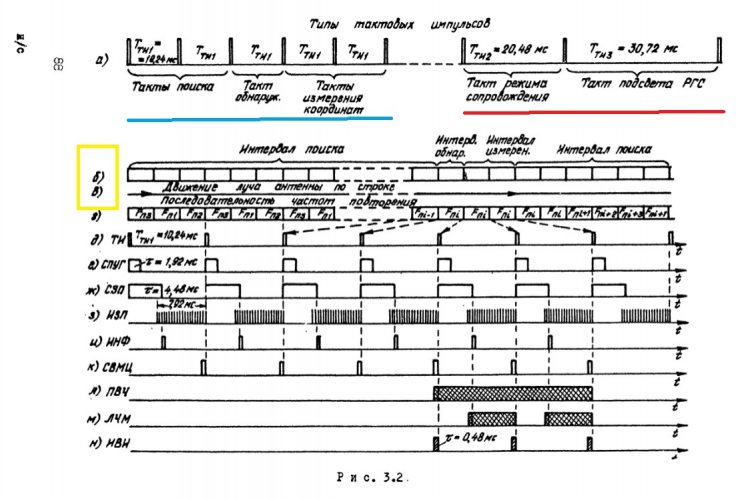
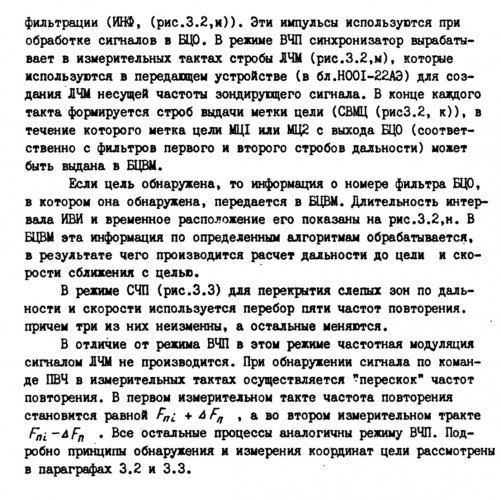
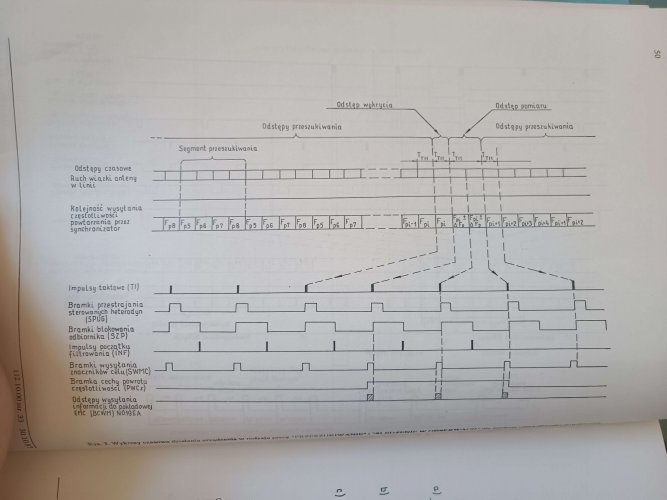
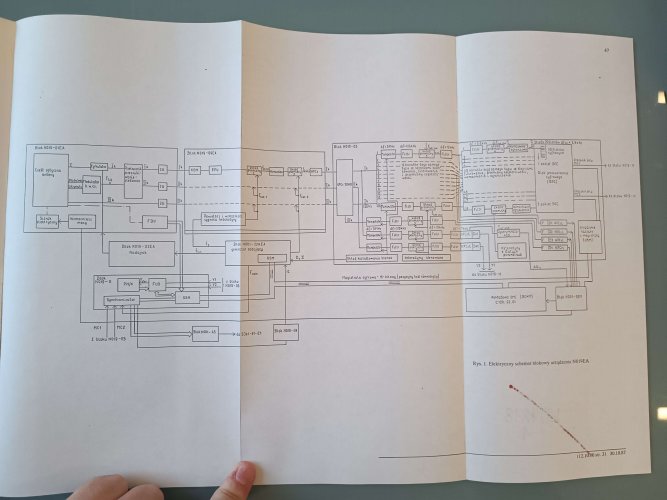
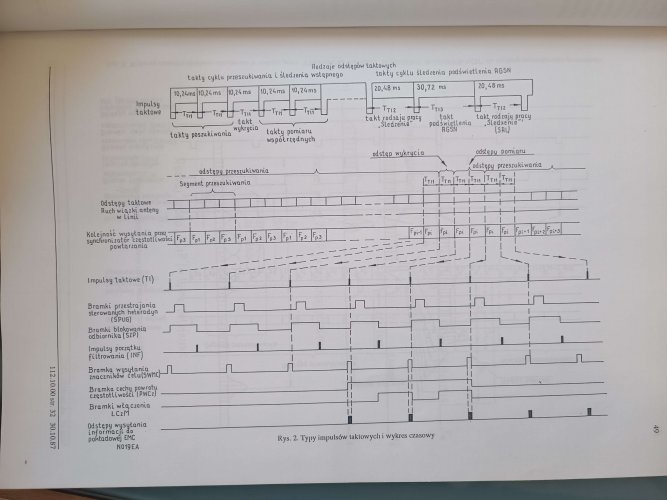
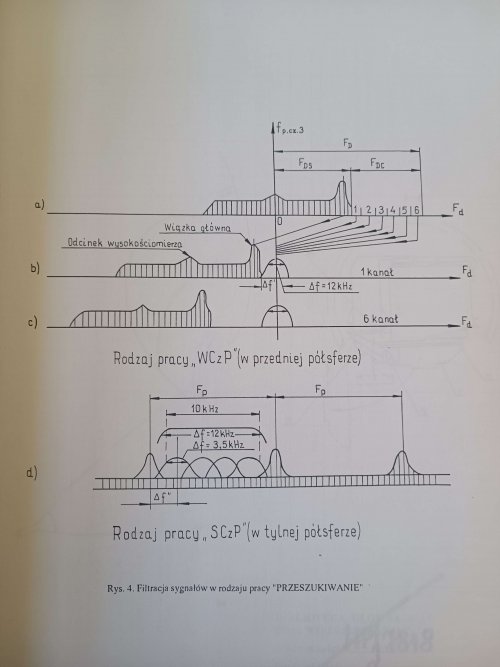
In the meantime ,some interesting details. We have here some very important things like how N019 really works during search/SNP ( V/D) ,lock-on/RNP and tracking/illuminating engaged target with radar guided AAM /DNP mode.
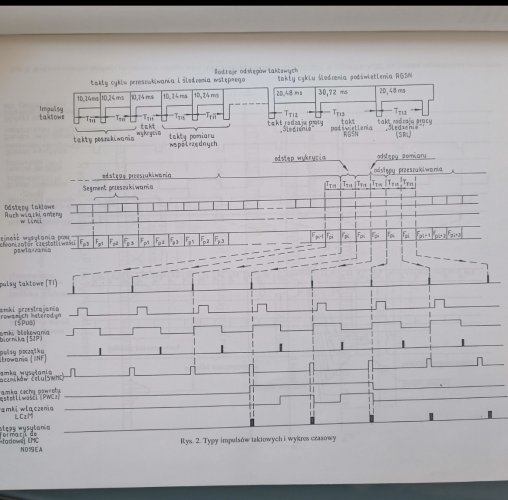
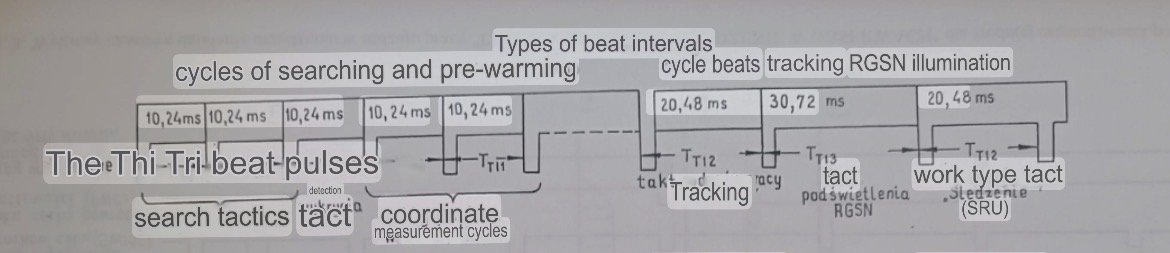
First we have ''a'' with title 'Types of the tacts pulses'. Tact of the search, tact of the detection and tact of the coordinates measuring lasts 10.24ms ( underlined with the blue line) . Tact of the tracking mode and the Illumination mode last 20.48ms and 30.72ms respectively ( underlined with the red line).
Now this is important, letters 'b' and 'v' ( Russian cyrillic alphabet) in the yellow rectangular :
Under the letter 'b' , we have so called intervals and there is search interval,detection interval,coordinates measuring interval and ( very important now) ,another search interval where Tact of the tracking mode and the Illumination mode are part of .
More important is what is described under the letter 'v' . It is function of the radar beam movement in the bars/lines.We can see that second search interval ( meaning DNP mode) has function of the radar beam movement.So during DNP mode, radar scans the given zone,mentined so many times, only the zone where engaged target is.
In the SNP ( V/D) or in the AVT as all search modes ,radar beam has function of the movement(radar is scanning). In the RNP as the lock-on mode ,after that pre-lock 8x4 scan box pattern ,radar beam has function to 'track' only one ,given target w/o scanning the given zone. So radar has no capability of searching/scanning.
In the DNP mode ,radar beam has function of movement not only to track engaged target but to scan given zone in which engaged target flies. RC-channel coded signals in the meantime will be sent via sidelobes.
RC-channel mode.
Бортовой комплекс самолетовождения, прицеливания и управления вооружением самолета МИГ-29Б
Do you suggest that illumination(30ms)/tracking(20ms) sequence is done while regular scan pattern? In all phases from beginning till impact? This would mean that target is effectively illuminated only when the main beam* passes over target.
(*it may be somehow "widen", as I described in before - but this is just speculation. No proof that illumination beam can be directed to selected of horn).
And maybe via let say "side-lobes" when missile is very close to the target?
Well, this sounds unlikely:
First of all - may decrease kill probability Also this seems to somehow illogical... what about the main target's position update? Is it done using mono pulse technique? When? while scanning? And If this is the case, and if precision is enough for the main target tracking and missile corrections, why to bother with locking target before? And maybe better just to start with SNP, if SNP is precisely enough?
According to my understanding - mono-pulse tracking uses different circuits, for precise tuning to frequency (filters), distance (range gate) and angle; separate waveform. And this takes more time than available during scanning.
All in all I will stop, more or less probable, speculations. Only manuals/documents/testimony will tell. So I will stop here.
I hope you will understand now. ''illumination(30ms)/tracking(20ms) sequence'' is in fact part of the search interval of the DNP mode. So yes, it is done during 'DNP scan pattern'.
Mono-pulse technique is used only during RNP/lock -on mode. During DNP is used quasi-continuous method of target tracking ,so for the main target position update and possible use of the RC channel. Keep in mind that in the case of very strong /active jamming ,pilot will probably not use RC-channel at all.
You've forget that AIM-54 has combined INS+SARH+ARH. First phase after launch is inertial phase than SARH phase ( during both of them MCGU- mid course guidance unit/RC channel can be used if I remember well), than as terminal phase is in fact ARH
Incorrect. It is SARH if Tomcat goes into STT. Under TWS shot it is datalink/ins and ARH at terminal. The pilot can choose if they want SARH or ARH. I mention only datalink > ARH becuase we were discussing multi target attack, which is not possible with Single target track.
Mode DNP is not STT ( how many times I mentioned that). DNP is the MTT ( multi target track), where radar scans the given zone ( where engaged target is ) ,tracks engaged target and illuminates him. All of that is done by quasi-continuous tracking method. All of that is described e.g. in the MiG-29 FM.
You have no sources for this. Target tracking is ALWAYS quasi continuous as there is no CW emitter onboard. Quasi continuous or pseudo continuous does not mean there is scanning period between tracking/illumination but only that the signal is interrupted at certain points (to send out datalink/illumination, PRF switching, etc).
If you really think that mode DNP ( again, descrete continuous illumination), which starts after R-27R/R1 is launched is STT mode only , where only one, only engaged target can be tracked and than illuminated ,I don't know what to say,what to write. I'm finnished with other comments and explanations.
the DNP mode ,radar beam has function of movement not only to track engaged target but to scan given zone in which engaged target flies. RC-channel coded signals in the meantime will be sent via sidelobes.
So in RNP it can only do one thing but both track illuminate send out datalink and scan other targets in DNP? How are these targets shown on display exactly?? It only shows one target guidance circle for 9.12/9.12A/9.12B/9.13. The technical manual makes very clear what the display shows. No manual shows the ability to display extra targets while guiding a R-27R. I wonder why. There are pictures of every display mode. If this mode existed no manual shows how it would display these extra targets during missile guidance, or it’s….. tracking targets for no reason. There is only one target circle for 9.12/9.12A/9.12B/9.13, and RNP/DNP is not showing a B scope.
And tell me how does “quasi continuous” wave form even track the target? It can’t. Mono pulse is the reason you can have 0.25 degree azimuth accuracy. Monopulse is the reason you can know if your radar dish is on target and how off it is. The only other way to do this for mechanical scan is conical scan, and this isn’t that.
Quasi continuous means exactly that, it’s not a continuous signal but interrupted. There is no way for it to continue tracking of the target for R-27R illumination this way becuase if it was quasi continuous without monopulse you would get only range and closure info with absolutely no idea where the target is or what direction it is moving within the 3.5 degree beam width. Pseudo continuous was required because they did not want to add a CW horn, and thus needed gaps in the transmission for datalink illumination and tracking. It’s that simple. Unlike F-4/14 which have separate illuminator for radar tracking and CW horn illuminator for SARH.
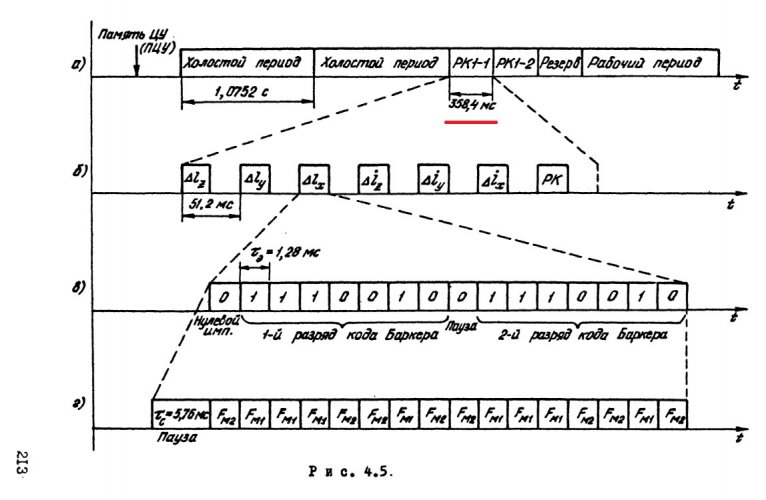
The picture you have posted isn’t saying a search cycle precedes every illumination cycle during DNP, it is showing you the progression of target tracking as it detects a target 3 times to get coordinate info, switches to RNP then DNP for missile guidance. No where in text is this disputed. The chapter on this is about search modes, and the text you highlighted as yellow basically says as much. Go through the different letters explained in the text for that chapter and every single one is a search mode. The part you underlined as red. Notice how the timing of its illumination/tracking period is no where to be seen in the rest of the figure. The chapter it is from explains this.
Your second picture, the red underline is under the first datalink period. Followed by the second. Then a short off period then back to tracking/illumination. That’s why it says a “single period” is 1.0752s becuase under datalink that is the transmission cycle in DNP when datalink is needed. As soon as “turn on seeker” command is sent it no longer needs these 1-2 352 ms datalink periods. All the stuff under that is just the barker code transmissions inside each datalink period.
Lukas, just wait a moment, it’s quite a few pages.
Incorrect. It is SARH if Tomcat goes into STT. Under TWS shot it is datalink/ins and ARH at terminal. The pilot can choose if they want SARH or ARH. I mention only datalink > ARH becuase we were discussing multi target attack, which is not possible with Single target track.
And ? So AN/AWG-9 has separate illuminator for radar tracking ( searching ) and CW horn illuminator for SARH/ CWI . Where is the STT ( lock on mode) in that case anyway if one illuminator can do the search and other can do only CWI of engaged target ???
Did you see those graphs anyway ? Did you realise that ''Tracking mode tact'' and the ''Illumination mode tact'' belong to the ''Interval of the searching /scanning'' ??? Did you see that function of the radar beam movements anyway ?
And tell me how does “quasi continuous” wave form even track the target? It can’t. Mono pulse is the reason you can have 0.25 degree azimuth accuracy. Monopulse is the reason you can know if your radar dish is on target and how off it is. The only other way to do this for mechanical scan is conical scan, and this isn’t that.
Man, if you as I wrote ,think that radar works in the STT mode ( that is and it can be only lock-on mode), after AAM with inertial +SARH, I am done with you. You are living in the 1950's and 1960's because the AAM with inertial+SARH is not one 'radar beam riding missile'.
AAM's with inertial + SARH ( guidance) do not need the STT mode after they are launched. Period.
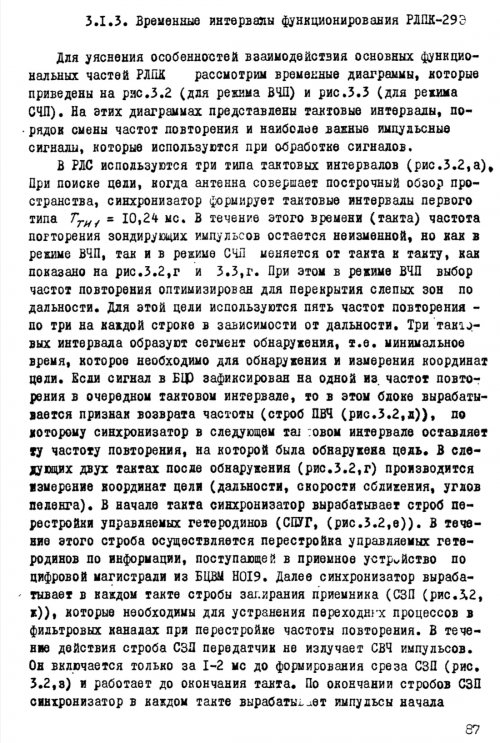
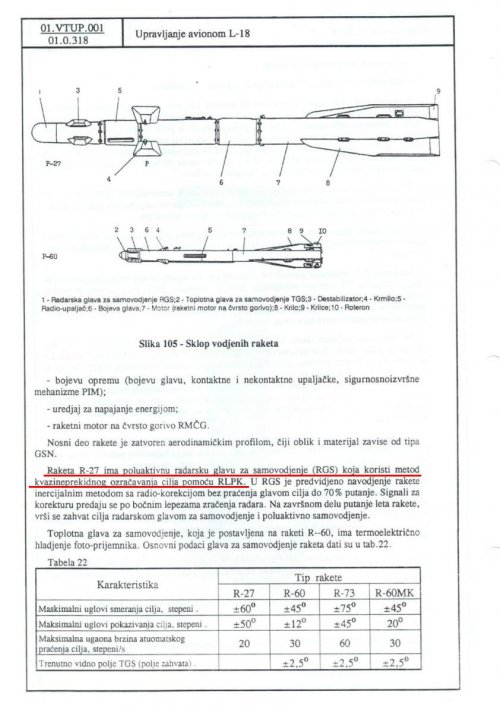
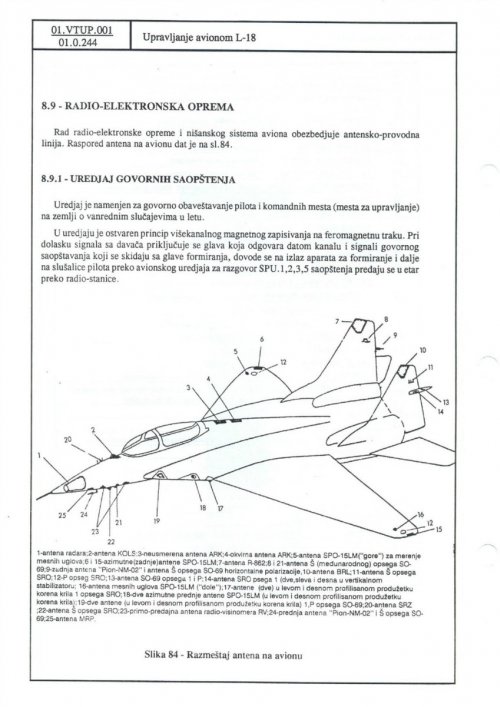
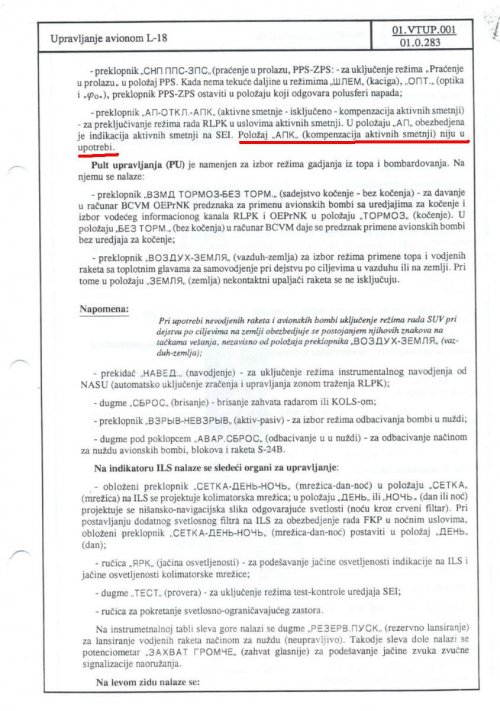
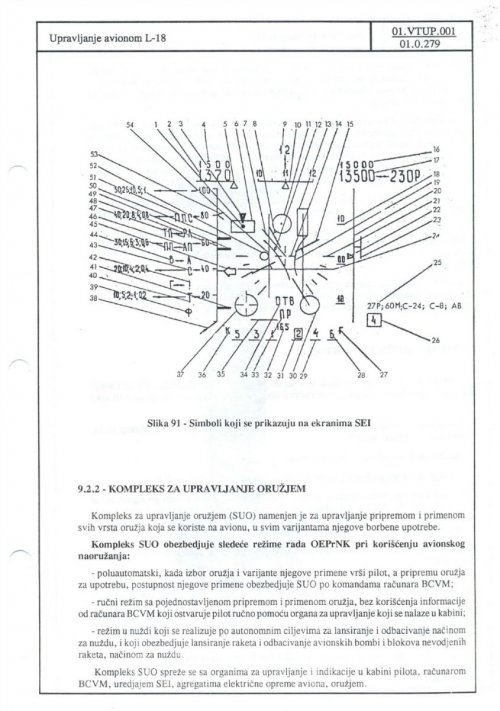
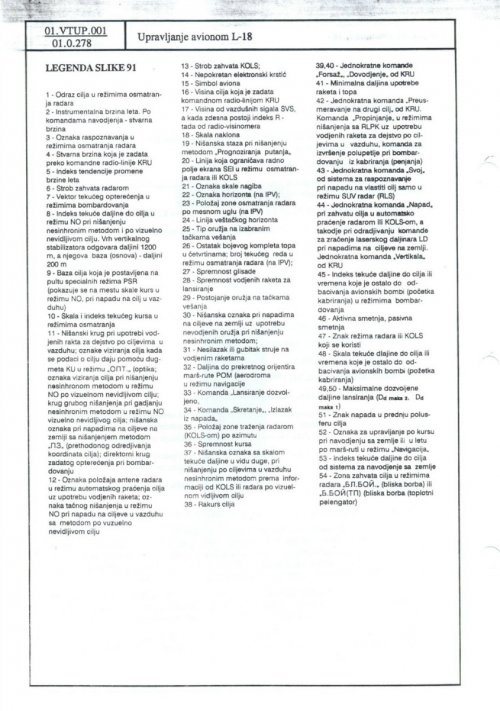
Btw ,this page is from the former Yugoslav AF L-18 ( local military designation) of the MiG-29B Flight Manual.It is called ''VTUP L-18''. I have both 'paper' and the 'comp' version of this translated FM from the original MiG-29B/9.12B FM written on Russian language.
Underlined red : ''Missile R-27 (R1) has semi-active radar seeker which uses quasi-continuous method of the target's illumination by the radar.''
And ? So AN/AWG-9 has separate illuminator for radar tracking ( searching ) and CW horn illuminator for SARH/ CWI . Where is the STT ( lock on mode) in that case anyway if one illuminator can do the search and other can do only CWI of engaged target ???
Tell me, how does a CW illuminator with a wide field of view track the target? It can’t. It’s only there for missile illumination and never pauses to recieve reflections and no ability to find target angle.
This is why flood mode works without designating a target. You still need the radar to track the target if you want to know where it is
OR use the Sparrow F/M/MH/P or AIM-54 Phoenix with PD illumination which roughly doubles seeker range which almost anyone would do unless they were forced to use an older sparrow that does not support PD illumination. The Phoenix doesn’t use the CW illuminator at all.
Even worse? To make flood mode work, you need to know approximate speed of the target and input it. This is becuase the radar tracks the target and tells the missile “I’m using this frequency/PRF so look for this value to find the correct target” so that you have a chance to target the correct target. R-27R is a step ahead here despite not having a true flood mode, it is sent the target parameters both before launch and after by datalink if the shot is far enough.
Did you see those graphs anyway ? Did you realise that ''Tracking mode tact'' and the ''Illumination mode tact'' belong to the ''Interval of the searching /scanning'' ??? Did you see that function of the radar beam movements anyway ?
Like I said, read the whole chapter and maybe the ones after. It has a very specific structure where it explains search modes, then how they work, then explains RNP and how it works, then a whole chapter on R-27R guidance. The graphic of the target illumination sequence is there only as an example of radar operation when switching from search to tracking, nothing in the text supports an alternate interpretation and says otherwise. I don’t need to read you I need to read the manual to find out what it means. Like I said, the whole chapter and next half a dozen chapters cover search modes and thus why it mentions beam scanning.
There is no such thing as quasi continuous tracking, it is a type of radar wave that is just an interrupted Continuous Wave signal. Do you know what DNP stands for as well? Discrete continuous illumination mode.
Where did you get this idea? The missile seeker sees the reflection of the radar illumination or jamming signal and homes on that using proportional guidance. No beam riding required. Every SARH fired from mechanical scanned radar needs the target to be illuminated and to do this the radar needs to also track the target, unless it is in HOJ mode or using reflections of a CW horn in flood mode, or in R-27Rs case even using radar sidelobes at short ranges in search mode to illuminate the target.
this page is from the former Yugoslav AF L-18 ( local military designation) of the MiG-29B Flight Manual.It is called ''VTUP L-18''. I have both 'paper' and the 'comp' version of this translated FM from the original MiG-29B/9.12B FM written on Russian language.
Quasi continuous means just that, the signal is interrupted. You were not able to answer how such a waveform is able to track a target by angle, it can only track range and closure.
Find somewhere that says it can perform angular tracking and replace mono pulse functions. I don’t think you will.
Notice the quote from the manual you
Underlined does not say “quasi continuous tracking” but “quasi continuous illumination.”
I wish you the best as well, I have nothing against you I only wish for future readers of the thread to not be misinformed.
Here’s a description of quasi continuous from an academic paper
“
Introduction
Quasi-continuous wave radar is a new radar system that has the advantages of both
continuous wave radar and pulse radar [
1
]. It uses pulse waveform with a working ratio
close to 50%, which solves the problem of transmitting and receiving isolation of continuous
wave radar, increases the operating range of radar, and overcomes the shortcomings of
high peak power of pulse radar, with low interception rate and anti-active jamming ability.
Its advantage lies in the method of truncating the phase-modulated continuous-wave
(CW) signal with appropriate sequence to form a large-time wideband wide-product
expanded spectrum signal, which not only retains the main advantages of CW radar, but
also has high range and velocity resolution and solves the problem of transmit–receive
isolation of CW radar [
1
]. Due to the large duration of the signal, the coherent processing
time of the radar can be increased, and the distant target can be found with lower radiation
power. At the same detection distance, the transmitting power of this radar is low, so it
has low interception probability performance and good electromagnetic compatibility. In
receiver, it adopts the method of pseudo-code matching filter for correlation processing,
and has a strong ability to resist active and passive interference”
More than fifty years ago ( so half a century), there was one Soviet fighter with then LPRF only, pulse radar with of course mechanical scanning .That radar has two channel transmitter, one, the main for the search ( scanning) ,other known as the KNP or on the Russian ,КНП-канал непрерывного подсвета ( continuous illumination/CWI channel ).Main channel was used not only for the scanning but also for the lock-on of the 'most dangerous target'.That mode ,lock-on mode was of course STT / single target track mode or the mode in which radar is capable to track only one ,given target that is designated for the engaging.During STT mode ,there was no possibility for scanning the air space sector of course.
Now after the radar guided AAM with SARH in the terminal phase was launched ( one was first in the world with the monopulse seeker) ,radar's second channel of the transmmiter ( KNP) would be activated.Its only job was to illuminate engaged target for the SARH phase of the launched AAM. The main one would continue for search,so scanning given sector of the air space.
Now guess which fighter,radar,AAM were that ,practically 50 years ago with only one question. Where was your STT mode even than , half a century ago in the case where given AAM with SARH was launched ???
You don't have to remind me what that means because I mentioned that so many times.I also mentioned that DNP ,btw starts immediately after R-27R/R1 is/are launched, is some sort of scanning/searching not STT mode. It is described by the book which link I posted here. It is clear that tracking mode tact and illumination mode tact, together belong to the search interval of the radar N019/E.
I apologize if I wasn’t clear but what I’m saying is it’s a radar which uses monopulse for direction/LOS rate accuracy and a quasi continuous waveform becuase there is no continuous wave transmitter on the aircraft thus combining the illuminator and radar tracking into one transmitter.
The tracking by angles is done via monopulse using a quasi continuous waveform for the sake of R-27R/ER guidance. This quasi continuous waveform is measuring range and closure like most other radar waveforms, but only becuase of monopulse can the target be tracked in “angles” to quote the MiG-29B technical manual. If it wasn’t monopulse, it would need to use conical scan to find target position with accuracy and know what direction to move the radar to maintain tracking.
You could also say “tracking is done by transmitting a quasi continuous waveform, then using monopulse tracking on the received pulses with FM range finding for range and closure.
It can track only by angles using monopulse fine (lock onto jamming strobe), but it can’t track with only range/closure info
The tracking is using monopulse for angle measurement and the quasi continuous waveform of various PRF to measure closure and range and illuminate/datalink R-27R/ER
R-27R/ER is receiving quasi continuous waveform, using that to find closure and range, and monopulse antenna to find the angular position of the target and its LOS rate. Monopulse angle tracking only if using HOJ.
German document , OCR based.
BTW - it explain slightly better some details, like switch SNP/PPS-EPC
Some foreword to document:
"
... The present study material is based on excerpts from the technical
description and methodology of the combat deployment of the
MiG-23ML fighter aircraft, as well as a preliminary translation of the manual
for the use of the "SUW-29" weapon control system, prepared by the Air Engineering Service
of the Air Force/Air Defense Command, which was specially edited for publication."
Here is a scattering of radar docs. There may be some duplicate Polish docs and some may be hard to read. I threw in the PowerPoints translated and original, C100 stuff, section of MiG-29B tech on R-27R guidance, and 2 Russian RLEs on radio avionics. https://drive.google.com/drive/folders/1ObwMYtFdqPEZ3vNZWH0FeiMGHjiVCXfH
Here is a scattering of radar docs. There may be some duplicate Polish docs and some may be hard to read. I threw in the PowerPoints translated and original, C100 stuff, section of MiG-29B tech on R-27R guidance, and 2 Russian RLEs on radio avionics. https://drive.google.com/drive/folders/1ObwMYtFdqPEZ3vNZWH0FeiMGHjiVCXfH
Thank you Gloria very much. I downloaded Polish and soviet documents . I can manage Polish, na pewno. However in this polish scans there is no “illumination mode” described. But all in all this helps a lot in understanding how this radar works.
Thank you again.
Maybe in couple of days I will write some post with some summary of all evidences for topic “track and illuminate while scan” I actually was written some text.. but need to correct them.
Thank you Gloria very much. I downloaded Polish and soviet documents . I can manage Polish, na pewno. However in this polish scans there is no “illumination mode” described. But all in all this helps a lot in understanding how this radar works.
Thank you again.
Maybe in couple of days I will write some post with some summary of all evidences for topic “track and illuminate while scan” I actually was written some text.. but need to correct them.
Yes I don’t think the person who photographed these was able to get that chapter or upload it. The PowerPoint and MiG-29B technical manual shared previously will be your best bet as they both describe the illumination modes. The R-27 manual in the same google drive link is from the 29B technical manual and will mention the illumination > tracking > datalink > illumination cycle quite a bit.
The 29B manual basically calls any STT mode “continuous direction finding (RNP),” with the only changes being if the tracking cycle needs to be interrupted for illumination and/or datalink. It doesn’t use DNP at all to describe the missile guidance mode.
Thank you Gloria very much. I downloaded Polish and soviet documents . I can manage Polish, na pewno. However in this polish scans there is no “illumination mode” described. But all in all this helps a lot in understanding how this radar works.
Thank you again.
Maybe in couple of days I will write some post with some summary of all evidences for topic “track and illuminate while scan” I actually was written some text.. but need to correct them.
Also a few other things, a few stuff on the search waveform. And one showing how in lock the waveform is 10.24 ms periods of tracking then measurement of coordinates. Then illumination of R-27R is 20.48 ms periods of tracking/coordinate measurement and 30.72 ms of illumination, as this is without the datalink being needed at this moment.
Also a few other things, a few stuff on the search waveform. And one showing how in lock the waveform is 10.24 ms periods of tracking then measurement of coordinates. Then illumination of R-27R is 20.48 ms periods of tracking/coordinate measurement and 30.72 ms of illumination, as this is without the datalink being needed at this moment.
The 29B manual basically calls any STT mode “continuous direction finding (RNP),” with the only changes being if the tracking cycle needs to be interrupted for illumination and/or datalink. It doesn’t use DNP at all to describe the missile guidance mode.
Friend ,there is no need to complicate the thing .From the ''LukaszK'' post ( No73, from 25 Jan 2021)
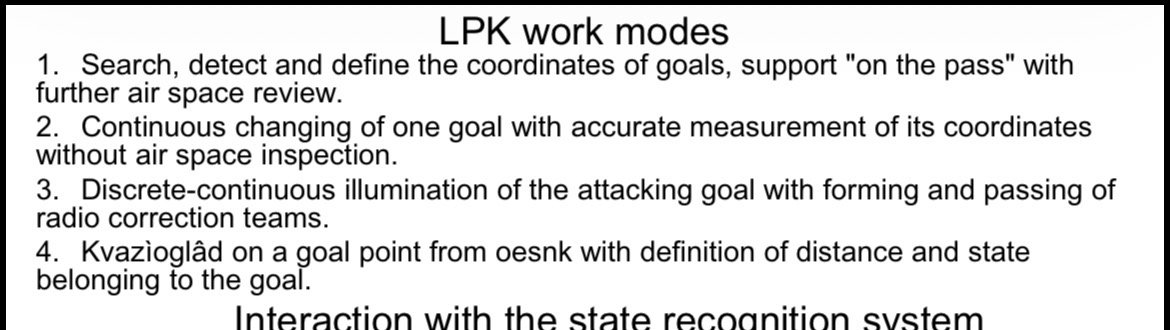
RLPK operates in the following modes:
the mode of review and detection of targets with the determination of coordinates and setting them on the SNP (tracking no more than 10 targets on the "pass");
RNP mode (continuous direction finding mode), when the coordinates of one target are determined with the accuracy necessary for the launch conditions of guided missiles without maintaining the view of space;
DNP mode (discrete-continuous illumination mode), when the attacked target is tracked and illuminated and commands are transmitted to the missile via the RK line (radio corrections for missiles with RGS);
Also a few other things, a few stuff on the search waveform. And one showing how in lock the waveform is 10.24 ms periods of tracking then measurement of coordinates. Then illumination of R-27R is 20.48 ms periods of tracking/coordinate measurement and 30.72 ms of illumination, as this is without the datalink being needed at this moment.
DNP is the mode as part of the search interval with two main tacts : tracking mode tact which lasts 20.48ms where engaged target is tracked together with other aircraft in the DNP scan zone ( if they appear anyway) and the illumination mode tact which lasts 30.72ms ( illumination of the engaged target with different working frequency used during tracking mode tact ). As it is mentioned before, DNP uses quasi-continuous mode (waveform) as it is used during search/scan.
SNP is the MTT ( multi target track ) mode. SNP as submode in fact is available only for the 'V' and 'D' combat mode but not for the 'AVT' mode. RNP is the STT ( single target track ) mode ( lock-on mode) DNP is the MTT mode also.
According to Russian pilots this mode was only found on early production Russian MiG-29s. It was a search mode, and was removed on later production batches. It was not present on any export MiG-29s. The name suggests it might have been a non-lookdown mode, but this is speculation.
'SP' means 'Svobodny Poisk' in fact not Prostranstvo ,yes , that is 'Free search'. I've found that it was HPRF mode and it could be used during high ECM environment.That mode was part of the N019 Rubin in the first about 70 produced 9.12 which we can recognise by the forward hemisphere RSBN ( Pion-NM-02) antenna below the radome and those ventral fins under the vertical stabilizers.
''The earliest production MiG-29s had ventral fins below the vertical fins and tailplanes, and lacked the fin leading-edge extension chaff/flare disepensers fitted to later MiG-29s. These early aircraft were retrofitted with broad-chord rudders and pitot-mounted vortex generators after entry service.''
https://ria.ru/20141208/1036645938.html
That mode was later abandoned and new mode was introduced AP/APK with switch on the PUR-31 panel. RSBN 'Pion-NM-02' antenna was integrated inside of the radome. Here we can see that antenna ( No 24) on the YuAF MiG-29B / L-18 'FM'.
Interestingly,mode APK ( active jamm compensation or compensation of the interference signals) was not available in the 9-12A/B ,so N019E have not that mode as usable. If pilot choose AP mode ,than during V-SNP search ,N019 could track only one target as the source of the ECM.
AP/APK mode was nicely explained in German manual:
“Passive jamming is largely suppressed by utilizing the Doppler effect and is therefore not very effective.Protection against active jamming is ensured by the "AP-OTKAZ. — APK" switch on the PUR-31 control panel. Under combat conditions, this switch should generally be set to the "AP" position when using FMVK, which allows existing active jamming to be analyzed by the computer using special algorithms.If the active jamming cannot be suppressed, then at least decoy targets are hidden, and a jamming stripe appears in the azimuth of the jamming device.When switching to target operation, the jamming device is automatically detected and tracked according to its angular coordinates.If a different target is to be engaged and the jamming stripe hinders target acquisition or tracking, the special operating mode "SNP" must be used and switched to the "APK" position (compensation of active jamming). The jamming strip becomes significantly narrower (2 to 3 times narrower), however, the range also decreases to about 50%.Under these conditions, the distance to the target must be transmitted from the ground, or, at short distances to the target, it is determined by the OEVNK-29.”
AP/APK mode was nicely explained in German manual:
“Passive jamming is largely suppressed by utilizing the Doppler effect and is therefore not very effective.Protection against active jamming is ensured by the "AP-OTKAZ. — APK" switch on the PUR-31 control panel. Under combat conditions, this switch should generally be set to the "AP" position when using FMVK, which allows existing active jamming to be analyzed by the computer using special algorithms.If the active jamming cannot be suppressed, then at least decoy targets are hidden, and a jamming stripe appears in the azimuth of the jamming device.When switching to target operation, the jamming device is automatically detected and tracked according to its angular coordinates.If a different target is to be engaged and the jamming stripe hinders target acquisition or tracking, the special operating mode "SNP" must be used and switched to the "APK" position (compensation of active jamming). The jamming strip becomes significantly narrower (2 to 3 times narrower), however, the range also decreases to about 50%.Under these conditions, the distance to the target must be transmitted from the ground, or, at short distances to the target, it is determined by the OEVNK-29.”
Squirrel, I didn’t say DNP wasn’t a thing. I said MiG-29B technical manual doesn’t describe the illumination mode as DNP. Find a quote from MiG-29B technical manual and I will retract it.
tracking mode tact which lasts 20.48ms where engaged target is tracked together with other aircraft in the DNP scan zone ( if they appear anyway) and the illumination mode tact which lasts 30.72ms ( illumination of the engaged target with different working frequency used during tracking mode tact )
A. How are these other aircraft shown on the HUD while R-27R is guided? Why does not a single document describe this or how it is displayed?
B. What is the tactical use? MiG-29 is designed to attack one plane at a time. Why reduce update rate to find new planes for a missile designed to pull 30 G and hit 8 G targets when your plane is supposed to destroy one plane at a time? It would be useless and detrimental to MiG-29 mission even IF it could be displayed on HUD
I’m sorry but this idea of R-27R being guided while radar searches and shows other targets that is not shown or supported by a manual is as good as MiG-29 fan fiction. How does pilot see this? Why? What do they do with it? Why decrease effectiveness of the R-27R? There is a reason Lazur/Beryuza guide you to one target, becuase you only destroy one person at a time in the cold War unless you’re an F-14 with AIM-54 or MiG-31 with R-33. And guess what, this is also why they have datalinks to show more then one target ( unlike Lazur/Beryuza on MiG-29).
I’m sorry? You attach a page from MiG-29B manual talking about the AP/APK switch! It is described in both 9.12A and 9.12B manuals. What source is there it was not on these models, which were made after 9.12 production was complete and thus benefited from all the upgrades of the early 9.12 service life such as BZPP-4D radar block?
Free space is described in Russian manual. It showed targets on azimuth vs closure. It was not a “ECCM” mode but “ECM resistant.” If you tried to lock someone, it would switch to regular RNP.
AP/APK by comparison is not a SUV mode but just adding sensitivity adjustment to deal with jamming in AP position or doing sensitivity adjustment AND adding the compensation function (turned on exclusively by compensation switch to side. This function decreases ground clutter and reduces affect of azimuth deception jammers).
The purpose of AP/APK is to also display jamming strobes on the ILS-31 HUD. If you were fighting a normal jammer you would use AP to see strobe and lock it, OFF to just ignore the strobes and lock target normally after burn through, or APK to reduce effect of azimuth jammer, see/lock the strobes, and reduce effect of ground clutter on search display.
And this talk about Pion. Do you know what Pion is? ILS/PRMG/RSBN. Not radar related at all.
I’m sorry but this idea of R-27R being guided while radar searches and shows other targets that is not shown or supported by a manual is as good as MiG-29 fan fiction. How does pilot see this?
As I mentioned so many times, pilot see on the HUD only engaged target with NAV( Marshrut) markings.That is important to keep target inside DNP scan zone. Other aircraft ( if they appeared anyway ) will be shown on the HDD.
Yes ,radar N019 searches/scans like all other radars with mechanical scanning in 3 and 4 gen fighters from 1970's while AAM with inertial +SARH flies toward the egaged target.
Question for you. How would you explain what's happening after AAM with inertial+SARH is launched toward its target ? E.g. that radar track only but only engaged target than illuminates him and so on ?
Forget that because w/o RNP mode it is impossible to achieve something like that. I already posted some nice material where we can see details about facts,intervals and function of the radar beam movements.
What makes you think this? MiG-29B technical manual stated that the IPV repeats the HUD with the addition of
1. Line showing tilt of the radar antenna in elevation compared to level on a 60 degree scale
2. The number of bar being scanned in the radar pattern
No where is there an image or description of it showing search contacts while HUD shows track, or even any evidence of it showing information on two different targets between HUD and IPV.
If you can’t show any evidence of this I can only assume there is no evidence of its existence.
I mentioned so many times, pilot see on the HUD only engaged target with NAV( Marshrut) markings.That is important to keep target inside DNP scan zone. Other aircraft ( if they appeared anyway ) will be shown on the HDD.
You have explained but that is not enough to prove its existence. What’s important to keep target tracked is not the circle but the radar diamond/rhombus as that shows the actual gimbal limits of the radar. Only the diamond allows the pilot to actually know where the target is. If you actually have proof then I will retract all I have said but it doesn’t seem like you do and this is what you “wished” it did.
Yes ,radar N019 searches/scans like all other radars with mechanical scanning in 3 and 4 gen fighters from 1970's while AAM with inertial +SARH flies toward the egaged target.
Okay….. what other mechanical scanned fighter can do this with a fox 1. I don’t know of any. What are they? Only other fox 1 with datalink I think is AIM-7P also.
Question for you. How would you explain what's happening after AAM with inertial+SARH is launched toward its target ? E.g. that radar track only but only engaged target than illuminates him and so on ?
Yes that is exactly what’s happening as described by MiG-29B technical manual and other sources of documentation.
It is meant to attack one plane at a time for goodness sake!
You fire R-27R, datalink and INS support it until seeker activation, upon seeker activation the datalink transmission stops and radar switches between “tracking/listening-processing/illumination/tracking.” With the only addition compared to RNP being the illumination part.
All while the pilot can track the targets position in space compared to their plane with radar diamond and missile aiming cue with circle, maintaining near constant illumination so the missile has constant guidance to react to target maneuvering and hit despite up to 8 G movements and pulling 25-30 G.
And I told you how those graphics were in chapters 100% talking about only search modes and the timeline of DNP shown for convenience of understanding the sequence of events. It is clear if you read the radar section of the manual before during and after the graphic you posted that no where does it say or imply “it is searching during the DNP phase.”
“Yes let’s reduce the time the R-27R is updated in terminal flight against possibly 4th generation fighters despite being designed to hit 8G targets so that the radar can take the time to scan the space around it and show this info on HDD, a process that takes 3.5s for one scan cycle when not even guiding a missile. This is a good idea even though MiG-29 is made to attack one plane at a time and ensure destruction of a fast maneuvering target.”
-Said absolutely no one ever
Pilot: “wow when I look down I can see the targets around the guy I’m trying to kill right now and doing this makes my missile unable to update faster then once every 3.5 seconds! Gee I hope they maintain their maneuver for 4 seconds atleast so my missile has a chance to hit! This is so useful! I much prefer my missile only hitting barely manuevering targets instead of having my radar illuminating the target constantly so the missile has the best chance to destroy the maneuverable target! The missile is only closing on the target at Mach 3-6 a 4s update rate should be fine even if they pull 8 G! Seeing the targets around them is totally worth the complete inability of my missile to hit maneuvering targets like 4th gen fighters!”
I was doing some research on cassegrain and came across the first page where there was some talk about Gardenia.
Reading stuff, fo MiG-29 gardenia was synced enough with SPO that it merely reduced the effectiveness of its CW detection by 80% and pulsed emitter detection by 25%. However, Gardenia was not synced with radar and would be forced into rear hemisphere mode when radar turned on.
For Su-27SK, they seemed to be unable to achieve this and it delivers junk to SPO display. It is not automatically forcing rear hemisphere mode with radar turned on like MiG-29 either, as manual instructs to manually set to rear hemisphere mode when using radar and if launching R-27R/ER to set to RECEIVE mode before launch and then back to TRANSMIT 3-4 seconds after launch (while in the rear hemisphere mode.)
I know of a 9.13 pilot who said that he would’ve happily exchanged Gardenia for more fuel.
I wonder how much better the much more modern Sorbitsiya system works with the N-001 and L-006LM
Maybe this is somehow off topic, but is seems that some kind of illumination during TWS scanning for semi active missiles was considered. Not on the East but on the West...
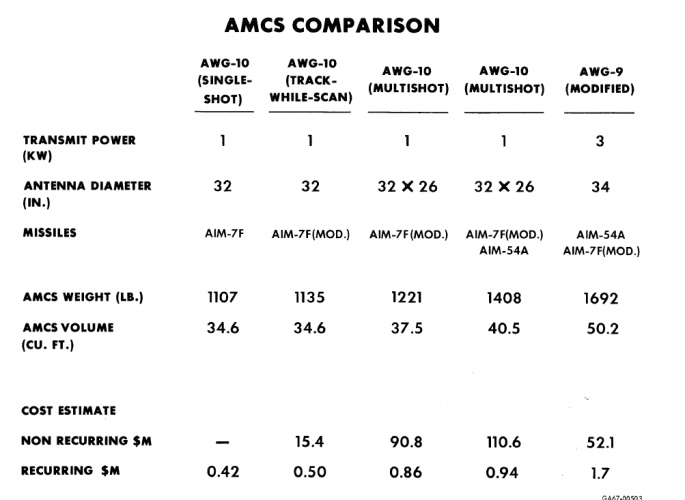
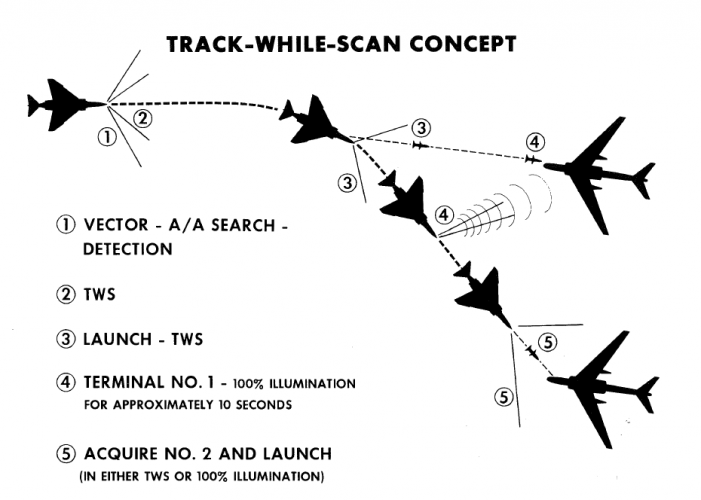
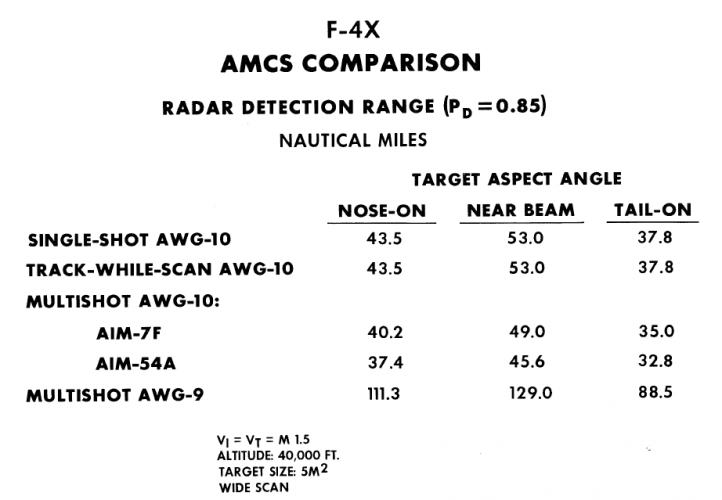
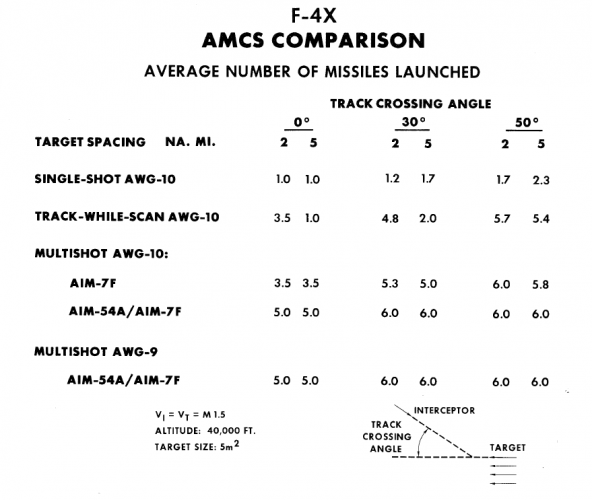
"AIM-7F Multishot was a proposal under the US Navy's F-4X program of the 1960s to equip the then under development missiles and their launch platforms with a datalink for track-via-missile guidance akin to that of AIM-54 Phoenix, which would enable multiple AIM-7 missiles to be guided simultaneously. As each missile would only need terminal illumination from the F-4's radar, it could engage multiple aircraft simultaneously as long as it kept all targets within view of its radar.[26] As this modification would have required all-new solid state electronics for the AN/AWG-10 radars on the launching F-4s, it was not pursued."
And reference is : " McDonnell, January 1967. F-4X For U.S. Navy. Retrieved 5 April 2025."
However - no link, and I have not manged to find this document.
But seems that somebody, at least consider such approach. But no details. Not sure, if they were going to illuminate one after one, in final phase(s), or rather all at once - by some wider beam.
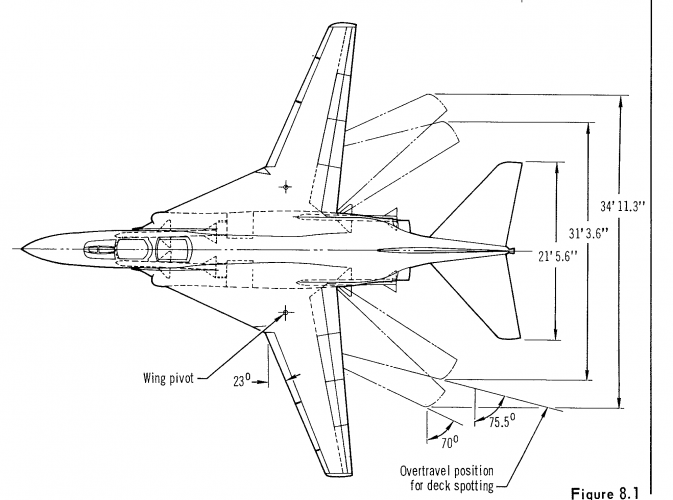
"F-4X (U.S. Navy)F-4X was a 1960s program pursued by the U.S. Navy in search of substantial upgrades to the extant F-4 fleet due to the ongoing issues with F-111B's development, as a potential alternative to what would become F-14. The fire control system was one of the main focuses of the program, with four variants proposed. The most basic was a new version of AN/AWG-10 using solid state electronics to enable track while scan operation of the radar. Beyond that was multishot AWG-10, leveraging the track while scan capability to enable multiple AIM-7 missiles to be guided simultaneously, even against different targets through the addition of a dedicated guidance antenna in the nose. The ultimate evolution of the AWG-10 was to introduce compatibility with AIM-54, as the missile was considered essential for the combat air patrol role the aircraft was to fill. A variant of AN/AWG-9 was also proposed, as it was substantially more powerful and better suited to the mission set, at the cost of requiring far more power and space than any AWG-10. All designs also added an extendable nose gear akin to that of the Phantom FG.1 for better catapult performance, and switched from a bridle to nose tow for attaching to the catapult.[36]"
"
Friedman, Norman (2016). Fighters over the Fleet: Naval Air Defense from Biplanes to the Cold War. Barnsley, South Yorkshire: Seaforth Publishing. p. 355. ISBN978 1 84832 404 6.
" One of the main limitations of the Phantom's weapons system was that the AIM-7, being an active radar-guided missile, depended on the launching aircraft keeping the target "illuminated" throughout the missile's flight.
Therefore, while multiple targets could be tracked on the display, only one could be engaged at a time. To engage multiple targets simultaneously, the Westinghouse AN/AWG-10 radar system was equipped with a bidirectional data link, the AIM-7 Sparrow III missile was integrated, and a new digital fire control computer was installed. This avionics suite was called the Airborne Weapon Control System, or AWCS, and was estimated to be able to guide up to six missiles simultaneously. In conjunction with the AWG-10, an antenna mounted in the nose and below the radar was capable of providing terminal guidance for two missiles."
Sorry for cluttering this thread... but somehow related.
Generally this refers to F-4FVS - swing wing proposal - some competition, backup project to F-111B / F-14A.
Ofcourse - it was not selected.
Generally, seems that concept is TWS system, and INS+ datalink Aim-7F.
Final illumination is provided by additional "near" antenna. Somehow directional, but seems not very narrow.
Could handle up to 6 targets with final, parallel ilumination to 2 of them.
" 4.2.2 Electronic Systems
The F-4(FVS) electronic systems provide significant increases in air-to-
air performance and air-to-ground weapon delivery accuracy over the F-4J.
The systems which are not changed or changed only slightly to provide this
improvement retain current fabrication techniques. New systems or those re-
quiring major changes will take advantage of the present state of the art in
miniaturized packaging.
The primary intercept with two-way data link improvement results from
the addition of a multiple target attack capability. The F-4(FVS) Multiple
Target Weapon System is based on minimum changes to the F-4J aircraft, the
Westinghouse AN/AWG-10 missile control system, and the Raytheon Sparrow
missile. Normal evolution of these basic components produces an Airborne
Weapon Control System (AWCS) capable of detecting and tracking multiple
targets, both clustered and widely spaced. Detection and tracking of tar-
gets, preparation of the missile for launch, missile launch, and missile
guidance to target impact are inherent in this system. It is planned that
the AWCS will have data handling capabilities for up to six missiles in
flight simultaneously.
To achieve this multiple target capability, the AWG-10 analog computer
is replaced by a digital computer to provide the increased computing capa-
bility required. The Radar Intercept Officer is provided with a small
indicator in addition to a larger main display tube and a synthetic display
for complete attack information. A new (terminal illuminate) antenna is
added immediately below the AWG-10 antenna to provide guidance at a high data
rate for up to two missiles during their terminal flight period."
No, it is not and stop writing nonsense and more please friend,in the 21st century and after 50 years of ...
Now ,question for you.
Can you explain here ,how can radar ( mech.scanning) after radar guided AAM ( INS+SARH like R-27R/R1) is launched ,tracks only one ( engaged ) target and illuminate him in the situation when radar beam has function to follow only that engaged target??? So ,radar beam has no function to move by the rows.
Keep in mind that I already wrote, it is technically impossible to achieve something like that.
''Track-illuminate-track-illuminate, etc'' ( in the situation when radar beam has no function of movement by rows).
I will repeat to make it easier for you to answer, radar beam has function to follow only designated for the engagement target in the RNP ( lock-on mode). In that mode radar beam has no function of movement by rows.
So what is happening in the DNP/illuminaton mode? Be aware of that and keep in mind that N019's transmitter/TWT is dual-mode like those in the N001 and many other ''mech. scanning radars'' of the 4th gen fighters from 1970's ....
PS
In the meantime, from your own work as you mentioned :
20. Search area N-019 by elevation angle (IPV only)
28. Bar currently searched by N-019 (only IPV)
20-The line that limits the rightward working field of the SEI screen in the radar observation mode or KOLS (only IPV, displays 22 & 23 as a +/-45
degree scale)
23-Position of the radar elevation zone by local angle (only IPV)
26-Remainder of the battle set of the gun in quarters; number of the
current row in the radar observation mode (only IPV);
IPV means what ? ИПВ-1 ''индикатор прямой видимости''.
If you don't mind one another question ,pls. Why HUD/ILS-31 has no vertical line which HDD/IPV-1 has and it is designated with the No 16 ?
I will write only this time. That vertical line on the IPV-1 is what pilot can see in the DNP/illumination mode.
You mentioned YuAF MiG-29B/L-18 Flight Manual, OK than let us see it .
One of the main limitations of the Phantom's weapons system was that the AIM-7, being an active radar-guided missile, depended on the launching aircraft keeping the target "illuminated" throughout the missile's flight.
How is it nonsense if you can’t disprove it or prove your hypothesis? Or even explain why it would be beneficial to lower R-27 update rate to see other targets that can’t be attacked until lock is broken on a missile designed to hit 8 G 4th gen fighters, or how it would be displayed and why that’s helpful to show a 2D B-scope while the attacked target is shown on elevation/azimuth coordinates.
what is happening in the DNP/illuminaton mode? Be aware of that and keep in mind that N019's transmitter/TWT is dual-mode like those in the N001 and many other ''mech. scanning radars'' of the 4th gen fighters from 1970's ....
Exactly what is stated by MiG-29B technical manual and the PowerPoint. It tracks, sends out datalink, illuminates, tracks, datalink, illuminate. When datalink drop command is sent then it’s just going from “tracking” to “illumination.”
Dual mode? That does not mean what you might want it to mean. Even Su-27 can’t fire on two targets at once with N-001. The half phased array radar it was intended for could do this, but when N-001 became mechanical scan dual target attack with R-27 became impossible. This easy info to research. Soviets worked hard on downsizing Zaslon tech to make this work so that it could target 2x enemies with R-27, but it was not possible so they just upscaled N-019.
I do not know why didn’t put it on the HUD. It’s a mystery. As you have read, this line is the right border for circle/rhombus movement and the sign of N-019 antenna elevation in search mode. I don’t know how the pilot is supposed to see other targets on this while guiding a missile…….
I already translated it and sent you a link, though it is outdated and needs an update
The +/-45 degrees refers to the scale of the arrow showing antenna elevation. But I might need to correct it to 60 degrees. There isn’t really anything that directly says the number.
There is a very good reason this says “cycles of search” has a space then says “cycles of RGS Illumination.” It is not searching and tracking at the same time, or tell me why would it need to track and illuminate 2x in a row before going back to search? It says “types” of cycles not “type.”
It is not reasonable to look at a graphic that shows cycles of search and illumination, the whole rest of the page is about search mode and the whole half dozen chapters before and after about search mode only, and to then say “this obviously means it does search while guiding a R-27r at the same time despite decreasing the effectiveness of the missile and not doing this in RNP.”
One comments on concept from F-4X.
This somehow similar to claimed TWS , and illumination capability of R-27R. Similar TWS work of mode - after lauching missiles, same use of INS and datalink.
However, the main difference is additional,dedicated array to illuminate missiles in final phase: "near antenna".
Seems to be something between horn/flood antenna and pencil beam antenna. From images - something like 20 -30 deg of beam - that can be directed into targets in final phase (less than 10s). This allows for somehow directed illumination, with power density - enough for final approach of missile. But on the other hand - wide enough to "provide illumination for 2 targets in final phase."
On Mig/Su there is nothing like this second antenna.
So if on Mig/Su some illumination while scanning - is really implemented, in final phase, there is a need somehow illuminate target with some means: either by main - pencil beam, or somehow by flood beam or something like this. But there is no dedicated device for that.
Ideally it can be used the main horn for that purposes. For that - there would be a need to just to make the main, parabolic mirror (this "reverse" , fixed mirror) a transparent just for illumination phase.
And the simplest possibility would be just to switch polarization of emitted signal. This would make "mirror" a transparent.
But still emitting horn is pointed somehow downside. Another option would be a use of main beam - that is somehow 3.5 wide. But this refers only to 1/2 power level. A side - there is still several degrees with power level much above "flood antenna"
Another similarity with AMCS concept and system on at least Su is multi-targeting possibility: the same number of two targets can be engaged. At least some sources provides that possibility.
In sources - there is sometimes stated that Su-27 can engaged two targets, in other than only one. And to be clear, I am talking about using R-27R/RE, in regular Su-27S from 80tees. Just regular version.
Examples: https://www.airwar.ru/weapon/avv/r27.html
"Ракета разработана предприятием ГосМКБ LВымпел и представляет собой вариант ракеты Р-27, имеющий инерциальное управление с радиокоррекцией и полуактивное радиолокационное самонаведение на конечном участке полета. Дальность пуска 80 км. Инерциально-полуактивная радиолокационная ГСН 9Б-1101К разработана также в МНИИ LАгат. ГСН предназначена для захвата целей в диапазоне высот от 20 м до 25 км с максимальным превышением (принижением) 10 км при скорости целей до 3500 км/ч и перегрузке 8. Возможен пуск двух ракет по двум целям. Обеспечена готовность ГСН к применению через 1 с после получения целеуказания от системы управления вооружением носителя типа МиГ-29."
"The missile was developed by the Vympel State Design Bureau and is a variant of the R-27 missile, featuring inertial guidance with radio correction and semi-active radar homing in the terminal phase of flight. The launch range is 80 km. The 9B-1101K inertial-semi-active radar seeker was also developed by the Agat Research Institute. The seeker is designed to lock on to targets at altitudes ranging from 20 m to 25 km with a maximum overshoot (drop) of 10 km, at target speeds of up to 3,500 km/h and a G-force of 8. It is possible to launch two missiles at two targets. The seeker is ready for use within 1 second of receiving target designation from the MiG-29 carrier's weapons control system."
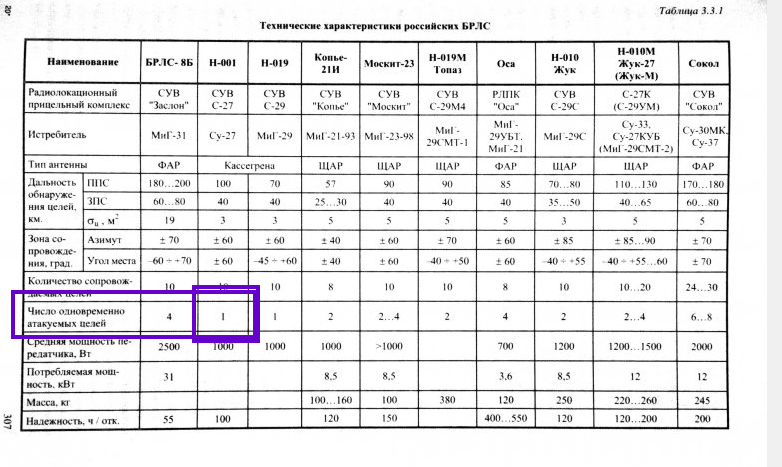
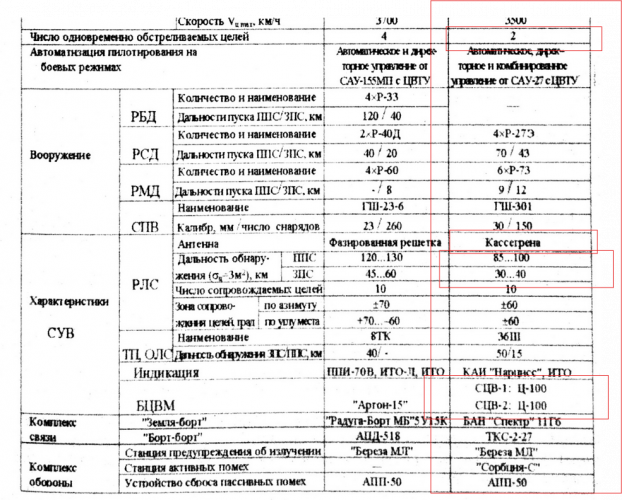
Please take a look on tables, related for Su-27...
First table - nothing suprising - just one target can be engaged:
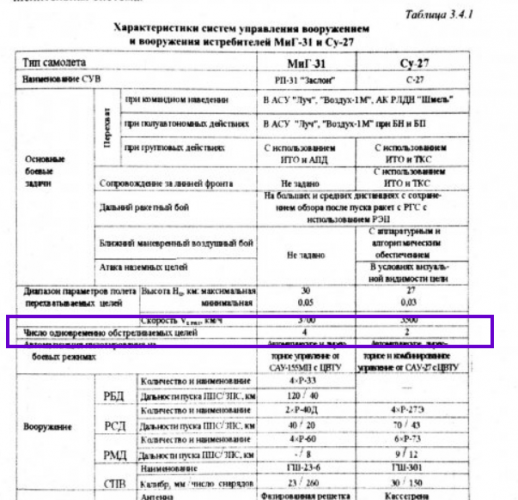
But in the same post is the second table:
It is clearly stated - number of engaged targets :2 and provided missile type R-27 "Число одновременно обстреливаемых целей"
"Number of targets fired upon simultaneously"
So, it is not so clear.
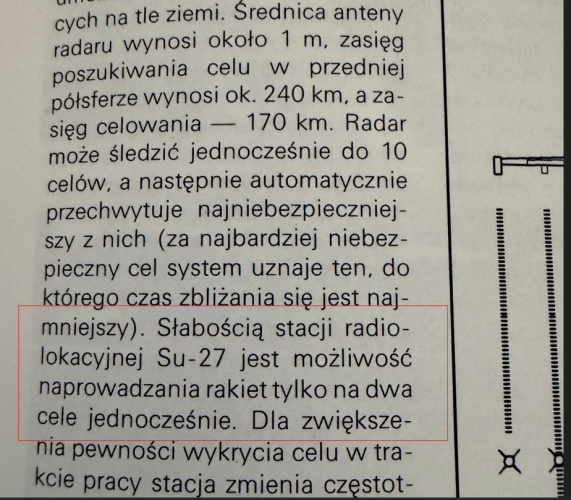
Other sources - book from Piotr Butowski, 1994 - Samoloty Wojskowe Rosji. And in section of Su-27 (basic one), it is said that:
"Weakness of Su-27 radar is possibility of guiding missiles only on two targets simultaneously"
you know ...weakness....
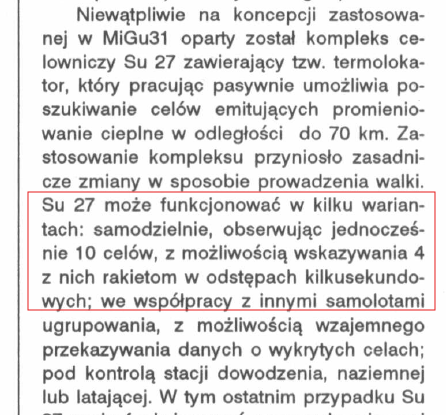
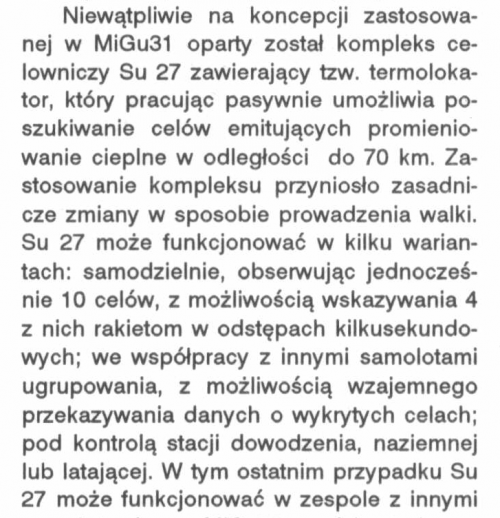
So this claims emerged in different sources. In still other sources (i will not make screen, only if you really want) - some monograph of Su-27 from 91 year, polish this one
it is claimed that it can designate up to 4 targets with several seconds intervals.
"Su 27 może funkcjonować w kilku warian-
tach: samodzielnie, obserwując jednocześ-
nie 10 celów, z możliwością wskazywania 4
z nich rakietom w odstępach kilkusekundo-
wych;"
"The Su-27 can operate in several variants: independently, observing 10 targets simultaneously, with the ability to designate 4 of them to missiles at intervals of several seconds;"
Still another source (I am writing from memory) was published in 80tee - when this plane (Su-27, 1988 or 89) was presented for west. And designer was asked to compare missile of Su (R-27) with its recent counterparts - that time it was Aim-120A that was finishing development.
And he said, that R-27 are inferior in respect to Aim-120 that they can not be launched parallel to multiple targets at once as AIM-120 can do. But he claimed that they can be lunch with small intervals of time.
So - well, there were claims that indeed at least Su-27 & R-27R has such limited, multi target possibility.
I am just wondering how this would be accomplished? Maybe:
Either - missiles are launched in some sequence.
As R-27RE had advantage in range - it could be lauched first, against the closest target. After several seconds - there would be lauched missile(s) (R-27R) against the second target. After launch - radar would work in some kind TWS updating data to missiles about two targets.
And when the first missile(s) for the first target is(are) in final part of its flight - just before target, several seconds before impact - radar switches , for couple of seconds to single target tracking & illumination of the first target, until impact.
The second target is that time not tracked, and just extrapolated.
(Maybe - data is taken , via fighter - fighter datalink from other plances - Su-27 works in common information field via TKS-2).
The second missile fly with own INS. Once the first target is engaged, radar could switch to the second - to re-find them, updates missiles - and egaged the second target.
Another option would be instant multi-target mode, with use - this scanning approach (as Squirrel claims, if this is true).
As Su- does not have any dedicated antenna for ilumination, and (if) for that just main beam is used - both targets have to be in some rather narrow field of view - to allows for frequent illumination by main beam (assuming scan line work of radar), and also by some side part of beam (less power denisty - but several degree wide).
Of course - such mode would be implemented only on Su-27. On Mig - this had no sense -as it have only pair of shorter range R-27R.
But still such scanning while tracking & ilumination would be possible. And have several advantages (maybe I will write in another post)
Of course - guess that such extended functionality would be only for Soviet Union maybe War Pac. Not to be implemented on Su-27SK or sth like this. That is maybe a reason why such mode is not present in manuals.
It is not accomplished. Do you want Su-27 manual? All modes and functions are described there. Does it mention dual target function? No it does not.
If flight manual is not trusted, it is not backed up by Yefim Gordon, Markovsky, or any of the other aviation authors that write about Su-27.
The paper you reference also lists radars like Bars, and does not list what variant of Su-27 it is. Like I said, Su-27 was originally meant to have a vertically electronically phased antenna, but it never worked out and they had to used an upscaled N-019 instead. Later variants with Bars can absolutely do multiple target attack with R-27R/ER the same way MiG-31 does so with R-33. As your source said, the “missile” is capable of it, but not all radars for it.
The N-001 and N-001E have the exact same functions. This can be easily found out from multiple sources such as books written by Yefim Gordon (who yes isn’t perfect) and Andre Formin ( who is pretty much perfect ). There is no need for speculation.
As we have discussed, if you were attacking extremely slow maneuvering targets it could be possible by reducing update rate AND being able to toggle the function with a switch or button (which dos not exist).. But guess what MiG-29S requires a Ts101 processor to do this with R-77, and Su-27/MiG-29 in service in 80s only has Ts100. If the N-019M needed a new processor to do these things, and a new processor is not needed for R-77 (J-11A), it’s probably the dual target function and range increase it needs 2x the data rate for. R-77 also has almost the same practical range of R-27R, maybe even slightly less if we don’t consider a launch from MiG-31, so there is no need for more radar range to use it. The Ts101 processor and BZPP-5 radar block was for the dual target function and the range boost a nice to have.
People, read books, they will tell you these things. There is no dual target function for these aircraft. Yes it can use its computer to extrapolate the flight course of up to 10 aircraft in search mode or its single locked target. Yes the SU wanted it to happen. But it didn’t. Reality can be depressing, except I think killing one target at a time is plenty cool enough for a 80s fighter jet
And yeah you have done some reading which is great. But that one Polish book is either mistaken about Su-27S targeting ability or referring to later variants or even the originally planned idea (it is also incorrect about the IRST range, unless it is referring to some data point not referenced in any of the manuals (Su-15 head on, Su-15 tail aspect, MiG-25 AB head on).
Your other polish source says vaguely “the weakness is ‘possibility of dual target engagement” which could easily mean “the weakness that this is as desired but did not happen.”
The whole “fire one missile before the other so its terminal phase happens before the second missile” completely falls apart under one possibility, what if the first target turns? Then the second target might be hit first. What if they both turn but the first target turns much more violently and now the terminal phase isn’t the same time and only one missile can be supported.
It is fantasy, which makes it nice to dream about I understand. But dreams are for when you sleep!
While there is one aspect in your previous argumentation which was wrong concerning the Phoenix (especially the AIM-54A) I totally agree with you. A SAHR missile requires fast update rates, especially during the terminal phase and an M-Scan radar can't provide this in TWS. Hence a need to lock on to the target. Pretending that a missile requires a lock for launch, but not for guidance thereafter is completely counterintuitive and makes no sense. But apparently people love to dream and defend their dreams, pretending that they are true. All the drivel about what's shown on the IPV, but not on the HUD proves nothing, but the desperate attempt to somehow distract from the fact that the stated wish, is nothing but smoke and mirrors. Guess this discussion can be quit, as it leads to nowhere, believers believe, that's why they are believers.;-)
In this post I will only refer comments for multi-tageting possibility in Su-27
Topic "iluminate while scan" - is somehow related, maybe I will write on them in the future (or not).
But I dual targeting might be implemented without that (as for example dual target track).
To specify my statements more clear. I am not saying that Su-27 (vanilla one) has for sure multitarget capabilities.
I want to say, that there were some sources - that stated such possibility.
The most common understanding is - 10 target tracked, single engaged. And most of sources stated like that.
But from time to time - there are claims, about at least limited multi-target capability.
And they are not consistent. Sometimes even in case of single publication.
You can ignore them, but they were.
And those claims have not emerged from creativity or imagination of authors of publication, but are after some claims from designers etc.
Below, I try to clear be consistent and separate facts from my opinion or interpretation.
No. The reference provided by Squirrel https://www.secretprojects.co.uk/threads/mig-31-avionics.153/post-860827
in topic related for Mig-31 is some print screen from some book related to radar or avionics systems.
Maybe Squirrel can help - and say what is that source, and maybe preprint other pages related to Su-27
Facts: And as I said - they are two tables provided. In the first - number of engaged targets is one.
But later - in the same book - there is stated "2". And if you look at the whole parameters, in that page - you can see parameters typical for mechanical scan "Sword". No, this is not Bars.
So no. This table refers to just "original" N-001. It is stated clearly that number of targets engaged in the same time is 2.
Opinion: That book (maybe Squirrel would help) - seems to be technical, written by some who has indeed some knowledge in that topic. This seems to not be some "western journalist", with some knowledge just heard from somebody else.
And here, in this table - he claims number target: 2.
So maybe author also did not know what he wrote.. and you know better ...
In any case, for some reason in one table - there is stated "1" and in the other table "2".
Maybe it is somehow limited tactically? Or was introduced later, not from the first series...
Your other polish source says vaguely “the weakness is ‘possibility of dual target engagement” which could easily mean “the weakness that this is as desired but did not happen.”
Fact: There is no discussion what he wrote.
Mr Piotr Butowski wrote in his book that it can engage two targets. And that is its drawback , that only two.
Drawback is that it can not engage 3 , 4 ... but only 2. Period.
That is what is written. No "says vaguely"
" Słabością stacji radiolokacyjnej Su-27 jest możliwość naprowadzania rakiet tylko na dwa cele jednocześnie."
"The weakness of the Su-27 radar station is the ability to guide missiles only at two targets at a time."
Speculation: Mr Butowski could be wrong. But I do not think he invent this statement by his own. He had to get information from some sources. And I found this author as reliable. He will not confabulate.
And yeah you have done some reading which is great. But that one Polish book is either mistaken about Su-27S targeting ability or referring to later variants or even the originally planned idea (it is also incorrect about the IRST range, unless it is referring to some data point not referenced in any of the manuals (Su-15 head on, Su-15 tail aspect, MiG-25 AB head on).
Well, I think those authors does not "invent" this statement from sky. This claims in this periodic was after some claims of designer, I mentioned. That claims were - on Paris display (1989), probably. I had this probably in another source, but it would be hard to find. And I for sure will not dig into some achieve Flight Global or sth.
And - well trying to undermine source based on IRST range, well... That time was OLS-27K or later variants ready - and they had greater range 30/40 forward and some ~70 back.
Later variants with Bars can absolutely do multiple target attack with R-27R/ER the same way MiG-31 does so with R-33. As your source said, the “missile” is capable of it, but not all radars for it.
Facts: Indeed, in source: https://www.airwar.ru/weapon/avv/r27.html, there is stated that missile has such possibility, but not refers to any supporting radar.
Opinion: Source says nothing this capability works only with PESA radars, or "not working with mechanical scanning radars".
If there is nothing specified, personally, I would relate that statement with typical radar for that missile.
Like I said, Su-27 was originally meant to have a vertically electronically phased antenna, but it never worked out and they had to used an upscaled N-019 instead.
Sure. I know. To be honest I tried to find this in books:
"ИСТРЕБИТЕЛЬ Cy-27 НАЧАЛО ИСТОРИИ" Павел Плунский et. all and in ИСТРЕБИТЕЛЬ Cy-27 РОЖДЕНИЕ ЛЕГЕНДЫ
And, there is stated: "The issue was quite serious, since the transition to a new antenna design inevitably led to a deterioration in the performance of the Su-27 radar. Implementing some of the station's operating modes specified in the technical specifications, such as dual-target mode, i.e., guiding the missiles to two targets simultaneously, became problematic."
проблематично
Opinion: So now I will play with words. It was not said: impossible. Problematic - means: difficult, not straightforward, complicated.
"constituting or presenting a problem or difficulty." But not impossible.
And as dual target track was in requirements (TTS), maybe they had to address this somehow.
Tried to implemented them using other means. And this could be implemented in that later series...
Fact: And in the whole books (more than 300 and 600 pages), I can not manage to find statement that its radar specifically can engage only single target. I tried, but I couldn't find. Of course maybe I miss that. You can try.
What I found was (page 601)
"Радиолокационный прицельный комплекс РЛПК-27 обеспечивает:
обнаружение и определение координат на проходе, захват и сопровождение воздушных целей
в простых и сложных метеоусловиях днем и ночью, в том числе, в условиях организованных помех;"
"The RLPK-27 radar targeting system provides:
detection and coordinate determination during flight (*SNP here), acquisition, and tracking of aerial targets
in good and adverse weather conditions, day and night, including jamming;
Later (page 602/603): "При боевом применении используются основные режимы:
· обзора и обнаружения с сопровождением целей «на проходе» (СНП), до 10 целей с определением их координат и сохранением обзора пространства;
· захват и непрерывная пеленгация (РНП), с точным определением координат цели для обеспечения пуска ракет и стрельбы из пушки;
· ближнего маневренного воздушного боя (БМБ), при визуальной видимости цели;"
"· "During combat use, the following main modes are used:
· Surveillance and detection with target tracking "on the fly" (SNT), for up to 10 targets, determining their coordinates and maintaining a full field of view;
· Acquisition and continuous direction finding (RCF), with precise target coordinate determination for missile launch and cannon firing;
· Close-in maneuverable air combat (CMC), with visual visibility of the target;"
The N-001 and N-001E have the exact same functions. This can be easily found out from multiple sources such as books written by Yefim Gordon (who yes isn’t perfect) and Andre Formin ( who is pretty much perfect ). There is no need for speculation.
If you think that version for Soviet and other countries were the same, especially other no War Pac well.. you are somehow naive.
Facts:
If you look in to the blocks of any equipment - you can see additional sufficies like EA ..EB... so those blocks were different.
And even radars has own names : Rubin vs Topaz, as like they were different system. So for export - there was prepared a different version of equipment. And later - that version were differentiated for WarPac and other countries.
Even, missile has different variants - for own country R-27R, for export R1.
Opinion:
So Soviets pay effort to prepare different blocks, components. This was additional effort and complication. All this changes and no differences in performance or possibility?
Do you think that Soviets would compromise own secrets, for export variants - especially for non War -Pac, those country could easily, leak secrets to the West?
So they downgrade parameters but also may remove some sensitive modes.
Especially modes , if keep in secret, could potentially bring benefits for own forces.
And sure Russians sources will say "almost the same". And if you want to sell your product, you will not say: "significantly downgraded".
So there was always only "minor differences". Minor differences but serious implications. Especially in terms of resistance to countermeasures, and maybe some additional modes.
That is why - export manuals, for sure are valuable sources for insight how generally equipment works. But I would be careful to clams that they are says everything.
As we have discussed, if you were attacking extremely slow maneuvering targets it could be possible by reducing update rate AND being able to toggle the function with a switch or button (which dos not exist)..
Fact: interrupted illumination, in final phase - this is not an option. This has no sense. To hit target - semi-active guidance - need to be continue - at least in final phase.
Speculations:
In final phase of guidance radar has to be in STT mode. But this not excludes TWS mode in INS +command part.
If there is provided some kind of "flood illumination", in terminal phase - still, main pencil beam can do scanning and illumination - in periods of time when main array points to the target. And when main array is in other direction - that flood illumination would "fill the gaps". For very short distance between missile and target - in final phase (for example less than 2-3km) - maybe -that will work
But - still - this is without evidences.
Fact: Ok, N-019, N-001 - seems to have small horn placed above main mirror antenna (some have , some not)
Opinion: But if this is used for illumination, or other purposes (like guard channel) - it is not clear.
But guess what MiG-29S requires a Ts101 processor to do this with R-77, and Su-27/MiG-29 in service in 80s only has Ts100. If the N-019M needed a new processor to do these things, and a new processor is not needed for R-77 (J-11A), it’s probably the dual target function and range increase it needs 2x the data rate for. R-77 also has almost the same practical range of R-27R, maybe even slightly less if we don’t consider a launch from MiG-31, so there is no need for more radar range to use it. The Ts101 processor and BZPP-5 radar block was for the dual target function and the range boost a nice to have.
Fact: Well, at least according to Su-27 - its was being refined during 80tees, for long time. Its software was being developed providing expected, required in specifications (TTS) functionality (like TKS-2), and fixing defects.
Versions "-3" "-4" were tested. The latest version was being developed in late 80tees. In parallel with development of radar and software for N-019M.
Speculations:
I think this is more case of software.
So maybe truth is somewhere between, and such multi-target, limited capability - was introduced later. Or maybe were just tested, not introduced.
The whole “fire one missile before the other so its terminal phase happens before the second missile” completely falls apart under one possibility, what if the first target turns? Then the second target might be hit first. What if they both turn but the first target turns much more violently and now the terminal phase isn’t the same time and only one missile can be supported.
It is fantasy, which makes it nice to dream about I understand. But dreams are for when you sleep!
Ok, in the above post I wrote some possible scenarios - as this might be implemented.
And sure If target turns, or there would be conditions - that both targets need to be illuminated the same time, in such scenario one target will be missed. That I said: limited capability. But in many cases, there is chance provide guidance to two targets.
And if there is a group operation - maybe some other fighter could assist in such case with illumination.
While there is one aspect in your previous argumentation which was wrong concerning the Phoenix (especially the AIM-54A) I totally agree with you. A SAHR missile requires fast update rates, especially during the terminal phase and an M-Scan radar can't provide this in TWS. Hence a need to lock on to the target.
Generally I agree with you.
So there is a need to go in terminal phase to STT. Or - if claims from Squirrel are true, this would require some kind of flood illumination. Or from the main beam but some "side" illumination. We have not guess how emitting beam looks like (At least for N-019)
From Polish manual, with my annotations:
That is energy diagram emitted by radar. Normalized to max value.
It is somehow strange, that, according definition - bandwidth is angle where half of energy occurs. And here, if we looked directly - it should be 20 degrees. From other sources we know that beamwidth is 3.5 deg. So here diagram need to be in dB and then normalized.
Having such assumption, assuming main gain of antenna of 36dB (in reality it could be slightly less 33dB -after Ukrainian presentation gain is "3000") and assuming range of detection of missile - cited as "25km" for fighter size (in central part)- there are roughly estimated detection ranges by missile head in respect to angles. Blue, central rectangle- is beamwidth.
If we limit scans to - let say +/- 15 deg from target, maybe this can work.
For first glance - yes. This seems makes no sense. And this is common argument against.
Shortly: but when you realized the whole process: SNP - low precision -> STT - high precision of coordinates and precise 3D vector -> TWS - high precision for single target, this start to make sense.
STT serves as initial point missile guidance. But is also required as initial point for track while scan algorithm for the single target- with narrow tracking gates.
Without going to STT - that would be not possible. And going from SNP to STT - takes enormous amount of time (counted in seconds). It can not be accomplished during SNP scan time (just about 60ms when beamwidth is over the target, for scanning speed 57deg/s)
But once lock is achieved, position and vector is determined with high precision, system can go to scanning, with update ratio let say 1...2 s. Position of target can be extrapolated with great precision. There is only a need to refresh information from narrow box (in angle using a monopulse method, and what is more importantly in distance - just several hundreds meters)
And that maybe can be maintained during scan time, using N-019/001 hardware.
I will extent this in other post.
But apparently people love to dream and defend their dreams, pretending that they are true. All the drivel about what's shown on the IPV, but not on the HUD proves nothing, but the desperate attempt to somehow distract from the fact that the stated wish, is nothing but smoke and mirrors. Guess this discussion can be quit, as it leads to nowhere, believers believe, that's why they are believers.;-)
As I said, I will provide some argument for and against "illumination while scan" in other post.
Agree - discussion may lead nowhere, and to be honest - I do not have time for that.
So according to topic of "dual target engagement with R-27R/RE"- that is all from my side.
тветом на новую угрозу стало создание МигГ-29С (9-13С), в состав вооружения которого вошла ракета РВВ-АЕ с данными, идентичными ракете АМВААМ. Новый РЛПК-29М с локатором НО19М и БЦВМ Ц-101 обеспечил возможность пуска ракет одновременно по двум целям, улучшились также характеристики помехозащищённости и встроенного контроля. Кроме того, стало возможным применение «энергетических» вариантов ракеты Р-27 с увеличенной дальностью пуска, а максимальная масса бомбовой нагрузки возросла до 4 тонн.
В 1988—1989 годах для отработки СУВ-29С и новых ракет на базе серийных машин № 3916 и № 4318 построили два опытных самолёта № 405 (взлетел 20 января 1989 года) и № 404 (взлетел 30 июня 1989 года).
сентябре 1991 года испытания были завершены с положительным результатом, и МиГ-29С запустили в серийное производство. На его базе создали экспортную модификацию МиГ-29СЭ (9-13СЭ)
the response to the new threat was the creation of the MiG-29S (9-13S), the armament of which included a missile RVV-AE with data identical to the AMRAAM missile. New RLPK-29M with NO19M locator and Ts-101 on-board computer provided the ability to launch missiles simultaneously for two targets, the characteristics have also improved noise immunity and built-in control. In addition, it became possible to use “energy” versions of the R-27 missile with an increased launch range, and the maximum bomb load weight increased to 4 tons.
In 1988-1989, to test the SUV-29S and new missiles on the basis of serial machines No. 3916 and No. 4318, two experimental aircraft No. 405 (took off on January 20, 1989) and No. 404 (took off on June 30, 1989) were built.
In September 1991, the tests were completed with a positive result, and the MiG-29S was launched into mass production. An export modification of the MiG-29SE (9-13SE) was created on its basis.
Dual target engagement capability was introduced on the MiG-29S from early 1990s with upgraded N-019M radar alongside R-77 support. This rules out dual target engagement capability in the baseline N-019 radar even in 'Soviet' model. You can engage up to 2 targets at once with R-77. We have nothing supporting N-019M guiding two R-27R or R-27ER at once. Its not explicitly ruled out I guess but Fedosov's Air Defence Aviation of Russia goes into some detail on how the phased array antenna of Zaslon was the enabling technology to allow simultaneous engagement of 4 targets with SARH homing R-33. The R-27 section has nothing similar, but the R-77 section mentions multiple target engagement capability.
Unless you have some real serious evidence to the contrary (no 1990s Polish or Western publications), this should be the end of discussion on the matter.
If you think that version for Soviet and other countries were the same, especially other no War Pac well.. you are somehow naive.
Facts:
If you look in to the blocks of any equipment - you can see additional sufficies like EA ..EB... so those blocks were different.
I am well aware that N-001E has different components from N-001, or N-019EA from N-019, or even the export 9.12A/9.12B navigation system has a different block with some differing procedures and less features.
However, that does not mean evidence exists saying there is a performance difference between them. Perhaps some components they did not want analyzed and made options, maybe they wanted to reduce sensitive computer components. We do not know.
But Su-27S and Su-27SK has same quoted radar ranges, radar modes, acquisition times, etc. same for N-019 and N-019EA, export and domestic documentation show exact same performance and modes.
It is precisely the same case here. There is 0 evidence of any performance difference between this and domestic R-27R. If there is evidence, I am happy to see it for this or N-001/019 vs export.
. There is only a need to refresh information from narrow box (in angle using a monopulse method, and what is more importantly in distance - just several hundreds meters)
Fact: interrupted illumination, in final phase - this is not an option. This has no sense. To hit target - semi-active guidance - need to be continue - at least in final phase.
The missile will use its INS to guide to predicted intercept point when an illumination cycle is missed. I thought this is what the “dual target attack” argument
rests on.
Not to mind that such seekers have an accuracy of 8m or so, and a proximity fuse of 11m. If it needs to use INS from datalink phase the datalink velocity vector corrections are only in multiples of 50 m/s I believe.
Facts: Indeed, in source: https://www.airwar.ru/weapon/avv/r27.html, there is stated that missile has such possibility, but not refers to any supporting radar.
Opinion: Source says nothing this capability works only with PESA radars, or "not working with mechanical scanning radars".
If there is nothing specified, personally, I would relate that statement with typical radar for that missile.
If nothing specified, I would relate to that statement to what is most plausible, not that the “typical radar would support dual target engagement” for it.
And - well trying to undermine source based on IRST range, well... That time was OLS-27K or later variants ready - and they had greater range 30/40 forward and some ~70 back.
I admit it seems a small thing, but I have not seen 70 km quoted anywhere in OLS-27 documents. It’s always up to 50 km on rear aspect targets and 90-100 km on high altitude after burning supersonic targets.
Fact: And in the whole books (more than 300 and 600 pages), I can not manage to find statement that its radar specifically can engage only single target. I tried, but I couldn't find. Of course maybe I miss that. You can try.
I'll briefly sum it up as, strong beliefs and claims, lot of speculation and no hard facts, or evidence that actually proves these claims. N019M Topaz supports two R-77/RVV-AE in SNP2 mode and that's it, the upgraded N001M/V is attributed with the same capability and that's it. What random public sources claim is irrelevant, if they are not authorative sources, or directly cite authorative sources. "High precision TWS for a single target" makes no sense at all and doesn't address the lock for the first target mandatory, but not for the second. It would also assume two pretty cooperative targets flying close together and not reacting to the RWR triggered SAHR launch warnings. A dual frequency guidance only implies that the missile can be updated on at least two frequencies. That's required for de-confliction alone, if a two ship engages two targets and ofcourse we know that the Su-27's radar was originally supposed to be a PESA and could have provided such a capability as it scans fast enough, compared to a M-Scan. The R-27 was designed in parallel with that radar and it makes perfectly sense that it was appropriately provisioned to support dual-target engagement with a suitable radar, that the planned, but eventually cancelled PESA for the Su-27 would have been!
From a practical operational point of view dual-target engagement of two targets over a tiny sector of 8x4 deg makes no sense at all and I doubt that the Russians are stupid and aim for an operationally useless capability.
This site uses cookies to help personalise content, tailor your experience and to keep you logged in if you register.
By continuing to use this site, you are consenting to our use of cookies.

 . I post result in separate post.