MiG-29 Avionics

Sorry but you misunderstand almost everything. There is no 8°x40°/ 40x8 so called box pattern during lock-on mode ,only 8°x4°.

I already posted and commented this citation:

View attachment 791222

''Not more than 8 degrees but exactly inside the previously mentioned so-called ''lock-on box'' limited by 8°x4°. ''

Again, N019/M radar beam has width of 3.5° and after first target is locked on in that ''box'' ( 8x4 degrees) second one ( if it apeared as I wrote) , can be locked-on after first one( I previousle wrote ''one after another'') ... Note: with that width of the radar beam ( on Russian DNA -diagrama napravlenosty anteny), there is enough place for two targets by azimuth in that box pattern.

In TWS/TWF ( whatever) ,you can have different scan boxes and it depends on manual or auto mode of searching/scanning.
I never said 40x8 is a lock on pattern, it is the track while scan pattern after it has locked onto the most dangerous target. This is the scan pattern used by N-019M to lock on to two targets. No lock button necessary. Like mentioned, it says 8 degrees azimuth by 10 km range becuase that is the exact size of the TDC and thus the exact minimum distance it can designate two targets in TWS. If it can only lock on two targets separated by 8 degrees and 10 km, how can it lock two within 8 degrees and 10 km according to the previously quoted source? The new source you quote, while it says “up to 8 degrees,” which honestly sounds like more of a wording error to me (especially since we have two other sources on this page saying over 8 degrees azimuth, which makes complete sense with TDC gate size), then goes on to say “a distance of over 10 km.” The TDC range gate is 10 km long, therefore, you cannot lock two targets with one lock button press, a button press that defeats the whole purpose and design principle of TWS/TWF to begin with.

If you are creating a radar to lock two targets, wouldn’t you want to lock two targets within 40x8 degrees rather then 8x4? And both sources you have now quoted say the targets must be over 10 km away from each other beyond range gate distance. Lukas found another source saying over 8 degrees away.

If lock button needs to be pressed, it is no longer “TWS” mode. Lock is only option to lock before missile range and may engage single target only track. So are you saying you believe the pilot enters TWS, finds two targets practically right In front and behind each other, separated by atleast 10 km, then presses lock despite it being TWS and this is the only situation it can lock on two targets rather then it being an automatic process using the whole TWS scan zone?
 
Last edited:
I never said 40x8 is a lock on pattern, it is the track while scan pattern after it has locked onto the most dangerous target. This is the scan pattern used by N-019M to lock on to two targets. No lock button necessary. Like mentioned, it says 8 degrees azimuth by 10 km range becuase that is the exact size of the TDC and thus the exact minimum distance it can designate two targets in TWS. If it can only lock on two targets separated by 8 degrees and 10 km, how can it lock two within 8 degrees and 10 km according to the previously quoted source? The new source you quote, while it says “up to 8 degrees,” which honestly sounds like more of a wording error to me (especially since we have two other sources on this page saying over 8 degrees azimuth, which makes complete sense with TDC gate size), then goes on to say “a distance of over 10 km.” The TDC range gate is 10 km long, therefore, you cannot lock two targets with one lock button press, a button press that defeats the whole purpose and design principle of TWS/TWF to begin with.

If you are creating a radar to lock two targets, wouldn’t you want to lock two targets within 40x8 degrees rather then 8x4? And both sources you have now quoted say the targets must be over 10 km away from each other beyond range gate distance. Lukas found another source saying over 8 degrees away.

If lock button needs to be pressed, it is no longer “TWS” mode. Lock is only option to lock before missile range and may engage single target only track. So are you saying you believe the pilot enters TWS, finds two targets practically right In front and behind each other, separated by atleast 10 km, then presses lock despite it being TWS and this is the only situation it can lock on two targets rather then it being an automatic process using the whole TWS scan zone?

Hm,what can I write ? I will now present how N019 Rubin and N019M Topaz work in both SNP (search) and RNP ( lock-on ) combat modes. I think and hope that You will understand everything and I will try to explain as easily as possible friend.

So N019 Rubin works in SNP ( TWS) , e.g. in 'V-Vstrechya combat mode ( only 'V' -front hemisphere and 'D'- rear hemisphere can use SNP ). During search/scan there can be more differ scan zones and it depends on which scanning mode is used : Auto or Manual ( already mentioned that ).

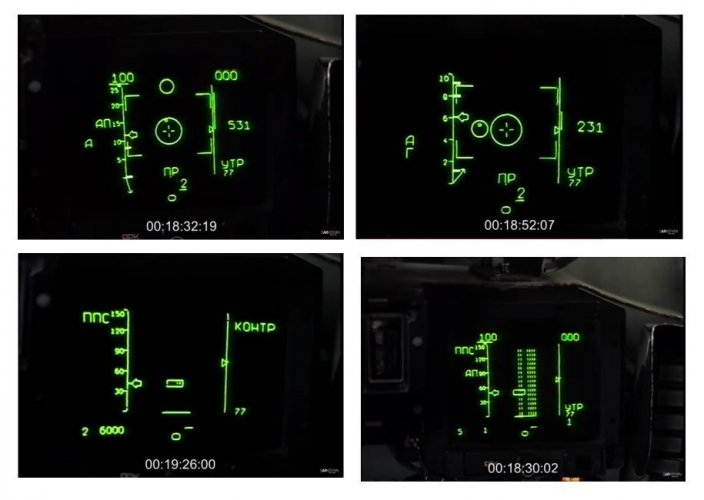
Let us supose that in V-SNP N019 tracked 10 differ aircraft. From those 10 aircraft ( automatically or manualy ,nevermind) , it was chosen one aircraft to be asigned,designated as a target.Before real lock-on mode (yes, monopulse tracking) is activated ( 'MRK.ZAHV.PZ' button on the thrust lever of the left engine), there will be that 'box pattern' limited by 8°x4° where scan lasts only 0.8sec.

Note : your story about ''40x8 scan zone'' or whatever is completely irrelevant 'cause as it is described earlier ,there can be more differ scan zones in the SNP submode.

Now, when given target is designated in that box pattern ( there can be max two differ aircraft/targets in that 'box pottern' in the zone limited by 8° in azimuth or more than 10km), after 0.8sec, lock -on or RNP mode will be activated .After AAM is launched ,DNP mode will be activated and it lasts exactly 60 sec ( illumination of the given/engaged target will last 1 min ).

Now N019M Topaz can do the same things but where is the difference? The difference is in that 'box pattern' limited by 8x4 degrees. Reason for that is very simple. After the first target is locked-on and engaged with AAM,second target from that box pattern ( if appeared) will be locked-on.

Of course, there is no simultaneous( in the same period of time) lock-on for both of targets because it is impossible to achieve. That's why I wrote earlier ''one after another''. Even N007 Zaslon with PESA and two TWT's can not accomplished literally simultaneous lock-on of four differ targets.For lock-on of four different targets it takes about 10 sec.

I really hope You will understand all of these,all best .
 
Last edited:
Hm,what can I write ? I will now present how N019 Rubin and N019M Topaz work in both SNP (search) and RNP ( lock-on ) combat modes. I think and hope that You will understand everything and I will try to explain as easily as possible friend.

So N019 Rubin works in SNP ( TWS) , e.g. in 'V-Vstrechya combat mode ( only 'V' -front hemisphere and 'D'- rear hemisphere can use SNP ). During search/scan there can be more differ scan zones and it depends on which scanning mode is used : Auto or Manual ( already mentioned that ).

Let us supose that in V-SNP N019 tracked 10 differ aircraft. From those 10 aircraft ( automatically or manualy ,nevermind) , it was chosen one aircraft to be asigned,designated as a target.Before real lock-on mode (yes, monopulse tracking) is activated ( 'MRK.ZAHV.PZ' button on the thrust lever of the left engine), there will be that 'box pattern' limited by 8°x4° where scan lasts only 0.8sec.

Note : your story about ''40x8 scan zone'' or whatever is completely irrelevant 'cause as it is described earlier ,there can be more differ scan zones in the SNP submode.

Now, when given target is designated in that box pattern ( there can be max two differ aircraft/targets in that 'box pottern' in the zone limited by 8° in azimuth or more than 10km), after 0.8sec, lock -on or RNP mode will be activated .After AAM is launched ,DNP mode will be activated and it lasts exactly 60 sec ( illumination of the given/engaged target will last 1 min ).

Now N019M Topaz can do the same things but where is the difference? The difference is in that 'box pattern' limited by 8x4 degrees. Reason for that is very simple. After the first target is locked-on and engaged with AAM,second target from that box pattern ( if appeared) will be locked-on.

Of course, there is no simultaneous( in the same period of time) lock-on for both of targets because it is impossible to achieve. That's why I wrote earlier ''one after another''. Even N007 Zaslon with PESA and two TWT's can not accomplished literally simultaneous lock-on of four differ targets.For lock-on of four different targets it takes about 10 sec.

I really hope You will understand all of these,all best .
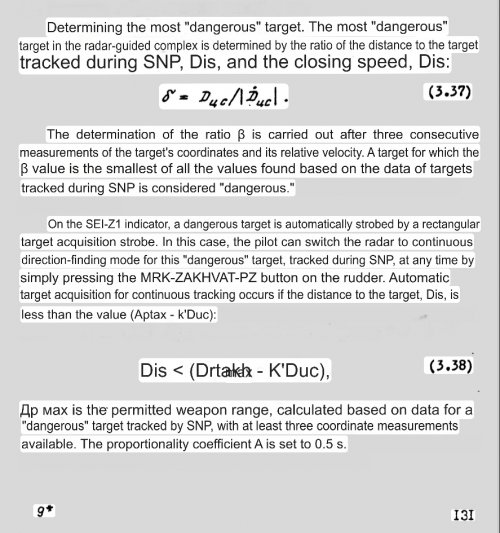
For N-019, where does MRL.ZAHV.PZ come into play? The pilot simply doesn’t need to press it, the lock on (your precious 8x4 scan) will occur at max missile range if pilot wants it or not in SNP mode. They can use lock button to enact since target track earlier, but the whole point of SNP is you don’t need to touch lock button for minimal target warning and max surveillance of the space around the target. The 40x8 zone is mentioned when talking about the tracking of the most dangerous target before lock on in SNP mode but after the dangerous target is gated.

I understand what you are trying to say about locking two targets In a 8x4 zone, but it seems like you are really interpreting what you know here. Are there any sources for this that you have not yet posted?
 
For N-019, where does MRL.ZAHV.PZ come into play? The pilot simply doesn’t need to press it, the lock on (your precious 8x4 scan) will occur at max missile range if pilot wants it or not in SNP mode. They can use lock button to enact since target track earlier, but the whole point of SNP is you don’t need to touch lock button for minimal target warning and max surveillance of the space around the target. The 40x8 zone is mentioned when talking about the tracking of the most dangerous target before lock on in SNP mode but after the dangerous target is gated.

I understand what you are trying to say about locking two targets In a 8x4 zone, but it seems like you are really interpreting what you know here. Are there any sources for this that you have not yet posted?

As I mentioned to LukaszK earlier, was in the MiG-29SM simulator several times and believe me know how things work.All depends on which mode you choose,Auto or Manual when we talk about locking on given target ( pressing that 'MRK .Zahv. PZ ' button).You can even 'override' what is locked on in Auto mode etc .You always mention that '40x8 zone' but believe me there is more scan/search zones in the SNP ( for V or D only).If you choose Auto mode ,radar will automatically designate ( on Russian it is STROB) most dangerous aircraft and will be presented to you as a target in that 8x4 box pattern.Detected/tracked aircraft will become a target only when it appeared in that 'box pattern' where scan lasts only 0.8 sec.If after three scan cycles designated target disappear ,everything must be repetaed. Of coruse, everything of this you can find in FM for the MiG-29 ( A/B) . That's it friend.
 
As I mentioned to LukaszK earlier, was in the MiG-29SM simulator several times and believe me know how things work.All depends on which mode you choose,Auto or Manual when we talk about locking on given target ( pressing that 'MRK .Zahv. PZ ' button).You can even 'override' what is locked on in Auto mode etc .You always mention that '40x8 zone' but believe me there is more scan/search zones in the SNP ( for V or D only).If you choose Auto mode ,radar will automatically designate ( on Russian it is STROB) most dangerous aircraft and will be presented to you as a target in that 8x4 box pattern.Detected/tracked aircraft will become a target only when it appeared in that 'box pattern' where scan lasts only 0.8 sec.If after three scan cycles designated target disappear ,everything must be repetaed. Of coruse, everything of this you can find in FM for the MiG-29 ( A/B) . That's it friend.
There’s nothing about dual scan track in any 9.12/9.13 manual and while I have manuals that contain info for 9.13S none fully explain the dual target track feature. Just the regular track while scan mode with purely automatic target acquisition. I would love to see such FM if they are out there. And like we have seen, we already have twice as any sources saying “over 8 degrees and 10 km apart” then “within 8 degrees and 10 km.”
 
Last edited:
There’s nothing about dual scan track in any 9.12/9.13 manual and while I have manuals that contain info for 9.13S none fully explain the dual target track feature. Just the regular track while scan mode with purely automatic target acquisition. I would love to see such FM if they are out there. And like we have seen, we already have twice as any sources saying “over 8 degrees and 10 km apart” then “within 8 degrees and 10 km.”

Friend what is that 'dual scan track'' anyway ? Never heard of before . Pls but pls find the 'MiG-29 FM' and learn some things... In the real MiG-29 FM you can find details about that 'box pattern 8x4 degrees' .

Civilian sources /sites are one thing ,military sources are something else,something completely different and completely valuable . All best !
 
Friend what is that 'dual scan track'' anyway ? Never heard of before . Pls but pls find the 'MiG-29 FM' and learn some things... In the real MiG-29 FM you can find details about that 'box pattern 8x4 degrees' .

Civilian sources /sites are one thing ,military sources are something else,something completely different and completely valuable . All best !
Exactly what you are talking about, the ability of MiG-29S to have a TWS track on two targets and fire R-77 at both generating datalink signals from the TWS returns

I have over 80 MiG-29 documents, many about 9.13, some with info about 9.13s, NONE of them include info about the dual TWS lock and dual launch of R-77 ability of 29S you are talking about. You are talking about locking two targets, so must mean this becuase MiG-29 9.12/9.13 can only lock one target and is not compatible with R-77.

I know all about the 8x4 pattern used to lock a single target by N-019, but in “FM” for MiG-29S with N-019M? Apparently you can’t find them either yet tell me to look for them to “learn some things.”
 

Attachments

  • IMG_7736.jpeg
    IMG_7736.jpeg
    191.2 KB · Views: 49
Exactly what you are talking about, the ability of MiG-29S to have a TWS track on two targets and fire R-77 at both generating datalink signals from the TWS returns

I have over 80 MiG-29 documents, many about 9.13, some with info about 9.13s, NONE of them include info about the dual TWS lock and dual launch of R-77 ability of 29S you are talking about. You are talking about locking two targets, so must mean this becuase MiG-29 9.12/9.13 can only lock one target and is not compatible with R-77.

I know all about the 8x4 pattern used to lock a single target by N-019, but in “FM” for MiG-29S with N-019M? Apparently you can’t find them either yet tell me to look for them to “learn some things.”

Hm, sorry but do you read my comments anyway ? What about TWS track of two targets when N019 and N019M can track max ten aircraft in TWS submode.

Again, difference between N019 Rubin and N019M Topaz is in the box pattern 8x4 degrees.N019 can lock on only one target from that 'box' during STROB. After AAM's launch in the DNP mode, that engaged target will be tracked and illuminated.

N019M can lock on two targets in that 'box' ,yes, both of them ,one after another, not in the same period of time. After AAM's launch ( it can be not only R-77 but R-27R/ER also) , in the DNP mode,two engaged targets will be tracked and illuminated ( in the case of R-27R/ER with INS+SARH).

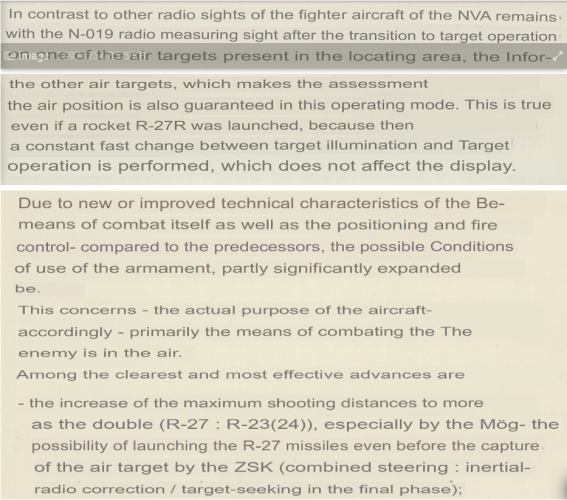
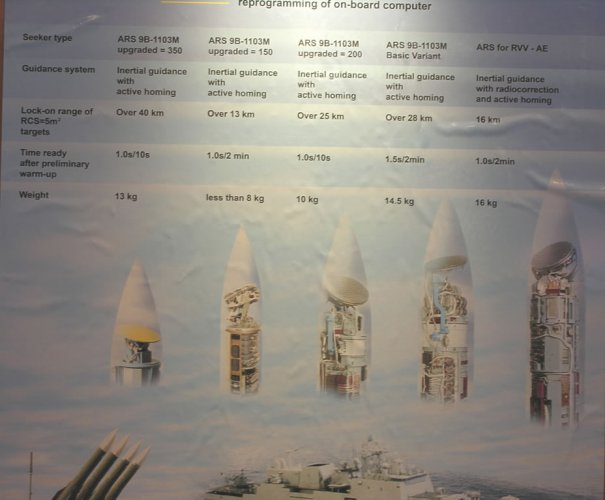
You have so many docs about MiG-29 ? OK ,do you have something like this ? Transl pls ...Tnx


N019M Topaz.jpeg
 
Yes we have discussed this before. I don’t understand, I’m talking about tracking and shooting two targets and you’re talking about tracking and shooting two targets. Not the10 that can be shown on the ILS at one time.

The MiG-29S with N-019M is not shooting 2x R-27R/ER at two different targets. You will not find single source for this, they will all say it can shoot 2x R-77 at 2 different targets since the active seeker of R-77 makes it possible.

You need a PESA radar to guide 2x SARH missiles at once, only then do you have the ability to not only track two targets sufficiently but ability to illuminate them constantly since the beam can slew at the speed of light. R-27R/ER as described by MiG-29B book has a very specific illumination sequence that makes up more then half a second, there is not space to illuminate two targets and have the R-27R/ER seeker guide unless you have this PESA with a electronically slewed beam.

Even the replacement Zhuk radar can only guide multiple R-77 at once or launch multiple R-73 simultaneously (per Yemeni SMT radio manual), not R-27

This is only possible for N-019M by instead of converting a single track into datalink coordinates and flight vectors, instead transitions the two chosen TWS tracks to datalink coordinates and flight vectors. In such a case, update rates of beyond 1 second (and closer to the usual scan pattern of 3-4 second update) is sufficient
Hm, sorry but do you read my comments anyway ? What about TWS track of two targets when N019 and N019M can track max ten aircraft in TWS submode.

Again, difference between N019 Rubin and N019M Topaz is in the box pattern 8x4 degrees.N019 can lock on only one target from that 'box' during STROB. After AAM's launch in the DNP mode, that engaged target will be tracked and illuminated.

N019M can lock on two targets in that 'box' ,yes, both of them ,one after another, not in the same period of time. After AAM's launch ( it can be not only R-77 but R-27R/ER also) , in the DNP mode,two engaged targets will be tracked and illuminated ( in the case of R-27R/ER with INS+SARH).

You have so many docs about MiG-29 ? OK ,do you have something like this ? Transl pls ...Tnx


View attachment 791844
 
Yes we have discussed this before. I don’t understand, I’m talking about tracking and shooting two targets and you’re talking about tracking and shooting two targets. Not the10 that can be shown on the ILS at one time.

The MiG-29S with N-019M is not shooting 2x R-27R/ER at two different targets. You will not find single source for this, they will all say it can shoot 2x R-77 at 2 different targets since the active seeker of R-77 makes it possible.

You need a PESA radar to guide 2x SARH missiles at once, only then do you have the ability to not only track two targets sufficiently but ability to illuminate them constantly since the beam can slew at the speed of light. R-27R/ER as described by MiG-29B book has a very specific illumination sequence that makes up more then half a second, there is not space to illuminate two targets and have the R-27R/ER seeker guide unless you have this PESA with a electronically slewed beam.

Even the replacement Zhuk radar can only guide multiple R-77 at once or launch multiple R-73 simultaneously (per Yemeni SMT radio manual), not R-27

This is only possible for N-019M by instead of converting a single track into datalink coordinates and flight vectors, instead transitions the two chosen TWS tracks to datalink coordinates and flight vectors. In such a case, update rates of beyond 1 second (and closer to the usual scan pattern of 3-4 second update) is sufficient

Is AAM type R-77 mentioned in that 'white' citation ? No .

Btw , R-77 ( old one from 1990's) had two launch modes : LOAL ( for the BVR) and LOBL ( for the WVR).

MiG-29B with N019EB is not the same as MiG-29S with N019M.

Again, N019 can lock on only one target from box pattern 8x4 degrees . N019M can lock on two differ targets from that box pattern.
 
Is AAM type R-77 mentioned in that 'white' citation ? No .

Btw , R-77 ( old one from 1990's) had two launch modes : LOAL ( for the BVR) and LOBL ( for the WVR).

MiG-29B with N019EB is not the same as MiG-29S with N019M.

Again, N019 can lock on only one target from box pattern 8x4 degrees . N019M can lock on two differ targets from that box pattern.
I am not saying MiG-29B radar is same as N-019M;) I am quoting its description of R-27R, which spans nearly a fifth of the book. There its illumination cycle required is described in extreme detail.
Sure perhaps it’s not stated in that white citation, yet I guarantee you it is the truth and there are other references which state so. There is very good reason the Zaslon PESA radar, from service entry before N-019 or N-001 could guide multiple SARH at a time, and not N-001/019. It being left out of the citation is not proof of the N-019M being able to fire any missile at multiple targets ;)

Tell me then, what explanation is there for a mechanical scanned radar guiding 2x SARH at once? It is perfectly capable of sending 2x datalink signals at once while tracking two targets with its normal 3.5 second update rate with enough accuracy to get the active seeker into the “basket” to see the target.
 
I am not saying MiG-29B radar is same as N-019M;) I am quoting its description of R-27R, which spans nearly a fifth of the book. There its illumination cycle required is described in extreme detail.

Sure perhaps it’s not stated in that white citation, yet I guarantee you it is the truth and there are other references which state so. There is very good reason the Zaslon PESA radar, from service entry before N-019 or N-001 could guide multiple SARH at a time, and not N-001/019. It being left out of the citation is not proof of the N-019M being able to fire any missile at multiple targets ;)

Tell me then, what explanation is there for a mechanical scanned radar guiding 2x SARH at once? It is perfectly capable of sending 2x datalink signals at once while tracking two targets with its normal 3.5 second update rate with enough accuracy to get the active seeker into the “basket” to see the target.

I have only one detail for you . Illumination sequence of the N09 Rubin lasts only 30.72ms. Only 30.72ms. That's it.
 
I have only one detail for you . Illumination sequence of the N09 Rubin lasts only 30.72ms. Only 30.72ms. That's it.
it is specifically 30.72ms for missile illumination followed by 20.48 ms for illumination for the radars own tracking needs. The total illumination period during datalink phase is 30.72 ms + 20.48 ms x7 for total 358.4 ms. Thus why it can datalink two missiles at a time for a single target with N-019 (716.8 ms) while maintaining 1 second update rate.

For STT, this cycle is constantly repeating between 30.72 ms illumination and 20.48 ms for tracking, or are you saying you believe the R-27 missile only needs 30.72 ms out of a whole second guide properly, or are you saying that the R-27 only needs this 30.72 once instead of multiple times in a row so the radar has time to move to and illuminate your second other target, and move back back and illuminate your other target, all while providing uninterrupted guidance for 2x SARH going to two targets? How much of a gap between illumination is there to expect for a SARH to guide onto a target when it’s rated to be able to hit up to 8 G targets pulling 24-30 G? Problems like this are exactly why Zaslon is a PESA!

Sorry but I don’t think there’s any info you can provide me outside of your own conjecture that may be convincing
In an objective measure, and I don’t think I could ever sway you. But I do think what I say is what almost everyone here understands about the limits of mechanical scanned and electronic scanned radars. If the two targets move out of this 8x4 box, the radar will need to move greater distances, can this upset the needed illumination period squirrel and take more time and thus upset SARH guidance? This is why a 40x8 scan zone for dual target is the most likely truth, it is comparable to what other radars do, feasible, and provides capability. Not even Americans were able to get a mechanical scanned radar to guide SARH onto two targets at once!

Here is a source from Peru


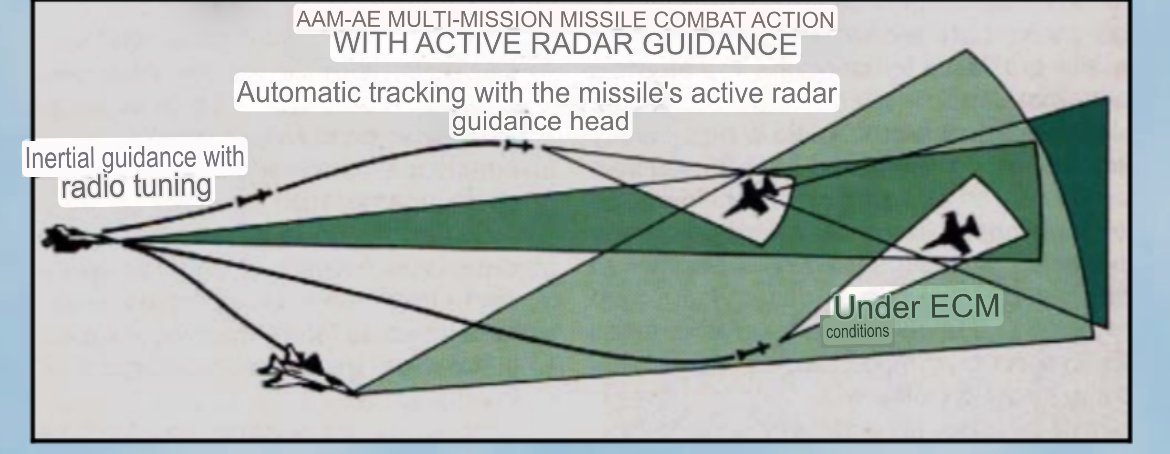
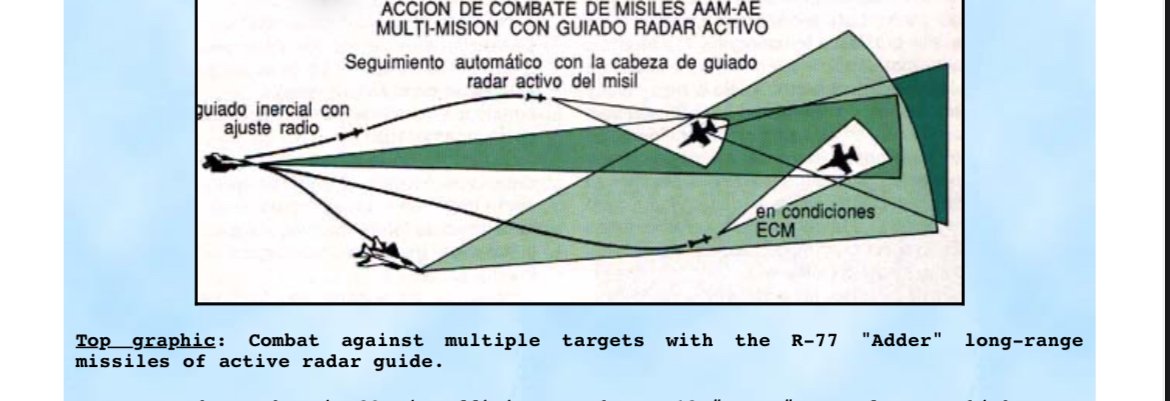
In addition to them, Peru has 3 aircraft of the Mig-29 SE variant with greater internal fuel capacity, and with the capabilities of carrying six AA-12 "Adder" or "AMRAAMsky" air-to-air missiles in allusion to the fact that it is analogous to the American AMRAAM (Advanced Medium Range Air to Air Missile) missile in Russian code is the R-77. These missiles are long-range using an active radar guidance system, that is, the missile itself has its radar emitter and automatic self-engagement to the target. The Mig-29 SE has the ability to hook two targets at the same time with this type of missile,”

From a website on MiG-29 variants that got its info somewhere “
Revised weapon system algorithms in the MiG-29S's software, combined with an increase in processing capacity, allows for the tracking of up to 10 targets and the simultaneous engagement of two with the R-77 missile.”

From the magazine “Pucara” issue 10 from 2021

“Enhancements in software and processing capabilities allow the tracking of up to 10 targets and the simultaneous engagement of two with the R-77 missile.”

If you want me to believe that N-019M was somehow capable of dual missile guidance of SARH -‘s every other type of missile, yet the Zhuk radar that replaced it could only launch multiple R-77 and R-73 simultaneously, I’m sorry but I don’t think it will happen unless you can turn these sources with something definitive that doesn’t just leave the type of missile so we can guess, proof by omission is a logical fallacy afterall!
 

Attachments

  • IMG_7775.jpeg
    IMG_7775.jpeg
    390.1 KB · Views: 28
  • IMG_7776.jpeg
    IMG_7776.jpeg
    309.6 KB · Views: 28
it is specifically 30.72ms for missile illumination followed by 20.48 ms for illumination for the radars own tracking needs. The total illumination period during datalink phase is 30.72 ms + 20.48 ms x7 for total 358.4 ms. Thus why it can datalink two missiles at a time for a single target with N-019 (716.8 ms) while maintaining 1 second update rate.

For STT, this cycle is constantly repeating between 30.72 ms illumination and 20.48 ms for tracking, or are you saying you believe the R-27 missile only needs 30.72 ms out of a whole second guide properly, or are you saying that the R-27 only needs this 30.72 once instead of multiple times in a row so the radar has time to move to and illuminate your second other target, and move back back and illuminate your other target, all while providing uninterrupted guidance for 2x SARH going to two targets? How much of a gap between illumination is there to expect for a SARH to guide onto a target when it’s rated to be able to hit up to 8 G targets pulling 24-30 G? Problems like this are exactly why Zaslon is a PESA!

Sorry but I don’t think there’s any info you can provide me outside of your own conjecture that may be convincing
In an objective measure, and I don’t think I could ever sway you. But I do think what I say is what almost everyone here understands about the limits of mechanical scanned and electronic scanned radars. If the two targets move out of this 8x4 box, the radar will need to move greater distances, can this upset the needed illumination period squirrel and take more time and thus upset SARH guidance? This is why a 40x8 scan zone for dual target is the most likely truth, it is comparable to what other radars do, feasible, and provides capability. Not even Americans were able to get a mechanical scanned radar to guide SARH onto two targets at once!

Here is a source from Peru


In addition to them, Peru has 3 aircraft of the Mig-29 SE variant with greater internal fuel capacity, and with the capabilities of carrying six AA-12 "Adder" or "AMRAAMsky" air-to-air missiles in allusion to the fact that it is analogous to the American AMRAAM (Advanced Medium Range Air to Air Missile) missile in Russian code is the R-77. These missiles are long-range using an active radar guidance system, that is, the missile itself has its radar emitter and automatic self-engagement to the target. The Mig-29 SE has the ability to hook two targets at the same time with this type of missile,”

From a website on MiG-29 variants that got its info somewhere “
Revised weapon system algorithms in the MiG-29S's software, combined with an increase in processing capacity, allows for the tracking of up to 10 targets and the simultaneous engagement of two with the R-77 missile.”

From the magazine “Pucara” issue 10 from 2021

“Enhancements in software and processing capabilities allow the tracking of up to 10 targets and the simultaneous engagement of two with the R-77 missile.”

If you want me to believe that N-019M was somehow capable of dual missile guidance of SARH -‘s every other type of missile, yet the Zhuk radar that replaced it could only launch multiple R-77 and R-73 simultaneously, I’m sorry but I don’t think it will happen unless you can turn these sources with something definitive that doesn’t just leave the type of missile so we can guess, proof by omission is a logical fallacy afterall!

Wrong friend , 30.72ms is for the illuminaton of the engaged target during DNP mode .Then we have seqeunce which lasts 20.48ms where 10.24ms is for tracking other aircraft in the scan zone and another 10.24ms is for the tracking of engaged target. That's it.

Again ,40x8 is wrong. You need to read real Manuals not some magazines,websites etc.Then you will understand that after AAM/'s is/are launched there will be no more that box pattern of 8x4.In DNP mode ,radar scan the zone where one ( N019 ) or two targets ( N019M ) are. It is simple as that.
 
;)Wrong friend , 30.72ms is for the illuminaton of the engaged target during DNP mode .Then we have seqeunce which lasts 20.48ms where 10.24ms is for tracking other aircraft in the scan zone and another 10.24ms is for the tracking of engaged target. That's it.

Again ,40x8 is wrong. You need to read real Manuals not some magazines,websites etc.Then you will understand that after AAM/'s is/are launched there will be no more that box pattern of 8x4.In DNP mode ,radar scan the zone where one ( N019 ) or two targets ( N019M ) are. It is simple as that.
I never said there was box pattern after launch, that is apparently you saying this so that N-019M can track two targets and where does your information that 20.48 ms period is split in two for tracking two targets? The 20.48 ms is part of track sequence for original N-019 where here it does monopulse to track target.

Yes, 30.72 ms is for illumination, but illumination for what? The missile or the radar? It is for the missile becuase here the radar is operating in pseudo CW, a pseudo CW signal is what the R-27 requires to guide and how an RWR would determine missile launch.

You are saying 10.24 ms is enough for this mechanical radar to slew and scan another target in this 8x4 zone. Or can the targets be separated by more then 8x4 after launch, increasing the time it would take the radar to scan and track it, 8x4 being a much smaller scan zone then I think you understand when it comes to battlefield practicability ;)
 
I never said there was box pattern after launch, that is apparently you saying this so that N-019M can track two targets and where does your information that 20.48 ms period is split in two for tracking two targets? The 20.48 ms is part of track sequence for original N-019 where here it does monopulse to track target.

Yes, 30.72 ms is for illumination, but illumination for what? The missile or the radar? It is for the missile becuase here the radar is operating in pseudo CW, a pseudo CW signal is what the R-27 requires to guide and how an RWR would determine missile launch.

You are saying 10.24 ms is enough for this mechanical radar to slew and scan another target in this 8x4 zone. Or can the targets be separated by more then 8x4 after launch, increasing the time it would take the radar to scan and track it, 8x4 being a much smaller scan zone then I think you understand when it comes to battlefield practicability ;)

You mentioned that you have 80 docs about MiG-29 ,OK. I must ask, from civilian sources or the military ones ? Again, track sequences in the DNP mode are : 10.24ms for the tracking aircraft in the scan zone, 10.24 ms for the tracking only engaged target in that scan zone and 30.72ms for the illumination of the engaged target in the same scan zone .

Pre lock-on 'box pattern' 8x4 has nothing to do with those tracking sequences in the DNP mode .You must know that. In the box pattern scan lasts only 0.8 sec. For that time, N019 can lock on only one target after designation. N019M can lock both of them ( if aperared in that box ), one after another.
 
You mentioned that you have 80 docs about MiG-29 ,OK. I must ask, from civilian sources or the military ones ? Again, track sequences in the DNP mode are : 10.24ms for the tracking aircraft in the scan zone, 10.24 ms for the tracking only engaged target in that scan zone and 30.72ms for the illumination of the engaged target in the same scan zone .

Pre lock-on 'box pattern' 8x4 has nothing to do with those tracking sequences in the DNP mode .You must know that. In the box pattern scan lasts only 0.8 sec. For that time, N019 can lock on only one target after designation. N019M can lock both of them ( if aperared in that box ), one after another.
I’m not saying 8x4 has anything to do with locked target ;) You are the one saying the two targets must be within this box to maintain 10.24 ms timing. If they were to maneuver apart 8x4 degrees, the radar with its absolute maximum of 70 deg/s scanning could not keep the same scanning time to illuminate 2x R-27 at once;) We are talking about thousands of a second! There is no source for it to have such a limitation when the obvious conclusion of it sending datalinked flight vectors to 2x r-77 is more then plausible and already sourced for your pleasure.

And So you don’t have sources for 20.48 ms being split between two targets and the 8x4 box scanning two, okay then. I don’t think there’s anything else that can be added to this discussion.
 
Last edited:
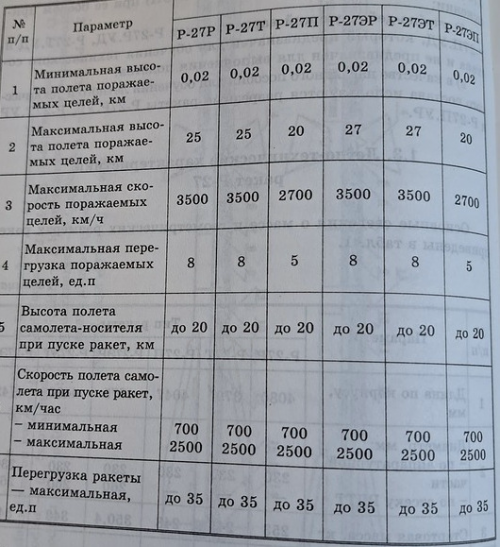
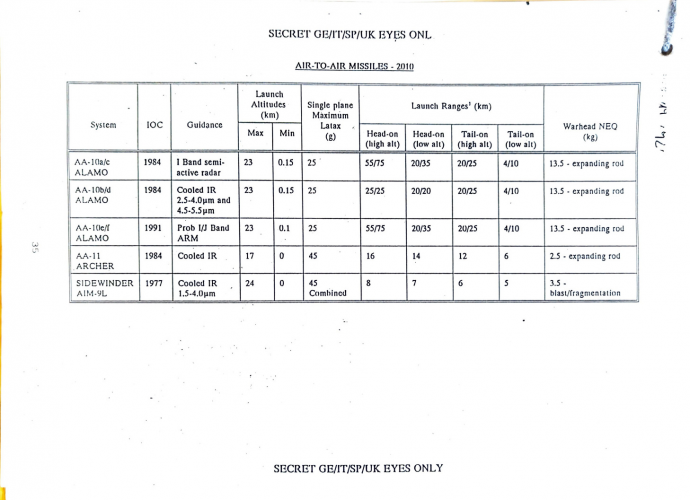
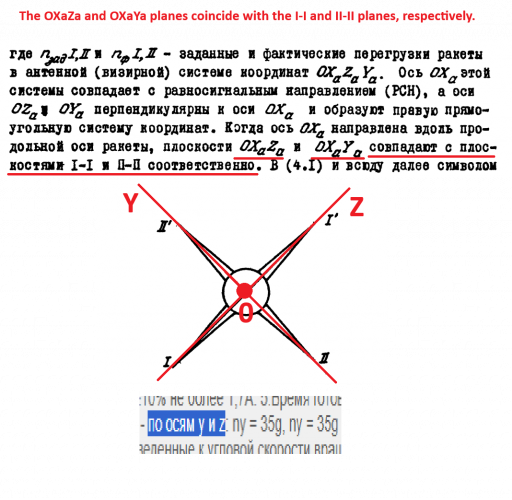
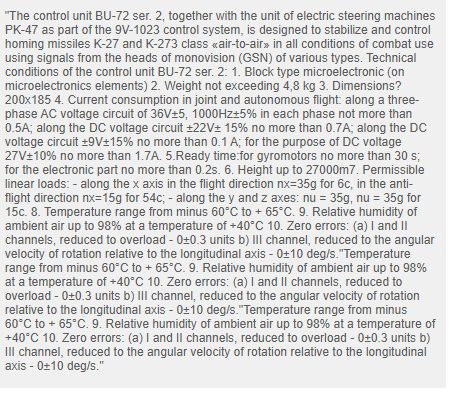
Do you know where this is from? It would make sense to me if 35 G is structural limit, but we see 24-30 G quoted in other material as maneuver limit which makes sense if 24G is for single plane and 30 G dual plane
its 25 g single plane 35g normal.
It can also only pull 35g for 6 - 15 seconds max depending on temperature
 

Attachments

  • 1763586469534.png
    1763586469534.png
    758.7 KB · Views: 29
  • 1763586487872.png
    1763586487872.png
    219.5 KB · Views: 21
  • 1763586636036.png
    1763586636036.png
    52.2 KB · Views: 28
You are the one saying the two targets must be within this box to maintain 10.24 ms timing.

No , that was not what I was write about . Read again pls.

10.24ms is the tracking sequence in the DNP mode only, not in the RNP. That's it.

And So you don’t have sources for 20.48 ms being split between two targets and the 8x4 box scanning two, okay then. I don’t think there’s anything else that can be added to this discussion.

Sorry ,do you read my posts anyway ? 20.48 is normaly divided into two track sequencies: 10.24ms+10.24ms ,of course in the DNP mode again. MiG-29 FM ? You wrote that you have read it ? You mentioned even 9.13 and moreover 9.13S /MiG-29S FM ??? OK ,better to end all of this . All best.
 
No , that was not what I was write about . Read again pls.

10.24ms is the tracking sequence in the DNP mode only, not in the RNP. That's it.


Sorry ,do you read my posts anyway ? 20.48 is normaly divided into two track sequencies: 10.24ms+10.24ms ,of course in the DNP mode again. MiG-29 FM ? You wrote that you have read it ? You mentioned even 9.13 and moreover 9.13S /MiG-29S FM ??? OK ,better to end all of this . All best.
Yes I read them, and there is no source that this 20.48 period is broken into two for what is it now, one period for radar tracking and one for tracking one or two targets??????

Yes this 10.24 ms period is used for own radar tracking. But you must understand how improbable and downright unrealistic it is to claim that N-019M is engineered to track two targets inside a 8x4 zone, who must stay in this zone to necessitate precise radar timing illumination to apparently guide two times SARH missiles despite the radar only being able to slew so fast being mechanical and not PESA. Or are you saying it’s within the 30.72 ms period that it tracks two targets, 30.72 ms which requires to guide a single R-27? What if the targets maneuver farther apart then 8x4 and timing is upset. I’m sorry, it holds no water with me. Again you tell me to read sources when you can’t back up your own statements with sources. I have provided plenty of sources for N-019M only guiding 2x R-77 at once, which is perfectly probably and explainable with many many many many radars able to do the exact same thing using their entire scan field of view
 
@Aeria Gloria and @Squirrel

maybe you should start defining what you are talking about here. The 8x4 deg is acquisition, i.e. radar attempting to lock on. For dual-target engagement you typically don't "hard lock" (single target tracking), but designate a TWS track for engagement. The radar may alter its scan pattern to achieve better track update rates, but that's it. Many people use the term "lock on", which is somewhat misleading, when we aren't talking about STT, i.e radar tracking a single target, continuously pointing it's antenna at it. I think you both failed to understand each other by a different interpretation of "lock on".
 
@Aeria Gloria and @Squirrel

maybe you should start defining what you are talking about here. The 8x4 deg is acquisition, i.e. radar attempting to lock on. For dual-target engagement you typically don't "hard lock" (single target tracking), but designate a TWS track for engagement. The radar may alter its scan pattern to achieve better track update rates, but that's it. Many people use the term "lock on", which is somewhat misleading, when we aren't talking about STT, i.e radar tracking a single target, continuously pointing it's antenna at it. I think you both failed to understand each other by a different interpretation of "lock on".
What he’s saying is N-019M Topaz locks two targets after the 8x4 lock on pattern. I’m saying it’s almost certainly the 8x40 degree TWS/SNP pattern used to get around 3.5s update rate.

If he means soft lock or hard lock, I don’t agree with it for the reasons mentioned above, the range inaccuracy, the lack of utility in only tracking two targets inside 8 degrees, etc

He also seems to believe that it can guide 2x R-27R/ER at once, which I don’t agree with as being possible for the mechanical scanned radar.

It’s possible, afterall at short range it can use radar sidelobes and the INS of the missile can fill in the gaps between scans…… unless the target maneuvers much…….but completely unrealistic and unlike how it’s done anywhere else and how I would expect the engineers to design the mode, as you say, using a scan pattern small enough for a good update rate but large enough to sufficiently track 2 targets, which 8x40 degree scan pattern would do perfectly. And the fact that such a technique, TWS simultaneous missiles, is basically not a thing until Fox 3 is on the scene and their datalink updates work perfectly with it. Unlike R-27R/ER that needs a relatively constant signal in terminal. For example he mentions that he thinks in N-019M it is using DNP mode to guide 2x missiles on 2 targets. DNP is STT.

It seems he’s relying on a single mistranslation of a single article, so I give up trying to explain the absurdity of N-019M guiding two Fox-1/3 missiles onto two targets in a 8x4 box but no larger.
 
@Aeria Gloria and @Squirrel

maybe you should start defining what you are talking about here. The 8x4 deg is acquisition, i.e. radar attempting to lock on. For dual-target engagement you typically don't "hard lock" (single target tracking), but designate a TWS track for engagement. The radar may alter its scan pattern to achieve better track update rates, but that's it. Many people use the term "lock on", which is somewhat misleading, when we aren't talking about STT, i.e radar tracking a single target, continuously pointing it's antenna at it. I think you both failed to understand each other by a different interpretation of "lock on".

Sorry friend ,did you have opportunity to do some 'work ' in the MiG-29S/SM simulator because I did. I know what is the lock-on mode ( STT btw ) and know exactly when it starts. After the target is designated ( with use of the button KU-31 STROB ), in the 8x4 degrees pattern box, lock-on mode ( in Russian RNP ,or STT) starts. Usually it takes several seconds for acquiring real lock on for the given target (monopulse tracking) and after AAM is launched ,mode DNP starts. Again, DNP is some kind of the search mode where radar tracks not only engaged target but other aircraft in the given search zone ( only the zone where the engaged target is ) ,than during that mode, target is illuminated also. N019 Rubin /N019M Topaz use quasi-continuos illumination.

Again , N019 Rubin has capability to lock on only one target from that pattern box ( if two appeared anyway beacuse in the box pattern 8x4 degrees there is enough place for two aircraft to be tracked in the azimuth), N019M Topaz has capability to lock on both of them ,one after another.

What he’s saying is N-019M Topaz locks two targets after the 8x4 lock on pattern. I’m saying it’s almost certainly the 8x40 degree TWS/SNP pattern used to get around 3.5s update rate.

If he means soft lock or hard lock, I don’t agree with it for the reasons mentioned above, the range inaccuracy, the lack of utility in only tracking two targets inside 8 degrees, etc

He also seems to believe that it can guide 2x R-27R/ER at once, which I don’t agree with as being possible for the mechanical scanned radar.

It’s possible, afterall at short range it can use radar sidelobes and the INS of the missile can fill in the gaps between scans…… unless the target maneuvers much…….but completely unrealistic and unlike how it’s done anywhere else and how I would expect the engineers to design the mode, as you say, using a scan pattern small enough for a good update rate but large enough to sufficiently track 2 targets, which 8x40 degree scan pattern would do perfectly. And the fact that such a technique, TWS simultaneous missiles, is basically not a thing until Fox 3 is on the scene and their datalink updates work perfectly with it. Unlike R-27R/ER that needs a relatively constant signal in terminal. For example he mentions that he thinks in N-019M it is using DNP mode to guide 2x missiles on 2 targets. DNP is STT.

It seems he’s relying on a single mistranslation of a single article, so I give up trying to explain the absurdity of N-019M guiding two Fox-1/3 missiles onto two targets in a 8x4 box but no larger.

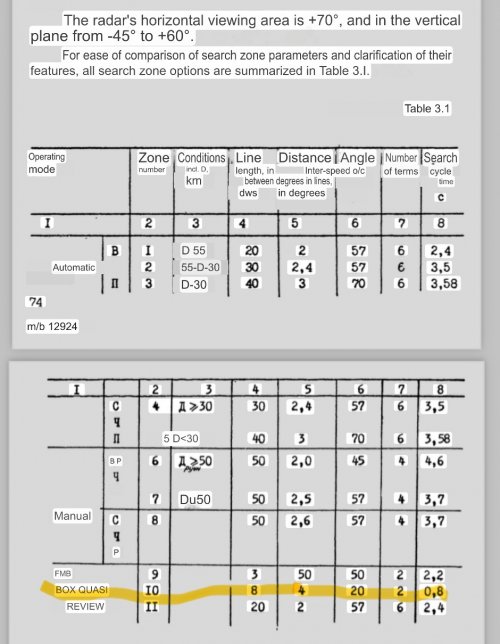
There is no 8x40 degrees TWS/SNP pattern.Search box patterns can be next: 15x40,12x30 and 10x20 degrees in the auto mode and 10.5x50 , 7,8x50 degrees in the manual mode.

DNP is not the STT mode. DNP mode is the mode with scanning/searching capability. In the DNP mode ,radar only scans the zone in which engaged target is.
 
Sorry friend
I think you are thinking of DRB, where the radar is in scan mode.

And You misunderstand me. I did not say that DNP was “only” STT only that it was a STT lock. DNP is STT with radio correction for missile datalink. I.e, not a “soft” lock.

I shouldn’t have to explain how an 80s Soviet mechanical scan radar doing STT on two targets with high enough update rate to guide 2x R-27R/ER onto 8 G targets is ridiculous, or why this 8 degree limit makes the mode similarly near useless when it works differently in every single case we see. 8x4 degree scan takes 0.8 seconds, good luck with that update rate and maintaining the maneuvering capability of the missile. But then again, I guess with 8x4 degree limit you’re already limited to targets already in formation. That’s 7 km width and 3.5 km height at 50 km (and within 10 km). 3.5/1.75 km at 25 Km( within 10 km).

I would ask for sources but that hasn’t gotten us anywhere.

I gave you over 5 sources that this dual launch feature is only supported for R-77, becuase this makes sense for a mechanical scan radar and how we see such a feature implemented anywhere. The radar scans and sends out datalink on two targets within its scan zone, which is not out of the realm of the possibility for N-019M and R-77, unlike your STT inside 8x4 degrees for 2x targets with literally atleast 4 km range inaccuracy. hypotheses that stretches credulity for all hardware and software involved. Whether it’s a 8x40 pattern or the regular pattern for the mode and range is less important.

Look man, okay, believe what you want, I’ve made my position clear. I can’t believe this just becuase you saw the simulator with your own eyes without ruling out misunderstanding.

That’s my stance. Good luck with everything.
 
Last edited:
I think you are thinking of DRB, where the radar is in scan mode.

And You misunderstand me. I did not say that DNP was “only” STT only that it was a STT lock. DNP is STT with radio correction for missile datalink. I.e, not a “soft” lock.

I shouldn’t have to explain how an 80s Soviet mechanical scan radar doing STT on two targets with high enough update rate to guide 2x R-27R/ER onto 8 G targets is ridiculous, or why this 8 degree limit makes the mode similarly near useless when it works differently in every single case we see.

I would ask for sources but that hasn’t gotten us anywhere.

I gave you over 5 sources that this dual launch feature is only supported for R-77, becuase this makes sense for a mechanical scan radar and how we see such a feature implemented anywhere. The radar scans and sends out datalink on two targets within its scan zone, which is not out of the realm of the possibility for N-019M and R-77, unlike your STT inside 8x4 degrees for 2x targets with literally 10 km range inaccuracy. hypotheses that stretches credulity for all hardware and software involved. Whether it’s a 8x40 pattern or the regular pattern for the mode and range is less important.

Look man, okay, believe what you want, I’ve made my position clear. I can’t believe this just becuase you saw the simulator with your own eyes without ruling out misunderstanding. As for your previous posts There is no autopilot coupling to Lazur (which is frankly an oversight compared to MiG-23), Lazur does not effect the landing mode which depends on PRMG, extrapolation occurs under STT/SNP but only in STT does it try to find an extrapolated target that was lost for up to 5-8 seconds, and DNP does not transition to SNP after 60 seconds as that would ruin any follow up shot.

That’s my stance. Good luck with everything.

Again ,DNP is not STT or single target track mode,that's it. DNP is searching/scanning mode. Take a look back to some overscan's comments from one east-Europian radar technician especially about RNP and DNP modes.

Btw ,there is no 'soft' or 'hard' lock, lock-on is lock-on,nothing else. I've done 'some work' in the MiG-29SM sim ,not only saw him .

From your comments I've realised you think that DNP is some kind of mode where radar track and illuminate engaged target but only that target. In fact, in that mode, radar can track other aircraft in case they fly in the scan zone. That scan zone is not 8x4 degree scan pattern box ( scan in that box can be done in less than 1 sec btw).

Another detail, primary target for the R-27R/ER is not one fighter but bomber,recce aircraft or any other medium/big air target.

Not Lazur as the data-link between NASU or the ground automatic guidance station and the fighter but RSBN which can provide flight in the full auto-mode and landing process within 50m above the runway.
 
Last edited:
8x4 degree scan takes 0.8 seconds, good luck with that update rate and maintaining the maneuvering capability of the missile. But then again, I guess with 8x4 degree limit you’re already limited to targets already in formation. That’s 7 km width and 3.5 km height at 50 km (and within 10 km). 3.5/1.75 km at 25 Km( within 10 km).

Do you really read my comments ? 8x4 scan pattern box is only box pattern for the lock-on mode / RNP in Russian . After AAM is launched , DNP mode starts. There is no more 8x4 box pattern. I hope and think you will finally understand this. Also good luck for you !
 
Soft lock is referring to SNP target designation, or how any TWS mechanical scanned plane would guide multiple missiles onto multiple targets. By designating a target to be scanned in scan mode and remember its closure/distsnce/azimuth and correlate direction of flight from multiple hits.
Do you really read my comments ? 8x4 scan pattern box is only box pattern for the lock-on mode / RNP in Russian . After AAM is launched , DNP mode starts. There is no more 8x4 box pattern. I hope and think you will finally understand this. Also good luck for you !

So your position is now that it would lock two targets inside this 8x4 box, and then they can both be tracked within the radar gimbal, by this mechanical scanned radar…… for 2x R-27R/ER SARH missiles…..
 
Good grief guys! Stop the nonesense. We are talking about target acquisition here and nothing else, this has nothing to do with tracking two targets, it's simply the transition from search/multiple target track mode to single target track (lock on). The two 10.24ms cycles are for target confirmation to initiate a track in the first place. 8x4 is the acquisition phase (scan to find & confirm the target before a lock is established), if the target is confirmed twice, the track is established and the target locked. It's no rocket since and it's not specific to the N-019.
 
Good grief guys! Stop the nonesense. We are talking about target acquisition here and nothing else, this has nothing to do with tracking two targets, it's simply the transition from search/multiple target track mode to single target track (lock on). The two 10.24ms cycles are for target confirmation to initiate a track in the first place. 8x4 is the acquisition phase (scan to find & confirm the target before a lock is established), if the target is confirmed twice, the track is established and the target locked. It's no rocket since and it's not specific to the N-019.
Yes there is nothing to argue about for N-019, only how N-019M does its dual target track feature for R-77 (R-27R/ER also if you ask Squirrel). This mode has no documentation I am aware of.
 
Soft lock is referring to SNP target designation, or how any TWS mechanical scanned plane would guide multiple missiles onto multiple targets. By designating a target to be scanned in scan mode and remember its closure/distsnce/azimuth and correlate direction of flight from multiple hits.

Before you could engage such a target tracked in the SNP mode, you must lock-on him. So after SNP, there is RNP than DNP mode. That's how things work in N019.

So your position is now that it would lock two targets inside this 8x4 box, and then they can both be tracked within the radar gimbal, by this mechanical scanned radar…… for 2x R-27R/ER SARH missiles…..

Not now friend ,it was always ( from the very beggining ) my statement. Again, N019 Rubin in the 9.12/.13 can engage only one given target from the 8x4 box pattern. N019 Rubin can illuminate only one engaged target in the DNP mode. N019M Topaz in the 9.13S on the other side can lock on two different targets from the 8x4 box pattern. Of course ,not in the same time but one after another.

Yes there is nothing to argue about for N-019, only how N-019M does its dual target track feature for R-77 (R-27R/ER also if you ask Squirrel). This mode has no documentation I am aware of.


Where could there be confusion?

There is so many sources which mention that it is possible to engage two differ targets but only with R-77 ( inertial + ARH) and R-73/M as IR guided AAM. Even sources like 'airwar.ru' mentioned that etc .... but... I gave the source in which we can see that it is possible to engage two targets, no matter with which AAM. What is or can be the problem for radar ( even with mechanical scanning) to ensure illumination of two different targets?


You asked this :

''and then they can both be tracked within the radar gimbal, by this mechanical scanned radar…… for 2x R-27R/ER SARH missiles…..''

What about R-77 , old one of course? Are this AAM's also need tracking of the engaged targets ? Of course, when we talk about BVR combat. Tracking yes, not the illumination.

Btw ,for the N001V Myech ( in the Su-27SM) ,there is info that this version also ensures engagement of two differ targets with any AAM.
Good grief guys! Stop the nonesense. We are talking about target acquisition here and nothing else, this has nothing to do with tracking two targets, it's simply the transition from search/multiple target track mode to single target track (lock on). The two 10.24ms cycles are for target confirmation to initiate a track in the first place. 8x4 is the acquisition phase (scan to find & confirm the target before a lock is established), if the target is confirmed twice, the track is established and the target locked. It's no rocket since and it's not specific to the N-019.

That is not the problem. I've already described all of that several times so far .The problem is what is going on after AAM is/are launched.

8x4 box pattern is very important because it is possible to track two differ targets there. If neither of two is designated after three scan cycles,process must be repeated. N019 Rubin can lock- on only one from thos two but N019 Topaz can lock -on both of them.

For the SNP ( search mode) and RNP ( lock on mode) , I think we have no disagreements.

Only disagreement we have about DNP mode. Again,there is no '8x40 or 8x4 ' scan pattern in the DNP. N019 can track and illuminate only one engaged target during DNP but it seems that N019M can track and illuminate two differ targets.

R-77 can btw be launched in two regimes: LOBL during WVR combat and LOAL during BVR combat.Upper sequences are in the relation with LOBL mode of training version of the R-77 during simulations.

R-77 IPV-1.jpg
 
No we disagree there also. It is described in many places that SNP will automatically gate the TDC around the target using the discrimination of which target has the highest ratio of speed:range, then locks in RNP on its own with no pilot input when close to max range, so nothing more is required then if you used Lazur guidance. Or perhaps you meant that by saying “we must lock him first”?

I disagree about all AAMs for the mechanical scanned radar, I think you are using sources that say “allows dual target attack” without saying it has a missile restriction and are assuming it must be for all missiles, like I mentioned before even for MiG-29SMT it only can do this for R-77 and R-73

And yes, tracking two targets with STT+ illumination (and datalink) suitable for dual target Fox 1 attack in a mechanical scanned fighter jet radar is unprecedented.

My argument wasn’t a 8x40 scan in DNP, it was in SNP, more specifically whatever they added for N-019M when SNP and R-77 is selected and two targets within detection range (or the 2 with highest speed:range), and using the information of that mode (speed, direction, range, altitude) to send out datalink to 2x R-77, the way all other mechanical scan radars simultaneously fire 2x Fox 3 missiles at 2x targets (including Zhuk/SMT, which used the same functionality for multiple R-73 launch only no datalink)

I’m not sure there is any point in discussing it further until there is information found about this “locking two targets during small box transition to STT and/or guiding 2x of any missile onto 2x targets.”
 
Last edited:
No we disagree there also. It is described in many places that SNP will automatically gate the TDC around the target using the discrimination of which target has the highest ratio of speed:range, then locks in RNP on its own with no pilot input when close to max range, so nothing more is required then if you used Lazur guidance. Or perhaps you meant that by saying “we must lock him first”?

Yes ,that is in the auto mode ( guidance via Lazur/ NASU) .Radar will do automatic lock-on of course and pilot can even override that with pressing the button SBROS. Anyway , so in any case ,we have next ''SNP-RNP-DNP'' just as I described earlier.

I disagree about all AAMs for the mechanical scanned radar, I think you are using sources that say “allows dual target attack” without saying it has a missile restriction and are assuming it must be for all missiles, like I mentioned before even for MiG-29SMT it only can do this for R-77 and R-73

What if there is no AAM restriction at all ? What about possibility to illuminate two engaged targets with separate 30.72ms time sequencies ?

And yes, tracking two targets with STT+ illumination (and datalink) suitable for dual target Fox 1 attack in a mechanical scanned fighter jet radar is unprecedented.

There is no STT+Ill mode . DNP is not the STT mode, forget STT / lock on after the AAM is launched.

My argument wasn’t a 8x40 scan in DNP, it was in SNP, more specifically whatever they added for N-019M when SNP and R-77 is selected and two targets within detection range (or the 2 with highest speed:range), and using the information of that mode (speed, direction, range, altitude) to send out datalink to 2x R-77, the way all other mechanical scan radars simultaneously fire 2x Fox 3 missiles at 2x targets (including Zhuk/SMT, which used the same functionality for multiple R-73 launch only no datalink)


During 1989 one prototype of the MiG-29S/9.13S ( 05 blue) launched two AAM's against two differ targets for the first time .

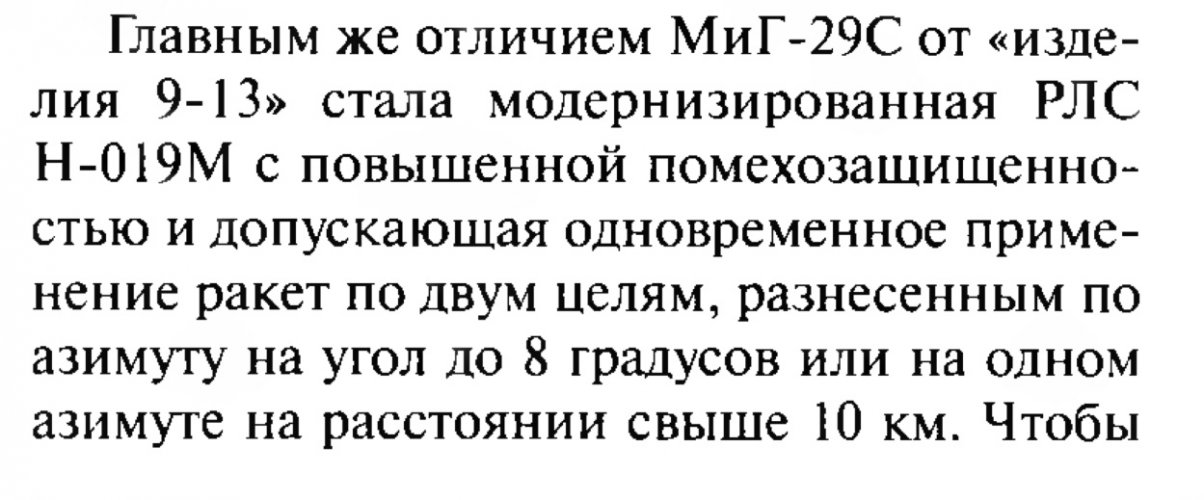
''Для испытаний новой системы управления вооружением на ММЗ им. А.И.Микояна в 1988-1989 гг. переоборудовали два серийных истребителя типа «9-13». Первый из них, получивший №405 (бортовой №05), поднялся в воздух 20 января 1989 г., второй - МиГ-29 №404 (бортовой №04) - 30 июня 1989 г. На этих самолетах отрабатывались функционирование модернизированного РЛПК-29М и СУВ-29С в целом, применение ракет РВВ-АЕ. В частности на 405-м впервые произвели успешный пуск двух ракет по двум воздушным целям одновременно. Было доказано, что новая СУВ обеспечивает одновременный или последовательный пуск ракет по целям, разнесенным по азимуту на угол более 8° или находящимся на одном азимуте на расстоянии более 10 км. При входе обеих целей в зону разрешенных пусков и появлении на экране системы единой индикации соответствующих символов пуск мог производиться либо в ручном, либо в автоматическом режиме. Если цели входили в зону разрешенных пусков последовательно, одна за другой, то соответственно последовательно производились и пуски ракет.''

''To test the new weapons control system, two serial Type 9-13 fighters were converted at the Mikoyan Machine Building Plant in 1988-1989. The first of these, designated No. 405 (tail number 05), took to the air on January 20, 1989, and the second, MiG-29 No. 404 (tail number 04), took to the air on June 30, 1989.
These aircraft were used to practice the operation of the modernized RLPK-29M and SUV-29S systems in general, as well as the use of RVV-AE missiles. Specifically, the 405th successfully launched two missiles simultaneously against two airborne targets for the first time.
It has been proven that the new FCS enables the simultaneous or sequential launch of missiles at targets separated in azimuth by an angle of more than 8° or located at the same azimuth at a distance of more than 10 km.
When both targets entered the permitted launch zone and the corresponding symbols appeared on the screen of the unified indication system, the launch could be carried out either in manual or automatic mode.
If the targets entered the permitted launch zone sequentially, one after another, then the missile launches were carried out sequentially accordingly.''

https://www.airwar.ru/enc/fighter/mig29s.html
It was 8x4 degrees pattern box in the SNP mode as the pre-RNP process. If I remember well, some Russian sources mentioned 'SNP2' mode for the N019M . I think that simultaneous launch can be done only in LOBL mode ?

I’m not sure there is any point in discussing it further until there is information found about this “locking two targets during small box transition to STT and/or guiding 2x of any missile onto 2x targets.”

Then let us find MiG-29S/SM -FM or N019M/M1 -TM. ;)
 
Mig-29 and su-27 radar at least had provisions to use 2 r-27ers/rs at once, it just wasn't realized. from german 29 radar manual
 

Attachments

  • 1769263520259.png
    1769263520259.png
    795.7 KB · Views: 38
Mig-29 and su-27 radar at least had provisions to use 2 r-27ers/rs at once, it just wasn't realized. from german 29 radar manual

Yes, two R-27R/R1 ( ER/ER1) against one target but not against two differ targets. That is the case with the Izd. 9.12A/B and the Su-27S/SK. If I remember well, there was posibility to engage one target even with three R-27R/R1 (ER/ER1), in the case of N001/E.
 
Yes ,that is in the auto mode ( guidance via Lazur/ NASU) .Radar will do automatic lock-on of course and pilot can even override that with pressing the button SBROS. Anyway , so in any case ,we have next ''SNP-RNP-DNP'' just as I described earlier.
Incorrect, SNP supports automatic lock on in any MiG-29 manual you read. This occurs just before the calculated maximum range of the R-27R for N-019. The whole point of SNP is to give some of the functions of Lazur but with voice GCI as described by the combat manual.

There is no STT+Ill mode . DNP is not the STT mode, forget STT / lock on after the AAM is launched.

For N-019/019M there is for single target attack. How else do you guide a R-27R/ER without STT the target and sending datalink signals. Gaps in the sequence for datalink and illumination does not mean it isn’t STT. It sends out datalink at 1 hz rate and the standard STT+datalink+illumination pattern as described in MiG-29B technical manual and the translated PowerPoint means that the update rate for the missile would reach more then 15-20 hz once the seeker locks on if we take into account the 2-4 ms gap between radar STT/illumination/datalink. Is that not STT? It needs to intercept an 8 G target.

What if there is no AAM restriction at all ?

Then the 5-6 sources I gave you are wrong and the MiG-29SMT a huge downgrade in this respect. I have yet to see a source that says all missiles rather then “allows dual target attack.” We have to be realistic here and not pie in the sky. And the 5-6 sources I sent you saying specifically for R-77.

405th successfully launched two missiles simultaneously against two airborne targets for the first time.
See? If you wish to ignore the half a dozen sources I sent in favor of optimism with no logical basis then that’s fine.

has been proven that the new FCS enables the simultaneous or sequential launch of missiles at targets separated in azimuth by an angle of more than 8° or located at the same azimuth at a distance of more than 10 km.

Notice it says more then 8 degrees azimuth and more then 10 km away, becuase that’s the limits of the TDC box in SNP (when target is gated/soft locked box expands by 1.5 times) and the range in accuracy in SNP is up to 10 km.

the launch could be carried out either in manual or automatic mode.
It is saying here that lock is automatic at max missile range or manually initiated. I.e, pilot doesn’t need to press lock button. As I said, this is a feature of SNP you will find described in almost every MiG-29 manual.

think that simultaneous launch can be done only in LOBL mode ?
Why? We have a processor that has double the capacity of Ts100, a radar that can support 2x datalink transmissions at once. Does it not make sense from a capability standpoint that SNP acquires two targets, and as the targets are scanned within the search pattern it sends out datalink signals to the R-77. This source you have attached right here mentions launch right after passing maximum range, why wait until 16 km for seeker lock on on a medium range missile whose range exceeds R-27R?

MiG-29SMT does require LOBL of course for multiple R-73 launch.

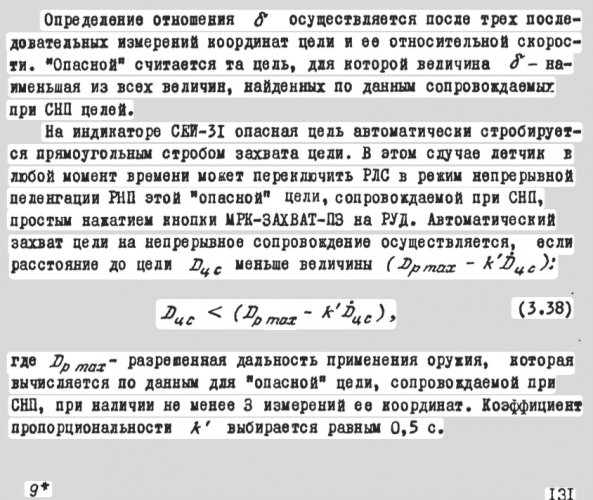
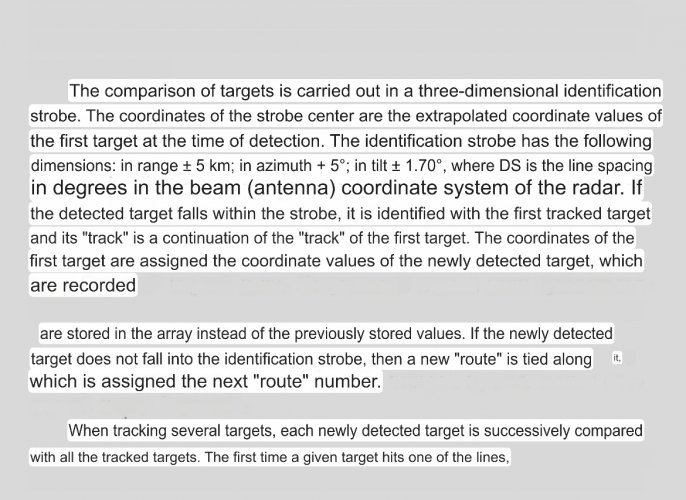
Here is the most technical source you will find, the MiG-29B technical manual in its chapter for SNP. It basically is saying once range is less then max weapon range - 0.5s of the current closure speed, it switches to RNP. Page 131. It also says SNP has 1.7 degree bar spacing, which with 3.5 degree beam width adds up to 8.6 degrees scan elevation.
 

Attachments

  • IMG_8554.jpeg
    IMG_8554.jpeg
    103.9 KB · Views: 34
  • IMG_8556.jpeg
    IMG_8556.jpeg
    415.3 KB · Views: 24
  • IMG_8557.jpeg
    IMG_8557.jpeg
    355.6 KB · Views: 15
  • IMG_8558.jpeg
    IMG_8558.jpeg
    451.4 KB · Views: 20
Last edited:
could you provide link to this manual from German source?
Fragments you provided seems to provide some hint, but are too narrowly cut to understand context
Mig-29 and su-27 radar at least had provisions to use 2 r-27ers/rs at once, it just wasn't realized. from german 29 radar manual
Edit: I noticed link several posts earlier, but still , could you provide some more text? Or page?
I have not found them so far, in German manual…
Edit 2:
I found this :). I post result in separate post.
 
Last edited:

Similar threads

Back
Top Bottom