Multiple Protective Shelters- basically a shell game where each MX missile and some decoys would be periodically moved between 23 different shelters. The Soviets would have no way (except through some very impressive espionage work) of knowing which shelter contained the real missile, so they would have to destroy all of them.

Dense Pack considered cheaper to build but more vulnerable?
 
Dense Pack considered cheaper to build but more vulnerable?
Lots of debate about Dense Pack and the concept of fratricide that was to be one of its survival methods basically, and people are free to correct me, you had four main points

1) Enough spacing to prevent even the most powerful Soviet warheads from killing two silos
2) Ultra hard silos that you’d 100% have to use at least two warheads per silo (yes two warheads per “any” silo is standard but this was still part of selling dense pack)
3) The need for perfectly timed warhead arrival or the first warheads would throw enough debris in the air to effectively kill proceeding warheads also know as fratricide.
4) Limiting damage to CONUS by having your ICBMs (warhead sponge) less spread out

And yes ultimately less expensive than MPS system.

I personally liked the deep hard rock basing concept of the WS-120a that was also discussed for MX IIRC.
 
Lots of debate about Dense Pack and the concept of fratricide that was to be one of its survival methods basically, and people are free to correct me, you had four main points

1) Enough spacing to prevent even the most powerful Soviet warheads from killing two silos
2) Ultra hard silos that you’d 100% have to use at least two warheads per silo (yes two warheads per “any” silo is standard but this was still part of selling dense pack)
3) The need for perfectly timed warhead arrival or the first warheads would throw enough debris in the air to effectively kill proceeding warheads also know as fratricide.
4) Limiting damage to CONUS by having your ICBMs (warhead sponge) less spread out

And yes ultimately less expensive than MPS system.

I personally liked the deep hard rock basing concept of the WS-120a that was also discussed for MX IIRC.
The problem was that the Soviets could easily get around fratricide by spacing their attacks by a few seconds.

As for deep hard rock basing, no matter how far underground you go, your silo still needs an opening and a direct hit, even if the missile survives, will destroy the opening and leave the missile useless.

One idea I like is putting the missiles in floating capsules anchored to the bottoms of lakes.
 
The problem was that the Soviets could easily get around fratricide by spacing their attacks by a few seconds.

As for deep hard rock basing, no matter how far underground you go, your silo still needs an opening and a direct hit, even if the missile survives, will destroy the opening and leave the missile useless.

One idea I like is putting the missiles in floating capsules anchored to the bottoms of lakes.
I think one concept including having tunnelling machines housed with the missile.

Again going from memory it was going to be a missile facility in a Cheyenne Mountain type complex with missiles on mobile launchers housed with machines to dig them out if the exits were targeted.

I also seem to recall quickly discarded due to very high cost.
 
The problem was that the Soviets could easily get around fratricide by spacing their attacks by a few seconds.
Longer than that.


As for deep hard rock basing, no matter how far underground you go, your silo still needs an opening and a direct hit, even if the missile survives, will destroy the opening and leave the missile useless.
The other trick was to stick the silos where a large chunk of rock was in the way between the usual approach lines an RV would have to make.

So you'd have a large mesa roughly-north of the silo(s), essentially forcing the Soviets to use FOBS to have any chance of hitting that location.


One idea I like is putting the missiles in floating capsules anchored to the bottoms of lakes.
Not actually enough deep lakes to pull that off.
 
The other trick was to stick the silos where a large chunk of rock was in the way between the usual approach lines an RV would have to make.

So you'd have a large mesa roughly-north of the silo(s), essentially forcing the Soviets to use FOBS to have any chance of hitting that location.
Or they could've used SLBMs or just hit the top of the cliff in the knowledge that the debris would bury the silo.
Not actually enough deep lakes to pull that off.
Lake Superior is pretty deep
 
I think history has absolved the MPS concept. Now that we have de-MIRVed our ICBMs, the cost exchange ratio would be far more favorable. Under the original concept, the Russians could have destroyed 2000 warheads by hitting all 4600 shelters. With only 1 warhead per missile, they would only destroy 200 warheads by hitting 4600 shelters.
Why 23 shelters per? Why not 24, or 25, or 20? What made 23 the magic number?

Although an advantage is if you want to continue production you have a lot of extra shelters that can house a missile.
 
And the deep spots are relatively small targets. 10MT later, and all those floating silos are crushed beer cans.
Designing a nuclear warhead that can survive hitting water at Mach 20 and then gracefully drop to the bottom and detonate would be very difficult.

Why 23 shelters per? Why not 24, or 25, or 20? What made 23 the magic number?

Although an advantage is if you want to continue production you have a lot of extra shelters that can house a missile.
The system was designed to be expandable to 33 shelters per. I'm guessing they arrived at that number trying to balance the cost of the shell game system with the ability to deter an attack.

That second point was used as an argument by MX's opponents, that the temptation to fill the empty silos with more missiles would be too great. It ignores the fact that ICBMs don't grow on trees and economics alone would preclude us from acquiring an additional 4400 MX missiles.
 
I wonder if these construction practices might be applicable off world—or to store things in deep time like the Long Now folks.

There you may have to alter construction so as to take into account any melting glaciers/rocks overhead…run-off, etc.
 
But underwater, it's impossible to know the exact coordinates of the missiles.
If it's not fenced off with buoys, you drive some boats over with fish-finder sonars to look for the big thing in 200+ft deep water.

If it is fenced off with buoys, just aim the missile for the center of the area if it's small, carpet the area if it's big.


I wonder if these construction practices might be applicable off world—or to store things in deep time like the Long Now folks.

There you may have to alter construction so as to take into account any melting glaciers/rocks overhead…run-off, etc.
For deep time storage, I think you're looking at things like nuclear waste geologic storage. Deep in the salt mines.
 
That second point was used as an argument by MX's opponents, that the temptation to fill the empty silos with more missiles would be too great. It ignores the fact that ICBMs don't grow on trees and economics alone would preclude us from acquiring an additional 4400 MX missiles.
4400 MXs a guy can dream ;)
 
If it's not fenced off with buoys, you drive some boats over with fish-finder sonars to look for the big thing in 200+ft deep water.

If it is fenced off with buoys, just aim the missile for the center of the area if it's small, carpet the area if it's big.
A. Lake Superior has large portions that are over 600 feet deep
B. I doubt the Soviets would be able to get boats with fish finder sonars past the Saint Lawrence Seaway without being detected
 
Designing a nuclear warhead that can survive hitting water at Mach 20 and then gracefully drop to the bottom and detonate would be very difficult.


The system was designed to be expandable to 33 shelters per. I'm guessing they arrived at that number trying to balance the cost of the shell game system with the ability to deter an attack.

That second point was used as an argument by MX's opponents, that the temptation to fill the empty silos with more missiles would be too great. It ignores the fact that ICBMs don't grow on trees and economics alone would preclude us from acquiring an additional 4400 MX missiles.
I'm not saying fill them all, just that if you wanted two or three missiles per circuit it would b easy to do.

Although now that I think about it, that would work against the economics of needing a greater than 2/1 ratio of warhead committed to the attack to warheads attacked. If you expanded to 33 you could expand to two MXs per set of shelters while still making a first strike "uneconomical". I guess this basing system is a way to counteract MIRVing of missiles by "MIRVing" missile silos. One warhead per missile means more than one missile is needed to take out each missile, MIRVing means one missile can take out multiple missiles, multiply the launch sites and you're back to needing more than one missile to take out each missile. Of course this only works if the cost of the launch sites and missile is less than the cost of additional missiles.
 
I'm not saying fill them all, just that if you wanted two or three missiles per circuit it would b easy to do.

Although now that I think about it, that would work against the economics of needing a greater than 2/1 ratio of warhead committed to the attack to warheads attacked. If you expanded to 33 you could expand to two MXs per set of shelters while still making a first strike "uneconomical". I guess this basing system is a way to counteract MIRVing of missiles by "MIRVing" missile silos. One warhead per missile means more than one missile is needed to take out each missile, MIRVing means one missile can take out multiple missiles, multiply the launch sites and you're back to needing more than one missile to take out each missile. Of course this only works if the cost of the launch sites and missile is less than the cost of additional missiles.
The real genius of MPS is that now its the defender that's using decoys to flip the cost-exchange ratio in his favor. Building extra shelters is much cheaper than adding more warheads
 
B. I doubt the Soviets would be able to get boats with fish finder sonars past the Saint Lawrence Seaway without being detected
They don't needed to, they just need to get a few good old boys to go on vacation in the area.

And FUCKING RENT ONE from any of the Marinas.

The Great lakes has a massive tourists industry for fishing that was even bigger in the 70s and 80s. It be easy as saying Bob you monkey Uncle for the Soviets to set that up.
 
They don't needed to, they just need to get a few good old boys to go on vacation in the area.

And FUCKING RENT ONE from any of the Marinas.

The Great lakes has a massive tourists industry for fishing that was even bigger in the 70s and 80s. It be easy as saying Bob you monkey Uncle for the Soviets to set that up.
Screenshot 2025-07-27 at 3.08.12 PM.png
An exclusion area of about this size could fit 59 capsules each spaced 4 miles apart. The Soviets would have no way of knowing exactly where each missile was.
 
Right through the center starting around 1940ish as the Lakers got more power.

And it needs to be reminded that Canada has a MASSIVE VOTE in this as well since they share the lakes basically 50/50 with the US.

Fucking the Shipping routes like this is going to need to be signed off on by them.

And with the amount of trade on the Lakes?


It dead on arrival.
 
Right through the center starting around 1940ish as the Lakers got more power.

And it needs to be reminded that Canada has a MASSIVE VOTE in this as well since they share the lakes basically 50/50 with the US.

Fucking the Shipping routes like this is going to need to be signed off on by them.

And with the amount of trade on the Lakes?


It dead on arrival.
That's what I thought, but my entire Navy time on the Lakes was boot camp and learning what Lake Effect Snow was.
 
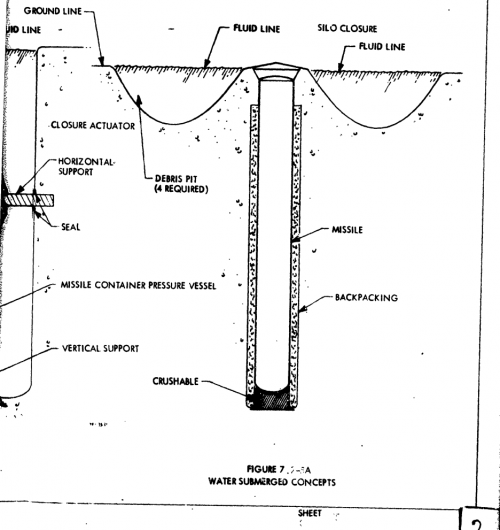
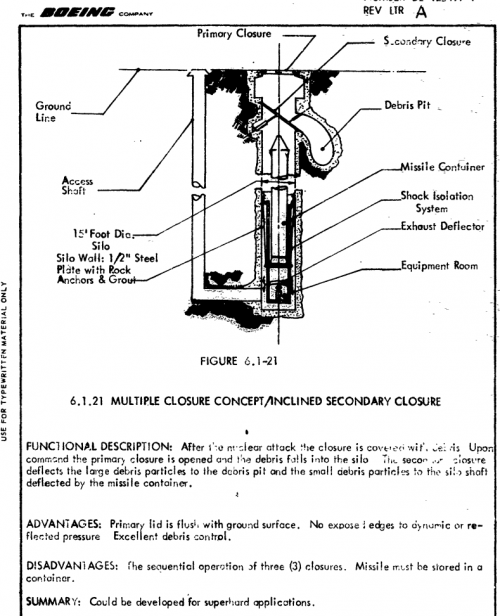
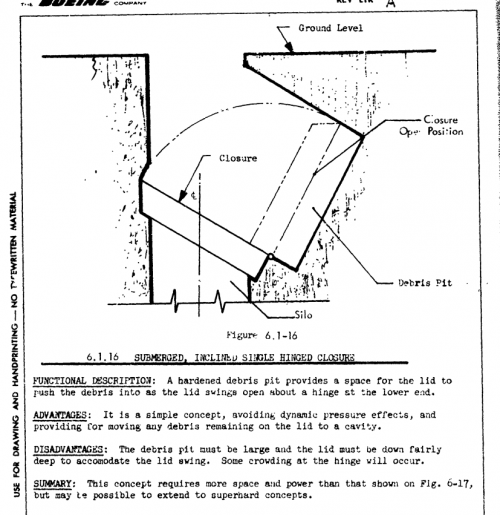
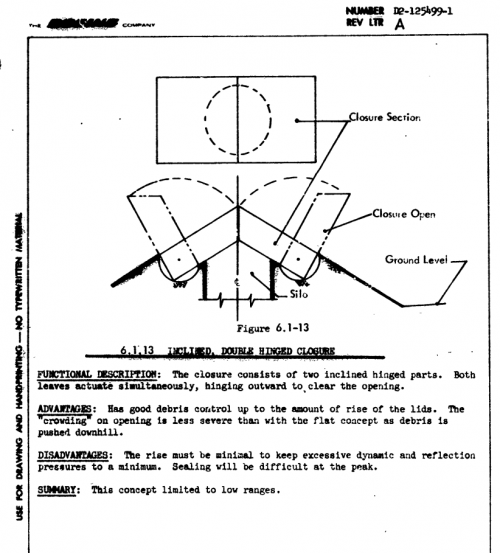
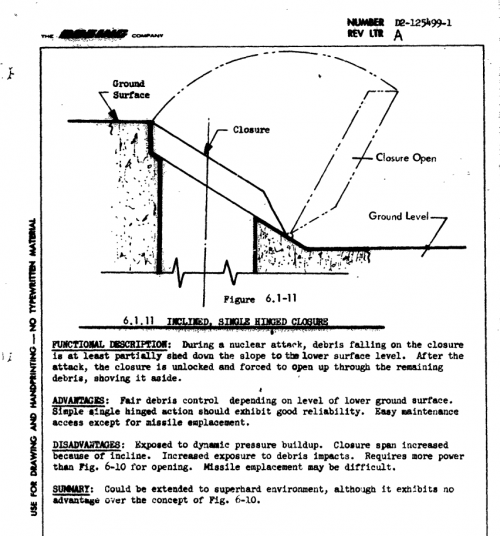
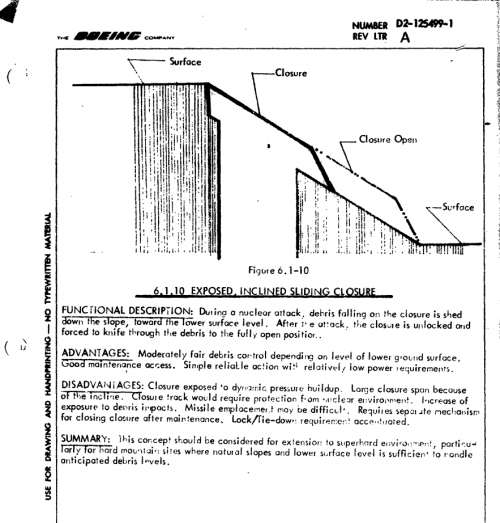
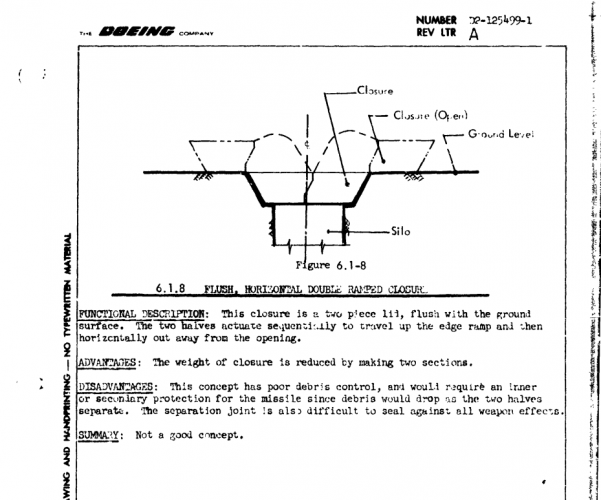
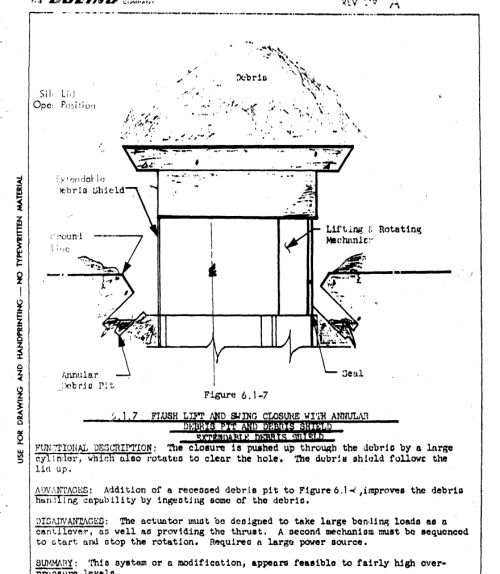
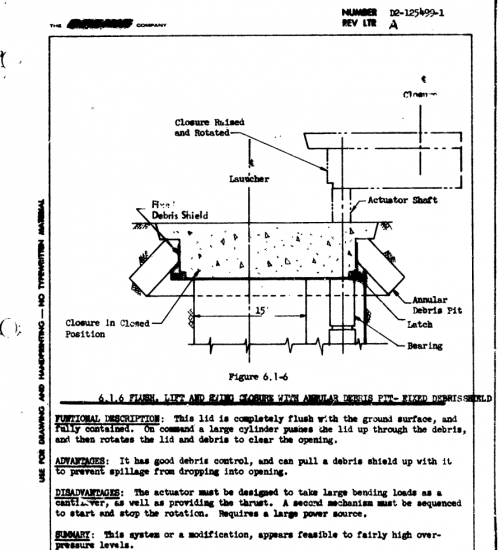
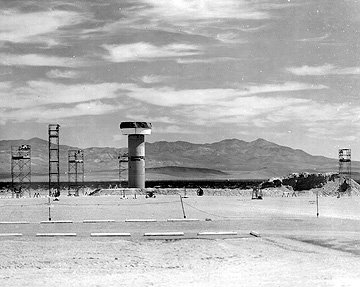
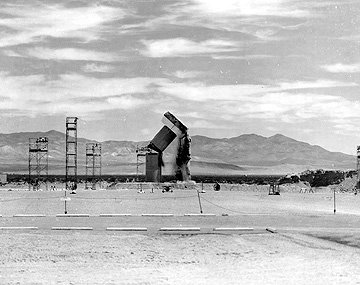
Always wondered how the silo doors would work for the superhard concepts (Russian hinged design vs typical US sliding style, etc.), and found a document on the different silo closure and debris-handling designs.

"Closures and Debris-Handling Concepts for Superhard Missile Launch Facilities"

https://apps.dtic.mil/sti/tr/pdf/AD0844615.pdf

a few pictures below, but there's a lot more.
 

Attachments

  • 1770927222232.png
    1770927222232.png
    187.9 KB · Views: 60
  • 1770927137377.png
    1770927137377.png
    237.1 KB · Views: 42
  • 1770927108049.png
    1770927108049.png
    234.1 KB · Views: 41
  • 1770927082290.png
    1770927082290.png
    195.1 KB · Views: 38
  • 1770927067567.png
    1770927067567.png
    234.5 KB · Views: 39
  • 1770927054287.png
    1770927054287.png
    264.5 KB · Views: 36
  • 1770927027217.png
    1770927027217.png
    171.9 KB · Views: 34
  • 1770926994371.png
    1770926994371.png
    206.4 KB · Views: 32
  • 1770926963948.png
    1770926963948.png
    192 KB · Views: 40
"Closures and Debris-Handling Concepts for Superhard Missile Launch Facilities"
that remind me of proposal to install MX in horizontal silos in Mountain range
so debris not blocking the silos
one proposed site were cliffs of Hawaii

Source:
Raumfahrt Lexicon by Bruno Stanek 1983
under M like MX
 
If we had just accepted that the only role for our land based missiles was to serve as a "nuclear sponge", with our far greater number of warheads located on submarines serving the real retaliation role, then we wouldn't have needed to worry so much about survivability and we could have used a far less expensive basing system, perhaps with mobile launchers.
 
If we had just accepted that the only role for our land based missiles was to serve as a "nuclear sponge", with our far greater number of warheads located on submarines serving the real retaliation role, then we wouldn't have needed to worry so much about survivability and we could have used a far less expensive basing system, perhaps with mobile launchers.
Mobile Launchers were rejected after Midgetman. The security implications just don't make sense for the US.
 
I'm not sure how such a terrorist attack would work. The launchers would be guarded heavily and the warheads are designed so that they can't be detonated in the wrong hands.
It'd be more like a Spetsnaz attack, not exactly terrorists.

But in general, there's idiots who want to stop everything nuclear. FFS they were stopping nuclear waste trucks back in the 1980s/90s. Greenpeace laying in the road, that kind of thing.
 
It would be pretty hard for Spetsnaz to get into the middle of the Nevada desert. And again, the launchers would be heavily guarded
Judging by how many people have entered the US illegally historically, it doesn't seem that hard to cross the border.

And once over the border, traveling in the US is trivial. And when you're talking about the resources of the USSR to provide logistics, it wouldn't be hard.

Also, not Nevada. Wyoming, Montana, Dakotas.
 
Judging by how many people have entered the US illegally historically, it doesn't seem that hard to cross the border.

And once over the border, traveling in the US is trivial. And when you're talking about the resources of the USSR to provide logistics, it wouldn't be hard.

Also, not Nevada. Wyoming, Montana, Dakotas.
MX was to be based in Nevada. And while they can get over the border, it would be difficult to get past the perimeter of whatever exclusion zone would be set up for the launchers, and again, the launchers themselves would be guarded by armed soldiers
 
MX was to be based in Nevada. And while they can get over the border, it would be difficult to get past the perimeter of whatever exclusion zone would be set up for the launchers, and again, the launchers themselves would be guarded by armed soldiers
The biggest reason that "road mobile" was rejected was the assumption in some quarters that the missiles would be out on the interstate. Which makes for no exclusion zone while the things are in motion because they're in public.

And a relatively easy intercept, the expedient being to use a heavy truck to ram the missile carrier off the road. If you time it right, the missile truck would be heavily damaged (most importantly the missile). Say, forcing the missile carrier off right before a bridge. Crunch.

If we're assuming the missiles moving inside a government-controlled area, that's a more difficult thing but not impossible.
 
Back
Top Bottom