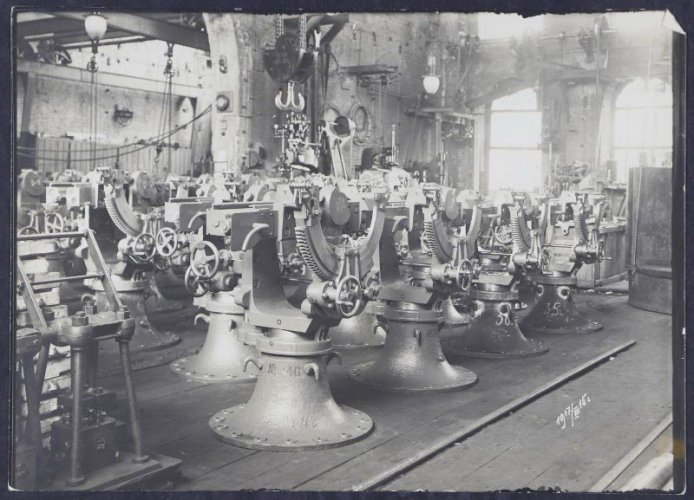
“The history of the creation of the Russian 180-mm cannon dates back to the Russo-Japanese War of 1904-1905. In 1906, L.F. Dobrotvorsky, who commanded the cruiser “Oleg” in the Battle of Tsushima, proposed adopting American 178-mm guns instead of 152-mm guns, as more effective, but still allowed manual loading and did not require additional mechanisms. In 1912, after the commissioning of the battleship “Emperor Paul I”, which was armed as auxiliary artillery with 203-mm cannons in turrets and casemate mounts, it was found that the rate of fire of casemate mounts with manual feeding of shells was even higher than that of turrets, which had mechanical loading. It turned out that at the then level of technological development, mechanical loading made sense only for guns of 254 mm caliber and higher, and for smaller calibers it only slowed down the operation and reduced the reliability of the guns. At the same time, the 203 mm projectile, weighing 139 kg, was too heavy for manual loading in this connection, the idea of switching to 7-inch (178 mm) artillery as the main weapon for light cruisers and auxiliary weapons for battleships arose again.
It was planned to develop a 7-inch gun weighing 9.76 tons, the weight of the projectile for which would be 74.8 kg, and the weight of the charge would be 32.5 kg. As a result, it would be possible to obtain a fairly powerful gun that had a rate of fire of about 6 - 8 rounds per minute when manually loaded, and the shot would include a projectile and two half-charges.
The main “ideologists of the 7-inch caliber were artillerymen of the Naval General Staff, while a number of specialists from the Artillery Department of the Main Directorate of Shipbuilding were opposed to the development of such artillery pieces. At the same time, many artillerymen from the floating fleet supported the idea of using 7-inch guns. Thus, at the very beginning of 1914, when assessing the tactical and technical tasks of the Naval General Staff for the design of a promising battleship, the flagship artilleryman of the Baltic Sea Battleship Brigade N. A. Virenius put forward the idea of a 30-knot light “squadron” cruiser with 7-inch guns in three or four-gun installations. The same caliber as an auxiliary weapon was proposed in the «Project of the 23,000-ton linear mine ship», presented by ship engineer Lieutenant P.V. Yankov at the end of 1913. However, the First World War stopped the development of these plans.