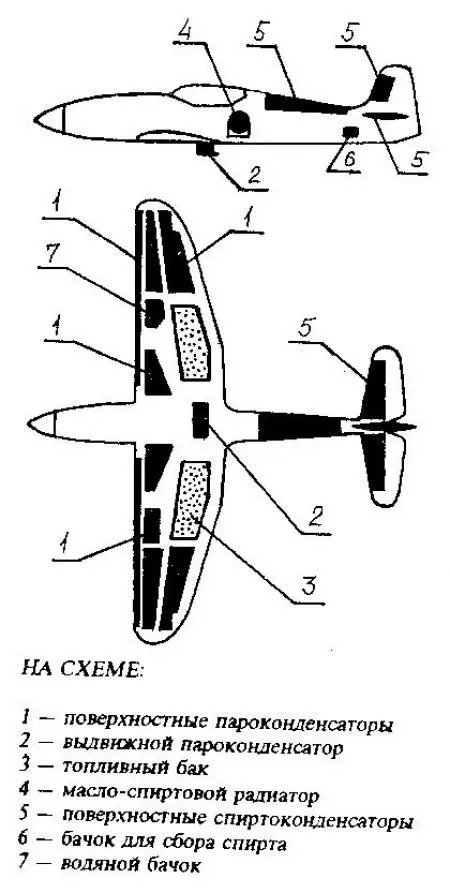
I have read somewhere that the He-100's unique cooling system could have been a liability to relatively light damage.
In the 1935 contest for the future fighter of the
Jagdwaffe, the Heinkel He 112 lost against the Messerschmitt Bf 109 because of its elliptic wing, more difficult to manufacture.
In 1937, in an effort to remain in the contest, Dr. Heinkel promised to
General Luftzeugmeister Udet that he would be able to manufacture a fighter that, propelled by a Daimler Benz DB 601, would be capable of reaching 700 km/h. Although Udet considered it impossible, the project – named Heinkel P1035 - started on 25 May 1937. The design team, led by Siegfried Günter, followed the streamlining and drag reduction in the main guidelines. They adopted a well faired cockpit, a fully retractable tail wheel and a stressed skin wing covering, reducing the number of ‘Butter’ rivets.
The DB 601 engine had exhaust ejectors for a small amount of thrust and the supercharger inlet was moved from the side of the cowling to a location under the propeller hub. The frontal radiator was replaced by a surface cooling system, inspired by the Macchi seaplane racers, which was already being tested on the He 119 V1.
The steam generated at high temperature was separated from the cooling fluid coming from the engine, using a centrifugal compressor and an expansion chamber. The heat exchangers, located in the wings, had a total capacity of 345 lt and transferred the heat outside through the light alloy stressed covering. The steam was then condensed into liquid by cooling and returned to the engine circuit by means of 22 electric driven centrifugal pumps.
A similar system was designed to refrigerate the oil, by passing it through a heat exchanger where methyl alcohol was added. The resulting vapour was then being ducted to the tail surfaces, where it was to be condensed back to liquid before returning to the heat exchanger. By the end of October, the project was presented to the
Luftwaffe Technisches Amt, receiving the He 100 number type.
During the flight tests of the first prototype, it turned out that the wing suffered a structural distortion, caused by the high temperatures. It was also confirmed that the oil cooling system did not work at all. The second prototype had a reinforced wing cladding and was equipped with a retractable auxiliary cooler for the ground running and another, on the port wing root, for the oil.
On 30 March 1939, the prototype Heinkel He 100 V8, powered by one 1,800 hp Daimler Benz DB 601 ReV engine, set a world speed record flying at 746.6 kph. In order to minimise drag, the conventional radiator was replaced by one experimental surface-evaporation cooling system that used pressurised water at 110 ºC.
More prototypes and a short preproduction series were built and the He 100 achieved several speed records. But its little reliable cooling system - that made it very vulnerable in combat- together with its maintenance problems and the lack of DB 601 engines, advised against its mass production, foreseen for 1939.