Hi,
One issue that comes across my mind while reading alot about the LCS, FFG(X) and FF(X) concerns the ability to develop a design in the US. I see alot of people suggesting that the us can no longer design a warship right now, but I am not fully sure that I totally agree with that in that I do not necessarily think that it is an issue with doing a functional or detail design, but rather the issues may be further up the "food chain" with regards to whether the US can currently adequately define at a high level what they want and whether what they want is currently within the realms of possibility.
I think part of this issue derives in part from the end of the Cold War. Specifically, during the Cold War there appeared to be a fairly constant "drum beat" of needing to replace an existing aging class of Ocean Escorts with a newer generation and the need to replace an existing Fleet Escort class with a new generation of vessels. As such, you had the Dealy class, followed by the Jones class, followed by the Bronstein and Garcia classes, then the Know and finally Perry classes, etc. (or for the DDGs you had the Farraguts followed by the Adams, then Spruance and Burkes etc.) This of course didn't mean that there weren't some side excursions/studies such as the SEA HAWK DDG concept in the late 60s, or investigations into Surface Effects Ships and such, but there was at least some clarity as to what the next vessels might have to be at a minimum (eg there will be a need for either new vessels capable of escorting merchant ships, Amphibious Ready Groups, Underway Replenishment Groups, and Carrier Battle Groups or othe rSurface Action Groups).
However, once the Cold War ended and the Russian (former Soviet) navy was not seen as such an immediate threat it became less clear what might be needed to fight the next war and/or serve during the upcoming hopefully semi-peaceful period with the potential for local (hopefully) regionalized incidences of conflict.
In addition, with the end of the Cold War it was realized that funding may become more scarce and as such reducing costs and getting ships into service quicker, while improving their potential days at sea while also improving the quality of life at sea so as to attract better qualified personal to service while also reducing the potential turn-over of loosing those personnel that you just spent a long time training also came to the fore front.
As such a lot of different concepts that had been floating around all began to come to fore, including if not directly the Street Sweeper concept then at least the concept of smaller/lighter faster warships as force multipliers as well as the use of modularity to allow ships to swap from one focus to another between missions, and the idea of reduced manning/more automation, CORE Crew with fly on detachments and/or BLUE/GOLD crew swapping to allow a vessel to have more days at sea, while allow the crews a reasonable balance between at sea and shore side duty.
In addition there was also a concept that arose wherein warship programs would be treated more like aircraft acquisition programs, wherein the main hull and some baseline equipment would be treated as a "seaframe" where other equipment including some sensors and weaponry could be added on later (as modules) similar to how a warplane may have its main fuselage, machinery, avionics and perhaps some other baseline weaponry and senosr/electronics as the base "airframe", but that other weapons and sensors could be added on as needed as pods on underslung rails or enclosed bays. And similarly during procurement the first few hulls or "seaframes" would be Test and Trails craft where lessons could be learned, prior to entering a full rate of production.
In addition, there was also a push to try and filter out potentially over onerous design standards and possibly make use of either commercial specifications and/or commercial off the shelf components. And finally, there was also a similar but different issue brewing in the background where it was noticed that in the commercial world there existed notionally vessels with speed and range capabilities that seemed to outstrip what military ships seemed capable of, some of which may have been due in part to commercial operators being more willing to embrace the use of advance technology and hullforms. And finally there was a drive from some quarters for the need to be "transformational" in this "new period" and not just stick to building ships that may no longer be all that applicable to the new potential threats that the world may face.
As such, to me at least, it appears that as the USN started looking into what comes next (if I am understanding correctly) they first began to focus on a destroyer, which I believe evolved into the land attack destroyer and then the DDG1000. And if I am understanding correctly I believe that at one time it was intended that this class would replace all DDs/DDGs and FFs/FFGs. However, as the program developed, I believe somewhere along the way it was decided that there would also be a need for a Small Surface Combatant, and as such a more or less fact finding project was set up called the Focused Mission Ship to first get input from industry on what may be possible by means of a Request for Information and then to down select to a few concepts to have industry better flesh out the concepts that appeared to have good potential.
It was then from these studies that the Littoral Combat Ship program arose, where the ships would be designed as "seaframes" with some base capability with modular spaces to allow them to fit additional weapons and sensors to perform more complex duties and where those modules could easily be swapped to allow the "seaframe" to relatively quickly change role. In addition, it is my understanding that not only were the first two vessels meant to be Test and Trails ships called the Flt 0 designs, but that the actual productions vessels were intended to be of a follow Flt 1 design which would incorporate some lessons learned, etc.
Somewhere along the way when the Focused Mission Ship RFIs went out they were focused around the ability to attain a high sprint speed, use modularity to swap missions, and be lean manned etc. So presumably (I am guessing) the powers that be in the Navy responsible for developing the requirements outlined in this RFI believed that either those requirement could either potentially be attained or that the contractor responses to the RFI would show what was and what was not attainable.
Unfortunately, in looking back at this period though it appears that there may have been a lot of
grey areas between what it appeared the Navy was looking for and what industry believed might be attainable. And as such, many proposals were put forth based roughly either on some existing commercial concepts (such as fast ferries) specialty smaller naval craft (such as the Skjold class Surface Effect Ship (SES)), or commercial concept vessels (like the monohull Destriero high speed ship). From this three more detailed design studies were funded for a high-speed aluminum trimaran, an SES, and a high-speed monohull. And eventually, although the original intent appears to have been to down select to a single design, and decision was eventually made to down select to both the aluminum trimaran design and the monohull design, with two vessels of each type being built as the Flt 0's of each class.
If I am understanding correctly it was during the phase when all three designs were still competing that many issues began arising, where it became clear that some hopes/desires and/or requirements may not have been as well defined as they probably should have. Specifically, this included such things as where commercial type requirements could/would be applicable and where more stringent Navy standards would apply, such as what items may or may not need to be shock mounted. However, diving a little further it also impacted issues like how is "Sprint Speed" defined, in that for commercial ferries, and also I believe high speed smaller navy craft a "sprint" speed may be determined at a relatively high percent of a ship's installed Maximum Continuous Rating (MCR) for its power plant (perhaps as high as 95-97%) whereas the group within the USN responsible for defining the design requirements for USN warships instead treated this as a "sustained" speed which is typically the speed achieved at approximately 85% MCR or so, potentially leading to a need for more installed power, which in turn would likely increase the size and displacement of the vessels, for instance.
Additionally, somewhere along the way, after the down select was made to two designs, the Navy also decided to cancel the LCS Flt 1 program and just accept the Flt 0 designs, which were initially intended as Test and Trials vessels, as the regular production variants of the LCSs, eventhough some design changes were found desirable. As such, for example the first three monohull LCS vessels have some degree of difference particularly with regards to ther stern configuration (at least as delivered), and later there were also some changes in the reduction/combining gear design between the early and later monohull LCS designs for example.
Also as part of the LCS program, as a mean of getting hulls into the water quickly, much of the actual different "modules" that they were being developed concurrently. And because each of the down selected LCS designs approached how they would handle some of the notional components differently it likely added to the complexity of some of the design requirements for those modules.
As it turns out some of the proposed components of these modules either failed to meet their requirements and/or were replaced by other systems and/or were canceled outright leaving the LCSs that were built at time being a bit under armed/outfitted.
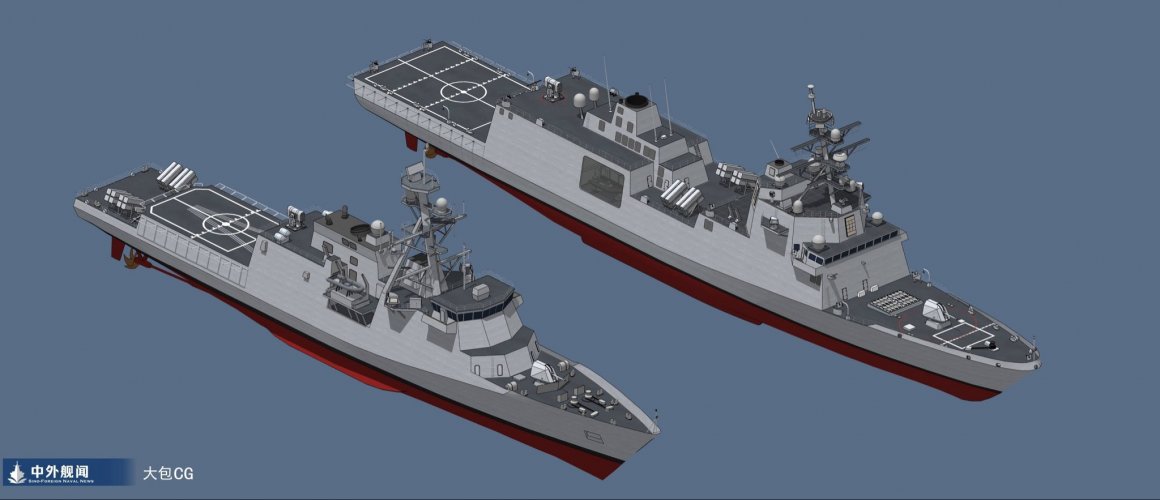
Eventually as time went on, in part due to the lessons that were being learned, and struggles that arose from trying to introduce so many new types of machinery and new concepts onto a ship with a reduced "CORE" crew, it was decided to curtail the LCS program and start a Frigate program. Initially, these were at in part I believe meant to be based on the existing LCS designs, but as the program evolved a decision appears to have been made that the designs would be based on an exisiting inservice vessel that could be modified to meet US requirements septically including a three faced SPY-6 radar with fixed array and other US weapons, sensors, "Buy America" components and other factors. Once again here I suspect that there was more
"grey area" in what this actually meant though as it appears that there eventually arose a number of issues with modifying the down-selected FFG(X) design which was based on the Italian variant of the FREMM frigate to meet all the US requirements that were "eventually" identified.
It appears that some of these issues may have led to the purported 700+ ton recent growth in the design.
In addition it also appears from recently published information that the based "functional design" which would relatively firmly define what the vessel is intended to do was not fully locked down when the Detail Design and Construction contract for the FFG(X) was let, which (if I am understanding correctly) means that some of the core requirements for the vessel may still be subject to change while the shipyard is trying to do the detail design and construction of components of the ship.
As such, it now appears that the decision has been made to curtail the FFG(X) program at two ships (at least for now) and instead embark on an FF(X) program, where the initial FF(X) vessel has been sole sourced to the builder of the USCG's National Security Cutter/WHSL design with purported very minimal design changes. Purportedly the NSC/WHSL design (with very minimal changes has been chosen for the FF(X) because it is a US design whose parent hull has been built successfully in a US yard (after some initial design issues) and it specs US equipment and material and has been built to US design standards
However, once again, at least publicly there appears to be a lot of
grey area regarding a lot of basic issues for this program as well. Specifically, although the NSC/WHSL parent design has been designed and built to USCG based US standards, they do not meets some USN type US standards. In particular I previously posted an article where one of the bidders for the FFG(X) program commented on issues related to the need for machinery segregation on the FFG(X) while an inboard profile for the current NSC/WHSL previously posted on this forum shows that the NSC/WHSL design has its Gas Turbine and its diesel engines in adjacent compartments with a shared bulkhead, which does not equate to any real separation of spaces. Similarly I believe that the USCG and USN use similar but different damage stability requirements where USCG vessels (I believe) only typically meet the length of damage requirements for Auxiliary Vessels whereas a USN FF or FFG would typically be expected to meet a more onerous Combatant length of damage requirement.
To me then, I'm not so convinced that a modern warship can't be designed and built in the US but rather it appears that our current system is not overly well suited to;
- understanding what is currently feasible, specifically with regards to how well commercial practices can be translated to military needs
- what the impacts will be on trying to incorporate new concepts and practices into regular navy usage, especially with regards to attempts at reduced manning while also trying to bring new machinery components (such as new gas turbine types, new gearing concepts (CODAG vice CODGO, etc) while also just trying to debug any new design that doesn't share a lot in common with legacy fleet units.
- and in general how their high-level aspirations of concepts like "basing on a parent hull" or converting to commercial standards to as large an extent "as possible" may actually flow down into the actual ship design.
Personally I'm old enough to remember a period during the 1980s where there was talk of the need for an "Evolution at Sea" with fancy artwork that showed sleek minimally manned arsenal ships with loads of VLS tubes sailing alongside more conventional Ticonderoga class ships with the CGs acting as the "eyes and ears" of the fleet while the Arsenal ships acted as the high tech "muscle" of the fleet.
At the time I kind of wondered if trying to go too "transformational" (to use a more modern term) all at once might not be kind of risky and whether trying to do something more "Evolutionary" might make more sense. I know that for many classes of ships talk is made of "spiral designs" and building in "flights" or "tranches", but at time this seems kind of constrained to trying to shoehorn items into the basis more or less somewhat fixed design. Whereas my thoughts were kind of a little different.
Specifically when you look at both US and UK destroyer design in the 1930s it appears that they kind of did it batches by class where, for example, the Bagley class appears to have been an advance on the preceding Mahan class using the same machinery of the Mahan class but using the same basic more modern hullform, and the weapons and sensors of the of the more or less concurrently building Gridley and Benham classes (If I am understanding correctly). While the Sumers class was based on the previous Porter class and the eventual Sims class incorporating lessons learned from previous classes.
As such, my thought would be for an "evolutionary" approach where a ship is designed and built potentially based on a previous design, incorporating only a limited amount of new concepts and technology, to be followed by a follow-on design that will incorporate X% of the previous design (say the same hullform, base weaponry and sensors) but may then introduce a new machinery concept (such as IEP or something similar) etc. The next tranche of vessels could then try and introduce newer weapons and or sensors and such, or incorporate some other sort of steady progression. And each design tranche or batch will be designed to at least try and have an appreciable enough level of Service Life Allowance and potentially use some degree of modularity in its internal systems (not just weapons and sensors) so that out of date auxiliary machinery and fittings, as well as some of the weapons and sensors etc can potentially be more easily upgraded to what may be on later tranches/batches of the notionally partially similar ship types during a future upgrade.
Of course such an approach would lose some of the benefits of fleet wide commonalities and mean extra design work over the long term, but even now there are some appreciable differences in some ships of notionally the same class* and the US Navy has undertaken several design efforts over the last several years with little to currently show for it. And by having multiple only partially similar classes of ships the drumbeat of each next design would help serve to nsure a steady flow of work to maintain that skilled labor force.
*As a note to the above if you looked up the current DDG 51 class (such as on Wikipedia) you will that some of them are outfitted with 2 x CIWS a subset appear to be outfitted with both a CIWS and a SeaRAM mount, some have the 5"/54 Mk 45 Mod 1/2 while other have the 5"/62 Mk 45 Mod 4, some are outfitted with Harpoon while other mount NSM missiles, some are outfitted with an Optical Dazzler Interdictor Array while other appear to be fitted for a high Energy Laser, and of course some are fitted with a helicopter hangar while others aren't. And while there are some broad distributions into Flights, such as Flight I, Flight II, Flight IIa, and Flight III, some of the differences in outfit appears to potentially extend across these broad flight separations. As such there is already some degree of multiple baselines throughout just that single ship class.
Regards