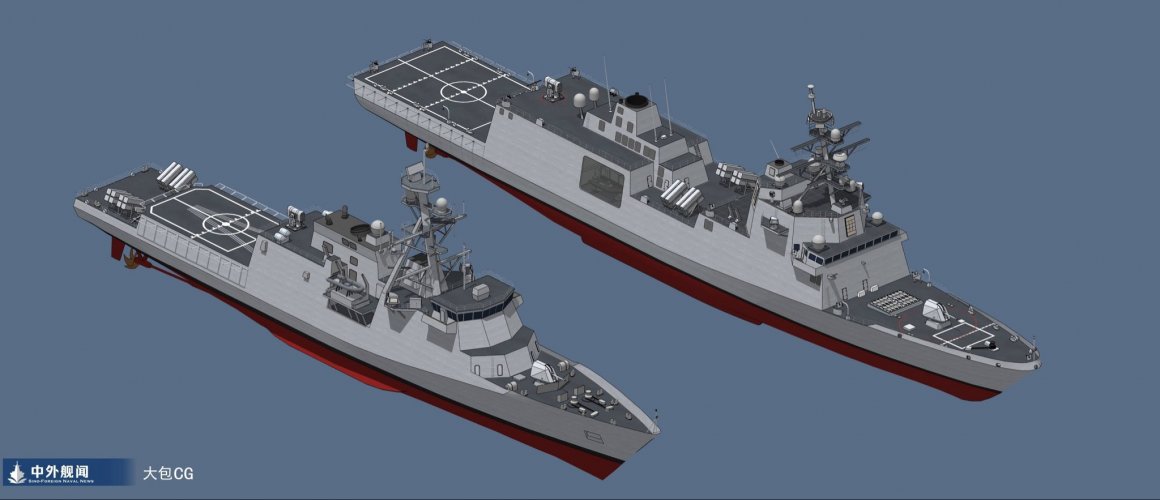
...
Why is the Freedom class LCS bad for the PF mission? The only way the LCS wins out is in endurance but that is such a minor concern when compared to other ships such as the Burke itself. Sensors, guns, etc. are all superior on the Freedom class.

Literally common sense. NSC is a CODAG design with no serious concern for quieting because it does law enforcement missions. It has no provisions for a TA or VDS. It is probably about as quiet as a Burke which is to say too noisy to be a dedicated ASW platform. It also has no space to support UxVs which are the next major frontier in shipboard ASW. Ok, I guess you could argue it can "do" ASW but the capability is so negligible over a Burke that it is essentially useless.
Hi,
Just a quick note - it is important to differentiate between the terms Range and endurance. In the US, for naval/government ship design the term range refers to how for a ship can notionally go on a full load of fuel, whereas Endurance is used to define how many days of stores etca ship can go before needing resupply.

For the LCS Freedom class I believe that they were designed to a 21 day endurance (though it may be as low as 14 days) and are notionally capable of a range of 3,500nm @ cruise speed or about 1,000nm (or so) @ sprint speed. It is however unclear what cruise speed has been assumed in these calculations as some sources will state a speed of 14kts, while others will suggest a notional cruise speed of 18kts (though it is unclear if this is the maximum speed that the ship can attain on its cruise engines or if it is the speed at which the range calculation was performed).

For the Burke Flt IIa class of ships I believe that they were designed to at least a 30 day endurance, but I will have to check my sources (which I do not currently have available right now). Additionally, they have a stated range of somewhere between 4,400 and 4,890nm or so @ 20kts.

And for the NSC/WHSL (and presumably the FF(X) design) I believe that they were initially designed to a 60 day endurance, and have a notional range of 12,000nm @ an undefined cruise speed which may be 14 kts or lower.

However, it should be noted that "endurance" (in terms of stores) can be increased by means of underway replenishment, and that the ranges noted above are "notional" and typically based on the assumption of burning all the available that can be potentially burned, whereas in real life the ships would likely only do that in an emergency and that underway refueling can be used to increase a ships range when at sea.

Anyway though, I believe that it is risky to say that "The only way the LCS wins out is in endurance" as I do not believe that the available data would likely support that claim.

Regards

PS. It should also probably be noted that while the NSC/WHSL (and presumably the FF(X) ) do have CODAG plants it should also be noted that the LCS Freedom and Independence classes are also fitted with CODAG plants)
 
How else do people learn but by asking questions?
Ask questions then, don’t assert that FF(X) is going to have things which they haven’t said it will have and/or do not logically make sense.

SPY-6 that much necessary
SPY-6 is the baseline for operating with CSGs and its cost is really not all that great, neither are its requirements. It’s just silly to mount it on an NSC, hence why Ingalls did not propose an NSC derived FFG(X) in the end.
which would require bigger hangar,
Very difficult, I do not believe they will change it from 1 helicopter and 2 UAVs.

redesign of a hull for bow sonar
A bow sonar is a nice to have but unnecessary, the critical components are a TA and VDS. It is theoretically possible to fit these on the stern however it doesn’t solve the natural problems that come with having a design base in no way meant for ASW
The v2 is only really used as aircraft control radars for amphibs and CVs not as something for engagements.
I have wondered whether it might be ok if paired with TRS-4d or something similar to provide maximum awareness
 
Hi,
Just a quick note - it is important to differentiate between the terms Range and endurance. In the US, for naval/government ship design the term range refers to how for a ship can notionally go on a full load of fuel, whereas Endurance is used to define how many days of stores etca ship can go before needing resupply.

For the LCS Freedom class I believe that they were designed to a 21 day endurance (though it may be as low as 14 days) and are notionally capable of a range of 3,500nm @ cruise speed or about 1,000nm (or so) @ sprint speed. It is however unclear what cruise speed has been assumed in these calculations as some sources will state a speed of 14kts, while others will suggest a notional cruise speed of 18kts (though it is unclear if this is the maximum speed that the ship can attain on its cruise engines or if it is the speed at which the range calculation was performed).

For the Burke Flt IIa class of ships I believe that they were designed to at least a 30 day endurance, but I will have to check my sources (which I do not currently have available right now). Additionally, they have a stated range of somewhere between 4,400 and 4,890nm or so @ 20kts.

And for the NSC/WHSL (and presumably the FF(X) design) I believe that they were initially designed to a 60 day endurance, and have a notional range of 12,000nm @ an undefined cruise speed which may be 14 kts or lower.

However, it should be noted that "endurance" (in terms of stores) can be increased by means of underway replenishment, and that the ranges noted above are "notional" and typically based on the assumption of burning all the available that can be potentially burned, whereas in real life the ships would likely only do that in an emergency and that underway refueling can be used to increase a ships range when at sea.

Anyway though, I believe that it is risky to say that "The only way the LCS wins out is in endurance" as I do not believe that the available data would likely support that claim.

Regards

PS. It should also probably be noted that while the NSC/WHSL (and presumably the FF(X) ) do have CODAG plants it should also be noted that the LCS Freedom and Independence classes are also fitted with CODAG plants)
Entirely good points, thanks, I think I misspoke and meant to say “the only way the NSC wins out is endurance” so my apologies, I’ll rectify that.
Also with regards to powerplant choice, this effects NSC more than LCS as LCS does not do ASW whereas an NSC derived FF would by virtue of requirements be forced to do ASW
 
Hi,
...

SPY-6 is the baseline for operating with CSGs and its cost is really not all that great, neither are its requirements. It’s just silly to mount it on an NSC, hence why Ingalls did not propose an NSC derived FFG(X) in the end.
...
I have wondered whether it might be ok if paired with TRS-4d or something similar to provide maximum awareness
Hi,
It is not just the direct costs of a system that need to be considered but also its flow down costs. The three face installation on the FFG(X) takes up a fairly substantial amount of space and is located fairly high up. It likely also has cooling and electrical impacts that can drive up the needs for larger auxiliary systems, as well as potential increased manning requirements. All of this will likely lead to the need for a larger (and hence more expensive vessel) than a ship without such a large multi-face fixed array.

A single rotating SPY-6 array could potentially have a fair bit lower impact on the design of a ship, though I currently do not have any information yet on how much smaller that impact may be.

With respect to fixed arrays versus rotating arrays, it is clear that the fixed arrays would provide a greater capability especially against fast moving threats, for a smaller ship that may not be able to fit a large multi-face fixed array, a rotating SPY-6 array would potentially provide a better capability than no such array at all.

It should also be noted that ESSM is specifically designed to be fitted to a wide variety of platforms, and that while a multi-face fixed array may help an ESSM vessel better defend itself against attack, a fixed multi-face array is not specifically necessary for use on an ESSM armed vessel.

Regards
 
Entirely good points, thanks, I think I misspoke and meant to say “the only way the NSC wins out is endurance” so my apologies, I’ll rectify that.
Also with regards to powerplant choice, this effects NSC more than LCS as LCS does not do ASW whereas an NSC derived FF would by virtue of requirements be forced to do ASW
Hi,
Not a problem. I do that all the time too and I agree with you about the CODAG stuff :)
 
Does SPY-6 that much necessary? 054B lives just fine w/o Type 346A from 052D.
You can launch ESSM just fine w/o it, and 50km range of ESSM is pretty good for a frigate. 16 Mk-41 for it would be more than enough.
SPY-6 would have allowed the vessel to piggyback on munition depth via unmanned vessels, it doesn't need many VLS within the smaller hull if it can use cells in other platforms.
I'd say the main issue is complete lack of ASW, which would require bigger hangar, redesign of a hull for bow sonar and for towed/VDS.
The future of ASW to me is also unmanned. I'd rather an enlarged heli deck to allow ASW equipped drones to operate from or payload modules that allow deployment of UUSVs.
 
The future of ASW to me is also unmanned. I'd rather an enlarged heli deck to allow ASW equipped drones to operate from or payload modules that allow deployment of UUSVs.
You still need a pretty big ship to pull towed arrays. Which of the Brit ships were reported as worn out because of constantly towing the arrays?
 
Hi,

One issue that comes across my mind while reading alot about the LCS, FFG(X) and FF(X) concerns the ability to develop a design in the US. I see alot of people suggesting that the us can no longer design a warship right now, but I am not fully sure that I totally agree with that in that I do not necessarily think that it is an issue with doing a functional or detail design, but rather the issues may be further up the "food chain" with regards to whether the US can currently adequately define at a high level what they want and whether what they want is currently within the realms of possibility.

I think part of this issue derives in part from the end of the Cold War. Specifically, during the Cold War there appeared to be a fairly constant "drum beat" of needing to replace an existing aging class of Ocean Escorts with a newer generation and the need to replace an existing Fleet Escort class with a new generation of vessels. As such, you had the Dealy class, followed by the Jones class, followed by the Bronstein and Garcia classes, then the Know and finally Perry classes, etc. (or for the DDGs you had the Farraguts followed by the Adams, then Spruance and Burkes etc.) This of course didn't mean that there weren't some side excursions/studies such as the SEA HAWK DDG concept in the late 60s, or investigations into Surface Effects Ships and such, but there was at least some clarity as to what the next vessels might have to be at a minimum (eg there will be a need for either new vessels capable of escorting merchant ships, Amphibious Ready Groups, Underway Replenishment Groups, and Carrier Battle Groups or othe rSurface Action Groups).

However, once the Cold War ended and the Russian (former Soviet) navy was not seen as such an immediate threat it became less clear what might be needed to fight the next war and/or serve during the upcoming hopefully semi-peaceful period with the potential for local (hopefully) regionalized incidences of conflict.

In addition, with the end of the Cold War it was realized that funding may become more scarce and as such reducing costs and getting ships into service quicker, while improving their potential days at sea while also improving the quality of life at sea so as to attract better qualified personal to service while also reducing the potential turn-over of loosing those personnel that you just spent a long time training also came to the fore front.

As such a lot of different concepts that had been floating around all began to come to fore, including if not directly the Street Sweeper concept then at least the concept of smaller/lighter faster warships as force multipliers as well as the use of modularity to allow ships to swap from one focus to another between missions, and the idea of reduced manning/more automation, CORE Crew with fly on detachments and/or BLUE/GOLD crew swapping to allow a vessel to have more days at sea, while allow the crews a reasonable balance between at sea and shore side duty.

In addition there was also a concept that arose wherein warship programs would be treated more like aircraft acquisition programs, wherein the main hull and some baseline equipment would be treated as a "seaframe" where other equipment including some sensors and weaponry could be added on later (as modules) similar to how a warplane may have its main fuselage, machinery, avionics and perhaps some other baseline weaponry and senosr/electronics as the base "airframe", but that other weapons and sensors could be added on as needed as pods on underslung rails or enclosed bays. And similarly during procurement the first few hulls or "seaframes" would be Test and Trails craft where lessons could be learned, prior to entering a full rate of production.

In addition, there was also a push to try and filter out potentially over onerous design standards and possibly make use of either commercial specifications and/or commercial off the shelf components. And finally, there was also a similar but different issue brewing in the background where it was noticed that in the commercial world there existed notionally vessels with speed and range capabilities that seemed to outstrip what military ships seemed capable of, some of which may have been due in part to commercial operators being more willing to embrace the use of advance technology and hullforms. And finally there was a drive from some quarters for the need to be "transformational" in this "new period" and not just stick to building ships that may no longer be all that applicable to the new potential threats that the world may face.

As such, to me at least, it appears that as the USN started looking into what comes next (if I am understanding correctly) they first began to focus on a destroyer, which I believe evolved into the land attack destroyer and then the DDG1000. And if I am understanding correctly I believe that at one time it was intended that this class would replace all DDs/DDGs and FFs/FFGs. However, as the program developed, I believe somewhere along the way it was decided that there would also be a need for a Small Surface Combatant, and as such a more or less fact finding project was set up called the Focused Mission Ship to first get input from industry on what may be possible by means of a Request for Information and then to down select to a few concepts to have industry better flesh out the concepts that appeared to have good potential.

It was then from these studies that the Littoral Combat Ship program arose, where the ships would be designed as "seaframes" with some base capability with modular spaces to allow them to fit additional weapons and sensors to perform more complex duties and where those modules could easily be swapped to allow the "seaframe" to relatively quickly change role. In addition, it is my understanding that not only were the first two vessels meant to be Test and Trails ships called the Flt 0 designs, but that the actual productions vessels were intended to be of a follow Flt 1 design which would incorporate some lessons learned, etc.

Somewhere along the way when the Focused Mission Ship RFIs went out they were focused around the ability to attain a high sprint speed, use modularity to swap missions, and be lean manned etc. So presumably (I am guessing) the powers that be in the Navy responsible for developing the requirements outlined in this RFI believed that either those requirement could either potentially be attained or that the contractor responses to the RFI would show what was and what was not attainable.

Unfortunately, in looking back at this period though it appears that there may have been a lot of grey areas between what it appeared the Navy was looking for and what industry believed might be attainable. And as such, many proposals were put forth based roughly either on some existing commercial concepts (such as fast ferries) specialty smaller naval craft (such as the Skjold class Surface Effect Ship (SES)), or commercial concept vessels (like the monohull Destriero high speed ship). From this three more detailed design studies were funded for a high-speed aluminum trimaran, an SES, and a high-speed monohull. And eventually, although the original intent appears to have been to down select to a single design, and decision was eventually made to down select to both the aluminum trimaran design and the monohull design, with two vessels of each type being built as the Flt 0's of each class.

If I am understanding correctly it was during the phase when all three designs were still competing that many issues began arising, where it became clear that some hopes/desires and/or requirements may not have been as well defined as they probably should have. Specifically, this included such things as where commercial type requirements could/would be applicable and where more stringent Navy standards would apply, such as what items may or may not need to be shock mounted. However, diving a little further it also impacted issues like how is "Sprint Speed" defined, in that for commercial ferries, and also I believe high speed smaller navy craft a "sprint" speed may be determined at a relatively high percent of a ship's installed Maximum Continuous Rating (MCR) for its power plant (perhaps as high as 95-97%) whereas the group within the USN responsible for defining the design requirements for USN warships instead treated this as a "sustained" speed which is typically the speed achieved at approximately 85% MCR or so, potentially leading to a need for more installed power, which in turn would likely increase the size and displacement of the vessels, for instance.

Additionally, somewhere along the way, after the down select was made to two designs, the Navy also decided to cancel the LCS Flt 1 program and just accept the Flt 0 designs, which were initially intended as Test and Trials vessels, as the regular production variants of the LCSs, eventhough some design changes were found desirable. As such, for example the first three monohull LCS vessels have some degree of difference particularly with regards to ther stern configuration (at least as delivered), and later there were also some changes in the reduction/combining gear design between the early and later monohull LCS designs for example.

Also as part of the LCS program, as a mean of getting hulls into the water quickly, much of the actual different "modules" that they were being developed concurrently. And because each of the down selected LCS designs approached how they would handle some of the notional components differently it likely added to the complexity of some of the design requirements for those modules.

As it turns out some of the proposed components of these modules either failed to meet their requirements and/or were replaced by other systems and/or were canceled outright leaving the LCSs that were built at time being a bit under armed/outfitted.

Eventually as time went on, in part due to the lessons that were being learned, and struggles that arose from trying to introduce so many new types of machinery and new concepts onto a ship with a reduced "CORE" crew, it was decided to curtail the LCS program and start a Frigate program. Initially, these were at in part I believe meant to be based on the existing LCS designs, but as the program evolved a decision appears to have been made that the designs would be based on an exisiting inservice vessel that could be modified to meet US requirements septically including a three faced SPY-6 radar with fixed array and other US weapons, sensors, "Buy America" components and other factors. Once again here I suspect that there was more "grey area" in what this actually meant though as it appears that there eventually arose a number of issues with modifying the down-selected FFG(X) design which was based on the Italian variant of the FREMM frigate to meet all the US requirements that were "eventually" identified.

It appears that some of these issues may have led to the purported 700+ ton recent growth in the design.

In addition it also appears from recently published information that the based "functional design" which would relatively firmly define what the vessel is intended to do was not fully locked down when the Detail Design and Construction contract for the FFG(X) was let, which (if I am understanding correctly) means that some of the core requirements for the vessel may still be subject to change while the shipyard is trying to do the detail design and construction of components of the ship.

As such, it now appears that the decision has been made to curtail the FFG(X) program at two ships (at least for now) and instead embark on an FF(X) program, where the initial FF(X) vessel has been sole sourced to the builder of the USCG's National Security Cutter/WHSL design with purported very minimal design changes. Purportedly the NSC/WHSL design (with very minimal changes has been chosen for the FF(X) because it is a US design whose parent hull has been built successfully in a US yard (after some initial design issues) and it specs US equipment and material and has been built to US design standards

However, once again, at least publicly there appears to be a lot of grey area regarding a lot of basic issues for this program as well. Specifically, although the NSC/WHSL parent design has been designed and built to USCG based US standards, they do not meets some USN type US standards. In particular I previously posted an article where one of the bidders for the FFG(X) program commented on issues related to the need for machinery segregation on the FFG(X) while an inboard profile for the current NSC/WHSL previously posted on this forum shows that the NSC/WHSL design has its Gas Turbine and its diesel engines in adjacent compartments with a shared bulkhead, which does not equate to any real separation of spaces. Similarly I believe that the USCG and USN use similar but different damage stability requirements where USCG vessels (I believe) only typically meet the length of damage requirements for Auxiliary Vessels whereas a USN FF or FFG would typically be expected to meet a more onerous Combatant length of damage requirement.

To me then, I'm not so convinced that a modern warship can't be designed and built in the US but rather it appears that our current system is not overly well suited to;
  • understanding what is currently feasible, specifically with regards to how well commercial practices can be translated to military needs
  • what the impacts will be on trying to incorporate new concepts and practices into regular navy usage, especially with regards to attempts at reduced manning while also trying to bring new machinery components (such as new gas turbine types, new gearing concepts (CODAG vice CODGO, etc) while also just trying to debug any new design that doesn't share a lot in common with legacy fleet units.
  • and in general how their high-level aspirations of concepts like "basing on a parent hull" or converting to commercial standards to as large an extent "as possible" may actually flow down into the actual ship design.
Personally I'm old enough to remember a period during the 1980s where there was talk of the need for an "Evolution at Sea" with fancy artwork that showed sleek minimally manned arsenal ships with loads of VLS tubes sailing alongside more conventional Ticonderoga class ships with the CGs acting as the "eyes and ears" of the fleet while the Arsenal ships acted as the high tech "muscle" of the fleet.

At the time I kind of wondered if trying to go too "transformational" (to use a more modern term) all at once might not be kind of risky and whether trying to do something more "Evolutionary" might make more sense. I know that for many classes of ships talk is made of "spiral designs" and building in "flights" or "tranches", but at time this seems kind of constrained to trying to shoehorn items into the basis more or less somewhat fixed design. Whereas my thoughts were kind of a little different.

Specifically when you look at both US and UK destroyer design in the 1930s it appears that they kind of did it batches by class where, for example, the Bagley class appears to have been an advance on the preceding Mahan class using the same machinery of the Mahan class but using the same basic more modern hullform, and the weapons and sensors of the of the more or less concurrently building Gridley and Benham classes (If I am understanding correctly). While the Sumers class was based on the previous Porter class and the eventual Sims class incorporating lessons learned from previous classes.

As such, my thought would be for an "evolutionary" approach where a ship is designed and built potentially based on a previous design, incorporating only a limited amount of new concepts and technology, to be followed by a follow-on design that will incorporate X% of the previous design (say the same hullform, base weaponry and sensors) but may then introduce a new machinery concept (such as IEP or something similar) etc. The next tranche of vessels could then try and introduce newer weapons and or sensors and such, or incorporate some other sort of steady progression. And each design tranche or batch will be designed to at least try and have an appreciable enough level of Service Life Allowance and potentially use some degree of modularity in its internal systems (not just weapons and sensors) so that out of date auxiliary machinery and fittings, as well as some of the weapons and sensors etc can potentially be more easily upgraded to what may be on later tranches/batches of the notionally partially similar ship types during a future upgrade.

Of course such an approach would lose some of the benefits of fleet wide commonalities and mean extra design work over the long term, but even now there are some appreciable differences in some ships of notionally the same class* and the US Navy has undertaken several design efforts over the last several years with little to currently show for it. And by having multiple only partially similar classes of ships the drumbeat of each next design would help serve to nsure a steady flow of work to maintain that skilled labor force.

*As a note to the above if you looked up the current DDG 51 class (such as on Wikipedia) you will that some of them are outfitted with 2 x CIWS a subset appear to be outfitted with both a CIWS and a SeaRAM mount, some have the 5"/54 Mk 45 Mod 1/2 while other have the 5"/62 Mk 45 Mod 4, some are outfitted with Harpoon while other mount NSM missiles, some are outfitted with an Optical Dazzler Interdictor Array while other appear to be fitted for a high Energy Laser, and of course some are fitted with a helicopter hangar while others aren't. And while there are some broad distributions into Flights, such as Flight I, Flight II, Flight IIa, and Flight III, some of the differences in outfit appears to potentially extend across these broad flight separations. As such there is already some degree of multiple baselines throughout just that single ship class.

Regards

 
Question for the skimmer folks:

How difficult is it to add a couple more parallel frames amidships to an existing design?

For example, the USS Henry M Jackson accidentally acquired one extra parallel frame right at the missile compartment/engineroom interface.
 
As such, my thought would be for an "evolutionary" approach where a ship is designed and built potentially based on a previous design, incorporating only a limited amount of new concepts and technology, to be followed by a follow-on design that will incorporate X% of the previous design (say the same hullform, base weaponry and sensors) but may then introduce a new machinery concept (such as IEP or something similar) etc. The next tranche of vessels could then try and introduce newer weapons and or sensors and such, or incorporate some other sort of steady progression. And each design tranche or batch will be designed to at least try and have an appreciable enough level of Service Life Allowance and potentially use some degree of modularity in its internal systems (not just weapons and sensors) so that out of date auxiliary machinery and fittings, as well as some of the weapons and sensors etc can potentially be more easily upgraded to what may be on later tranches/batches of the notionally partially similar ship types during a future upgrade.
The problem, so to speak, is that this worked really well when big changes to technology were happening extremely quickly compare a (1930s DD to a 1945 DD). The difference is now that systems can take 10-20 years to mature which makes this sort of approach more difficult. This is exemplified by the DDG 1000-Burke Flt III-DDG(X) timeline. DDG(X) is a very conventional design by modern standards because it is introducing almost no new technology. It uses advanced tech from DDG 1000, radars developed and implemented on Flt III and Flt IIA, etc. which means that the only really revolutionary tech on DDG(X) are larger cells for strike weapons and greater stored energy capacity (which is in many ways extremely similar to proven tech from the Ford class carrier).

Hence, Navy believes that generational evolutions in ship design provide the best outcomes despite creating teething issues and difficulty with the initial ships in the class. This is why Ford is a constant game of whackamole to fix issues, but successor ships will come with the fixes preinstalled providing a smoother pathway through service.
As such there is already some degree of multiple baselines throughout just that single ship class.
This is the degree of evolutionary change within a ship class that is optimal but the basis of the ship is still the same
 
The problem, so to speak, is that this worked really well when big changes to technology were happening extremely quickly compare a (1930s DD to a 1945 DD). The difference is now that systems can take 10-20 years to mature which makes this sort of approach more difficult. This is exemplified by the DDG 1000-Burke Flt III-DDG(X) timeline. DDG(X) is a very conventional design by modern standards because it is introducing almost no new technology. It uses advanced tech from DDG 1000, radars developed and implemented on Flt III and Flt IIA, etc. which means that the only really revolutionary tech on DDG(X) are larger cells for strike weapons and greater stored energy capacity (which is in many ways extremely similar to proven tech from the Ford class carrier).

Hence, Navy believes that generational evolutions in ship design provide the best outcomes despite creating teething issues and difficulty with the initial ships in the class. This is why Ford is a constant game of whackamole to fix issues, but successor ships will come with the fixes preinstalled providing a smoother pathway through service.

This is the degree of evolutionary change within a ship class that is optimal but the basis of the ship is still the same
Hi,

I think my main concern, which I probably didn't express all that well previously, is that there kind of seems to be a rush too early on to do things too quickly without fully understanding lessons learned or the full flow down impact of some of what is being proposed. And then this tends to get combined with a desire to have a generally somewhat set designed that will only undergo at most some limited development between flights while some early design decisions will end up being carried through over perhaps a 50yr + time frame.

In perhaps the 50s or 60s, when the USN was putting out 10 to 11 ships in a six year period (such as the Garcia Class (plus the Glover) it would be one thing but now that the USN is taking about 35 ship (or more) sized classes, I'm not convinced that such a large class is such a good approach.

Specifically, since the first of class may take a handful years of functional and detail design and construction, and then once full rate production is entered you may end up with series production lasting 15 years or more with the final ship notionally being delivered perhaps as much as 20yrs after the design was first having taken place during its original functional design, but with that final ship being expected to serve a 35yr or service life). Which results in a ship like the DDG 125 (which is a DDG 51 Flt III vessel) which commissioned in 2023 and which is expected to remain in service potentially until at least 2058 being constrained in some ways by design constraints placed on the original DDG 51 design back in the early 1980s or so. Granted the Flt III do have some upgrades to their weapons and sensor in comparison to earlier DDG 51 Flts but they are still limited by their powerplant configuration and damage stability constraints, etc and are said to have run out of growth potential.

In some ways it appears that the DDG(X) program is attempting to address some of this especially by leveraging some existing systems as noted and by notionally making the ship design capable of receiving a future hull plug, but the current FF(X) seems to be much more constrained, first being based on a USCG design that I believe was designed around more constrained damage stability and survivability criteria, and as such likely already have "baked" into the design constraints that would limit potential future growth.

Regards
 
In perhaps the 50s or 60s, when the USN was putting out 10 to 11 ships in a six year period (such as the Garcia Class (plus the Glover) it would be one thing but now that the USN is taking about 35 ship (or more) sized classes, I'm not convinced that such a large class is such a good approach.
I happen to agree that the USN is being stupid about their ship classes.

IMO they should be designing a class every 10 years or less. It may be a revision to a previous class, but it's still a full redesign. See the Japanese Kongo-Atago-Maya classes, and particularly their submarine classes.

Yes, it is more expensive to do it that way. But it means you have a team that knows how to design a ship from scratch.
 
You still need a pretty big ship to pull towed arrays. Which of the Brit ships were reported as worn out because of constantly towing the arrays?
OHP ran a rowed sonar and will likely be less tonnage and length compared to whatever arrives as the FFX.
 
I happen to agree that the USN is being stupid about their ship classes.

IMO they should be designing a class every 10 years or less. It may be a revision to a previous class, but it's still a full redesign. See the Japanese Kongo-Atago-Maya classes, and particularly their submarine classes.

Yes, it is more expensive to do it that way. But it means you have a team that knows how to design a ship from scratch.

Except the USN can't even afford to order the present ship classes it does buy in enough quantity.

It also can't design any ship classes whatsoever. That is all contracted out since the 1990's.
 
The fact the designing ship classes takes a long time and is expensive means that you need to have more or less revolutionary ship classes other wise by the time you've amortized the development costs the follow on ships are more or less obsolete. The only reason the AB has lasted so long is because it was revolutionary when designed. It's a similar case with the Zumwalt, it was revolutionary and would still be quite a very good ship if it was produced in greater numbers with the two guns replaced by additional VLS and missiles developed to take advantage of the larger VLS size. In fact it would be exactly want we want in DDGX.

It's great that the Japanese are able to design new slightly modified classes so quickly. But are they really doing anything novel other than making ships larger and incrementally more capabel?
 
It's great that the Japanese are able to design new slightly modified classes so quickly. But are they really doing anything novel other than making ships larger and incrementally more capabel?
That is all the US has done with the AB though. The original wasn't exactly ground breaking. It favoured a slightly wider beam and steel construction but hosted the same weapons and sensors as the CG-47.

As the Japanese do the platform evolved though it's various flights.
 
Literally common sense. NSC is a CODAG design with no serious concern for quieting because it does law enforcement missions.
There are indeed many anti-submarine warfare ships that adopt the CODAG system, such as the Mogami-class and its derivative, the New FFM, with their total number in service expected to exceed 30. Perhaps the shortcomings of CODAG can be overcome?
 
There are indeed many anti-submarine warfare ships that adopt the CODAG system, such as the Mogami-class and its derivative, the New FFM, with their total number in service expected to exceed 30. Perhaps the shortcomings of CODAG can be overcome?
The problem is not CODAG itself, although it isn't optimal. The bigger issue is the mountings. Redesigning these mountings can be quite arduous all things considered which will further complicate the 2028 timeline. A good example of this is the Hunter class frigate being adopted by the RAN which is CODLOG with an extreme amount of focus put on isolating the machinery from the rest of the ship such that they don't resonate (funnily enough the same is done on cruise ships to maximize passenger comfort). This is a known issue with Burkes (alongside a host of others when they are used in the ASW picket role).

As for why pure CODAG is not optimal, the electric drive allows an extremely quiet creep functionality. With the increasing proliferation of sensors this is invaluable. It is, of course, surmountable if other measures are put in place. Again, it will be hard to put these measures in place, meet the 2028 deadline, and still produce a ship effective to navy requirements
 
The fact the designing ship classes takes a long time and is expensive means that you need to have more or less revolutionary ship classes other wise by the time you've amortized the development costs the follow on ships are more or less obsolete.
"Make a few, make them fast, make them better than the last"
John Fisher.

At some point, USN&Co may come to terms with need for different classes of ships in the first place. There's no need to have revolution every time (it's a recipe for disaster), there's no need to place all eggs into a single pipeline, which will never make everyone remotely happy.

Right now, for frigates, US have 3 several broad requirements:

Hi frigate/lo destroyer (what was mean "cruiser" before the guided era; yes, now it's below destroyer). Generalist ship with >destroyer level capabilities for independent action, superior ASW, yet more affordable via lesser primary aaw/strike capability. That's what Constellation was meant to be). And will, just at 2 ships for the entire globe. As such, for now, mission set is dead (uses Burkes).

"Gulf area frigate" (low tier regional power deterrent) - fast, highly capable of fighting numerous small threats, and defending against low end attacks in specific congested environment (meaning FAC swarms, mines and subs). LCS series tried here, but failed on numerous fronts, and underestimated what Gulf area (Iran) is. I.e. it should've been SEWIP.
Subset - "Philippines area frigate" - which is, broadly, LCS++, something that can survive and conduct lower scale operations at significant stand off from mainland PRC (and maybe in Europe - Baltics/Black sea). Which is ~LCS with ~Constellation level weapon/sensor suit - for Connie itself this subset is rather unfortunate.
Ironically for both subsets, it was contemplated and considered (Independence and especially Freedom SEWIP; Saudis now get something similar; the best throw was LM FFG on Freedom hull), but didn't go anywhere at all. I.e. both mission sets will use Burkes as well.
message-editor%2F1559095210297-lockmart-ffgx-3.jpg

Finally, US needs "something grey" in lower threat zones. As a peacetime baseline, really any grey hull with minimum self-defence kit (57mm BAE, SeaRAM). Wartime rear area - adding ASW, mixed AAW/ASuW (limited high end/broader low end) and some strike.
Which is new FFX.

The irony is of course that USN tries those one by one and fails, because it doesn't want to downgrade from its beautiful stalions.
All that when it really, really needs all 3 groups to be productive pipelines.
 
There's no need to have revolution every time (it's a recipe for disaster)
You have no proof of this beyond Zumwalt. The Navy also has an entire group dedicated to tracking how to best design ships and disagree with you.
Hi frigate/lo destroyer (what was mean "cruiser" before the guided era; yes, now it's below destroyer). Generalist ship with >destroyer level capabilities for independent action, superior ASW, yet more affordable via lesser primary aaw/strike capability. That's what Constellation was meant to be). And will, just at 2 ships for the entire globe. As such, for now, mission set is dead (uses Burkes).

"Gulf area frigate" (low tier regional power deterrent) - fast, highly capable of fighting numerous small threats, and defending against low end attacks in specific congested environment (meaning FAC swarms, mines and subs). LCS series tried here, but failed on numerous fronts, and underestimated what Gulf area (Iran) is.
Subset - "Philippines area frigate" - which is, broadly, LCS++, something that can survive and conduct lower scale operations at significant stand off from mainland PRC (and maybe in Europe - Baltics/Black sea). Which is ~LCS with ~Constellation level weapon suit.
Ironically for both subsets, contemplated and considered (Independence and especially Freedom SEWIP; Saudis now get something similar), but didn't go anywhere at all. I.e. both mission sets will use Burkes as well.

Finally, US needs "something grey" in lower threat zones. As a peacetime baseline, really any grey hull with minimum self-defence kit (57mm BAE, SeaRAM). Wartime rear area - adding ASW, mixed AAW/ASuW (limited high end/broader low end) and some strike.
Which is new FFX.
This is not based in any facts either. For one the LCS ASuW module is fairly well matured atp, it is fairly well suited to the gulf, especially when it operates under the Burke AD umbrella, as per the CONOPS.
The Phillipines requires high end surface combatants at this point given PRC missile ranges from the mainland, reclaimed islands, aircraft, And ships.
LCS is a bad substitute for Constellation, as per the SSC studies from the mid 2010s. Constellation is a different ship for a different mission.
FF(X) is just a less good LCS with the ASuW module
The irony is of course that USN tries those one by one and fails, because it doesn't want to downgrade from its beautiful stalions.
The USN focuses on high tech warships because it understands replacing hulls in wartime is extremely difficult, hence maximising what you go to war with is key. It is not some sense of pride or avarice, nor lust for fancy things but a genuine need for the best
 
Last edited:
You have no proof of this beyond Zumwalt. The Navy also has an entire group dedicated to tracking how to best design ships and disagree with you.
There's 35 years of failed design, and most certainly it isn't just Zumwalt (which wasn't even meant as a high end AAW ship, rather it was a more strike/stand in focused ancestor of Connie; just from this exchange alone we probably should remember that there was a CG(x); and where it is?). That's way more years than some forum members live on this planet.
This is not based in any facts either. For one the LCS ASuW module is fairly well matured atp, it is fairly well suited to the gulf, especially when it operates under the Burke AD umbrella, as per the CONOPS.
Would be so nice for CONOPS to remain relevant in, say, two-front war.
Need to have both Burkes and LCS (which already run at >60% Burke price, and by itself hardly adds any capability Cyclone didn't) defeats the purpose. Especially when Iran, if its system work as designed(which should be assumed even after June 2025), can sink both: LCS isn't much, Burke isn't exactly a great design again swarming attacks.
The Phillipines requires high end surface combatants at this point given PRC missile ranges from the mainland, reclaimed islands, aircraft, And ships.
PRC can chew through any high end surface combatants, unless it's either
-enough of them, far enough (and with targeting loop broken enough) to defend themselves for a given period of time, or
-something suitable for fast dispersed operation (i.e. mixing speed, defense, low enough threat profile and actual usable mission volumes).
Single Constellation has enough value to be cancelled, and it doesn't have what it takes to escape. Neither does Burke.
If anything, new FFG is ironically better - it may just not be worth a high end attack ~1500km away from mainland.
The USN focuses on high tech warships because it understands replacing hulls in wartime is extremely difficult, hence maximising what you go to war with is key. It is not some sense of “pride” or avarice, nor lust for fancy things but a genuine need for the best
USN, as of now, has 11 carriers. It will have 10/11 large amphibs by the year 2030.
It won't take you too much math to get that US has barely 3 escort units just per their flight decks alone, before any losses. That's before we consider any side quests, anywhere across the entire Earth. Which doesn't work, as European navies aren't really designed to even work without US presence.
And remember that you want to have personal Burke within horizon for any gulf in LCS.

Even US high level escort force, alone, currently requires something along the lines of ~100 ships. That's before we consider entire remainder of the world. Can it be done? Yes, sure, via alliance networks. Which is a cross-dependence, cross dependence US is breaking as we chat.
 
Last edited:
There's 35 years of failed design, and most certainly it isn't just Zumwalt. That's more years than some forum members lived on this planet.
Oh this claim again. I’m sick of reiterating all the successful programs because evidently no one cares about those.
which already run at >60% Burke price, and by itself hardly adds any capability Cyclone class didn't
Have you seen the price of a bone stock NSC???
PRC can chew through any high end surface combatant
Massive assumption, also assuming that the US can’t do anything in return
Single Constellation has enough value to be cancelled, and it doesn't have what it takes to escape. Neither does Burke.
“oh no ASMD is suddenly useless just because I said so”
If anything, new FFG is ironically better - it may just not be worth a high end attack ~1500km away from mainland.
first of all it’s an FF, secondly that’s the dumbest thing I’ve heard in a hot minute. Why would the new FF even be within shooting distance of China given it’s abject uselessness in theatre and extreme vulnerability?
USN, as of now, has 11 carriers. It will have 10/11 large amphibs by the year 2030.
It won't take you too much math to get that US has barely 3 escort units just per their flight decks alone. That's before we consider any side quests, anywhere across the entire Earth.
This doesn’t account for availability rates, operational requirements, etc. so that really isn’t a great way to quantify anything.
 
Oh this claim again. I’m sick of reiterating all the successful programs because evidently no one cares about those.
B/c result with surface force is evidently on the plate. Entire useful force is Burkes; LCS stuck doing who know what, even when there's a literal blockade going on.
Have you seen the price of a bone stock NSC???
Ship has two prices: procurement and running.
Bone stock NSC does great at least on the latter - once procured, it won't eat too much. Which is very important for escort ship - as its return value is measured by time at sea.
Yes, would be better if US could produce ships more affordably. Still, even that applies everywhere - Constellation and Burke price climbed proportionally, to ~1.5 and >3 bil apiece. In this sense, NSC is still a bargain.
Massive assumption, also assuming that the US can’t do anything in return
That's basics of the theater. It isn't 2010 anymore.
China has more space targeting than US, 2 decade lead in building OtH fires, and more and more force elements going over Tirpitz criteria v US. There are some areas where China is behind in terms of catch up, but it isn't surface ships or ASuW fires.
“oh no ASMD is suddenly useless just because I said so”
Something doesn't have to be useless to be breached. We're talking about emerging superpower here.
Again, it isn't 2010. China outproduces US in everything military at this point, and the only areas where it struggles to catch up are items where the very long lead will take them long to match/overcome, as process started too soon (CVNs, SSNs).
Both are off topic.
first of all it’s an FF, secondly that’s the dumbest thing I’ve heard in a hot minute. Why would the new FF even be within shooting distance of China given it’s abject uselessness in theatre and extreme vulnerability?
As goods still need to be moved and escorted within 1500 km radius of China, if you want to operate there(have allies there, don't throw away dispersed USMC and army ops there). If you will throw them away - fine, but PLARGF and PLAAF aren't static - they can and will be brought forward when opportunity arises. Radius will just move forward.
This doesn’t account for availability rates, operational requirements, etc. so that really isn’t a great way to quantify anything.
Same applies to both forces. Destroyers require service, too. Especially those going beyond their designed life.
 
Last edited:
According to highly decorated Admiral Caudle, the FFX meets the Navy's requirements and is exactly what is needed.

Who are we to argue with search a credentialed naval expert?

(There are some here who place great stock in credentials).

 
That is all the US has done with the AB though. The original wasn't exactly ground breaking. It favoured a slightly wider beam and steel construction but hosted the same weapons and sensors as the CG-47.

As the Japanese do the platform evolved though it's various flights.
There haven't been any significant performance improvements across the classes other than making things bigger. No new technologies or features.
There's 35 years of failed design, and most certainly it isn't just Zumwalt (which wasn't even meant as a high end AAW ship, rather it was a more strike/stand in focused ancestor of Connie; just from this exchange alone we probably should remember that there was a CG(x); and where it is?). That's way more years than some forum members live on this planet.

Would be so nice for CONOPS to remain relevant in, say, two-front war.
Need to have both Burkes and LCS (which already run at >60% Burke price, and by itself hardly adds any capability Cyclone didn't) defeats the purpose. Especially when Iran, if its system work as designed(which should be assumed even after June 2025), can sink both: LCS isn't much, Burke isn't exactly a great design again swarming attacks.

PRC can chew through any high end surface combatants, unless it's either
-enough of them, far enough (and with targeting loop broken enough) to defend themselves for a given period of time, or
-something suitable for fast dispersed operation (i.e. mixing speed, defense, low enough threat profile and actual usable mission volumes).
Single Constellation has enough value to be cancelled, and it doesn't have what it takes to escape. Neither does Burke.
If anything, new FFG is ironically better - it may just not be worth a high end attack ~1500km away from mainland.

USN, as of now, has 11 carriers. It will have 10/11 large amphibs by the year 2030.
It won't take you too much math to get that US has barely 3 escort units just per their flight decks alone, before any losses. That's before we consider any side quests, anywhere across the entire Earth. Which doesn't work, as European navies aren't really designed to even work without US presence.
And remember that you want to have personal Burke within horizon for any gulf in LCS.

Even US high level escort force, alone, currently requires something along the lines of ~100 ships. That's before we consider entire remainder of the world. Can it be done? Yes, sure, via alliance networks. Which is a cross-dependence, cross dependence US is breaking as we chat.

The Zumwalt wasn't a failed design. It delivered or would have delivered upon everything it was deisgned to do. If Congress didn't gut the program. If it was still in production, with some already done modifications (removing the guns for VLS) it would remove the need for DDG(X).
The LCS was a fuck up due to improper requirements, but it ended up delivering more or less what the requirements needed.

So, instead of a combatant which can contribute to conflict with China, you're proposing something worse than the LCS and will siphon resources and more importantly political will away from actual useful ships?

You also clearly have no clue what contributes to running costs of ships. All the fancy electronics/missiles that will drive FFG(X) over FF(X) costs are low to no maintaince. Where as the cost drivers such crew on ships, shipboard maintenance, fuel, and similar are very similar between the two.

You're both saying China is some unbeatable juggernaut and Burkes will be easy targets while also saying your virtually unarmed FF(X) can operate near China and contribute. Which one is it? You can't have both.
 
Last edited:
The Zumwalt wasn't a failed design.
They weren't built as designed, and for the most part they weren't built at all, leaving a huge gap. Everything else from policy perspective is immaterial, tbh.
So, instead of a combatant which can contribute to conflict with China, you're proposing something worse than the LCS and will siphon resources and more importantly political will away from actual useful ships?
It's impossible to make rest of the world dissapear, no matter how you concentrate on China. Tasks will be performed by a finite pool of ships, and number of places these ships can be in is limited. I.e. to concentrate the actual battleforce on China, rest of the work has to be done by something else, doing all this work as cheeply as possible.
Otherwise, battle force will be doing these, and it won't be able to concentrate.
You also clearly have no clue what contributes to running costs of ships. All the fancy electronics/missiles that will drive FFG(X) over FF(X) costs are low to no maintaince. Where as the cost drivers such crew on ships, shipboard maintenance, fuel, and similar are very similar between the two.
Perhaps I am clueless. All these appear out of thin air, or they depend on something?
You're both saying China is some unbeatable juggernaut and Burkes will be easy targets while also saying your virtually unarmed FF(X) can operate near China and contribute. Which one is it? You can't have both.
Japan of WW2 wasn't an unbeatable juggernaut(and arguably could be crushed by US battlefleet on "day 1" - unlike China, btw). But it disabled US battlefleet on day 1, and it took 3 years to push through. Mostly with ships and planes far less resilient than Pearl Harbor 8.
Japanese planes from Rabaul could sink Chicago of Rennel(almost 6000 km away from Tokyo) - in area where destroyers, destroyer transports, etc operated and contributed.

You absolutely can have both, as China is not anymore a nation which can be just crushed. Attempt to do so will likely result in the opposite outcome. That leads to a (protracted) - positional, attritional - naval war. Which is run via bases, via delivering supplies and attritable assets to places where they can be attrited with best possible impact.
Not glorious victory in one fell swoop, but exhausting naval tug of war, won by side with better strategy. What is strategy when naval combat is inherently tactical? Naval strategy is build strategy.

Building more of strongest ships you can build isn't a strategy. Neither is building strongest and a few "almost as strong".
At the same time, notably, PRC has that very build strategy. Yes, straighforward and honestly rather boring one (get everything to a reasonable standard and build everything at the same time), but with China's economy, industrial capability and benefit of time - it's a solid one.
 
They weren't built as designed, and for the most part they weren't built at all, leaving a huge gap. Everything else from policy perspective is immaterial, tbh.

It's impossible to make rest of the world dissapear, no matter how you concentrate on China. Tasks will be performed by a finite pool of ships, and number of places these ships can be in is limited. I.e. to concentrate the actual battleforce on China, rest of the work has to be done by something else, doing all this work as cheeply as possible.
Otherwise, battle force will be doing these, and it won't be able to concentrate.

Perhaps I am clueless. All these appear out of thin air, or they depend on something?

Japan of WW2 wasn't an unbeatable juggernaut(and arguably could be crushed by US battlefleet on "day 1" - unlike China, btw). But it disabled US battlefleet on day 1, and it took 3 years to push through. Mostly with ships and planes far less resilient than Pearl Harbor 8.
Japanese planes from Rabaul could sink Chicago of Rennel(almost 6000 km away from Tokyo) - in area where destroyers, destroyer transports, etc operated and contributed.

You absolutely can have both, as China is not anymore a nation which can be just crushed. Attempt to do so will likely result in the opposite outcome. That leads to a (protracted) - positional, attritional - naval war. Which is run via bases, via delivering supplies and attritable assets to places where they can be attrited with best possible impact.
Not glorious victory in one fell swoop, but exhausting naval tug of war, won by side with better strategy. What is strategy when naval combat is inherently tactical? Naval strategy is build strategy.

Building more of strongest ships you can build isn't a strategy. Neither is building strongest and a few "almost as strong".
At the same time, notably, PRC has that very build strategy. Yes, straighforward and honestly rather boring one (get everything to a reasonable standard and build everything at the same time), but with China's economy, industrial capability and benefit of time - it's a solid one.
The Zumalts failed due to politics and the peace dividend. Any other new destroyer design would have failed at the same time.

You can pull out all forces from the Atlantic, around Europe, and the Med. These would be managed by Nato allies who would likely not want to directly contribute to a Pacific war. Additionally in a full scale war luxuries will be cut.

You miss the important bit. They are "similar" between the FFG(X) and FF(X) leading to little to no operational cost savings for the FF(X).

You don't have attritional warfare on the sea. Build times for key components and even missiles are long enough that you start the war with nearly everything you will ever have. Even if the war is multiple years long, capable ships are almost irreplaceable. National ship building resources including political will need to be conserved. Building useless ships now means you will lack them for the war. What you're proposing will instead give us useless ships.

It may make sense to build even further cut down FF(X) variants once the war has started to do raiding on Chinese merchant ships off the African coast/Indian ocean. As the political will, will be there for unlimited ship building. But even that is of dubious value, as China may recall all of their merchant vessels.

If you want coast guard cutters, find more funding for the coast guard. Don't class them as frigates giving the politicians excuses to reduce naval procurement.
 
Last edited:
You can pull out all forces from the Atlantic, around Europe, and the Med. These would be managed by Nato allies who would likely not want to directly contribute to a Pacific war. Additionally in a full scale war luxuries will be cut.
You could in principle, but Nato allies didn't really want to commit even before; they're ultimately separate countries with their own national interests and scepticism. And new US envoy to Greenland will most certainly not make it better anytime soon.
US, as a nation, runs on control of global sea trade and other benefits of naval superiority. Especially in a war against an opponent half a globe(literally) away, where every delivery is potentially interdictable.
You miss the important bit. They are "similar" between the FFG(X) and FF(X) leading to little to no operational cost savings for the FF(X).
I respectfully disagee. Lead ships already will cost almost 50% apart, and running cost for FF(X) will certainly be lower.
Smaller ship, lesser powerplant, less equipment to maintain.
You don't have attritional warfare on the sea. Build times for key components and even missiles are long enough that you start the war with nearly everything you will ever have. Even if the war is multiple years long, capable ships are almost irreplaceable. National ship building resources including political will need to be conserved. Building useless ships now means you will lack them for the war. What you're proposing will instead give us useless ships.
You don't fight attritional warfare with ships, to be exact.
You absolutely have attritional warfare at sea - as naval warfare is centered on bases, which do it in a very land-like way. Ships are there to move(or deny) movement via amphibious operations, aka capturing new positions.
All of that runs on logistics, and logistics - all, everywhere, - have to be kept safe.

Granted, we aren't in WW2, a lot of it now is air. But there's still a huge gap in delivery capability, and the way world trade is run in general.

Oil Tanker from gulf won't defend itself from USVs(who knows where they emerged from). Something should be able to inspect who the heck launched the drone bomber out of 3 known vessels in the area (all recent events, btw).
Someone should escort a LSM with MLR's battery to unknown island south of Luzon, and then on occasion make support runs for it to work - or pick up unlucky C-130 crew, intercepted by some J-36. Before sharks will.
In Chinese case, all these tasks are ranged and arranged - especially if it's close to China's home turf. 056A - 50 of them, - can do enough in home waters (but also can do a kill net with SURTASS). Go further from home, and there's >50 054 /A(covered by a dozen older destroyers and 054Bs doing ~Connie job), which can do all these errands.
None of these tasks require a single 052D from the destroyer pool (which is also a more affordable and faster-built ship than Burke). PLAN doesn't even have to run them through maintenance/working up/deployment cycle, which by default cuts ~60% of the force.
As such, entirety of Chinese aegis destroyer force (which is shooting at ~60 ships by around 2030) is going to be available to the PLAN commander at a time of his chosing. A force which is now split over way less ships(let's assume 14 flat decks of all kinds by 2030), which also can at least partially be served by frigates(071/075 on a safer rear assignement hardly need an all-destroyer screen).
And mind you, all of that is in Westpac, even if "split" between SCS and ECS theaters.


US has to mirror that, otherwise math just won't add up. Right now we're talking ~75 DDG, <30 LCS force(only small portion of which can go to Westpac at the same time). Given flat deck requirements and LCS unsuitability for escort assignements beyond brown waters, this number doesn't work.

Was it possible via one big run of, say, 50 FFG(X)? I doubt it, even if it would be 100% off the shelf design [as it should had been]. Yes, that would've brought the fleet way up (very broadly, 80 DDG, 50 FFG, 30 LCS). It is still not enough, however.
Will replacing hypothetical 50 FFG with 80 FF help? To a degree, but it'll still take DDGs to cover up. But with a weighted force, it is possible, say, to replace 50 FFG with ~16 FFG and 50 FF - and avoid distracting destroyers altogether.
Do a similar split for LCS force - and it's even more better spread to cover littoral hotspots, where more traditional ships are less valuable.
 
Last edited:
They will commit to policing their own backyard with the USN gone doing other things. They are not doing so now as there's another option to them footing the bill themselves.

Again lead ship cost differences are almost entirely in the electronics or fancier propulsion and electronics maintenance costs are low to none. The largest cost for ship upkeep is the crew (~50%), and these vessels have almost the same complement. You wouldn't save anything on hull maintenance as it still takes the same amount of dry dock and hull maintenance and it also have a gas turbine. Due to how hydrodynamics works you wouldn't save much fuel and either way an AB only burns about $15 million of fuel a year (~15% of it's operational costs)

How will your FF(X) help in attritional warfare? It can't defend tankers or military convoys. It can't do ASW. It can't do AAW for convoy defense. The FFG(X) is the minimum viable ship for such a task.

The US does not import much oil from the Persian gulf anymore, only 5% of it's consumption. The reason there is such a large American presence in the gulf is to protect oil supplies for the rest of the world. China would not want to attack these other tankers or other cargo vessels for risk of drawing other previously neutral European or SEA countries into the war. Trade out of China to other nations would more or less stop during the war.

I have large doubts China or even the US would send ships hundreds to thousands of miles out of the way to rescue a the crew of a single aircraft. This certainly wasn't the plan during the cold war. Either way if this is required you run these missions with the Freedom class LCS is more capable than the FF(X) and much cheaper.

Again you don't seem to realize that the FF(X) as designed is currently useless, and similarly capable can be built as part of a wartime surge by the US or allies. Where as FFG(X) class ships cannot.

If anything you should be advocating for the continued build of more Freedom class LCS in the form of the MMSC (~$600 million) with the mission bays filled with permanently installed tactical length VLS cells, containerized vls for ASROC and a few SM2, and modification of the super structure to install spy6v3 (it seems possible to do so) instead of the FF(X).

Regarding build costs and large fleets. We don't have the maintain facilities/infrastructure to support 50 additional ships let alone 80. The second batch of NSC cost $1.03 billion adjusted for inflation, before we even account for production restart or modifications from the base NSC cost. That does not compare favorably to the FFG(X) which is projected to cost 1.4 billion.
 
Last edited:
I haven't followed the USN Frigate woes closely over the years, it's too depressing, but in the last couple of pages of this thread about the general uselessness of the FF(X) global patrol/policing has come up once or twice.

Given China's massive appetite for imports, including strategic things like oil, LNG and even food I think global patrol/policing will be an important role in a major Western Pacific war. FF(X) could be tasked with controlling trade flows close to their point of origin or at very distant shipping choke points to throttle Chinese imports well outside the active war zone. This is what Britain did in the World Wars with older and/or less effective ships, it's un-glamorous grunt work but it beats trying to stop convoys when they can be covered by the recipient.
 
That does not compare favorably to the FFG(X) which is projected to cost 1.4 billion.

$1.1-1.2B was the latest estimate from both the Navy and the CBO. $1.4B was an upper bound estimate from the CBO years ago, since revised downward. If accurate, it makes the NSC pivot look even more stupid, doesn't it.
 
$1.1-1.2B was the latest estimate from both the Navy and the CBO. $1.4B was an upper bound estimate from the CBO years ago, since revised downward. If accurate, it makes the NSC pivot look even more stupid, doesn't it.
Sounds like corruption and grift from the current administration then.

I haven't followed the USN Frigate woes closely over the years, it's too depressing, but in the last couple of pages of this thread about the general uselessness of the FF(X) global patrol/policing has come up once or twice.

Given China's massive appetite for imports, including strategic things like oil, LNG and even food I think global patrol/policing will be an important role in a major Western Pacific war. FF(X) could be tasked with controlling trade flows close to their point of origin or at very distant shipping choke points to throttle Chinese imports well outside the active war zone. This is what Britain did in the World Wars with older and/or less effective ships, it's un-glamorous grunt work but it beats trying to stop convoys when they can be covered by the recipient.
I doubt there will be much if any civilian vessels going in and out of China regardless of how many American vessels serve as block enforcers.

If civilian traffic exists and there are no Chinese naval escorts for these ships you can use coast guard vessels or even cheaper war build ships with a single 57mm gun for blockade enforcement far away from the war zone. If there are Chinese escorts a FF(X) will not cut it.
 
According to highly decorated Admiral Caudle, the FFX meets the Navy's requirements and is exactly what is needed.

Who are we to argue with search a credentialed naval expert?

(There are some here who place great stock in credentials).

every time the navy screwed up, it was done by highly credentialed men and every time they do, they also sent out other highly credentialed men to defend such credentialed decisions
 
It's honestly amusing to see people trying to pretend a failure isn't a failure because the reasons for it's failure were of the political side (and mission profile) rather than outright technical in nature.

As if that makes a flat out failure somehow less severe. It's like saying it's somehow less worse that you sunk a ship by smashing it into an iceberg than it being sunk by a missile or something. It's still at the proverbial bottom of the ocean.

Also just pretending like politics aren't one of the biggest driving factors behind any military program and thus a fundamental and intrinsic part of the.
 
It's honestly amusing to see people trying to pretend a failure isn't a failure because the reasons for it's failure were of the political side (and mission profile) rather than outright technical in nature.

As if that makes a flat out failure somehow less severe. It's like saying it's somehow less worse that you sunk a ship by smashing it into an iceberg than it being sunk by a missile or something. It's still at the proverbial bottom of the ocean.

Also just pretending like politics aren't one of the biggest driving factors behind any military program and thus a fundamental and intrinsic part of the.
It implies very different future actions should be taken.

In this case figure out the politics (seems like they realize they need to build ships) and the requirements (everyone seems to be aligned on fighting China). It clearly wasn't a technological failure, so we don't need to go to simple ships.

I wouldn't say the Zumwalt mission profile failure is meaningful. As you can just rip out the guns and stuff VLS cells in their place, as is being currently done. As mentioned before a slightly modified Zumwalt would fill all of the DDG(X) requirements.
 
Last edited:
LCS stuck doing who know what
LCS is forward deployed to do MCM and patrol duties. Maybe google it before you spout shit?
Bone stock NSC does great at least on the latter
It is about 700 million USD for NSC, compared to about 500 million per LCS. Cost of running is a much worse metric when you consider that the NSC does not do great when it comes to overall capability. Sustainment costs are balanced against capability, which the NSC lacks.
That's basics of the theater. It isn't 2010 anymore.
China has more space targeting than US, 2 decade lead in building OtH fires, and more and more force elements going over Tirpitz criteria v US. There are some areas where China is behind in terms of catch up, but it isn't surface ships or ASuW fires.
I can't be bothered explaining how one sided this assessment is. Again, it's easy to ignore every successful program the US has (subs, carriers, Flt III) if it means claiming China has ridiculous overmatch.
As goods still need to be moved and escorted within 1500 km radius of China, if you want to operate there(have allies there, don't throw away dispersed USMC and army ops there). If you will throw them away - fine, but PLARGF and PLAAF aren't static - they can and will be brought forward when opportunity arises. Radius will just move forward.
The FF can't defend against submarine or missile threats. Why would they put the FF there???
Who are we to argue with search a credentialed naval expert?
You are aware he is Trump's political appointee?
Given China's massive appetite for imports, including strategic things like oil, LNG and even food I think global patrol/policing will be an important role in a major Western Pacific war. FF(X) could be tasked with controlling trade flows close to their point of origin or at very distant shipping choke points to throttle Chinese imports well outside the active war zone. This is what Britain did in the World Wars with older and/or less effective ships, it's un-glamorous grunt work but it beats trying to stop convoys when they can be covered by the recipient.
The Navy literally assessed the role FF(X) fills as already filled in 2024 by surplus LCS.
It's honestly amusing to see people trying to pretend a failure isn't a failure because the reasons for it's failure were of the political side (and mission profile) rather than outright technical in nature.

As if that makes a flat out failure somehow less severe. It's like saying it's somehow less worse that you sunk a ship by smashing it into an iceberg than it being sunk by a missile or something. It's still at the proverbial bottom of the ocean.

Also just pretending like politics aren't one of the biggest driving factors behind any military program and thus a fundamental and intrinsic part of the.
Hang on, if the failure is political why should the technical aspects be changed given they were a success?
Your analogy doesn't make sense either, it does matter if a ship hit an iceberg or got hit by a missile. If the ship is a destroyer than it should have a certain degree of resilience to missiles that it shouldn't have to icebergs. If the ship is an icebreaker it should have great resilience to icebergs that it shouldn't have to missiles.
 

Similar threads

Back
Top Bottom