Su-57 powerplant discussion

It depends on the SFC of each engine at the required power setting for that flight condition. Engines typically have their best SFC at around 80-90% of Mil power, and it gets worse above and below that SFC bucket. The higher thrust engine may be operating below that optimum power setting.

On the other hand, the higher thrust engine, operated at its optimum cruise SFC may allow the cruise to at a higher altitude, which lowers available thrust and fuel flow, resulting in lower actual fuel burn. There are a lot of variables in the equation…..

Indeed. Just wanted to point out that static SFC isn't the complete picture.
 
Something i wanted to ask about this Izd. 177 engine, is this the engine we saw unveiled i think 2 or 3 years ago, which was initially speculated to be the Izd. 30 but knowledgeable russian posters said it was not?
 
The presentation mentions both 99 and 117 as source of gas generator and AFB.
We don't know diameter of 177S - is it 905 or 924mm (max limit for Su027 family)? Does it use GG from izd.99 or 117?
If it has 14.5 ton with GG from 99, then replacing it with GG from 117 might do the trick.
Also, chinese infocrad shows it as 14500+ thrust class, so it has room for more.
View: https://imgur.com/wpV6uvh
Perhaps this is why figures from 14,500 to 16,000 are mentioned, when upgraded from the Izd. 99/AL-31FP gas generator the power is indeed 14,500 kgf, but when upgraded from the Izd.117/AL-41F1 the power is about 16,000 kgf?

At any rate, if this will ever be implemented for VKS would be glorious to see the Su-30SM and Su-35S upgraded with these new engines, as well as most avionics and weapons of the Su-57.
 
Something i wanted to ask about this Izd. 177 engine, is this the engine we saw unveiled i think 2 or 3 years ago, which was initially speculated to be the Izd. 30 but knowledgeable russian posters said it was not?
These are different engines, even visually, izd.30 is a little shorter. And it probably has a thrust with afterburning of more than 16,000 kgf, since the achievement of such a thrust was announced by an insider during the testing period of izd.117
 
Most statements about the izdeliye 30, or AL-51F-1, came from journalists, some credible and some aren't. Lyulka-Saturn and UMPO themselves have been relatively quiet about the details, save for some passing statements, and the 2021 UMPO slide deck offers some quantitative information. Reputable sources generally state that the izdeliye 30 is "17-18% more effective" than the izdeliye 117, which indicates 16-17 metric tons of thrust. 18 metric tons is often thrown around, but that may be a number achieved in certain red-lined bench test conditions rather than the rated number.

The izdeliye 117 weighs about 1,600 kg, about the same as the 117S and the main difference between the two engines is the control system. The izdeliye 30 is generally considered to be a bit lighter.


AL-41F-1 is 150kg lighter then AL-31F, mentioned that several times so far. So 1530kg-150kg=.... AL-51F is even lighter. Dry weight of the Izd.30 is then about 1300kg.

Next data are from E.Marchukov himself ,collected in last several years.

''На сегодняшний день это единственный в мире двигатель в своем классе, который полностью соответствует 5-му поколению, подчеркнул Марчуков в интервью.

По понятным причинам подробностей по бесфорсажной многорежимности нового двигателя «главный» не приводит. Однако в открытых источник есть информация, что бесфорсажная тяга АЛ-51Ф1 чуть более 11000 кгс против 8800 кгс у АЛ-41Ф1, максимальная тяга на форсаже - до 18000 кгс против 14500 кгс, а тяга в особом режиме 19500 кгс против 15000 гкс у предшественника, что собственно уже весьма впечатляет.
Евгений Марчуков также поделился, что в новом двигателе АЛ-51Ф1 конструкторы кардинально изменили термодинамический процесс, который применяется на силовых установках предыдущих поколениях. Это связано с особой ионизацией воздушного потока в воздушно-топливной смеси.

Он уточнил, что в традиционной камере сгорания располагается форсажная камера. В двигателе же нового поколения АЛ-51Ф1 форсажной камеры как таковой нет.
Вместо неё появилась так называемая кольцевая система, которая будет создавать сгорание топлива без его дополнительной подачи по насосным системам, что будет иметь существенное преимущество в малозаметности на больших скоростях и будет гораздо экономичнее, поделился главный конструктор.Компрессор обеспечивает сжатие поступающего воздуха со степенью 6,7, обеспечивая расход воздуха до 20-23 кг/с.Температура газов перед турбиной находится в пределах от 1950K до 2100K a удельный расход топлива у «Изделия 30» остался на уровне двигателя АЛ-31Ф – около 0,67 кг•кгс/час. По разным оценкам, крейсерская сверхзвуковая скорость самолета Су-57 без применения форсажа, обеспечиваемая двумя двигателями с тягой по 11000 кгс, может достигать М=1,5. В новом двигателе должна быть достигнута рекордная степень форсирования тяги — отношение увеличения тяги при переходе с обычного режима на форсированный к величине нефорсированной тяги, выраженное в процентах. У «Изделия 30» это ((18 000 — 11 000)/11 000)*100=63,6%.

В завершении Евгений Марчуков подчеркнул, что остальные детали и характеристики двигателя не станет раскрывать, так как его ТТХ, как собственно и самого истребителя, еще долгое время будет под «грифом». ''

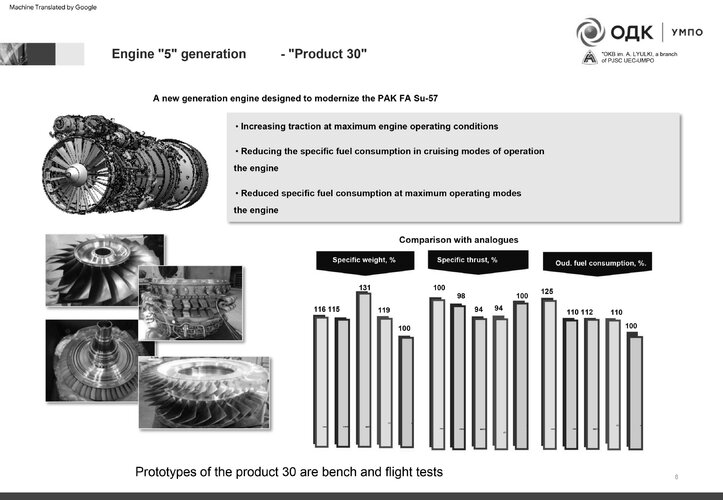
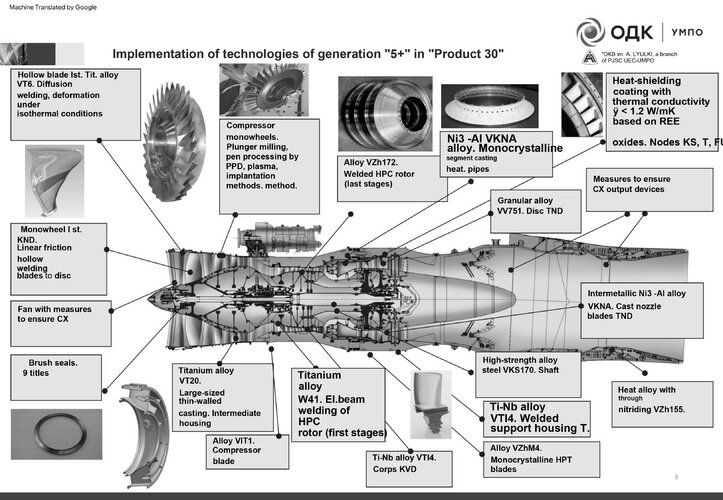
About this detail for not having afterburner chamber at all, I've read that in several occasions. AL-51F has 3-stage LPC and 5- stage HPC, then single-stage LPT and HPT .In comparison with AL-41F-1 has 19% higher t/w ratio , 6.4% better specific thrust and 9% lower specific fuel consumption. If thrust figures are from the static tests done in 2016/17 ,then we have realistic values for parameters ( H=0,V=0,t=+15°C) : >11000kgf of max static thrust on MP mode and 18000kgf as max static thrust on Full AB mode or something equivalent to that working mode. 19500kgf as max static thrust on special mode. So T.I.T. is about 1800°C.

Lyulka - 0008.jpg
Lyulka - 0009.jpg
 
Last edited:
1800°C isn't as good as the F135's TIT, but it is comparable to the IHI XF9, whose technology will roll into GCAP consortium project. Lots of interesting airframes in the current and future peeking over the visible horizon.
 
AL-41F-1 is 150kg lighter then AL-31F, mentioned that several times so far. So 1530kg-150kg=.... AL-51F is even lighter. Dry weight of the Izd.30 is then about 1300kg.

Very Interesting. So about the "AL51 not having an Afterburner, but instead some annular combustion.... " , does anyone here know about what kind of technology is being talked about here? Is it something already known but not practically implemented or something as yet unknown to us?
 
AL-41F-1 is 150kg lighter then AL-31F, mentioned that several times so far. So 1530kg-150kg=.... AL-51F is even lighter. Dry weight of the Izd.30 is then about 1300kg.

Next data are from E.Marchukov himself ,collected in last several years.

''На сегодняшний день это единственный в мире двигатель в своем классе, который полностью соответствует 5-му поколению, подчеркнул Марчуков в интервью.


Евгений Марчуков также поделился, что в новом двигателе АЛ-51Ф1 конструкторы кардинально изменили термодинамический процесс, который применяется на силовых установках предыдущих поколениях. Это связано с особой ионизацией воздушного потока в воздушно-топливной смеси.

Он уточнил, что в традиционной камере сгорания располагается форсажная камера. В двигателе же нового поколения АЛ-51Ф1 форсажной камеры как таковой нет.
Вместо неё появилась так называемая кольцевая система, которая будет создавать сгорание топлива без его дополнительной подачи по насосным системам, что будет иметь существенное преимущество в малозаметности на больших скоростях и будет гораздо экономичнее, поделился главный конструктор.Компрессор обеспечивает сжатие поступающего воздуха со степенью 6,7, обеспечивая расход воздуха до 20-23 кг/с.Температура газов перед турбиной находится в пределах от 1950K до 2100K a удельный расход топлива у «Изделия 30» остался на уровне двигателя АЛ-31Ф – около 0,67 кг•кгс/час. По разным оценкам, крейсерская сверхзвуковая скорость самолета Су-57 без применения форсажа, обеспечиваемая двумя двигателями с тягой по 11000 кгс, может достигать М=1,5. В новом двигателе должна быть достигнута рекордная степень форсирования тяги — отношение увеличения тяги при переходе с обычного режима на форсированный к величине нефорсированной тяги, выраженное в процентах. У «Изделия 30» это ((18 000 — 11 000)/11 000)*100=63,6%.

В завершении Евгений Марчуков подчеркнул, что остальные детали и характеристики двигателя не станет раскрывать, так как его ТТХ, как собственно и самого истребителя, еще долгое время будет под «грифом». ''

About this detail for not having afterburner chamber at all, I've read that in several occasions. AL-51F has 3-stage LPC and 5- stage HPC, then single-stage LPT and HPT .In comparison with AL-41F-1 has 19% higher t/w ratio , 6.4% better specific thrust and 9% lower specific fuel consumption. If thrust figures are from the static tests done in 2016/17 ,then we have realistic values for parameters ( H=0,V=0,t=+15°C) : >11000kgf of max static thrust on MP mode and 18000kgf as max static thrust on Full AB mode or something equivalent to that working mode. 19500kgf as max static thrust on special mode. So T.I.T. is about 1800°C.

View attachment 755245
View attachment 755246
A thrust to weight ratio 13.8:1 (18000 / 1300) is frankly unbelievable, not even counting the “special mode”, even with some of the control components being airframe mounted. If the service life is limited to 50 hours - maybe, but even that is stretching the imagination. The figures provided indicate AF-51 is capable of thrust levels higher than the F119, while weighing less than the original F100 prototypes with titanium rotors for the full length of the high compressor.

There is going to need to be some extreme data disclosure before this can be considered to be anything beyond propaganda
 
According to the latest data, the thrust at the afterburner is 16300 kgf, the maximum is 10500 kgf. It may be increased later.
The mass is unlikely to be much different, the alignment will shift
 
At 16,300 kg, the T/W is still pretty unbelievable at 12.5:1. If the weight is closer to 1600 kg, the T/W is closer to 10:1, which might be believable, similar to the EJ200 or F414. But this doesn’t leave any turbine temp or rotor speed margin for the high inlet temperatures encountered during supercruise at M1.5+.
 
All that data is nonsense. But I remember I followed the chain of official statements by Marchukov, plus published materials, and the resulting TWR was indeed very high, well above 10. Recent disclosure of export izd. 177 performance makes it clear the izd. 30 should clearly be above alleged values of the F119 in mil and max thrust, and it has officially been claimed as at least matching its specific thrust.
I hope I find the time to gather the evidence again, it has never been a direct and complete specs disclosure (it would not be allowed), but a series of deliberately vague comments from the official sources.

At 16,300 kg, the T/W is still pretty unbelievable at 12.5:1.
Is there any disclosed value for the F135's TWR? That would be the closest technological reference, granted it is not a supercruising engine. But still I think it was higher than 11:1 wasn't it?
 
Last edited:
All that data is nonsense. But I remember I followed the chain of official statements by Marchukov, plus published materials, and the resulting TWR was indeed very high, well above 10. Recent disclosure of export izd. 177 performance makes it clear the izd. 30 should clearly be above alleged values of the F119 in mil and max thrust, and it has officially been claimed as at least matching its specific thrust.
I hope I find the time to gather the evidence again, it has never been a direct and complete specs disclosure (it would not be allowed), but a series of deliberately vague comments from the official sources.


Is there any disclosed value for the F135's TWR? That would be the closest technological reference, granted it is not a supercruising engine. But still I think it was higher than 11:1 wasn't it?
It has not been publicly disclosed, but it is 11:1 only if you believe all the speculation on the internet.
 
At 16,300 kg, the T/W is still pretty unbelievable at 12.5:1. If the weight is closer to 1600 kg, the T/W is closer to 10:1, which might be believable, similar to the EJ200 or F414. But this doesn’t leave any turbine temp or rotor speed margin for the high inlet temperatures encountered during supercruise at M1.5+.

At the Dubai airshow, this Rostec guy has claimed 16000Kgf for the 177 engine,which are being offered for sale.
View: https://youtu.be/qb_xhRDBitE?si=R4uj1vMtCVU5-jZH


Navigate to about 11:40 minute mark.

I love how he describes the engine thrust the way an italian guy would describe good food, LOL
 
Between 117S and 117 the T:W ratio has be increased by ~ 1

117S has T:W Ratio of 9.4:1
117 has T:W Ratio of 10.3:1
 
It has not been publicly disclosed, but it is 11:1 only if you believe all the speculation on the internet.

Even AL-41F-1 has that t/w ratio ,11:1, 15000kgf : 1380kg=10.9. E.Marchukov said that during UEC presentation in June 2023 at Samara University.

''Изделие 117
По сравнению с серийным АЛ-31Ф новый двигатель также стал на 150 кг легче и имел повышенную на 15-20% тягу, доведенную до 14-15 тонн. Удельная тяга двигателя должна была находиться в диапазоне 0,85-0,8.''

''Item 117
Compared to the production AL-31F, the new engine was also 150 kg lighter and had a 15-20% increase in thrust, reaching 14-15 tons. The engine's specific thrust was expected to be in the range of 0.85-0.8.''

1530kg -150kg=1380kg.

Source: https://vk.com/@aviation_forever-k-istorii-proektov-dvigatelya-5-pokoleniya

Izdeliye 30 /AL-51F can only be lighter than Izd 117 with of course more thrust in both Full AB and MP mode.

Between 117S and 117 the T:W ratio has be increased by ~ 1

117S has T:W Ratio of 9.4:1
117 has T:W Ratio of 10.3:1

177S has the same dry weight as the old AL-31F with 2000kg more thrust on the Full AB mode. 117S is little heavier but with much bigger thrust on the Full AB ,especially on the MP mode.
 
From what I been reading in some of the blogs , Product 30 needs further refinement and adding a 3rd stream will make it into a VCE for 6th Gen Program , The current AB thrust of Product 30 stands at ~ 18 T

Probably we will see Product 30 mature into a 6th Gen Variable Cycle Engine in few years
 
177S has the same dry weight as the old AL-31F with 2000kg more thrust on the Full AB mode. 117S is little heavier but with much bigger thrust on the Full AB ,especially on the MP mode.

The Chart of spec posted about stated 177S engine has dry weight of 1,530 kg
 
From what I been reading in some of the blogs , Product 30 needs further refinement and adding a 3rd stream will make it into a VCE for 6th Gen Program , The current AB thrust of Product 30 stands at ~ 18 T

Probably we will see Product 30 mature into a 6th Gen Variable Cycle Engine in few years
Can you post the link to those blogs please?
 
This is one article about Izdeliye 30 from 2013 and there is some very interesting things/details about its possible weight. I already mentioned that it is lighter than ~1400kg heavy AL-41F-1. There is also some details about so called VCE.

Генконструктор НПО "Сатурн" Юрий Шмотин: "Двигатель второго этапа подарит самолету пятого поколения новую жизнь​


Одной из важнейших задач, стоящих сегодня перед российским авиадвигателестроением, является разработка двигателя второго этапа для самолета ПАК ФА (Т-50). Большую часть работ по созданию этого двигателя выполняет Рыбинское НПО "Сатурн".


О том, на какой стадии находится процесс создания этого двигателя, какие возможности приобретет самолет с новым "сердцем" рассказал "Интерфаксу-АВН" генеральный конструктор НПО "Сатурн" Юрий ШМОТИН.


- Юрий Николаевич, расскажите, каким должен быть двигатель для самолета пятого поколения? Каковы его основные признаки?


- Самолет пятого поколения Т-50 это не просто истребитель, бомбардировщик или штурмовик. Это многоцелевой летательный аппарат. Такому самолету надо дать новое "сердце", которое позволит сделать его высокоманевренным, скоростным, экономичным и способным противостоять таким конкурентам, как американские F-22 и F-35.

Двигатель для самолета пятого поколения будет отличаться от двигателя предыдущего поколения увеличенной удельной тягой, меньшим весом, сниженным удельным расходом топлива и наличием новых решений по малой заметности. При этом он должен быть относительно дешевым в обслуживании и эксплуатации. НПО "Сатурн" сейчас работает именно над таким двигателем.


- Каким узлам и агрегатам нового двигателя уделяется особое внимание при разработке? Что представляет наибольшую сложность для инженеров?


- В авиационном двигателе важно все. Одним из сложнейших узлов двигателя является турбина высокого давления. Нам было задано сделать турбину, работающую при таком уровне температур, при которых металлические никелевые сплавы просто плавятся. Эта работа была успешно выполнена.


Сердцем авиационного двигателя является компрессор высокого давления. От уровня его совершенства напрямую зависят все основные характеристики двигателя. Количество деталей в новом компрессоре высокого давления мы сумели сократить практически вдвое по сравнению с компрессором предыдущего этапа, при этом обеспечили значительное увеличение работы на одну ступень. Стоимость изготовления такого компрессора не будет превышать стоимость изготовления КВД двигателя четвертого поколения. И это при условии применения новых материалов и технологий.

Решив эти и другие задачи, на выходе мы получим газогенератор с новым уровнем характеристик, который будет основой для нового семейства двигателей. Характеристики узлов этого газогенератора, например эффективность КВД, повышена в среднем более чем на четыре процента, а на ряде режимов и на восемь. Фактически, это революция в двигателестроении, т.к. определяет возможность создания двигателя с колоссальным резервом развития по тяге.


- Каким конструкционным материалам отдается предпочтение при создании нового двигателя?

- Без принципиально новых материалов невозможно обеспечить те характеристики, которые мы предъявляем к ГТД нового поколения. У специалистов НПО "Сатурн" есть опыт и неплохие результаты применения новых материалов, разработанных Всероссийским научно-исследовательским институтом авиационных материалов (ВИАМ).

В первую очередь, это, конечно, лопаточные жаропрочные никелевые сплавы. Лопатка турбины - это абсолютно уникальное изделие. Она представляет собой сложную пространственную конструкцию, которая должна работать при температурах выше 2000 К.


Есть также материалы собственной разработки НПО "Сатурн". Мы готовы предложить их для двигателя нового поколения. Эти материалы позволяют в полтора раза повысить ресурс двигателя при тех же температурах.


Сегодня много говорится о применении композиционных материалов. В новом двигателе для ПАК ФА применяются композиты, которые построены не только на полимерной матрице для холодной части, а также детали, созданные на высокотемпературных композициях. Эти работы НПО "Сатурн" ведет уже достаточно давно.


- Нельзя забывать, что все новое и современное со временем устаревает. Предусмотрена ли в создаваемом двигателе возможность его модернизации?


- Конечно. Одновременно с выполнением опытно-конструкторских работ по двигателю пятого поколения мы формируем задел, который позволит развивать двигатель не только на десять, но и на 30, возможно и 50 лет вперед.

Сегодня в НПО "Сатурн" ведутся серьезные исследования по развитию двигателя пятого поколения с применением технологии, которую называют "двигатель переменного цикла". Выполнены исследования, которые говорят о том, что при определенной трансформации термодинамики двигателя за счет конструктивных изменений можно существенно улучшить характеристики двигателя на дозвуковых и сверхзвуковых режимах полета. Одной из таких трансформаций может стать применение третьего контура. Все это предусмотрено.


- Каким образом повлияет установка новых двигателей на летные характеристики истребителя пятого поколения? Почувствует ли разницу летчик, пересевший с самолета с двигателем первого этапа на самолет с двигателем второго этапа?


- Новый двигатель принципиально отличается от предыдущего изделия первого этапа. Безусловно, летчик сразу почувствует разницу в тяге. Самолет с новым двигателем станет более послушным и сможет быстрее реагировать на действия пилота. Фактически, двигатель второго этапа должен дать самолету Т-50 новую жизнь.


- Юрий Николаевич, известно, что ПАК ФА уже проходит испытания. Какими двигателями оснащаются первые опытные образцы?


Сейчас опытные образцы комплектуются двигателем первого этапа, который в инженерных кругах известен как изделие 117. По сути, это результат глубокого развития семейства двигателей АЛ-31, который устанавливается сегодня на самолеты семейства Су-27.

Безусловно, это замечательный двигатель, который является бестселлером и построен на основных принципах и базовых идеях конструкторского бюро Архипа Люльки. Но все-таки это двигатель этапа 4++.


Source:https://vpk.name/news/87906_genkons...samoletu_pyatogo_pokoleniya_novuyu_zhizn.html

Transl:

Saturn NPO General Designer Yuri Shmotin: "The second-stage engine will give the fifth-generation aircraft a new lease of life."

One of the most important tasks facing Russian aircraft engine manufacturing today is the development of the second-stage engine for the PAK FA (T-50) aircraft. The Rybinsk-based NPO Saturn is carrying out most of the work on this engine.

Yuri Shmotin, General Designer of NPO Saturn, spoke to Interfax-AVN about the current stage of the engine's development and the capabilities the aircraft will acquire with its new "heart."

Yuri Nikolaevich, please tell us what an engine for a fifth-generation aircraft should be like. What are its key features?

-The fifth-generation T-50 aircraft isn't just a fighter, bomber, or attack aircraft. It's a multirole aircraft. Such an aircraft needs a new "heart" that will make it highly maneuverable, fast, fuel-efficient, and capable of competing with competitors like the American F-22 and F-35.

The engine for the fifth-generation aircraft will differ from the previous generation engine in that it has increased specific thrust, lower weight, reduced specific fuel consumption, and new low-observability solutions.At the same time, it should be relatively inexpensive to maintain and operate. NPO Saturn is currently working on just such an engine.

Which components and assemblies of the new engine are receiving special attention during development? What presents the greatest challenges for engineers?

-Everything is important in an aircraft engine. One of the most complex engine components is the high-pressure turbine. We were tasked with creating a turbine that would operate at temperatures that would melt nickel alloys. This work was successfully completed.

The heart of an aircraft engine is the high-pressure compressor. All key engine performance characteristics directly depend on its level of sophistication. We've managed to reduce the number of components in the new high-pressure compressor by almost half compared to the previous version,at the same time, they provided a significant increase in performance per stage. The cost of manufacturing such a compressor will not exceed the cost of manufacturing a fourth-generation engine's high-pressure compressor. This is provided that new materials and technologies are used.

By solving these and other problems, we will obtain a gas generator with a new level of performance, which will serve as the basis for a new family of engines. The performance of this gas generator's components, such as the efficiency of the high-pressure compressor, has been increased by an average of more than four percent, and by eight percent in some modes.

In fact, this is a revolution in engine building, since it determines the possibility of creating an engine with a colossal reserve for thrust development.

What construction materials are preferred when creating a new engine?

-Without fundamentally new materials, it's impossible to achieve the characteristics we require of a new-generation gas turbine engine. Saturn specialists have experience and demonstrated good results using new materials developed by the All-Russian Research Institute of Aviation Materials (VIAM).
First and foremost, these are, of course, heat-resistant nickel alloys for turbine blades. A turbine blade is a completely unique component. It is a complex spatial structure that must operate at temperatures above 2000 K.
NPO Saturn also has materials developed in-house. We are ready to offer them for the next-generation engine. These materials allow for a 50% increase in engine life at the same temperatures.
Much is being said today about the use of composite materials. The new PAK FA engine utilizes composites built not only on a polymer matrix for the cold section, but also components created using high-temperature composites. NPO Saturn has been conducting this work for quite some time.

We mustn't forget that everything new and modern eventually becomes obsolete. Does the engine being developed allow for upgrades?

- Of course. While we're conducting research and development on the fifth-generation engine, we're laying the groundwork that will allow us to develop the engine not just for ten, but for 30, and possibly even 50 years to come.

Today, NPO Saturn is conducting serious research into the development of a fifth-generation engine using technology called a "variable-cycle engine."

Research has been carried out which shows that with a certain transformation of the engine thermodynamics, through design changes, it is possible to significantly improve the engine's performance in subsonic and supersonic flight modes.One such transformation could be the use of a third circuit. All of this is provided for.

How will the installation of new engines affect the performance of the fifth-generation fighter? Will a pilot switching from an aircraft with a first-stage engine to one with a second-stage engine feel any difference?

-The new engine is fundamentally different from the previous first-stage product. The pilot will certainly immediately feel the difference in thrust. The aircraft with the new engine will be more responsive and able to respond more quickly to pilot inputs. Essentially, the second-stage engine should give the T-50 a new lease of life.

Yuri Nikolaevich, we know the PAK FA is already undergoing testing. What engines are the first prototypes equipped with?

-Currently, prototypes are equipped with the first-stage engine, known in engineering circles as Product 117. Essentially, this is the result of extensive development of the AL-31 engine family, which is currently installed on the Su-27 family of aircraft.

It's certainly a remarkable engine, a bestseller built on the core principles and ideas of Arkhip Lyulka's design bureau. But it's still a Stage 4++ engine.


So from the interview we can see that Izd. 30 has some parts and componentes made by very light composites,thus it must be lighter than Izd. 117. Another thing, we can see now that Izd. 30 is one engine and that VCE is another one. Article from 2013 tell us that both of them were in R&D phase in that time.

 
And yet, as of the end of 2025, the Izd.30 is not in service operation, they are advertising a hybrid engine with the new Fan module grafted on to the old gas generator, and the 3 steam engine is nowhere in sight.

We simply don't know is there operational Su-57's with AL-51F or not. After war started ,we could see some new serial aircraft produced and delivered during 2022,23 and 24. Only during April 2025 we could see two new with AL-41F-1 but production of them started maybe during 2024. Yuriy Slysar told once that new engine will be integrated during 2025 ( with no possibility to integrate them into delivered so far) ,some sources even mentioned that ratio between aircraft with AL-41F-1 and those with AL-51F will be 28:48 but who knows....Several days ago we could see one new on the flight test station of the KnAAZ but there is no way to see if it is equipped with Izd 30.

Now one for me very interesting detail of the air intake.

su-57_krr-1024x576 mod.jpg

This, in the red rectangular. Something similar like this air intakes of the Su-27/30 ( FFF) and MiG-29 have but they also have anti FOD grid . It is also something similar to those so called 'lips' which we can see in this place of the air intakes of MiG-25 and 31.

Is this something only for the ' anti FOD' or it has some similar role like those lips ( of course this is fixed not movable).We know that in the higher AoA there is LEVCON to do the work.
 
Last edited:
Btw, there is some news about the Izd. 30 but from two years ago. 'Armiya 2023' military technical forum :

''17 августа также на форуме «Армия-2023» Юрий Слюсарь заявил РИА Новости, что штатный двигатель («изделие 30») для истребителя пятого поколения Су-57 требует доработки и продолжения испытаний. Ранее ряд высокопоставленных представителей ОПК говорили о том, что испытания двигателя второго этапа должны были завершиться в 2022 году.

«Двигатель второго этапа для самолёта пятого поколения Су-57 уже есть, он летает, реально проходит испытания, но они закончатся не послезавтра. Мы не отступаем от модели, согласованной с Минобороны, разговоры о том, что его нет, пустые. Но как любой принципиально новый двигатель, он требует доработки, требует ещё испытаний», – сказал Слюсарь, добавив, что команда работает профессионально, деньги выделены. Сейчас на Су-57 стоят промежуточные двигатели с управляемым вектором тяги АЛ-41Ф1, которые являются модификацией, применяющейся на истребителе Су-35С.

Серийное производство истребителей Су-57 с новыми двигателями начнётся до 2027 года, заявил глава Объединённой двигателестроительной корпорации Вадим Бадеха. «Если они [сроки] назывались, мы точно их не сдвигаем вправо, всё идёт по плану», – сказал В. Бадеха.''

https://aviation21.ru/yu-slyusar-proizvodstvo-istrebitelej-su-57-za-god-vyroslo-v-razy/
''On August 17, also at the Army-2023 forum, Yuri Slyusar told RIA Novosti that the standard engine ("Product 30") for the Su-57 fifth-generation fighter requires further development and testing. Previously, several high-ranking defense industry officials stated that the second stage of engine testing was expected to be completed in 2022.

"The second-stage engine for the fifth-generation Su-57 aircraft already exists, it's flying, and is undergoing real testing, but it won't be finished the day after tomorrow. We're sticking to the model agreed upon with the Ministry of Defense; talk about it not being there is empty."
"But like any fundamentally new engine, it requires refinement and further testing," Slyusar said, adding that the team is working professionally and the funding has been allocated. The Su-57 is currently equipped with the AL-41F1 intermediate thrust vectoring engine, a modification of the same engine used on the Su-35S fighter.

Serial production of Su-57 fighter jets with new engines will begin before 2027, announced Vadim Badekha, head of the United Engine Corporation. "If they [the deadlines] were mentioned, we are definitely not pushing them back; everything is going according to plan," Badekha said.''
 
We simply don't know is there operational Su-57's with AL-51F or not. After war started ,we could see some new serial aircraft produced and delivered during 2022,23 and 24. Only during April 2025 we could see two new with AL-41F-1 but production of them started maybe during 2024. Yuriy Slysar told once that new engine will be integrated during 2025 ( with no possibility to integrate them into delivered so far) ,some sources even mentioned that ratio between aircraft with AL-41F-1 and those with AL-51F will be 28:48 but who knows....Several days ago we could see one new on the flight test station of the KnAAZ but there is no way to see if it is equipped with Izd 30.

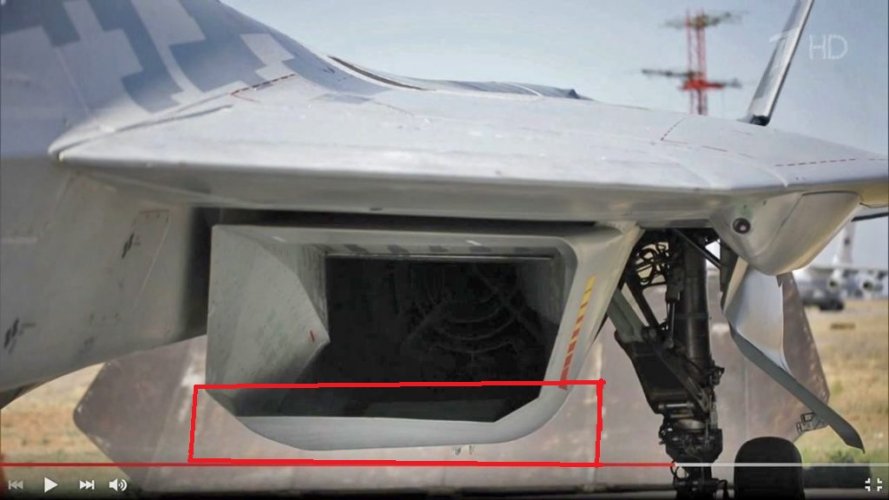
Now one for me very interesting detail of the air intake.

View attachment 796786

This, in the red rectangular. Something similar like this air intakes of the Su-27/30 ( FFF) and MiG-29 have but they also have anti FOD grid . It is also something similar to those so called 'lips' which we can see in this place of the air intakes of MiG-25 and 31.

Is this something only for the ' anti FOD' or it has some similar role like those lips ( of course this is fixed not movable).We know that in the higher AoA there is LEVCON to do the work.
What I find interesting is that the lower lip is roughly in line with the trailing edge of the first movable upper ramp, and well forward of the second ramp, as evidenced by the vertical side wall at the upper left of the pictured inlet. This implies the terminal normal shock is inside the inlet, vs being at the lower lip as seen on F-14 and F-15 inlets. The LEVCON will be generating an oblique shock forward of the inlet, and the lower lip is likely generating an oblique shock going upwards towards the movable ramps. This implies at least some mixed compression in the Su-57 inlet, which may support the claim that it can function efficiently up to M3. However, mixed compression is also notoriously difficult to remain “started”, especially during supersonic maneuvering. The Russians are very good aerodynamic engineers, and if they have mastered mixed compression during supersonic maneuvering flight, hats off to them. Even if this complexity is not particularly advantageous in the supercruise speed range.
 
What I find interesting is that the lower lip is roughly in line with the trailing edge of the first movable upper ramp, and well forward of the second ramp, as evidenced by the vertical side wall at the upper left of the pictured inlet. This implies the terminal normal shock is inside the inlet, vs being at the lower lip as seen on F-14 and F-15 inlets. The LEVCON will be generating an oblique shock forward of the inlet, and the lower lip is likely generating an oblique shock going upwards towards the movable ramps. This implies at least some mixed compression in the Su-57 inlet, which may support the claim that it can function efficiently up to M3. However, mixed compression is also notoriously difficult to remain “started”, especially during supersonic maneuvering. The Russians are very good aerodynamic engineers, and if they have mastered mixed compression during supersonic maneuvering flight, hats off to them. Even if this complexity is not particularly advantageous in the supercruise speed range.

About that, I 've found something interesting :

''Силовая установка с воздухозаборником смешанного сжатия и многорежимным управляемым сверхзвуковым соплом.''

''Power plant with mixed compression air intake and multi-mode controlled supersonic nozzle.''

This citation is in relation with the Sukhoi T-4 or 'Izdeliye 100' as the 3 Mach capable missile carrier from the 1960's.

Source: https://oat.mai.ru/book/glava20/20_2/20_2.html

Maybe for this theme is usable Patent doc. of the Su-57's air intake ?

https://www1.fips.ru/fips_servl/fips_servlet?DB=RUPAT&DocNumber=2460892
 
What I find interesting is that the lower lip is roughly in line with the trailing edge of the first movable upper ramp, and well forward of the second ramp, as evidenced by the vertical side wall at the upper left of the pictured inlet. This implies the terminal normal shock is inside the inlet, vs being at the lower lip as seen on F-14 and F-15 inlets. The LEVCON will be generating an oblique shock forward of the inlet, and the lower lip is likely generating an oblique shock going upwards towards the movable ramps. This implies at least some mixed compression in the Su-57 inlet, which may support the claim that it can function efficiently up to M3. However, mixed compression is also notoriously difficult to remain “started”, especially during supersonic maneuvering. The Russians are very good aerodynamic engineers, and if they have mastered mixed compression during supersonic maneuvering flight, hats off to them. Even if this complexity is not particularly advantageous in the supercruise speed range.

I wonder if this explains the fewer compressor and turbine stages in the Al51 Engine? Maybe they are trying to get the mixed compression thing working and the Al51 is specifically designed for this? Perhaps the difficulties of keeping this "started" while manuevering is causing engine induction delays?
 
@F119Doctor

I have one question about Izdeliye 30 , if you don't mind.

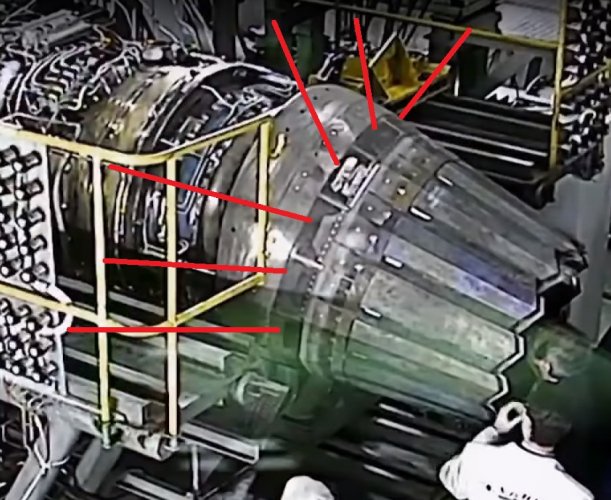
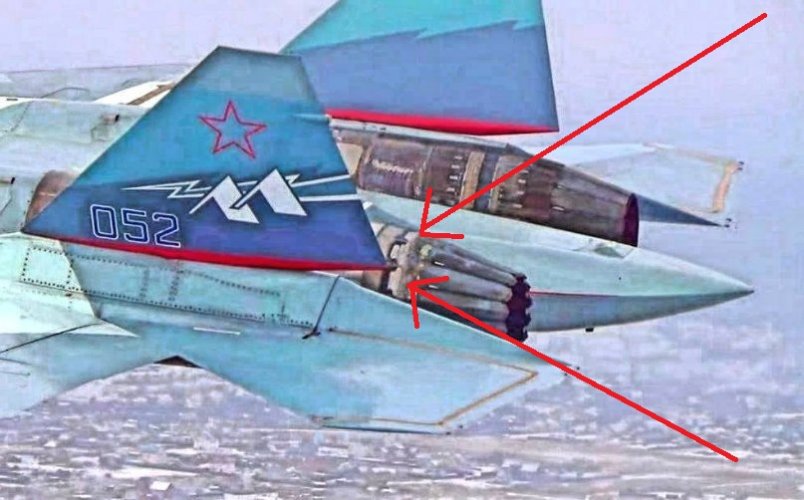
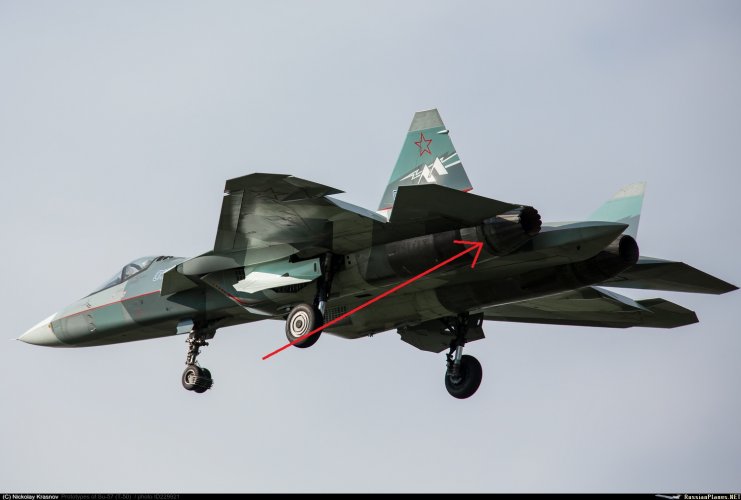
What can be those hatches ( opening panels ) if they really are ?

We can see them during static tests ( Nov 2016) .

Izdelie 30 mod.jpg

Also during flight tests from Dec. 2017

Izd 30 mod1.jpg

The same but better photo we have here in this article :

Изделие 177 или Изделие 30: Про новый двигатель на Су-57​


''Есть также фото из 2019 года, когда испытания «Изделия 30» только стартовали:''

''There are also photos from 2019, when testing of "Product 30" had just begun:''

Author even forgot that flight test began on Dec. 2017...

Source: https://tehnoomsk.ru/archives/22882

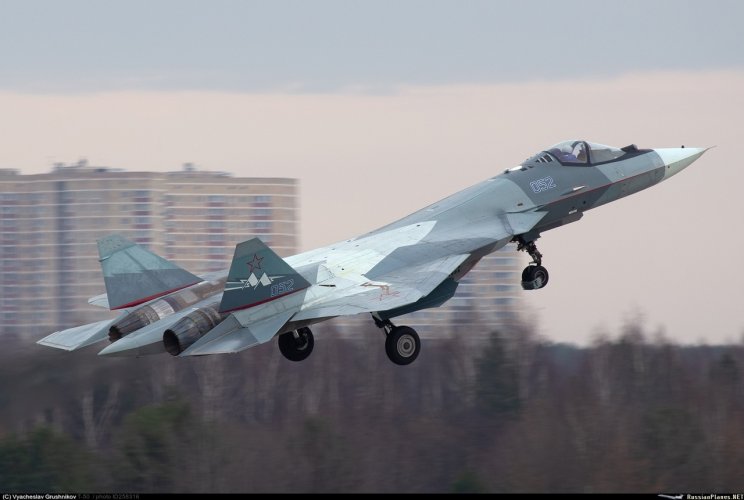
Another photo made during flight

T-50-2LL with Izdeliye 30  in flight mod1.jpg

In this photo we can not see them, they were closed.

T-50-2 Izd 30 2019.jpg
 
I don’t believe that those are discrete panels, but an optical illusion. There is a dark coating around the nozzle static structure, which has axial ridges where the cylindrical structure transitions to a polygon shape to match the faceted shape of the external flaps. These ridges are the visual separations you are seeing between the “panels”.
 
I don’t believe that those are discrete panels, but an optical illusion. There is a dark coating around the nozzle static structure, which has axial ridges where the cylindrical structure transitions to a polygon shape to match the faceted shape of the external flaps. These ridges are the visual separations you are seeing between the “panels”.

Hm ,thanks. That's why I mentioned possibility that there is maybe no hatches at all.
 
Some info about Izd 30 from Ye. Marchukov :

''Удельным весом в авиации принято называть отношение массы двигателя к его полной тяге. Для перспективного «Изделия 30» этот показатель составляет менее 0,1, то есть двигатель способен выдавать более чем в 10 раз больше тяги, чем весит сам. Удельной же тягой называется отношение полной тяги к расходу воздуха двигателем.''

''In aviation, specific gravity is the ratio of an engine's mass to its total thrust. For the promising "Product 30," this figure is less than 0.1, meaning the engine is capable of producing more than 10 times its own thrust. Specific thrust, on the other hand, is the ratio of total thrust to the engine's airflow.''

Even Izd 117/AL-41F-1 ( weighs about 1400kg) has t/w ratio more than 10:1, 11:1 exactly. Izd 30 is even lighter I guess with more thrust ,especially in MP mode,also in the AB mode.

''В двигателе второго этапа для Су-57 разработчики применили ряд новых конструкторских подходов и технологий, благодаря чему «Изделие 30» по удельному расходу топлива примерно соответствует двухконтурному двигателю АЛ-31Ф (670 граммов на килограмм-силы в час в крейсерском режиме), однако превосходит его по показателю удельной тяги.''

''In the second stage engine for the Su-57, the developers applied a number of new design approaches and technologies, thanks to which the “Product 30” in terms of specific fuel consumption is approximately equal to the AL-31F bypass engine (670 grams per kilogram-force per hour in cruising mode), but surpasses it in terms of specific thrust.''

"Specific fuel consumption is in opposition to specific thrust. Civilian twin-fan engines achieve the best fuel consumption, but they have the lowest specific thrust due to their high bypass ratio. Conversely, single-fan engines have high specific thrust, but also high fuel consumption.
“Thanks to the use of new designs and technologies in Product 30, the specific fuel consumption remained at the same level, but the specific thrust increased,” Marchukov said.''

If this is correct ,that is great to have the engine with almost the same specific fuel consumption in the cruise mode ( in fact supercruise mode) like old engine AL-31F. For comparison, Su-27 can achieve long term cruising at alt 13 km with speed M 0.85.We have info that Su-57 even with AL-41F-1 has range more than 1500km flying in supersonic mode.

Next citation :

''Двигатель пятого поколения «Изделие 30» будет отличаться от АЛ-41Ф1 повышенной топливной эффективностью и меньшей стоимостью жизненного цикла.

«По сравнению с двигателями четвертого поколения в пятом добавилась возможность крейсерского сверхзвукового движения — для этого двигатель должен обладать изменяемой степенью двухконтурности. Это требование добавило еще один удельный параметр — удельный расход топлива на крейсерском сверхзвуке. Также у двигателя должна быть значительно меньшая заметность в инфракрасном и радиоволновом диапазоне. Это достигается специальной конструкцией сопла и воздухозаборника. Серьезным аспектом нового двигателя является также снижение стоимости жизненного цикла машины — меньше расхода на обслуживание, больше межремонтный ресурс», — рассказал о новых силовых установках Марчуков.''

''The fifth-generation engine, Product 30, will differ from the AL-41F1 in its increased fuel efficiency and lower life cycle costs.
Compared to fourth-generation engines, the fifth-generation added the capability of supersonic cruising—to achieve this, the engine required a variable bypass ratio. This requirement added another specific parameter—specific fuel consumption at supersonic cruising speed.The engine should also have significantly lower infrared and radio frequency signatures. This is achieved through a special nozzle and air intake design.
"Another significant aspect of the new engine is the reduction in lifecycle costs—less maintenance and a longer service life between overhauls," Marchukov said of the new power units.''


''В 2013 году разработчики показали лопатки компрессора высокого давления для двигателя второго этапа, предназначенного к установке на Су-57. Они были изготовлены из алюминида титана — сплава титана и алюминия. В СМИ появлялась информация и о том, что этот же сплав может быть использован для изготовления лопаток турбины низкого давления «Изделия 30». Но позднее все эти работы были приостановлены. По словам Марчукова, алюминид титана не подходит для военного двигателя.''

''In 2013, the developers demonstrated high-pressure compressor blades for the second-stage engine intended for installation on the Su-57. They were made of titanium aluminide—an alloy of titanium and aluminum.
There were also media reports that this same alloy could be used to manufacture blades for the Izdeliye 30 low-pressure turbine. However, all such work was later suspended. According to Marchukov, titanium aluminide is not suitable for military engines.''

''Лопатки из алюминида титана используются в самых последних ступенях турбины низкого давления на гражданских самолетах, где температура газов относительно низка. Это дает значительную экономию по массе, так как в гражданских двигателях турбины многоступенчатые. В военном двигателе температура газов даже перед турбиной низкого давления значительно выше, и алюминид титана в этих условиях просто неприменим», — пояснил генеральный конструктор ОКБ имени А. Люльки.

Интерметаллиды вроде алюминида титана не подходят и для лопаток компрессора. Этот материал хрупок, и любая забоина на лопатке чревата ее разрушением. Да и экономия по весу для компрессора получается незначительной», — добавил Марчуков.''

Titanium aluminide blades are used in the very last stages of low-pressure turbines on commercial aircraft, where gas temperatures are relatively low. This provides significant weight savings, as commercial engines have multi-stage turbines.
"In a military engine, the gas temperature even before the low-pressure turbine is significantly higher, and titanium aluminide is simply not applicable under these conditions," explained the general designer of the A. Lyulka Design Bureau.

"Intermetallic compounds like titanium aluminide are also unsuitable for compressor blades. This material is brittle, and any nicks in the blade can lead to its failure. Furthermore, the weight savings for the compressor are negligible," Marchukov added.


''В целом же разработка «Изделия 30» ведется с применением технологий компьютерного моделирования и симуляций. Благодаря этому полную программу испытаний двигателя планируется завершить с помощью всего десяти опытных образцов.''

''Overall, the development of "Product 30" is being conducted using computer modeling and simulation technologies. As a result, the full engine testing program is planned to be completed using just ten prototypes.''

There was also some info about 6th gen 'three circuit' ( VCE) engine in the well known article from 2019:

https://nplus1.ru/material/2019/03/06/engines

So Izd. 30 is the engine with variable bypass ratio ,question is , what about Izd. 117 ?

Izdeliye 30 during statis tests .

Izdeliye 30 during static tests 2016.jpeg
 
Variable bypass with a 2 shaft mixed flow turbofan is easy to accomplish, at least over a limited range. All you have to donis open the exhaust nozzle, which reduces the fan presssure ratio and increases the pressure drop across the low pressure turbine. This increases the fan speed / airflow and the bypass ratio. You might be able to vary bypass ratio from 0.6 to 0.8 using this technique before something like fan duct blockage becomes a restriction. However, the OPR and TIT will decrease, which may offset any SFC improvement due to the increase in BPR. This is not the same as a 3 stream configuration.

Interesting that there was a long discussion about their advancements with Ti-Al materials, but then how they are unsuitable for use in military turbofans in the HPC and LPT.

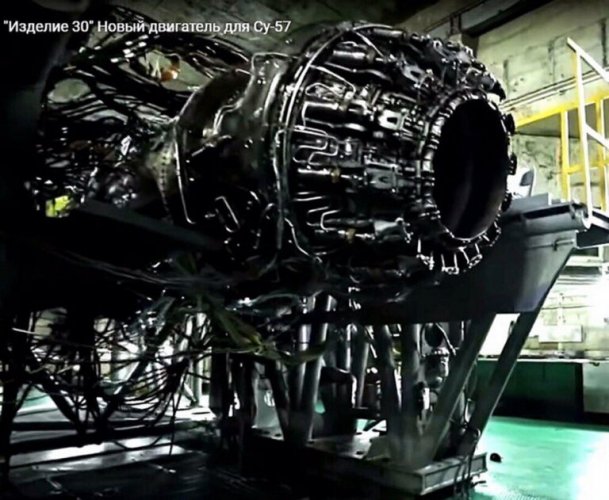
The photo of the Product 30 nozzle is interesting in how massive it appears, and this doesn’t even include the divergent section of the nozzle. This may be a result of the decision to create the vector capability by pivoting the entire nozzle forward of the convergent section, with each segment having its hydraulic actuator, which are not lightweight. I don’t know if all of the Russian vectoring nozzles have this configuration.
 
All supersonic inlets have a maximum and minimum corrected airflow where they operate in a stable manner, with the shock waves properly positioned. The faster you go, the narrower spread between these values. For the F-15 and F-16, 1.4M was the speed where spread reached its minimum and the engine was maintained at Mil power to prevent dropping below that minimum corrected airflow. When the corrected airflow drops below the minimum, the normal shock is pushed forward out of the throat, and pressure recovery drops abruptly. With the pressure behind the throat decreased, the airflow in the inlet is momentarily increased, the shock is swallowed, pressure recovery increases, airflow drops below minimum, and the process repeats, many times per second. This is inlet buzz, and it can be very damaging to both the airframe inlet structure and the engine.

I will transfer some details from the basic Su-57's thread which we already discussed.

Translated from the Su-27SK F.M.

''The air intake mechanization includes the ARV-40A electro-hydraulic control system and a system for protecting the air intakes and engines from foreign objects.

The ARV-40A system is designed to control the position of panels of two separate air intakes in order to ensure optimal performance of the combined operation of the air intakes with the engines.

The panel position is controlled:

On the main channel – automatically, according to a program, depending on the engine speed, with altitude correction, as well as by signals from the engine control system. Panel control begins when Mach 1.35 is reached; prior to this, they are in the retracted position''

https://www.secretprojects.co.uk/th...opment-operations-2012-current.15626/page-117
Now it is question if Su-57's intakes work as those in Su-27 when we talk about air intake mechanization,automatization program.
 
The photo of the Product 30 nozzle is interesting in how massive it appears, and this doesn’t even include the divergent section of the nozzle. This may be a result of the decision to create the vector capability by pivoting the entire nozzle forward of the convergent section, with each segment having its hydraulic actuator, which are not lightweight. I don’t know if all of the Russian vectoring nozzles have this configuration.

Here's one video for the better observation .

Новый двигатель для Су-57 (Изделие 30)

https://vkvideo.ru/video-42331_456240468
Also sequences from 4:25....

https://vk.com/video-220155889_456239117
 
Last edited:
The photo of the Product 30 nozzle is interesting in how massive it appears, and this doesn’t even include the divergent section of the nozzle. This may be a result of the decision to create the vector capability by pivoting the entire nozzle forward of the convergent section, with each segment having its hydraulic actuator, which are not lightweight. I don’t know if all of the Russian vectoring nozzles have this configuration.
IIRC the Su37's turkey feathers have their actuators mounted to a floating ring with a set of hydraulic actuators that push the ring around. So the floating ring doesn't move to change the con-di nozzle settings, the normal actuators do that. The floating ring/actuators only does vector changes.

Which is a lot more elegant of a solution, IMO.
 
I will transfer some details from the basic Su-57's thread which we already discussed.

Translated from the Su-27SK F.M.

''The air intake mechanization includes the ARV-40A electro-hydraulic control system and a system for protecting the air intakes and engines from foreign objects.

The ARV-40A system is designed to control the position of panels of two separate air intakes in order to ensure optimal performance of the combined operation of the air intakes with the engines.

The panel position is controlled:

On the main channel – automatically, according to a program, depending on the engine speed, with altitude correction, as well as by signals from the engine control system. Panel control begins when Mach 1.35 is reached; prior to this, they are in the retracted position''

https://www.secretprojects.co.uk/th...opment-operations-2012-current.15626/page-117
Now it is question if Su-57's intakes work as those in Su-27 when we talk about air intake mechanization,automatization program.
I don’t think there is any relationship between the M1.4 minimum airflow buzz limit for the F-15 / F-16 and the M1.35 beginning inlet ramp scheduling of the Su-27. On the F-16 there is obviously no schedule for the fixed inlet, and F-15 inlet is scheduled by the Air Inlet Controller as a function of Mn and AOA.

With a more sophisticated inlet control with airflow feedback from the engine, I could see the ramps scheduled to reduce the inlet flow when the engine is pulled back below Mil power. The shock placement would non-optimum with significant spillage drag, but would probably be stable, and you are trying to slow down anyway.
 

Similar threads

Back
Top Bottom