https://www.twz.com/air/f-22-raptor...l-fighter-drone-collaborative-combat-aircraft
The F-22 will be using tablets, likely on the kneeboard, for controlling CCAs. I believe this method has some limitations and task saturation may be a concern, but this may perhaps be the most rapid way to get an operational capability. A more modern cockpit should better integrate these controls into the organic MFDs.

Everything is likely tablet based until F-47. I cannot imagine the F-35 code ever successfully being updated to allow full integration, given that blk4 might not be done by end of decade. If there’s any aircraft that has a fully integrated solution before F-47, it would probably be B-21.

Tablets do suck comparatively, but they bypass years of software integration. I suspect any new, cheap cruise missiles the USAF buys for its fighters also get a quickie tablet integration Ukraine style to speed the process of bulking up munition inventories. Most of the weapons in that class are already developed and the ones going to Ukraine presumably already have a tablet solution.
 
Could the F-22 even support usable DEW without a major overhaul to it's power plant?

No space, no power, no budget, and it would be an utter nightmare to integrate. I suspect F-22 code is still in ada and it certainly is not modular; you would probably need a tablet solution again even if all of the first three problems were overcome.

As previously stated, the F-35 has been the candidate for a fighter DEW system from the beginning due to the -B variants ability to potentially drive a very large generator in place of the fan. What would be required first is any EW system that worked…
 
I would assume that the significance is that Trump is trying to sell more F-35s and he either did not have a pin for that or just didn’t know the difference.
Related you think in particular to the apparent renewed effort in recent weeks by Lockheed Martin and others to promote the 'Ferrari' derivative of the F-35?

So Trump is wearing an F-22 pin, so what, really?
In the past, Presidential apparel has been known to be used as a means of subtly (or otherwise) signaling executive intentions or desires, including as a means of flying of political kites.
 
Last edited:
I admit to being a little surprised by that, given that F-35 was what I thought the Incr1 CCAs were designed around performance wise (IIRC CCAs had to keep up with F-35 cruise speed and be able to overtake the cruise speed of F-35 with max power). But from an integration standpoint, I think either aircraft is going to be using a separate stand alone controller anyway. F-22 is probably hopeless antiquated for any full integration attempt and F-35 already hopelessly behind in terms of software dev and weapon integration. I suspect full control integration from a plane occurs in the B-21 or F-47 first.
 
I admit to being a little surprised by that, given that F-35 was what I thought the Incr1 CCAs were designed around performance wise (IIRC CCAs had to keep up with F-35 cruise speed and be able to overtake the cruise speed of F-35 with max power). But from an integration standpoint, I think either aircraft is going to be using a separate stand alone controller anyway. F-22 is probably hopeless antiquated for any full integration attempt and F-35 already hopelessly behind in terms of software dev and weapon integration. I suspect full control integration from a plane occurs in the B-21 or F-47 first.

LM and the Air Force have been working since about 2018 on making the F-22 software and hardware more "agile". The F-22 is now more flexible in many ways that other aircraft. Software to support new capabilities can be deployed as containers or virtual machines on F-22s - basically self contained "apps". For example, the new IRST systems are an "app".

This was one of the key enablers for CCAs. The plan has always been that F-22s would be the first USAF platform to would get CCA capabilities - that has always been the plan. USAF is forecasting that F-35s will get CCA capabilities but there is (still) no concrete plan for how to do so or when.
 
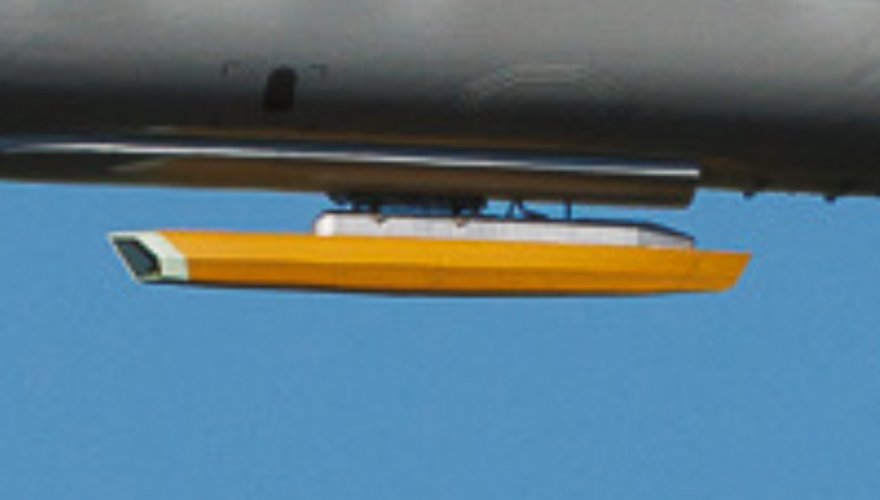
The RACR program and those more-than-just-IRST pods surely must be some of the enabling technologies for Raptor getting CCAs first, no?

Kubernetes!!
 
The RACR program and those more-than-just-IRST pods surely must be some of the enabling technologies for Raptor getting CCAs first, no?

Kubernetes!!

At least in the pods, no, not CCA related. The other things I don’t know but don’t think so. The virtualization etc software changes laid the foundation for all of the upgrades though.

The F-22 upgrades are more extensive than has been widely reported.
 
Some insights about the steath features of the engine exhaust. Link here so people curious in the su-57 thread can read without derailing that thread.
https://aviationweek.com/defense/physics-techniques-infrared-stealth
"The engines of both also have stealthy augmenters. Aft of the low-pressure turbine are thick, curved vanes that, when looking up the tailpipe, block any direct view of the hot, rotating turbine components. Fuel injectors are integrated into these vanes, replacing the conventional afterburner spray bars and flame holders. The vanes mask the turbine and contain minute holes that introduce cooler air.

Both aircraft also feature IR-suppressive skin coatings. The final addition to the F-22’s low-observable treatment is a polyurethane-based “IR topcoat” precisely sprayed by robots.

The F-22’s “non-axisymmetric,” or 2D, thrust-vectoring nozzles have upper and lower surfaces ending in wedges with blended central edges. These nozzles further mask the engine hot parts while flattening the exhaust plume and generating vortices. Minute holes are evident on their inner surfaces, likely providing bypass air for enhanced cooling."


Few notes from me:

Some of the gaps you might see are intentional to avoid heat conduction. F-22 back end has multiple layers where there are gap between each layer to avoid heat transfer to the outer layer and show up on IR sensors. There are workaround techniques to make sure these gaps do not negatively impact rcs.

Suppressing IR also contribute positively to RCS as it creates less radar reflective plume (water condensation can scatter radar waves).

PS. for those curious about the prominent gaps right outside of the exhausts where the vertical tails meet the aft fuselage - they are intentional stealth features. They help avoid a near 90 degree cavity between the vertical tail and fuselage and help terminate traveling waves through a few techniques in those gaps.
 
Last edited:
Sorry if this is a dumb question, but there was a question about the cooling ducts of the Su-57's new 2D nozzles, and the Raptor was brought up as comparison. It got me confused about the presence of cooling ducts in the nozzle in the F-119 (and other planes)

First, what purpose do they serve? Do all engines have them? Is it a 5th gen thing? Or a stealth thing?

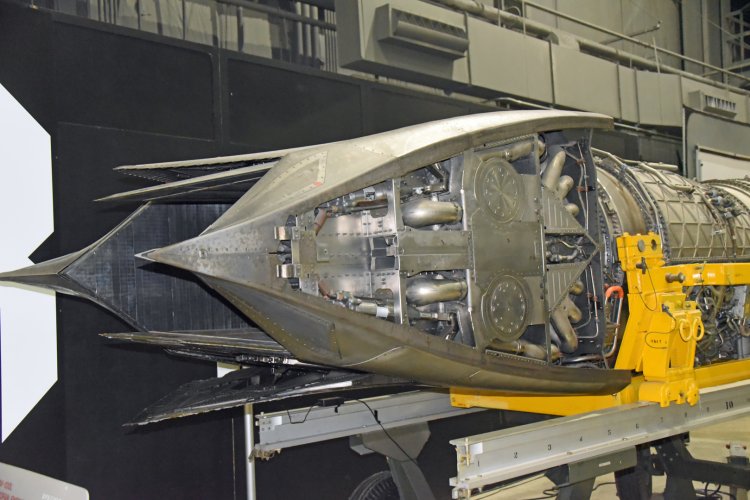
First, here's a picture of an F119 on the test bench: The exhaust seems to consist of 2 petals on each side, with a cooling channel presumably running between them:

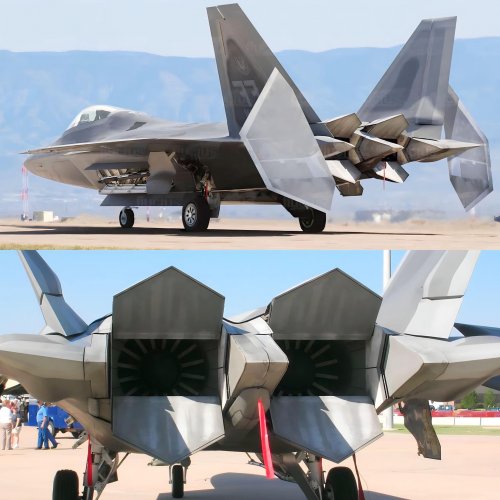
The latter is an image of a production Raptor from the rear. The exhausts seem to be made from a single piece - with looks like a solid block, no cooling air ducts visible (to me):
 

Attachments

  • YF119-PW-100L_USAF3.jpg
    YF119-PW-100L_USAF3.jpg
    1.1 MB · Views: 589
  • 6WoiQ.jpg
    6WoiQ.jpg
    282 KB · Views: 597
Last edited by a moderator:
Sorry if this is a dumb question, but there was a question about the cooling ducts of the Su-57's new 2D nozzles, and the Raptor was brought up as comparison. It got me confused about the presence of cooling ducts in the nozzle in the F-119 (and other planes)

First, what purpose do they serve? Do all engines have them? Is it a 5th gen thing? Or a stealth thing?

First, here's a picture of an F119 on the test bench: The exhaust seems to consist of 2 petals on each side, with a cooling channel presumably running between them:


View attachment 792266
The latter is an image of a production Raptor from the rear. The exhausts seem to be made from a single piece - with looks like a solid block, no cooling air ducts visible (to me):
View attachment 792272

The top photo is the YF119 engine used in the YF-22 Dem Val program. The production F119 nozzle and exhaust system is completely different.
 
Do the exhaust petals have bypass air running through them in the final variant? How common it is to have/not have this in nozzles in general?
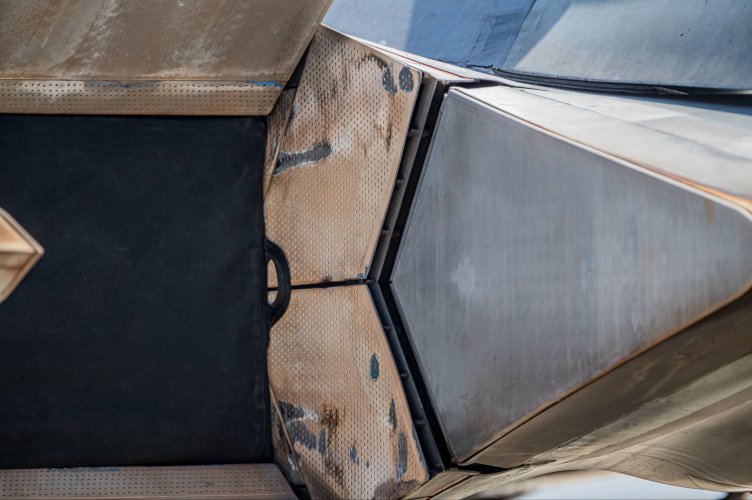
They are completely perforated for superior cooling.
From national museum:


Some did feature some kind of thermal painting or coating, too.
 

Attachments

  • F22-TVC-perforation.jpg
    F22-TVC-perforation.jpg
    376.4 KB · Views: 127
  • 071010-F-1234S-008.jpg
    071010-F-1234S-008.jpg
    370.3 KB · Views: 230
Last edited by a moderator:
They are completely perforated for superior cooling.
From national museum:
View attachment 792340
071010-F-1234S-008.JPG


View attachment 792336

Some did feature some kind of thermal painting or coating, too.
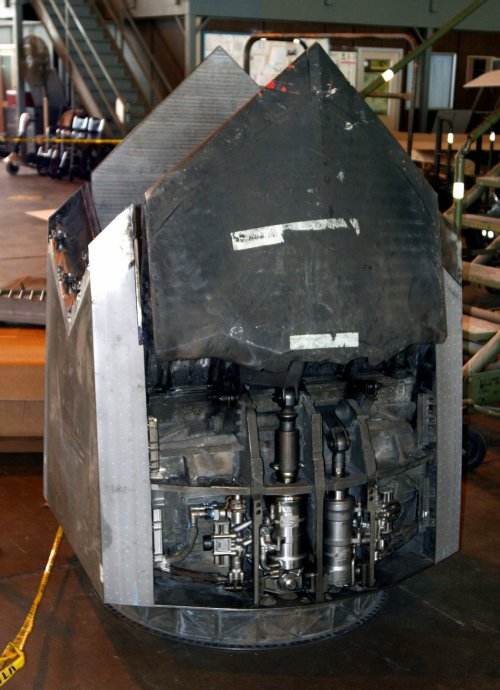
The removed nozzle on the floor appears to be one of the first Initial Service Release (ISR) configuration nozzles from EMD flight test. The silver tape was likely part of the flight test instrumentation.

Lower photo is primarily showing the nozzle sidewall liners and airpumps (ejectors for sucking out engine bay ventilation airflow), with the Aicraft Mounted Nozzle Sidewalls (AMNS) at the aft end, all cooled with fan bypass air. And yes, P&W is the expert on high temperature LO coatings, how to make them live in the exhaust environment, and how to repair the coatings on the individual components.
 
The AESA upgrades are great but based on Mitchell Instit. interview I posted sometime ago, IRST technology has really really improved.
 
They are completely perforated for superior cooling.
From national museum:
View attachment 792340
071010-F-1234S-008.JPG


View attachment 792336

Some did feature some kind of thermal painting or coating, too.
Very good view of the nozzle actuation system. Unique looking, high-temp servovalves. I assume the actuators are made from Titanium or possibly Inconel due to the thermal environment but Inconel is heavy, Titanium would be a better bet due to the lighter weight.
 
Very good view of the nozzle actuation system. Unique looking, high-temp servovalves. I assume the actuators are made from Titanium or possibly Inconel due to the thermal environment but Inconel is heavy, Titanium would be a better bet due to the lighter weight.
If I remember correctly, the nozzle actuator housings are made of titanium. While the environment is definitely warm, it is separated from the hot gas flow by a layer of fan bypass air inside the structure, and in an area ventilated by engine bay air. These are fueldraulic actuators, with the engine fuel pumps providing the actuation pressure and the fuel returning to main burn flow after the actuator.

An interesting feature on the divergent flap actuator (left one in the photo) is the slotted collar around the exposed rod. When the engine is shut down, the actuator fully retracts, pulling the bulged section of the rod near the upper end thru the fingers of that collar. This is the shutdown lock that holds the upper flap up on the ground. This lock is only on the upper actuator. If the actuator does not retract all the way (only does this on the ground), the upper flap will slowly droop down, making crewchief access for postflight inspection difficult.
 
If I remember correctly, the nozzle actuator housings are made of titanium. While the environment is definitely warm, it is separated from the hot gas flow by a layer of fan bypass air inside the structure, and in an area ventilated by engine bay air. These are fueldraulic actuators, with the engine fuel pumps providing the actuation pressure and the fuel returning to main burn flow after the actuator.

An interesting feature on the divergent flap actuator (left one in the photo) is the slotted collar around the exposed rod. When the engine is shut down, the actuator fully retracts, pulling the bulged section of the rod near the upper end thru the fingers of that collar. This is the shutdown lock that holds the upper flap up on the ground. This lock is only on the upper actuator. If the actuator does not retract all the way (only does this on the ground), the upper flap will slowly droop down, making crewchief access for postflight inspection difficult.
Thank you for the info, I kind of figured the actuation was fueldraulic. I supported the YF-23 (including B-2 and others when I was at Northrop) during the DemVal program with the YF-22 at EAFB. I was involved with hydro, flight controls, landing gear and all things actuated, didn't get into propulsion much.
 
Thank you for the info, I kind of figured the actuation was fueldraulic. I supported the YF-23 (including B-2 and others when I was at Northrop) during the DemVal program with the YF-22 at EAFB. I was involved with hydro, flight controls, landing gear and all things actuated, didn't get into propulsion much.
I was over the wall, supporting the YF-22 during Dem-Val

The YF119 had a self contained Mil-H-83282 hydraulic fluid actuation system that was a real pain. The system was originally envisioned to share the aircraft hydraulic system, but they could never resolve the issue of whether the engine or flight controls was highest priority in a failure scenario. The engine had to be re-engineered to include its own hydraulic pump and a closed system bootstrapped fluid reservoir. We had to service the system every day to remove any air, and take fluid samples that go tested for viscosity, contamination, and particle counts back in what we called “ the crack lab” back in the engine shop. The open end fueldraulic system on the F119 is much better….

And, on the YF119, there was no nozzle shutdown lock. We had to stick a 2x4 across the top of the nozzle to hold the divergent flap up for post flight inspection. Adding the nozzle shutdown lock and moving the fan inlet guide vanes to the axial position to ease inspection access during ground shutdown were two maintenance enhancement suggestions from Dem-Val that were incorporated into the production F119.
 
I was over the wall, supporting the YF-22 during Dem-Val

The YF119 had a self contained Mil-H-83282 hydraulic fluid actuation system that was a real pain. The system was originally envisioned to share the aircraft hydraulic system, but they could never resolve the issue of whether the engine or flight controls was highest priority in a failure scenario. The engine had to be re-engineered to include its own hydraulic pump and a closed system bootstrapped fluid reservoir. We had to service the system every day to remove any air, and take fluid samples that go tested for viscosity, contamination, and particle counts back in what we called “ the crack lab” back in the engine shop. The open end fueldraulic system on the F119 is much better….

And, on the YF119, there was no nozzle shutdown lock. We had to stick a 2x4 across the top of the nozzle to hold the divergent flap up for post flight inspection. Adding the nozzle shutdown lock and moving the fan inlet guide vanes to the axial position to ease inspection access during ground shutdown were two maintenance enhancement suggestions from Dem-Val that were incorporated into the production F119.
So we both were separated by the wall which I think also had the heavy black curtain on it too since we were in the same hangar. That was quite some time ago for sure.
 
The AESA upgrades are great but based on Mitchell Instit. interview I posted sometime ago, IRST technology has really really improved.
When did the radar get upgraded? haven't seen anything about that but maybe I missed it. Is it finally getting GaN modules? or is it just new added capabilities?
 

Similar threads

Back
Top Bottom