A first-class AAW system needs big radar arrays, especially if you want to add BMD capabilities, which means a physically large ship to carry it around stably. Look at the Japanese ASEVs, those are looking at 14,000 tonnes. The USN DDGX is looking at 13,500 tonnes. Sejong the Great class are 10-12,000 tonnes. And of course the Zumwalts are ~15,600 tonnes, IIRC mostly due to the tumblehome design for stealth.

So I think we really are stuck looking at designs in the 12-14k range for the "first class AAW/BMD" ships.
Ok, the First Rater is 14k. That is a semi-capital ship which means fewer of them. That makes Second Rater a Burke size ship, 3rd Rater is FFG-62 type ships and 4th Rater is the notional ASW escort. How many of each type to build the best system of ships?
 
You can either build a ship competently (slowly) or build it poorly (quickly). Thankfully, the PRC seems to have chosen the latter, since it produces vessels at nearly the same rate as the Spanish, so we can probably expect to be just as squishy as Spanish ships.
Hold on a minute. Why are we assuming high production volume equates to lower quality? There are other factors that go into production right? Why are we also concluding the Chinese surface combatants are also of poor quality due to European choices?

Where is the empirical evidence that Chinese vessels are built to a substandard survivability standard due to it's production rate?

"You can either build a plane competently (slowly) or build it poorly (quickly). Thankfully, the USA seems to have chosen the latter."
- Russian Agent. See how ridiculous that statement sounds?

A lot that goes into Chinese shipbuilding is due to industrial scale. In terms of size, the Spanish ship building industry is FAR closer to the USA's than China's.
 
Last edited:
Hold on a minute. Why are we assuming high production volume equates to lower quality?

Less time per unit given man hours and less stringent certification requirements. The latter drives cost the most. Japanese surface ships are notable here. Part of the reason the USN envies Japan's shipbuilding, like it envies Italy, is because it will occasionally forget that they build ships rapidly and cheaply at the expense of combat survivability.

When it remembers this, it usually orders a few more Burkes.

There are other factors that go into production right?

In something as well understood as shipbuilding, no. You can build a ship really poorly but the PLAN doesn't seem to do that. Could be wrong.

Why are we also concluding the Chinese surface combatants are also of poor quality due to European choices?

"Poor quality".

No, at least not in general terms. Weakly survivable, which is poor for combat standards by the United States' measure, but if you want to ignore that context you can. Which is to say I am saying PLAN ships are likely more similar to European ones than American ones. European ships, broadly speaking, are cheaply made and quickly assembled. This is reflected in their survivability against shock and large vessel impacts such as in the case of the Helge Ingstad.

This is just a reflection of the weaponization of a large commercial shipbuilding sector if anything, something the United States notably lacks, thus its warships are built to rather high survivability standards.

If we are judging ships by the U.S. Navy standard, there is the U.S. Navy's Battle Force, and then there are cargo ships. That some of these cargo ships might have radars, 30+ knot hulls, and Standard missiles makes little difference when shock ruptures welds and causes cascading flooding into compartments. The PLAN likely builds their ships closer to European standards, than American ones, if only because that is the easiest way to scale production rates quickly and effectively when you have a large commercial shipbuilding operation.

Incidentally, what does the European Union have again? Oh right, the third largest commercial shipbuilding industry by tonnage. Not coincidentally there is usually a lull in naval ship construction in the PRC when their commercial shipbuilding is doing well, and a surge in naval shipbuilding their commercial ship construction is doing poorly, because they often share the same workforce and yards!

That's not to say that PLAN ships are "built to commercial standards" but their battle force units likely have survivability standards similar to auxiliaries according to the USN, which would be in line with European FREMM or F100 classes, but we'll know for certain once they start missile and torpedo hits!

The United States' naval shipbuilding has not been affected by its near total atrophy of commercial shipbuilding because they are functionally independent units. Over the past 5 years there has actually been a significant divergence in the PRC, of a similar nature between naval and commercial shipbuilding, but if war is coming by the end of this decade then it simply may not matter. It depends on how the structure of the shipbuilding industry looked between 2010-2018 when the naval construction rapidly escalated, since declined, and whether that was due to new capacities or restructuring of commercial yards.

Commercial standards? Not likely. European standards? Very possible. That makes them rather more vulnerable to damage than USN ships. However this is also good, because it ultimately reduces the quantity of strategic targets needed to be hit to destroy the PLAN's battle damage repair capability, if a potential US-PRC naval fight results in mutual intercontinental exchange.

Where is the empirical evidence that Chinese vessels are built to a substandard survivability standard due to it's production rate?

The production rate itself is evidence enough but perhaps they are building a Burke every 12 months in all aspects rather than, say, a FREMM.

"You can either build a plane competently (slowly) or build it poorly (quickly). Thankfully, the USA seems to have chosen the latter."
- Russian Agent. See how ridiculous that statement sounds?

Shockingly enough, aircraft and warships are sufficiently different that construction practices between one doesn't translate to the other. Anyway, the U.S. has demonstrated its survivability of warships over several decades. The PLAN, Japan, ROK, and most of Europe (including the former USSR) don't. There is some evidence to suggest the contrary, actually.

A lot that goes into Chinese shipbuilding is due to industrial scale. In terms of size, the Spanish ship building industry is FAR closer to the USA's than China's.

You can use Japan or Korea if you want. It's unlikely the PLAN differs substantially to all three.

 
Last edited:
Less time per unit given man hours and less stringent certification requirements. The latter drives cost the most. Japanese surface ships are notable here. Part of the reason the USN envies Japan's shipbuilding, like it envies Italy, is because it will occasionally forget that they build ships rapidly and cheaply at the expense of combat survivability.

When it remembers this, it usually orders a few more Burkes.


In something as well understood as shipbuilding, no. You can build a ship really poorly but the PLAN doesn't seem to do that. Could be wrong.


"Poor quality".

No, at least not in general terms. Weakly survivable, which is poor for combat standards by the United States' measure, but if you want to ignore that context you can. Which is to say I am saying PLAN ships are likely more similar to European ones than American ones. European ships, broadly speaking, are cheaply made and quickly assembled. This is reflected in their survivability against shock and large vessel impacts such as in the case of the Helge Ingstad.

This is just a reflection of the weaponization of a large commercial shipbuilding sector if anything, something the United States notably lacks, thus its warships are built to rather high survivability standards.

If we are judging ships by the U.S. Navy standard, there is the U.S. Navy's Battle Force, and then there are cargo ships. That some of these cargo ships might have radars, 30+ knot hulls, and Standard missiles makes little difference when shock ruptures welds and causes cascading flooding into compartments. The PLAN likely builds their ships closer to European standards, than American ones, if only because that is the easiest way to scale production rates quickly and effectively when you have a large commercial shipbuilding operation.

Incidentally, what does the European Union have again? Oh right, the third largest commercial shipbuilding industry by tonnage. Not coincidentally there is usually a lull in naval ship construction in the PRC when their commercial shipbuilding is doing well, and a surge in naval shipbuilding their commercial ship construction is doing poorly, because they often share the same workforce and yards!

That's not to say that PLAN ships are "built to commercial standards" but their battle force units likely have survivability standards similar to auxiliaries according to the USN, which would be in line with European FREMM or F100 classes, but we'll know for certain once they start missile and torpedo hits!

The United States' naval shipbuilding has not been affected by its near total atrophy of commercial shipbuilding because they are functionally independent units. Over the past 5 years there has actually been a significant divergence in the PRC, of a similar nature between naval and commercial shipbuilding, but if war is coming by the end of this decade then it simply may not matter. It depends on how the structure of the shipbuilding industry looked between 2010-2018 when the naval construction rapidly escalated, since declined, and whether that was due to new capacities or restructuring of commercial yards.

Commercial standards? Not likely. European standards? Very possible. That makes them rather more vulnerable to damage than USN ships. However this is also good, because it ultimately reduces the quantity of strategic targets needed to be hit to destroy the PLAN's battle damage repair capability, if a potential US-PRC naval fight results in mutual intercontinental exchange.


The production rate itself is evidence enough but perhaps they are building a Burke every 12 months in all aspects rather than, say, a FREMM.


Shockingly enough, aircraft and warships are sufficiently different that construction practices between one doesn't translate to the other. Anyway, the U.S. has demonstrated its survivability of warships over several decades. The PLAN, Japan, ROK, and most of Europe (including the former USSR) don't. There is some evidence to suggest the contrary, actually.


You can use Japan or Korea if you want. It's unlikely the PLAN differs substantially to all three.
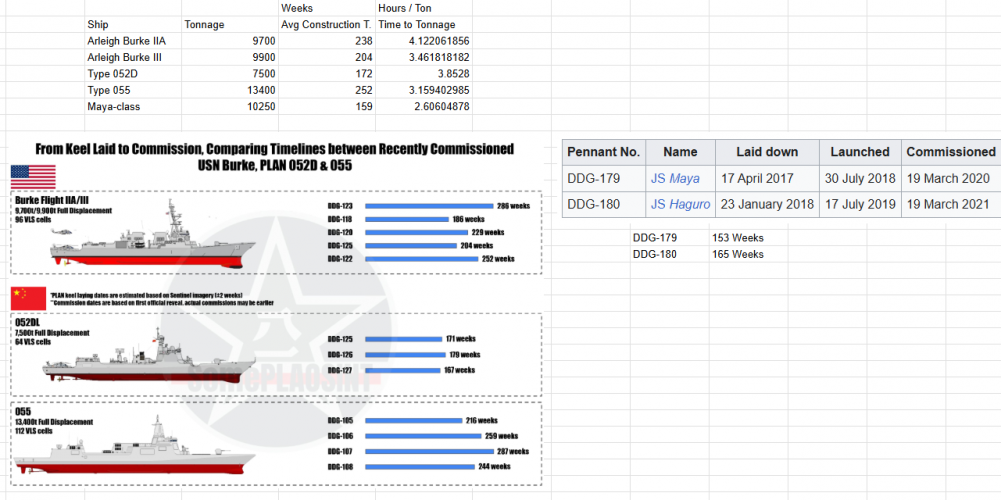
Here's your DDG production* time comparison for the USA, China, and Japan. I equalized the production time per tonnage. Japan builds it's DDG's far faster than both China and the US.
1764650247316.png
Chinese ships are not built massively faster than American ones. It only appears to be that way due to large batches being built simultaneously which allows commissions to stagger and appear at a fast rate.
Per ton, the 052D is actually built slower than the flight III. Which to be fair could just be a coincidence as the data only includes a single flight III.
 
Last edited:
As for the standards issue, note that US ships involved in collisions do well, while a European frigate sank. Also, USS Cole and Stark. You get what you pay for and that is the issue. Is it worth it?

In a shooting war with hypersonic weapons…probably not. Damaged ships are useless ships likely not returning service before a peer war is over. It might save lives, but on the other hand, how much capability was just lost on a failed program in pursuit of level 3 standards? And how many lives will that cost?
 
Less time per unit given man hours and less stringent certification requirements. The latter drives cost the most. Japanese surface ships are notable here. Part of the reason the USN envies Japan's shipbuilding, like it envies Italy, is because it will occasionally forget that they build ships rapidly and cheaply at the expense of combat survivability.

When it remembers this, it usually orders a few more Burkes.


In something as well understood as shipbuilding, no. You can build a ship really poorly but the PLAN doesn't seem to do that. Could be wrong.


"Poor quality".

No, at least not in general terms. Weakly survivable, which is poor for combat standards by the United States' measure, but if you want to ignore that context you can. Which is to say I am saying PLAN ships are likely more similar to European ones than American ones. European ships, broadly speaking, are cheaply made and quickly assembled. This is reflected in their survivability against shock and large vessel impacts such as in the case of the Helge Ingstad.

This is just a reflection of the weaponization of a large commercial shipbuilding sector if anything, something the United States notably lacks, thus its warships are built to rather high survivability standards.

If we are judging ships by the U.S. Navy standard, there is the U.S. Navy's Battle Force, and then there are cargo ships. That some of these cargo ships might have radars, 30+ knot hulls, and Standard missiles makes little difference when shock ruptures welds and causes cascading flooding into compartments. The PLAN likely builds their ships closer to European standards, than American ones, if only because that is the easiest way to scale production rates quickly and effectively when you have a large commercial shipbuilding operation.

Incidentally, what does the European Union have again? Oh right, the third largest commercial shipbuilding industry by tonnage. Not coincidentally there is usually a lull in naval ship construction in the PRC when their commercial shipbuilding is doing well, and a surge in naval shipbuilding their commercial ship construction is doing poorly, because they often share the same workforce and yards!

That's not to say that PLAN ships are "built to commercial standards" but their battle force units likely have survivability standards similar to auxiliaries according to the USN, which would be in line with European FREMM or F100 classes, but we'll know for certain once they start missile and torpedo hits!

The United States' naval shipbuilding has not been affected by its near total atrophy of commercial shipbuilding because they are functionally independent units. Over the past 5 years there has actually been a significant divergence in the PRC, of a similar nature between naval and commercial shipbuilding, but if war is coming by the end of this decade then it simply may not matter. It depends on how the structure of the shipbuilding industry looked between 2010-2018 when the naval construction rapidly escalated, since declined, and whether that was due to new capacities or restructuring of commercial yards.

Commercial standards? Not likely. European standards? Very possible. That makes them rather more vulnerable to damage than USN ships. However this is also good, because it ultimately reduces the quantity of strategic targets needed to be hit to destroy the PLAN's battle damage repair capability, if a potential US-PRC naval fight results in mutual intercontinental exchange.


The production rate itself is evidence enough but perhaps they are building a Burke every 12 months in all aspects rather than, say, a FREMM.


Shockingly enough, aircraft and warships are sufficiently different that construction practices between one doesn't translate to the other. Anyway, the U.S. has demonstrated its survivability of warships over several decades. The PLAN, Japan, ROK, and most of Europe (including the former USSR) don't. There is some evidence to suggest the contrary, actually.


You can use Japan or Korea if you want. It's unlikely the PLAN differs substantially to all three.
Have you made a detailed comparison of the differences between the USN and other countries in terms of warship construction standards and damage resistance?

Modern warships are not like classical warships; collisions are not a primary combat mode of modern warships. Collision damage only tests a warship's structural design and materials. Modern warship damage control consists of three parts: structural strength (relying on design), rapid location of damaged compartments and assessment of damage (relying on sensors and crew), and crew-led repair (relying on skilled crew). Given the frequent collisions involving the USN in recent years, how can you determine whether naval crew members who cannot even guarantee basic navigational safety have ability to perfectly perform damage control operations?
 
Ok, the First Rater is 14k. That is a semi-capital ship which means fewer of them. That makes Second Rater a Burke size ship, 3rd Rater is FFG-62 type ships and 4th Rater is the notional ASW escort. How many of each type to build the best system of ships?
Well, if we're matching up to the 1980s USN, we're looking at 18 CG/CGNs, 27 Aegis CGs, 31+4+29 Sprucan+Kidd+CFAdams DDs, and 51+46+11+6 Perry+Knox+Garcia+Brooke FF/FFGs. 45 Cruisers, 64 Destroyers, and 114 Frigates

We're probably looking at:
  • ~30 DDGX
  • ~40something Burke IIA Tech Inserts and IIIs (there are already 8x BIITIs and 25 BIIIs on order/authorized, likely to get >5 more since DDGX isn't ready yet)
  • ~65 Burke I/II/IIA/IIA Restarts
  • ~50 FFG-62s and ~65 4th Rate OR
  • ~115 4th Rate
OR
  • 45 DDGX (correlating to the CG/CGN and Aegis total)
  • 60something Burke IIATIs/IIIs (correlating to the destroyer totals and role)
  • ~37 Burkes Flight IIA and Restarts (correlating to the Perry class)
  • 40ish 4th Rates or FFG-62s, exact quality depends on outside factors (correlating to the older FFs and FFGs)
In both cases those totals won't exactly happen, the oldest Burkes will be leaving the fleet as the DDGX enter. By the time all the DDGX are in service, I doubt there will be more than ~20 Burke IIA and Restarts left.​

In addition to all the ships in Option 2, I'd prefer to have the full 115 frigates that the USN had back in the 1980s, Congress demands more missions than the USN has ships. For that same reason, the USN really needs to figure out how to get back up to about 90 attack submarines. I've been thinking ~70-80x SSNs and ~12-16x SSPs, with the SSPs along the lines of HISutton's sailless proposal with dual DDS focusing on Special Operations support.

It may be worth having a "Carrier ASW Escort" frigate and an "everywhere else ASW Escort" frigate, though ironically it may be better to have aegis on the "everywhere else" and mere CEC on the "carrier escort."


Given the frequent collisions involving the USN in recent years, how can you determine whether naval crew members who cannot even guarantee basic navigational safety have ability to perfectly perform damage control operations?
The fact that the ships were not lost after that catastrophic a fuckup says that the crews know their DC, even if their officers can't steer. :mad:
 
Recently I had the opportunity to exchange notes with one of BIW’s lead naval architects on their FFG(X) submission. The conversation has added more nuance to how I view the outcome of the FFG(X) competition. Although I still believe the FMM proposal promised greater overall capability, I increasingly think BIW had a stronger chance of delivering a ship on time.

BIW was significantly more familiar with the F100 parent design than FMM was with FREMM, and U.S.–Spanish naval cooperation has historically been much closer than the U.S.–Italian equivalent. This partnership goes back to at least the 1980s, when Spain purchased the FFG-7s from the U.S. Navy and BIW personnel traveled to Spain to assist with the early F100 program. I have not been able to determine exactly how much of the F100 BIW designed, but Navantia’s baseline hull was already much closer to U.S. Navy standards than FREMM. The exact quote reads as follows,

“F100 incorporated many U.S. military standards and systems in the design: Mk 41, LM2500, U.S. shock requirements, U.S. damage-stability requirements, several survivability requirements. We had to modify the transom slightly for towed-array requirements. Structure was increased to meet USN requirements.”

However, the F100 hull is objectively less capable than the FREMM design. Contrary to some rumors, BIW would have retained the baseline CODOG power plant. NAVSEA was reportedly satisfied with this from a power-generation standpoint, but direct-drive gas turbines introduce several drawbacks. Gas turbines consume more fuel than diesels, and FREMM’s diesel-hybrid arrangement extends its endurance advantage even further. F100’s range is comparable to the Arleigh Burkes’, which the Navy already considers insufficient. Gas turbines are also much louder than diesel-electric drive systems, which is suboptimal for an ASW frigate. And direct drive limits available ship-service power for DEWs.

Additionally, the FFG(X) requirements explicitly called for more equipment than the baseline F100 carried: the VDS, a double hangar, CEC, and other systems. While he explained that
“F100 had larger Service Life Allowance than USN requirements… [and they] were able to trade and recover margin and meet requirements,” do note the other F100 derivates (Hobart and Nansen), are struggling with their margins as is. Most eyebrow raising is he did not explain how VDS or the double hangar would be integrated, when I specifically mentioned these two items by name.

FREMM, if redesigned to meet NAVSEA standards, would avoid nearly all of these issues. Its electric drive increases ship-service power, reduces fuel consumption and machinery noise, and its base hull was large enough to incorporate the additional systems with margin to spare. If BIW made the required modifications to F100, we likely would have ended up with an aging, constrained hull pushed to its limits, but delivered on schedule. Very similar to the Flight III program.

He also said “our proposal included a detailed plan and master schedule giving them all the evidence they needed to understand the realism of our design, plan, and price. Detailed support for 3.8 years, start fab to delivery.”
I fully believe they could pull this off, BIW is a much more competent yard than FMM, with significant experience designing and building warships of this category, and the design changes are much more manageable.

But the F100 hull inherently constrained their proposal to the point that FREMM simply looked better on paper. While several of F100’s issues could rectified with a hull plug to create more volume, “switching” to IEP (very nontrivial), completely overhauling the powerplant like with Flight III, etc, this would have undoubtedly created delays analogous to those of the FREMM, breaking the estimated 3.8 year timeline, which is the only real selling point BIW has over FREMM.

As for why FMM won, we know that both NAVSEA and FMM underestimated the scope of the work required to bring FREMM up to standard. NAVSEA out of potentially willful ignorance and deference to FMM, and FMM because they simply didn't have the requisite experience to know better, having never built anything larger than an LCS.

Additionally, BIW has been struggling with delivery schedules since the Flight IIA restart in the early 2010s. This has lead to a decline in trust that seems to have peaked in the late 2010s and early 2020s, when BIW was awarded just 4/10 Flight IIIs in the FY23 block buy. Between this and FMM’s better specs on paper, it’s easy to see why NAVSEA selected FMM, albeit with some hesitation.

If FMM can ultimately deliver their vessel, even with the three-year delay, I think the decision to procure FREMM was worth it. Should they be unable to meet the contracted requirements, then I would suggest procuring MMSC as an interim solution and either revisiting BIW’s proposal or initiating a clean-slate design program. The latter would clearly be more capable and free of the F100’s limitations, but BIW could at least have met the original schedule, albeit with a less capable ship.
 
Last edited by a moderator:
LCS are next to useless for anti-air and anti-missile defense. They are barely capable of self-defense, with just RAM and 57-mm cannon.
This isn't their main problem even; armament ultimately can be changed, and their sensor suit isn't hopeless for the job.
Just a wrong hull at a wrong operational price point.
 
European vessels broadly suffer from similar issues as Japanese ones in WW2: bad flooding control, bad damage control, high vulnerability to impact and shock, all of which sank a Spanish built Eurofrigate very similar in nature to Italian and Dutch designs.
Both European and Japanese vessels shown examplary cases of DC effort. Japanese ones quite a lot, despite the well known deficiencies in the very way DC was organized(well recorded and demonstrated by Kaga:Akagi pair). To a significant degree US DC record was due to just being able to afford to do it in most situations after Midway.

Furthermore, if we look at recent cases(Norway, Russia) - more than DC shortcomings, it's general sentiment. DC wasn't even done for the fear of betting lives on ship. As soon as Moscow heard about Moscow - crew was ordered off the ship, for a fear of political ramifications.
You can either build a ship competently (slowly) or build it poorly (quickly). Thankfully, the PRC seems to have chosen the latter, since it produces vessels at nearly the same rate as the Spanish, so we can probably expect to be just as squishy as Spanish ships.
This is not how industrial manufacturing works. All things equal, well oiled system produces better ships, much cheaper and faster. It doesn't mean they're ersatz units.
And in and case, since you've brought the Spanish - Spain, back in it's glory days, lost Maritime superiority exactly by building excellent quality artisan ships from precious woods, to a Dutch shitboat conveyor. Which soon enough wasn't all that shit either.
High coldwar Soviet ships were perhaps not as well built compared to US ships (coming from a much more efficient and oiled conveyor, rather than any artisan workshop), but they certainly were better than any artisanship Russias did before or after. Or even the Soviets themselves.

"But our quality" is usually little more than psychological defense. Chinese warships aren't produced at any special rate compared to historical US ones(not even that long ago, that was already after the cold war), and likely not even close to what they actually can do. They're just building stuff normally via larger industry and supply chain, living in a competitive environment.
 
Last edited:
This isn't their main problem even; armament ultimately can be changed, and their sensor suit isn't hopeless for the job.
Just a wrong hull at a wrong operational price point.
I didn't say its hopeless; for escort ship, it seems fine. Of course it would require normal fire control radar installed to work with anything like area defense missiles.
 
I didn't say its hopeless; for escort ship, it seems fine. Of course it would require normal fire control radar installed to work with anything like area defense missiles.
Their radar is in fact OK enough, it can support short to medium range(ESSM) engagement just fine - which is already collective defense . I assume TRS-4D will manage even ABM with some footprint, at least if warned and provided with adequate effector.
 
Last edited:
Their radar is in fact OK enough, it can support short to medium range(ESSM) engagement just fine - which is already collective defense . I assume TRS-4D will manage even ABM with some footprint, at least if warned and provided with adequate effector.
Well, yes, but AFAIK it can't support SM-2 engagement (and I'm not sure about FCS being able to provide mid-course guidance for SM-6 as well). So to have proper area defense capacity - which is required from escort ship - at least one AN/SPG-62 must be fit.
 
Well, yes, but AFAIK it can't support SM-2 engagement (and I'm not sure about FCS being able to provide mid-course guidance for SM-6 as well). So to have proper area defense capacity - which is required from escort ship - at least one AN/SPG-62 must be fit.
Here's question what we want.
SM-2 is 150km class weapon - it is already collective defense in a very broad sense; SM-6 is 4xx+ class, which develops into a universal atmospheric effector, AAW/ASuV/strike.
While both are mentioned in ABM context - neither are ABM weapons of choice, and iirc there were mentions that SM-6s didn't exactly contribute well to Israel ABM.
Which is why ABM is SM-3 and ongoing PAC-3 integration effort.

For frigate, IMHO, even SM-2 is very top class. It covers just about any sensible spread of civilian convoy, any sensible radar horizon around it for collective defense (not just ship, but also via networked oth fire control via escort on opposite end of the formation), and cuts off tactical weapons high altitude release from aircraft (+60-80 nmi off that point). It already made Constellation top of the line frigate, fully capable of holding its own (in place of destroyer if necessary) in fleet action.
SM-6 is just fallacy, it's advantages are only relevant in high end warfare or strike - but it costs a lot per unit, generating FC solutions at ranges where it has advantage costs your small country's annual budget, and it's still highly limited by production.

I.e. even Constellation itself is a very high end approach to a frigate problem; it's anything but cheap, for a navy with global commitments.
ESSM(and PAC-3) are not point defense weapons*, they also have significant protected footprint even in ABM. it's totally feasible to create much smaller, cheaper combatant, which will still be able to protect a ~10 mile formation (does our convoy even pretend to stick together?) from significant threats.

*frankly speaking, even SeaRAM is not just PD, and totally can escort - it has 3 times the threat radius(and more like 5 the effective one) of WW2 5" gun in AA.
 
. The latter would clearly be more capable and free of the F100’s limitations, but BIW could at least have met the original schedule, albeit with a less capable ship.
At that point F110 could be an serious option assuming most of the better qualities of F100 stayed
 
LCS are next to useless for anti-air and anti-missile defense. They are barely capable of self-defense, with just RAM and 57-mm cannon.
Easier to integrate ESSM with COMBATSS-21 than it is to restart NSC production.
 
BIW can sell as many Burkes as it can build to the Navy.

I can't see them having the excess capacity to also build frigates.

The US fleet is shrinking and with older Burkes retiring soon, the move for BIW is to build as many newer, more capable Burkes that it can.
 
F110 is a completely different ship with no relation to BIW, and not built to NAVSEA standards. All the problems of FREMM with none of the benefits of F100.
One could assume that standards where retained as requierments for the spanish navy.....
 
One could assume that standards where retained as requierments for the spanish navy.....
Not when the Spanish Navy is struggling for funding as is, and there was no consultation with an American yard.

The US fleet is shrinking and with older Burkes retiring soon, the move for BIW is to build as many newer, more capable Burkes that it can.
Under the 30 Year Shipbuilding Plans released in the past few years, all of the LSC fleets shrink. Come 2050 there will not be as many LSCs as there are now, nor should there be.

If I’m remembering correctly, the 28 Flight 8 and IIs will all be gone by the early 2040s, and the first the Flight IIAs not far behind. A total of 24 Flight IIIs have been ordered thus far, and DDG(X) will commission at 1.5/year starting in 2039. Definitely not a 1:1 replacement rate.

That said, operating such a top-heavy (high-end) has been a maintenance nightmare, and we can increasingly start handing off lesser roles to frigates and UxVs. And DDG(X) will simply be too expensive to buy more than 1-2 a year.
 
Not when the Spanish Navy is struggling for funding as is, and there was no consultation with an American yard.


Under the 30 Year Shipbuilding Plans released in the past few years, all of the LSC fleets shrink. Come 2050 there will not be as many LSCs as there are now, nor should there be.

If I’m remembering correctly, the 28 Flight 8 and IIs will all be gone by the early 2040s, and the first the Flight IIAs not far behind. A total of 24 Flight IIIs have been ordered thus far, and DDG(X) will commission at 1.5/year starting in 2039. Definitely not a 1:1 replacement rate.

That said, operating such a top-heavy (high-end) has been a maintenance nightmare, and we can increasingly start handing off lesser roles to frigates and UxVs. And DDG(X) will simply be too expensive to buy more than 1-2 a year.

The Navy's tends toward optimistic planning.

Thirty years is a long time. A lot can change in thirty years.

Shipbuilding plans have come and gone without coming to fruition.

Maybe DDGX will be ready on time and budget but that is a big if.

Maybe the Navy will have a sufficient number of Frigates by then but that is also a big if.

I hope it happens but would bet against it.
 
The Navy's tends toward optimistic planning.

Thirty years is a long time. A lot can change in thirty years.

And some things never change. There has been a major upturn in planned ship procurements just outside the FYDP in every SCN budget since I became aware of defense budgets. So, 30+ years now. The "bow wave" is real, and yet is never actually real.
 
The Navy's tends toward optimistic planning.

Thirty years is a long time. A lot can change in thirty years.

Shipbuilding plans have come and gone without coming to fruition.

Maybe DDGX will be ready on time and budget but that is a big if.

Maybe the Navy will have a sufficient number of Frigates by then but that is also a big if.

I hope it happens but would bet against it.
None of this changes the fact we’d have a more flexible navy if we divested from an LSC-heavy fleet. Having Bath start a frigate line and slow Burke production wouldn’t be the end of the world.
 
None of this changes the fact we’d have a more flexible navy if we divested from an LSC-heavy fleet. Having Bath start a frigate line and slow Burke production wouldn’t be the end of the world.

Bath is contracted to build three Burkes a year. Are they hitting that goal? Nope.

I have nothing against Bath but they are behind on what they are already contracted for.

Adding more to their plate right now is questionable at best.
 
Bath is contracted to build three Burkes a year. Are they hitting that goal? Nope.
Three Burkes/year hasn’t been hit since the 90s, when split between 2 different yards. I’m not sure where you got that number from.

I have nothing against Bath but they are behind on what they are already contracted for.
Preferably they would’ve gotten FFG-62 in 2019 and received 1-2 Burkes in the FY23 block buy (not 4). But again, we’re trying to divest from the LSC fleet, so you wouldn’t have to sustain current production rates.
 
Three Burkes/year hasn’t been hit since the 90s, when split between 2 different yards. I’m not sure where you got that number from.


Preferably they would’ve gotten FFG-62 in 2019 and received 1-2 Burkes in the FY23 block buy (not 4). But again, we’re trying to divest from the LSC fleet, so you wouldn’t have to sustain current production rates.

How many Burkes did Bath deliver in 2025?
 
Not when the Spanish Navy is struggling for funding as is, and there was no consultation with an American yard.
Thats assuming the requierments for those standards have changed but if they reused the same requierments from back then ....
Anyway without someone involved from the problem we likely wont know
 
Recently I’ve been exchanging emails with a BIW lead naval architect for their F100 derivative.
If the FMM design is really dead, I think we’ll see a clean sheet program or give BIW a call.
Build some MMSCs and do LCS Lethality & Survivability Upgrades Phase II in the interim.
I'm very much in the clean sheet camp, FWIW. Keep the requirements stable and design to them.
 
So what I'm getting at is that the USN needs a modern Sprucan. Something fast enough to keep up with carriers and good at ASW. Because it'll be in the carrier group, it doesn't necessarily need as much AA as a Burke.
In my view that's FFG(X). Closer to the JSDF DDs in role.
This. Phelan is simply giving up on manned ships altogether, not finding a better way to build them faster.
Yeah I mean if they do full drone that's all she wrote.
 
As for the standards issue, note that US ships involved in collisions do well, while a European frigate sank. Also, USS Cole and Stark. You get what you pay for and that is the issue. Is it worth it?
I think it's interesting to look into the Helge Instad, McCain, Fitzgerald and Nottingham incidents and compare how each ship performed. And I'm not sure USN DC measures come out in front.

HNoMS Helge Ingstad (Fridjtof Nansen Class, 5,290t full) collided almost head on with the Sola TS in 2018. Helge Instad was running at 17kts, Sola TS at 7kt and the collision opened 7 compartments with a 45m gash (a third of her length). The impact resulted in 8 minor injuries. Helge Ingstad was running without AIS in the dark in a busy channel and rejected a call from Sola TS to turn away because Helge Ingstad's bridge crew had apparently decided Sola TS's lights were the oil terminal on the other side of the fjord and they couldn't turn until they were past it. Having just left the terminal Sola TS had a pilot aboard and the assistance of a tug, plus the channel traffic control ashore. Despite everyone telling them to change course the OOW on Helge Ingstad didn't realise Sola TS was a ship, not a distant platform, until they were 250m apart. Sola TS's anchor then ripped a gash into Helge Ingstad's starboard side from midships aft. Flooding was progressive from the generator room through the shaft alley to the gearing room and through there to the engine rooms.
She immediately lost power and grounded 10 minutes after the collision. Her CO quickly decided she was likely to capsize and ordered her abandoned. When abandoned multiple hatchways appear to have been left open (interestingly she'd scored the highest score by any Norwegian vessel in flooding control when doing FOST the year before). Having grounded she was lashed to shore by cable to hold her in place, but the cables parted as her flooding increased and she capsized. The Norwegian Navy investigation concluded that of 88 measures which should have prevented the loss, 53 were breached. RNoN tried to sue DNV (Det Norsk Veritas), the Classification Society for the Nansens, over the risk of the hollow propeller shafts, which interestingly don't exist in the Spanish Alvaro de Bazans, but that was abandoned when the extent of RNoN failings became clear. Norway's suit against Navantia over the same issue resulted in an arbitrated settlement in which Navantia granted Norway a credit of 47.5m Euros against future logistical support. https://maritimesafetyinnovationlab...e-Ingstad-Sola-TS-Collision-November-2018.pdf

The John S McCain (Arleigh Burke Flight 1, 6,624t Light) collided with MS Alnic MC in 2017. Immediately before the collision McCain was not under command due to a clusterfuck combination of poor crew training and spectacularly poor bridge systems, which lead to her cutting into a busy traffic lane and being run down by Alnic MC, whose bow dome opened a 9m diameter hole in the hull over Berthing Compartments 3 (upper) and 5 (lower). Watertight doors and hatches were closed, but scuttles open (condition Modified Zebra). Berthing 5 flooded immediately and only two sailors of 12 in the compartment were able to escape through the open scuttle, which was then secured as water started to flood out of it. In Berthing 3 several sailors were trapped in their collapsed racks, with one requiring a hydraulic cutter to free him and another being trapped for an hour. Berthing 7 flooded through a crack from Berthing 5, while Berthing 4 and 6 on the other side of the ship from the impact, flooded through cross-flooding ducts from Berthing 5 and 7. McCain took on a 5 degree list following the impact.

The Fitzgerald (Arleigh Burke Flight 1, 6,624t Light) collided with ACX Crystal 2 months after the McCain collision, this time resulting in 7 dead and 3 injured. The Fitzgerald was at 20kts and was hit on the starboard side below the bridge by the faster ACX Crystal effectively overtaking from astern - the OOW had decided they could cut in front of her. Again the issue was basic seamanship on the bridge of the US ship, leading to sackings all the way up to COMSEVENTHFLT. The damage to Fitzgerald was caused by the ACX Crystal's bow dome, opening a 4m by 6m hole into Aux 1 and Berthing 2, which then flooded adjacent compartments, despite watertight doors being already closed (again scuttles were open at Modified Zebra). Additional flooding was caused by a ruptured firemain and cross flooding ducts. Berthing 1 flooded to 5 feet in depth because there was no waterproof hatch between it and Berthing 2 on the deck below. Radio Central partially flooded, and Main Engine Room 1 flooded to a depth of 3 feet due to leaks from Aux 1. Multiple sonar compartments flooded to a depth of 5 feet, with three sailors trapped. The ship developed a list of around 5 degrees. Initial attempts by Damage Control Central to direct the personnel from the closest repair locker to the breach were unsuccessful, forcing them to use the personnel from the engineering repair locker instead. The trapped personnel were evacuated about 45 minutes into the event, but it took 4 hours to establish that 7 men were missing.
https://www.secnav.navy.mil/foia/re...Fitzgerald and USS John S McCain Response.pdf
HMS Nottingham (Type 42 Batch 2, 3,500t Std) ran aground on Wolf Rock off Lord Howe Island in Australia in 2002 while doing 25kts, due to navigational failures while the captain was ashore, opening 5 compartments, including the forward engine room (flooded to a depth of 18 feet) and two magazines, with a 49m gash that also stripped off 21 feet of stem forging and vertical keel and ripped out the starboard stabiliser fin. Despite a rapidly developing 15 degree list leading to plans to beach her, the ship was largely secured with flooding barrier in place and shored within 25 minutes and almost completely secured in two hours. Damage was sufficient she needed to be towed stern first to Newcastle, NSW. https://www.whatdotheyknow.com/requ...BOI Grounding of HMS NOTTINGHAM 2002.pdf.html

There clearly are some physical issues on the Nansens (which interestingly don't affect their half-sisters the Bazans), but bigger problems with the crew. If they'd closed the watertight doors before abandoning, or not abandoned, then they might have saved the ship. I wonder if the difference results between the accident and FOST represent significant changes of the conscript crew since FOST (the helmsman and lookouts had experience measured in months). The two US collisions have seamanship failings at their core, while damage control wise they seem to represent less serious damage scenarios than those facing the British and Norwegian vessels, particularly as they're roughly twice the size. Both ships had significant problems dealing with progressive flooding, even if some of it was an intentional damage control measure. HMS Nottingham arguably faced the worst scenario, in the oldest and smallest hull, but dealt with it rapidly due to effective crew training.
 
So in the real world, what has mattered in damage control was maintaining good training standards and discipline.
That is what made the difference between a ship lost and a ship that stayed afloat....to live and fight another day.

Was the crew.

And all the highest of standards in construction and design mean nothing if the crew isn't kept to a high standard.

One might reccal that in the many wars, centuries past between France and England, often each seized and reused the ships of the other.
If Britain's Royal Navy ultimately came to win by the aggregate of many victories over France. It was more the difference between the standards and discipline of the crew, than the differences in ship design.
 
In my view that's FFG(X). Closer to the JSDF DDs in role.
That's where we disagree.

IIRC, FFGX is supposed to be the equivalent of the old Perry class, which was the "low end ASW but fast enough to keep up with carriers." Spruance were supposed to be the high end ASW.

IMO we could rotate the older Burkes into the "Sprucan replacement" role but IIRC the IIAs would need a minor refit to be fitted with a towed array sonar.

It might be possible to run large USVs (akin to the RN Type 9x USVs) as the equivalents to the US Knox-class FF. Armament would roughly be gun of some type (probably 57mm), ~16x Mk41, Harpoons/NSM (or a 24-cell Mk41 with 8xLRASM in Mk41), dual Mk32 triple LWT tubes, SeaRAM. "Typical" VLS load would be 6x ASROC, 40x ESSM.
 
IMO we could rotate the older Burkes into the "Sprucan replacement" role but IIRC the IIAs would need a minor refit to be fitted with a towed array sonar.
A Constellation will always be a better ASW combatant than the Burke. Burke’s gas turbines and direct drive make it loud, and it lacks VDS to see below the thermal layer.

I think Constellation is the dedicated ASW ship, cheap enough to mass produce and put on second line duty, but capable enough to operate with the CSGs as needed. You’d get very minimal return going larger.
 
A Constellation will always be a better ASW combatant than the Burke. Burke’s gas turbines and direct drive make it loud, and it lacks VDS to see below the thermal layer.

I think Constellation is the dedicated ASW ship, cheap enough to mass produce and put on second line duty, but capable enough to operate with the CSGs as needed. You’d get very minimal return going larger.
Could you go cheaper and maintain the needed ASW capabilities and be credible on other areas?
 
1. Some of the posts above show that I was misinformed by an authoritative sounding poster on another, now defunct, board with regards to the resilience of US vs Euro ships.

2. Has anyone read "The Cost of Seapower" by Philip Pugh? It gets into the crux of the issue here.

All costs are labor costs.
Labor gets more expensive every year.
Cost growth in weapons systems averages 7% per year so they double every decade.
In the long term, nations get priced out of owning types of vessel because cost growth exceeds GDP growth.
The only ways around cost growth are to grow GDP faster than 7% per yer (IMPOSSIBLE! you say, which nation has ever done THAT?), devote an ever larger % of GDP to the Navy, or get weaker each year.
IIRC he said that a ship type becomes senile not just because it devotes too much to defense but the primary reason is that another type of ship can do the job more cost effectively.
Attempts to get around the fundamentals like the jeune ecole or submarines either do not work or just shift the cost growth race to the new type of system. This is the real lesson of the book. Shifting from expensive BBs to cheaper CVs did not reduce costs, costs increased but cost effectiveness also increased because CVs were so much more effective than BBs. "Technological breakthroughs" do nothing to alter the cost growth fundamentals, they just make the cost growth race about iron ships instead of wood, steel instead of iron, battleships instead of ships of the line, dreadnoughts instead of battleships. All the tech breakthrough does is make the old stuff you spent money on obsolete. Drones, USVs, AI, etc. is not a way out, it just shifts the winner of the competition to the bigger GDP country.

There is a pitfall in analyzing Pugh's work. Equating GDP with productive capacity. Nation A counts bounced check fees in its GDP as "financial services". So, every bounced check, every grift, every fraud, every unit of currency spent on landscaping, short term rentals, food delivered to one's doorstep, lawyer's fees to sue one's neighbor for the dog making a mess on one's lawn inflates GDP and makes nation A look as strong as Nation B. Nation B grows crops, cuts down trees, mines minerals, and builds things for its GDP. Which nation can build more war systems? Pugh tells us that the nation with the bigger economy wins but when the measure of the economy is fraudulent, that must be accounted for. There is a difference between a productive industrial economy and a FIRE economy designed to generate large flows of currency that can be dipped into.

So basically, FFG-62 never mattered.


There is no way out of the fundamentals described by Pugh. I'm sure some people disagree though. AI will build us a time machine, we will go back to the 70's not make the political mistakes, grow the economy at 7%+ per year and be able to buy it all in 2025. They can go back and have McNamara let the USN keep the ship design capability while they are at it. I'm sure if we just prompt AI enough it will get smart enough to build us the time machine.
 
Last edited:
Could you go cheaper and maintain the needed ASW capabilities and be credible on other areas?
Why? For the billionth time, because numerous people on here fail to comprehend it, the USN builds a fleet of warships to very high standards. These standards are not arbitrary, nor are they over the top. They have proven themselves in both combat and in peacetime accidents. The crew are trained to a high standard, production is held to a high standard. Cheapening ships is merely a synonym for losing ships.
Recently I had the opportunity to exchange notes with one of BIW’s lead naval architects on their FFG(X) submission. The conversation has added more nuance to how I view the outcome of the FFG(X) competition. Although I still believe the FMM proposal promised greater overall capability, I increasingly think BIW had a stronger chance of delivering a ship on time.

BIW was significantly more familiar with the F100 parent design than FMM was with FREMM, and U.S.–Spanish naval cooperation has historically been much closer than the U.S.–Italian equivalent. This partnership goes back to at least the 1980s, when Spain purchased the FFG-7s from the U.S. Navy and BIW personnel traveled to Spain to assist with the early F100 program. I have not been able to determine exactly how much of the F100 BIW designed, but Navantia’s baseline hull was already much closer to U.S. Navy standards than FREMM. The exact quote reads as follows,

“F100 incorporated many U.S. military standards and systems in the design: Mk 41, LM2500, U.S. shock requirements, U.S. damage-stability requirements, several survivability requirements. We had to modify the transom slightly for towed-array requirements. Structure was increased to meet USN requirements.”

However, the F100 hull is objectively less capable than the FREMM design. Contrary to some rumors, BIW would have retained the baseline CODOG power plant. NAVSEA was reportedly satisfied with this from a power-generation standpoint, but direct-drive gas turbines introduce several drawbacks. Gas turbines consume more fuel than diesels, and FREMM’s diesel-hybrid arrangement extends its endurance advantage even further. F100’s range is comparable to the Arleigh Burkes’, which the Navy already considers insufficient. Gas turbines are also much louder than diesel-electric drive systems, which is suboptimal for an ASW frigate. And direct drive limits available ship-service power for DEWs.

Additionally, the FFG(X) requirements explicitly called for more equipment than the baseline F100 carried: the VDS, a double hangar, CEC, and other systems. While he explained that
“F100 had larger Service Life Allowance than USN requirements… [and they] were able to trade and recover margin and meet requirements,” do note the other F100 derivates (Hobart and Nansen), are struggling with their margins as is. Most eyebrow raising is he did not explain how VDS or the double hangar would be integrated, when I specifically mentioned these two items by name.

FREMM, if redesigned to meet NAVSEA standards, would avoid nearly all of these issues. Its electric drive increases ship-service power, reduces fuel consumption and machinery noise, and its base hull was large enough to incorporate the additional systems with margin to spare. If BIW made the required modifications to F100, we likely would have ended up with an aging, constrained hull pushed to its limits, but delivered on schedule. Very similar to the Flight III program.

He also said “our proposal included a detailed plan and master schedule giving them all the evidence they needed to understand the realism of our design, plan, and price. Detailed support for 3.8 years, start fab to delivery.”
I fully believe they could pull this off, BIW is a much more competent yard than FMM, with significant experience designing and building warships of this category, and the design changes are much more manageable.

But the F100 hull inherently constrained their proposal to the point that FREMM simply looked better on paper. While several of F100’s issues could rectified with a hull plug to create more volume, “switching” to IEP (very nontrivial), completely overhauling the powerplant like with Flight III, etc, this would have undoubtedly created delays analogous to those of the FREMM, breaking the estimated 3.8 year timeline, which is the only real selling point BIW has over FREMM.

As for why FMM won, we know that both NAVSEA and FMM underestimated the scope of the work required to bring FREMM up to standard. NAVSEA out of potentially willful ignorance and deference to FMM, and FMM because they simply didn't have the requisite experience to know better, having never built anything larger than an LCS.

Additionally, BIW has been struggling with delivery schedules since the Flight IIA restart in the early 2010s. This has lead to a decline in trust that seems to have peaked in the late 2010s and early 2020s, when BIW was awarded just 4/10 Flight IIIs in the FY23 block buy. Between this and FMM’s better specs on paper, it’s easy to see why NAVSEA selected FMM, albeit with some hesitation.

If FMM can ultimately deliver their vessel, even with the three-year delay, I think the decision to procure FREMM was worth it. Should they be unable to meet the contracted requirements, then I would suggest procuring MMSC as an interim solution and either revisiting BIW’s proposal or initiating a clean-slate design program. The latter would clearly be more capable and free of the F100’s limitations, but BIW could at least have met the original schedule, albeit with a less capable ship.
This explains very well where ships can have compromises in design and where they can’t. I’ll give you a hint: keeping skilled crews alive and having combat capable ships is not a compromise, otherwise it’s a disaster
 
Last edited:
BIW can sell as many Burkes as it can build to the Navy.

I can't see them having the excess capacity to also build frigates.

The US fleet is shrinking and with older Burkes retiring soon, the move for BIW is to build as many newer, more capable Burkes that it can.
The DDG51's hull design is outdated and no longer suitable for the needs of modern warfare. Private contractors are currently useless; the outcome can be seen from the domestic manufacturers' proposals during the Constellation-class corvette bidding process. If the Navy wants to maintain its fleet size and improve its quality, it must restore its own design capabilities and the shipyards' construction capacity.
 

Similar threads

Back
Top Bottom