The FCAS specs are approximately half way between the F-35A and J-20A.

F-35A
Length: 15.7 m
Wing span: 11 m
Empty weight: 13.3 ton
Fuel Capacity: 8.3 ton
Thrust: 190 kn
Combat Radius: 760 nm

J-20A
Length: 21.2 m
Wing span: 13.01 m
Empty weight: 17 ton
Fuel Capacity: 12 ton
Thrust: 284 kn
Combat Radius: 1,100 nm

FCAS half way point between the above.
Length: 18.45 m
Wing span: 12 m
Empty weight: 15.1 ton
Fuel Capacity: 10.1 ton
Thrust: 237 kn
Combat Radius: 930 nm

Big upgrade over Rafale.
How do they compare to the latest GCAP specs? I don't want to go off-topic, I just haven't followed the GCAP development enough.
 
How do they compare to the latest GCAP specs? I don't want to go off-topic, I just haven't followed the GCAP development enough.
Since detailed information has not yet been officially disclosed, this is merely a journalist’s speculation, but:
Length: 65 feet
Wingspan: 54 feet
Empty weight: about one-third greater than that of the Typhoon
Fuel capacity: probably around 30,000 pounds


As for the engines, based on Japan’s XF9 engine, the output per engine could be around over 11 tf (108 kN) dry; over 15 tf (147 kN) with afterburner.
 
How do they compare to the latest GCAP specs? I don't want to go off-topic, I just haven't followed the GCAP development enough.
GCAP is much bigger. The quotes of "Atlantic range" point to a 1,500nm combat radius. This is F-111 and light bomber territory.

I would start at the F-111 specs. Thrust to weight will be lower than the Eurofighter and F-22. A big delta wing to provide excellent transonic drag to provide high supercruise capability. Thrust vectoring will give excellent instantaneous turn rate.

25 ton empty weight
15 ton of fuel
4 ton internal payload.
44 ton MTOW

Similar to the FB-22 and X-44 manta proposals. A delta wing F-22
 
A few nuggets from French Senate hearings today, mostly confirming what is already known about FCAS/NGF:
  • 15t empty weight
  • 11t thrust engines which will leverage work on the 9t M88 T-REX for Rafale F5 (T-REX is a critical stepping stone for Safran to de-risk the FCAS engine and catch up with US technology levels and raise hot section temperatures)
  • Germany, Spain & French defense staffs all aligned on key requirements
Can you give me a link from the French hearing where they mentioned those figures? Because I've seen people mention an 11-ton engine thrust, but I haven't seen the other data like empty weight and length that another user mentioned.
 
Can you give me a link from the French hearing where they mentioned those figures? Because I've seen people mention an 11-ton engine thrust, but I haven't seen the other data like empty weight and length that another user mentioned.
He gives those figures multiple times, for example at 43:00
 
~15% heavier and more thrust than an F-35A, and without the STOVL design penalties, so probably more accurate to think of FCAS/NGF as being in the weight class just above F-35.
The FCAS specs are approximately half way between the F-35A and J-20A.

F-35A
Length: 15.7 m
Wing span: 11 m
Empty weight: 13.3 ton
Fuel Capacity: 8.3 ton
Thrust: 190 kn
Combat Radius: 760 nm

J-20A
Length: 21.2 m
Wing span: 13.01 m
Empty weight: 17 ton
Fuel Capacity: 12 ton
Thrust: 284 kn
Combat Radius: 1,100 nm

FCAS half way point between the above.
Length: 18.45 m
Wing span: 12 m
Empty weight: 15.1 ton
Fuel Capacity: 10.1 ton
Thrust: 237 kn
Combat Radius: 930 nm

Big upgrade over Rafale.
or in other words, closer to the J-35 in both size and weight
 
So in terms of weight, it's basically a Super Hornet with more power
15t empty makes it somewhat bigger than a Super Hornet or F-15C (with CFTs) which are both around 14t.

Also considering advances in structural materials, engine density etc... which should allow for a larger sized platform even if empty weights were the same. On the flipside... does anyone have a good estimate for the weight penalty of stealth coatings and shaping? (which might offset some of the gains vs the F-15/F-18 generation).
 
P.S. Going on a slight tangent, but relevant in terms of defining a realistic baseline for FCAS/NGF, it's interesting to look back at some of the McDonnell Douglas stealth studies from the 90s (link below).

Their more interesting designs (2408, 2409) were in the 14-15t empty weight class, with 8-9t internal fuel and large weapon bays for 2x 2,000lb class A/G weapons and 2x AAMs. So that should be the right ball park for FCAS/NGF.

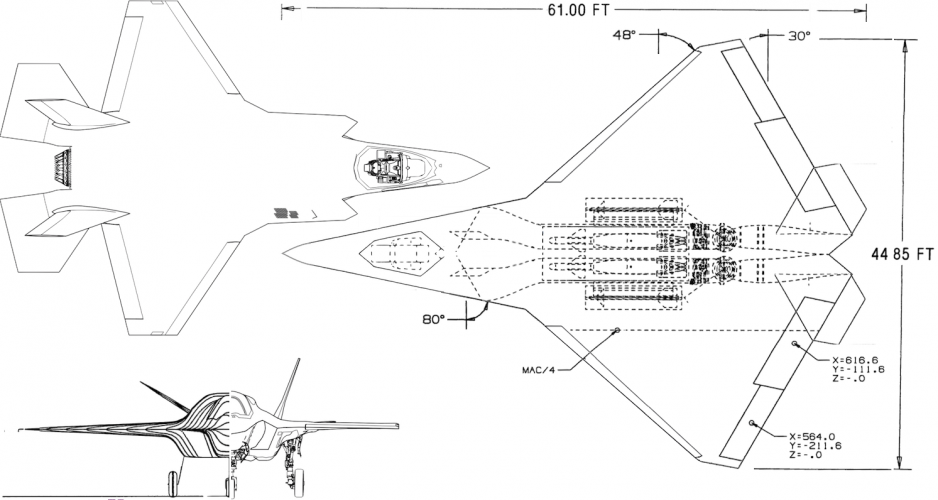
To illustrate rough relative size of such a 15t class fighter vs. an F-35, here's McDD design 2408 (which I modded slightly with side intakes instead of the original chin intake, added vertical stabilizers, decreased wing sweep from 50 to 48deg, clipped wingtips, longer nose).

MCDD 2408 mod 50px=1m vs F-35 v6.png
 
Last edited:
"Power" for launch from a carrier is provided by the ship itself (over the deck wind and catapult) as used by French doctrine. The airframe contributing essentially with... Lift.

Rafale-M takes off in full afterburner, 15 tons of thrust from the aircraft for 2-4 seconds depending on combat load plus an instantaneous 90 tons being released from the built up steam in the piston of the catapult.
Over a four second take-off 66% of the energy will be coming from the aircraft rather than the catapult, even on a 2 second takeoff 33% of the energy will be coming from the aircraft itself.
 
Last edited:
Pardon me, seems I got very behind in this thread.

The Saudis want to build a defense industry, have the money, but I assume they dont have the breadth in skilled labour to do so.
Combined response:
Agreed. I'm not trying to be political or controversial by any means, but isn't most of the skilled labor/ blue collar work taken up by foreign nationals from countries that aren't known for their high tech manufacturing?
Yes. Basically all the support work is done by foreign nationals in Saudi.


India on the other hand at least has a greater breadth of worker skill to choose from not to mention an existing thirst for greater expertise.
I'm not sure they'd be willing to admit it and join SCAF.


Well, there we go then. 15-16 tons empty suggests a 30-32 ton MTOW.


To echo @Hood 's point, then it's very unclear what either project is actually "demonstrating" Vs being very expensive re-learning exercises for new personnel who haven't designed an aircraft before. Still - it'd cost more if silly mistakes got made on the real projects.
Demonstrating that the noobs can successfully design an aircraft is still demonstrating something of value.


~15% heavier and more thrust than an F-35A, and without the STOVL design penalties, so probably more accurate to think of FCAS/NGF as being in the weight class just above F-35.
~15% heavier than an F-35A is getting into F-14 weight class.
 
Can you believe it, FCAS and MGCS have been annouced over 7 years ago already for absolutely zero tangible results
Not really. The Phase 1 is nearly over, with 2 to 3 configs proposed to the 3 chief of staff.
One one choosen, the prototyp phase can begin. Probably a 80% scale prototyp, so as to use 9tons M88 direct derivativ engines (not possible to use EJ200 engine because of intelectual property issues).
 
Why does France always withdraw to go it alone whenever Europe jointly develops a combat timer? Could the M-88 engine be used in sixth-generation fighter jets?
only one first try : Rafale / Eurofighter.
Rafale is better fitted to french needs and more affordable than EF. Export result is the proof we made the right choice.
The germans, english, italian, spanish have not studied and produce alone a sole top class fighter for decades. ths SAAB case is intersting : US engine and FBW...

M88 : no. A new one is key.
 
Lmao what? He knows damn well that Airbus cannot do this without Dassault. And if Dassault leaves, they won't be leaving alone.
The best solution is for 2 independent aircraft while keeping the other pillars as a collaboration. If they keep trying to make NGF together, phase 2 won't start until 2035. Someone needs to take that damn decision already and then once this is over, we need an official treaty forbiding Germany and France from ever partnering again on military equipment programs.
Exactly.
Let Dassault and Airbus build their own prototyp, because the battle is only about the frame of the jet, not all the rest (at least at this time), test the 2 and choose the best (YF22 and YF23 way, with same engines).
 
Isn't Macron the sole decidor for these military matters? Of course the parliament can refuse to vote his budget proposals to put pressure on him though.
 
Isn't Macron the sole decidor for these military matters? Of course the parliament can refuse to vote his budget proposals to put pressure on him though.
Nope , and Macron with only 11% of the population support is unable to push this program by his own , like I said the French part of the FCAS fighter is dead and it is realy sad for the French Air Force, because France alone is unable to pay for a 6th gen fighter program.
 
Exactly.
Let Dassault and Airbus build their own prototyp, because the battle is only about the frame of the jet, not all the rest (at least at this time), test the 2 and choose the best (YF22 and YF23 way, with same engines).
The biggest problem now is the money for a program like that.
 
Exactly.
Let Dassault and Airbus build their own prototyp, because the battle is only about the frame of the jet, not all the rest (at least at this time), test the 2 and choose the best (YF22 and YF23 way, with same engines).
Why should that happen and what problem would that solve? The problem is between industrialist and not politicians, Paris could just tell Dassault to shut up or they are out and they would shut up. The problem is that Macron is to weak for that and the rest of Paris supports DA without question.
 
Why should that happen and what problem would that solve? The problem is between industrialist and not politicians, Paris could just tell Dassault to shut up or they are out and they would shut up. The problem is that Macron is to weak for that and the rest of Paris supports DA without question.
"Paris" or Macron has no authority on Dassault, it's a private company, and if they want to voice their opinions on how the program goes, they are entirely free to do so, fortunately.
As for everyone in the French political landscape supporting Dassault (even LFI or the commies would, they are defending a sovereign defence industry even more than Macron, as a post above shows), that's how/why France have domestic made jet fighters in the first place. Not gonna change any time soon. The question is more about how to build that next fighter with the Germans and Spanish, the Dassault way, or what the Germans want which is more the Eurofighter way.
 
Why should that happen and what problem would that solve? The problem is between industrialist and not politicians, Paris could just tell Dassault to shut up or they are out and they would shut up. The problem is that Macron is to weak for that and the rest of Paris supports DA without question.
Why would Macron tell Dassault to shut up when honestly, Dassault is telling the truth and Macron probably agrees about that too?
The problem is solely politician as it is politicians that initially forced 2 competitors to work together without proper preparation (a problem GCAP doesn't have) for the sake of showing some European unity after Brexit.
 
it is realy sad for the French Air Force, because France alone is unable to pay for a 6th gen fighter program.
France can easily afford a 5th gen fighter program.

The technologies for a 5th gen fighter are mature. The Rafale systems and T-REX engines are definitely 5th generational and these are by far the largest development cost of a fighter. All that is needed is a stealthy frame with internal weapons bay. Dassault could do this easily and have something on par with the F-35. It could be in service in 10 years time and be within the French budget.

The export potential for a French only fighter will be greater as no one can block the sales. All the profits goes to France. Dassault is ramping Rafale production and it will sell for another decade. I could see a French 5th gen sell well up to 2050. France doesn't necessarily need to skip straight to 6th gen to get export sales. Historically the French Mirage and Rafale customers typically don't want state of the art technology.

Some of the key technologies that distinguish a 6th gen fighter will require tens of billions and a decade of research and development. You are correct that France alone is unable to afford this.

The Super Hornet was meant to be a temporary bridging aircraft. It took all the existing classic Hornet systems and placed them into an airframe with a radar cross section about 10% of the classic Hornet. The Super Hornet then stayed in production much longer than expected. France could do the same process with the Rafale but target a much lower radar cross section with the newer airframe.
 
France can easily afford a 5th gen fighter program.

The technologies for a 5th gen fighter are mature. The Rafale systems and T-REX engines are definitely 5th generational and these are by far the largest development cost of a fighter. All that is needed is a stealthy frame with internal weapons bay. Dassault could do this easily and have something on par with the F-35. It could be in service in 10 years time and be within the French budget.

The export potential for a French only fighter will be greater as no one can block the sales. All the profits goes to France. Dassault is ramping Rafale production and it will sell for another decade. I could see a French 5th gen sell well up to 2050. France doesn't necessarily need to skip straight to 6th gen to get export sales. Historically the French Mirage and Rafale customers typically don't want state of the art technology.

Some of the key technologies that distinguish a 6th gen fighter will require tens of billions and a decade of research and development. You are correct that France alone is unable to afford this.

The Super Hornet was meant to be a temporary bridging aircraft. It took all the existing classic Hornet systems and placed them into an airframe with a radar cross section about 10% of the classic Hornet. The Super Hornet then stayed in production much longer than expected. France could do the same process with the Rafale but target a much lower radar cross section with the newer airframe.
So just like Sweden then. It could work for France. But will the french collective ego accept the idea that they're not flying 6th gen fighters in 2040 like the UK and Italy? But I think an 5.5 gen fighter may have more export success than something as big as GCAP, not initially (it will cost more) but in the long run it could pay off just like with the Rafale.
 
The Super Hornet was meant to be a temporary bridging aircraft. It took all the existing classic Hornet systems and placed them into an airframe with a radar cross section about 10% of the classic Hornet. The Super Hornet then stayed in production much longer than expected. France could do the same process with the Rafale but target a much lower radar cross section with the newer airframe.
I'm pretty sure Dassault is keeping that in their back pocket, but they don't want to do that. Assuming that you can build an airframe that still looks like Rafale but is an order of magnitude smaller RCS.


...and it's quite possible that this is how this painful story will end.
Hopefully not, no.

That would mean there's a 4.75 or a 5gen-minus flying for France when everyone else is flying true 6th generation aircraft.
 
But will the french collective ego accept the idea that they're not flying 6th gen fighters in 2040 like the UK and Italy? But I think an 5.5 gen fighter may have more export success than something as big as GCAP, not initially (it will cost more) but in the long run it could pay off just like with the Rafale.
Europe accepted developing 4th gen fighters despite the 5th gen F-22 entering service a couple years later.

A stealthy 5th gen fighter design can add 6th gen technologies at a later date. The main feature of 5th gen was stealth and this could not be added to a 4th gen design. I think a 5th gen fighter developed today would be more future proof than a 4th gen fighter developed 20 years ago.
 
Europe accepted developing 4th gen fighters despite the 5th gen F-22 entering service a couple years later.
That was only because Europe thought that the 5th generation of fighters was going for more maneuverability when they started development.


A stealthy 5th gen fighter design can add 6th gen technologies at a later date. The main feature of 5th gen was stealth and this could not be added to a 4th gen design.
But can you add 360 broadband stealth to a 5th gen design?


I think a 5th gen fighter developed today would be more future proof than a 4th gen fighter developed 20 years ago.
Yes, a 5th gen fighter (F-35 to F-22 equivalent stealth) fitted with 6th gen sensors/sensor fusion would be more future proof than an Eagle or Super Bug.
 
And here we go again: the awkward, tiring obsession with “generations.” 4.83G, 5.1G… OMG.

When one of these so-called “European” projects finally produces a fighter with VCEs and a fully tailless design, I’ll eat my hat.

France and the UK are where they are because that’s simply how their evolution went. SCAF grows out of Rafale, GCAP out of Typhoon, NGAD out of the F-35 and F-22, and so on.

The US and China embraced the new paradigm looong time ago, and with massive government funding they spent 20 years researching new technologies and design approaches building on existing stealth tech — while “Europe” was asleep.

That’s why GCAP ends up looking more like a J-20 without canards than an F-47.

If you want to call it “6G,” go ahead, but in the next decade only the Americans and the Chinese will actually have it.

Everyone else will have to accept Taiclet’s “bridging fighter”: “We can deliver 80% of 6th-gen capability at 50% of the cost.” (Except for the fifty percent...)
 
I agree but have to add, that only the US, China and Russia will need full 6th Gen capabilities (all-aspect VLO). Hard power projection comes not for cheap.
I think the Russians will be happy to field whatever fits their specific doctrine and needs, rather than trying to follow the Chinese and American approaches step by step.

And this is also true for FCAS and GCAP, an aircraft is not meant to win rankings or top trumps games, instead aircraft are meant to fill a role and deliver a previously specified capability. Everything else is purely secondary. Furthermore, the airframe itself is arguably one of the less important factors of the next flock of fighters, as in how the aircraft looks, flight performance etc. What's important is the avionics, the sensors, the power generation, the engines, the battlespace management and so on. The airframe is simple wrapped around this in a manner that aims to reduce it's radar and IR signature, while ideally not compromising too heavily on flight performance compared to existing designs.

This ultimately makes it harder for previous designs to adapt such technology, because 5th generation fighters simply won't have the necessary hardware and/or space to incorporate the highly capable subsystems and especially cooling becomes a bottleneck that's difficult to overcome.

Meaning, if you are designing a clean sheet design with next generation systems in mind, you might as well develop a proper next generation aircraft, because otherwise you won't be able to utilize the most advantageous aspects of next generation designs. It would be limiting yourself from the start for nothing else but cost saving.
 
Europe accepted developing 4th gen fighters despite the 5th gen F-22 entering service a couple years later.

A stealthy 5th gen fighter design can add 6th gen technologies at a later date. The main feature of 5th gen was stealth and this could not be added to a 4th gen design. I think a 5th gen fighter developed today would be more future proof than a 4th gen fighter developed 20 years ago.
But all of Europe was developing 4th gen fighter despite F-22. But this time France would be the only one "behind" with Sweden.
 
But all of Europe was developing 4th gen fighter despite F-22. But this time France would be the only one "behind" with Sweden.
You are 100% wrong.

Turkey KAAN
Korea KF-21
India AMCA
Sweden Flygsystem 2020
Russia Su-57
Russia Su-75

These are all 5th gen fighters under development. France would not be the "behind'. France could actually be the first country to make an aircraft that beats the F-35 in all areas. France already has excellent avionics and engine technology in the Rafale. All of the other countries on the above list either lack indigenous engines, avionics or both.

I would also avoid using the 5th gen and 6th gen labels. The main key difference between 4th and 5th gen was stealth. Some 4.5 gens had supercruise and sensor fusion so these are not 5th gen exclusive.

What is 6th gen?
A bit more speed
A bit more range
A bit more stealth
A bit more electrical generation
A bit more powerful radar
A bit more sensor fusion
Maybe lasers.

A 5th gen fighter design can get a mid life refresh with a more advanced adaptive engine, radar and stealth coating. Then technically it gains everything on this list. It becomes 6th gen.

It seems people want to define 6th gen as having Mach 2 supercruise and 1,000nm combat radius. This can only be achieved by 100,000+lb MTOW fighters.The F-22, Su-57 and J-20 are heavy class. So it makes sense to call the 6th gen designs super heavy.

I doubt a true 6th gen fighter design can fit on a French carrier. I can see it getting the 5.5 gen label as the size will limit how far it can exceed the F-35 benchmark. The smaller Gripen for example was always behind the Rafale and Eurofighter due to the lower range and smaller radar. It was hard to call the original Gripen a 4.5th gen fighter.

The public will not know if a design has 5th or 6th gen levels of stealth which makes this even harder.

I could see a super heavy weight 5th gen fighter getting incorrectly called 6th gen because the large size is associated with being 6th gen. The UK Tempest fighter could easily fall into this category depending on how high they set the performance targets. The Chinese 3 engine fighter might be a perfect example of this. It could be another foxbat moment.

We will eventually have people saying 5.25 gen and 5.75 gen depending how many of the 6th gen requirements are achieved. This will be incredibly annoying for some people as it is entirely open to interpretation.

 
Last edited:
I doubt a true 6th gen fighter design can fit on a French carrier. I can see it getting the 5.5 gen label as the size will limit how far it can exceed the F-35 benchmark.
The French carrier is getting EMALs, it will be able to throw a 100,000lb aircraft.

But I think we're looking at the French requirements giving us a Tomcat sized airframe. ~74klbs without external weapons.


I could see a super heavy weight 5th gen fighter getting incorrectly called 6th gen because the large size is associated with being 6th gen. The UK Tempest fighter could easily fall into this category depending on how high they set the performance targets. The Chinese 3 engine fighter might be a perfect example of this. It could be another foxbat moment.
Possible, but we know the Chinese have 35klb engines. That's what we're all assuming it has for power. That means a 105klb MTOW airframe would have a TWR of about 1.27:1 at 50% fuel and 5000lbs weapons.
 
You are 100% wrong.

Turkey KAAN
Korea KF-21
India AMCA
Sweden Flygsystem 2020
Russia Su-57
Russia Su-75

These are all 5th gen fighters under development. France would not be the "behind'. France could actually be the first country to make an aircraft that beats the F-35 in all areas. France already has excellent avionics and engine technology in the Rafale. All of the other countries on the above list either lack indigenous engines, avionics or both.

I would also avoid using the 5th gen and 6th gen labels. The main key difference between 4th and 5th gen was stealth. Some 4.5 gens had supercruise and sensor fusion so these are not 5th gen exclusive.

What is 6th gen?
A bit more speed
A bit more range
A bit more stealth
A bit more electrical generation
A bit more powerful radar
A bit more sensor fusion
Maybe lasers.

A 5th gen fighter design can get a mid life refresh with a more advanced adaptive engine, radar and stealth coating. Then technically it gains everything on this list. It becomes 6th gen.

It seems people want to define 6th gen as having Mach 2 supercruise and 1,000nm combat radius. This can only be achieved by 100,000+lb MTOW fighters.The F-22, Su-57 and J-20 are heavy class. So it makes sense to call the 6th gen designs super heavy.

I doubt a true 6th gen fighter design can fit on a French carrier. I can see it getting the 5.5 gen label as the size will limit how far it can exceed the F-35 benchmark. The smaller Gripen for example was always behind the Rafale and Eurofighter due to the lower range and smaller radar. It was hard to call the original Gripen a 4.5th gen fighter.

The public will not know if a design has 5th or 6th gen levels of stealth which makes this even harder.

I could see a super heavy weight 5th gen fighter getting incorrectly called 6th gen because the large size is associated with being 6th gen. The UK Tempest fighter could easily fall into this category depending on how high they set the performance targets. The Chinese 3 engine fighter might be a perfect example of this. It could be another foxbat moment.

We will eventually have people saying 5.25 gen and 5.75 gen depending how many of the 6th gen requirements are achieved. This will be incredibly annoying for some people as it is entirely open to interpretation.
I can’t really agree with your claim that sixth-generation fighters are just an extension of fifth-gen designs.
Fifth-gen jets are all about individual platform capability, but sixth-gen is a completely different game — it’s about networked warfare and system integration.

A true sixth-gen fighter isn’t meant to fight alone; it’s designed to lead a whole team — drones, ground systems, maybe even naval assets — all linked together as one coordinated “combat group.”

So just saying “6th gen is only slightly better than 5th gen” totally misses the point. You’re evaluating it as a single aircraft, when in reality it’s the core of a whole combat ecosystem.

And even if you upgrade existing fifth-gen jets, they simply won’t reach that level of integration.
To act as the central command node, you’d need megawatt-class power generation, advanced thermal management, and next-level electronic warfare systems.
A “bit more power” or a “slightly better radar” just isn’t going to cut it.

Also, judging what counts as a sixth-gen fighter purely by whether it has a variable-cycle engine or a tailless airframe feels like an outdated way of thinking.
The real difference isn’t in the shape or the engine ......

Sorry — saying “megawatt-class power generation” was a bit of an overstatement.
 
Last edited:
The French carrier is getting EMALs, it will be able to throw a 100,000lb aircraft.
Given Trump EO - is it still?
US EMALs aren't properly figured out yet, and now there's solid chance the existing system won't be.
Possible, but we know the Chinese have 35klb engines. That's what we're all assuming it has for power. That means a 105klb MTOW airframe would have a TWR of about 1.27:1 at 50% fuel and 5000lbs weapons.
IMHO, the highest likelihood of "foxbat moment" isn't TWR, it's that entire heavy branch of "zerstorers" is only part of the answer. It's quite difficult imagine J-36 being effective against jet shahed swarms.
Fifth-gen jets are all about individual platform capability, but sixth-gen is a completely different game — it’s about networked warfare and system integration.
It's mostly software. Software isn't hard bound to airframe standard. There are borders which fundamentally separate oldest(F-22), older(F-35, J-20, Uu-57) and maybe newer lo aircraft in their software architecture. But this isn't a national border, it's timeframe one.

Software didn't turn out to be some great power skill - after decade of stories how incomprehensible f-35 sensor fusion software is (not as much as a good competition commercial app, and 5 million lines of code isn't that much of a flex unless for grannies), turned out either LM as organization or F-35 office in particular just isn't good at Software development.
 
Fifth-gen jets are all about individual platform capability, but sixth-gen is a completely different game — it’s about networked warfare and system integration.

A true sixth-gen fighter isn’t meant to fight alone; it’s designed to lead a whole team — drones, ground systems, maybe even naval assets — all linked together as one coordinated “combat group.”
That sounds like software and datalinks. This can all be added to a 5th gen platform.

And even if you upgrade existing fifth-gen jets, they simply won’t reach that level of integration.
To act as the central command node, you’d need megawatt-class power generation, advanced thermal management, and next-level electronic warfare systems.
A “bit more power” or a “slightly better radar” just isn’t going to cut it.
The software and datalinks such as MADL will be fairly low power. No extreme levels of power generation is required. Self defense energy weapons is probably the only things that require power generation beyond what the current 5th gen aircraft can provide.

I doubt energy weapons will be common. It makes more sense to have a kinetic kill. If you look at how seeker heads are getting smaller then small guided powered or unpowered hit-to-kill self defense weapons can be used. Similar to the evolution of chafe/flare dispenser and towed decoy. The unpowered ones drop from the rear and cover any incoming missiles from behind and below. More expensive powered mini-missiles like the mdsm missile then take out the large missiles coming from the front.

This is why France building a solid 5th gen design will allow for future technology to be added. France will not be doomed or be behind if they decide to build a 5th gen aircraft by itself.

Possible, but we know the Chinese have 35klb engines. That's what we're all assuming it has for power. That means a 105klb MTOW airframe would have a TWR of about 1.27:1 at 50% fuel and 5000lbs weapons.

The J-36 is massive. Minimum of 150,000lb MTOW in my opinion. Weight scales to the cube. 20% of extra length, width and height is actually 73% more volume. The wingspan is reported to be over 20 metres and simple math points to a wing area more than double of the F-22 and J-20.

This is why I call it another Foxbat moment. The west thought the Foxbat was a 50,000lb class fighter and based on the engines and wingspan it would have had F-15 like agility. But the Foxbat was a 80,000lb class fighter that it performed like an F-4 Phantom.

It would not surprise me if the J-36 had lower agility than an F-111. Not a 6th gen air dominance fighter at all. A supersonic light bomber that has self defense capability. 50,000+lb of internal fuel designed to attack Guam.
 
That sounds like software and datalinks. This can all be added to a 5th gen platform.


The software and datalinks such as MADL will be fairly low power. No extreme levels of power generation is required. Self defense energy weapons is probably the only things that require power generation beyond what the current 5th gen aircraft can provide.

I doubt energy weapons will be common. It makes more sense to have a kinetic kill. If you look at how seeker heads are getting smaller then small guided powered or unpowered hit-to-kill self defense weapons can be used. Similar to the evolution of chafe/flare dispenser and towed decoy. The unpowered ones drop from the rear and cover any incoming missiles from behind and below. More expensive powered mini-missiles like the mdsm missile then take out the large missiles coming from the front.

This is why France building a solid 5th gen design will allow for future technology to be added. France will not be doomed or be behind if they decide to build a 5th gen aircraft by itself.


The J-36 is massive. Minimum of 150,000lb MTOW in my opinion. Weight scales to the cube. 20% of extra length, width and height is actually 73% more volume. The wingspan is reported to be over 20 metres and simple math points to a wing area more than double of the F-22 and J-20.

This is why I call it another Foxbat moment. The west thought the Foxbat was a 50,000lb class fighter and based on the engines and wingspan it would have had F-15 like agility. But the Foxbat was a 80,000lb class fighter that it performed like an F-4 Phantom.

It would not surprise me if the J-36 had lower agility than an F-111. Not a 6th gen air dominance fighter at all. A supersonic light bomber that has self defense capability. 50,000+lb of internal fuel designed to attack Guam.
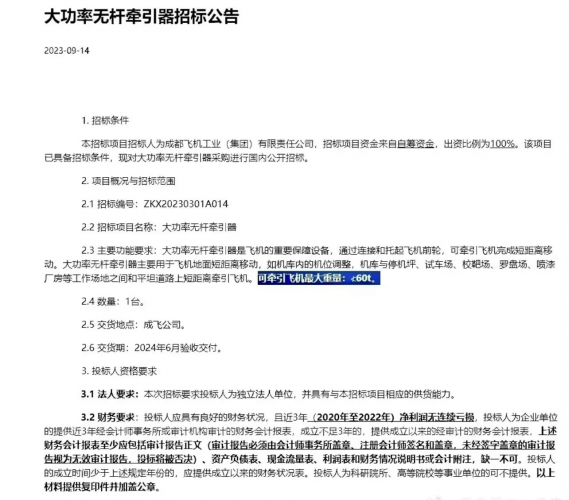
Why are you just making numbers up for 150,000lbs? There are many reasons why most peoples estimates are 55-60T MTOW. First of all recent satellite imagery puts the J-36 to around 20m long and 20m wingspan. Not exactly 20% longer than the J-20. Similarly, the FB-22 was around this size and was a similar configuration and had a estimated MTOW of 54,400 kg. Lastly there was a tender for Chengdu in 2023 that asked for a airplane tug capable of moving 60T. Why is it every time you open up your mouth about Chinese related subject you don't do any actual research?
1762753484754.png
 
Software didn't turn out to be some great power skill - after decade of stories how incomprehensible f-35 sensor fusion software is (not as much as a good competition commercial app, and 5 million lines of code isn't that much of a flex unless for grannies), turned out either LM as organization or F-35 office in particular just isn't good at Software development.
This may be true, but its also far from clear if any other combat air programme is doing a better, or comparable job. From a public perspective, then its getting much harder to compare the true capability of different aircraft with each other when its more dependent on software where the functionality and performance is hidden. Or wider measures like refresh rate.
 
Why are you just making numbers up for 150,000lbs? There are many reasons why most peoples estimates are 55-60T MTOW. First of all recent satellite imagery puts the J-36 to around 20m long and 20m wingspan. Not exactly 20% longer than the J-20.
Most people don't know how to estimate. The online estimates will get revised upwards when more experienced people provide their estimate.

60T is already at 132,000lb. Most people always underestimate the internal fuel capacity required to get long range. My empty weight estimate is most likely similar to many online observers. I would estimate a much higher internal fuel capacity. A big blended delta wing would have a huge internal fuel capacity.

Look at the SR-71 for example. It has a 172,000 lb MTOW and more than half of that is internal fuel. The J-36 has a bigger wing than the SR-71.

All of the satellite images show the J-50 with a ground footprint around twice the size of the J-20.

This is also why we see the 6th gen designs with big blended big delta wings. Fuel capacity not online means range it provides the ability to go fast.
 

Similar threads

Back
Top Bottom