But how often do you really need that?
If you ask for a regional bomber, you're going to get one.
With corresponding sortie rate and price. Which are decisive metrics for war aircraft.
Yes, 4x-6x 2000lb JDAM-ER is pretty unlikely for a weapons load, though a bay long enough to take a 15.5ft weapon would give you some options for a better bunker-buster. Like a BLU109 with a 2ft long rocket bolted to the tail.

4x AGM-158s internally is a little unusual unless you were doing some weird time-on-target thing where they only had about 500km of range from target.

ASALM/HALO would be about the same size and weight as AGM-158C, ~2800lbs per weapon. And I can see a lot of missions calling for 4x 500km M4.5 missiles, that still need to be carried into someone's A2AD bubble prior to launch.

2x AARGM-ER, 2x-3x 2000lb JDAM-ERs and a pair of AAMs would be 7000-9000lbs.

2x AARGM-ER (~1000lbs), 2x AGM-154 (~1100lbs) or JSMs (~900lbs) and a pair of AAMs would be my suggested "standard strike mission load". Yes, that is only ~5000lbs internal.

Thing is, AARGM-ERs and JSMs are about the same width as AGM-158s. So if an AARGM-ER can fit in the bay, so can a JASSM.


PA-NG, the new French Carrier design, has the same EMALs and AAG as a Ford-class. So it has the same upper limits for the airframe size. And this 80,000lb MTOW 12,000lb internal payload plane is that maximum.
 
That adapting these B-61 on new Typhoons would have send a strong signal to their EUROPEAN partners (you know, that famous European Union and stuff...that we Europeans are part of) that they are committed to the independent EUROPEAN defense policy that is most needed, while keeps their engagement to NATO for the time being. Sure their would not have had the F-35 wonder fighter to carry these B-61, but the necessity of building a common European defense policy/structure/industry not tied to a US ally that is getting more and more difficult to work with is more important on the long term than again paying billions to LM, in the hope that the current US admin keeps his commitment itself to NATO.

B-61 integration was long ago rejected by both sides as US access to Typhoon's software was necessary for integration...

Germany had a choice....if they wanted to maintain the B-61 capability.

Buy F-35
Buy F-15EX (but have to pay for nuclear certification)
Buy F-16

Clearly purchasing F-35 was the only sensible option....but it also comes with other benefits....Germany, uniquely amongst the SCAF partners, will actually have experience over a decade prior to SCAF service entry of operating an LO combat aircraft. That experience could prove to be very important...by the time SCAF arrives the USAF, for example, will have been operating LO aircraft for 60 years....
GCAP will be too large and specialized for the Japanese and British pacific ideas.

We've been over this so many times now....

Please look at a globe....the 'Pacific' does not have different range requirements than Europe does....and that is as true for SCAF as it is for GCAP...

Look at where British, Japanese, Italian GCAP.....or French and German SCAF will have to reach to do the jobs they need to do....there is little difference in practice...
 
Looking at the 80% French work share demand, I really do wonder if part of the arithmetic is to make up for the near total ban on export sales that any German work share will entail. However, is any combat aircraft in this size and weight category
exportable, aside from legacy Sukhois and F-15s?

A bigger problem going forward is the engine development program. Just how much can the Spanish and German partners contribute to Safran? At this very moment, only the Japanese have a full scale demonstrator for a next gen turbofan, and their partnership is the only thing making GCAP somewhat credible. And only Turkey has an actual flying demonstrator. My gut tells me that there are just too many competing European combat aircraft and engine programs and only the French have a truly proven track records for a fully indigenous solution. The only other entirely credible non-ITAR alternative is buying into the Turkish Kaan program and getting into an engine joint venture. At least the Kaan flies and is scaled around a suitably sized interim turbofan, unlike Britain’s upcoming (sub scale or merely underpowered?) EJ200 based demonstrator. And the overall Turkish program seems credible, especially if there was a partner to assist with production techniques for the Turkish indigenous turbofan. I have to admit that the Turks have a very plausible military airframe manufacturing capability, only just behind Dassault but ahead of the rest of Europe.

You believe that the TAI Kaan is ... "credible"... credible?! But someway, somehow... GCAP wich happens to be built by a consortium that among others, comprises BAE, RRoyce and Leonardo is only "somewhat credible" because the Japanese are in it and they have demonstrator of a "next gen turbofan"?!

And TAI have a plausible manufacturing capability "ahead of the rest of Europe"?!


Oh dear...
 
Last edited:
We've been over this so many times now....

Please look at a globe....the 'Pacific' does not have different range requirements than Europe does....and that is as true for SCAF as it is for GCAP...

Look at where British, Japanese, Italian GCAP.....or French and German SCAF will have to reach to do the jobs they need to do....there is little difference in practice...

Engaging the PLAN(AF) and PLAAF over the Pacific Ocean and South East Asia imposes vastly different requirements than *checks notes* launching from an aircraft carrier to strike *checks notes* Africa from the Mediterranean Sea? Germany essentially only needs an aircraft with little range. The purpose of the German military is Landesverteidigung, that means national defence. In short, it requires what is more or less an interceptor to intercept inbound threats at or slightly beyond the German border. Everything else is simply unnecessary spending, political posturing and borderline unconstitutional (Bündnisverteidigung - Alliance defence, is the only exception to that, but a secondary or even tertiary function at best). So an aircraft with the necessary performance and readiness to function as an effective interceptor is what the Luftwaffe would actually need. The Eurofighter is a relatively good example of that. FCAS as the Franzmänner imagine it definitely isn't.
 
Look at where British, Japanese, Italian GCAP.....or French and German SCAF will have to reach to do the jobs they need to do....there is little difference in practice...
Where? Pacific strike aircraft need to reach there because it's where majority of targets are. Short range aircraft is just secondary.

Eu strike aircraft need to reach that far, at most, because that's where the furthest imaginable targets are (and there are further ones anyway). At the expense of those that actually matter. Precisely at a moment when Russia comes to realize what lacking ambition in aerial campaign (and settling for few long range aircraft, that can't be risked to pen anyway) is a sin.

France and UK being stuck in Douhet is totally ok, but Germany being in that gang will be quite ironic.
 
It's too early to tell, but the last time the US and Europe produced aircraft of comparable roles and era, the Eurofighter, Rafale and Gripen blew the F-15, F/A-18 and F-16 out of the water, precisely because they arrived later but were ultimately more sophisticated machines compared to their US counterparts.
That's a very dishonest argument, really. ATF and ECF(later ECA and ACA) started around the same time period, only a few years apart, whereas F-X and LWF were both the products of the 60s, shaped by the lessons learnt from the ongoing Vietnam War.

If anything, the US absolutely blew its European counterparts out of the water when it comes to the next generation fighter development that was introduced around the turn of the century. There was absolutely no competition when it comes to how much more advanced and forward looking the US concept and implementation of combat air was. This has always been the case since the F4H.

We'll see if this holds true with the contemporary next-gen, but I would be surprised if it isn't. Only country with comparable financial and human resource to them when it comes to combat air system development is China and we all know this.

Everything else is simply unnecessary spending, political posturing and borderline unconstitutional (Bündnisverteidigung - Alliance defence, is the only exception to that, but a secondary or even tertiary function at best).
That is again a very different painting of what is actually going on in the real world, if we consider German posturing in the Baltics.

Current NATO/European defence posture centres around the Baltic theatre since that is where Russia has the biggest incentive to engage in hybrid, grey area warfare, and if needed, pursue fait accompli scenarios in the region. If anything, thry have already sort of demonstrated this in Ukraine.

I've said this before in the GCAP thread and will say it again; since the end of Cold War, western European nations never needed a point defence fighter that is only capable of defending its home soil. Threat is not at their bay. You don't have Warsaw Pact forces waiting to jump on you just across the West-East border between BDR and DDR. What they need is force projection aircraft. You don't even need Pacific in the equation to say this. The obligation, the point of interest of Western Europe for the defence of common European community lies to the east and to the north east, far from their borders. There's a reason Britain has been giving so much effort building credible defence policy in assissting Eastern European nations and their security.

There are just way more reason for NGF and GCAP to be much bigger fighters than Eurofighter and Rafale, products of the 80s Cold War environment, than there isn't. Eurofighter and Rafale first flew 10 years (or more) before the inclusion of Baltic states into NATO. 20 years before Euromaidan and Crimea. GCAP and NGF partners will be building fighter aircraft reflecting defence needs of the near future, into the 2030s, not 40 years past.
 
Last edited:
Which means they're in the market for FAXX instead. Or they build it themselves.

But I'm not going to discount SCAF from at least making the sales pitch.
NGAD.
I don't see Israel or many other potential customers of an American 6th gen picking a navalized variant. These are usually expensive mods that are overall detrimental to performance.
 
NGAD.
I don't see Israel or many other potential customers of an American 6th gen picking a navalized variant. These are usually expensive mods that are overall detrimental to performance.
NGAD is not strike optimized, and what Israel needs is long range strike more than they need air dominance.

Now, it is possible that the F-47 is doing the F-35 thing where the F-47A is USAF and F-47B is USN, but that's about the only scenario in which the NGAD would be Israel's choice in the matter.
 
NGAD is not strike optimized, and what Israel needs is long range strike more than they need air dominance.

Now, it is possible that the F-47 is doing the F-35 thing where the F-47A is USAF and F-47B is USN, but that's about the only scenario in which the NGAD would be Israel's choice in the matter.
Israel has no preference for strike or air dominance. For decades it opted for multirole. It needs both roles equally.
I see no reason to believe F-47 will be air dominance optimized. We heard the same stories about the F-16 and F-15 yet here we are.

If for any reason the F-47 isn't introduced early as multirole, Israel has other options like using the F-15IA and F-35 as strike, or consider requesting a B-21 purchase.
 
I've said this before in the GCAP thread and will say it again; since the end of Cold War, western European nations never needed a point defence fighter that is only capable of defending its home soil. Threat is not at their bay. You don't have Warsaw Pact forces waiting to jump on you just across the West-East border between BDR and DDR.
To be fair, won't be their first time to come to Sedan fight with a deterrence knife.
NGAD is not strike optimized, and what Israel needs is long range strike more than they need air dominance.
Israel is unique in that it builds a clear war fighting force. Not scared guy's deterrence/def-ca.
They need all of them, as many as possible, and use them as intensively as possible - strategic effects, not strategic aircraft. And in this analogy above this is a clear Luftwaffe posture; there's no special division between air dominance and long range strike.
They need both, in one aircraft, which will claim air superiority - in air or against ground.
And it'll work, because their opponents can't comprehend neither numbers nor intensity.
 
Last edited:
I see no reason to believe F-47 will be air dominance optimized. We heard the same stories about the F-16 and F-15 yet here we are.
Now, I know that they aren't perfectly representative, but none of the very well made models of F47 on this forum, and nothing I have read about the project itself, have indicated a desire to hold anything larger than a 2000lb JDAM or SiAW internally, ie F35A stuff. Most of the payloads and missions will be A2A only using JATMs.
France are driven by their need to preserve the strategic deterrence, so SCAF will definitely be able to carry ASN4G somewhere (maybe externally) along with FC/ASW.
 
Now, I know that they aren't perfectly representative, but none of the very well made models of F47 on this forum, and nothing I have read about the project itself, have indicated a desire to hold anything larger than a 2000lb JDAM or SiAW internally, ie F35A stuff. Most of the payloads and missions will be A2A only using JATMs.
France are driven by their need to preserve the strategic deterrence, so SCAF will definitely be able to carry ASN4G somewhere (maybe externally) along with FC/ASW.
If the USAF mission set does not include strike, why do F-35A and F-15EX exist?
 
Germany essentially only needs an aircraft with little range. The purpose of the German military is Landesverteidigung, that means national defence. In short, it requires what is more or less an interceptor to intercept inbound threats at or slightly beyond the German border. Everything else is simply unnecessary spending, political posturing and borderline unconstitutional

So that's why they bought the Tornado with the combat radius to get from Jagel to Leningrad? (As it was, that was somewhat less than the RAF really wanted).

The idea that Germany only needs aircraft able to reach slightly beyond its borders will come as a surprise to the Cold War planners who presumed they would be interdicting supply lines in Poland and Belorussia to prevent the Warsaw Pact follow-on echelons from reaching the IGB.

Moving to the current situation, you're still going to need to get from Jagel to St Petersburg, and with even more fuel in reserve, if you're operating a CAP over Tallinn and the airfields in the Baltics are all under Russian artillery fire.
 
We're saying that the mission set of the F-15, F-22, and F-47 does not include heavy strike.
F-22 program was cut short without a chance to evolve.
The F-15 is currently the premier western strike aircraft in terms of payload.
And this doesn't answer my question.
Is there anything tangible suggesting that the F-47 will not have strike capability?
 
F-22 program was cut short without a chance to evolve.
The F-15 is currently the premier western strike aircraft in terms of payload.
Worth pointing out it's through lack of competition.

Both F-15E and Su-34 are compromises even when compared to previous gen strike designs(f-111, su-24), much less what was possible with purpose design of same tech level.

They're, however, good enough.
 
If the USAF mission set does not include strike, why do F-35A and F-15EX exist?
F35A isn't a deep strike aircraft, not properly. Only F15EX (maybe, though the US hasn't used it as such very often) and the large bombers are.
The US (as shown by this conversation, IMO) has got into a mindset where the strike capacity of an aircraft means the number of JDAMs it can carry multiplied by its maximum range (etc). The really useful weapons like JASSM only seem to get used by the bomber force, whereas in Europe Storm Shadow has been extremely effective launched from fighters like Typhoon (still not deep strike).
If F47 is either stealthy or strike (because big missiles have to be external) it isn't exactly optimised, is it? Same with F15, a big strike payload impacts performance. This is shameful fanboy behaviour, but I think GCAP got it right, with the airframe being big enough for internal carriage of both our JASSM-ER and AIM-174 equivalents (FC/ASW TP15 and RJ10).
 
F35A isn't a deep strike aircraft, not properly. Only F15EX (maybe, though the US hasn't used it as such very often) and the large bombers are.
The US (as shown by this conversation, IMO) has got into a mindset where the strike capacity of an aircraft means the number of JDAMs it can carry multiplied by its maximum range (etc). The really useful weapons like JASSM only seem to get used by the bomber force, whereas in Europe Storm Shadow has been extremely effective launched from fighters like Typhoon (still not deep strike).
If F47 is either stealthy or strike (because big missiles have to be external) it isn't exactly optimised, is it? Same with F15, a big strike payload impacts performance. This is shameful fanboy behaviour, but I think GCAP got it right, with the airframe being big enough for internal carriage of both our JASSM-ER and AIM-174 equivalents (FC/ASW TP15 and RJ10).
I don't think any platform will have significant internal carriage space. There will always be a bigger payload. But that does not mean it's not gonna do the job well.
Every platform will need to be able to drop at least a JDAM or two stealthily, but it also doesn't have to be a JDAM.
For most jobs the SDB or SPICE250 are good. They can be internally carried and in good numbers.
Large cruise missiles are not worth pursuing IMO. Over very long distances they are vulnerable. They need speed, hence the steady but quick shift to ALBMs, which are typically too large for internal carriage anyway.
What then? Internal carriage at least on par with or greater than F-35, but mostly longer range. This will be particularly true for the European market, which prefers long flight time over sortie rate.
 
I don't think any platform will have significant internal carriage space. There will always be a bigger payload. But that does not mean it's not gonna do the job well.
Every platform will need to be able to drop at least a JDAM or two stealthily, but it also doesn't have to be a JDAM.
For most jobs the SDB or SPICE250 are good. They can be internally carried and in good numbers.
Large cruise missiles are not worth pursuing IMO. Over very long distances they are vulnerable. They need speed, hence the steady but quick shift to ALBMs, which are typically too large for internal carriage anyway.
What then? Internal carriage at least on par with or greater than F-35, but mostly longer range. This will be particularly true for the European market, which prefers long flight time over sortie rate.
This is a point on which the Israeli/American design philosophy differs hugely from Europe. France in particular see the supersonic/hypersonic manoeuvring cruise missile as more survivable than either stealth cruise missiles or ALBMs, and rely on them for nuclear deterrence. That's why SCAF will need to carry big missiles somehow (ASMP weighs as much as an AIM-174), even if they are external, with more typical A2G payloads being AASM standoff bombs or FC/ASW, which will itself be in the 1 tonne range.
The US has the luxury of the B21 as a dedicated long range strike aircraft, whereas Europe has to make do with multirole. An F47 will be wasted on destroying a bunker, the same as if you tried to use B2s with AMRAAM.
 
This is a point on which the Israeli/American design philosophy differs hugely from Europe. France in particular see the supersonic/hypersonic manoeuvring cruise missile as more survivable than either stealth cruise missiles or ALBMs, and rely on them for nuclear deterrence. That's why SCAF will need to carry big missiles somehow (ASMP weighs as much as an AIM-174), even if they are external, with more typical A2G payloads being AASM standoff bombs or FC/ASW, which will itself be in the 1 tonne range.
The US has the luxury of the B21 as a dedicated long range strike aircraft, whereas Europe has to make do with multirole. An F47 will be wasted on destroying a bunker, the same as if you tried to use B2s with AMRAAM.
For a hypersonic weapon you may not necessarily need internal carriage though. Standoff and all.
And I doubt stealth would benefit much the deployment of such munition.
 
For a hypersonic weapon you may not necessarily need internal carriage though. Standoff and all.
And I doubt stealth would benefit much the deployment of such munition.
To combine the long range with the big weapons you need internal carriage, as far as I can tell. Those Israeli aeroballistic missiles are 0.5m in diameter, there's no way you'd ever get them internally. They're much bigger than something like a stealthy Tomahawk, for a similar survivability (compare Kinzhal against Patriot with Storm Shadow against the Crimean peninsula).
And (going with GCAP again, because we know more about it than SCAF) the doctrine with at least one of the 6th gen fighters is to have it launch long-range weapons from internal bays when already inside enemy airspace, in order to strike at the entire opposing country. Against Russia's early warning radars, that means big stealthy cruise missiles flying at low altitude.
 
Really? No German or Spanish armed service inputs?
I suspect that they'd be happy with the MN requirements for A2G payload. Germany really wants a Typhoon replacement, so they're more concerned with the air-to-air capabilities. Spain is replacing Legacy Hornets and Typhoons, so probably wants a more even split between A2G and A2A.
 
To combine the long range with the big weapons you need internal carriage, as far as I can tell. Those Israeli aeroballistic missiles are 0.5m in diameter, there's no way you'd ever get them internally. They're much bigger than something like a stealthy Tomahawk

There's a way to carry a big internal weapon if you keep the engines widely separated, like on the A-5 Vigilante.

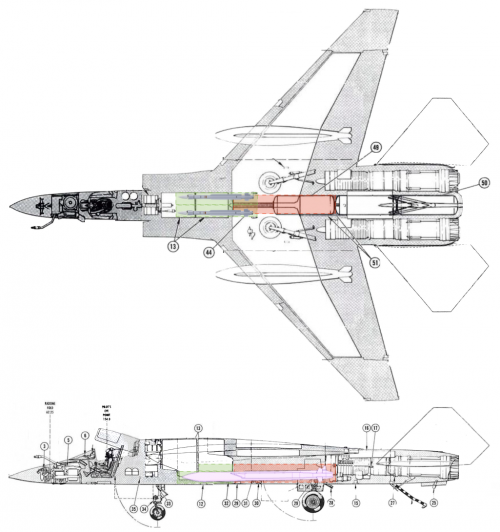
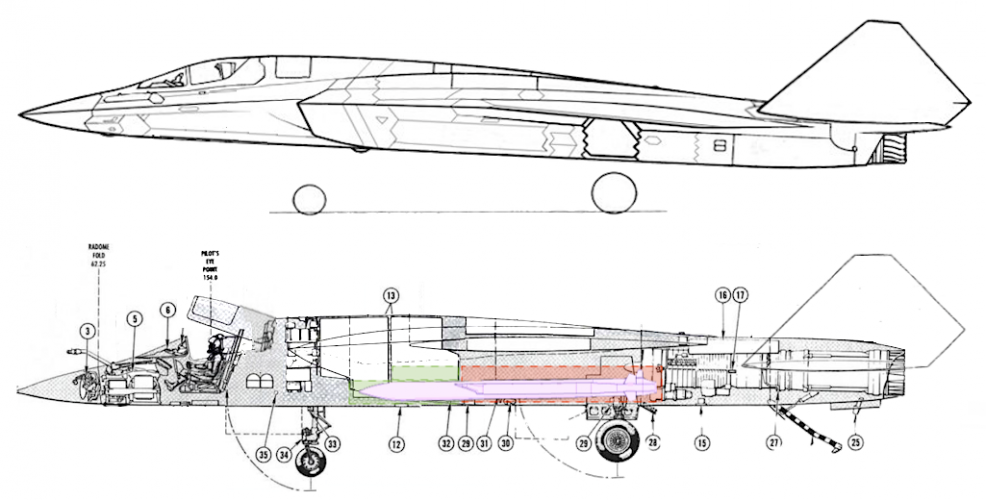
To illustrate, here's a modified Vigilante single-seater with movable ruddervators as on the FCAS/NGF mock-up. I haven't bothered to draw fully stealth contours or redesign the wing, but this should give a rough idea...
  • Down the middle (in red) you have the forward part of the Vigilante's weapons tunnel (approx 80cm in diameter) and the equipment bays for reconnaissance gear​
  • Forward (in green) you have the lower fuselage tanks​
  • The total red and green area is approximately 6.5m long x 80cm wide x 80cm high. The middle part is large enough for carriage of a single heavy store. The forward half of the weapons bay would be ~1m wide to allow for AAM carriage alongside the centerline store. Total stores volume ~4,500 liters.​
  • Possible internal carriage would be:​
    • 1x large store + 2x AAMs, or​
    • 10x SDB-sized bombs + 4x AAMs, or​
    • 6-7 AAMs.​
  • The Vigilante's large internal fuel volume would be retained (~9 tonnes, 11,000 liters), as you still have the fuel tanks between the engines (rear weapons tunnel), large dorsal hump and wing tanks​
  • Thrust would likely be in the 2x ~120kN class as the J79s could be replaced by F414 EDEs with similar cross-section and airflow)​
  • Empty weight with lighter modern engines would be ~13.5 tonnes (similar to the Mirage 4000)​
  • Take off weight clean would be ~25 tonnes including 2t internal weapons and 9t fuel. Take off weight with external stores would be ~28-30 tonnes with 2x external tanks (2x 2,500L) or 2x heavy underwing stores. Max take off weight - 2x tanks AND 2 heavy external stores would be ~32t. Perhaps dorsal CFTs might also be an option?​
  • Overall dimensions would be 18.5m long (fuselage), 19.6m overall including moving tail, 17m with nose folded (for carrier stowage)​
Obviously this is rough and requires a bit of imagination to picture 6th gen stealth contour lines, chined fuselage, redesigned wing etc, but hopefully useful to illustrate what might be possible within reasonable dimensional limits.
A-5 Vigilante mod 3 50px=1m.png


P.S. Added a stealthier side view, inspired from here: https://www.whatifmodellers.com/index.php?topic=9782.90

A-5 Vigilante mod 4 side 50px=1m.png
 
Last edited:
There's a way to carry a big internal weapon if you keep the engines widely separated, like on the A-5 Vigilante.

To illustrate, here's a modified Vigilante single-seater with movable ruddervators as on the NGF mock-up. I haven't bothered to draw fully stealth contours or redesign the wing, but this should give a rough idea...
  • Down the middle (in red) you have the forward part of the Vigilante's weapons tunnel (approx 80cm in diameter) and the equipment bays for reconnaissance gear​
  • Forward (in green) you have the lower fuselage tanks​
  • The total red and green area is approximately 6.5m long x 80cm wide x 80cm high. The middle part is large enough for carriage of a single heavy store. The forward half of the weapons bay would be ~1m wide to allow for AAM carriage alongside the centerline store. Total stores volume ~4,500 liters.​
  • Possible internal carriage would be:​
    • 1x large store + 2x AAMs, or​
    • 10x SDB-sized bombs + 4x AAMs, or​
    • 6-7 AAMs.​
  • The Vigilante's large internal fuel volume would be retained (~9 tonnes, 11,000 liters), as you still have the fuel tanks between the engines (rear weapons tunnel), large dorsal hump and wing tanks​
  • Thrust would likely be in the 2x ~120kN class as the J79s could be replaced by F414 EDEs with similar cross-section and airflow)​
  • Empty weight with lighter modern engines would be ~13.5 tonnes (similar to the Mirage 4000)​
  • Take off weight clean would be ~25 tonnes including 2t internal weapons and 9t fuel. Take off weight with external stores would be ~28-30 tonnes with 2x external tanks (2x 2,500L) or 2x heavy underwing stores. Max take off weight - 2x tanks AND 2 heavy external stores would be ~32t. Perhaps dorsal CFTs might also be an option?​
  • Overall dimensions would be 18.5m long (fuselage), 19.6m overall including moving tail, 17m with nose folded (for carrier stowage)​
Obviously this is rough and requires a bit of imagination to picture 6th gen stealth contour lines, chined fuselage, redesigned wing etc, but hopefully useful to illustrate what might be possible within reasonable dimensional limits.
That's very useful, thanks.
But what's stopping you having the engines slightly further apart in a blended-wing configuration, and then putting two narrower cruise missiles side by side? Same range, similar survivability, twice the payload.
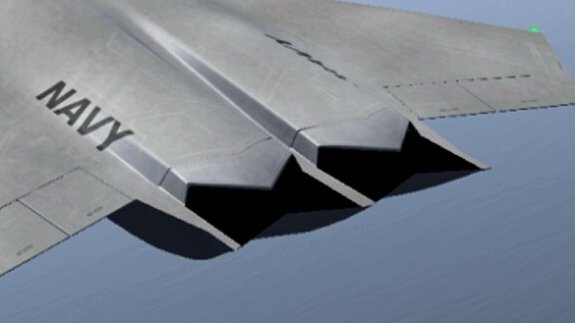
An alternative arrangement would be something similar to this FB-22 idea, using bays in front of the engines (which are supposedly smaller for GCAP but retaining similar power, instead of being more powerful than Typhoon) to carry larger weapons:
popsci-fb-22-1-66a3e4fa22848.jpg

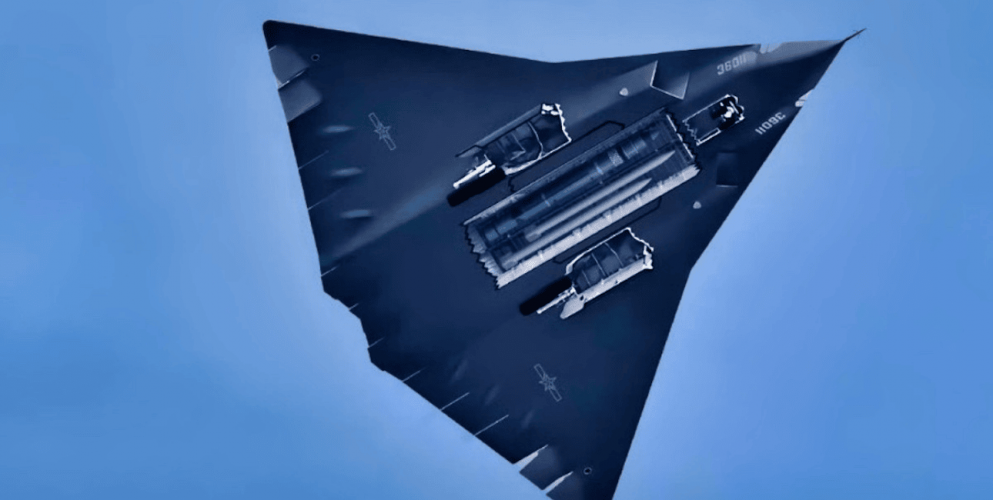
There's also the weapon bays on the J-36:
1753131711510.png
 
But what's stopping you having the engines slightly further apart in a blended-wing configuration, and then putting two narrower cruise missiles side by side? Same range, similar survivability, twice the payload.
Well a wider bay means bigger frontal cross section, more drag, more thrust needed, larger diameter engines, which means even more drag... do that design loop a few times then you need to increase fuel stowage too, which leads to an even bigger aircraft, bigger wing, more thrust needed... and after a few more design loops you have something bigger than an FB-22!

Basically internal payload isn't free.

I find the Vigilante interesting because it's a known starting point, optimized for minimum drag and frontal cross-section in order to achieve high supersonic performance with underpowered engines, while retaining good payload carrying capability (internal weapons + fuel volume). With current engine tech, structural weight gains (composites) etc, the potential improvements would be significant. The external planform would have to be very different for stealth, but the internal layout might not be too dissimilar given the same design constraints (though with access to the weapons bay being from below obviously).

P.S. The J-36 illustrates my point actually... that massive weapons bay requires a 3rd engine to make the design work!
 
Last edited:
That's very useful, thanks.
But what's stopping you having the engines slightly further apart in a blended-wing configuration, and then putting two narrower cruise missiles side by side? Same range, similar survivability, twice the payload.
Mostly the greatly-increased drag from larger frontal area.

Let's assume for a minute that SCAF is very comparable to my FAXX concept.
40,000lbs empty, 80,000lbs MTOW, 12,000lbs internal payload, 28,000lbs fuel. 55,000lbs trap weight.​
Main bay(s) capacity designed around carrying 4x JASSM-sized weapons, each ~25" wide (and enough bay length to hold AIM-174Bs, but that's a separate discussion). Also has AAM bays somewhere, I've usually been assuming on the sides of the inlet like an F-22 but with AMRAAM volume instead of just Sidewinder.​

Weapons need clearance around them to drop safely, for sake of this discussion we'll assume 5" spacing between weapon and sides of bay and between weapons. JASSMs or AARGM-ERs, really any weapon with strakes or chines, cannot pack as tight as AAMs can because you can stagger AAMs in length to still give that 5" clearance while "overlapping" their fins.

A single bay is now 5+25+5+25+5+25+5+25+5=125" wide. 10.5 feet wide. But that means big doors and big doors are slow to open and shut, so let's try 2 bays side by side.
Two bays side by side would need some amount of space between them, 5-10" to allow for door flutter while open. Now the bays are 130-135" wide, ~11ft.

Then you want engines outboard of the weapons bay? That's another 8 feet in width, we're talking a fuselage ~20ft wide now! Or a shape like the F-14, YF-23, or Su-57 with engine nacelles outboard of a flat center section. I'm not sure a plane that wide could even break Mach.

But let's be nice and tuck the engines behind the weapons bays, like on an F-22. We're still talking a fuselage 4 feet wider than an F-22!

Two bays in tandem, however, would actually be narrower than an F-22's bay.
5+25+5+25+5=65", an F-22's bay is ~6x14"=~84" wide.
 
...A single bay is now 5+25+5+25+5+25+5+25+5=125" wide. 10.5 feet wide. But that means big doors and big doors are slow to open and shut, so let's try 2 bays side by side.
Two bays side by side would need some amount of space between them, 5-10" to allow for door flutter while open. Now the bays are 130-135" wide, ~11ft...

You should really learn to sketch by hand or learn to use some sw tool. Things getting much clearer once you draw them to scale, and you may find out that accommodation of weapons, engines, ducts, fuel, etc., without ridiculously inflating the fuselage, is not as easy as you may think ;)
 
You should really learn to sketch by hand or learn to use some sw tool. Things getting much clearer once you draw them to scale, and you may find out that accommodation of weapons, engines, ducts, fuel, etc., without ridiculously inflating the fuselage, is not as easy as you may think ;)
Oh, I've done drafting, just nearly 30 years ago. No printer, no scanner here, though.
 
Some of the weapons to consider for internal carriage on FCAS are already more precisely known:
- IRIS-T FCAAM as IIRAAM
- Meteor MLU as BVRAAM (so no staggering due to its intakes)
- Light Remote Carrier like FEANIX
- possibly Heavy Remote Carrier like RCM²
 
What the heck do they need Meteor on a 6th Gen a/c?!! What the point of spending so much in stealth if that is to illuminate your targets for half an hour per day (and be seen by everyone else on the same hemisphere).
The lack of logics here is flabbergasting.
 
What the heck do they need Meteor on a 6th Gen a/c?!! What the point of spending so much in stealth if that is to illuminate your targets for half an hour per day (and be seen by everyone else on the same hemisphere).
The lack of logics here is flabbergasting.
What are u talking about? U can fire the missile with data from any source.. u dont need to use ur own radar.
 

Similar threads

Back
Top Bottom